


Matthew 27:33
Bible text: King James Version (1769 Blayney text) · Public domain
Bible text: Berean Standard Bible · Public domain
Bible text: American Standard Version (1901) · Public domain
Bible text: World English Bible, Messianic edition · Public domain
Bible text: Geneva Bible (1599) · Public domain
Bible text: Young's Literal Translation · Public domain
- ΚαὶKaiAndG2532CONJConjunction
- ἐλθόντεςelthonteshaving comeG2064V-2AAP-NPMVerb 2nd Aorist Active Participle Nominative Plural Masculine
- εἰςeistoG1519PREPPreposition
- τόπονtopona placeG5117N-ASMNoun Accusative Singular Masculine
- λεγόμενονlegomenonbeing namedG3004V-PPP-ASMVerb Present Passive Participle Accusative Singular Masculine
- ΓολγοθᾶGolgothaGolgothaG1115N-ASF-LNoun Accusative Singular Feminine Location
- ὅhowhichG3739R-NSNRelative pronoun Nominative Singular Neuter
- ἐστινestinisG1510V-PAI-3SVerb Present Active Indicative 3rd Singular
- κρανίουkraniouof a SkullG2898N-GSN-LNoun Genitive Singular Neuter Location
- τόποςtoposPlaceG5117N-NSM-LNoun Nominative Singular Masculine Location
- λεγόμενοςlegomenosbeing namedG3004V-PPP-NSMVerb Present Passive Participle Nominative Singular Masculine
English is a literal word-by-word gloss of the Greek, not the KJV's wording. Why?
This is the original text the KJV's translators worked from — each Greek word with its own literal English meaning in this verse, prepared by scholars at Tyndale House, Cambridge. The KJV translates whole sentences, not word by word, so its wording differs: one Greek word can become several English words, and the KJV may choose “charity” where the gloss reads “love”. Both are faithful — they answer different questions. For the KJV's own rendering, switch to the KJV text.
Details
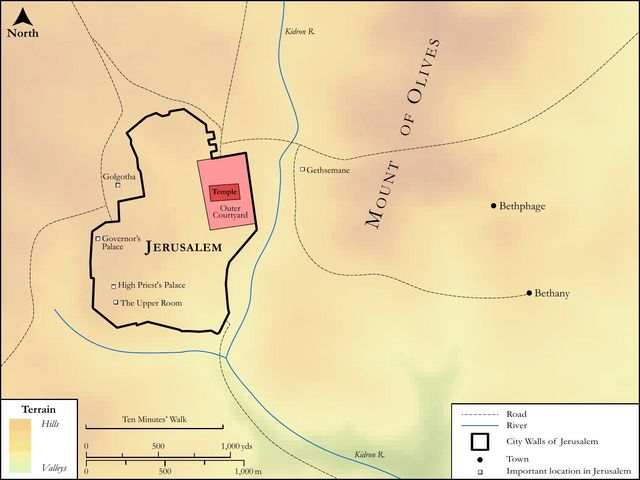
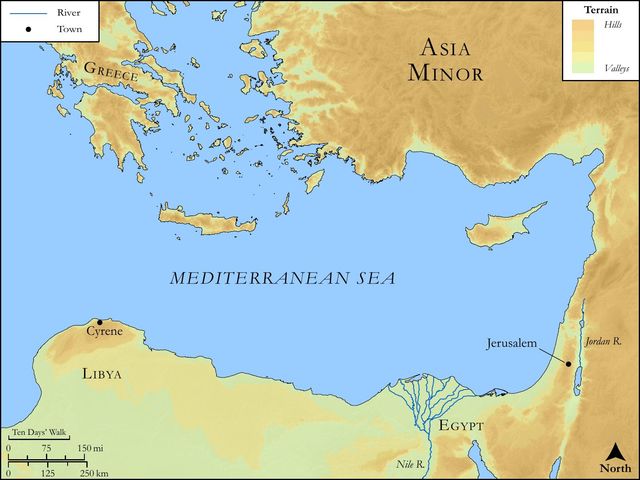
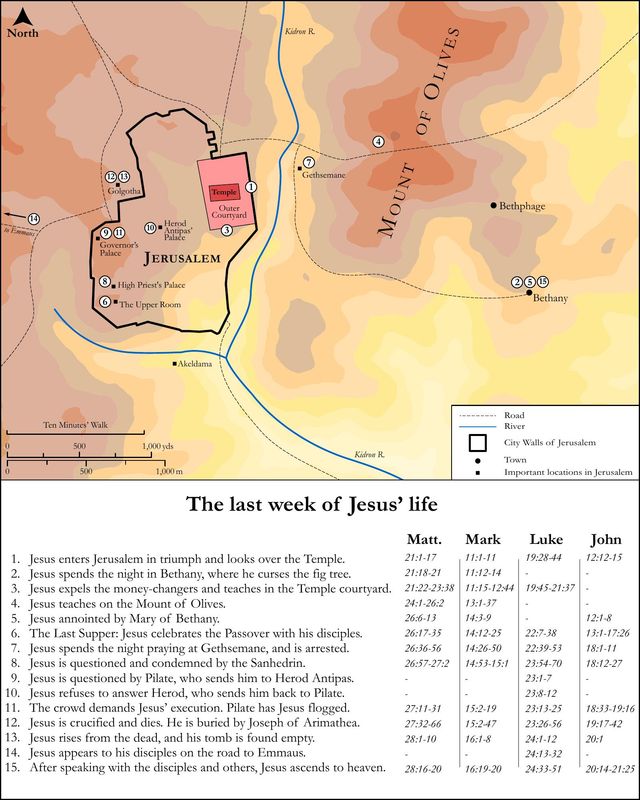
See on the biblical-era maps
Study this verse
Historical interpretation
Nine Centuries of Reception
10 surviving comments on this verse. Each one is dated, so this reads as a timeline rather than a list.
Select a marker to jump to its quote. Markers stagger vertically where authors wrote within a few decades of each other.
For a Jew was not worthy to bear Christ's cross, but it was reserved for the faith of the Gentiles both to take the cross, and to suffer with Him.
Such is the place of the cross, set up in the centre of the earth, that it might be equally free to all nations to attain the knowledge of God.
Or, He therefore refused the wine mingled with gall, because the bitterness of sin is not mingled with the incorruption of eternal glory.
When they had come to Golgotha, the Gospel says, “They gave him vinegar mixed with gall, but when he tasted it, he refused to drink.” This event was foretold by David when he wrote, “They gave me gall for food, and they gave me vinegar to slake my thirst.” Take note of the mystery revealed here. Long ago, Adam tasted the sweetness of the apple and obtained the bitterness of death for the whole human race. In contrast to this, the Lord tasted the bitterness of gall and obtained our restoration from death’s sting to the sweetness of life. He took on himself the bitterness of gall in order to extinguish in us the bitterness of death. He received acrid vinegar into himself but poured out for us the precious wine of his blood. He suffered evil and returned good. He accepted death and gave life. The location of his death is also not without significance, for it is reported that the body of Adam is buried in that very ground. Christ was crucified there where Adam was buried, that life might arise where death once entered. Death comes through Adam, but life comes through Christ, who deigned to be crucified and to die so that by the wood of the cross he might erase the sin of the tree and by the mystery of his own death he might cancel the punishment of our death.
For after "they had mocked Him, they led Him to crucify Him," it is said, and when they had stripped Him, they took His garments, and sat down and watched Him, when He should die. And they divide His garments amongst them, which sort of thing is done in the case of very vile and abject criminals, and such as have no one belonging to them, and are in utter desolation.
They parted the garments, by which such great miracles were done. But they wrought none now, Christ restraining His unspeakable power. And this was no small addition of insult. For as to one base and abject, as I said, and the vilest of all men; so do they dare to do all things. To the thieves at any rate they did nothing of the kind, but to Christ they dare it all. And they crucified Him in the midst of them, that He might share in their reputation.
And they gave Him gall to drink, and this to insult Him, but He would not. But another saith, that having tasted it, He said, "It is finished." And what meaneth, "It is finished?" The prophecy was fulfilled concerning Him. "For they gave me," it is said, "gall for my meat, and for my thirst they gave me vinegar to drink." But neither doth that evangelist indicate that He drank, for merely to taste differs not from not drinking, but hath one and the same signification.
(Hom. de Cruc. et Lat. ii.) The Lord would not suffer under a roof, or in the Jewish Temple, that you should not suppose that He was offered for that people alone; but without the city, without the walls, that you might know that the sacrifice was common, that it was the offering of the whole earth, that the purification was general.
It is to be noted, that when Jesus is scourged and spit upon, He has not on His own garments, but those which He took for our sins; but when He is crucified, and the show of His mockery is completed, then He takes again His former garments, and His own dress, and immediately the elements are shaken, and the creature gives testimony to the Creator.
Let none think that John's narrative contradicts this place of the Evangelist. John says that the Lord went forth from the prætorium bearing His cross; Matthew tells, that they found a man of Cyrene upon whom they laid Jesus' cross. We must suppose that as Jesus went out of the prætorium, He was bearing His cross, and that afterwards they met Simon, whom they compelled to bear it.
Figuratively, the nations take up the cross, and the foreigner by obedience bears the ignominy of the Saviour.
I have heard Calvary expoundedb as the spot in which Adam was buried, as though it had been so called from the head of the old man being buried there. A plausible interpretation, and agreeable to the ears of the people, yet not a true one. Without the city outside the gate are the places where criminals are executed, and these have got the name of Calvary, that is, of the beheaded. And Jesus was crucified there, that where the plot of criminals had been, there might be set up the flag of martyrdom. But Adam was buried near Ebron and Arbee, as we read in the volume of Jesus the son of Navec.
The bitter vine makes bitter wine; this they gave the Lord Jesus to drink, that that might be fulfilled which was written, They gave me also gall for my meat. (Ps. 69:21.) And God addresses Jerusalem, I had planted there a true vine, how art thou turned into the bitterness of a strange vine? (Jer. 2:21.)
(Verse 33.) And they came to a place called Golgotha, which is the place of Calvary. I have heard someone explain the place of Calvary, where Adam was buried, and therefore it is called that because there the head of the ancient man is buried, and this is what the Apostle says: Awake, you who sleep, and arise from the dead, and Christ will give you light. A favorable interpretation that pleases the ears of the people, but not true. For outside the city and beyond the gate, there are places where the heads of the condemned are severed, and they took the name of Calvary, that is, beheaders. Therefore the Lord was crucified there, so that where there had been a place of condemnation, there might be erected the banners of martyrdom. And just as He was made a curse for us, and was scourged, and was crucified, so for the salvation of all, even though guilty among the guilty, He would be crucified. But if someone should wish to argue, why was the Lord crucified there, so that His blood might drop upon the tomb of Adam, let us ask him why, then, were the other thieves crucified in the same place? From which it is clear that Calvary does not signify the tomb of the first man, but the place of the beheaded, so that where sin abounded, grace might more abound (Rom. 5). But we read in the volume of Jesus son of Navé that Adam was buried near Hebron and Arbee (Josh. 14).
For this Simon was not a man of Jerusalem, but a foreigner, and denizen, being a Cyrenean; Cyrene is a town of Lybia. Simon is interpreted 'obedient,' and a Cyrenean 'an heir;' whence he well denotes the people of the Gentiles, which was strange to the testaments of God, but by believing became a fellow-citizen of the saints, of the household, and an heir of God.
(Hom. in. Ev. xxxii. 3.) Or otherwise; By Simon who bears the burden of the Lord's cross are denoted those who are abstinent and proud; these by their abstinence afflict their flesh, but seek not within the fruit of abstinence. Thus Simon bears the cross, but does not die thereon, as these afflict the body, but in desire of vain-glory live to the world.
Golgotha is a Syriac word, and is interpreted Calvary.
(non occ. Aug. de Cons. Ev. iii. 9.) After the Evangelist had narrated what concerned the mocking of Christ, he proceeds to His crucifixion.
Continue studying Matthew 27:33 across the web’s major study libraries — every link below opens this exact verse, chapter, or book on the destination site.
Read & Compare
 BibleGatewayThis verse in more than 200 translations and 70 languages.
 Bible.comThe YouVersion reader — hundreds of translations, reading plans, and highlights.
 ESV.orgCrossway's official English Standard Version reader.
 NET BibleThe NET translation with 60,000+ translators' notes on every rendering decision.
 STEP BibleTyndale House's free study tool — original text, vocabulary, and scholarly resources.
 BibliaLogos Bible Software's free web reader.
 USCCBThe New American Bible (Revised Edition) with the U.S. bishops' study notes.
Commentaries
 BibleHub CommentariesDozens of classic commentaries on this verse, gathered on one page.
 StudyLightMore than 100 commentary sets — the largest collection on the web.
 BibleRefPlain-English commentary on what this verse means, verse by verse.
 Enduring WordDavid Guzik's free commentary on this chapter, widely used by Bible teachers.
 Bible Study ToolsVerse commentary alongside Greek and Hebrew study aids.
Original Language & Research
- BibleHub InterlinearThe verse word by word — original language, transliteration, and English.
- BibleHub LexiconEvery word's original-language definition and Strong's entry.
 Blue Letter BibleDeep-study tools — Strong's numbers, concordance, and word studies.
 CNTR CollationThe earliest Greek manuscripts of this verse, collated letter by letter.
Sermons, Hymns & Audio


TrulyRandomVerse is not affiliated with these sites and doesn’t control their content. They’re linked because they’re genuinely useful.
Summary
Matthew 27:33 marks the grim but pivotal arrival of Jesus and His escorts at Golgotha, the designated site for His crucifixion outside Jerusalem. This verse immediately precedes the crucifixion itself, identifying the location by its Aramaic name, Golgotha, and providing its Greek translation, "a place of a skull," thereby setting the stage for the most significant event in human history: the atoning sacrifice of the Son of God.
Context
ShowHideLiterary Context
Matthew 27:33 serves as the immediate geographical and narrative prelude to the crucifixion. It follows Jesus' condemnation by Pontius Pilate (Matthew 27:24-26), the brutal scourging and mockery by the Roman soldiers (Matthew 27:27-31), and the forced march out of Jerusalem, during which Simon of Cyrene was compelled to carry Jesus' cross (Matthew 27:32). The arrival at Golgotha signifies the end of the journey of suffering and the beginning of the ultimate act of atonement, directly leading into the details of the crucifixion in the subsequent verses (Matthew 27:34-38). This verse provides the precise location for the fulfillment of God's redemptive plan.
Historical & Cultural Context
Roman crucifixion was a brutal form of capital punishment, designed to inflict maximum pain and public humiliation. Executions typically occurred outside city walls to avoid defiling the city and to serve as a public deterrent. Jerusalem, as a holy city, would have strictly adhered to this practice, especially during Passover. Golgotha, or "the place of a skull," was likely a rocky outcrop or hill just outside one of Jerusalem's gates. Its name suggests a site associated with death, perhaps due to its skull-like appearance, its use as a burial or execution ground, or even an ancient tradition regarding Adam's skull. The public procession to such a place underscored Jesus' status as a condemned criminal, yet paradoxically, it was the very stage for His triumph over sin and death.
Key Themes
ShowHideThis verse contributes to several key themes within Matthew's Gospel and the broader biblical narrative. Firstly, it highlights the Fulfillment of Prophecy, as Jesus is led outside the city, echoing the Old Testament practice of sin offerings being burned outside the camp, a theme later expounded upon in Hebrews 13:11-12. Secondly, it emphasizes the profound Humiliation and Suffering endured by Jesus, who, though innocent, bore the public shame and physical agony associated with a criminal's death. This public display underscores the depths to which God's Son descended for humanity's redemption. Thirdly, the naming of Golgotha reinforces the Specificity and Historicity of Sacrifice. This was not a mythical event but a real act in a real location, anchoring the Christian faith in tangible historical reality, as seen in the detailed accounts across all four Gospels, including Mark 15:22 and John 19:17.
Exposition and Analysis
ShowHideKey Word Analysis
ShowHideDerived from a Chaldee word meaning "the skull," Golgotha is the Aramaic name for the knoll near Jerusalem where Jesus was crucified. Matthew's immediate translation of the name for his Greek-speaking audience underscores its significance and perhaps its striking appearance or association with death.
This verb signifies a movement towards a destination, often with purpose or inevitability. In this context, it marks the completion of the arduous journey to the execution site, a journey that was both physically taxing for Jesus and spiritually momentous as it led to the culmination of His earthly mission.
This word, from which we derive "cranium," is a diminutive of a word meaning "horn" or "head." It directly translates the Aramaic "Golgotha" and emphasizes the grim reality of the place, associated with death and bones, a stark contrast to the life-giving sacrifice about to occur there.
Verse Breakdown
ShowHide"And when they were come unto a place called Golgotha"
This clause describes the arrival of Jesus, His executioners, and the accompanying crowd at the designated site. The use of "they" refers to the Roman soldiers leading Jesus, along with Jesus Himself and the two criminals who would be crucified with Him. The journey, though short, represented the final steps of Jesus' earthly life before His atoning death. The phrase "called Golgotha" introduces the specific, historically identifiable location.
"that is to say, a place of a skull"
This explanatory phrase provides the Greek translation of the Aramaic name "Golgotha." Matthew includes this translation to ensure his Hellenistic audience understands the meaning of the place name. The name "place of a skull" vividly evokes images of death, perhaps due to the hill's shape resembling a skull, or more likely, because it was a common site for executions, thus littered with the remains of the condemned. This grim designation powerfully foreshadows the death that is about to transpire.
Literary Devices
ShowHideMatthew employs several literary devices in this concise verse. Toponymy is central, as the specific naming of "Golgotha" and its immediate translation grounds the narrative in a concrete, historical location, emphasizing the factual nature of Jesus' crucifixion. The name itself, "a place of a skull," functions as powerful Symbolism, representing death, judgment, and the ultimate consequence of sin. However, this grim symbol is paradoxically transformed into a symbol of life and redemption through Christ's sacrifice. The phrase also acts as Foreshadowing, directly hinting at the death that is about to occur, preparing the reader for the crucifixion narrative. Furthermore, there is an implicit Juxtaposition between the mundane act of arriving at an execution site and the eternal, redemptive significance of the event that is about to unfold there.
Theological and Thematic Connections
ShowHideMatthew 27:33, though brief, is profoundly significant as it marks the physical setting for the climax of God's redemptive plan. Golgotha, the "place of a skull," becomes the intersection of divine justice and boundless mercy, where the sinless Son of God bore the full weight of humanity's sin. It is here that the ancient prophecies concerning the suffering servant are fulfilled, and the ultimate sacrifice for atonement is made. The specificity of the location underscores the historical reality of the crucifixion, grounding our faith not in myth, but in a tangible, verifiable event. This place of death is transformed by Christ's sacrifice into the wellspring of eternal life, demonstrating God's radical love and His unwavering commitment to reconcile humanity to Himself.
Reflection and Application
ShowHideThe arrival at Golgotha is a moment that calls for profound reflection. It reminds us of the immense cost of our sin, which necessitated such a brutal and public display of suffering by the Son of God. Yet, more powerfully, it speaks to the boundless, unfathomable love of God, who willingly allowed His Son to endure this humiliation and agony for our redemption. As believers, Golgotha is not merely a historical landmark but a spiritual touchstone, representing the place where our salvation was secured. It urges us to contemplate the depth of Christ's sacrifice, to acknowledge the reality of His suffering, and to live lives transformed by the grace poured out at that "place of a skull." Our faith is not based on abstract ideas but on a concrete, historical event that forever altered the course of human destiny.
Questions for Reflection
ShowHideFAQ
ShowHideWhy is Golgotha also called Calvary?
ShowHideGolgotha is the Aramaic name for the place of Jesus' crucifixion, meaning "skull." The name "Calvary" comes from the Latin word Calvaria, which also means "skull" or "bald head." The Latin Vulgate Bible, translated by Jerome, used Calvaria to render the Greek kranion (skull) found in the Gospels. Thus, "Calvary" is simply the Latin equivalent of Golgotha, both referring to the same location known as "the place of a skull."
What is the significance of Jesus being crucified outside the city walls?
ShowHideJesus' crucifixion outside the city walls carried multiple layers of significance. Historically and culturally, Roman executions were typically conducted outside city gates to avoid defiling the city and to serve as a public spectacle and deterrent. Theologically, this act aligns with the Old Testament practice of sin offerings and sacrifices being taken outside the camp and burned, as described in Leviticus 16:27. The author of Hebrews explicitly connects Jesus' suffering "outside the gate" to this sacrificial imagery, emphasizing that He suffered there to sanctify His people through His own blood (Hebrews 13:11-12). This act also underscored Jesus' rejection by the religious and political powers within the city, even as He was fulfilling God's redemptive plan.
Christ-Centered Fulfillment
ShowHideMatthew 27:33, by naming Golgotha as "a place of a skull," powerfully underscores the grim reality of death and sin that Jesus confronted head-on. Yet, it is precisely at this place of ultimate human depravity and divine judgment that Christ's redemptive work finds its glorious fulfillment. The "skull," a stark symbol of mortality, becomes the very ground upon which the Lamb of God, who takes away the sin of the world (John 1:29), conquers death itself. Through His crucifixion at Golgotha, Jesus inaugurated the new covenant in His blood (Luke 22:20), offering Himself as the perfect, once-for-all sacrifice that reconciles humanity to God (Colossians 1:19-20). The cross, erected on this "place of a skull," transforms from an instrument of shame into the very power of God for salvation to everyone who believes (1 Corinthians 1:18), demonstrating that where sin abounded, grace abounded much more (Romans 5:20).