


Luke 23:33
Bible text: King James Version (1769 Blayney text) · Public domain
Bible text: King James Version with Strong's numbers · Public domain
Bible text: Berean Standard Bible · Public domain
Bible text: American Standard Version (1901) · Public domain
Bible text: World English Bible, Messianic edition · Public domain
Bible text: Geneva Bible (1599) · Public domain
Bible text: Young's Literal Translation · Public domain
- καὶkaiAndG2532CONJConjunction
- ὅτεhotewhenG3753CONJConjunction
- ἦλθονēlthonthey cameG2064V-2AAI-3PVerb 2nd Aorist Active Indicative 3rd Plural
- ἐπὶepitoG1909PREPPreposition
- τὸνtontheG3588T-ASMDefinite article Accusative Singular Masculine
- τόπονtoponplaceG5117N-ASMNoun Accusative Singular Masculine
- τὸνtonwhichG3588T-ASMDefinite article Accusative Singular Masculine
- καλούμενονkaloumenonis being calledG2564V-PPP-ASMVerb Present Passive Participle Accusative Singular Masculine
- ΚρανίονKranion[The] SkullG2898N-ASN-LNoun Accusative Singular Neuter Location
- ἐκεῖekeithereG1563ADVAdverb
- ἐσταύρωσανestaurōsanthey crucifiedG4717V-AAI-3PVerb Aorist Active Indicative 3rd Plural
- αὐτὸνautonHimG846P-ASMPersonal pronoun Accusative Singular Masculine
- καὶkaiandG2532CONJConjunction
- τοὺςtoustheG3588T-APMDefinite article Accusative Plural Masculine
- κακούργουςkakourgouscriminalsG2557A-APMAdjective Accusative Plural Masculine
- ὃνhontheG3739R-ASMRelative pronoun Accusative Singular Masculine
- μὲνmenoneG3303PRTParticle or Disjunctive
- ἐκekon [the]G1537PREPPreposition
- δεξιῶνdexiōnrightG1188A-GPNAdjective Genitive Plural Neuter
- ὃνhonanotherG3739R-ASMRelative pronoun Accusative Singular Masculine
- δὲdeandG1161CONJConjunction
- ἐξexonG1537PREPPreposition
- ἀριστερῶνaristerōn[the] leftG710A-GPNAdjective Genitive Plural Neuter
English is a literal word-by-word gloss of the Greek, not the KJV's wording. Why?
This is the original text the KJV's translators worked from — each Greek word with its own literal English meaning in this verse, prepared by scholars at Tyndale House, Cambridge. The KJV translates whole sentences, not word by word, so its wording differs: one Greek word can become several English words, and the KJV may choose “charity” where the gloss reads “love”. Both are faithful — they answer different questions. For the KJV's own rendering, switch to the KJV text.
Details
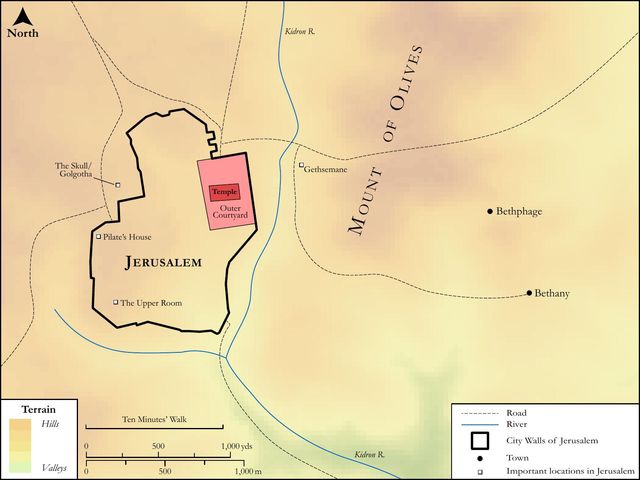
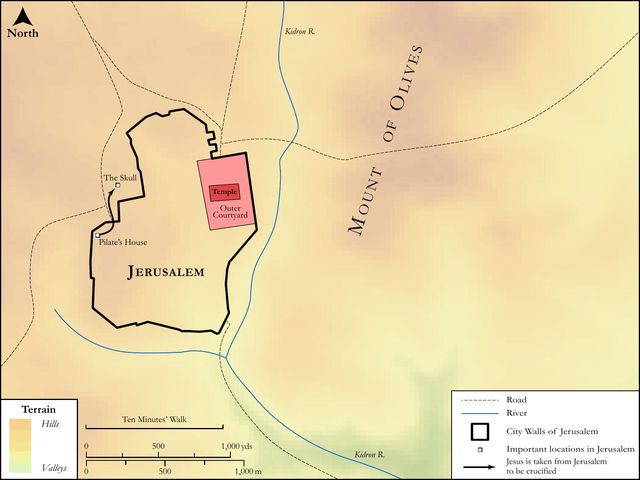
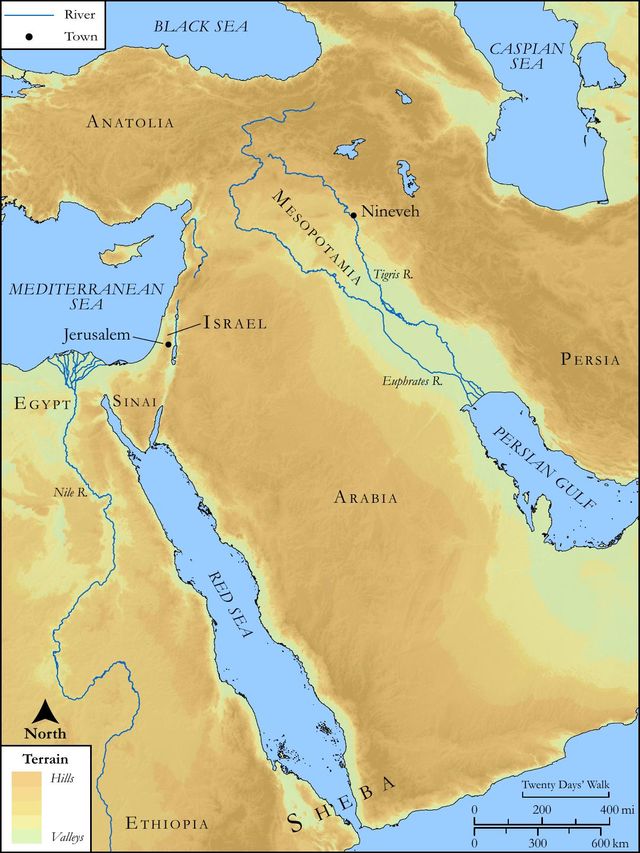
See on the biblical-era maps
Study this verse
Public-domain commentary
Matthew Henry
From his Commentary on the Whole Bible. Henry comments on passages, not single verses — this entry covers Luke 23:32–43. His four-level outline is real structure in the source text, so it is rendered as structure.
In these verses we have,
I.Divers passages which we had before in Matthew and Mark concerning Christ's sufferings.
1.That there were two others, malefactors, led with him to the place of execution, who, it is probable, had been for some time under sentence of death, and were designed to be executed on this day, which was probably the pretence for making such haste in the prosecution of Christ, that he and these two malefactors might be executed together, and one solemnity might serve.
2.That he was crucified at a place called Calvary, Kranion, the Greek name for Golgotha - the place of a skull: an ignominious place, to add to the reproach of his sufferings, but significant, for there he triumphed over death as it were upon his own dunghill. He was crucified. His hands and feet were nailed to the cross as it lay upon the ground, and it was then lifted up, and fastened into the earth, or into some socket made to receive it. This was a painful and shameful death above any other.
3.That he was crucified in the midst between two thieves, as if he had been the worst of the three. Thus he was not only treated as a transgressor, but numbered with them, the worst of them.
4.That the soldiers who were employed in the execution seized his garments as their fee, and divided them among themselves by lot: They parted his raiment, and cast lots; it was worth so little that, if divided, it would come to next to nothing, and therefore they cast lots for it.
5.That he was reviled and reproached, and treated with all the scorn and contempt imaginable, when he was lifted up upon the cross. It was strange that so much barbarity should be found in the human nature: The people stood beholding, not at all concerned, but rather pleasing themselves with the spectacle; and the rulers, whom from their office one would take to be men of sense and men of honour, stood among the rabble, and derided him, to set those on that were about them to do so too; and they said, He saved others, let him save himself. Thus was he upbraided for the good works he had done, as if it were indeed for these that they crucified him. They triumphed over him as if they had conquered him, whereas he was himself then more than a conqueror; they challenged him to save himself from the cross, when he was saving others by the cross: If he be the Christ, the chosen of God, let him save himself. They knew that the Christ was the chosen of God, designed by him, and dear to him. "If he, as the Christ, would deliver our nation from the Romans (and they could not form any other idea than that of the Messiah), let him deliver himself from the Romans that have him now in their hands." Thus the Jewish rulers jeered him as subdued by the Romans, instead of subduing them. The Roman soldiers jeered him as the King of the Jews: "A people good enough for such a prince, and a prince good enough for such a people." They mocked him (Luk 23:36, Luk 23:37); they made sport with him, and made a jest of his sufferings; and when they were drinking sharp sour wine themselves, such as was generally allotted them, they triumphantly asked him if he would pledge them, or drink with them. And they said, If thou be the king of the Jews, save thyself; for, as the Jews prosecuted him under the notion of a pretended Messiah, so the Romans under the notion of a pretended king.
6.That the superscription over his head, setting forth his crime, was, This is the King of the Jews, Luk 23:38. He is put to death for pretending to be the king of the Jews; so they meant it; but God intended it to be a declaration of what he really was, notwithstanding his present disgrace: he is the king of the Jews, the king of the church, and his cross is the way to his crown. This was written in those that were called the three learned languages, Greek, and Latin, and Hebrew, for those are best learned that have learned Christ. It was written in these three languages that it might be known and read of all men; but God designed by it to signify that the gospel of Christ should be preached to all nations, beginning at Jerusalem, and be read in all languages. The Gentile philosophy made the Greek tongue famous, the Roman laws and government made the Latin tongue so, and the Hebrew excelled them all for the sake of the Old Testament. In these three languages is Jesus Christ proclaimed king. Young scholars, that are taking pains at school to make themselves masters of these three languages, should aim at this, that in the use of them they may increase their acquaintance with Christ.
II.Here are two passages which we had not before, and they are very remarkable ones.
1.Christ's prayer for his enemies (Luk 23:34): Father, forgive them. Seven remarkable words Christ spoke after he was nailed to the cross, and before he died, and this is the first. One reason why he died the death of the cross was that he might have liberty of speech to the last, and so might glorify his Father and edify those about him. As soon as ever he was fastened to the cross, or while they were nailing him, he prayed this prayer, in which observe,
(1.)The petition: Father, forgive them. One would think that he should have prayed, "Father, consume them; the Lord look upon it, and requite it." The sin they were now guilty of might justly have been made unpardonable, and justly might they have been excepted by name out of the act of indemnity. No, these are particularly prayed for. Now he made intercession for transgressors, as was foretold (Isa 53:12), and it is to be added to his prayer (Jn. 17), to complete the specimen he gave of his intercession within the veil: that for saints, this for sinners. Now the sayings of Christ upon the cross as well as his sufferings had a further intention than they seemed to have. This was a mediatorial word, and explicatory of the intent and meaning of his death: "Father, forgive them, not only these, but all that shall repent, and believe the gospel;" and he did not intend that these should be forgiven upon any other terms. "Father, that which I am now suffering and dying for is in order to this, that poor sinners may be pardoned." Note,
[1.]The great thing which Christ died to purchase and procure for us is the forgiveness of sin.
[2.]This is that for which Christ intercedes for all that repent and believe in the virtue of his satisfaction; his blood speaks this: Father, forgive them.
[3.]The greatest sinners may, through Christ, upon their repentance, hope to find mercy. Though they were his persecutors and murderers, he prayed, Father, forgive them.
(2.)The plea: For they know not what they do; for, if they had known, they would not have crucified him, Co1 2:8. There was a veil upon his glory and upon their understandings; and how could they see through two veils? They wished his blood on them and their children: but, had they known what they did, they would have unwished it again. Note,
[1.]The crucifiers of Christ know not what they do. They that speak ill or religion speak ill of that which they know not, and it is because they will not know it.
[2.]There is a kind of ignorance that does in part excuse sin: ignorance through want of the means of knowledge or of a capacity to receive instruction, through the infelicities of education, or inadvertency. The crucifiers of Christ were kept in ignorance by their rulers, and had prejudices against him instilled into them, so that in what they did against Christ and his doctrine they thought they did God service, Joh 16:2. Such as to be pitied and prayed for. This prayer of Christ was answered not long after, when many of those that had a hand in his death were converted by Peter's preaching. This is written also for example to us. First, We must in prayer call God Father, and come to him with reverence and confidence, as children to a father. Secondly, The great thing we must beg of God, both for ourselves and others, is the forgiveness of sins. Thirdly, We must pray for our enemies, and those that hate and persecute us, must extenuate their offences, and not aggravate them as we must our own (They know not what they do; peradventure it was an oversight); and we must be earnest with God in prayer for the forgiveness of their sins, their sins against us. This is Christ's example to his own rule (Mat 5:44, Mat 5:45, Love your enemies); and it very much strengthens the rule, for, if Christ loved and prayed for such enemies, what enemies can we have that we are not obliged to love and pray for?
2.The conversion of the thief upon the cross, which is an illustrious instance of Christ's triumphing over principalities and powers even when he seemed to be triumphed over by them. Christ was crucified between two thieves, and in them were represented the different effects which the cross of Christ would have upon the children of men, to whom it would be brought near in the preaching of the gospel. They were all malefactors, all guilty before God. Now the cross of Christ is to some a savour of life unto life, to others of death unto death. To them that perish it is foolishness, but to them that are saved it is the wisdom of God and the power of God.
(1.)Here was one of these malefactors that was hardened to the last. Near to the cross of Christ, he railed on him, as others did (Luk 23:39): he said, If thou be the Christ, as they say thou art, save thyself and us. Though he was now in pain and agony, and in the valley of the shadow of death, yet this did not humble his proud spirit, nor teach him to give good language, no, not to his fellow-sufferer. Though thou bray a fool in a mortar, yet will not his foolishness depart from him. No troubles will of themselves work a change in a wicked heart, but sometimes they irritate the corruption which one would think they should mortify. He challenges Christ to save both himself and them. Note, There are some that have the impudence to rail at Christ, and yet the confidence to expect to be saved by him; nay, and to conclude that, if he do not save them, he is not to be looked upon as the Saviour.
(2.)Here was the other of them that was softened at the last. It as said in Matthew and Mark that the thieves, even they that were crucified with him, reviled him, which some think is by a figure put for one of them, but others think that they both reviled him at first, till the heart of one of them was wonderfully changed, and with it his language on a sudden. This malefactor, when just ready to fall into the hands of Satan, was snatched as a brand out of the burning, and made a monument of divine mercy and grace, and Satan was left to roar as a lion disappointed of his prey. This gives no encouragement to any to put off their repentance to their death-bed, or to hope that then they shall find mercy; for, though it is certain that true repentance is never too late, it is as certain that late repentance is seldom true. None can be sure that they shall have time to repent at death, but every man may be sure that he cannot have the advantages that this penitent thief had, whose case was altogether extraordinary. He never had any offer of Christ, nor day of grace, before how: he was designed to be made a singular instance of the power of Christ's grace now at a time when he was crucified in weakness. Christ, having conquered Satan in the destruction of Judas and the preservation of Peter, erects this further trophy of his victory over him in the conversion of this malefactor, as a specimen of what he would do. We shall see the case to be extraordinary if we observe,
[1.]The extraordinary operations of God's grace upon him, which appeared in what he said. Here were so many evidences given in a short time of a blessed change wrought in him that more could not have been given in so little a compass.
First, See what he said to the other malefactor, Luk 23:40, Luk 23:41. 1. He reproved him for railing at Christ, as destitute of the fear of God, and having no sense at all of religion: Dost not thou fear God? This implies that it was the fear of God which restrained him from following the multitude to do this evil. "I fear God, and therefore dare not do it; and dost not thou?" All that have their eyes opened see this to be at the bottom of the wickedness of the wicked, that they have not the fear of God before their eyes. "If thou hadst any humanity in thee, thou wouldest not insult over one that is thy fellow-sufferer; thou art in the same condition; thou art a dying man too, and therefore, whatever these wicked people do, it ill becomes thee to abuse a dying man." 2. He owns that he deserves what was done to him: We indeed justly. It is probable that they both suffered for one and the same crime, and therefore he spoke with the more assurance, We received the due reward of our deeds. This magnifies divine grace, as acting in a distinguishing way. These two have been comrades in sin and suffering, and yet one is saved and the other perishes; two that had gone together all along hitherto, and yet now one taken and the other left. He does not say, Thou indeed justly, but We. Note, True penitents acknowledge the justice of God in all the punishments of their sin. God has done right, but we have done wickedly. 3. He believes Christ to have suffered wrongfully. Though he was condemned in two courts, and run upon as if he had been the worst of malefactors, yet this penitent thief is convinced, by his conduct in his sufferings, that he has done nothing amiss, ouden atopon - nothing absurd, or unbecoming his character. The chief priests would have him crucified between the malefactors, as one of them; but this thief has more sense than they, and owns he is not one of them. Whether he had before heard of Christ and of his wonderous works does not appear, but the Spirit of grace enlightened him with this knowledge, and enabled him to say, This man has done nothing amiss.
Secondly, See what he said to our Lord Jesus: Lord, remember me when thou comest into thy kingdom, Luk 23:42. This is the prayer of a dying sinner to a dying Saviour. It was the honour of Christ to be thus prayed to, though he was upon the cross reproached and reviled. It was the happiness of the thief thus to pray; perhaps he never prayed before, and yet now was heard, and saved at the last gasp. While there is life there is hope, and while there is hope there is room for prayer. 1. Observe his faith in this prayer. In his confession of sin (Luk 23:41) he discovered repentance towards God. In this petition he discovered faith towards our Lord Jesus Christ. He owns him to be Lord, and to have a kingdom, and that he was going to that kingdom, that he should have authority in that kingdom, and that those should be happy whom he favoured; and to believe and confess all this was a great thing at this time of day. Christ was now in the depth of disgrace, deserted by his own disciples, reviled by his own nation, suffering as a pretender, and not delivered by his Father He made this profession before those prodigies happened which put honour upon his sufferings, and which startled the centurion; yet verily we have not found so great faith, no, not in Israel. He believed another life after this, and desired to be happy in that life, not as the other thief, to be saved from the cross, but to be well provided for when the cross had done its worst. 2. Observe his humility in this prayer. All his request is, Lord, remember me. He does not pray, Lord, prefer me (as they did, Mat 20:21), though, having the honour as none of the disciples had to drink of Christ's cup and to be baptized with his baptism either on his right hand or on his left in his sufferings when his own disciples had deserted him he might have had some colour to ask as they did to sit on his right hand and on his left in his kingdom. Acquaintance in sufferings has sometimes gained such a point, Jer 52:31, Jer 52:32. But he is far from the thought of it. All he begs is, Lord, remember me, referring himself to Christ in what way to remember him. It is a request like that of Joseph to the chief butler, Think on me (Gen 40:14), and it sped better; the chief butler forgot Joseph, but Christ remembered this thief. 3. There is an air of importunity and fervency in this prayer. He does, as it were, breathe out his soul in it: "Lord, remember me, and I have enough; I desire no more; into thy hands I commit my case." Note, To be remembered by Christ, now that he is in his kingdom, is what we should earnestly desire and pray for, and it will be enough to secure our welfare living and dying. Christ is in his kingdom, interceding. "Lord, remember me, and intercede for me." He is there ruling. "Lord, remember me, and rule in me by thy Spirit." He is there preparing places for those that are his. "Lord, remember me, and prepare a place for me; remember me at death, remember me in the resurrection." See Job 14:13.
[2.]The extraordinary grants of Christ's favour to him: Jesus said unto him, in answer to his prayer, "Verily I say unto thee, I the Amen, the faithful Witness, I say Amen to this prayer, put my fiat to it: nay, thou shalt have more than thou didst ask, This day thou shalt be with me in paradise," Luk 23:43. Observe,
First, To whom this was spoken: to the penitent thief, to him, and not to his companion. Christ upon the cross is like Christ upon the throne; for now is the judgment of this world: one departs with a curse, the other with a blessing. Though Christ himself was now in the greatest struggle and agony, yet he had a word of comfort to speak to a poor penitent that committed himself to him. Note, Even great sinners, if they be true penitents, shall, through Christ, obtain not only the pardon of their sins, but a place in the paradise of God, Heb 9:15. This magnifies the riches of free grace, that rebels and traitors shall not only be pardoned, but preferred, thus preferred.
Secondly, By whom this was spoken. This was another mediatorial word which Christ spoke, though upon a particular occasion, yet with a general intention to explain the true intent and meaning of his sufferings; as he died to purchase the forgiveness of sins for us (Luk 23:34), so also to purchase eternal life for us. By this word we are given to understand that Jesus Christ died to open the kingdom of heaven to all penitent obedient believers. 1. Christ here lets us know that he was going to paradise himself, to hades - the invisible world. His human soul was removing to the place of separate souls; not to the place of the damned, but to paradise, the place of the blessed. By this he assures us that his satisfaction was accepted, and the Father was well pleased in him, else he had not gone to paradise; that was the beginning of the joy set before him, with the prospect of which he comforted himself. He went by the cross to the crown, and we must not think of going any other way, or of being perfected but by sufferings. 2. He lets all penitent believers know that when they die they shall go to be with him there. He was now, as a priest, purchasing this happiness for them, and is ready, as a king, to confer it upon them when they are prepared and made ready for it. See here how the happiness of heaven is set forth to us. (1.) It is paradise, a garden of pleasure, the paradise of God (Rev 2:7), alluding to the garden of Eden, in which our first parents were placed when they were innocent. In the second Adam we are restored to all we lost in the first Adam, and more, to a heavenly paradise instead of an earthly one. (2.) It is being with Christ there. That is the happiness of heaven, to see Christ, and sit with him, and share in his glory, Joh 17:24. (3.) It is immediate upon death: This day shalt thou be with me, tonight, before tomorrow. Thou souls of the faithful, after they are delivered from the burden of the flesh, immediately are in joy and felicity; the spirits of just men are immediately made perfect. Lazarus departs, and is immediately comforted; Paul departs, and is immediately with Christ, Phi 1:23.
Historical interpretation
Nine Centuries of Reception
14 surviving comments on this verse. Each one is dated, so this reads as a timeline rather than a list.
Select a marker to jump to its quote. Markers stagger vertically where authors wrote within a few decades of each other.
Moreover two malefactors are crucified around Him, in order that He might be reckoned amongst the transgressors. Although His raiment was, without doubt, parted among the soldiers, and partly distributed by lot, yet Marcion has erased it all (from his Gospel), for he had his eye upon the Psalm: "They parted my garments amongst them, and cast lots upon my vesture.
But if, on the contrary, after His intercourse with men, He suddenly disappeared, flying away to avoid death, He might be likened by man to a phantom. And just as if any one wished to exhibit some incombustible vessel, which triumphed over the nature of fire, he would put it into the flame, and then directly draw it out from the flame unharmed; so the Word of God, wishing to show that the instrument which He used for the salvation of men was superior to death, exposed His mortal body to death to manifest His nature, then after a little rescued it from death by the force of His divine power. This is indeed the first cause of Christ's death. But the second is the manifestation of the divine power of Christ inhabiting a body. For seeing that men of old deified those who were destined to a like end with themselves, and whom they called Heroes and Gods, He taught that He alone of the dead must be acknowledged the true God, who having vanquished death is adorned with the rewards of victory, having trodden death under His feet. The third reason is, that a victim must be slain for the whole race of mankind, which being offered, the whole power of the evil spirits was destroyed, and every error put to silence. There is also another cause of the healthgiving death, that the disciples with secret faith might behold the resurrection after death. Whereunto they were taught to lift up their own hopes, that despising death they might embark cheerfully in the conflict with error.
(Hom. in Pass. Dom.) When mankind became corrupted, then Christ manifested His own body, that where corruption has been seen, there might spring up incorruption. Wherefore He is crucified in the place of Calvary; which place the Jewish doctors say was the burial-place of Adam.
(de Inc. Verb. Dei.) Now our Saviour came to accomplish not His own death, but that of man, for He experienced not death who is Life. Therefore not by His own death did He put off the body, but He endured that which was inflicted by men. But although His body had been afflicted, and was loosed in the sight of all men, yet was it not fitting that He who should heal the sicknesses of others should have His own body visited with sickness. But yet if without any disease He had put off His body apart in some remote place, He would not be believed when speaking of His resurrection. For death must precede resurrection; why then should He openly proclaim His resurrection, but die in secret? Surely if these things had happened secretly, what calumnies would unbelieving men have invented? How would the victory of Christ over death appear, unless undergoing it in the sight of all men He had proved it to be swallowed up by the incorruption of His body? But you will say, At least He ought to have devised for Himself a glorious death, to have avoided the death of the cross. But if He had done this, He would have made Himself suspected of not having power over every kind of death. As then the champion by laying prostrate whomsoever the enemy has opposed to him is shown to be superior to all, so the Life of all men took upon Him that death which His enemies inflicted, because it was the most dreadful and shameful, the abominable death upon the cross, that having destroyed it, the dominion of death might be entirely overthrown. Wherefore His head is not cut off as John's was; He was not sawn asunder as Isaiah, that He might preserve His body entire, and indivisible to death, and not become an excuse to those who would divide the Church. For He wished to bear the curse of sin which we had incurred, by taking upon Him the accursed death of the cross, as it is said, Cursed is he that hangeth upon a tree. He dies also on the cross with outstretched hands, that with one indeed He may draw to Him the ancient people, with the other the Gentiles, joining both to Himself. Dying also on the cross He purges the air of evil spirits, and prepares for us an ascent into heaven.
(Orat. 1. de Res. Christ.) But the figure of the cross from one centre of contact branching out into four separate terminations, signifies the power and providence of Him who hung upon it extending every where.
But the very place of the cross, either in the middle, as visible to all, or above Adam, as the Hebrews argue, for burial. For it was fitting that there our first-fruits of life should be placed, where the beginnings of death had been.
(Hom. 87. in Matt.) Two thieves also they crucified on the two sides, that He might be a partaker of their reproach; as it follows, And the thieves one on his right hand, the other on his left. But it did not so turn out. For of them nothing is said, but His cross is every where honoured. Kings, laying aside their crowns, assume the cross on their purple, on their diadems, on their arms. On the consecrated table, throughout the whole earth, the cross glitters. Such things are not of men. For even in their lifetime those who have acted nobly are mocked by their own actions, and when they perish their actions perish also. But in Christ it is quite different. For before the cross all things were gloomy, after it all things are joyful and glorious, that you may know that not a mere man was crucified.
(de Gr. Nov. Test. Ep. 140.) For not without reason did He choose this kind of death, in order that He might be the master of breadth and length, and heighth and depth. For breadth lies in that cross piece of wood which is fastened from above. This belongs to good works, because on it the hands are outstretched. Length lies in that which is seen reaching from the former piece to the ground, for there in a certain manner we stand, that is, abide firm or persevere. And this is applied to longsuffering. Heighth is in that piece of wood which is left reaching upwards from that which is fixed across, that is, to the head of the Crucified; for the expectation of those who hope for better things is upward. Again, that part of the wood which is fixed hidden in the ground, signifies the depth of unrestrained grace.
The only-begotten Son of God did not Himself in His own nature in which He is God suffer the things which belong to the body, but rather in His earthly nature. For of one and the same Son both may be affirmed, namely, that He doth not suffer in His divine nature, and that He suffered in His human.
By becoming like us and bearing our sufferings for our sakes, Christ restores human nature to how it was in the beginning. The first man was certainly in the Paradise of delight in the beginning. The absence of suffering and of corruption exalted him. He despised the commandment given to him and fell under a curse, condemnation and the snare of death by eating the fruit of the forbidden tree. By the very same thing, Christ restores him to his original condition. He became the fruit of the tree by enduring the precious cross for our sakes, that he might destroy death, which by means of the tree [of Adam] had invaded the bodies of humankind.
When he hung on the precious cross, two thieves were hung with him. What comes from this? It was truly a mockery as far as the plan of the Jews, but it was also the commemoration of prophecy. It is written, “He was also numbered with the transgressors.” For our sakes, he became a curse. That is, he became accursed. It is written again, “Cursed is every one that hangs on a tree.” His act did away with the curse that was on us. We are blessed with him and because of him. Knowing this, blessed David says, “Blessed are we of the Lord, who made heaven and earth.” Blessings descend to us by his sufferings. He paid our debts in our place. He bore our sins. He was stricken in our place, as it is written. He took our sins in his own body on the tree, because it is true that his bruises heal us. He also was sick because of our sins, and we are delivered from the sicknesses of the soul.
Or else, without the gate were the places where the heads of condemned criminals were cut off, and they received the name of Calvary, that is, beheaded. Thus for the salvation of all men the innocent is crucified among the guilty, that where sin abounded, there grace might much more abound.
But the two robbers crucified with Christ signify those who under the faith of Christ undergo either the pains of martyrdom, or the rules of a still stricter continence. But they do this for eternal glory, who imitate the actions of the thief on the right hand; while they who do it to gain the praise of men, imitate the thief on the left hand.
And after they came to the place that is called Calvary, there they crucified him. Outside the city of Jerusalem and outside the gate there were places where they beheaded the condemned, and they took the name Calvary, that is, of the beheaded. Therefore the Lord was crucified there, so that where the area of the condemned had been before, the standards of martyrdom might be raised. And just as he was made a curse for us on the cross, and was scourged, and crucified, so for the salvation of all he was crucified among the guilty as if he were guilty, so that where sin abounded, grace might abound all the more. Certainly, how the Lord was placed on the cross, and what the position of that most sacred body signifies in itself as a royal type, Sedulius beautifully expressed in verses in his Paschal poem: "That no one may be unaware of the form of the cross to be revered, which carried the Lord exultantly with powerful reasoning, gathering the four regions of the squared world. The resplendent East shines from the head of the creator, the sacred feet are bathed by the star of the West. The right hand holds the North, the left elevates the middle axis, and the entire nature of the creator lives from the members. And Christ controls the world, embraced by the cross, everywhere." The Apostle also describes the moral figure of the most holy cross, where he says: "Rooted and grounded in love, that you might comprehend with all the saints what is the breadth and length and height and depth, to know also the love of Christ which surpasses knowledge" (Ephesians 3). In the breadth indeed he signifies good works of charity, in the length the perseverance of a holy life unto the end, in the height the hope of heavenly rewards, in the depth the unsearchable judgments of God, from which this grace comes to men. And these are so connected to the sacrament of the cross, that in the breadth it is understood the transverse beam to which the hands are outstretched, for the signification of works. In the length, from itself down to the earth, where the whole crucified body seems to stand, which signifies persistence, that is, long perseverance. In the height, from the same transverse beam upwards, which stands out toward the head, because of the expectation of what is on high, lest those good works and perseverance in them are believed to be done for earthly and temporary benefits of God, but rather for that which faith, working through love, hopes eternally from above. In the depth also, the part of the wood that is hidden and fixed in the ground, but from which all that emerges arises, just as from the hidden will of God man is called to the participation of so great a grace in one way or another, but above all the love of Christ that surpasses knowledge, where indeed there is that peace which surpasses all understanding.
And the thieves, one on the right and the other on the left. The thieves who are crucified with the Lord on either side signify those who, under the faith and confession of Christ, either undergo the struggle of martyrdom or the discipline of stricter continence. But as many as do these things solely for eternal and heavenly glory, these are rightly designated by the merit and faith of the right-hand thief. But those who renounce the world either with a view to human praise or for any less worthy intention, not unreasonably imitate the mind and actions of the blasphemous and left-hand thief. Of such the Apostle says: If I give my body to be burned, if I give all my goods to feed the poor, if I do many other things, but have not charity, it profits me nothing (I Cor. XIII). But blessed are they who suffer persecution for justice's sake, for theirs is the kingdom of heaven (Matt. V).
But the Devil, desiring to engender an evil opinion of our Lord, caused robbers also to be crucified with Him; whence it follows, And there were two other malefactors led with him to be put to death.
Because also by a tree death bad entered, it must needs be that by a tree it should be abolished, and that the Lord passing unconquered through the pains of a tree should subdue the pleasures which flow from a tree.
Continue studying Luke 23:33 across the web’s major study libraries — every link below opens this exact verse, chapter, or book on the destination site.
Read & Compare
 BibleGatewayThis verse in more than 200 translations and 70 languages.
 Bible.comThe YouVersion reader — hundreds of translations, reading plans, and highlights.
 ESV.orgCrossway's official English Standard Version reader.
 NET BibleThe NET translation with 60,000+ translators' notes on every rendering decision.
 STEP BibleTyndale House's free study tool — original text, vocabulary, and scholarly resources.
 BibliaLogos Bible Software's free web reader.
 USCCBThe New American Bible (Revised Edition) with the U.S. bishops' study notes.
Commentaries
 BibleHub CommentariesDozens of classic commentaries on this verse, gathered on one page.
 StudyLightMore than 100 commentary sets — the largest collection on the web.
 BibleRefPlain-English commentary on what this verse means, verse by verse.
 Enduring WordDavid Guzik's free commentary on this chapter, widely used by Bible teachers.
 Bible Study ToolsVerse commentary alongside Greek and Hebrew study aids.
Original Language & Research
- BibleHub InterlinearThe verse word by word — original language, transliteration, and English.
- BibleHub LexiconEvery word's original-language definition and Strong's entry.
 Blue Letter BibleDeep-study tools — Strong's numbers, concordance, and word studies.
 CNTR CollationThe earliest Greek manuscripts of this verse, collated letter by letter.
Sermons, Hymns & Audio


TrulyRandomVerse is not affiliated with these sites and doesn’t control their content. They’re linked because they’re genuinely useful.
Summary
Luke 23:33 marks the somber and pivotal moment of Jesus's crucifixion, detailing His arrival at "Calvary" (Golgotha) where He was impaled alongside two criminals. This verse encapsulates the ultimate act of divine love and sacrifice, setting the stage for the atoning work of Christ and fulfilling ancient prophecies concerning the Suffering Servant who would be "numbered with the transgressors." It is a stark depiction of human sin and divine redemption, highlighting the profound humility and identification of the Son of God with a fallen humanity.
Context
ShowHideLiterary Context
This verse is the climactic point of Luke's passion narrative, immediately following Jesus's arduous journey to the execution site. Prior to this, Luke meticulously chronicles Jesus's arrest, the series of unjust trials before the Sanhedrin, Pilate, and Herod, the crowd's insistent demand for His crucifixion, and Simon of Cyrene being compelled to carry His cross. Jesus's compassionate words to the weeping women of Jerusalem (Luke 23:27-31) precede His arrival at Calvary, underscoring His unwavering focus on others even in His profound suffering. Luke 23:33 initiates the actual act of crucifixion, leading directly into the mocking of Jesus, the interaction with the two criminals, His final words, and His death, all of which unfold in the subsequent verses of Luke 23.
Historical & Cultural Context
The "place, which is called Calvary" (Latin for "skull") is known in Aramaic as Golgotha, also meaning "place of a skull." This site was typically a rocky outcrop or small hill outside the city walls of Jerusalem, serving as a common execution ground. Roman crucifixion was a brutal and public method of capital punishment, designed to inflict maximum pain, humiliation, and serve as a deterrent. It was reserved for the lowest classes, rebellious slaves, and the most dangerous criminals, emphasizing the profound scandal and shame associated with Jesus's death. The practice of crucifying multiple individuals simultaneously, as seen with the "malefactors," was common, further highlighting Jesus's deliberate placement among transgressors, a detail rich with theological significance.
Key Themes
ShowHideLuke 23:33 contributes significantly to several overarching themes in the Gospel of Luke and the broader biblical narrative. It powerfully illustrates the Fulfillment of Prophecy, particularly the Suffering Servant prophecies of Isaiah 53, where the Messiah is "numbered with the transgressors" (Isaiah 53:12). The verse also underscores the Ultimate Sacrifice of Jesus, presenting Calvary as the focal point of His atoning work, where He bore the sin of humanity. Furthermore, Jesus's crucifixion between two criminals highlights His profound Identification with Humanity, especially with sinners, demonstrating His mission to save the lost. This scene also serves as a stark reminder of the Gravity of Sin and the immense cost required for its atonement, contrasting Jesus's perfect innocence with the guilt of those He died for.
Exposition and Analysis
ShowHideKey Word Analysis
ShowHideDerived from a diminutive of a word meaning "horn," this term literally translates to "skull." It refers to the specific location where Jesus was crucified, known for its skull-like appearance or perhaps as a place where the skulls of executed criminals were left. The name itself is evocative of death and the grim reality of execution.
This verb means "to impale on the cross" or "to fix to a cross." It describes the brutal method of execution employed by the Romans, involving nailing or tying a person to a wooden cross. The term carries immense theological weight, signifying the means by which Christ accomplished atonement and bore the curse of sin.
Composed of "bad" (kakos) and "work" (ergon), this term literally means "evil-doer" or "wrong-doer," referring to criminals or those who commit wicked acts. Their presence alongside Jesus emphasizes His placement among transgressors, fulfilling prophecy and highlighting the profound irony and injustice of His death.
Verse Breakdown
ShowHide"And when they were come to the place, which is called Calvary,"
This clause establishes the setting for the crucifixion. The journey from Jerusalem's city gate to Calvary (Golgotha) was a short but arduous one, often marked by public humiliation. "Calvary" is the Latinized form of the Greek "kranion," meaning "skull," a grim and fitting name for an execution site.
"there they crucified him,"
This concise phrase describes the central, horrific act. "They" refers to the Roman soldiers carrying out the sentence. The crucifixion itself was a prolonged, agonizing death, designed to inflict maximum suffering and public shame, a stark contrast to the innocent character of Jesus.
"and the malefactors, one on the right hand, and the other on the left."
This final clause details the company Jesus kept in His death. The "malefactors" were common criminals. Their placement on either side of Jesus fulfills the prophecy of Isaiah 53:12, where the Suffering Servant is "numbered with the transgressors." This arrangement also sets the stage for the profound theological interaction between Jesus and the two criminals in the subsequent verses.
Literary Devices
ShowHideLuke 23:33 is rich in literary devices that amplify its profound theological message. Symbolism is prominent, with "Calvary" (Golgotha) serving not merely as a geographical location but as a powerful symbol of sin's ultimate consequence, the depth of human depravity, and simultaneously, the apex of divine love and sacrificial atonement. The cross itself, initially a symbol of Roman brutality and shame, is transformed through Christ's death into the ultimate symbol of redemption and victory over sin and death. Irony is powerfully present: the Son of God, the King of Kings, is crucified not on a throne, but on a cross, and not among dignitaries, but between common criminals. This stark contrast underscores the profound humility of Christ and the scandal of the cross, where the innocent Lamb of God is treated as the vilest of offenders. Furthermore, the verse employs Juxtaposition by placing the innocent Jesus directly between two guilty malefactors, highlighting the unique nature of His sacrifice and His identification with a fallen world, even as His sinlessness stands in stark relief against their criminality.
Theological and Thematic Connections
ShowHideLuke 23:33 stands as a foundational text for understanding the heart of Christian theology: the atonement. At Calvary, God's justice and His boundless love converge. The horrific reality of crucifixion underscores the immense gravity of human sin, which necessitated such a radical divine intervention. Yet, in this very act of suffering, God demonstrates His immeasurable love by offering His Son as the perfect, once-for-all sacrifice for the sins of humanity. Jesus's willingness to be "numbered with the transgressors" reveals His profound empathy and His mission to redeem even the most condemned, offering salvation not to the righteous, but to sinners. This moment is the central act of reconciliation between a holy God and a rebellious humanity, making a way for forgiveness and new life.
Reflection and Application
ShowHideLuke 23:33 invites us to gaze upon the cross with profound reverence and gratitude. It is a powerful reminder that our salvation was not achieved cheaply or easily, but at the immeasurable cost of God's own Son. The scene at Calvary compels us to confront the reality of our own sin and the depth of God's love that would provide such a radical remedy. Jesus's crucifixion between two criminals also serves as a poignant illustration of His universal reach and willingness to save anyone, regardless of their past. The grace extended to the repentant criminal (Luke 23:43) is a timeless testament to the boundless mercy available to all who turn to Christ, even in their final moments. This verse calls us to move beyond mere intellectual assent to the crucifixion and to embrace its personal implications: to acknowledge our need for a Savior, to repent of our sins, and to live in light of the incredible sacrifice made on our behalf, allowing the love displayed at Calvary to transform our lives and motivate our obedience.
Questions for Reflection
ShowHideFAQ
ShowHideWhat is the significance of the place being called "Calvary"?
ShowHideThe name "Calvary" is derived from the Latin word Calvaria, which, like its Aramaic/Hebrew equivalent "Golgotha," means "place of a skull." The significance is multi-layered. It may have been named for its physical appearance, resembling a skull or a rounded hill. Alternatively, it could have been a place where the skulls or bones of executed criminals were left unburied, making it a grim and stark reminder of death. Theologically, the name "skull" powerfully symbolizes death and the wages of sin, making it a fitting, albeit grim, location for the ultimate sacrifice that would conquer death and sin. This site, outside the city walls, also aligns with the Old Testament practice of sacrifices being taken "outside the camp" (e.g., Leviticus 16:27), foreshadowing Jesus as the ultimate sin offering.
Why were "malefactors" crucified alongside Jesus?
ShowHideIt was common Roman practice to crucify multiple criminals at once, especially during times of heightened political tension or public unrest, as a display of imperial power and a deterrent against crime or rebellion. In Jesus's case, His crucifixion between two "malefactors" (criminals or evil-doers) served several purposes. From a human perspective, it was likely intended to further humiliate Jesus by associating Him with common criminals, thereby diminishing His perceived status and message. However, from a divine perspective, it was a direct fulfillment of Old Testament prophecy, specifically Isaiah 53:12, which foretold that the Suffering Servant would be "numbered with the transgressors." This placement highlights Jesus's profound identification with sinful humanity, demonstrating that He died not for the righteous, but for sinners, even the worst among them.
Christ-Centered Fulfillment
ShowHideLuke 23:33, in its stark depiction of the crucifixion at Calvary, finds its ultimate Christ-centered fulfillment in Jesus's role as the Lamb of God and the Suffering Servant. This is not merely an execution of a man, but the climactic act of God's redemptive plan. Jesus, the sinless Son of God, willingly allowed Himself to be "numbered with the transgressors" (Isaiah 53:12), taking the place of humanity under the curse of sin. At Calvary, He became "sin for us, that we might become the righteousness of God in Him" (2 Corinthians 5:21). His death on the cross, a symbol of Roman shame, became the very means by which He disarmed the powers and authorities, triumphing over them (Colossians 2:14-15). The blood shed at Calvary is the new covenant blood, poured out for the forgiveness of sins (Matthew 26:28), making propitiation for our sins and reconciling us to God (Romans 3:25). Thus, Calvary is the definitive moment where the love of God is most profoundly demonstrated, providing the singular, perfect sacrifice necessary to bridge the chasm between a holy God and a sinful humanity, fulfilling all that the Old Testament sacrifices and prophecies pointed towards in the person and work of Jesus Christ.