


John 19:18
Bible text: King James Version (1769 Blayney text) · Public domain
Bible text: Berean Standard Bible · Public domain
Bible text: American Standard Version (1901) · Public domain
Bible text: World English Bible, Messianic edition · Public domain
Bible text: Geneva Bible (1599) · Public domain
Bible text: Young's Literal Translation · Public domain
- ὅπουhopouwhereG3699PREPPreposition
- αὐτὸνautonHimG846P-ASMPersonal pronoun Accusative Singular Masculine
- ἐσταύρωσανestaurōsanthey crucifiedG4717V-AAI-3PVerb Aorist Active Indicative 3rd Plural
- καὶkaiandG2532CONJConjunction
- μετ᾽met᾽withG3326PREPPreposition
- αὐτοῦautouHimG846P-GSMPersonal pronoun Genitive Singular Masculine
- ἄλλουςallousothersG243A-APMAdjective Accusative Plural Masculine
- δύοduotwoG1417A-NUIAdjective
- ἐντεῦθενenteuthenon this sideG1782ADVAdverb
- καὶkaiandG2532CONJConjunction
- ἐντεῦθενenteuthenon that sideG1782ADVAdverb
- μέσονmesonin betweenG3319A-ASNAdjective Accusative Singular Neuter
- δὲdenowG1161CONJConjunction
- τὸνton<the>G3588T-ASMDefinite article Accusative Singular Masculine
- ἸησοῦνIēsounJesusG2424N-ASM-PNoun Accusative Singular Masculine Individual
English is a literal word-by-word gloss of the Greek, not the KJV's wording. Why?
This is the original text the KJV's translators worked from — each Greek word with its own literal English meaning in this verse, prepared by scholars at Tyndale House, Cambridge. The KJV translates whole sentences, not word by word, so its wording differs: one Greek word can become several English words, and the KJV may choose “charity” where the gloss reads “love”. Both are faithful — they answer different questions. For the KJV's own rendering, switch to the KJV text.
Details
See on the biblical-era maps
Study this verse
Public-domain commentary
Matthew Henry
From his Commentary on the Whole Bible. Henry comments on passages, not single verses — this entry covers John 19:16–18. His three-level outline is real structure in the source text, so it is rendered as structure.
We have here sentence of death passed upon our Lord Jesus, and execution done soon after. A mighty struggle Pilate had had within him between his convictions and his corruptions; but at length his convictions yielded, and his corruptions prevailed, the fear of man having a greater power over him than the fear of God.
I.Pilate gave judgment against Christ, and signed the warrant for his execution, Joh 19:16. We may see here,
1.How Pilate sinned against his conscience: he had again and again pronounced him innocent, and yet at last condemned him as guilty. Pilate, since he came to be governor, had in many instances disobliged and exasperated the Jewish nation; for he was a man of a haughty and implacable spirit, and extremely wedded to his humour. He had seized upon the Corban, and spent it upon a water-work; he had brought into Jerusalem shields stamped with Caesar's image, which was very provoking to the Jews; he had sacrificed the lives of many to his resolutions herein. Fearing therefore that he should be complained of for these and other insolences, he was willing to gratify the Jews. Now this makes the matter much worse. If he had been of an easy, soft, and pliable disposition, his yielding to so strong a stream had been the more excusable; but for a man that was so wilful in other things, and of so fierce a resolution, to be overcome in a thing of this nature, shows him to be a bad man indeed, that could better bear the wronging of his conscience than the crossing of his humour.
2.How he endeavoured to transfer the guilt upon the Jews. He delivered him not to his own officers (as usual), but to the prosecutors, the chief priests and elders; so excusing the wrong to his own conscience with this, that it was but a permissive condemnation, and that he did not put Christ to death, but only connived at those that did it.
3.How Christ was made sin for us. We deserved to have been condemned, but Christ was condemned for us, that to us there might be no condemnation. God was now entering into judgment with his Son, that he might not enter into judgment with his servants.
II.Judgment was no sooner given than with all possible expedition the prosecutors, having gained their point, resolved to lose not time lest Pilate should change his mind, and order a reprieve (those are enemies to our souls, the worst of enemies, that hurry us to sin, and then leave us no room to undo what we have done amiss), and also lest there should be an uproar among the people, and they should find a greater number against them than they had with so much artifice got to be for them. It were well if we would be thus expeditious in that which is good, and not stay for more difficulties.
1.They immediately hurried away the prisoner. The chief priests greedily flew upon the prey which they had been long waiting for; now it is drawn into their net. Or they, that is, the soldiers who were to attend the execution, they took him and led him away, not to the place whence he came, and thence to the place of execution, as is usual with us, but directly to the place of execution. Both the priests and the soldiers joined in leading him away. Now was the Son of man delivered into the hands of men, wicked and unreasonable men. By the law of Moses (and in appeals by our law) the prosecutors were to be the executioners, Deu 17:7. And the priests here were proud of the office. His being led away does not suppose him to have made any opposition, but the scripture must be fulfilled, he was led as a sheep to the slaughter, Act 8:32. We deserved to have been led forth with the workers of iniquity as criminals to execution, Psa 125:5. But he was led forth for us, that we might escape.
2.To add to his misery, they obliged him as long as he was able, to carry his cross (Joh 19:17), according to the custom among the Romans; hence Furcifer was among them a name of reproach. Their crosses did not stand up constantly, as our gibbets do in the places of execution, because the malefactor was nailed to the cross as it lay along upon the ground, and then it was lifted up, and fastened in the earth, and removed when the execution was over, and commonly buried with the body; so that every one that was crucified had a cross of his own. Now Christ's carrying his cross may be considered,
(1.)As a part of his sufferings; he endured the cross literally. It was a long and thick piece of timber that was necessary for such a use, and some think it was neither seasoned nor hewn. The blessed body of the Lord Jesus was tender, and unaccustomed to such burdens; it had now lately been harassed and tired out; his shoulders were sore with the stripes they had given him; every jog of the cross would renew his smart, and be apt to strike the thorns he was crowned with into his head; yet all this he patiently underwent, and it was but the beginning of sorrows.
(2.)As answering the type which went before him; Isaac, when he was to be offered, carried the wood on which he was to be bound and with which he was to be burned.
(3.)As very significant of his undertaking, the Father having laid upon him the iniquity of us all (Isa 53:6), and he having to take away sin by bearing it in his own body upon the tree, Pe1 2:24. He had said in effect, On me be the curse; for he was made a curse for us, and therefore on him was the cross.
(4.)As very instructive to us. Our Master hereby taught all his disciples to take up their cross, and follow him. Whatever cross he calls us out to bear at any time, we must remember that he bore the cross first, and, by bearing it for us, bears it off from us in great measure, for thus he hath made his yoke easy, and his burden light. He bore that end of the cross that had the curse upon it; this was the heavy end; and hence all that are his are enabled to call their afflictions for him light, and but for a moment.
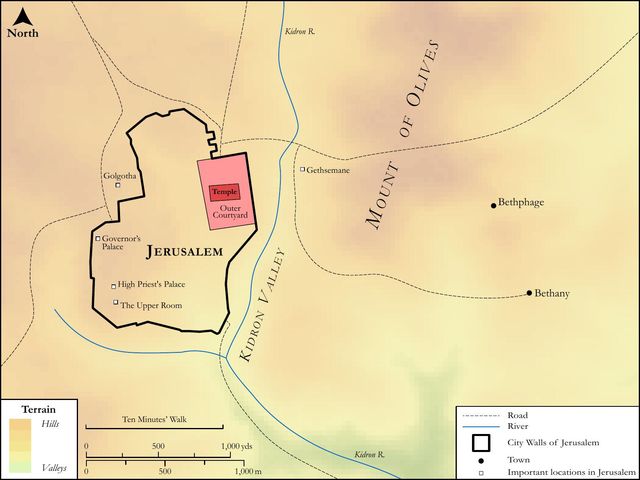
3.They brought him to the place of execution: He went forth, not dragged against his will, but voluntary in his sufferings. He went forth out of the city, for he was crucified without the gate, Heb 13:12. And, to put the greater infamy upon his sufferings, he was brought to the common place of execution, as one in all points numbered among the transgressors, a place called Golgotha, the place of a skull, where they threw dead men's skulls and bones, or where the heads of beheaded malefactors were left, - a place ceremonially unclean; there Christ suffered, because he was made sin for us, that he might purge our consciences from dead works, and the pollution of them. If one would take notice of the traditions of the elders, there are two which are mentioned by many of the ancient writers concerning this place: - (1.) That Adam was buried here, and that this was the place of his skull, and they observe that where death triumphed over the first Adam there the second Adam triumphed over him. Gerhard quotes for this tradition Origen, Cyprian, Epiphanius, Austin, Jerome, and others. (2.) That this was that mountain in the land of Moriah on which Abraham offered up Isaac, and the ram was a ransom for Isaac.
4.There they crucified him, and the other malefactors with him (Joh 19:18): There they crucified him. Observe (1.) What death Christ died; the death of the cross, a bloody, painful, shameful death, a cursed death. He was nailed to the cross, as a sacrifice bound to the altar, as a Saviour fixed for his undertaking; his ear nailed to God's door-post, to serve him for ever. He was lifted up as the brazen serpent, hung between heaven and earth because we were unworthy of either, and abandoned by both. His hands were stretched out to invite and embrace us; he hung upon the tree some hours, dying gradually in the full use of reason and speech, that he might actually resign himself a sacrifice. (2.) In what company he died: Two others with him. Probably these would not have been executed at that time, but at the request of the chief priests, to add to the disgrace of our Lord Jesus, which might be the reason why one of them reviled him, because their death was hastened for his sake. Had they taken two of his disciples, and crucified them with him, it had been an honour to him; but, if such as they had been partakers with him in suffering, it would have looked as if they had been undertakers with him in satisfaction. Therefore it was ordered that his fellow-sufferers should be the worst of sinners, that he might bear our reproach, and that the merit might appear to be his only. This exposed him much to the people's contempt and hatred, who are apt to judge of persons by the lump, and are not curious in distinguishing, and would conclude him not only malefactor because he was yoked with malefactors, but the worst of the three because put in the midst. But thus the scripture was fulfilled, He was numbered among the transgressors. He did not die at the altar among the sacrifices, nor mingle his blood with that of bulls and goats; but he died among the criminals, and mingled his blood with theirs who were sacrificed to public justice.
And now let us pause awhile, and with an eye of faith look upon Jesus. Was ever sorrow like unto his sorrow? See him who was clothed with glory stripped of it all, and clothed with shame - him who was the praise of angels made a reproach of men - him who had been with eternal delight and joy in the bosom of his Father now in the extremities of pain and agony. See him bleeding, see him struggling, see him dying, see him and love him, love him and live to him, and study what we shall render.
Historical interpretation
Seven Centuries of Reception
6 surviving comments on this verse. Each one is dated, so this reads as a timeline rather than a list.
Select a marker to jump to its quote. Markers stagger vertically where authors wrote within a few decades of each other.
'Successes' have terrible power to cast down or draw aside those who take not heed. Thus the Jews, who at first enjoyed the influence of God, sought the law of royalty from the Gentiles, and in the wilderness after the manna remembered the onions. In the same way here, refusing the Kingdom of Christ, they invited to themselves that of Caesar. Wherefore God set a king over them, according to their own decision. When then Pilate heard these things, he delivered Him to be crucified. Utterly without reason. For when he ought to have enquired whether Christ had aimed at sovereign power, he pronounced the sentence through fear alone. Yet that this might not befall him, Christ said beforehand, "My kingdom is not of this world"; but he having given himself wholly up to present things, would practice no great amount of wisdom. And yet his wife's dream should have been sufficient to terrify him; but by none of these things was he made better, nor did he look to heaven, but delivered Him up. And now they laid the cross upon Him as a malefactor. For even the wood they abominated, and endured not even to touch it. This was also the case in the type; for Isaac bare the wood. But then the matter stopped at the will of his father, for it was the type; while here it proceeded to action, for it was the reality.
"And He came to the place of a skull." Some say that Adam died there, and there lieth; and that Jesus in this place where death had reigned, there also set up the trophy. For He went forth bearing the Cross as a trophy over the tyranny of death: and as conquerors do, so He bare upon His shoulders the symbol of victory. What matter if the Jews did these things with a different intent. They crucified Him too with thieves, in this also unintentionally fulfilling prophecy; for what they did for insult contributed to the truth, that thou mayest learn how great is its power, since the Prophet had foretold of old, that "He was numbered with the transgressors." (Isa. liii. 12.) The devil therefore wished to cast a veil over what was done, but was unable; for the three were crucified, but Jesus alone was glorious, that thou mayest learn, that His power effected all. Yet the miracles took place when the three had been nailed to the cross; but no one attributed anything of what was done to either of those others, but to Jesus only; so entirely was the plot of the devil rendered vain, and all returned upon his own head. For even of these two, one was saved. He therefore did not insult the glory of the Cross, but contributed to it not a little. For it was not a less matter than shaking the rocks, to change a thief upon the cross, and to bring him unto Paradise.
(Hom. lxxxv. 1) They compel Jesus to bear the cross, regarding it as unholy, and therefore avoiding the touch of it themselves. And He bearing His cross went forth into a place called the place of a skull, which is called in Hebrew Golgotha, where they crucified Him. The same was done typically by Isaac, who carried the wood. But then the matter only proceeded as far as his father's good pleasure ordered, but now it was fully accomplished, for the reality had appeared.
(Hom. lxxxv) He carried the badge of victory on His shoulders, as conquerors do. Some say that the place of Calvary was where Adam died and was buried; so that in the very place where death reigned, there Jesus erected His trophy.
(Hom. lxxxv. 1) They crucified Him with the thieves: And two others with Him, on either side one, and Jesus in the midst; thus fulfilling the prophecy, And He was numbered with the transgressors. (Isa. 53:12) What they did in wickedness, was a gain to the truth. The devil wished to obscure what was done, but could not. Though three were nailed on the cross, it was evident that Jesus alone did the miracles; and the arts of the devil were frustrated. Nay, they even added to His glory; for to convert a thief on the cross, and bring him into paradise, was no less a miracle than the rending of the rocks.
"Bearing," therefore, "His cross, He went forth into the place that is called Calvary, in the Hebrew, Golgotha; where they crucified Him, and two others with Him on either side one, and Jesus in the midst." These two, as we have learned in the narrative of the other evangelists, were thieves with whom He was crucified, and between whom He was fixed, whereof the prophecy sent before had declared, "And He was numbered among the transgressors."
(Tr. cxvi) They, i. e. the soldiers, the guards of the governor, as appears more clearly afterwards; Then the soldiers when they had crucified Jesus; though the Evangelist might justly have attributed the whole to the Jews, who were really the authors of what they procured to be done.
(Tr. xxxi. in fin.) Yea, even the cross, if thou consider it, was a judgment seat: for the Judge being the middle, one thief, who believed, was pardoned, the other, who mocked, was damned: a sign of what He would once do to the quick and dead, place the one on His right hand, the other on His left.
Two robbers were crucified together with Christ, and this was owing to the malice of the Jews. For, as though to emphasize the dishonour of our Saviour's death, they involved the just Man in the same condemnation as the transgressors of the Law. And we may take the condemned criminals, who hung by Christ's side, as symbolical of the two nations who were shortly about to be brought into close contact with Him, I mean the children of Israel and the Gentiles. And why do we take condemned criminals as the type? Because the Jews were condemned by the Law, for they were guilty of transgressing it; and the Greeks by their idolatry, for they worshipped the creature more than the Creator.
And after another manner those who are united with Christ are also crucified with Him; for enduring, as it were, death to their old conversation in the flesh, they are reformed into a new life, according to the Gospel. Yea, Paul said: And they that are of Christ Jesus have crucified the flesh, with the passions and the lusts thereof; and again, speaking of himself in words applicable to all men: For I, through the Law, died unto the Law, that I might live unto God. I have been crucified with Christ: yet I live; and yet no longer I, but Christ liveth in me. And he exhorts also the Colossians: Wherefore, if ye died from the world, why do ye behave yourselves as though living in the world? For, by becoming dead unto worldly conversation, we are brought to the rudiments of conduct and life in Christ. Therefore the crucifixion of the two robbers, side by side with Christ, signifies in a manner to us, through the medium of that event, the juxtaposition of the two nations, dying together, as it were, with the Saviour Christ, by bidding farewell to worldly pleasures, and refusing any longer to live after the flesh, and preferring to live with their Lord, so far as may be, by fashioning their lives according to Him, and consecrating them in His service. And the meaning of the figure is in no way affected by the fact, that the men who hung by His side were malefactors; for we were by nature children of wrath, before we believed in Christ, and were all doomed to death, as we said before.
But as there Isaac was let go, and a ram offered; so here too the Divine nature remains impassible, but the human, of which the ram was the type, the offspring of that straying ram, was slain. But why does another Evangelist say that they hired Simon to bear the cross?
Continue studying John 19:18 across the web’s major study libraries — every link below opens this exact verse, chapter, or book on the destination site.
Read & Compare
 BibleGatewayThis verse in more than 200 translations and 70 languages.
 Bible.comThe YouVersion reader — hundreds of translations, reading plans, and highlights.
 ESV.orgCrossway's official English Standard Version reader.
 NET BibleThe NET translation with 60,000+ translators' notes on every rendering decision.
 STEP BibleTyndale House's free study tool — original text, vocabulary, and scholarly resources.
 BibliaLogos Bible Software's free web reader.
 USCCBThe New American Bible (Revised Edition) with the U.S. bishops' study notes.
Commentaries
 BibleHub CommentariesDozens of classic commentaries on this verse, gathered on one page.
 StudyLightMore than 100 commentary sets — the largest collection on the web.
 BibleRefPlain-English commentary on what this verse means, verse by verse.
 Enduring WordDavid Guzik's free commentary on this chapter, widely used by Bible teachers.
 Bible Study ToolsVerse commentary alongside Greek and Hebrew study aids.
Original Language & Research
- BibleHub InterlinearThe verse word by word — original language, transliteration, and English.
- BibleHub LexiconEvery word's original-language definition and Strong's entry.
 Blue Letter BibleDeep-study tools — Strong's numbers, concordance, and word studies.
 CNTR CollationThe earliest Greek manuscripts of this verse, collated letter by letter.
Sermons, Hymns & Audio


TrulyRandomVerse is not affiliated with these sites and doesn’t control their content. They’re linked because they’re genuinely useful.
Summary
John 19:18 graphically depicts the scene of Jesus' crucifixion, a moment of profound theological significance. This verse precisely situates Jesus physically between two other condemned individuals, highlighting both the historical reality of His execution and the deep spiritual implications of His placement, which underscores His identification with humanity's fallen state and His unique role in God's redemptive plan.
Context
ShowHideLiterary Context
John 19:18 immediately follows the account of Jesus being led to Golgotha, the "Place of a Skull," carrying His own cross (or at least starting to, before Simon of Cyrene was compelled to carry it, as mentioned in the Synoptics). The preceding verses detail Pilate's final, reluctant condemnation of Jesus and the Jewish leaders' insistence on His crucifixion. The narrative in John consistently emphasizes Jesus' sovereignty, even in His suffering, portraying Him as in control of His destiny, fulfilling divine prophecy. This verse sets the stage for the subsequent events of the crucifixion, including the inscription on the cross, the division of His garments, and the presence of His mother and other women, all of which further underscore the profound and public nature of this pivotal event.
Historical & Cultural Context
Roman crucifixion was a brutal and public form of execution designed to inflict maximum pain, humiliation, and serve as a deterrent to rebellion or crime. It was typically carried out outside city walls, often on a prominent hill, to ensure visibility. It was common practice for multiple condemned individuals to be executed simultaneously, especially during times of unrest or major festivals like Passover, to send a clear message. The placement of Jesus between two others, identified in other Gospels as "robbers" or "criminals" (e.g., Matthew 27:38), was intended to associate Him with common criminals and further His public disgrace, stripping Him of any perceived dignity or authority.
Key Themes
ShowHideThis verse contributes significantly to several overarching themes within John's Gospel and biblical theology. Firstly, it powerfully illustrates the Fulfillment of Prophecy, particularly Isaiah 53:12, which foretold that the suffering servant would be "numbered with the transgressors." Jesus' placement among criminals directly actualizes this ancient prediction. Secondly, despite the attempt to humiliate Him, Jesus' position "in the midst" paradoxically reinforces His Centrality in God's plan. Even at His lowest point, He is the focal point of divine attention and human destiny, the hinge upon which salvation history turns. Thirdly, the scene highlights the Ultimate Humiliation and Divine Purpose of Christ's suffering. The ignominy of being crucified between common criminals amplified the shame, yet this extreme debasement was precisely part of God's sovereign plan for redemption, demonstrating the unparalleled depth of Christ's sacrifice and His obedience unto death.
Exposition and Analysis
ShowHideKey Word Analysis
ShowHideThis verb, derived from stauros (cross), literally means "to impale on the cross." It vividly conveys the brutal, agonizing, and public method of execution employed by the Romans. The use of this term here emphasizes the physical reality and immense suffering Jesus endured, a death reserved for the worst criminals and rebels, underscoring the depth of His humiliation.
Derived from meta (among, with), this word describes a central or intermediate position. In John 19:18, "in the midst" (ἐν μέσῳ, en mesō) refers to Jesus' physical placement between the two other crucified individuals. While a simple geographical description, it carries profound theological weight, signifying Jesus' central position not merely on the cross, but in God's redemptive plan for humanity, even as He is numbered among transgressors.
Verse Breakdown
ShowHide"Where they crucified him,"
This opening clause establishes the location and the primary action. "Where" (G3699, hópou) points to Golgotha, the place of execution. The passive voice "they crucified him" indicates the action was carried out by the Roman authorities, specifically the soldiers, under Pilate's order, yet also implies the broader human culpability in His death.
"and two other with him,"
This introduces the presence of two additional individuals who were also being crucified. The term "other" (G243, állos) suggests they were different from Jesus, implying they were common criminals, as confirmed by other Gospel accounts. Their presence underscores the public nature of the execution and Jesus' association with the condemned.
"on either side one,"
This specifies the precise arrangement of the three crucified men. "On either side one" (G1782, enteûthen repeated) literally means "from here and from here," indicating one on the right and one on the left. This detail is crucial for the fulfillment of prophecy and emphasizes Jesus' central, yet ignominious, position.
"and Jesus in the midst."
This final clause explicitly states Jesus' central placement. The conjunction "and" (G1161, dé) serves as a continuative, further detailing the scene. "In the midst" (G3319, mésos) highlights His unique position, making Him the focal point of this tragic yet divinely orchestrated tableau. Despite being placed among criminals, He remains the central figure, the one around whom all attention revolves.
Literary Devices
ShowHideJohn 19:18 employs several literary devices to convey its profound message. There is significant Irony in this scene: the Son of God, the King of kings, is crucified as a common criminal, placed between two actual criminals. This stark contrast highlights the depth of His condescension and the blindness of those who condemned Him. The verse also functions as a powerful instance of Fulfillment of Prophecy, specifically referencing Isaiah 53:12, where the suffering servant is "numbered with the transgressors." This deliberate arrangement by the Roman authorities, seemingly by chance, is presented as part of God's sovereign plan. Furthermore, the phrase "in the midst" carries significant Symbolism. While literally describing Jesus' physical location, it also symbolically underscores His centrality in salvation history. Even in His ultimate humiliation, He remains the pivotal figure, the one through whom reconciliation is achieved, standing between a lost humanity and a holy God.
Theological and Thematic Connections
ShowHideJohn 19:18 is a cornerstone verse for understanding the nature of Christ's atoning sacrifice. His placement "in the midst" of two criminals is not merely a historical detail but a profound theological statement. It signifies His identification with humanity in its fallen, sinful state, even to the point of being numbered among transgressors. This act of profound humility and solidarity demonstrates the boundless love of God, who sent His Son to bear the shame and penalty of sin on behalf of all. Jesus, though sinless, took the place of sinners, effectively mediating between a righteous God and a condemned humanity. His central position on the cross, flanked by those who deserved their fate, powerfully illustrates His unique role as the one and only Mediator, the Lamb of God who takes away the sin of the world.
Reflection and Application
ShowHideJohn 19:18 compels us to gaze upon the cross with sober reflection and profound gratitude. It reminds us of the stark reality and immense cost of our salvation. Jesus, the sinless Son of God, willingly endured the ultimate shame and suffering, identifying with the lowest of humanity, to bridge the chasm between a holy God and sinful humanity. His placement between criminals powerfully highlights His mission to save all, even those considered beyond hope or deserving of condemnation. This scene challenges us to confront the depth of our own sin, which necessitated such a sacrifice, and simultaneously magnifies the incomprehensible love of God. It calls us to reflect on the transformative power of the cross, which, though a symbol of Roman brutality, has become the central emblem of Christian faith and the wellspring of our hope, forgiveness, and new life.
Questions for Reflection
ShowHideFAQ
ShowHideWhy was Jesus crucified between two criminals?
ShowHideJesus was crucified between two criminals for several significant reasons, all pointing to God's sovereign plan and the fulfillment of prophecy. Historically, it was common Roman practice to crucify multiple individuals simultaneously, especially during major festivals, to maximize public deterrence and humiliation. By placing Jesus, who claimed to be a king, between common criminals, the Roman authorities and Jewish leaders sought to further disgrace Him and invalidate His claims, associating Him with the lowest of society. However, from a theological perspective, this arrangement was a direct fulfillment of Old Testament prophecy, specifically Isaiah 53:12, which foretold that the suffering servant would be "numbered with the transgressors." This placement powerfully symbolizes Jesus' identification with humanity's sinful condition. Though sinless Himself, He bore the penalty for our sins, effectively taking the place of sinners. His position "in the midst" also paradoxically highlights His unique and central role as the mediator between God and humanity, even in His ultimate humiliation.
Christ-Centered Fulfillment
ShowHideJohn 19:18, detailing Jesus' crucifixion "in the midst" of two criminals, is a profound Christ-centered fulfillment of God's redemptive plan. This seemingly ignominious placement perfectly illustrates Christ's role as the ultimate sacrifice and mediator. He, the sinless Lamb of God, was numbered with transgressors, not because He was one, but because He was taking their place, bearing the full weight of humanity's sin and shame (as seen in 2 Corinthians 5:21). His central position on the cross foreshadows His eternal centrality in the cosmos and in the hearts of believers, for it is through His death and resurrection that all things are reconciled to God (Colossians 1:20). The cross, with Jesus at its heart, becomes the pivotal point of history where divine justice and divine love perfectly converge, offering forgiveness and new life to all who believe, demonstrating that He is indeed the one mediator between God and mankind). Even in the depths of His humiliation, Jesus remained the sovereign Lord, fulfilling His mission to draw all people to Himself (John 12:32), making the cross, not a symbol of defeat, but of ultimate victory and the very heart of the Gospel.