


Matthew 27:52
Bible text: King James Version (1769 Blayney text) · Public domain
Bible text: Berean Standard Bible · Public domain
Bible text: American Standard Version (1901) · Public domain
Bible text: World English Bible, Messianic edition · Public domain
Bible text: Geneva Bible (1599) · Public domain
Bible text: Young's Literal Translation · Public domain
- καὶkaiandG2532CONJConjunction
- τὰtatheG3588T-NPNDefinite article Nominative Plural Neuter
- μνημεῖαmnēmeiatombsG3419N-NPNNoun Nominative Plural Neuter
- ἀνεῴχθησανaneōchthēsanwere openedG455V-API-3PVerb Aorist Passive Indicative 3rd Plural
- καὶkaiandG2532CONJConjunction
- πολλὰpollamanyG4183A-NPNAdjective Nominative Plural Neuter
- σώματαsōmatabodiesG4983N-NPNNoun Nominative Plural Neuter
- τῶνtōnof theG3588T-GPMDefinite article Genitive Plural Masculine
- κεκοιμημένωνkekoimēmenōnhaving fallen asleepG2837V-RMP-GPMVerb Perfect Middle Participle Genitive Plural Masculine
- ἁγίωνhagiōnsaintsG40A-GPMAdjective Genitive Plural Masculine
- ἠγέρθησανēgerthēsanwere raisedG1453V-API-3PVerb Aorist Passive Indicative 3rd Plural
English is a literal word-by-word gloss of the Greek, not the KJV's wording. Why?
This is the original text the KJV's translators worked from — each Greek word with its own literal English meaning in this verse, prepared by scholars at Tyndale House, Cambridge. The KJV translates whole sentences, not word by word, so its wording differs: one Greek word can become several English words, and the KJV may choose “charity” where the gloss reads “love”. Both are faithful — they answer different questions. For the KJV's own rendering, switch to the KJV text.
Details
See on the biblical-era maps
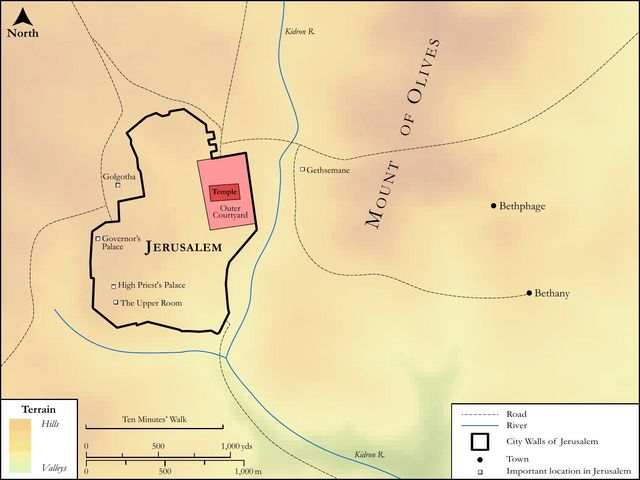
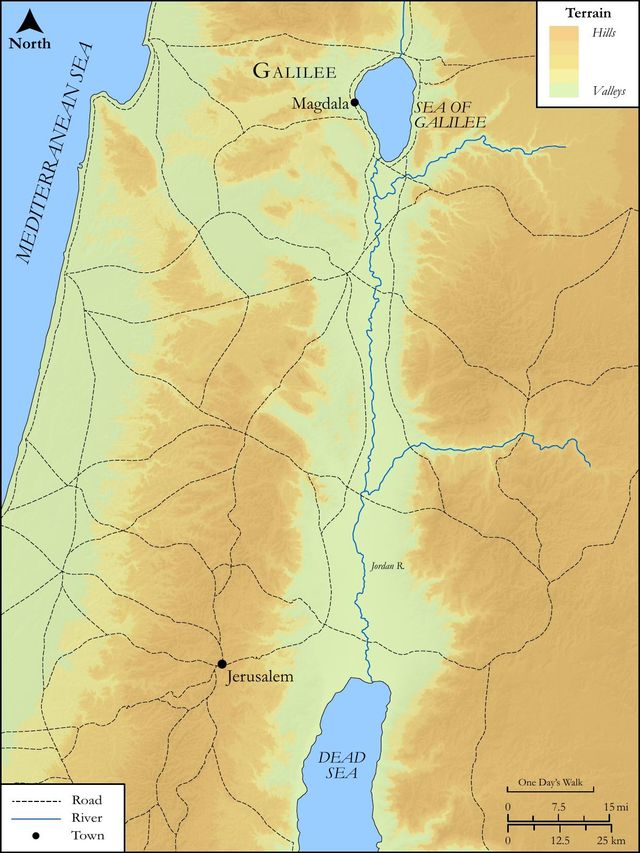
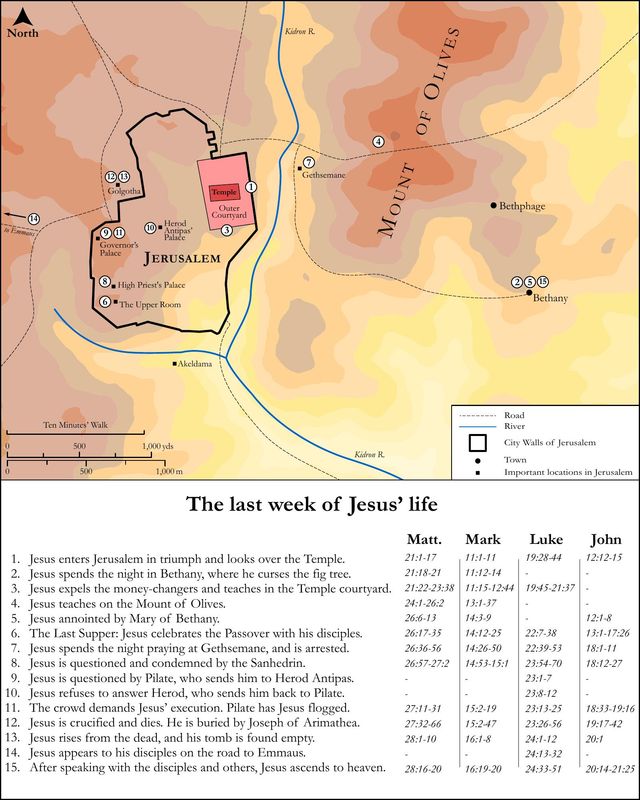
Study this verse
Historical interpretation
Seven Centuries of Reception
16 surviving comments on this verse. Each one is dated, so this reads as a timeline rather than a list.
Select a marker to jump to its quote. Markers stagger vertically where authors wrote within a few decades of each other.
How shall we be able to live apart from Him, whose disciples the prophets themselves in the Spirit did wait for Him as their Teacher? And therefore He whom they rightly waited for, having come, raised them from the dead.
The graves are the bodies of sinful souls, that is, souls dead to God; but when by God's grace these souls have been raised, their bodies which before were graves, become bodies of Saints, and appear to go out of themselves, and follow Him who rose again, and walk with Him in newness of life; and such as are worthy to have their conversation in heaven enter into the Holy City at divers times, and appear unto many who see their good works.
Or, He gave up the ghost with a loud voice, in grief that He was not carrying the sins of all men.
Or, The veil of the temple is rent, because from this time the nation was dispersed, and the honour of the veil is taken away with the guardianship of the protecting Angel.
The earth quaked, because it was unequal to contain such a body; the rocks rent, for the Word of God that pierces all strong and mighty things, and the virtue of the eternal Power had penetrated them; the graves were opened, for the bands of death were loosed. And many bodies of the saints which slept arose, for illumining the darkness of death, and shedding light upon the gloom of Hades, He robbed the spirits of death.
Immediately thereafter the curtain of the temple was torn. After that the people were split into factions. The glory of the curtain along with the protection of its defending angel was taken away.
The earth shook. For the earth could not hold this dead man. Rocks were split, for the Word of God and the power of his eternal goodness rushed in, penetrating every stronghold and principality. Graves were opened, for the gates of death had been unlocked. And a number of the bodies of the saints who had fallen asleep arose. Dispelling the shadows of death and illuminating the darkness of hell, Christ destroyed the spoils of death itself at the resurrection of the saints, who saw him immediately. The centurion and the guards who witnessed this disturbance of the entire natural order confessed him to be the Son of God.
This cry rent the veil, and opened the tombs, and made the house desolate. And He did this, not as offering insult to the temple (for how should He, who saith, "Make not my Father's house a house of merchandise," but declaring them to be unworthy even of His abiding there; like as also when He delivered it over to the Babylonians. But not for this only were these things done, but what took place was a prophecy of the coming desolation, and of the change into the greater and higher state; and a sign of His might.
And together with these things He showed Himself also by what followed after these things, by the raising of the dead. For in the instance of Elisha; one on touching a dead body rose again, but now by a voice He raised them, His body continuing up there, on the cross. And besides, those things were a type of this. For that this might be believed, therefore is that all done. And they are not merely raised, but also rocks are rent, and the earth shaken, that they might learn, that He was able to strike themselves blind, and to rend them in pieces. For He that cleft rocks asunder, and darkened the world, much more could have done these things to them, had it been His will. But He would not, but having discharged His wrath upon the elements, them it was His will to save by clemency. But they abated not their madness. Such is envy, such is jealousy, it is not easily stayed. At that time then they were impudent in setting themselves against the actual appearances; and afterwards even against the things themselves, when a seal being put upon Him, and soldiers watching Him, He rose again, and they heard these things from the very guards; they even gave money, in order both to corrupt others, and to steal away the history of the resurrection.
Marvel not therefore if at this time also they were perverse, being thus altogether prepared to set themselves impudently against all things; but observe this other point, how great signs He had wrought, some from Heaven, some on earth, some in the very temple, at once marking His indignation, and at the same time showing that what were unapproachable are now to be entered, and that Heaven shall be opened; and the work removed to the true Holy of Holies. And they indeed said, "If He be the King of Israel, let Him come down now from the cross," but He shows that He is King of all the world. And whereas those men said, "Thou that destroyest this temple, and buildest it in three days," He shows that it shall be made forever desolate. Again they said, "He saved others, Himself He cannot save." but He while abiding on the cross proved this most abundantly on the bodies of His servants. For if for Lazarus to rise on the fourth day was a great thing, how much more for all those who had long ago fallen asleep, at once to appear alive, which was a sign of the future resurrection. For, "many bodies of the saints which slept, arose," it is said, "and went into the holy city, and appeared to many." For in order that what was done might not be accounted to be an imagination, they appear, even to many, in the city. And the Centurion too then glorified God, saying, "Truly this was a righteous man. And the multitudes that came together to that sight, returned beating their breasts." So great was the power of the crucified, that after so many mockings, and scoffs, and jeers, both the centurion was moved to compunction, and the people. And some say that there is also a martyrdom of this centurion, who after these things grew to manhood in the faith.
"And many women were there beholding afar off, which had followed Him, ministering unto Him, Mary Magdalene, and Mary the mother of James, and Joses, and the mother of Zebedee's sons."
These things the women see done, these who were most inclined to feel for Him, who were most of all bewailing Him. And mark how great their assiduity. They had followed Him ministering to Him, and were present even unto the time of the dangers. Wherefore also they saw all; how He cried, how He gave up the ghost, how the rocks were rent, and all the rest.
And these first see Jesus; and the sex that was most condemned, this first enjoys the sight of the blessings, this most shows its courage. And when the disciples had fled, these were present. But who were these? His mother, for she is called mother of James, and the rest. But another evangelist saith, that many also lamented over the things that were done, and smote their breasts, which above all shows the cruelty of the Jews, for that they gloried in things for which others were lamenting, and were neither moved by pity, nor checked by fear. For indeed the things that were done were of great wrath, and were not merely signs, but signs of anger all of them, the darkness, the cloven rocks, the veil rent in the midst, the shaking of the earth, and great was the excess of the indignation.
When He remained on the cross they had said tauntingly, He saved others, himself he cannot save. But what He would not do for Himself, that He did and more than that for the bodies of the Saints. For if it was a great thing to raise Lazarus after four days, much more was it that they who had long slept should now show themselves alive; this is indeed a proof of the resurrection to come. But that it might not be thought that that which was done was an appearance merely, the Evangelist adds, And came out of the graves after his resurrection., and went into the holy city, and appeared unto many.
These women thus watching the things that are done are the most compassionate, the most sorrowful. They had followed Him ministering, and remained by Him in danger, showing the highest courage, for when the disciples fled they remained.
The literal meaning of the great signs is undoubtedly that both heaven and earth and all things within them wished to acclaim their crucified Lord. It seems to me, however, that the trembling earth and other signs also represent a type of believers, namely, those who once were comparable to a graveyard but who, having abandoned the errors of their former ways and having softened their once stony hearts, have come to acknowledge the Creator.
(Verse 52) And the earth shook, and the rocks were split, and the tombs were opened. There is no doubt that this signifies, literally, the magnitude of the signs, such as the crucified Lord and the heavens and the earth, demonstrating everything. But it seems to me that the earthquake and the rest symbolize the belief of the believers, who, having abandoned the vices of their past errors and softened the hardness of their hearts, who were previously like the tombs of the dead, have now recognized the Creator.
It is not doubtful to any what these great signs signify according to the letter, namely, that heaven and earth and all things should bear witness to their crucified Lord.
As Lazarus rose from the dead, so also did many bodies of the Saints rise again to show forth the Lord's resurrection; yet notwithstanding that the graves were opened, they did not rise again before the Lord rose, that He might be the first-born of the resurrection from the dead. The holy city in which they were seen after they had risen may be understood to mean either the heavenly Jerusalem, or this earthly, which once had been holy. For the city of Jerusalem was called Holy on account of the Temple and the Holy of Holies, and to distinguish it from other cities in which idols were worshipped. When it is said, And appeared unto many, it is signified that this was not a general resurrection which all should see, but special, seen only by such as were worthy to see it.
Observe, that in the very midst of the offence of His passion the Centurion acknowledges the Son of God, while Arius in the Church proclaims Him a creature.
It was a Jewish custom, and held no disgrace, according to the manners of the people of old, for women to minister of their substance, food, and clothing to their teachers. This Paul says, that he refused, because it might occasion scandal among the Gentiles. They ministered to the Lord of their substance, that He might reap their carnal things, of whom they reaped spiritual things. Not that the Lord needed food of the creature, but that He might set an example for the teacher, that He should be content to receive food and clothing from His disciples. But let us see what sort of attendants He had; Among whom was Mary Magdalene, and Mary the mother of James and Joseph, and the mother of Zebedee's children.
(adv. Helvid.) 'See,' says Helvidius, 'Jacob and Joseph are the sons of Mary the Lord's mother, whom the Jews call the brethren of Christ. (Mark 6:3.) He is also called James the less, to distinguish him from James the greater, who was the son of Zebedee.' And he urges that 'it were impious to suppose that His mother Mary would be absent, when the other women were there; or that we should have to invent some other third unknown person of the name of Mary, and that too when John's Gospel witnesses that His mother was present.' O blind folly! O mind perverted to its own destruction! Hear what the Evangelist John says: There stood by the cross of Jesus, his mother, and his mother's sister, Mary the wife of Cleophas, and Mary Magdalene. (John 19:25.) No one can doubt that there were two Apostles called James; the son of Zebedee, and the son of Alpheus. This unknown James the less, whom Scripture mentions as the son of Mary, if he is an Apostle, is the son of Alpheus; if he is not an Apostle, but a third unknown James, how can he be supposed to be the Lord's brother, and why should he be styled 'The Less,' to distinguish him from 'The Greater?' For The Greater and The Less are epithets which distinguish two persons, but not three. And that the James, the Lord's brother, was an Apostle, is proved by Paul, Other of the Apostles saw I none, save James the Lord's brother. (Gal. 1:19.) But that you should not suppose this James to be the son of Zebedee, read the Acts, (Acts 12:1.) where he was put to death by Herod. The conclusion then remains, that this Mary, who is described as the mother of James the less (vid. sup. 13:55.), was wife of Alpheus, and sister of Mary the Lord's mother, called by John, Mary the wife of Cleophas. But should you incline to think them two different persons, because in one place she is called Mary the mother of James the less, and in another place Mary the wife of Cleophas, you will learn the Scripture custom of calling the same man by different names; as Raguel Moses' father-in-law is called Jethro. In like manner then, Mary the wife of Cleophas is called the wife of Alpheus, and the mother of James the less. For if she had been the Lord's mother, the Evangelist would here, as in all other places, have called her so, and not described her as the mother of James, when he meant to designate the mother of the Lord. But even if Mary the wife of Cleophas, and Mary the mother of James and Joses, were different persons, it is still certain, that Mary the mother of James and Joses was not the Lord's mother.
But the lower parts of the earth, hell, are understood to be where our Lord and Savior descended, so that He might lead with Him to the heavens the souls of the saints who were being held captive there. Hence, after His resurrection, many bodies of the righteous were seen in the holy city (Matthew 27:52-53). And that hell is in the lower part of the earth is attested by the Psalmist who says: "The earth opened and swallowed up Dathan and covered the congregation of Abiron" (Psalm 106:17). This is also explained more fully in the Book of Numbers (chapter 16). In another place we read: "Let death come upon them and let them go down alive into hell" (Psalm 55:15).
('Leo, in Serm. de Pass.' non occ.) The sudden commotion in the elements is a sufficient sign in witness of His venerable Passion, The earth quaked, and the rocks rent, and the graves were opened.
(Serm. 66. 3.) From this example then of the Centurion let the substance of the earth tremble in the punishment of its Redeemer, let the rocks of unbelieving minds be rent, and those who were pent up in these sepulchres of mortality leap forth, bursting the bonds that would detain them; and let them show themselves in the Holy City, i. e. the Church of God, as signs of the Resurrection to come; and thus let that take place in the heart, which we must believe takes place in the body.
But some one will ask, what became of those who rose again when the Lord rose. We must believe that they rose again to be witnesses of the Lord's resurrection. Some have said that they died again, and were turned to dust, as Lazarus and the rest whom the Lord raised. But we must by no means give credit to these men's sayings, since if they were to die again, it would be greater torment to them, than if they had not risen again. We ought therefore to believe without hesitation that they who rose from the dead at the Lord's resurrection, ascended also into heaven together with Him.
But perhaps someone may say: He rightly rose again who, being God, could not be held by death. Therefore, to instruct our ignorance, to strengthen our weakness, He did not wish the example of His own resurrection alone to suffice for us. He alone died at that time, and yet He by no means rose again alone. For it is written: "Many bodies of the saints who had fallen asleep arose." Therefore all arguments of unbelief have been removed. For lest anyone say: A man ought not to hope for himself what God made man displayed in His flesh, behold we know that men rose again together with God, and we do not doubt that they were mere men. If therefore we are members of our Redeemer, let us presume in ourselves what is established to have taken place in the Head. If we greatly abase ourselves, we who are the lowest members ought to hope in ourselves for what we have heard concerning His higher members.
Whence with good reason by the Centurion is denoted the faith of the Church, which, when the veil of heavenly mysteries had been rent by the Lord's death, immediately asserts Jesus to be both very Man, and truly Son of God, while the Synagogue held its peace.
In the time before the Messiah came, the expectation of the godly was to die and go to Sheol. Jonah (most likely) actually died and cried out to God from the depths of Sheol (Jon. 2:1). The psalmist expected that Sheol would swallow him up (Ps. 18:5; 86:13; 116:3).
In the parable of Lazarus and the rich man, they both died and went down to Hades. In that parable, Hades was divided in two by a vast chasm. The side where Lazarus was had the name of Abraham’s bosom (Luke 16:23), while the rich man was in torment in Hades. Nevertheless, it was possible for communication to occur across the chasm.
In our text [Matt. 12:40], Jesus said that He was going to be three days and nights in the heart of the earth. But He also told the thief on the cross that He would be with him in Paradise that same day (Luke 23:43). So then, Abraham’s bosom was also known as Paradise. To the Greeks, this went by the name of Elysium. This is where Jesus went, and preached across the chasm.
The Greek word for the lowest pit of Hades, the worst part, was Tartarus. This word is used once in the New Testament (without any redefinition, mind). Peter tells us this: “For if God spared not the angels that sinned, but cast them down to hell [Tartarus], and delivered them into chains of darkness, to be reserved unto judgment” (2 Peter 2:4).
While in Hades, the Lord preached. But the preaching was not “second chance” preaching. Rather the word used is one used for heralding or announcing, not the word for preaching the gospel. “By which also he went and preached unto the spirits in prison; Which sometime were disobedient, when once the longsuffering of God waited in the days of Noah, while the ark was a preparing, wherein few, that is, eight souls were saved by water” (1 Pet. 3:19–20). The Lord was announcing their final defeat to the “sons of God” and Nephilim both. And this, incidentally, tells us how momentous the rebellion at the time of the Flood actually was. Thousands of years after their definitive defeat, Jesus went to them to announce their final defeat.
The Bible teaches us that Jesus is the king of all things. The devil is not the ruler of Gehenna—Jesus is. The lake of fire was prepared for the devil and his angels (Matt. 25:41). It is a place of torment for the devil. Furthermore, Jesus holds the keys to Hades as well. “I am he that liveth, and was dead; and, behold, I am alive for evermore, Amen; and have the keys of hell [Hades] and of death.” (Rev. 1:18). Jesus, not the devil, is the King of Hell. Jesus, not the devil, is the Lord of Hades.
When the Lord rose from the dead, He led captivity captive (Eph. 4:8)—all the saints in the Old Testament who had died and gone to Abraham’s bosom were transferred when Paradise was moved (Matt. 27:52). And by the time of Paul, Paradise was up (2 Cor. 12:4). So if you had lived in the Old Testament, you would have died and gone down to Sheol/Hades. But the part of Hades that contained the saints of God has been emptied out, and now when God’s people die, what happens? To be absent from the body is to be present with the Lord (2 Cor. 5:6, 8). We still go to Paradise, but Paradise itself has been moved into the heavens.
Continue studying Matthew 27:52 across the web’s major study libraries — every link below opens this exact verse, chapter, or book on the destination site.
Read & Compare
 BibleGatewayThis verse in more than 200 translations and 70 languages.
 Bible.comThe YouVersion reader — hundreds of translations, reading plans, and highlights.
 ESV.orgCrossway's official English Standard Version reader.
 NET BibleThe NET translation with 60,000+ translators' notes on every rendering decision.
 STEP BibleTyndale House's free study tool — original text, vocabulary, and scholarly resources.
 BibliaLogos Bible Software's free web reader.
 USCCBThe New American Bible (Revised Edition) with the U.S. bishops' study notes.
Commentaries
 BibleHub CommentariesDozens of classic commentaries on this verse, gathered on one page.
 StudyLightMore than 100 commentary sets — the largest collection on the web.
 BibleRefPlain-English commentary on what this verse means, verse by verse.
 Enduring WordDavid Guzik's free commentary on this chapter, widely used by Bible teachers.
 Bible Study ToolsVerse commentary alongside Greek and Hebrew study aids.
Original Language & Research
- BibleHub InterlinearThe verse word by word — original language, transliteration, and English.
- BibleHub LexiconEvery word's original-language definition and Strong's entry.
 Blue Letter BibleDeep-study tools — Strong's numbers, concordance, and word studies.
 CNTR CollationThe earliest Greek manuscripts of this verse, collated letter by letter.
Sermons, Hymns & Audio


TrulyRandomVerse is not affiliated with these sites and doesn’t control their content. They’re linked because they’re genuinely useful.
Summary
This verse details a profound and supernatural event that transpired immediately following the crucifixion and death of Jesus Christ: the opening of graves and the subsequent resurrection of many bodies of the saints who had died. This miraculous occurrence serves as a dramatic divine attestation to the immense power unleashed by Christ's atoning sacrifice, signaling His victory over death and foreshadowing the broader hope of resurrection for all who believe.
Context
ShowHideLiterary Context
This verse immediately follows the profoundly dramatic events described in Matthew 27:51, which include the tearing of the temple veil from top to bottom, a great earthquake, and the splitting of rocks. These preceding signs underscore the cosmic and theological significance of Jesus' death, marking the end of an old covenant and the inauguration of a new access to God. The opening of graves and the resurrection of saints' bodies serve as the climactic supernatural attestation, further emphasizing the unprecedented power and divine authority inherent in Christ's atoning sacrifice. This sequence of events presents a unified, divinely orchestrated display confirming Jesus' identity and the radical shift His death initiated.
Historical & Cultural Context
In first-century Jewish culture, burial practices typically involved placing bodies in rock-cut tombs or graves, often within family plots. The concept of resurrection was a significant theological debate, particularly between the Pharisees (who believed in it) and the Sadducees (who did not). While a general resurrection at the end of time was anticipated, the immediate, visible resurrection of individuals concurrent with the Messiah's death was utterly unprecedented and profoundly shocking. From a Roman perspective, crucifixion was the ultimate display of imperial power, designed to inflict maximum suffering and public humiliation, ensuring that the condemned had no future. The supernatural events accompanying Jesus' death, including the resurrection of the saints, directly challenged and subverted this display of human power, asserting divine sovereignty over life and death in a manner comprehensible yet astounding to both Jewish and Roman observers.
Key Themes
ShowHideMatthew 27:52 powerfully contributes to several overarching themes within the Gospel of Matthew and the broader biblical narrative. Firstly, it unequivocally demonstrates Divine Power Over Death, showcasing God's absolute sovereignty over life and the grave, a theme central to the ministry of Jesus who declared, "I am the resurrection and the life". Secondly, these resurrected saints are often understood as Firstfruits of Resurrection, serving as a tangible preview and guarantee of the resurrection life secured by Christ's death. They prefigure Jesus' own glorious resurrection and the future general resurrection of believers, echoing the apostle Paul's teaching that Christ is the "firstfruits of those who have fallen asleep". Thirdly, the event signifies Victory Over Sin and Death, indicating that the power of death, which had held humanity captive since the Fall, was decisively broken by Jesus' sacrifice. Finally, it serves as a profound Confirmation of Jesus' Identity, as these dramatic supernatural phenomena, alongside the other signs, provided undeniable proof to eyewitnesses, including the Roman centurion who exclaimed, "Truly this was the Son of God".
Exposition and Analysis
ShowHideKey Word Analysis
ShowHideFrom μνήμη (mnēmē), meaning "remembrance." This term refers to a place of interment, a cenotaph, or a tomb. Its use here emphasizes the physical locations where the dead were laid to rest, making the subsequent opening and resurrection a literal and undeniable disruption of the natural order.
From κεῖμαι (keimai), "to lie down." This word means "to put to sleep," and passively or reflexively, "to slumber." Figuratively, it is a common biblical euphemism for death, particularly for believers. It implies that death is not a final cessation but a temporary state, like sleep, from which one will awaken, reinforcing the hope of resurrection.
Probably akin to the base of ἀγορά (agora), suggesting the idea of collecting one's faculties. This verb means "to waken" (transitively or intransitively), "to rouse" (literally, from sleep, from lying, from disease, from death; or figuratively, from obscurity, inactivity, nonexistence). Here, it denotes a literal, physical resurrection from the state of death, emphasizing the active, powerful intervention of God.
Verse Breakdown
ShowHide"And the graves were opened;"
This initial clause describes the immediate, physical manifestation of divine power. The word "graves" (mnēmeîon) refers to the tombs or burial places. The passive voice "were opened" (anoígō) highlights that this was not a human act but a supernatural intervention, directly attributable to the power unleashed by Jesus' death. It signifies the breaking of death's hold over those interred.
"and many bodies of the saints"
This specifies who was affected by the opening of the graves. "Many" (polýs) indicates a significant number, not just a few isolated cases, lending weight to the miraculous nature of the event. The term "bodies" (sōma) confirms a physical resurrection, not merely a spiritual one. Crucially, they are identified as "saints" (hágios), meaning holy ones or consecrated ones, implying they were righteous individuals, likely Old Testament believers who had died in faith, awaiting the Messiah's redemptive work.
"which slept arose,"
This final clause completes the miraculous action. "Slept" (koimáō) is a common biblical euphemism for death, particularly for believers, conveying the idea that death is a temporary state. The verb "arose" (egeírō) signifies a literal, physical rising from the dead. This is a direct act of resurrection, demonstrating the power of God to overcome the ultimate enemy, death. The timing—immediately after Jesus' death—links this resurrection directly to His atoning work, presenting these saints as the first beneficiaries of His victory over the grave.
Literary Devices
ShowHideMatthew 27:52 employs several powerful literary devices to convey its profound theological message. The most prominent is Miracle, as the opening of graves and the resurrection of bodies are supernatural occurrences that defy natural laws, serving as undeniable signs of divine intervention and power. This event functions as Symbolism, where the physical act of graves opening and bodies rising symbolizes Christ's victory over death and the breaking of its power. It is a tangible representation of the spiritual reality that through His death, Jesus conquered the grave. Furthermore, the passage utilizes Foreshadowing, as the resurrection of these saints prefigures Jesus' own glorious resurrection on the third day, and ultimately, the future general resurrection of all believers. The phrase "which slept" is a classic example of Euphemism, softening the harsh reality of death by likening it to a temporary slumber, thereby reinforcing the hope of awakening through resurrection. The cumulative effect of these devices is to underscore the immense, transformative power of Jesus' sacrifice and its far-reaching implications for all humanity.
Theological and Thematic Connections
ShowHideMatthew 27:52 stands as a powerful theological statement regarding the nature of death and the ultimate victory secured by Jesus Christ. It underscores the biblical truth that for believers, death is not a finality but a temporary "sleep," from which they will be awakened. This event, occurring precisely at the moment of Christ's death, serves as a tangible demonstration that the power of death, which had held humanity captive since the Fall, was decisively broken. It is a divine declaration that Jesus' sacrifice was not merely a human tragedy but a cosmic triumph, unlocking the gates of Hades and inaugurating the era of resurrection life. The resurrection of these saints is thus a "firstfruits" of the greater harvest to come, guaranteeing the future resurrection of all who are in Christ.
Reflection and Application
ShowHideMatthew 27:52 offers profound spiritual nourishment and practical application for believers today. It serves as a powerful reminder that death, for those who belong to Christ, is not an ultimate defeat but a temporary transition, akin to sleep. This truth provides immense comfort in times of grief and loss, assuring us that our loved ones who have died in faith are merely awaiting a glorious awakening. Furthermore, this miraculous event reinforces the absolute sovereignty of God over life and death, strengthening our faith in His ability to fulfill all His promises, including our own future resurrection. Living with the reality of resurrection hope transforms our perspective on suffering, mortality, and the transient nature of this world, empowering us to live with purpose, courage, and an eternal perspective, knowing that our ultimate destiny is life with Christ beyond the grave.
Questions for Reflection
ShowHideFAQ
ShowHideWho were these "saints" who arose?
ShowHideThe text identifies them as "saints which slept" (Matthew 27:52). While not explicitly named, the term "saints" (Greek: hagios) refers to holy or consecrated ones, typically understood as righteous Old Testament believers who had died in faith, awaiting the Messiah. They represent those who had lived faithfully under the old covenant and were now beneficiaries of the new life inaugurated by Christ's death. Their resurrection at this specific moment underscores the redemptive power of Jesus' sacrifice, which reached even into the realm of the dead.
When did these resurrected saints appear to people?
ShowHideMatthew 27:53 clarifies that "coming out of the graves after his resurrection, they went into the holy city, and appeared unto many." This means that while their graves were opened at the moment of Jesus' death, their actual emergence from the tombs and appearance to people in Jerusalem occurred after Jesus' own resurrection. This timing is crucial, as it establishes Jesus as the "firstfruits" of the resurrection (as seen in 1 Corinthians 15:20), and these saints as the initial beneficiaries of His triumph over death, confirming the power of His resurrection.
Why did God cause these saints to rise at Jesus' death?
ShowHideThis miraculous event served multiple profound purposes. Firstly, it was a dramatic divine attestation to the immense power and significance of Jesus' death, signaling His victory over sin and the grave. It demonstrated that His sacrifice was not a defeat but a triumph that broke death's dominion. Secondly, it served as a tangible preview of the general resurrection of believers, foreshadowing the hope and reality of eternal life available through Christ. Thirdly, it provided undeniable proof to eyewitnesses in Jerusalem that Jesus was indeed the Son of God and the promised Messiah, validating His claims and ministry. It was a visible sign of the new era of life and salvation inaugurated by the cross, fulfilling the prophetic hope that the Messiah would "destroy him that had the power of death" (Hebrews 2:14).
Christ-Centered Fulfillment
ShowHideMatthew 27:52 finds its ultimate Christ-centered fulfillment in the person and work of Jesus Christ, who is Himself "the resurrection and the life" (John 11:25). The resurrection of these saints, concurrent with His death, is not a standalone marvel but a direct consequence and powerful demonstration of the redemptive power unleashed by His atoning sacrifice. Their rising from the dead serves as the initial tangible evidence that Christ, by His death, "destroyed him who has the power of death, that is, the devil" (Hebrews 2:14). These resurrected saints are the "firstfruits" of a new humanity, redeemed and raised by Christ, prefiguring His own glorious resurrection and guaranteeing the future resurrection of all who believe in Him. The apostle Paul eloquently articulates this truth, declaring that "as in Adam all die, so in Christ all will be made alive" (1 Corinthians 15:22). Thus, Matthew 27:52 points directly to Jesus as the conqueror of death, the source of eternal life, and the guarantor of the believer's future hope, demonstrating that His cross was not an end, but the beginning of resurrection life for all who are in Him.