


John 12:23
- ὁho<the>G3588T-NSMDefinite article Nominative Singular Masculine
- δὲdeAndG1161CONJConjunction
- ἸησοῦςIēsousJesusG2424N-NSM-PNoun Nominative Singular Masculine Individual
- ἀποκρίνεταιapokrinetaiansweredG611V-PNI-3SVerb Present Middle Or Passive Deponent Indicative 3rd Singular
- αὐτοῖςautoisto themG846P-DPMPersonal pronoun Dative Plural Masculine
- λέγων·legōnsayingG3004V-PAP-NSMVerb Present Active Participle Nominative Singular Masculine
- ἐλήλυθενelēluthenHas comeG2064V-2RAI-3SVerb 2nd Perfect Active Indicative 3rd Singular
- ἡhētheG3588T-NSFDefinite article Nominative Singular Feminine
- ὥραhōrahourG5610N-NSFNoun Nominative Singular Feminine
- ἵναinathatG2443CONJConjunction
- δοξασθῇdoxasthēamay be glorifiedG1392V-APS-3SVerb Aorist Passive Subjunctive 3rd Singular
- ὁhotheG3588T-NSMDefinite article Nominative Singular Masculine
- υἱὸςhuiosSonG5207N-NSM-TNoun Nominative Singular Masculine Title
- τοῦtou<the>G3588T-GSMDefinite article Genitive Singular Masculine
- ἀνθρώπουanthrōpouof ManG444N-GSM-TNoun Genitive Singular Masculine Title
English is a literal word-by-word gloss of the Greek, not the KJV's wording. Why?
This is the original text the KJV's translators worked from — each Greek word with its own literal English meaning in this verse, prepared by scholars at Tyndale House, Cambridge. The KJV translates whole sentences, not word by word, so its wording differs: one Greek word can become several English words, and the KJV may choose “charity” where the gloss reads “love”. Both are faithful — they answer different questions. For the KJV's own rendering, switch to the KJV text.
Details
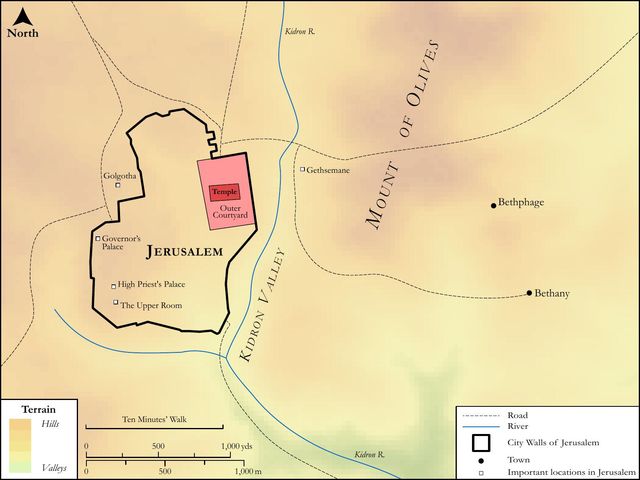
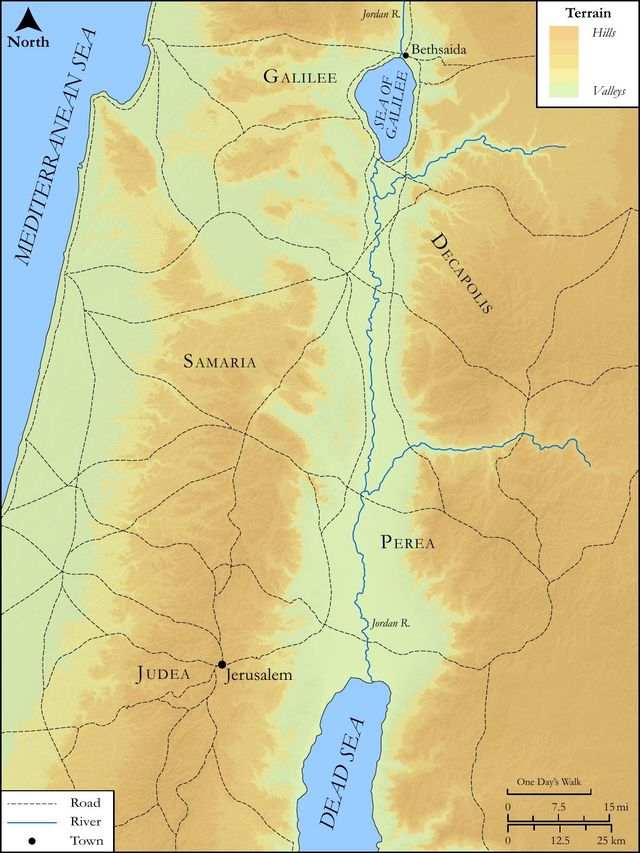
See on the biblical-era map

Study this verse
Public-domain commentary
Matthew Henry
From his Commentary on the Whole Bible. Henry comments on passages, not single verses — this entry covers John 12:20–26. His four-level outline is real structure in the source text, so it is rendered as structure.
Honour is here paid to Christ by certain Greeks that enquired or him with respect. We are not told what day of Christ's last week this was, probably not the same day he rode into Jerusalem (for that day was taken up in public work), but a day or two after.
I.We are told who they were that paid this honour to our Lord Jesus:
Certain Greeks among the people who came up to worship at the feast, Joh 12:20. Some think they were Jews of the dispersion, some of the twelve tribes that were scattered among the Gentiles, and were called Greeks, Hellenist Jews; but others think they were Gentiles, those whom they called proselytes of the gate, such as the eunuch and Cornelius. Pure natural religion met with the best assistance among the Jews, and therefore those among the Gentiles who were piously inclined joined with them in their solemn meetings, as far as was allowed them. There were devout worshippers of the true God even among those that were strangers to the commonwealth of Israel. It was in the latter ages of the Jewish church that there was this flocking of the Gentiles to the temple at Jerusalem, - a happy presage of the taking down of the partition-wall between Jews and Gentiles. The forbidding of the priests to accept of any oblation or sacrifice from a Gentile (which was done by Eleazar the son of Ananias, the high priest), Josephus says, was one of those things that brought the Romans upon them, War 2.409-410. Though these Greeks, if uncircumcised, were not admitted to eat the passover, yet they came to worship at the feast. We must thankfully use the privileges we have, though there may be others from which we are shut out.
II.What was the honour they paid him:
they desired to be acquainted with him, Joh 12:21. Having come to worship at the feast, they desired to make the best use they could of their time, and therefore applied to Philip, desiring that he would put them in a way to get some personal converse with the Lord Jesus.
1.Having a desire to see Christ, they were industrious in the use of proper means. They did not conclude it impossible, because he was so much crowded, to get to speak with him, nor rest in bare wishes, but resolved to try what could be done. Note, Those that would have the knowledge of Christ must seek it.
2.They made their application to Philip, one of his disciples. Some think that they had acquaintance with him formerly, and that they lived near Bethsaida in Galilee of the Gentiles; and then it teaches us that we should improve our acquaintance with good people, for our increase in the knowledge of Christ. It is good to know those who know the Lord. But if these Greeks had been near Galilee it is probable that they would have attended Christ there, where he mostly resided; therefore I think that they applied to him only because they saw him a close follower of Christ, and he was the first they could get to speak with. It was an instance of the veneration they had for Christ that they made an interest with one of his disciples for an opportunity to converse with him, a sign that they looked upon him as some great one, though he appeared mean. Those that would see Jesus by faith now that he is in heaven must apply to his ministers, whom he had appointed for this purpose, to guide poor souls in their enquiries after him. Paul must send for Ananias, and Cornelius for Peter. The bringing of these Greeks to the knowledge of Christ by the means of Philip signified the agency of the apostles, and the use made of their ministry in the conversion of the Gentiles to the faith and the discipling of the nations.
3.Their address to Philip was in short this: Sir, we would see Jesus. They gave him a title of respect, as one worthy of honour, because he was in relation to Christ. Their business is, they would see Jesus; not only see his face, that they might be able to say, when they came home, they had seen one that was so much talked of (it is probable they had seen him when he appeared publicly); but they would have some free conversation with him, and be taught by him, for which it was no easy thing to find him at leisure, his hands were so full of public work. Now that they were come to worship at the feast, they would see Jesus. Note, In our attendance upon holy ordinances, and particularly the gospel passover, the great desire of our souls should be to see Jesus; to have our acquaintance with him increased, our dependence on him encouraged, our conformity to him carried on; to see him as ours, to keep up communion with him, and derive communications of grace from him: we miss of our end in coming if we do not see Jesus.
4.Here is the report which Philip made of this to his Master, Joh 12:22. He tells Andrew, who was of Bethsaida likewise, and was a senior fellow in the college of the apostles, contemporary with Peter, and consults him what was to be done, whether he thought the motion would be acceptable or no, because Christ had sometimes said that he was not sent but to the house of Israel. They agree that it must be made; but then he would have Andrew go along with him, remembering the favourable acceptance Christ had promised them, in case two of them should agree touching any thing they should ask, Mat 18:19. Note, Christ's ministers should be helpful to one another and concur in helping souls to Christ: Two are better than one. It should seem that Andrew and Philip brought this message to Christ when he was teaching in public, for we read (Joh 12:29) of the people that stood by; but he was seldom alone.
III.Christ's acceptance of this honour paid him, signified by what he said to the people hereupon, Joh 12:23, etc., where he foretels both the honour which he himself should have in being followed (Joh 12:23, Joh 12:24) and the honour which those should have that followed him, Joh 12:25, Joh 12:26. This was intended for the direction and encouragement of these Greeks, and all others that desired acquaintance with him.
1.He foresees that plentiful harvest, in the conversion of the Gentiles, of which this was as it were the first-fruits, Joh 12:23. Christ said to the two disciples who spoke a good word for these Greeks, but doubted whether they should speed or no, The hour is come when the Son of Man shall be glorified, by the accession of the Gentiles to the church, and in order to that he must be rejected of the Jews. Observe,
(1.)The end designed hereby, and that is the glorifying of the Redeemer: "And is it so? Do the Gentiles begin to enquire after me? Does the morning-star appear to them? and that blessed day-spring, which knows its place and time too, does that begin to take hold of the ends of the earth? Then the hour is come for the glorifying of the Son of man." This was no surprise to Christ, but a paradox to those about him. Note, [1.] The calling, the effectual calling, of the Gentiles into the church of God greatly redounded to the glory of the Son of man. The multiplying of the redeemed was the magnifying of the Redeemer. [2.] there was a time, a set time, an hour, a certain hour, for the glorifying of the Son of man, which did come at last, when the days of his humiliation were numbered and finished, and he speaks of the approach of it with exultation and triumph: The hour is come.
(2.)The strange way in which this end was to be attained, and that was by the death of Christ, intimated in that similitude (Joh 12:24): "Verily, verily, I say unto you, you to whom I have spoken of my death and sufferings, except a corn of wheat fall not only to, but into, the ground, and die, and be buried and lost, it abideth alone, and you never see any more of it; but if it die according to the course of nature (otherwise it would be a miracle) it bringeth forth much fruit, God giving to every seed its own body." Christ is the corn of wheat, the most valuable and useful grain. Now here is,
[1.]The necessity of Christ's humiliation intimated. He would never have been the living quickening head and root of the church if he had not descended from heaven to this accursed earth and ascended from earth to the accursed tree, and so accomplished our redemption. He must pour out his soul unto death, else he cannot divide a portion with the great, Isa 53:12. He shall have a seed given him, but he must shed his blood to purchase them and purify, must win them and wear them. It was necessary likewise as a qualification for that glory which he was to have by the accession of multitudes to his church; for if he had not by his sufferings made satisfaction for sin, and so brought in an everlasting righteousness, he would not have been sufficiently provided for the entertainment of those that should come to him, and therefore must abide alone.
[2.]The advantage of Christ's humiliation illustrated. He fell to the ground in his incarnation, seemed to be buried alive in this earth, so much was his glory veiled; but this was not all: he died. This immortal seed submitted to the laws of mortality, he lay in the grave like seed under the clods; but as the seed comes up again green, and fresh, and flourishing, and with a great increase, so one dying Christ gathered to himself thousands of living Christians, and he became their root. The salvation of souls hitherto, and henceforward to the end of time, is all owing to the dying of this corn of wheat. Hereby the Father and the Son are glorified, the church is replenished, the mystical body is kept up, and will at length be completed; and, when time shall be no more, the Captain of our salvation, bringing many sons to glory by the virtue of his death, and being so made perfect by sufferings, shall be celebrated for ever with the admiring praises of saints and angels, Heb 2:10, Heb 2:13.
2.He foretels and promises an abundant recompence to those who should cordially embrace him and his gospel and interest, and should make it appear that they do so by their faithfulness in suffering for him or in serving him.
(1.)In suffering for him (Joh 12:25): He that loves his life better than Christ shall lose it; but he that hates his life in this world, and prefers the favour of God and an interest in Christ before it, shall keep it unto life eternal. This doctrine Christ much insisted on, it being the great design of his religion to wean us from this world, by setting before us another world.
[1.]See here the fatal consequences of an inordinate love of life; many a man hugs himself to death, and loses his life by over-loving it. He that so loves his animal life as to indulge his appetite, and make provision for the flesh, to fulfil the lusts thereof, shall thereby shorten his days, shall lose the life he is so fond of, and another infinitely better. He that is so much in love with the life of the body, and the ornaments and delights of it, as, for fear of exposing it or them, to deny Christ, he shall lose it, that is, lose a real happiness in the other world, while he thinks to secure an imaginary one in this. Skin for skin a man may give for his life, and make a good bargain, but he that gives his soul, his God, his heaven, for it, buys life too dear, and is guilty of the folly of him who sold a birth-right for a mess of pottage.
[2.]See also the blessed recompence of a holy contempt of life. He that so hates the life of the body as to venture it for the preserving of the life of his soul shall find both, with unspeakable advantage, in eternal life. Note, First, It is required of the disciples of Christ that they hate their life in this world; a life in this world supposes a life in the other world, and this is hated when it is loved less than that. Our life in this world includes all the enjoyments of our present state, riches, honours, pleasures, and long life in the possession of them; these we must hate, that is, despise them as vain and insufficient to make us happy, dread the temptations that are in them, and cheerfully part with them whenever they come in competition with the service of Christ, Act 20:24; Act 21:13; Rev 12:11. See here much of the power of godliness - that it conquers the strongest natural affections; and much of the mystery of godliness - that it is the greatest wisdom, and yet makes men hate their own lives. Secondly, Those who, in love to Christ, hate their own lives in this world, shall be abundantly recompensed in the resurrection of the just. He that hateth his life shall keep it; he puts it into the hands of one that will keep it to life eternal, and restore it with as great an improvement as the heavenly life can make of the earthly one.
(2.)In serving him (Joh 12:26): If any man profess to serve me, let him follow me, as a servant follows his master; and where I am, ekei kai ho diakonos ho emos estai - there let my servant be; so some read it, as part of the duty, there let him be, to attend upon me; we read it as part of the promise, there shall he be in happiness with me. And, lest this should seem a small matter, he adds, If any man serve me, him will my Father honour; and that is enough, more than enough. The Greeks desired to see Jesus (Joh 12:21), but Christ lets them know that it was not enough to see him, they must serve him. He did not come into the world, to be a show for us to gaze at, but a king to be ruled by. And he says this for the encouragement of those who enquired after him to become his servants. In taking servants it is usual to fix both the work and the wages; Christ does both here.
[1.]Here is the work which Christ expects from his servants; and it is very easy and reasonable, and such as becomes them.
First, Let them attend their Master's movements: If any man serve me, let him follow me. Christians must follow Christ, follow his methods and prescriptions, do the things that he says, follow his example and pattern, walk as he also walked, follow his conduct by his providence and Spirit. We must go whither he leads us, and in the way he leads us; must follow the Lamb whithersoever he goes before us. "If any man serve me, if he put himself into that relation to me, let him apply himself to the business of my service, and be always ready at my call." Or, "If any man do indeed serve me, let him make an open and public profession of his relation to me, by following me, as the servant owns his Master by following him in the streets."
Secondly, Let them attend their Master's repose: Where I am, there let my servant be, to wait upon me. Christ is where his church is, in the assemblies of his saints, where his ordinances are administered; and there let his servants be, to present themselves before him, and receive instructions from him. Or, "Where I am to be in heaven, whither I am now going, there let the thoughts and affections of my servants be, there let their conversation be, where Christ sitteth." Col 3:1, Col 3:2.
[2.]Here are the wages which Christ promises to his servants; and they are very rich and noble.
First, They shall be happy with him: Where I am, there shall also my servant be. To be with him, when he was here in poverty and disgrace, would seem but poor preferment, and therefore, doubtless, he means being with him in paradise, sitting with him at his table above, on his throne there; it is the happiness of heaven to be with Christ there, Joh 17:24. Christ speaks of heaven's happiness as if he were already in it: Where I am; because he was sure of it, and near to it, and it was still upon his heart, and in his eye. And the same joy and glory which he thought recompence enough for all his services and sufferings are proposed to his servants as the recompence of theirs. Those that follow him in the way shall be with him in the end.
Secondly, They shall be honoured by his Father; he will make them amends for all their pains and loss, by conferring an honour upon them, such as becomes a great God to give, but far beyond what such worthless worms of the earth could expect to receive. The rewarder is God himself, who takes the services done to the Lord Jesus as done to himself. The reward is honour, true lasting honour, the highest honour; it is the honour that comes from God. It is said (Pro 27:18), He that waits on his Master (humbly and diligently) shall be honoured. Those that wait on Christ God will put honour upon, such as will be taken notice of another day, though now under a veil. Those that serve Christ must humble themselves, and are commonly vilified by the world, in recompence of both which they shall be exalted in due time.
Thus far Christ's discourse has reference to those Greeks who desired to see him, encouraging them to serve him. What became of those Greeks we are not told, but are willing to hope that those who thus asked the way to heaven with their faces thitherward, found it, and walked in it.
Historical interpretation
Historical reception
4 surviving comments on this verse. Each one is dated, so this reads as a timeline rather than a list.
Select a marker to jump to its quote. Markers stagger vertically where authors wrote within a few decades of each other.
(Tr. li. 8) Listen we to the voice of the corner stone: And Jesus answered them, saying, The hour is come, that the Son of man should be glorified. Did He think Himself glorified, because the Gentiles wished to see? No. But He saw that after His passion and resurrection, the Gentiles in all lands would believe on Him; and took occasion from this request of some Gentiles to see Him, to announce the approaching fulness of the Gentiles, for that the hour of His being glorified was now at hand, and that after He was glorified in the heavens, the Gentiles would believe; according to the passage in the Psalm, Set up Thyself, O God, above the heavens, and Thy glory above all the earth. (Ps. 56, and 107) But it was necessary that His exaltation and glory should be preceded by His humiliation and passion; wherefore He says, Verily, verily, I say unto you, Except a corn of wheat fall into they round and die, it abideth alone: but if it die, it bringeth forth much fruit. That corn was He; to be mortified in the unbelief of the Jews, to be multiplied in the faith of the Gentiles.
Let us listen, then, to the voice of the Cornerstone: "And Jesus answered them, saying, The hour is come that the Son of man should be glorified." Perhaps some one supposes here that He spake of Himself as glorified, because the Gentiles wished to see Him. Such is not the case. But He saw the Gentiles themselves in all nations coming to the faith after His own passion and resurrection, because, as the apostle says, "Blindness in part has happened to Israel, until the fullness of the Gentiles should be come in." Taking occasion, therefore, from those Gentiles who desired to see Him, He announces the future fullness of the Gentile nations, and promises the near approach of the hour when He should be glorified Himself, and when, on its consummation in heaven, the Gentile nations should be brought to the faith. To this it is that the prediction pointed, "Be Thou exalted, O God, above the heavens, and Thy glory above all the earth." Such is the fullness of the Gentiles, of which the apostle saith, "Blindness in part is happened to Israel, till the fullness of the Gentiles come in."
But the height of His glorification had to be preceded by the depth of His passion. Accordingly, He went on to add, "Verily, verily, I say unto you, except a grain of wheat fall into the ground and die, it abideth alone; but if it die, it bringeth forth much fruit." But He spake of Himself. He Himself was the grain that had to die, and be multiplied; to suffer death through the unbelief of the Jews, and to be multiplied in the faith of many nations.
Seeing therefore that Gentiles are hastening in eager desire to see Him and to turn towards Him, on this account He says: The hour is come. For near at hand was the time of His Passion, after which the calling of the Gentiles immediately followed. And He calls the time now present "the hour," with the intention of showing that no other occasion can bring Him to the necessity of suffering, save only this season marked out by His own appointed limitations. For having done all things that were to lead men on to faith, and having preached the word of the kingdom of heaven, He now desires to pass onward to the very crowning point of His hope, namely to the destruction of death: and this could not otherwise be brought to pass, unless the Life underwent death for the sake of all men, that so in Him we all may live. For on this account also He speaks of Himself as glorified in His Death, and in suffering terrible things at the hands of the sinners who dishonour Him. Even though by the angels in heaven He had been glorified from everlasting, yet nevertheless His Cross was the beginning of His being glorified upon earth by the Gentiles as God. For after He had left to themselves the Jews who openly despised Him, He turned to the Gentiles and is glorified by them as God, being confidently expected to come again in the glory of the Father. And He declares not merely that the Word shall then be glorified, but, showing that He Who is ineffably to be regarded as sharing in humanity no less than Deity is One Only Son, He uses the title "Son of man:" for He is One Son and One Christ, capable since His Incarnation of no separation of Nature; but ever remaining and ever regarded as God, although clothed in flesh.
(From the Syriac.) [He is One Son and One Christ, capable since His Incarnation of no separation of Nature,] except so far as this, that we may say that we acknowledge separately the Nature of the Word and [the nature] of the flesh. And [we may say] that they are not the same in conception, for the one is of the Essence of God the Father, but the other had its root upon earth in the holy Virgin. Nevertheless there is only One Christ of the two, Who is not divided into a duality of Sons after the concourse of these Natures which have been mentioned, but remains and is regarded as in possession of the power of the Godhead, although clothed in Flesh.
[The Greeks say,] “We wish to see Jesus”—not so much in order to look him in his face, as to carry the cross.
And therefore Jesus, having seen their
intention,
Openly said to those present:
“The hour has come for the Son of man to be glorified.”
Glorified—referring to the conversion of the Greeks;
A glory that the Jews donned
But that the nations put on.
Therefore Jesus said concerning the Gentiles:
“The hour has come For the Son of man to be glorified.”
Glorified—referring to the cross.
For from it the power of the Lord was made known,
Because it changed the shame into glory—
the insult into honor,
the curse into blessing,
the gall into sweetness,
the vinegar into milk,
the slap in his face into freedom,
death into life.
The hour has come, For the Son of man to be glorified.
Glorified—referring to the cross,
For from it the cross is even now glorified.
For the cross itself even now still glorifies kings,
and gives radiance to priesthood,
and preserves virginity,
and establishes asceticism,
and strengthens union,
and guards widowhood,
and protects orphans,
and increases the blessing of children,
and multiples the church,
and enlightens the people,
and preserves a spiritual lifestyle,
and opens paradise,
and guides the robber,
and roots out enmity,
and extinguishes hatred,
and puts demons to flight,
and drives the devil away.
Continue studying John 12:23 across the web’s major study libraries — every link below opens this exact verse, chapter, or book on the destination site.
Read & Compare
 BibleGatewayThis verse in more than 200 translations and 70 languages.
 Bible.comThe YouVersion reader — hundreds of translations, reading plans, and highlights.
 ESV.orgCrossway's official English Standard Version reader.
 NET BibleThe NET translation with 60,000+ translators' notes on every rendering decision.
 STEP BibleTyndale House's free study tool — original text, vocabulary, and scholarly resources.
 BibliaLogos Bible Software's free web reader.
 USCCBThe New American Bible (Revised Edition) with the U.S. bishops' study notes.
Commentaries
 BibleHub CommentariesDozens of classic commentaries on this verse, gathered on one page.
 StudyLightMore than 100 commentary sets — the largest collection on the web.
 BibleRefPlain-English commentary on what this verse means, verse by verse.
 Enduring WordDavid Guzik's free commentary on this chapter, widely used by Bible teachers.
 Bible Study ToolsVerse commentary alongside Greek and Hebrew study aids.
Original Language & Research
- BibleHub InterlinearThe verse word by word — original language, transliteration, and English.
- BibleHub LexiconEvery word's original-language definition and Strong's entry.
 Blue Letter BibleDeep-study tools — Strong's numbers, concordance, and word studies.
 CNTR CollationThe earliest Greek manuscripts of this verse, collated letter by letter.
Sermons, Hymns & Audio


TrulyRandomVerse is not affiliated with these sites and doesn’t control their content. They’re linked because they’re genuinely useful.
Summary
In John 12:23, Jesus declares that "The hour is come, that the Son of man should be glorified." This pivotal statement marks a profound turning point in His earthly ministry, signaling the imminent commencement of His passion, death, resurrection, and ascension. It reveals that His ultimate glorification, far from being a worldly triumph, would be achieved through the path of suffering and self-sacrifice, thereby fulfilling His divine mission to bring salvation to all humanity.
Context
ShowHideLiterary Context
This declaration immediately follows a significant event: the arrival of certain Greeks in Jerusalem who expressed a desire to see Jesus (John 12:20-22). Their request, conveyed through Philip and Andrew, serves as a catalyst for Jesus' pronouncement. Up until this point in John's Gospel, Jesus had repeatedly stated that His "hour" had not yet come (e.g., John 2:4, John 7:6, John 7:30, John 8:20). The seeking of Gentiles for Jesus signifies that the scope of His redemptive work was broadening beyond Israel, indicating that the divinely appointed time for His ultimate sacrifice and universal impact was at hand. This moment occurs directly after His triumphal entry into Jerusalem (John 12:12-19), where He was publicly hailed as King, setting the stage for the dramatic events of Passion Week.
Historical & Cultural Context
The setting is Jerusalem during the Passover feast, a time when Jews from across the Roman Empire and beyond would gather to commemorate the Exodus and the lamb's sacrifice. The presence of "certain Greeks" (likely Gentile proselytes or God-fearers) at this Jewish feast is highly significant. In Jewish thought, the Messiah's reign would eventually extend to the Gentiles, but the immediate focus was often on Israel's restoration. The fact that Gentiles are now actively seeking Jesus underscores the universal scope of His mission, foreshadowing the inclusion of all nations into God's kingdom. Culturally, the concept of glory was often associated with power, victory, and earthly dominion. Jesus' redefinition of glory as achieved through suffering and death would have been counter-cultural and challenging to His Jewish audience, who largely anticipated a conquering Messiah.
Key Themes
ShowHideThe verse encapsulates several crucial themes prevalent in John's Gospel. The most prominent is The Arrival of "The Hour," which signifies the divinely appointed, climactic moment of Jesus' passion, death, resurrection, and ascension. This "hour" is not merely a chronological time but a theological concept representing the culmination of God's redemptive plan. Another key theme is Glorification Through Sacrifice. In John, Jesus' glorification is paradoxically linked to His crucifixion. His death on the cross, His resurrection from the dead, and His ascension to the Father are not simply acts of suffering but the ultimate revelation of God's love, power, and glory. It is through this act of self-giving that His divine nature is most fully displayed and His mission accomplished, as further elaborated in John 12:24. Finally, Jesus' consistent self-designation as "The Son of Man" (Greek: ho huios tou anthrōpou) emphasizes both His true humanity and His unique divine authority, drawing from the prophetic vision in Daniel 7:13-14. In this context, it highlights His role as the divinely appointed Messiah who must undergo suffering to achieve universal salvation and ultimate glory.
Exposition and Analysis
ShowHideKey Word Analysis
ShowHideThis term, common in John's Gospel, refers to a specific, divinely appointed moment. Here, it denotes the long-anticipated culmination of Jesus' earthly ministry, encompassing His suffering, death, resurrection, and ascension. It is not merely a temporal measurement but a theological marker for the decisive moment of God's redemptive plan.
This verb signifies arrival or coming. Its use in the perfect tense ("is come") emphasizes that the "hour" has definitively arrived and its effects are now present. It conveys a sense of divine inevitability and the fulfillment of prophecy, indicating that the preordained time has finally dawned.
Derived from dóxa (glory), this verb means to honor, magnify, or cause to have glory. In the context of John's Gospel, Jesus' glorification is uniquely tied to His crucifixion and resurrection. It signifies the revelation of His inherent divine nature and power, not despite His suffering, but precisely through it. This glorification is the ultimate display of God's redemptive purpose and Jesus' identity as the Son.
Verse Breakdown
ShowHide"And Jesus answered them, saying"
This phrase indicates that Jesus' declaration is a direct response to the request of the Greeks, mediated by Philip and Andrew. His answer is not a simple reply to their desire to "see" Him, but a profound theological statement about the significance of their arrival and the broader implications for His mission, signaling a shift in focus from His earthly ministry to His impending passion.
"The hour is come"
This is a momentous declaration. For much of John's Gospel, Jesus had stated that His "hour" had not yet arrived. Now, with the presence of Gentiles seeking Him, Jesus proclaims that the divinely appointed time for the climax of His redemptive work has finally dawned. This "hour" encompasses His crucifixion, resurrection, and ascension, which together constitute His ultimate glorification.
"that the Son of man should be glorified"
This clause reveals the purpose and nature of the "hour." Jesus' glorification is not a worldly coronation but a revelation of His divine nature and redemptive power through His suffering and death. The title "Son of Man" (a messianic title with roots in Daniel 7:13) emphasizes both His humanity and His unique authority as the one appointed by God to accomplish salvation. His glorification, therefore, is achieved through His obedient sacrifice, which brings about salvation for all who believe.
Literary Devices
ShowHideJohn 12:23 employs several potent literary devices. Paradox is central, as Jesus speaks of being "glorified" in the context of His impending suffering and death. For the disciples and the Jewish audience, glory was typically associated with triumph and power, not with crucifixion. Jesus redefines glory as achieved through humility, obedience, and self-sacrifice, a concept that would have been counter-intuitive. The verse also functions as Foreshadowing, clearly pointing to the events of the passion week—the crucifixion, resurrection, and ascension—as the means by which Jesus' divine glory will be fully revealed. The phrase "The hour is come" acts as a Theological Marker, signifying a pivotal moment in the divine timeline, a concept that has been building throughout John's Gospel. Finally, the use of the title "Son of Man" carries rich Symbolism, connecting Jesus to the prophetic figure in Daniel 7, who receives everlasting dominion and glory, but whose path to that glory, as Jesus reveals, involves suffering.
Theological and Thematic Connections
ShowHideJohn 12:23 profoundly articulates the theological truth that true glory in God's kingdom is often achieved through the path of suffering and self-sacrifice, rather than worldly power or acclaim. It reveals God's sovereign timing in the unfolding of His redemptive plan, where the arrival of Gentiles signals the universal scope of Christ's mission and the culmination of centuries of prophetic anticipation. Jesus' glorification through the cross underscores the depth of divine love and the unique nature of His Messiahship, where victory over sin and death is secured not by force, but by sacrificial obedience. This redefines glory, aligning it with God's character and His ultimate purpose for humanity.
Reflection and Application
ShowHideJohn 12:23 offers profound lessons for believers today, challenging our conventional understanding of glory and success. It teaches us that true spiritual glory, in the context of God's kingdom, often comes through humility, obedience, and self-sacrificial service, mirroring Christ's own path. Just as Jesus' glorification was achieved through His suffering on the cross, so too are believers called to a life of self-denial and surrender, understanding that following Christ involves taking up our cross daily (Luke 9:23). This verse also reminds us of the universal scope of the Gospel, signified by the Greeks seeking Jesus. It affirms that Christ's salvation is for all people, everywhere, and challenges us to participate in His global mission, extending the invitation of the Gospel to every nation, tribe, and tongue. Our willingness to "die" to self, to embrace hardship for the sake of Christ, and to serve others, becomes the means by which God's glory is revealed in and through our lives.
Questions for Reflection
ShowHideFAQ
ShowHideWhat is the significance of "the hour" in John's Gospel?
ShowHideIn John's Gospel, "the hour" (Greek: hṓra) is a crucial theological concept that refers to the divinely appointed, climactic moment of Jesus' passion, death, resurrection, and ascension. Prior to John 12:23, Jesus frequently states that His hour "had not yet come" (e.g., John 2:4, John 7:6, John 7:30, John 8:20). This indicates that He was operating according to God's precise timetable, not human will or timing. The declaration in John 12:23 signifies that this long-awaited, decisive moment has finally arrived, marking the beginning of the final phase of His redemptive work on earth, leading directly to His ultimate sacrifice and glorification. It underscores God's sovereignty and the fulfillment of His eternal plan.
Why is Jesus' glorification linked to His suffering and death in John's Gospel?
ShowHideIn John's Gospel, Jesus' glorification is paradoxically and intimately linked to His suffering and death on the cross. This is a central theme, contrasting sharply with worldly notions of glory. For Jesus, the cross is not merely an instrument of shame and suffering, but the very means by which His divine nature, power, and love are most fully revealed. His death is the ultimate act of obedience and self-sacrifice, through which He conquers sin and death, and opens the way for salvation for all humanity. Therefore, His crucifixion, resurrection, and ascension are seen as a unified act of glorification, demonstrating God's ultimate triumph and the fulfillment of His redemptive purpose. This concept is further elaborated in passages like John 13:31-32 and John 17:1-5, where Jesus explicitly prays for His glorification in connection with His impending sacrifice.
Christ-Centered Fulfillment
ShowHideJohn 12:23 stands as a profound Christ-centered declaration, revealing the very heart of God's redemptive plan. Jesus' pronouncement, "The hour is come, that the Son of man should be glorified," encapsulates the ultimate purpose of His incarnation. This "hour" is the culmination of all Old Testament prophecies concerning the Suffering Servant and the triumphant Messiah. It is through His voluntary submission to the cross that Jesus, the divine Son of Man, achieves ultimate victory over sin, death, and the devil. This glorification is not a worldly coronation, but the revelation of His inherent divine glory through His sacrificial death and subsequent resurrection, which secures salvation for all who believe. As Luke 24:26 affirms, "Ought not Christ to have suffered these things, and to enter into his glory?" This verse in John foreshadows the ultimate exaltation of Christ, who, "for the joy that was set before him endured the cross, despising the shame, and is set down at the right hand of the throne of God" (Hebrews 12:2). His glorification through suffering is the foundation of the New Covenant, making possible the outpouring of the Holy Spirit and the establishment of His universal kingdom, fulfilling the prophecies of a Messiah whose suffering would lead to glory for all nations (1 Peter 1:11).