


John 12:1
Bible text: King James Version (1769 Blayney text) · Public domain
Bible text: King James Version with Strong's numbers · Public domain
Bible text: Berean Standard Bible · Public domain
Bible text: American Standard Version (1901) · Public domain
Bible text: World English Bible, Messianic edition · Public domain
Bible text: Geneva Bible (1599) · Public domain
Bible text: Young's Literal Translation · Public domain
- ὉHo<the>G3588T-NSMDefinite article Nominative Singular Masculine
- οὖνounThereforeG3767CONJConjunction
- ἸησοῦςIēsousJesusG2424N-NSM-PNoun Nominative Singular Masculine Individual
- πρὸprobeforeG4253PREPPreposition
- ἓξhexsixG1803A-NUIAdjective
- ἡμερῶνhēmerōndaysG2250N-GPFNoun Genitive Plural Feminine
- τοῦtoutheG3588T-GSNDefinite article Genitive Singular Neuter
- πάσχαpaschaPassoverG3957N-GSNNoun Genitive Singular Neuter
- ἦλθενēlthencameG2064V-2AAI-3SVerb 2nd Aorist Active Indicative 3rd Singular
- εἰςeistoG1519PREPPreposition
- ΒηθανίανBēthanianBethanyG963N-ASF-LNoun Accusative Singular Feminine Location
- ὅπουhopouwhereG3699PREPPreposition
- ἦνēnwasG1510V-IAI-3SVerb Imperfect Active Indicative 3rd Singular
- ΛάζαροςLazarosLazarusG2976N-NSM-PNoun Nominative Singular Masculine Individual
- ὁhowhoG3588T-NSMDefinite article Nominative Singular Masculine
- τεθνηκώςtethnēkōshaving diedG2348V-RAP-NSMVerb Perfect Active Participle Nominative Singular Masculine
- ὃνhonwhomG3739R-ASMRelative pronoun Accusative Singular Masculine
- ἤγειρενēgeirenraisedG1453V-AAI-3SVerb Aorist Active Indicative 3rd Singular
- ἐκekout fromG1537PREPPreposition
- νεκρῶνnekrōn[the] deadG3498A-GPMAdjective Genitive Plural Masculine
English is a literal word-by-word gloss of the Greek, not the KJV's wording. Why?
This is the original text the KJV's translators worked from — each Greek word with its own literal English meaning in this verse, prepared by scholars at Tyndale House, Cambridge. The KJV translates whole sentences, not word by word, so its wording differs: one Greek word can become several English words, and the KJV may choose “charity” where the gloss reads “love”. Both are faithful — they answer different questions. For the KJV's own rendering, switch to the KJV text.
Details
See on the biblical-era maps
Study this verse
Public-domain commentary
Matthew Henry
From his Commentary on the Whole Bible. Henry comments on passages, not single verses — this entry covers John 12:1–11. His four-level outline is real structure in the source text, so it is rendered as structure.
In these verses we have,
I.The kind visit our Lord Jesus paid to his friends at Bethany, Joh 12:1.
He came up out of the country, six days before the passover, and took up at Bethany, a town which, according to the computation of our metropolis, lay so near Jerusalem as to be within the bills of mortality. He lodged here with his friend Lazarus, whom he had lately raised from the dead. His coming to Bethany now may be considered,
1.As a preface to the passover he intended to celebrate, to which reference is made in assigning the date of his coming: Six days before the passover. Devout men set time apart before, to prepare themselves for that solemnity, and thus it became our Lord Jesus to fulfil all righteousness. Thus he has set us an example of solemn self-sequestration, before the solemnities of the gospel passover; let us hear the voice crying, Prepare ye the way of the Lord.
2.As a voluntary exposing of himself to the fury of his enemies; now that his hour was at hand he came within their reach, and freely offered himself to them, though he had shown them how easily he could evade all their snares. Note,
(1.)Our Lord Jesus was voluntary in his sufferings; his life was not forced from him, but resigned: Lo, I come. As the strength of his persecutors could not overpower him, so their subtlety could not surprise him, but he died because he would.
(2.)As there is a time when we are allowed to shift for our own preservation, so there is a time when we are called to hazard our lives in the cause of God, as St. Paul, when he went bound in the Spirit to Jerusalem.
3.As an instance of his kindness to his friends at Bethany, whom he loved, and from whom he was shortly to be taken away. This was a farewell visit; he came to take leave of them, and to leave with them words of comfort against the day of trial that was approaching. Note, Though Christ depart for a time from his people, he will give them intimations that he departs in love, and not in anger. Bethany is here described to be the town where Lazarus was, whom he raised from the dead. The miracle wrought here put a new honour upon the place, and made it remarkable. Christ came hither to observe what improvement was made of this miracle; for where Christ works wonders, and shows signal favours, he looks after them, to see whether the intention of them be answered. Where he has sown plentifully, he observes whether it comes up again.
II.The kind entertainment which his friends there gave him:
They made him a supper (Joh 12:2), a great supper, a feast. It is queried whether this was the same with that which is recorded, Mat 24:6, etc., in the house of Simon. Most commentators think it was; for the substance of the story and many of the circumstances agree; but that comes in after what was said two days before the passover, whereas this was done six days before; nor is it likely that Martha should serve in any house but her own; and therefore I incline with Dr. Lightfoot to think them different: that in Matthew on the third day of the passover week, but this the seventh day of the week before, being the Jewish sabbath, the night before he rode in triumph into Jerusalem; that in the house of Simon; this of Lazarus. These two being the most public and solemn entertainments given him in Bethany, Mary probably graced them both with this token of her respect; and what she left of her ointment this first time, when she spent but a pound of it (Joh 12:3), she used that second time, when she poured it all out, Mar 14:3. Let us see the account of this entertainment.
1.They made him a supper; for with them, ordinarily, supper was the best meal. This they did in token of their respect and gratitude, for a feast is made for friendship; and that they might have an opportunity of free and pleasant conversation with him, for a feast is made for fellowship. Perhaps it is in allusion to this and the like entertainments given to Christ in the days of his flesh that he promises, to such as open the door of their hearts to him, that he will sup with them, Rev 3:20.
2.Martha served; she herself waited at table, in token of her great respect to the Master. Though a person of some quality, she did not think it below her to serve, when Christ sat at meat; nor should we think it a dishonour or disparagement to us to stoop to any service whereby Christ may be honoured. Christ had formerly reproved Martha for being troubled with much serving. But she did not therefore leave off serving, as some, who, when they are reproved for one extreme, peevishly run into another; no, still she served; not as then at a distance, but within hearing of Christ's gracious words, reckoning those happy who, as the queen of Sheba said concerning Solomon's servants, stood continually before him, to hear his wisdom; better be a waiter at Christ's table than a guest at the table of a prince.
3.Lazarus was one of those that sat at meat. It proved the truth of his resurrection, as it did of Christ's, that there were those who did eat and drink with him, Act 10:41. Lazarus did not retire into a wilderness after his resurrection, as if, when he had made a visit to the other world, he must ever after be a hermit in this; no, he conversed familiarly with people, as others did. He sat at meat, as a monument of the miracle Christ had wrought. Those whom Christ has raised up to a spiritual life are made to sit together with him. See Eph 2:5, Eph 2:6.
III.The particular respect which Mary showed him, above the rest, in anointing his feet with sweet ointment, Joh 12:3.
She had a pound of ointment of spikenard, very costly, which probably she had by her for her own use; but the death and resurrection of her brother had quite weaned her from the use of all such things, and with this she anointed the feet of Jesus, and, as a further token of her reverence for him and negligence of herself, she wiped them with her hair, and this was taken notice of by all that were present, for the house was filled with the odour of the ointment. See Pro 27:16.
1.Doubtless she intended this as a token of her love to Christ, who had given real tokens of his love to her and her family; and thus she studies what she shall render. Now by this her love to Christ appears to have been,
(1.)A generous love; so far from sparing necessary charges in his service, she is as ingenious to create an occasion of expense in religion as most are to avoid it. If she had any thing more valuable than another, that must be brought out for the honour of Christ. Note, Those who love Christ truly love him so much better than this world as to be willing to lay out the best they have for him.
(2.)A condescending love; she not only bestowed her ointment upon Christ, but with her own hands poured it upon him, which she might have ordered one of her servants to have done; nay, she did not, as usual, anoint his head with it, but his feet. True love, as it does not spare charges, so it does not spare pains, in honouring Christ. Considering what Christ has done and suffered for us, we are very ungrateful if we think any service too hard to do, or too mean to stoop to, whereby he may really be glorified.
(3.)A believing love; there was faith working by this love, faith in Jesus as the Messiah, the Christ, the Anointed, who, being both priest and king, was anointed as Aaron and David were. Note, God's Anointed should be our Anointed. Has God poured on him the oil of gladness above his fellows? Let us pour on him the ointment of our best affections above all competitors. By consenting to Christ as our king, we must comply with God's designs, appointing him our head whom he has appointed, Hos 1:11.
2.The filling of the house with the pleasant odour of the ointment may intimate to us,
(1.)That those who entertain Christ in their hearts and houses bring a sweet odour into them; Christ's presence brings with it an ointment and perfume which rejoice the heart.
(2.)Honours done to Christ are comforts to all his friends and followers; they are to God and good men an offering of a sweet-smelling savour.
IV.Judas's dislike of Mary's compliment, or token of her respect to Christ, Joh 12:4, Joh 12:5, where observe,
1.The person that carped at it was Judas, one of his disciples; not one of their nature, but only one of their number. It is possible for the worst of men to lurk under the disguise of the best profession; and there are many who pretend to stand in relation to Christ who really have no kindness for him. Judas was an apostle, a preacher of the gospel, and yet one that discouraged and checked this instance of pious affection and devotion. Note, It is sad to see the life of religion and holy zeal frowned upon and discountenanced by such as are bound by their office to assist and encourage it. But this was he that should betray Christ. Note, Coldness of love to Christ, and a secret contempt of serious piety, when they appear in professors of religion, are sad presages of a final apostasy. Hypocrites, by less instances of worldliness, discover themselves to be ready for a compliance with greater temptations.
2.The pretence with which he covered his dislike (Joh 12:5): "Why was not this ointment, since it was designed for a pious use, sold for three hundred pence" (8l. 10s. of our money), "and given to the poor?" (1.) Here is a foul iniquity gilded over with a specious and plausible pretence, for Satan transforms himself into an angel of light. (2.) Here is worldly wisdom passing a censure upon pious zeal, as guilty of imprudence and mismanagement. Those who value themselves upon their secular policy, and undervalue others for their serious piety, have more in them of the spirit of Judas than they would be thought to have. (3.) Here is charity to the poor made a colour for opposing a piece of piety to Christ, and secretly made a cloak for covetousness. Many excuse themselves from laying out in charity under pretence of laying up for charity: whereas, if the clouds be full of rain, they will empty themselves. Judas asked, Why was it not given to the poor? To which it is easy to answer, Because it was better bestowed upon the Lord Jesus. Note, We must not conclude that those do no acceptable piece of service who do not do it in our way, and just as we would have them; as if every thing must be adjudged imprudent and unfit which does not take its measures from us and our sentiments. Proud men think all ill-advised who do not advise with them.
3.The detection and discovery of Judas's hypocrisy herein, Joh 12:6. Here is the evangelist's remark upon it, by the direction of him who searches the heart: This he said, not that he cared for the poor, as he pretended, but because he was a thief, and had the bag.
(1.)It did not come from a principle of charity: Not that he cared for the poor. He had no compassion towards them, no concern for them: what were the poor to him any further than he might serve his own ends by being overseer of the poor? Thus some warmly contend for the power of the church, as others for its purity, when perhaps it may be said, Not that they care for the church; it is all one to them whether its true interest sink or swim, but under the pretence of this they are advancing themselves. Simeon and Levi pretended zeal for circumcision, not that they cared for the seal of the covenant, any more than Jehu for the Lord of hosts, when he said, Come see my zeal.
(2.)It did come from a principle of covetousness. The truth of the matter was, this ointment being designed for his Master, he would rather have had it in money, to be put in the common stock with which he was entrusted, and then he knew what to do with it. Observe,
[1.]Judas was treasurer of Christ's household, whence some think he was called Iscariot, the bag-bearer. First, See what estate Jesus and his disciples had to live upon. It was but little; they had neither farms nor merchandise, neither barns nor storehouses, only a bag; or, as some think the word signifies, a box, or coffer, wherein they kept just enough for their subsistence, giving the overplus, if any were, to the poor; this they carried about with them, wherever they went. Omnia mea mecum porto - I carry all my property about me. This bag was supplied by the contributions of good people, and the Master and his disciples had all in common; let this lessen our esteem of worldly wealth, and deaden us to the punctilios of state and ceremony, and reconcile us to a mean and despicable way of living, if this be our lot, that it was our Master's lot; for our sakes he became poor. Secondly, See who was the steward of the little they had; it was Judas, he was purse-bearer. It was his office to receive and pay, and we do not find that he gave any account what markets he made. He was appointed to this office, either, 1. Because he was the least and lowest of all the disciples; it was not Peter nor John that was made steward (though it was a place of trust and profit), but Judas, the meanest of them. Note, Secular employments, as they are a digression, so they are a degradation to a minister of the gospel; see Co1 6:4. The prime-ministers of state in Christ's kingdom refused to be concerned in the revenue, Act 6:2. 2. Because he was desirous of the place. He loved in his heart to be fingering money, and therefore had the moneybag committed to him, either, (1.) As a kindness, to please him, and thereby oblige him to be true to his Master. Subjects are sometimes disaffected to the government because disappointed of their preferment; but Judas had no cause to complain of this; the bag he chose, and the bag he had. Or, (2.) In judgment upon him, to punish him for his secret wickedness; that was put into his hands which would be a snare and trap to him. Note, Strong inclinations to sin within are often justly punished with strong temptations to sin without. We have little reason to be fond of the bag, or proud of it, for at the best we are but stewards of it; and it was Judas, one of an ill character, and born to be hanged (pardon the expression), that was steward of the bag. The prosperity of fools destroys them.
[2.]Being trusted with the bag, he was a thief, that is, he had a thievish disposition. The reigning love of money is heart-theft as much as anger and revenge are heart-murder. Or perhaps he had been really guilty of embezzling his Master's stores, and converting to his own use what was given to the public stock. And some conjecture that he was now contriving to fill his pockets, and then run away and leave his Master, having heard him speak so much of troubles approaching, to which he could by no means reconcile himself. Note, Those to whom the management and disposal of public money is committed have need to be governed by steady principles of justice and honesty, that no blot cleave to their hands; for though some make a jest of cheating the government, or the church, or the country, if cheating be thieving, and, communities being more considerable than particular persons, if robbing them be the greater sin, the guilt of theft and the portion of thieves will be found no jesting matter. Judas, who had betrayed his trust, soon after betrayed his Master.
V.Christ's justification of what Mary did (Joh 12:7, Joh 12:8):
Let her alone. Hereby he intimated his acceptance of her kindness (though he was perfectly mortified to all the delights of sense, yet, as it was a token of her goodwill, he signified himself well-pleased with it), and his care that she should not be molested in it: Pardon her, so it may be read; "excuse her this once, if it be an error it is an error of her love." Note, Christ would not have those censured nor discouraged who sincerely design to please him, though in their honest endeavours there be not all the discretion that may be, Rom 14:3. Though we would not do as they do, yet let them alone. For Mary's justification,
1.Christ puts a favourable construction upon what she did, which those that condemned it were not aware of: Against the day of my burying she has kept this. Or, She has reserved this for the day of my embalming; so Dr. Hammond. "You do not grudge the ointment used for the embalming of your dead friends, nor say that it should be sold, and given to the poor. Now this anointing either was so intended, or at least may be so interpreted; for the day of my burying is now at hand, and she has anointed a body that is already as good as dead." Note,
(1.)Our Lord Jesus thought much and often of his own death and burial; it would be good for us to do so too.
(2.)Providence does often so open a door of opportunity to good Christians, and the Spirit of grace does so open their hearts, that the expressions of their pious zeal prove to be more seasonable, and more beautiful, than any foresight of their own could make them.
(3.)The grace of Christ puts kind comments upon the pious words and actions of good people, and not only makes the best of what is amiss, but makes the most of what is good.
2.He gives a sufficient answer to Judas's objection, Joh 12:8.
(1.)It is so ordered in the kingdom of Providence that the poor we have always with us, some or other that are proper objects of charity (Deu 15:11); such there will be as long as there are in this lapsed state of mankind so much folly and so much affliction.
(2.)It is so ordered in the kingdom of grace that the church should not always have the bodily presence of Jesus Christ: "Me you have not always, but only nor for a little time." Note, We need wisdom, when two duties come in competition, to know which to give the preference to, which must be determined by the circumstances. Opportunities are to be improved, and those opportunities first and most vigorously which are likely to be of the shortest continuance, and which we see most speedily hastening away. That good duty which may be done at any time ought to give way to that which cannot be done but just now.
VI.The public notice which was taken of our Lord Jesus here at this supper in Bethany (Joh 12:9):
Much people of the Jews knew that he was there, for he was the talk of the town, and they came flocking thither; the more because he had lately absconded, and now broke out as the sun from behind a dark cloud.
1.They came to see Jesus, whose name was very much magnified, and made considerable by the late miracle he had wrought in raising Lazarus. They came, not to hear him, but to gratify their curiosity with a sight of him here at Bethany, fearing he would not appear publicly, as he used to do, this passover. They came, not to seize him, or inform against him, though the government had prosecuted him to an outlawry, but to see him and show him respect. Note, There are some in whose affections Christ will have an interest, in spite of all the attempts of his enemies to misrepresent him. It being known where Christ was, multitudes came to him. Note, Where the king is there is the court; where Christ is there will the gathering of the people be, Luk 17:37.
2.They came to see Lazarus and Christ together, which was a very inviting sight. Some came for the confirmation of their faith in Christ, to have the story perhaps from Lazarus's own mouth. Others came only for the gratifying of their curiosity, that they might say they had seen a man who had been dead and buried, and yet lived again; so that Lazarus served for a show, these holy-days, to those who, like the Athenians, spent their time in telling and hearing new things. Perhaps some came to put curious questions to Lazarus about the state of the dead, to ask what news from the other world; we ourselves have sometimes said, it may be, We would have gone a great way for one hour's discourse with Lazarus. But if any came on this errand it is probable that Lazarus was silent, and gave them no account of his voyage; at least, the scripture is silent, and gives us no account of it; and we must not covet to be wise above what is written. But our Lord Jesus was present, who was a much fitter person for them to apply to than Lazarus; for if we hear not Moses and the prophets, Christ and the apostles, if we heed not what they tell us concerning another world, neither should we be persuaded though Lazarus rose from the dead. We have a more sure word of prophecy.
VII.The indignation of the chief priests at the growing interest of our Lord Jesus, and their plot to crush it (Joh 12:10, Joh 12:11):
They consulted (or decreed) how they might put Lazarus also to death, because that by reason of him (of what was done to him, not of any thing he said or did) many of the Jews went away, and believed on Jesus. Here observe,
1.How vain and unsuccessful their attempts against Christ had hitherto been. They had done all they could to alienate the people from him, and exasperate them against him, and yet many of the Jews, their neighbours, their creatures, their admirers, were so overcome by the convincing evidence of Christ's miracles that they went away from the interest and party of the priests, went off from obedience to their tyranny, and believed on Jesus; and it was by reason of Lazarus; his resurrection put life into their faith, and convinced them that this Jesus was undoubtedly the Messiah, and had life in himself, and power to give life. This miracle confirmed them in the belief of his other miracles, which they had heard he wrought in Galilee: what was impossible to him that could raise the dead?
2.How absurd and unreasonable this day's vote was - that Lazarus must be put to death. This is an instance of the most brutish rage that could be; they were like a wild bull in a net, full of fury, and laying about them without any consideration. It was a sign that they neither feared God nor regarded man. For,
(1.)If they had feared God, they would not have done such an act of defiance to him. God will have Lazarus to live by miracle, and they will have him to die by malice. They cry, Away with such a fellow, it is not fit he should live, when God had so lately sent him back to the earth, declaring it highly fit he should live; what was this but walking contrary to God? They would put Lazarus to death, and challenge almighty power to raise him again, as if they could contend with God, and try titles with the King of kings. Who has the keys of death and the grave, he or they? O caeca malitia! Christus qui suscitare potuit mortuum, non possit occisum. - Blind malice, to suppose that Christ, who could raise one that had died a natural death, could not raise one that had been slain! - Augustine in loc. Lazarus is singled out to be the object of their special hatred, because God has distinguished him by the tokens of his peculiar love, as if they had made a league offensive and defensive with death and hell, and resolved to be severe upon all deserters. One would think that they should rather have consulted how they might have joined in friendship with Lazarus and his family, and by their mediation have reconciled themselves to this Jesus whom they had persecuted; but the god of this world had blinded their minds.
(2.)If they had regarded man, they would not have done such an act of injustice to Lazarus, an innocent man, to whose charge they could not pretend to lay any crime. What bands are strong enough to hold those who can so easily break through the most sacred ties of common justice, and violate the maxims which even nature itself teaches? But the support of their own tyranny and superstition was thought sufficient, as in the church of Rome, not only to justify, but to consecrate the greatest villanies, and make them meritorious.
Historical interpretation
Seven Centuries of Reception
15 surviving comments on this verse. Each one is dated, so this reads as a timeline rather than a list.
Select a marker to jump to its quote. Markers stagger vertically where authors wrote within a few decades of each other.
What then saith Christ? "She hath done a good work for My burying." But why did He not expose the disciple in the case of the woman, nor say to him what the Evangelist hath declared, that on account of his own thieving he rebuked her? In His abundant longsuffering He wished to bring him to a better mind. For because He knew that he was a traitor, He from the beginning often rebuked him, saying, "Not all believe," and, "One of you is a devil." He showed them that He knew him to be a traitor, yet He did not openly rebuke him, but bare with him, desiring to recall him.
(Hom. lxv) Mary did not take part in serving the guests generally, but gave all her attention to our Lord, treating Him not as mere man, but as God: Then took Mary a pound of spikenard, very costly, and anointed the feet of Jesus, and wiped His feet with her hair.
(Hom. lxv. 2) But why was a thief entrusted with the bags of the poor? Perhaps it was to give him no excuse of wanting money, for of this he had enough in the bag for all his desires.
(Hom. lxv. 2) Christ, with great forbearance, does not rebuke Judas for his thieving, in order to deprive him of all excuse for betraying Him.
(Hom. lxv. 2) Again, as if to remind His betrayer, He alludes to His burial; For the poor ye have always with you, but Me ye have not always: as if He said, I am a burden, a trouble to thee; but wait a little, and I shall be gone.
But none of these things turned back that savage madman; yet in truth Jesus said and did far more than this, He washed his feet that night, made him a sharer in the table and the salt, a thing which is wont to restrain even the souls of robbers, and spake other words, enough to melt a stone, and this, not long before, but on the very day, in order that not even time might cause it to be forgotten. But he stood out against all.
"Let her alone," He saith, "for against the day of My burying hath she done this." Again, He maketh mention of the traitor in speaking of His burial. But him the reproof reacheth not, nor doth the expression soften him, though sufficient to inspire him with pity: as if He had said, "I am burdensome and troublesome, but wait a little while, and I shall depart." This too he intended in saying, "But Me ye have not always."
How then saith another Evangelist, that all the disciples used these words? All used them, and so did he, but the others not with like purpose. And if any one ask why He put the bag of the poor in the hands of a thief, and made him steward who was a lover of money, we would reply, that God knoweth the secret reason; but that, if we may say something by conjecture, it was that He might cut off from him all excuse. For he could not say that he did this thing from love of money, (for he had in the bag sufficient to allay his desire,) but from excessive wickedness which Christ wished to restrain, using much condescension towards him. Wherefore He did not even rebuke him as stealing, although aware of it, stopping the way to his wicked desire, and taking from him all excuse.
This was a proof of the genuineness of his resurrection, that after many days he both lived and ate. "And Martha ministered"; whence it is clear that the meal was in her house, for they received Jesus as loving and beloved. Some, however, say, that it took place in the house of another. Mary did not minister, for she was a disciple. Here again she acted in the more spiritual manner. For she did not minister as being invited, nor did she afford her services to all alike. But she directeth the honor to Him alone, and approacheth Him not as a man, but as a God. On this account she poured out the ointment, and wiped (His feet) with the hairs of her head, which was the action of one who did not entertain the same opinion concerning Him as did others; yet Judas rebuked her, under the pretense forsooth of carefulness.
"Then Jesus, six days before the passover, came to Bethany, where Lazarus was who had been dead, whom Jesus raised from the dead. And there they made Him a supper; and Martha served: but Lazarus was one of them that reclined at the table." To prevent people thinking that the man had become a phantom, because he had risen from the dead, he was one of those who reclined at table; he was living, speaking, feasting: the truth was made manifest, and the unbelief of the Jews was confounded. The Lord, therefore, reclined at table with Lazarus and the others; and they were waited on by Martha, one of the sisters of Lazarus.
But "Mary," the other sister of Lazarus, "took a pound of ointment of pure nard, very precious, and anointed the feet of Jesus, and wiped His feet with her hair; and the house was filled with the odor of the ointment." Such was the incident, let us look into the mystery it imported. Whatever soul of you wishes to be truly faithful, anoint like Mary the feet of the Lord with precious ointment. That ointment was righteousness, and therefore it was exactly a pound weight: but it was ointment of pure nard, very precious. The root of the word "pure" in the Greek is by us called "faith." Thou wast seeking to work righteousness: the just shall live by faith. Anoint the feet of Jesus: follow by a good life the Lord's footsteps. Wipe them with thy hair: what thou hast of superfluity, give to the poor, and thou hast wiped the feet of the Lord; for the hair seems to be the superfluous part of the body. Thou hast something to spare of thy abundance: it is superfluous to thee, but necessary for the feet of the Lord. Perhaps on this earth the Lord's feet are still in need. For of whom but of His members is He yet to say in the end, "Inasmuch as ye did it to one of the least of mine, ye did it unto me"?
"And the house was filled with the odor." The world is filled with the fame of a good character: for a good character is as a pleasant odor. Those who live wickedly and bear the name of Christians, do injury to Christ: of such it is said, that through them "the name of the Lord is blasphemed." If through such God's name is blasphemed, through the good the name of the Lord is honored. Listen to the apostle, when he says, "We are a sweet savor of Christ in every place." As it is said also in the Song of Songs, "Thy name is as ointment poured forth."
And now, lastly, listen to what we have here, how this ointment was to some a sweet savor unto life, and to others a sweet savor unto death. When the pious Mary had rendered this grateful service to the Lord, straightway one of His disciples, Judas Iscariot, who was yet to betray Him, said, "Why was not this ointment sold for three hundred pence, and given to the poor?" Alas for thee, wretched man! the sweet savor hath slain thee. For the cause that led him so to speak is disclosed by the holy evangelist. "This he said, not that he cared for the poor; but because he was a thief, and had the money bag, and bare what was put therein."
Look now, and learn that this Judas did not become perverted only at the time when he yielded to the bribery of the Jews and betrayed his Lord. It was not then that he perished, but he was already a thief, and a reprobate, when following the Lord; for it was with his body and not with his heart that he followed. He made up the apostolic number of twelve, but had no part in the apostolic blessedness: he had been made the twelfth in semblance, and on his departure, and the succession of another, the apostolic reality was completed, and the entireness of the number conserved. What lesson then, my brethren, did our Lord Jesus Christ wish to impress on His Church, when it pleased Him to have one castaway among the twelve, but this, that we should bear with the wicked, and refrain from dividing the body of Christ? Here you have Judas among the saints,-that Judas, mark you! who was a thief, yea-do not overlook it-not a thief of any ordinary type, but a thief and a sacrilegist: a robber of money bags, but of such as were the Lord's; of money bags, but of such as were sacred.
Lay to heart our Lord's example while living with man upon earth. Why had He a money bag, who was ministered unto by angels, save to intimate that His Church was destined thereafter to have her repository for money? Why gave He admission to a thief, save to teach His Church patiently to bear with thieves?
"For the poor ye have always with you, but me ye will not have always." We can certainly understand, "the poor ye have always;" what He has thus said is true. When were the poor wanting in the Church? "But me ye will not have always;" what does He mean by this? How are we to understand, "Me ye will not have always"? Don't be alarmed: it was addressed to Judas. Why, then, did He not say, thou wilt have, but, ye will have? Because Judas is not here a unit. One wicked man represents the whole body of the wicked; in the same way as Peter, the whole body of the good, yea, the body of the Church, but in respect to the good.
"Much people of the Jews therefore knew that He was there: and they came not for Jesus' sake only, but that they might see Lazarus, whom He had raised from the dead." They were drawn by curiosity, not by charity: they came and saw. Hearken to the strange scheming of human vanity. Having seen Lazarus as one raised from the dead,-for the fame of such a miracle of the Lord's had been accompanied everywhere with so much evidence of its genuineness, and it had been so openly performed, that they could neither conceal nor deny what had been done,-only think of the plan they hit upon. "But the chief priests consulted that they might put Lazarus also to death; because that by reason of him many of the Jews went away, and believed on Jesus." O foolish consultation and blinded rage! Could not Christ the Lord, who was able to raise the dead, raise also the slain? When you were preparing a violent death for Lazarus, were you at the same time denuding the Lord of His power? If you think a dead man one thing, a murdered man another, look you only to this, that the Lord made both, and raised Lazarus to life when dead, and Himself when slain.
(Tr. l. 5) He lived, talked, feasted; the truth was established, the unbelief of the Jews confounded.
(Tr. l. 6) The word pistici seems to be the name of some place, from which this precious ointment came.
(de Con. Evang. ii. lxxix) That she did this on another occasion in Bethany is not mentioned in Luke's Gospel, but is in the other three. Matthew and Mark say that the ointment was poured on the head, John says, on the feet. Why not suppose that it was poured both on the head, and on the feet? (c. lxxviii.). Matthew and Mark introduce the supper and the ointment out of place in the order of time. (Mat 26:6. Mark 14:3.) When they are some way farther on in their narrationa, they go back to the sixth day before the passover.
And the house was filled with the odour of the ointment.
(Tr. l) Remember the Apostle's words: To the one we are the savour of death unto death; and to the other the savour of life unto life. (2 cor. 11:16)
(de Con. Evang. ii. lxxix. [156.]) Then saith one of His disciples, Judas Iscariot, Simon's son, which should betray Him, Why was not this ointment sold for three hundred pence, and given to the poor? In the other Gospels it is the disciples who murmured at the waste of the ointment. I think myself that Judas is put for the whole body of disciples; the singular for the plural. But at any rate we may supply for ourselves, that the other disciples said it, or thought it, or were persuaded by this very speech of Judas. The only difference is, that Matthew and Mark expressly mention the concurrence of the others, whereas John only mentions Judas, whose habit of thieving He takes occasion to notice: This he said, not that he cared for the poor, but because he was a thief, and had the bag, and bare what was put therein.
(Tr. l. 10) Judas did not perish at the time when he received money from the Jews to betray our Lord. He was already a thief, already lost, and followed our Lord in body, not in heart; wherein we are taught the duty of tolerating wicked men, lest we divide the body of Christ. He who robs the Church of any thing may be compared to the lost Judas. Tolerate the wicked, thou that art good, that thou mayest receive the reward of the good, and not fall into the punishment of the wicked. Follow the example of our Lord's conversation upon earth. Wherefore had He bags, to Whom the Angels ministered, except because His Church should afterwards have bags? Why did He admit thieves, but to show that His Church should tolerate thieves, while it suffered from them. It is not surprising that Judas, who was accustomed to steal money from the bags, should betray our Lord for money.
(Tr. l. 13) He was speaking of His bodily presence; for in respect of His majesty, providence, ineffable and invisible grace, those words are fulfilled, Lo, I am with you alway, even unto the end of the world. (Mat. 28:20) (c. 12.). Or thus: In the person of Judas are represented the wicked in the Church; for if thou art a good man, thou hast Christ now by faith, and the Sacrament, and thou shalt have Him always, for when thou hast departed hence, thou shalt go to Him who said to the thief, To-day shalt thou be with Me in paradise. (Luke 23:43) But if thou art wicked, thou seemest to have Christ, because thou art baptized with the baptism of Christ, because thou approachest to the altar of Christ: but by reason of thy wicked life, thou shalt not have Him alway. It is not thou hast, but ye have, the whole body of wicked men being addressed in Judas. (c. 14). Much people of the Jews therefore knew that He was there, and they came not for Jesus' sake only, but that they might see Lazarus also, whom He had raised from the dead. Curiosity brought them, not love.
(Tr. l. 14) When the news of this great miracle had spread every where, and was supported by such clear evidence, that they could neither suppress or deny the fact, then, The chief priests consulted that they might put Lazarus to death. O blind rage! as if the Lord could raise the dead, and not raise the slain. Lo, the Lord hath done both. He raised Lazarus, and He raised Himself.
(Tr. li. 6) The ointment with which Mary anointed the feet of Jesus was justice. It was therefore a pound. It was ointment of spikenard (pistici) too, very precious. Πίστις is Greek for faith. Dost thou seek to do justice? The just liveth by faith. (Heb. 10:38) Anoint the feet of Jesus by good living, follow the Lord's footsteps: if thou hast a superfluity, give to the poor, and thou hast wiped the Lord's feet; for the hair is a superfluous part of the body.
(Tr. li. 7) The house was filled with the odour; the world was filled with the good fame.
Disdaining the plot of the Jews, the Lord gives Himself up, willing to suffer when the time for suffering was come, going to Bethany; not actually into Jerusalem, lest, suddenly appearing to the Jews, He might kindle them to anger; but by the rumour of His being so near gradually softening the rage of their wrath. And He eats with Lazarus, thereby reminding those who saw them of His God-befitting power. And by telling us this, the Evangelist shows that Christ did not despise the law; whence also six days before the passover, when it was necessary that the lamb should be purchased and kept until the fourteenth day, He ate with Lazarus and his friends: perhaps because it was a custom, not of law but from long usage, for the Jews to have some little merry-making on the day before the lamb was taken, in order that after the lamb was obtained they might devote themselves, from that time until the feast, to fasting or spareness of food, and to purifications. The Lord therefore is seen to have honoured even in this the customs of the feast. And in amazement the Evangelist says that he who had been four days dead was eating with the Christ, to remind us of His God-befitting power. And he adds that Martha, out of her love towards Christ, served, and ministered at the labours of the table.
Being sure of the glory of his resurrection, Jesus first came to Bethany, a town near Jerusalem, where Lazarus was, whom he had raised from the dead. Then he went to Jerusalem, where he himself was to suffer and rise from the dead. He went to Jerusalem so that he might die there, but to Bethany so that the raising up of Lazarus might be imprinted more deeply on the memory of all.
“The Mediator between God and man, the man Christ Jesus,” who had come down to earth from heaven in order to suffer for the salvation of the human race, as the hour of his passion was drawing near, willed to draw near the place of his passion. Even by this it was to become apparent that he would not be suffering unwillingly but of his own volition.… He willed to come five days before the Passover … that by this again he might show that he was the stainless lamb who would take away the sins of the world. It was commanded that the paschal lamb, by whose immolation the people of Israel were freed from slavery in Egypt, should be selected five days before the Passover, that is, on the tenth day of the month, and immolated on the fourteenth day of the month.
Mystically, that He came to Bethany six days before the passover, means, that He who made all things in six days, who created man on the sixth, in the sixth age of the world, the sixth day, the sixth hour, came to redeem mankind. The Lord's Supper is the faith of the Church, working by love. Martha serveth, whenever a believing soul devotes itself to the worship of the Lord. Lazarus is one of them that sit at table, when those who have been raised from the death of sin, rejoice together with the righteous, who have been ever such, in the presence of truth, and are fed with the gifts of heavenly grace. The banquet is given in Bethany, which means, house of obedience, i. e. in the Church: for the Church is the house of obedience.
And observe, on the first occasion of her anointing, she anointed His feet only, but now she anoints both His feet and head. The former denotes the beginnings of penitence, the latter the righteousness of souls perfected. By the head of our Lord the loftiness of His Divine nature, by His feet the lowliness of His incarnation are signified; or by the head, Christ Himself, by the feet, the poor who are His members.
As the time approached in which our Lord had resolved to suffer, He approached the place which He had chosen for the scene of His suffering: Then Jesus six days before the passover came to Bethany. First, He went to Bethany, then to Jerusalem; to Jerusalem to suffer, to Bethany to keep alive the recollection of the recent resurrection of Lazarus; Where Lazarus was, which had been dead, whom He raised from the dead.
On the tenth day of the month they took the lamb which was to be sacrificed on the passover, and from that time began the preparation for the feast. Or rather the ninth day of the month, i. e. six days before the passover, was the commencement of the feast. They feasted abundantly on that day. Thus we find Jesus partook of a banquet at Bethany: There they made Him a supper, and Martha served. That Martha served, shows that the entertainment was in her house. See the fidelity of the woman: she does not leave the task of serving to the domestics, but takes it upon herself. The Evangelist adds, in order, it would seem, to settle Lazarus' resurrection beyond dispute, But Lazarus was one of them that sat at the table with Him.
On the tenth day of the month the Jews take the sheep which will be slaughtered for the Pascha, and from that time they begin the preparations for the feast. Therefore, six days before the Pascha, which is the ninth day of the month, they make a bountiful dinner which they consider a prelude to the feast. Coming to Bethany, Jesus also dines. To emphasize the great miracle of the raising of Lazarus the Evangelist says, Lazarus was one of them that sat at the table with Him. Having appeared from the tomb alive, he did not soon return to death, but remained among them a long time, eating, drinking, and living a normal life. By saying that Martha served, the Evangelist indicates that the dinner was in her house. Behold the faith of this woman, who did not permit servants to do the serving, but herself performed this duty. Paul says of the widow who was well reported of for good works, "if she have washed the feet of the saints." [I Tim. 5:10] Martha, then, serves all, but Mary reserves her honor for Christ alone, attending to Him not as a man but as God. She poured out the myrrh and wiped His feet with her hair, not regarding Him a mere man, as did many of the others, but Master and Lord. Maria can be understood allegorically to mean that which leads upwards to the divinity of the Father and Lord [kyrios] of all. For Maria means "mistress ruler" [kyria]. Thus the Ruler of all, the Divinity of the Father, has anointed Jesus' feet, signifying the flesh of the Lord in the last times, namely, God the Word, with the oil of the Spirit. As David says, Wherefore God, Thy God, hath anointed Thee with the oil of gladness. [Ps. 44:6] And the great Peter says, Therefore let all the house of Israel know assuredly, that God hath made that same Jesus, whom ye have crucified, both Lord and Christ. [Acts 2:36] The Flesh, assumed by the Word, and anointed by the divine Spirit Which entered the Virgin's womb, became what the Word is—God. And It filled the world with fragrance, just as the house was filled with the fragrance of Mary's myrrh. What meaning do we see in the hairs which wiped the feet? They represent the saints who the adorn the head of God and His supreme authority. Existing for the glory of God, they may be called His adornment and have become fellow sharers in the anointing of Christ's Flesh. Hence David says [in the Psalm quoted above], more than Thy fellows. And Paul says to the Corinthians, Now He Who establisheth us with you in Christ, and hath anointed us, is God. [I Cor. 1:21] We know that throughout the world those who live according to Christ are called "Christs." (1) Therefore the hairs that wiped Jesus' feet represent Christians, who share in the divine anointing. Just as hair is something dead, so too those who belong to Christ are dead. They have crucified the flesh, mortified their members that are on the earth, and died to the world. [See Gal. 5:24.] Hair is the adornment and glory of the head—the saints are the glory of God, their light shines before men, and the Father is glorified by them. [See Mt. 5:16.] Even their eating and drinking is to the glory of God, Whom they glorify in their members. And for you, O reader, Jesus has also resurrected your fallen mind like another Lazarus, and you have received Him into the house of your soul, and that which is risen feasts together with Him. Therefore anoint the feet of the Lord six days before the Pascha, before the dawning of the Pascha of the age to come, while you still live in this world which was fashioned in six days. The feet of Christ are the Apostle [Book] and the Gospel, in a word, His commandments. By these Christ walks in us. To these commandments bring myrrh, namely, a disposition composed of many virtues, of which the finest is faith as warm and pungent as costly spikenard. If you do not show a fervent, zealous and virtuous bond to Christ's commandments, and wipe them with your mortified members, as with hair, taking them to yourself, you will not be able to make your house fragrant. The Lord's feet are also the least brethren, in whom Christ walks to each man's door asking for what is needed. Anoint these too with the myrrh of almsgiving. There are many who give alms, but make a show of doing so, and thereby gain nothing. For they have their reward in this world. [Mt. 6:2] Wipe the feet [of these brethren] with the hair of your head and receive the benefit in your soul, and gather the reward of almsgiving in that principal and governing part of a man. If there is a part of you that is dead and lifeless, like hair, anoint it with this good chrism. For it is written, "Blot out your sins with almsgiving." [See Dan. 4:24.]
Continue studying John 12:1 across the web’s major study libraries — every link below opens this exact verse, chapter, or book on the destination site.
Read & Compare
 BibleGatewayThis verse in more than 200 translations and 70 languages.
 Bible.comThe YouVersion reader — hundreds of translations, reading plans, and highlights.
 ESV.orgCrossway's official English Standard Version reader.
 NET BibleThe NET translation with 60,000+ translators' notes on every rendering decision.
 STEP BibleTyndale House's free study tool — original text, vocabulary, and scholarly resources.
 BibliaLogos Bible Software's free web reader.
 USCCBThe New American Bible (Revised Edition) with the U.S. bishops' study notes.
Commentaries
 BibleHub CommentariesDozens of classic commentaries on this verse, gathered on one page.
 StudyLightMore than 100 commentary sets — the largest collection on the web.
 BibleRefPlain-English commentary on what this verse means, verse by verse.
 Enduring WordDavid Guzik's free commentary on this chapter, widely used by Bible teachers.
 Bible Study ToolsVerse commentary alongside Greek and Hebrew study aids.
Original Language & Research
- BibleHub InterlinearThe verse word by word — original language, transliteration, and English.
- BibleHub LexiconEvery word's original-language definition and Strong's entry.
 Blue Letter BibleDeep-study tools — Strong's numbers, concordance, and word studies.
 CNTR CollationThe earliest Greek manuscripts of this verse, collated letter by letter.
Sermons, Hymns & Audio


TrulyRandomVerse is not affiliated with these sites and doesn’t control their content. They’re linked because they’re genuinely useful.
Summary
John 12:1 serves as a critical chronological and geographical marker, situating Jesus in Bethany, a mere six days before the pivotal Passover feast in Jerusalem. This verse immediately highlights the recent, profound miracle of Lazarus's resurrection, establishing a direct connection between Jesus's demonstrated power over death and the impending events of his passion, which would culminate in his own death and resurrection. It sets the stage for the final, climactic week of Jesus's earthly ministry, underscoring the escalating tension and the divine purpose unfolding.
Context
ShowHideLiterary Context
This verse immediately follows the dramatic events of John 11, where Jesus miraculously raises Lazarus from the dead. The resurrection of Lazarus was a public and undeniable display of Jesus's divine power, which profoundly impacted many, leading them to believe in Him. However, it also intensified the opposition from the Jewish religious authorities, who, in response to this miracle, decided to put Jesus to death (John 11:53). Thus, John 12:1 marks the beginning of the final week leading up to Jesus's crucifixion, transitioning from the miraculous demonstration of life to the deliberate movement towards His sacrificial death. The mention of Lazarus's presence serves as a living testimony to Jesus's power, a powerful, undeniable fact that looms large over the ensuing narrative.
Historical & Cultural Context
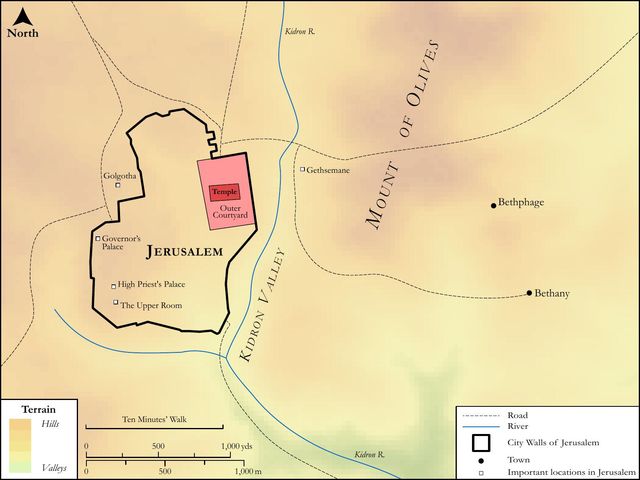
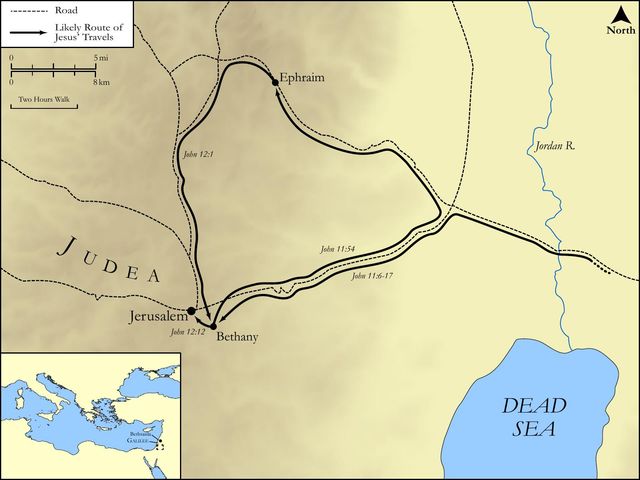
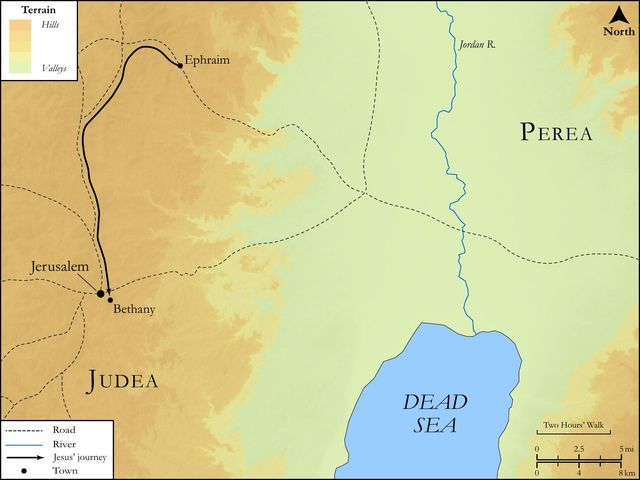
Bethany was a small village located on the eastern slope of the Mount of Olives, approximately two miles (3 km) east of Jerusalem. It was a familiar and beloved retreat for Jesus, particularly due to His close friendship with Lazarus, Mary, and Martha. The timing, "six days before the Passover," is highly significant. Passover (Pesach) was one of the most important annual Jewish festivals, commemorating the Exodus from Egypt and God's deliverance of His people. Pilgrims from all over the Jewish world would converge on Jerusalem for this feast, making the city densely populated and politically charged. The act of arriving in Bethany at this precise time underscores Jesus's intentional movement towards Jerusalem for the Passover, knowing full well what awaited Him there. The presence of Lazarus, recently raised, would have been a significant cultural talking point, drawing further attention to Jesus.
Key Themes
ShowHideJohn 12:1 contributes to several overarching themes in John's Gospel. Firstly, it highlights Jesus's Sovereignty and Divine Timing, as He deliberately orchestrates His movements in accordance with God's perfect plan, arriving at a precise moment before the Passover to fulfill His role as the ultimate sacrificial Lamb, as foreshadowed by John the Baptist's declaration in John 1:29. Secondly, the verse emphasizes The Power of Life Over Death, powerfully demonstrated through Lazarus's resurrection and serving as a precursor to Jesus's own resurrection. This miracle, though a sign of life, ironically becomes the catalyst for the religious leaders' decision to seek Jesus's death (John 11:47-53). Finally, it underscores The Theme of Friendship and Fellowship, as Jesus seeks solace and companionship in Bethany with His dear friends, Mary, Martha, and Lazarus, before facing the intense public scrutiny and ultimate sacrifice in Jerusalem.
Exposition and Analysis
ShowHideKey Word Analysis
ShowHideThis verb signifies intentional movement or arrival. In this context, it emphasizes Jesus's deliberate and purposeful journey to Bethany. It's not a casual visit but a significant step in His final approach to Jerusalem and the fulfillment of His mission. The use of this verb highlights Jesus's agency and His active participation in the unfolding divine plan, rather than being a passive participant in events.
This word refers to a specific period of time, often a 24-hour day. The precise mention of "six days before the Passover" is crucial, providing a clear chronological marker that signals the immediate proximity of the most significant event in Jesus's earthly ministry—His passion and crucifixion. This temporal detail underscores the divine orchestration of events, leading to Jesus's sacrifice at the appointed time, aligning with the Jewish festival.
This verb means "to waken, rouse, or lift up," particularly from sleep, disease, or death. Here, it directly refers to Jesus's miraculous act of bringing Lazarus back to life. The inclusion of this detail in the opening verse of John 12 immediately reminds the reader of Jesus's unparalleled power over death, setting a powerful backdrop for His own impending death and resurrection. It highlights the divine authority inherent in Jesus, capable of reversing the ultimate consequence of sin.
Verse Breakdown
ShowHide"Then Jesus six days before the passover came to Bethany"
This clause establishes the precise timing and location of Jesus's arrival. The "Then" (οὖν, oûn) serves as a connective, linking this event to the preceding narrative, particularly the aftermath of Lazarus's resurrection. The countdown to the Passover is initiated, marking the beginning of the final, climactic week of Jesus's earthly life. His intentional journey to Bethany, a place of refuge and friendship, is noted.
"where Lazarus was which had been dead"
This part of the verse identifies Bethany not just as a geographical location but as the site of a profound miracle. The presence of Lazarus, who "had been dead," immediately brings to mind the recent, undeniable display of Jesus's power over death. This detail serves as a tangible, living testimony to Jesus's divine authority, providing a stark contrast to the death that awaits Him.
"whom he raised from the dead"
This final phrase explicitly reiterates the miracle of Lazarus's resurrection, emphasizing Jesus's direct agency in bringing him back to life. It reinforces the central theme of Jesus as the "resurrection and the life" (John 11:25), and simultaneously highlights the very act that galvanized the religious leaders' opposition, setting the stage for the events of the Passion Week.
Literary Devices
ShowHideJohn 12:1 employs several significant literary devices. Foreshadowing is prominent, as the precise timing "six days before the Passover" immediately alerts the reader to the impending crucifixion of Jesus, who will be the ultimate Passover Lamb. The very presence of Lazarus, having been raised from the dead, creates a powerful juxtaposition between life and death. Lazarus, a living miracle, stands as a testament to Jesus's power over death, yet Jesus Himself is deliberately moving towards His own death. This creates a subtle irony, where the greatest display of life (Lazarus's resurrection) directly precipitates the plot against the Giver of Life. The repetition of the concept of "dead" ("had been dead," "from the dead") serves as a device of emphasis, underscoring the reality of Lazarus's prior state and the magnitude of Jesus's miracle, which will soon be mirrored in His own triumph over the grave.
Theological and Thematic Connections
ShowHideJohn 12:1 is saturated with profound theological significance, serving as a crucial hinge point in the Gospel narrative. It underscores Jesus's sovereign control over His destiny, as He deliberately walks towards Jerusalem and His preordained sacrifice. The precise timing "six days before the Passover" is not accidental but divinely appointed, aligning Jesus's crucifixion with the Jewish festival that commemorated deliverance through a sacrificial lamb. This highlights Jesus's identity as the ultimate Passover Lamb, whose blood would bring true and eternal deliverance from sin. The verse also emphasizes the undeniable power of Jesus over death, evidenced by Lazarus's living presence, a miracle that both drew many to faith and solidified the resolve of His enemies to kill Him. This tension between life and death, belief and unbelief, is a central theme throughout John's Gospel, culminating in Jesus's own death and resurrection.
Reflection and Application
ShowHideJohn 12:1 invites us to reflect on the deliberate and purposeful nature of Jesus's journey towards the cross. Even as the shadow of His impending suffering loomed large, Jesus chose to spend time in the comfort of friendship and in a place where His power over death had been so recently and visibly displayed. This reminds us that even in the face of immense trials, Jesus did not shy away from human connection or from the very places that bore witness to His divine authority. For us, this means recognizing that our journey of faith, though it may include difficult seasons, is always under the sovereign hand of God. We are called to walk in obedience, trusting in God's perfect timing and purpose, even when the path ahead seems daunting. The presence of Lazarus, a living testament to Jesus's power, serves as a powerful reminder that God's miracles are not just historical events but living realities that should strengthen our faith and embolden our witness.
Questions for Reflection
ShowHideFAQ
ShowHideWhy is Bethany specifically mentioned as the location, and what is its significance?
ShowHideBethany was a small village located on the Mount of Olives, just two miles east of Jerusalem. It held significant personal importance for Jesus as it was the home of His dear friends, Lazarus, Mary, and Martha. Mentioning Bethany immediately connects the narrative to the recent and dramatic miracle of Lazarus's resurrection (John 11), which had caused a stir among the people and intensified the opposition from the Jewish religious leaders. Thus, Bethany represents a place of both intimate fellowship and profound divine demonstration, setting the stage for the climactic events in Jerusalem.
Christ-Centered Fulfillment
ShowHideJohn 12:1, with its precise timing and the presence of Lazarus, profoundly points to Jesus as the Christ, the ultimate fulfillment of God's redemptive plan. The "six days before the Passover" explicitly positions Jesus as the true Passover Lamb, whose sacrifice would not merely commemorate a past deliverance but would secure eternal redemption for all who believe. Just as the original Passover lamb's blood protected Israel from death, Jesus's shed blood provides liberation from the bondage of sin and death (1 Peter 1:18-19). Furthermore, the living presence of Lazarus, whom Jesus "raised from the dead," serves as a powerful prefigurement and tangible proof of Jesus's own impending victory over death. Lazarus's resurrection foreshadows Jesus's greater resurrection, which would confirm His divine identity and secure the hope of resurrection for all believers (1 Corinthians 15:20-22). Thus, this verse encapsulates the essence of the Gospel: Jesus, the Lord of life, willingly walks towards death to become the sacrifice that brings life everlasting, triumphing over the very power that held Lazarus captive.