


Mark 14:3
Bible text: King James Version (1769 Blayney text) · Public domain
Bible text: King James Version with Strong's numbers · Public domain
Bible text: Berean Standard Bible · Public domain
Bible text: American Standard Version (1901) · Public domain
Bible text: World English Bible, Messianic edition · Public domain
Bible text: Geneva Bible (1599) · Public domain
Bible text: Young's Literal Translation · Public domain
- ΚαὶKaiAndG2532CONJConjunction
- ὄντοςontoswhen is beingG1510V-PAP-GSMVerb Present Active Participle Genitive Singular Masculine
- αὐτοῦautouHeG846P-GSMPersonal pronoun Genitive Singular Masculine
- ἐνeninG1722PREPPreposition
- ΒηθανίᾳBēthaniaBethanyG963N-DSF-LNoun Dative Singular Feminine Location
- ἐνeninG1722PREPPreposition
- τῇtēatheG3588T-DSFDefinite article Dative Singular Feminine
- οἰκίᾳoikiahouseG3614N-DSFNoun Dative Singular Feminine
- ΣίμωνοςSimōnosof SimonG4613N-GSM-PNoun Genitive Singular Masculine Individual
- τοῦtoutheG3588T-GSMDefinite article Genitive Singular Masculine
- λεπροῦleprouleperG3015A-GSMAdjective Genitive Singular Masculine
- κατακειμένουkatakeimenouwhen is recliningG2621V-PNP-GSMVerb Present Middle Or Passive Deponent Participle Genitive Singular Masculine
- αὐτοῦautouHeG846P-GSMPersonal pronoun Genitive Singular Masculine
- ἦλθενēlthencameG2064V-2AAI-3SVerb 2nd Aorist Active Indicative 3rd Singular
- γυνὴgunēa womanG1135N-NSFNoun Nominative Singular Feminine
- ἔχουσαechousahavingG2192V-PAP-NSFVerb Present Active Participle Nominative Singular Feminine
- ἀλάβαστρονalabastronan alabaster flaskG211N-ASFNoun Accusative Singular Feminine
- μύρουmurouof fragrant oilG3464N-GSNNoun Genitive Singular Neuter
- νάρδουnardouof nardG3487N-GSFNoun Genitive Singular Feminine
- πιστικῆςpistikēspureG4101A-GSFAdjective Genitive Singular Feminine
- πολυτελοῦςpolutelousof great priceG4185A-GSFAdjective Genitive Singular Feminine
- καὶkaiandG2532CONJConjunction
- συντρίψασαsuntripsasahaving brokenG4937V-AAP-NSFVerb Aorist Active Participle Nominative Singular Feminine
- τὴνtēntheG3588T-ASFDefinite article Accusative Singular Feminine
- ἀλάβαστρονalabastronalabaster flaskG211N-ASFNoun Accusative Singular Feminine
- κατέχεενkatecheenshe poured [it] onG2708V-AAI-3SVerb Aorist Active Indicative 3rd Singular
- αὐτοῦautouHisG846P-GSMPersonal pronoun Genitive Singular Masculine
- κατὰkataaccording toG2596PREPPreposition
- τῆςtēs<the>G3588T-GSFDefinite article Genitive Singular Feminine
- κεφαλῆςkephalēsheadG2776N-GSFNoun Genitive Singular Feminine
English is a literal word-by-word gloss of the Greek, not the KJV's wording. Why?
This is the original text the KJV's translators worked from — each Greek word with its own literal English meaning in this verse, prepared by scholars at Tyndale House, Cambridge. The KJV translates whole sentences, not word by word, so its wording differs: one Greek word can become several English words, and the KJV may choose “charity” where the gloss reads “love”. Both are faithful — they answer different questions. For the KJV's own rendering, switch to the KJV text.
Details
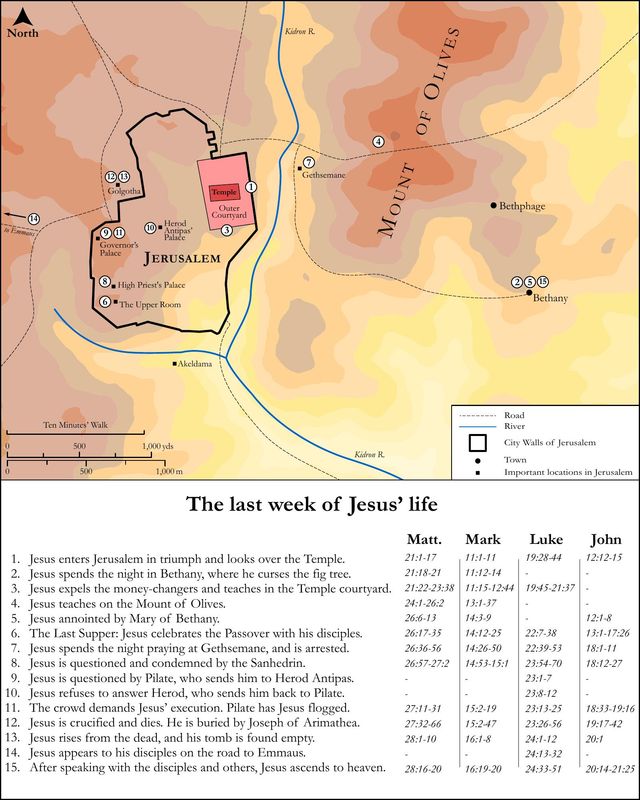
See on the biblical-era maps


Study this verse
Public-domain commentary
Matthew Henry
From his Commentary on the Whole Bible. Henry comments on passages, not single verses — this entry covers Mark 14:1–11. His three-level outline is real structure in the source text, so it is rendered as structure.
We have here instances,
I.Of the kindness of Christ's friends, and the provision made of respect and honour for him.
Some friends he had, even in and about Jerusalem, that loved him, and never thought they could do enough for him, among whom, though Israel be not gathered, he is, and will be, glorious.
1.Here was one friend, that was so kind as to invite him to sup with him; and he was so kind as to accept the invitation, Mar 14:3. Though he had a prospect of his death approaching, yet he did not abandon himself to a melancholy retirement from all company, but conversed as freely with his friends as usual.
2.Here was another friend, that was so kind as to anoint his head with very precious ointment as he sat at meat. This was an extraordinary piece of respect paid him by a good woman that thought nothing too good to bestow upon Christ, and to do him honour. Now the scripture was fulfilled, When the king sitteth at his table, my spikenard sendeth forth the smell thereof, Sol 1:12. Let us anoint Christ as our Beloved, kiss him with a kiss of affection; and anoint him as our Sovereign, kiss him with a kiss of allegiance. Did he pour out his soul unto death for us, and shall we think any box of ointment too precious to pour out upon him? It is observable that she took care to pour it all out upon Christ's head; she broke the box (so we read it); but because it was an alabaster box, not easily broken, nor was it necessary that it should be broken, to get out the ointment, some read it, she shook the box, or knocked it to the ground, to loosen what was in it, that it might be got out the better; or, she rubbed and scraped out all that stuck tot he sides of it. Christ must have been honoured with all we have, and we must not think to keep back any part of the price. Do we give him the precious ointment of our best affections? Let him have them all; love him with all the heart.
Now, (1.) There were those that put a worse construction upon this than it deserved. They called it a waste of the ointment, Mar 14:4. Because they could not have found their hearts to put themselves to such an expense for the honouring of Christ, they thought that she was prodigal, who did. Note, As the vile person ought to be called liberal, nor the churl said to be bountiful (Isa 32:5); so the liberal and bountiful ought not to be called wasteful. They pretend it might have been sold, and given to the poor, Mar 14:5. But as a common piety to the corban will not excuse from a particular charity to a poor parent (Mar 7:11), so a common charity to the poor will not excuse from a particular act of piety to the Lord Jesus. What thy hand finds to do, that is good, do it with thy might.
(2.)Our Lord Jesus put a better construction upon it than, for aught that appears, was designed. Probably, she intended no more, than to show the great honour she had for him, before all the company, and to complete his entertainment. But Christ makes it to be an act of great faith, as well as great love (Mar 14:8); "She is come aforehand, to anoint my body to the burying, as if she foresaw that my resurrection would prevent her doing it afterward." This funeral rite was a kind of presage of, or prelude to, his death approaching. See how Christ's heart was filled with the thoughts of his death, how every thing was construed with a reference to that, and how familiarly he spoke of it upon all occasions. It is usual for those who are condemned to die, to have their coffins prepared, and other provision made for their funerals, while they are yet alive; and so Christ accepted this. Christ's death and burial were the lowest steps of his humiliation, and therefore, though he cheerfully submitted to them, yet he would have some marks of honour to attend them, which might help to take off the offence of the cross, and be an intimation how precious in the sight of the Lord the death of his saints is. Christ never rode in triumph into Jerusalem, but when he came thither to suffer; nor had ever his head anointed, but for his burial.
(3.)He recommended this piece of heroic piety to the applause of the church in all ages; Wherever this gospel shall be preached, it shall be spoken of, for a memorial of her, Mar 14:9. Note, The honour which attends well-doing, even in this world, is sufficient to balance the reproach and contempt that are cast upon it. The memory of the just is blessed, and they that had trial of cruel mockings, yet obtained a good report, Heb 11:6, Heb 11:39. Thus was this good woman repaid for her box of ointment, Nec oleum perdidit nec operam - She lost neither her oil nor her labour. She got by it that good name which is better than precious ointment. Those that honour Christ he will honour.
II.Of the malice of Christ's enemies, and the preparation made by them to do him mischief.
1.The chief priests, his open enemies, consulted how they might put him to death, Mar 14:1, Mar 14:2. The feast of the passover was now at hand, and at that feast he must be crucified,
(1.)That his death and suffering might be the more public, and that all Israel, even those of the dispersion, who came from all parts to the feast, might be witnesses of it, and of the wonders that attended it.
(2.)That the Anti-type might answer to the type. Christ, our Passover, was sacrificed for us, and brought us out of the house of bondage, at the same time that the paschal lamb was sacrificed, and Israel's deliverance out of Egypt was commemorated.
Now see, [1.] How spiteful Christ's enemies were; they did not think it enough to banish or imprison him, for they aimed not only to silence him, and stop his progress for the future, but to be revenged on him for all the good he had done. [2.] How subtle they were; Not on the feast-day, when the people are together; they do not say, Lest they should be disturbed in their devotions, and diverted from them, but, Lest there should be an uproar (Mar 14:2); lest they should rise, and rescue him, and fall foul upon those that attempt any thing against him. They who desired nothing more than the praise of men, dreaded nothing more than the rage and displeasure of men.
2.Judas, his disguised enemy, contracted with them for the betraying of him, Mar 14:10, Mar 14:11. He is said to be one of the twelve that were Christ's family, intimate with him, trained up for the service of the kingdom; and he went to the chief priests, to tender his service in this affair.
(1.)That which he proposed to them, was, to betray Christ to them, and to give them notice when and where they might find him, and seize him, without making an uproar among the people, which they were afraid of, if they should seize him when he appeared in public, in the midst of his admirers. Did he know then what help it was they wanted, and where they were run aground in their counsels? It is probable that he did not, for the debate was held in their close cabal. Did they know that he had a mind to serve them, and make court to him? No, they could not imagine that any of his intimates should be so base; but Satan, who was entered into Judas, knew what occasion they had for him, and could guide him to be guide to them, who were contriving to take Jesus. Note, The spirit that works in all the children of disobedience, knows how to bring them in to the assistance one of another in a wicked project, and then to harden them in it, with the fancy that Providence favours them.
(2.)That which he proposed to himself, was, to get money by the bargain; he had what he aimed at, when they promised to give him money. Covetousness was Judas's master - lust, his own iniquity, and that betrayed him to the sin of betraying his Master; the devil suited his temptation to that, and so conquered him. It is not said, They promised him preferment (he was not ambitious of that), but, they promised him money. See what need we have to double our guard against the sin that most easily besets us. Perhaps it was Judas's covetousness that brought him at first to follow Christ, having a promise that he should be cash-keeper, or purser, to the society, and he loved in his heart to be fingering money; and now that there was money to be got on the other side, he was as ready to betray him as ever he had been to follow him. Note, Where the principle of men's profession of religion is carnal and worldly, and the serving of a secular interest, the very same principle, whenever the wind turns, will be the bitter root of a vile and scandalous apostasy.
(3.)Having secured the money, he set himself to make good his bargain; he sought how he might conveniently betray him, how he might seasonably deliver him up, so as to answer the intention of those who had hired him. See what need we have to be careful that we do not ensnare ourselves in sinful engagements. If at any time we be so ensnared in the words of our mouths, we are concerned to deliver ourselves by a speedy retreat, Pro 6:1-5. It is a rule in our law, as well as in our religion, that an obligation to do an evil thing is null and void; it binds to repentance, not to performance. See how the way of sin is down-hill - when men are in, they must be on; and what wicked contrivances many have in their sinful pursuits, to compass their designs conveniently; but such conveniences will prove mischiefs in the end.
Historical interpretation
Seven Centuries of Reception
10 surviving comments on this verse. Each one is dated, so this reads as a timeline rather than a list.
Select a marker to jump to its quote. Markers stagger vertically where authors wrote within a few decades of each other.
For the fawn amongst the stags ever comes back to his couch, that is, the Son, obedient to the Father even unto death, seeks for obedience from us.
Again in a mystic sense, Simon the leper means the world, first infidel, and afterwards converted, and the woman with the alabaster box, means the faith of the Church, who says, My spikenard sendeth forth its smell. It is called pistic nard, that is, faithful, and precious. (Cant. 1:12). The house filled with the smell of it is heaven and earth; the broken alabaster box is carnal desire, which is broken at the Head, from which the whole body is framed together, whilst He was reclining, that is, humbling Himself, that the faith of the sinner might be able to reach Him, for she went up from the feet to the head, and down from the head to the feet by faith, that is, to Christ and to His members. It goes on: And there were some that had indignation within themselves, and said, Why was this loss of the ointment? By the figure synecdoche, one is put for many, and many for one; for it is the lost Judas who finds loss in salvation; thus in the fruitful vine rises the snare of death. Under the cover of his avarice, however, the mystery of faith speaks; for our faith is bought for three hundred pence, in our ten senses, that is, (denarii i. e. ten asses.) our inward and outward senses which are again trebled by our body, soul, and spirit.
He says also, She hath wrought a good work on me, for whosoever believes on the Lord, it is counted unto Him for righteousness. For it is one thing to believe Him, and to believe on Him, that is, to cast ourselves entirely upon Him. It goes on: She hath done what she could, she is come aforehand to anoint my body to the burying.
Just as the grain of wheat, unless it falls into the ground and dies, does not bring forth any fruit, so, also, unless the alabaster jar be broken, we cannot spread its fragrance. HOMILIES OF ST.
This woman is outside the temple and carries with her a jar of ointment containing nard, genuine nard, from which she has prepared the ointment. This is why the faithful are called “genuine” or pure nard. The church, gathered from the nations, is offering the Savior the abounding faith of believers. The alabaster jar which had been sealed is broken that all may receive its perfume. Homilies of Saint , Homily
This woman has a very special message for you who are about to be baptized. She broke her alabaster jar that Christ may make you “christs,” his anointed. Hear what it says in the Canticle of Canticles: “Your name spoken is a spreading perfume, therefore the maidens love you. We will follow you eagerly in the fragrance of your perfume!” HOMILIES OF ST.
(de Con. Evan. ii. 79) I however think that nothing else can be meant, but that the sinner who then came to the feet of Jesus was no other than the same Mary who did this twice; once, as Luke relates it, when coming for the first time with humility and tears she merited the remission of her sins. For John also relates this, when he began to speak of the raising of Lazarus before He came to Bethany, saying, It was that Mary which anointed the Lord with ointment, and wiped his feet with her hair, whose brother Lazarus was sick. (John 11:2) But what she again did at Bethany is another act, unrecorded by Luke, but mentioned in the same way by the other three Evangelists. In that therefore Matthew and Mark say that the head of the Lord was anointed by the woman, whilst John says the feet, we must understand that both the head and the feet were anointed by the woman. Unless because Mark has said that she broke the box in order to anoint His head, any one is so fond of cavilling as to deny that, because the box was broken, any could remain to anoint the feet of the Lord. But a man of a more pious spirit will contend that it was not broken so as to pour out the whole, or else that the feet were anointed before it was broken, so that there remained in the unbroken box enough to anoint the head.
(de Con. Evan. ii. 78) It may appear to be a contradiction, that Matthew and Mark after mentioning two days and the Passover, (John 12:1) add afterwards that Jesus was in Bethany, where that precious ointment is mentioned; whilst John, just before he speaks of the anointing, says, that Jesus came into Bethany six days before the feast. But those persons who are troubled by this, are not aware that Matthew and Mark do not place that anointing in Bethany immediately after that two days of which he foretold, but by way of recapitulation at the time when there were yet six days to the Passover.
We should not doubt that this was that same woman, once a sinner, who, as the Evangelist Luke reports, came to our Lord with an alabaster vase of ointment “and, standing behind him at his feet, began to bathe his feet with her tears, and she wiped them with the hair of her head, and kissed his feet and anointed them with ointment.” This is the same woman, but there, she bent over and anointed only our Lord’s feet, and she did this amid her tears of repentance. Here amid the joy of her righteous action she did not hesitate both to anoint his feet and to stand up to anoint his head also.
(ubi sup.) The Lord when about to suffer for the whole world, and to redeem all nations with His blood, dwells in Bethany, that is, in the house of obedience; wherefore it is said, And being in Bethany in the house of Simon the leper, as he sat at meat, there came a woman.
(ubi sup.) He says of Simon the leper, not because he remained still a leper at that time, but because having once been such, he was healed by our Saviour; his former name is left, that the virtue of the Healer may be made manifest.
(ubi sup.) Alabaster is a sort of white marble, veined with various colours which is often hollowed out for boxes of ointment, because it keeps things of that nature most uncorrupt. Nard is an aromatic shrub of a large and thick root, but short, black, and brittle; though unctuous, it smells like cypress, and has a sharp taste, and small and dense leaves. Its tops spread themselves out like ears of corn, therefore, its gift being double, perfumers make much of the spikes and the leaves of the nard. And this is what is meant by Mark, when he says spikenard very precious, that is, the ointment which Mary brought for the Lord was not made of the root of nard, but even, what made it more precious, by the addition of the spikes and the leaves, the gratefulness of its smell and virtue was augmented.
(ubi sup.) And in that he says, And they murmured against her, we must not understand this to be spoken of the faithful Apostles, but rather of Judas mentioned in the plural.
(ubi sup.) To me, indeed, He seems to speak of His bodily presence, that He should by no means be with them after His resurrection, as He then was living with them in all familiarity.
(ubi sup.) As if the Lord said, What ye think is a waste of ointment is the service of my burial.
(ubi sup.) Observe also, that as Mary won glory throughout the whole world for the service which she rendered to the Lord, so, on the contrary, he who was bold enough to reprove her service, is held in infamy far and wide; but the Lord in rewarding the good with due praise has passed over in silence the future shame of the impious.
A woman came having an alabaster jar of very costly ointment of spikenard, and having broken the jar, she poured it out on his head. This woman was Mary of Magdala, the sister of Lazarus, whom Jesus raised from the dead, as John openly mentions, who also attests that this happened six days before the Passover, the day before he came to Jerusalem sitting on a donkey with palms and the praise of the crowds. She is the one, not another, who once (as Luke writes) was still a sinner, coming to the Lord’s feet, washed them with tears of repentance and anointed them with the ointment of pious confession. And because she loved much, she earned forgiveness of many sins from the merciful judge. Now having been justified and made familiar with the Lord, she not only anointed his feet (as the same John narrates) but also his head (as Matthew and Mark testify) with sacred oil. Alabaster is a kind of white marble, speckled with various spots, which is typically hollowed out for ointment vessels because it is said to preserve them uncorrupted. It is found around the Thebes of Egypt, and the whitest around Damascus of Syria, but the best is in India. Nard itself is an aromatic shrub, with a heavy (they say) and thick root, but short and black and brittle, although rich, smelling like a rose or cypress, with a bitter taste, small and dense leaf, whose tips spread into spikes. Therefore, perfumers celebrate the spikes and leaves of nard for their dual property. And this is what Mark says: Very costly ointment of spikenard. Because indeed, the ointment which Mary brought to the Lord was not only made from the root of the nard, but also, to make it more precious, its perfume and power were enhanced by the addition of its spikes and leaves. Moreover, naturalists say about nard that it is principal among ointments. Therefore, it was rightly offered for the anointing of the Lord’s head and feet. There are many kinds of it, but all are less potent except for the Indian, which is the most precious. Mystically, this devotion of Mary ministering to the Lord signifies the faith and piety of the holy Church, which speaks in the Song of Songs saying: While the king was at his table, my nard gave forth its fragrance (Song 1). Undoubtedly, these words, both once literally fulfilled by the hands of Mary, and daily spiritually fulfilled in all its members, who, spread throughout the world, glorify and say: But thanks be to God, who always leads us in triumphal procession in Christ, and through us spreads everywhere the fragrance of the knowledge of Him. For we are to God the pleasing aroma of Christ (2 Cor. 2). When it acknowledges with worthy reverence the power of his divine strength, which he shares with the Father, it truly anoints his head with precious ointment. But when it equally regards with worthy reverence the mysteries of his assumed humanity, it surely anoints the Lord's feet with pure nard ointment, that is, faithful and true, because it piously commends and devoutly venerates that nature of his in which he deigned to touch the earth, that is, to live among men.
And when He was in Bethany, in the house of Simon the leper, and sat at meat. About to suffer for the entire world and to redeem all nations with His blood, He stayed in Bethany in the house of obedience, which once belonged to Simon the leper; not that the leper remained at that time, but because he who had been a leper was later cleansed by the Savior, the former name remaining, so that the power of the healer might appear. For even in the catalog of the apostles, Matthew the publican is named with his former vice and office, who certainly had ceased to be a publican. Some wish to understand Simon the leper as part of the people who believed in the Lord and were cured by Him. Simon is also called obedient.
Nevertheless, Christ Himself had determined for Himself the day of His Passion; for He wished to be crucified on the Passover, because He was the true Passover.
But although the four Evangelists record the anointing by a woman, there were two women and not one; one described by John, the sister of Lazarus; it was she who six days before the Passover anointed the feet of Jesus; another described by the other three Evangelists. Nay, if you examine, you will find three; for one is described by John, another by Luke, a third by the other two. For that one described by Luke is said to be a sinner and to have come to Jesus during the time of His preaching; but this other described by Matthew and Mark is said to have come at the time of the Passion, nor did she confess that she had been a sinner.
Or as is said in Greek, of pistic nard, that is, faithful, because the ointment of the nard was made faithfully and without counterfeit. (Matt. 26:2)
Or else, it appears to be aptly implied that many disciples murmured against the woman, because they had often heard our Lord talking of alms. Judas, however, was indignant, but not with the same feeling, but on account of his love of money, and filthy gain; wherefore John also records him alone, as accusing the woman with a fraudulent intent. But he says, They murmured against her, meaning that they troubled her with reproaches, and hard words. Then our Lord reproves His disciples, for throwing obstacles against the wish of the woman. Wherefore it goes on: And Jesus said, Let her alone, why trouble ye her? For after she had brought her gift, they wished to prevent her purpose by their reproaches.
For she is come aforehand as though led by God to anoint my body, as a sign of my approaching burial; by which He confounds the traitor, as if He said, With what conscience canst thou confound the woman, who anoints my body to the burial, and dost not confound thyself, who wilt deliver me to death? But the Lord makes a double prophecy; one that the Gospel shall be preached over the whole world, another that the deed of the woman shall be praised. Wherefore it goes on: Verily I say unto you, Wheresoever this gospel shall be preached throughout the whole world, this also that she hath done shall be spoken of for a memorial of her.
Continue studying Mark 14:3 across the web’s major study libraries — every link below opens this exact verse, chapter, or book on the destination site.
Read & Compare
 BibleGatewayThis verse in more than 200 translations and 70 languages.
 Bible.comThe YouVersion reader — hundreds of translations, reading plans, and highlights.
 ESV.orgCrossway's official English Standard Version reader.
 NET BibleThe NET translation with 60,000+ translators' notes on every rendering decision.
 STEP BibleTyndale House's free study tool — original text, vocabulary, and scholarly resources.
 BibliaLogos Bible Software's free web reader.
 USCCBThe New American Bible (Revised Edition) with the U.S. bishops' study notes.
Commentaries
 BibleHub CommentariesDozens of classic commentaries on this verse, gathered on one page.
 StudyLightMore than 100 commentary sets — the largest collection on the web.
 BibleRefPlain-English commentary on what this verse means, verse by verse.
 Enduring WordDavid Guzik's free commentary on this chapter, widely used by Bible teachers.
 Bible Study ToolsVerse commentary alongside Greek and Hebrew study aids.
Original Language & Research
- BibleHub InterlinearThe verse word by word — original language, transliteration, and English.
- BibleHub LexiconEvery word's original-language definition and Strong's entry.
 Blue Letter BibleDeep-study tools — Strong's numbers, concordance, and word studies.
 CNTR CollationThe earliest Greek manuscripts of this verse, collated letter by letter.
Sermons, Hymns & Audio


TrulyRandomVerse is not affiliated with these sites and doesn’t control their content. They’re linked because they’re genuinely useful.
Summary
Mark 14:3 describes a pivotal moment in Bethany, days before Jesus' crucifixion, where an unnamed woman performs an extraordinary act of devotion. In the home of Simon the leper, as Jesus reclines at a meal, she approaches with an alabaster flask containing exceedingly costly spikenard ointment. In a profound gesture of sacrificial worship, she breaks the sealed flask and pours its entire contents over Jesus' head, an act that Jesus Himself would later interpret as a prophetic anointing for His impending burial. This event stands as a powerful testament to extravagant love and foreshadows the ultimate sacrifice of Christ.
Context
ShowHideLiterary Context
This passage is strategically placed by Mark just after the chief priests and scribes plot to seize and kill Jesus, and immediately before Judas Iscariot's betrayal. It serves as a stark contrast to the calculating treachery of the religious leaders and Judas. While they are planning to betray Jesus for money, this woman is pouring out a fortune in an act of selfless devotion. The narrative flow moves from the conspiracy against Jesus in Mark 14:1-2 to this act of worship, then to Judas's betrayal in Mark 14:10-11, highlighting the divergent responses to Jesus' presence and impending passion. It also sets the stage for Jesus' explanation of the act as preparation for His burial in Mark 14:8, linking it directly to the central theme of His atoning death.
Historical & Cultural Context
The event takes place in Bethany, a village on the Mount of Olives, just two miles east of Jerusalem, making it a common stopping point for pilgrims traveling to the city for Passover. The setting is the home of Simon, identified as "the leper," which strongly suggests he was a former leper whom Jesus had healed, as lepers were typically ostracized from society. His ability to host a meal indicates his cleansing and reintegration, a testament to Jesus' transformative power. Reclining at "meat" (a meal) was the customary dining posture for men in that culture, signifying a relaxed, intimate setting. Anointing guests with oil was a common courtesy, but the quantity and cost of this spikenard elevate it far beyond mere hospitality. The Passover week was a time of immense spiritual and nationalistic fervor, with heightened expectations for the Messiah, yet also growing tension with the religious authorities, setting a dramatic backdrop for this prophetic act.
Key Themes
ShowHideThe anointing at Bethany profoundly contributes to several key themes within Mark's Gospel and the broader biblical narrative. Firstly, it exemplifies Extravagant Devotion, showcasing a radical act of worship that prioritizes honor for Christ above material value, contrasting sharply with the disciples' pragmatic objections and Judas's avarice. Secondly, it functions as a Prophetic Anointing, as Jesus interprets the woman's act as a direct preparation for His burial, underscoring His awareness of His imminent suffering and death (Mark 14:8). This theme of prophetic fulfillment is crucial to understanding Jesus' journey to the cross as a divinely ordained event. Thirdly, the incident highlights the theme of True Discipleship, where genuine faith is expressed not through outward displays or material accumulation, but through humble, sacrificial love for Jesus, often recognized and commended by Christ Himself, as seen in Mark 14:9.
Exposition and Analysis
ShowHideKey Word Analysis
ShowHideThis term refers to a female, but in this context, the woman's anonymity in Mark (she is identified as Mary in John 12:3) emphasizes the act of devotion itself rather than her specific identity. It highlights that such profound worship is accessible to anyone, regardless of social standing or public recognition. Her gender also subtly underscores the counter-cultural nature of her public, bold action in a male-dominated society.
This refers to a small, sealed flask, typically made of alabaster stone, used to hold precious perfumes or ointments. The material was often soft and easily carved, and the flask's design, often with a narrow neck, was intended to preserve the volatile fragrance. The act of "breaking" the box, as noted in the text, signifies not merely opening it, but a decisive, perhaps even destructive, act to ensure the entire contents were poured out, symbolizing total, unreserved giving.
This verb means "to crush completely" or "to shatter." It implies more than just unstopping a bottle; it suggests a breaking of the vessel itself. This detail underscores the woman's absolute commitment and the irreversible nature of her offering. She did not just pour a little; she rendered the container useless, ensuring that every drop of the precious ointment was given to Jesus, signifying a complete and unreserved sacrifice.
Verse Breakdown
ShowHide"And being in Bethany in the house of Simon the leper,"
The scene is set in Bethany, a village near Jerusalem, at the home of Simon. The designation "the leper" suggests he was a man whom Jesus had healed, as lepers were typically outcasts. This detail highlights Jesus' ongoing ministry of healing and restoration, even as His passion approaches.
"as he sat at meat,"
Jesus is depicted in a posture of relaxed intimacy, reclining at a meal. This common dining custom provides a domestic, seemingly ordinary setting for an extraordinary act, emphasizing that profound spiritual encounters can happen in everyday life.
"there came a woman having an alabaster box of ointment of spikenard very precious;"
An unnamed woman enters the scene, carrying a sealed alabaster flask of spikenard. The description "very precious" (Greek: polytelḗs) and "spikenard" (Greek: nárdos pistikós, meaning "genuine nard") emphasizes the immense value of the ointment, often equivalent to a year's wages, highlighting the significant personal sacrifice she is about to make.
"and she brake the box,"
This action is crucial. She did not merely open it; she shattered the alabaster flask. This act signifies an irreversible, total, and extravagant outpouring of the entire contents, demonstrating a complete lack of reservation in her devotion.
"and poured [it] on his head."
The culmination of her act is the anointing of Jesus' head. While anointing feet was also customary, anointing the head was typically reserved for kings or priests, or for preparing a body for burial. This act, therefore, carries significant symbolic weight, foreshadowing Jesus' kingship and His impending death and burial.
Literary Devices
ShowHideMark employs several powerful literary devices in this verse. Symbolism is prominent, with the alabaster box and its precious spikenard symbolizing the woman's immense personal sacrifice and profound love. The act of "breaking" the box itself is symbolic of a complete, unreserved offering, demonstrating that true devotion holds nothing back. There is also a strong element of Contrast in the narrative's immediate context; the woman's selfless, costly act of worship stands in stark opposition to the plotting of the chief priests and scribes to betray Jesus for money (Mark 14:1-2) and Judas's subsequent betrayal (Mark 14:10-11). Finally, the entire event serves as Foreshadowing, as Jesus explicitly interprets the anointing as preparation for His burial (Mark 14:8), subtly preparing the reader for the sacrificial nature of His death.
Theological and Thematic Connections
ShowHideThe anointing at Bethany is a profound theological statement on the nature of worship, sacrifice, and the recognition of Christ's supreme worth. It challenges the utilitarian mindset that often seeks to quantify spiritual acts, demonstrating that genuine devotion transcends mere practicality. The woman's act, though seemingly wasteful to some, is commended by Jesus as a beautiful and prophetic gesture, highlighting that true worship is often costly and born of deep love, rather than calculated utility. It underscores the theme that those who truly perceive Jesus' identity and mission are moved to extravagant expressions of honor, even when misunderstood by others.
Reflection and Application
ShowHideThis passage calls us to examine the depth and sincerity of our own devotion to Christ. The woman's act of breaking the alabaster box and pouring out its costly contents serves as a powerful metaphor for wholehearted surrender and sacrifice. Are there "precious" things in our lives—time, resources, talents, ambitions, even our very reputation—that we are unwilling to "break" or pour out for the sake of Christ? Her example challenges us to move beyond a calculated or convenient faith towards an extravagant love that holds nothing back. It reminds us that true worship is not about what is merely practical or efficient, but about what honors Jesus supremely, recognizing His infinite worth and the magnitude of His impending sacrifice for us. Our worship, like hers, should be a beautiful offering, given without reservation, anticipating and responding to the ultimate love shown on the cross.
Questions for Reflection
ShowHideFAQ
ShowHideWhy was the spikenard ointment considered "very precious"?
ShowHideThe spikenard ointment was "very precious" (Greek: polytelḗs) because it was an imported, highly prized aromatic oil derived from the nard plant, found primarily in the Himalayas. Its rarity, the difficulty of its extraction and transport, and its purity (indicated by pistikós, "genuine" or "unadulterated") made it extremely expensive. Historical accounts suggest its value could be equivalent to a year's wages for a common laborer, making the woman's offering an immense personal sacrifice and a profound act of extravagant devotion.
Who was Simon the leper, and why was Jesus in his house?
ShowHideSimon the leper was likely a man whom Jesus had previously healed of leprosy. In Jewish society, lepers were ritually unclean and ostracized, unable to participate in communal life or host guests. The fact that Simon was hosting a dinner for Jesus indicates that he had been cleansed and restored to society, underscoring Jesus' power to heal and transform. His willingness to host Jesus also suggests a deep gratitude and faith, making his home a fitting place for this act of worship.
Christ-Centered Fulfillment
ShowHideThe anointing of Jesus' head with precious spikenard in Mark 14:3 finds its ultimate fulfillment in Christ Himself, as both the anointed One and the One for whom the anointing was a prophetic sign. This act foreshadows Jesus' role as the true King and High Priest, anointed not with oil, but with the Holy Spirit for His messianic mission (Acts 10:38). More profoundly, Jesus interprets the woman's act as preparation for His burial (Mark 14:8), directly connecting this beautiful, costly offering to His impending death on the cross. Just as the woman poured out her most precious possession, so too would Christ pour out His very life, His precious blood, as the ultimate sacrifice for the sins of the world (Hebrews 9:22). Her act, therefore, becomes a tangible, prophetic symbol of the immeasurable cost of redemption, pointing to the Lamb of God who takes away the sin of the world (John 1:29), whose body was broken and whose life was poured out for our salvation. The fragrance of her devotion, filling the house, prefigures the sweet aroma of Christ's sacrifice, acceptable to God (Ephesians 5:2).