


Mark 14:11
Bible text: King James Version (1769 Blayney text) · Public domain
Bible text: Berean Standard Bible · Public domain
Bible text: American Standard Version (1901) · Public domain
Bible text: World English Bible, Messianic edition · Public domain
Bible text: Geneva Bible (1599) · Public domain
Bible text: Young's Literal Translation · Public domain
- οἱhoi<the>G3588T-NPMDefinite article Nominative Plural Masculine
- δὲdeAndG1161CONJConjunction
- ἀκούσαντεςakousanteshaving heardG191V-AAP-NPMVerb Aorist Active Participle Nominative Plural Masculine
- ἐχάρησανecharēsanthey rejoicedG5463V-2AOI-3PVerb 2nd Aorist Passive Deponent Indicative 3rd Plural
- καὶkaiandG2532CONJConjunction
- ἐπηγγείλαντοepēngeilantothey promisedG1861V-ANI-3PVerb Aorist Middle Or Passive Deponent Indicative 3rd Plural
- αὐτῷautōto himG846P-DSMPersonal pronoun Dative Singular Masculine
- ἀργύριονargurionmoneyG694N-ASNNoun Accusative Singular Neuter
- δοῦναι·dounaito giveG1325V-2AANVerb 2nd Aorist Active Infinitive
- καὶkaiAndG2532CONJConjunction
- ἐζήτειezēteihe was seekingG2212V-IAI-3SVerb Imperfect Active Indicative 3rd Singular
- πῶςpōshowG4459PRT-IInterrogative Particle Interrogative
- αὐτὸνautonHimG846P-ASMPersonal pronoun Accusative Singular Masculine
- εὐκαίρωςeukairōsconvenientlyG2122ADVAdverb
- παραδοῖparadoihe may deliver upG3860V-2AAS-3SVerb 2nd Aorist Active Subjunctive 3rd Singular
English is a literal word-by-word gloss of the Greek, not the KJV's wording. Why?
This is the original text the KJV's translators worked from — each Greek word with its own literal English meaning in this verse, prepared by scholars at Tyndale House, Cambridge. The KJV translates whole sentences, not word by word, so its wording differs: one Greek word can become several English words, and the KJV may choose “charity” where the gloss reads “love”. Both are faithful — they answer different questions. For the KJV's own rendering, switch to the KJV text.
Details
See on the biblical-era maps
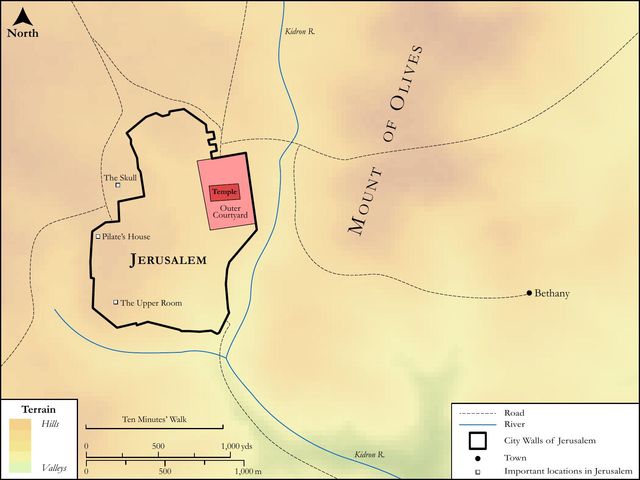
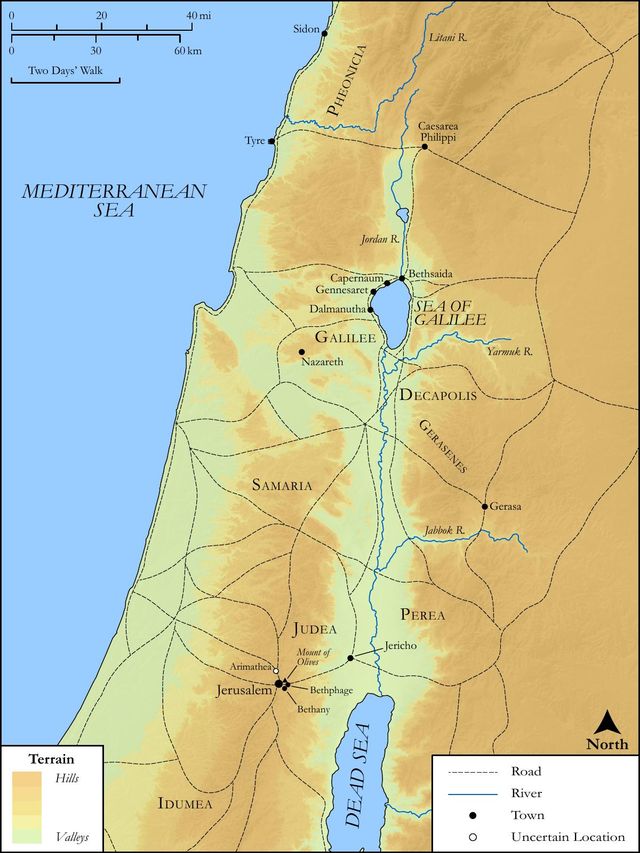
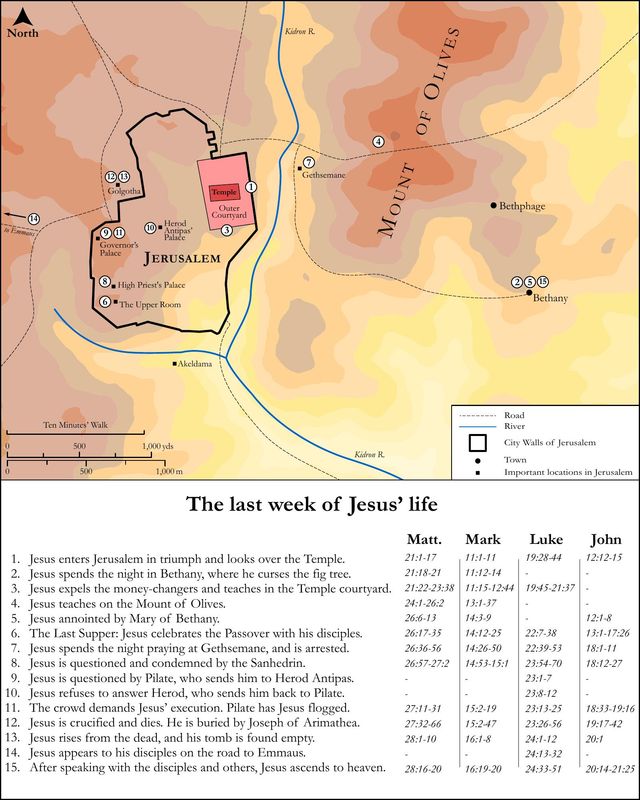
Study this verse
Public-domain commentary
Matthew Henry
From his Commentary on the Whole Bible. Henry comments on passages, not single verses — this entry covers Mark 14:1–11. His three-level outline is real structure in the source text, so it is rendered as structure.
We have here instances,
I.Of the kindness of Christ's friends, and the provision made of respect and honour for him.
Some friends he had, even in and about Jerusalem, that loved him, and never thought they could do enough for him, among whom, though Israel be not gathered, he is, and will be, glorious.
1.Here was one friend, that was so kind as to invite him to sup with him; and he was so kind as to accept the invitation, Mar 14:3. Though he had a prospect of his death approaching, yet he did not abandon himself to a melancholy retirement from all company, but conversed as freely with his friends as usual.
2.Here was another friend, that was so kind as to anoint his head with very precious ointment as he sat at meat. This was an extraordinary piece of respect paid him by a good woman that thought nothing too good to bestow upon Christ, and to do him honour. Now the scripture was fulfilled, When the king sitteth at his table, my spikenard sendeth forth the smell thereof, Sol 1:12. Let us anoint Christ as our Beloved, kiss him with a kiss of affection; and anoint him as our Sovereign, kiss him with a kiss of allegiance. Did he pour out his soul unto death for us, and shall we think any box of ointment too precious to pour out upon him? It is observable that she took care to pour it all out upon Christ's head; she broke the box (so we read it); but because it was an alabaster box, not easily broken, nor was it necessary that it should be broken, to get out the ointment, some read it, she shook the box, or knocked it to the ground, to loosen what was in it, that it might be got out the better; or, she rubbed and scraped out all that stuck tot he sides of it. Christ must have been honoured with all we have, and we must not think to keep back any part of the price. Do we give him the precious ointment of our best affections? Let him have them all; love him with all the heart.
Now, (1.) There were those that put a worse construction upon this than it deserved. They called it a waste of the ointment, Mar 14:4. Because they could not have found their hearts to put themselves to such an expense for the honouring of Christ, they thought that she was prodigal, who did. Note, As the vile person ought to be called liberal, nor the churl said to be bountiful (Isa 32:5); so the liberal and bountiful ought not to be called wasteful. They pretend it might have been sold, and given to the poor, Mar 14:5. But as a common piety to the corban will not excuse from a particular charity to a poor parent (Mar 7:11), so a common charity to the poor will not excuse from a particular act of piety to the Lord Jesus. What thy hand finds to do, that is good, do it with thy might.
(2.)Our Lord Jesus put a better construction upon it than, for aught that appears, was designed. Probably, she intended no more, than to show the great honour she had for him, before all the company, and to complete his entertainment. But Christ makes it to be an act of great faith, as well as great love (Mar 14:8); "She is come aforehand, to anoint my body to the burying, as if she foresaw that my resurrection would prevent her doing it afterward." This funeral rite was a kind of presage of, or prelude to, his death approaching. See how Christ's heart was filled with the thoughts of his death, how every thing was construed with a reference to that, and how familiarly he spoke of it upon all occasions. It is usual for those who are condemned to die, to have their coffins prepared, and other provision made for their funerals, while they are yet alive; and so Christ accepted this. Christ's death and burial were the lowest steps of his humiliation, and therefore, though he cheerfully submitted to them, yet he would have some marks of honour to attend them, which might help to take off the offence of the cross, and be an intimation how precious in the sight of the Lord the death of his saints is. Christ never rode in triumph into Jerusalem, but when he came thither to suffer; nor had ever his head anointed, but for his burial.
(3.)He recommended this piece of heroic piety to the applause of the church in all ages; Wherever this gospel shall be preached, it shall be spoken of, for a memorial of her, Mar 14:9. Note, The honour which attends well-doing, even in this world, is sufficient to balance the reproach and contempt that are cast upon it. The memory of the just is blessed, and they that had trial of cruel mockings, yet obtained a good report, Heb 11:6, Heb 11:39. Thus was this good woman repaid for her box of ointment, Nec oleum perdidit nec operam - She lost neither her oil nor her labour. She got by it that good name which is better than precious ointment. Those that honour Christ he will honour.
II.Of the malice of Christ's enemies, and the preparation made by them to do him mischief.
1.The chief priests, his open enemies, consulted how they might put him to death, Mar 14:1, Mar 14:2. The feast of the passover was now at hand, and at that feast he must be crucified,
(1.)That his death and suffering might be the more public, and that all Israel, even those of the dispersion, who came from all parts to the feast, might be witnesses of it, and of the wonders that attended it.
(2.)That the Anti-type might answer to the type. Christ, our Passover, was sacrificed for us, and brought us out of the house of bondage, at the same time that the paschal lamb was sacrificed, and Israel's deliverance out of Egypt was commemorated.
Now see, [1.] How spiteful Christ's enemies were; they did not think it enough to banish or imprison him, for they aimed not only to silence him, and stop his progress for the future, but to be revenged on him for all the good he had done. [2.] How subtle they were; Not on the feast-day, when the people are together; they do not say, Lest they should be disturbed in their devotions, and diverted from them, but, Lest there should be an uproar (Mar 14:2); lest they should rise, and rescue him, and fall foul upon those that attempt any thing against him. They who desired nothing more than the praise of men, dreaded nothing more than the rage and displeasure of men.
2.Judas, his disguised enemy, contracted with them for the betraying of him, Mar 14:10, Mar 14:11. He is said to be one of the twelve that were Christ's family, intimate with him, trained up for the service of the kingdom; and he went to the chief priests, to tender his service in this affair.
(1.)That which he proposed to them, was, to betray Christ to them, and to give them notice when and where they might find him, and seize him, without making an uproar among the people, which they were afraid of, if they should seize him when he appeared in public, in the midst of his admirers. Did he know then what help it was they wanted, and where they were run aground in their counsels? It is probable that he did not, for the debate was held in their close cabal. Did they know that he had a mind to serve them, and make court to him? No, they could not imagine that any of his intimates should be so base; but Satan, who was entered into Judas, knew what occasion they had for him, and could guide him to be guide to them, who were contriving to take Jesus. Note, The spirit that works in all the children of disobedience, knows how to bring them in to the assistance one of another in a wicked project, and then to harden them in it, with the fancy that Providence favours them.
(2.)That which he proposed to himself, was, to get money by the bargain; he had what he aimed at, when they promised to give him money. Covetousness was Judas's master - lust, his own iniquity, and that betrayed him to the sin of betraying his Master; the devil suited his temptation to that, and so conquered him. It is not said, They promised him preferment (he was not ambitious of that), but, they promised him money. See what need we have to double our guard against the sin that most easily besets us. Perhaps it was Judas's covetousness that brought him at first to follow Christ, having a promise that he should be cash-keeper, or purser, to the society, and he loved in his heart to be fingering money; and now that there was money to be got on the other side, he was as ready to betray him as ever he had been to follow him. Note, Where the principle of men's profession of religion is carnal and worldly, and the serving of a secular interest, the very same principle, whenever the wind turns, will be the bitter root of a vile and scandalous apostasy.
(3.)Having secured the money, he set himself to make good his bargain; he sought how he might conveniently betray him, how he might seasonably deliver him up, so as to answer the intention of those who had hired him. See what need we have to be careful that we do not ensnare ourselves in sinful engagements. If at any time we be so ensnared in the words of our mouths, we are concerned to deliver ourselves by a speedy retreat, Pro 6:1-5. It is a rule in our law, as well as in our religion, that an obligation to do an evil thing is null and void; it binds to repentance, not to performance. See how the way of sin is down-hill - when men are in, they must be on; and what wicked contrivances many have in their sinful pursuits, to compass their designs conveniently; but such conveniences will prove mischiefs in the end.
Historical interpretation
Nine Centuries of Reception
7 surviving comments on this verse. Each one is dated, so this reads as a timeline rather than a list.
Select a marker to jump to its quote. Markers stagger vertically where authors wrote within a few decades of each other.
(ὁ περὶ τὸν βασιλέα χορὸς ap. Chrys.) But he was one of the twelve in number, not in merit, one in body, not in soul. But he went to the Chief Priests after he went out and Satan entered into him. Every living thing unites with what is like itself.
And he promises to betray Him, as his master the devil said before, All this power I will give thee. (Luke 4:6) It goes on, And when they heard it they were glad, and promised to give him money. They promise him money, and they lose their life, which he also loses on receiving the money.
No opportunity for treachery can be found, such that it can escape vengeance here or there.
And Judas Iscariot, who was one of us, rose up and went his way to betray him. And Judas came with the scribes and with the priests of the people, and betrayed our Lord Jesus.Now this was done on the fourth day of the week. And in the night they seized our Lord Jesus. And the next day, which was the fourth of the week, he remained in ward in the house of Caiaphas the high priest. And on the same day the chiefs of the people were assembled and took counsel against him. And on the next day again, which was the fifth of the week, they brought him to Pilate the governor. And he remained again in the ward with Pilate the night after the fifth day of the week. But when it drew on (towards day) on the Friday, they accused him much before Pilate; and they could show nothing that was true, but gave false witness against him. And they asked him of Pilate to be put to death; and they crucified him on the same Friday.
He suffered, then, at the sixth hour on Friday. And these hours wherein our Lord was crucified were reckoned a day. And afterwards, again, there was darkness for three hours; and it was reckoned a night. And again, from the ninth hour until evening, three hours, (reckoned) a day. And afterwards again (there was) the night of the Sabbath of the Passion.
He is sold, and cheap was the price—thirty pieces of silver; yet he buys back the world at the mighty cost of his own blood. A sheep, he is led to the slaughter—yet he shepherds Israel and now the whole world as well.
(de Prod. Jud. Hom. 1) Why dost thou tell me of his country? would that I could also have been ignorant of his existence. But there was another disciple called Judas the zealot, the brother of James, and lest by calling him by this name there should arise a confusion between the two, he separates the one from the other. But he says not Judas the traitor, that he may teach us to be guiltless of detraction, and to avoid accusing others. In that however he says, one of the twelve, he enhanced the detestable guilt of the traitor; for there were seventy other disciples, these however were not so intimate with Him, nor admitted to such familiar intercourse. But these twelve were approved by Him, these were the regal band, out of which the wicked traitor came forth.
(ubi sup.) Oh! the madness, yea, the avarice of the traitor, for his covetousness brought forth all the evil. For covetousness retains the souls which it has taken, and confines them in every way when it has bound them, and makes them forget all things, maddening their minds. Judas, taken captive by this madness of avarice, forgets the conversation, the table of Christ, his own discipleship, Christ's warnings and persuasion. For there follows, And he sought how he might conveniently betray him.
Upon hearing this, they rejoiced and promised to give him money. And he sought how he might opportunely betray Him. Many today are horrified by Judas’s crime of selling his Lord and Master, and God with money, as something monstrous and wicked, yet they do not take heed. For when they speak false testimony against anyone for the sake of women, indeed because they deny the truth for money, they sell God for money. For He said: I am the truth. When they defile the fellowship of brotherhood with some plague of discord, they betray the Lord, because God is love. Therefore, those who spurn the commands of love and truth betray God, who is indeed love and truth, especially when they sin not out of weakness or ignorance, but in the likeness of Judas seek opportunities to change truth with lies and virtue with crime.
(ubi sup.) The unhappy Judas wishes to compensate with the price of his Master for the loss which he thought he had made by the pouring out of the ointment; wherefore it is said, And Judas Iscariot, one of the twelve, went unto the Chief Priests to betray him unto them.
But by the words, he went out, it is shown that he was not invited by the Chief Priests, nor bound by any necessity, but entered upon this design from the spontaneous wickedness of his own mind.
(ubi sup.) Many in this day shudder at the crime of Judas in selling his Master, his Lord and his God, for money, as monstrous and horrible wickedness; they however do not take heed, for when for the sake of gain they trample on the rights of charity and truth, they are traitors to God, who is Charity and Truth.
It is said, to betray him unto them, that is, to announce to them when He should be alone. But they feared to rush upon Him when He was teaching, for fear of the people.
Continue studying Mark 14:11 across the web’s major study libraries — every link below opens this exact verse, chapter, or book on the destination site.
Read & Compare
 BibleGatewayThis verse in more than 200 translations and 70 languages.
 Bible.comThe YouVersion reader — hundreds of translations, reading plans, and highlights.
 ESV.orgCrossway's official English Standard Version reader.
 NET BibleThe NET translation with 60,000+ translators' notes on every rendering decision.
 STEP BibleTyndale House's free study tool — original text, vocabulary, and scholarly resources.
 BibliaLogos Bible Software's free web reader.
 USCCBThe New American Bible (Revised Edition) with the U.S. bishops' study notes.
Commentaries
 BibleHub CommentariesDozens of classic commentaries on this verse, gathered on one page.
 StudyLightMore than 100 commentary sets — the largest collection on the web.
 BibleRefPlain-English commentary on what this verse means, verse by verse.
 Enduring WordDavid Guzik's free commentary on this chapter, widely used by Bible teachers.
 Bible Study ToolsVerse commentary alongside Greek and Hebrew study aids.
Original Language & Research
- BibleHub InterlinearThe verse word by word — original language, transliteration, and English.
- BibleHub LexiconEvery word's original-language definition and Strong's entry.
 Blue Letter BibleDeep-study tools — Strong's numbers, concordance, and word studies.
 CNTR CollationThe earliest Greek manuscripts of this verse, collated letter by letter.
Sermons, Hymns & Audio


TrulyRandomVerse is not affiliated with these sites and doesn’t control their content. They’re linked because they’re genuinely useful.
Summary
Mark 14:11 records the immediate, gleeful reaction of the chief priests and scribes to Judas Iscariot's offer to betray Jesus, and their subsequent promise of financial compensation. The verse then shifts focus to Judas, revealing his deliberate and calculating search for the most opportune moment to carry out his nefarious plan, thereby setting in motion the final, tragic events leading to Jesus's arrest and crucifixion.
Context
ShowHideLiterary Context
Mark 14:11 follows directly from Judas Iscariot's initial approach to the chief priests to betray Jesus. This act of treachery stands in stark contrast to the preceding narrative, which details Jesus's anointing by a woman in Bethany, an act of extravagant devotion that foreshadows His burial. The immediate context of Mark 14:1-2 reveals that the chief priests and scribes had been actively seeking a way to seize Jesus "by craft" and kill Him, specifically avoiding an open arrest during the Passover feast due to fear of public uproar. Judas's unexpected offer thus provides them with the precise "convenient" opportunity they desired, accelerating their malevolent plans and shifting the narrative towards the passion events.
Historical & Cultural Context
The setting is Jerusalem during the week leading up to Passover, a time when the city would be densely populated with pilgrims, making any public disturbance highly undesirable for the Jewish authorities and the Roman occupiers. The chief priests and scribes, representing the religious and political establishment, viewed Jesus as a dangerous threat to their authority and the prevailing order, fearing both His popular appeal and His challenging teachings. Their eagerness to pay Judas reflects the deep-seated animosity and desperation to eliminate Jesus, using financial inducement as a tool for their political and religious agenda. Betrayal for money, while universally condemned, was a stark reality, and the "money" offered would have been a significant sum, perhaps enough to tempt someone driven by greed or disillusionment.
Key Themes
ShowHideThis verse powerfully contributes to several overarching themes in Mark's Gospel. Firstly, it underscores the theme of Treachery and Betrayal, highlighting the profound perfidy of Judas, one of Jesus's inner circle, who willingly sells his Lord for financial gain. This act stands as a chilling example of human depravity and the corrupting influence of avarice. Secondly, it reinforces the theme of Conspiracy and Malice against Jesus, revealing the chief priests' and scribes' deep-seated hostility and their readiness to engage in clandestine plots to achieve their ends. Their "gladness" at Judas's offer exposes the darkness of their hearts. Thirdly, the verse subtly introduces the theme of Divine Sovereignty amidst human evil. While Judas and the religious leaders act according to their own wicked intentions, their actions unwittingly fulfill God's redemptive plan, a theme echoed throughout the Gospels and foreshadowed in Old Testament prophecies, such as Psalm 41:9. The deliberate search for a "convenient" moment also highlights Judas's calculated nature, emphasizing the premeditated aspect of his betrayal.
Exposition and Analysis
ShowHideKey Word Analysis
ShowHideThis primary verb signifies being "cheerful," "calmly happy," or "well-off." In this context, it describes the profound satisfaction and delight of the chief priests and scribes upon hearing Judas's offer. Their gladness is not born of joy or peace, but of malicious gratification, as they perceive this as the opportune moment to rid themselves of Jesus, whom they considered a threat. It reveals their deep-seated animosity and the corrupt nature of their authority.
Derived from a word meaning "silvery," this term refers to cash, specifically a silver coin (like a drachma or shekel). The promise of money underscores the mercenary motive behind Judas's betrayal. For the religious leaders, it was a practical means to achieve their goal, a bribe to secure Jesus's arrest without public disturbance. For Judas, it represented a tangible, material gain, prioritizing worldly wealth over loyalty and spiritual truth, a stark contrast to the values Jesus taught.
This adverb means "opportunely" or "at a favorable time." It suggests that Judas was not merely looking for an easy way to betray Jesus, but a strategically advantageous moment that would allow him to hand over Jesus without attracting attention or causing a riot among Jesus's followers. This implies a careful, premeditated plan rather than a spur-of-the-moment decision, further highlighting the depth and calculated nature of his treachery.
This verb, composed of "para" (alongside) and "didomi" (to give), means "to surrender," "yield up," "entrust," or "transmit." In this context, it carries the sinister meaning of handing over someone to an enemy, specifically to betray. It encapsulates Judas's act of delivering Jesus into the hands of those who sought His death, an act of ultimate disloyalty and treachery. The word is tragically ironic, as Jesus himself would later "give up" or "deliver over" His own life for the salvation of humanity.
Verse Breakdown
ShowHide"And when they heard [it], they were glad,"
This clause describes the immediate, emotional reaction of the chief priests and scribes. Upon hearing Judas's proposition to betray Jesus, their response is one of profound relief and satisfaction. This "gladness" is not benevolent but sinister, reflecting their eagerness to eliminate Jesus and their belief that a solution to their "Jesus problem" has finally presented itself. It underscores their malicious intent and the depth of their opposition to Jesus.
"and promised to give him money."
This part details the practical outcome of their gladness. To secure Judas's cooperation and incentivize his treachery, the religious authorities agree to his implicit or explicit demand for payment. This transaction highlights the mercenary nature of the betrayal and the corrupting power of money, as both parties engage in a morally reprehensible deal. It also signifies the formalization of the conspiracy against Jesus.
"And he sought how he might conveniently betray him."
This final clause shifts the focus back to Judas, revealing his active and calculated participation in the plot. His "seeking" indicates a deliberate, strategic effort to find the perfect "convenient" or "opportune" moment to hand over Jesus, avoiding any public outcry or resistance. This demonstrates his cold, premeditated intent and the depth of his commitment to his treacherous act, moving beyond a mere offer to active planning.
Literary Devices
ShowHideMark 14:11 employs several powerful Literary Devices. Irony is prominent, as Judas, one of the chosen twelve, becomes the instrument of betrayal against his Master, a profound subversion of his role as a disciple. There is also a stark Contrast between the spiritual mission of Jesus and the base, material motivation of Judas and the chief priests. The "gladness" of the religious leaders is an example of Dramatic Irony, as the reader knows their "victory" is ultimately part of God's larger redemptive plan, leading to their own spiritual defeat. The phrase "conveniently betray him" serves as Foreshadowing, indicating that Judas will meticulously plan the betrayal, setting the stage for the clandestine arrest in Gethsemane. Furthermore, the verse contributes to the Characterization of Judas as a calculating and avaricious individual, and of the chief priests as malevolent conspirators.
Theological and Thematic Connections
ShowHideMark 14:11 serves as a stark reminder of the pervasive nature of sin, particularly greed and betrayal, even within the closest circles. The "gladness" of the religious leaders reveals the depth of human depravity and the spiritual blindness that can lead individuals to actively plot against divine truth. Judas's calculated search for a "convenient" moment underscores the premeditated nature of evil and the insidious way in which personal gain can overshadow loyalty, integrity, and even spiritual conviction. Theologically, this event, while tragic, is also understood as a necessary step in God's sovereign plan for redemption. The betrayal, though an act of human wickedness, was paradoxically woven into the fabric of God's will to bring about the ultimate sacrifice for humanity's sin, demonstrating that even the darkest human actions cannot thwart God's ultimate purposes.
Cross-references illuminating this event include:
Reflection and Application
ShowHideMark 14:11 offers profound insights for personal reflection and application. It forces us to confront the reality of betrayal and the destructive power of greed, even from unexpected sources. We are challenged to examine our own hearts: are our motivations pure, or are we susceptible to the allure of material gain or personal advantage at the expense of our integrity, loyalty, or faith? Judas's calculated search for a "convenient" moment reminds us that evil often operates not impulsively, but through careful planning and seeking opportune times. This calls for spiritual vigilance, discerning not only the temptations we face but also the "convenient" moments that might lead us astray. Conversely, it also prompts us to consider how we might seek "convenient" moments to do good, to serve, and to honor God. Ultimately, even in the face of such profound human wickedness, the verse implicitly points to God's overarching sovereignty, reminding us that His redemptive plan unfolds even through the darkest human actions, offering hope and assurance that His purposes will prevail.
Questions for Reflection
ShowHideFAQ
ShowHideWhy did Judas betray Jesus?
ShowHideWhile Mark 14:11 highlights Judas's agreement to betray Jesus for money, the Gospels offer a multifaceted understanding of his motives. Greed is explicitly mentioned here and in Matthew 26:15. John's Gospel also reveals that Judas was a thief who pilfered from the disciples' common purse. Beyond financial gain, some scholars suggest other possible motives, such as disillusionment with Jesus's messianic vision (perhaps expecting a political rather than spiritual kingdom), a desire to force Jesus's hand, or even a sense of resentment. Luke 22:3 adds a spiritual dimension, stating that Satan entered Judas, indicating a deeper spiritual battle at play. Ultimately, a combination of personal failings, spiritual darkness, and external influence led to his tragic choice.
What does "conveniently betray him" mean?
ShowHideThe Greek word translated "conveniently" is eukaírōs (G2122), meaning "opportunely" or "at a favorable time." It signifies that Judas was not acting impulsively but was actively seeking a strategic moment to hand over Jesus. This implies a calculated, premeditated plan to betray Jesus without causing a public disturbance or riot among His followers. Given that the chief priests feared arresting Jesus during the Passover feast due to the crowds (Mark 14:2), Judas's search for a "convenient" moment would have involved finding a time and place where Jesus could be apprehended quietly, away from His supporters, such as in the Garden of Gethsemane (Mark 14:43-46).
Christ-Centered Fulfillment
ShowHideMark 14:11, detailing Judas's calculated betrayal and the religious leaders' sinister glee, finds its profound Christ-centered fulfillment not in the triumph of evil, but in the sovereign purpose of God through Jesus Christ. Though Judas's act was one of ultimate human treachery, it paradoxically served as a crucial step in God's redemptive plan. Jesus, the innocent Lamb of God, was "delivered over" ([compare the use of paradídōmi in Romans 4:25) by human hands, yet ultimately by divine design, to suffer and die for the sins of humanity. The "convenient" moment Judas sought for betrayal became, in God's overarching plan, the divinely appointed "convenient" moment for the ultimate sacrifice. Jesus willingly laid down His life (John 10:18), transforming an act of profound darkness into the very means of salvation. His betrayal and crucifixion, though orchestrated by human malice, were foretold (Isaiah 53:5) and necessary for Him to become the victorious King who conquers sin and death, offering forgiveness and eternal life to all who believe (Colossians 2:13-15). Thus, even in the depths of human sin, Christ's perfect obedience and self-giving love shine forth, demonstrating that God's plan of redemption cannot be thwarted, but rather encompasses and transcends all human wickedness.