


Luke 22:3
Bible text: King James Version (1769 Blayney text) · Public domain
Bible text: Berean Standard Bible · Public domain
Bible text: American Standard Version (1901) · Public domain
Bible text: World English Bible, Messianic edition · Public domain
Bible text: Geneva Bible (1599) · Public domain
Bible text: Young's Literal Translation · Public domain
- εἰσῆλθενeisēlthenEnteredG1525V-2AAI-3SVerb 2nd Aorist Active Indicative 3rd Singular
- δὲdethenG1161CONJConjunction
- ὁho<the>G3588T-NSMDefinite article Nominative Singular Masculine
- σατανᾶςsatanasSatanG4567N-NSM-TNoun Nominative Singular Masculine Title
- εἰςeisintoG1519PREPPreposition
- ἸούδανIoudanJudasG2455N-ASM-PNoun Accusative Singular Masculine Individual
- τὸνtonwhoG3588T-ASMDefinite article Accusative Singular Masculine
- καλούμενονkaloumenonis being calledG2564V-PPP-ASMVerb Present Passive Participle Accusative Singular Masculine
- ἸσκαριώτηνIskariōtēnIscariotG2469N-ASM-PNoun Accusative Singular Masculine Individual
- ὄνταontabeingG1510V-PAP-ASMVerb Present Active Participle Accusative Singular Masculine
- ἐκekofG1537PREPPreposition
- τοῦtoutheG3588T-GSMDefinite article Genitive Singular Masculine
- ἀριθμοῦarithmounumberG706N-GSMNoun Genitive Singular Masculine
- τῶνtōnof theG3588T-GPMDefinite article Genitive Plural Masculine
- δώδεκαdōdekaTwelveG1427A-NUIAdjective
English is a literal word-by-word gloss of the Greek, not the KJV's wording. Why?
This is the original text the KJV's translators worked from — each Greek word with its own literal English meaning in this verse, prepared by scholars at Tyndale House, Cambridge. The KJV translates whole sentences, not word by word, so its wording differs: one Greek word can become several English words, and the KJV may choose “charity” where the gloss reads “love”. Both are faithful — they answer different questions. For the KJV's own rendering, switch to the KJV text.
Details
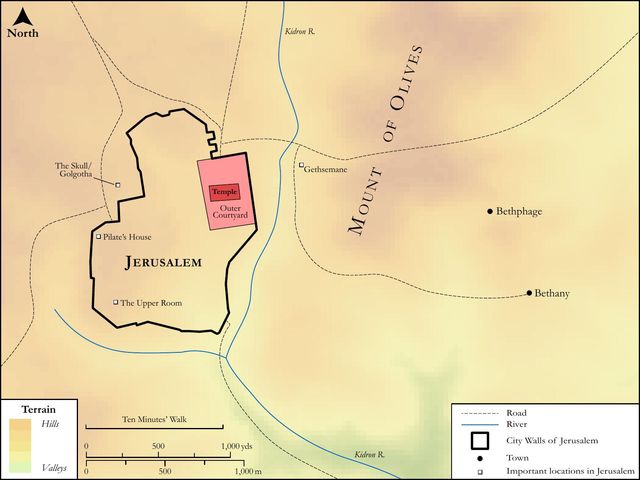
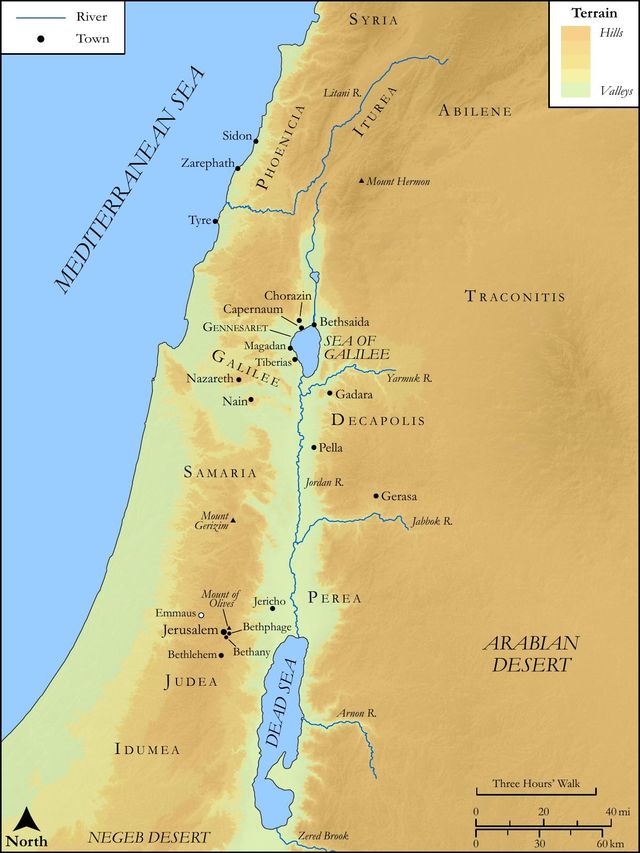
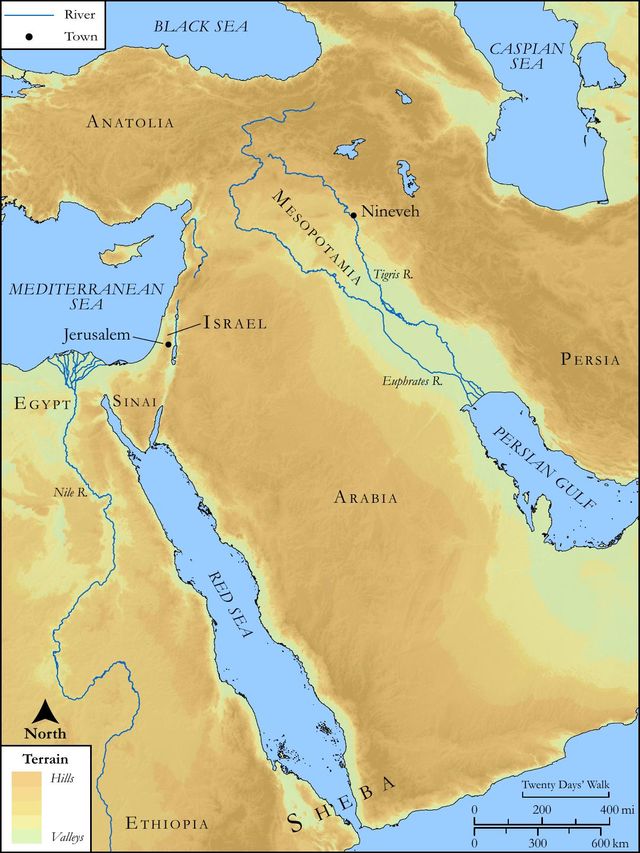
See on the biblical-era maps
Study this verse
Public-domain commentary
Matthew Henry
From his Commentary on the Whole Bible. Henry comments on passages, not single verses — this entry covers Luke 22:1–6. His two-level outline is real structure in the source text, so it is rendered as structure.
The year of the redeemed is now come, which had been from eternity fixed in the divine counsels, and long looked for by them that waited for the consolation of Israel. After the revolutions of many ages, it is at length come, Isa 63:4. And, it is observable, it is in the very first month of that year that the redemption is wrought out, so much in haste was the Redeemer to perform his undertaking, so was he straitened till it was accomplished. It was in the same month, and at the same time of the month (in the beginning of months, Exo 12:2), that God by Moses brought Israel out of Egypt, that the Antitype might answer the type. Christ is here delivered up, when the feast of unleavened bread drew nigh, Luk 22:1. About as long before that feast as they began to make preparation for it, here was preparation making for our Passover's being offered for us. Here we have,
I.His sworn enemies contriving it (Luk 22:2), the chief priests, men of sanctity, and the scribes, men of learning, seeking how they might kill him, either by force of fraud. Could they have had their will, it had been soon done, but they feared the people, and the more for what they now saw of their diligent attendance upon his preaching.
II.A treacherous disciple joining in with them, and coming to their assistance, Judas surnamed Iscariot.
He is here said to be of the number of the twelve, that dignified distinguished number. One would wonder that Christ, who knew all men, should take a traitor into that number, and that one of that number, who could not but know Christ, should be so base as to betray him; but Christ had wise and holy ends in taking Judas to be a disciple, and how he who knew Christ so well yet came to betray him we are here told: Satan entered into Judas, Luk 22:3. It was the devil's work, who thought hereby to ruin Christ's undertaking, to have broken his head; but it proved only the bruising of his heel. Whoever betrays Christ, or his truths or ways, it is Satan that puts them upon it. Judas knew how desirous the chief priests were to get Christ into their hands, and that they could not do it safely without the assistance of some that knew his retirements, as he did. He therefore went himself, and made the motion to them, Luk 22:4. Note, It is hard to say whether more mischief is done to Christ's kingdom by the power and policy of its open enemies, or by the treachery and self-seeking of its pretended friends: nay, without the latter its enemies could not gain their point as they do. When you see Judas communing with the chief priests, be sure some mischief is hatching; it is for no good that they are laying their heads together.
III.The issue of the treaty between them.
1.Judas must betray Christ to them, must bring them to a place where they might seize him without danger of tumult, and this they would be glad of.
2.They must give him a sum of money for doing it, and this he would be glad of (Luk 22:5): They covenanted to give him money. When the bargain was made, Judas sought opportunity to betray him. Probably, he slyly enquired of Peter and John, who were more intimate with their Master than he was, where he would be at such a time, and whither he would retire after the passover, and they were not sharp enough to suspect him. Somehow or other, in a little time he gained the advantage he sought, and fixed the time and place where it might be done, in the absence of the multitude, and without tumult.
Historical interpretation
Nine Centuries of Reception
9 surviving comments on this verse. Each one is dated, so this reads as a timeline rather than a list.
Select a marker to jump to its quote. Markers stagger vertically where authors wrote within a few decades of each other.
For it is written in my Gospel that "Satan entered into Judas." According to Marcion, however, the apostle in the passage under consideration does not allow the imputation of ignorance, with respect to the Lord of glory, to the powers of the Creator; because, indeed, he will have it that these are not meant by "the princes of this world.
Jesus Christ our Savior has been crucified. The author of this crime and father of this wickedness is, without doubt, the devil. It is written: "When, however, the devil had entered the heart of Judas Iscariot that he should betray him." The devil is the father of sin. He fathered Judas as his first son in this wickedness, but Judas alone could not execute the betrayal. What then is written? "Judas departed," Scripture says, "to the scribes and Pharisees and chief priests and said to them: 'What will you give me, and I will deliver him to you?' " The third and fourth generation of sin was born from Judas.
Satan entered into Judas not by force, but finding the door open. For forgetful of all that he had seen, Judas now turned his thoughts solely to covetousness.
And he adds, one of the twelve, since he made up the number, though he did not truly discharge the Apostolic office. Or the Evangelist adds this, as it were for contrast sake. As if he said, "He was of the first band of those who were especially chosen."
(Hom. 80. in Matt.) St. Luke gives his surname, because there was another Judas.
(ut sup.) Observe the exceeding iniquity of Judas, that he both sets out by himself, and that he does this for gain. It follows, And he went his way, and communed with the chief priests and captains.
(ut sup.) By covetousness then Judas became what he was, for it follows, And they covenanted to give him money. Such are the evil passions which covetousness engenders, it makes men irreligious, and compels them to lose all knowledge of God, though they have received a thousand benefits from Him, nay, even to injure Him, as it follows, And he contracted with them.
Judas lost heaven for a little silver. He missed the crown of immortality and the desirable honor of the apostleship. He missed to be numbered among the Twelve to whom Christ somewhere said, "You are the light of the world." He did not care to be a light of the world. He forgot Christ, who says, "You who have followed me in my temptations, when the Son of man shall sit upon the throne of his glory, you also will sit on twelve thrones and judge the twelve tribes of Israel." Judas did not want to reign with Christ. What a confusion of error blinded the mind of that greedy man! The Evangelist says, "Satan entered him." His pathway and door was the passion of greed. "There is great gain in godliness with contentment." The sacred Scripture says, "We neither brought anything into the world, nor can we carry anything out." Those who seek to be rich, fall into numerous and unprofitable lusts, which sink people in pitfalls and destruction. The disciple who became a traitor is a clear proof of this, because he perished for the sake of a few miserable coins.
What was this many-headed serpent's invention? It says, "He entered Judas Iscariot, who was one of the Twelve." Why did he not rather enter blessed Peter, James, John, or some other of the rest of the apostles? Why Judas Iscariot? What did Satan find in him? Satan could not approach any of those we have mentioned here, because their heart was steadfast and their love to Christ immovable. There was a place for Satan in the traitor. The bitter disease of greed, which the blessed Paul says is the root of all evil, had overpowered him. Satan is crafty in working evil. Whenever he gains possession of anyone's soul, he does not attack him by means of general vice. He rather searches for that particular passion that has power over him and by its means makes him his prey.
There is nothing contrary to this in what John says, that after the sop Satan entered into Judas; seeing he now entered into him as a stranger, but then as his own, whom he might lead after him to do whatsoever he willed.
Now many shudder at the wickedness of Judas, yet do not guard against it. For whosoever despises the laws of truth and love, betrays Christ who is truth and love. Above all, when he sins not from infirmity or ignorance, but after the likeness of Judas seeks opportunity, when no one is present, to change truth for a lie, virtue for crime.
But Satan entered into Judas surnamed Iscariot, who was one of the twelve. John notes in his Gospel that when the Lord had dipped the bread, he gave it to Judas, the son of Simon Iscariot, and after the morsel, then Satan entered into him. But this does not contradict Luke, who recounts that Satan had already invaded him before the morsel, because the one whom he now entered to deceive, he later entered to possess more fully as one already handed over. Now he entered to tempt as though he were still a stranger, then to drag him, as though already his own, to accomplish any harmful deeds he wished.
Having already said that the Chief Priests sought means how they might slay Jesus without incurring any danger, he next goes on to relate the means which occurred to them, as it is said, Then entered Satan into Judas.
The magistrates here mentioned were those appointed to take care of the buildings of the temple, or it may be those whom the Romans had set over the people to keep them from breaking forth into tumult; for they were seditious.
That is, he bargained and promised. And sought opportunity to betray him unto them, without the crowds, that is, when he saw Him standing by Himself apart, in the absence of the multitude.
Continue studying Luke 22:3 across the web’s major study libraries — every link below opens this exact verse, chapter, or book on the destination site.
Read & Compare
 BibleGatewayThis verse in more than 200 translations and 70 languages.
 Bible.comThe YouVersion reader — hundreds of translations, reading plans, and highlights.
 ESV.orgCrossway's official English Standard Version reader.
 NET BibleThe NET translation with 60,000+ translators' notes on every rendering decision.
 STEP BibleTyndale House's free study tool — original text, vocabulary, and scholarly resources.
 BibliaLogos Bible Software's free web reader.
 USCCBThe New American Bible (Revised Edition) with the U.S. bishops' study notes.
Commentaries
 BibleHub CommentariesDozens of classic commentaries on this verse, gathered on one page.
 StudyLightMore than 100 commentary sets — the largest collection on the web.
 BibleRefPlain-English commentary on what this verse means, verse by verse.
 Enduring WordDavid Guzik's free commentary on this chapter, widely used by Bible teachers.
 Bible Study ToolsVerse commentary alongside Greek and Hebrew study aids.
Original Language & Research
- BibleHub InterlinearThe verse word by word — original language, transliteration, and English.
- BibleHub LexiconEvery word's original-language definition and Strong's entry.
 Blue Letter BibleDeep-study tools — Strong's numbers, concordance, and word studies.
 CNTR CollationThe earliest Greek manuscripts of this verse, collated letter by letter.
Sermons, Hymns & Audio


TrulyRandomVerse is not affiliated with these sites and doesn’t control their content. They’re linked because they’re genuinely useful.
Summary
Luke 22:3 marks a pivotal and ominous moment in the passion narrative, revealing the direct intervention of Satan in the life of Judas Iscariot, one of Jesus's chosen twelve disciples. This verse sets the stage for the betrayal of Jesus, underscoring the spiritual forces at play behind human actions and highlighting the profound tragedy of a trusted insider becoming the instrument of evil. It serves as a stark reminder of the reality of spiritual warfare and the vulnerability of even those closest to divine truth when their hearts are not fully devoted.
Context
ShowHideLiterary Context
This verse immediately follows the account of the chief priests and scribes seeking a way to kill Jesus, fearing the people's reaction if they acted openly (Luke 22:1-2). The narrative then shifts abruptly to Judas, presenting his willingness to betray Jesus as the providential solution to their dilemma. This juxtaposition emphasizes the dark convergence of human malice and demonic influence, setting the stage for the Passover preparations and the Last Supper, which will be irrevocably tainted by this impending betrayal. The subsequent verses detail Judas's agreement with the religious authorities and their joy at securing an insider's help (Luke 22:4-6).
Historical & Cultural Context
The setting is Jerusalem, just before the Passover feast, a time when the city swelled with pilgrims, making any public arrest of a popular figure like Jesus fraught with danger for the authorities. The Sanhedrin, the Jewish high court, was desperate to eliminate Jesus, viewing Him as a threat to their authority and the delicate peace with Rome. Betrayal for money was not uncommon in that day, and the thirty pieces of silver mentioned in Matthew's account (Matthew 26:15) would have been a significant sum, though perhaps not enough to justify such an act for a truly devoted follower. The concept of demonic influence and possession was also well-understood in Jewish culture, providing a framework for interpreting extraordinary evil.
Key Themes
ShowHideThis verse powerfully contributes to several overarching themes in Luke's Gospel and the broader biblical narrative. It highlights the pervasive theme of spiritual warfare, demonstrating that human events, especially those with eternal significance, are often undergirded by unseen spiritual battles. The betrayal by an insider underscores the theme of discipleship and its perils, revealing that proximity to Jesus does not guarantee faithfulness if the heart is compromised by sin, as Judas's greed is noted elsewhere (John 12:6). Finally, it speaks to divine sovereignty and human responsibility, illustrating how even the wicked actions of individuals, influenced by evil, ultimately serve God's redemptive plan, leading to the crucifixion and resurrection (Acts 2:23).
Exposition and Analysis
ShowHideKey Word Analysis
ShowHideThis verb signifies a movement from outside to inside, indicating a complete and deliberate indwelling or penetration. In this context, it suggests more than mere temptation or influence; it implies a profound, personal invasion of Judas's being by Satan, contrasting with a superficial or external prompting. This entry marks a critical turning point, empowering Judas to act as Satan's direct agent.
Derived from a Hebrew word meaning "adversary" or "accuser," Satan is here presented as a personal, malevolent spiritual being, the chief antagonist of God and humanity. His "entering" Judas signifies his active role in orchestrating the betrayal of Jesus, revealing the ultimate source of the evil behind the human plot. He is not merely a force of evil but a cunning, strategic enemy.
This number is highly significant, referring to the innermost circle of Jesus's disciples, chosen by Him to be His apostles and the foundation of the new Israel (Luke 6:13). The fact that the betrayer came from "the number of the twelve" intensifies the shock and tragedy of the betrayal, highlighting the profound pain of treachery from within the most trusted ranks.
Verse Breakdown
ShowHide"Then entered Satan"
This phrase immediately establishes the supernatural dimension of the impending betrayal. It is not merely Judas's human weakness or greed at play, but the direct, active agency of Satan himself. The timing, "Then," links this spiritual invasion directly to the religious leaders' plot, suggesting a demonic orchestration of events to fulfill their murderous desires.
"into Judas surnamed Iscariot"
This identifies the specific target of Satan's entry. Judas, who had been a close disciple, is now depicted as being fully indwelt by the adversary. The "surnamed Iscariot" distinguishes him from other individuals named Judas and subtly reminds the reader of his identity as the infamous betrayer.
"being of the number of the twelve"
This clause emphasizes the shocking nature of the betrayal. Judas was not an outsider or an enemy agent, but one of the chosen inner circle, a witness to Jesus's miracles, teachings, and intimate fellowship. This detail magnifies the depth of the treachery and the pain it would inflict upon Jesus and the remaining disciples.
Literary Devices
ShowHideLuke's concise statement in Luke 22:3 employs several powerful literary devices. Foreshadowing is prominent, as this verse immediately signals the impending betrayal and the dark spiritual forces behind it, building tension for the passion narrative. The phrase "entered Satan" is a stark example of personification, attributing direct, active agency to Satan, not merely as a concept of evil but as a tangible, invading entity. The use of contrast is also evident: Judas, "of the number of the twelve," a position of immense privilege and trust, is juxtaposed with the horrifying reality of being indwelt by Satan, highlighting the tragic fall from grace. Finally, the succinctness of the verse contributes to its dramatic impact, delivering a chilling revelation with profound theological implications.
Theological and Thematic Connections
ShowHideLuke 22:3 serves as a profound theological statement on the reality of spiritual warfare and the vulnerability of the human heart to evil. It underscores the biblical truth that sin is not merely a human failing but often has a demonic dimension, with Satan actively seeking to corrupt and destroy. While Judas made a conscious choice to betray Jesus, this verse reveals the spiritual power that exploited his existing weaknesses—his greed and lack of true devotion—to achieve its malevolent ends. This highlights the constant need for vigilance and reliance on God's power to resist the schemes of the devil, even for those within the community of faith.
Reflection and Application
ShowHideThe chilling reality of Satan entering Judas serves as a powerful and sobering reminder for every believer. It teaches us that spiritual warfare is not a distant concept but a present reality, and that the enemy actively seeks to exploit our weaknesses and vulnerabilities. Judas, despite walking with Jesus, witnessing miracles, and hearing divine truth, allowed a foothold for evil through unaddressed sin, specifically greed. This calls us to a radical self-examination, to guard our hearts diligently against any sin that might become a gateway for destructive spiritual influence. It emphasizes the critical importance of cultivating genuine devotion, humility, and dependence on Christ, recognizing that outward religious observance without inward transformation is a dangerous facade. Our defense against such spiritual attacks lies in constant prayer, immersion in God's Word, and reliance on the Holy Spirit, ensuring that our hearts remain a dwelling place for Christ, not a foothold for the adversary.
Questions for Reflection
ShowHideFAQ
ShowHideDid Judas have a choice, or was he merely a puppet of Satan?
ShowHideThe biblical narrative presents a complex interplay between human choice and divine/demonic influence. While Luke 22:3 explicitly states that "Satan entered Judas," other passages indicate Judas's own agency and motivations. John 12:6 reveals his covetousness, and Matthew 26:14-16 shows him proactively seeking to betray Jesus for money. Satan's entry likely amplified and empowered Judas's pre-existing sinful desires, pushing him to act on them. Thus, Judas was not a mere puppet; he made a conscious, morally culpable choice, but his will was profoundly influenced and strengthened by Satan's direct intervention. This highlights the biblical tension between human responsibility and spiritual forces at play.
Christ-Centered Fulfillment
ShowHideLuke 22:3, though a dark moment, ultimately points to the profound redemptive work of Christ. The entry of Satan into Judas was a critical step in the collision of kingdoms leading to the crucifixion, an event that, though orchestrated by evil, was paradoxically part of God's sovereign plan for salvation. Jesus Himself foreknew this betrayal, even identifying His betrayer at the Last Supper (John 13:21-27), demonstrating His complete control even in the face of demonic opposition. The ultimate triumph of Christ on the cross and His resurrection utterly defeated Satan's power, rendering his schemes futile in the grand scope of God's purposes. The betrayal by Judas, empowered by Satan, served to fulfill ancient prophecies, particularly those concerning the suffering servant (Isaiah 53), and ultimately led to the very sacrifice that would redeem humanity from the power of sin and death, breaking the chains of the one who had the power of death, that is, the devil (Hebrews 2:14-15). Thus, even the deepest betrayal becomes a testament to Christ's unwavering commitment to His mission and His ultimate victory over all the forces of darkness.