


Mark 14:9
Bible text: King James Version (1769 Blayney text) · Public domain
Bible text: King James Version with Strong's numbers · Public domain
Bible text: Berean Standard Bible · Public domain
Bible text: American Standard Version (1901) · Public domain
Bible text: World English Bible, Messianic edition · Public domain
Bible text: Geneva Bible (1599) · Public domain
Bible text: Young's Literal Translation · Public domain
- ἀμὴνamēnAmenG281INJ-HEBInterjection
- λέγωlegōI sayG3004V-PAI-1SVerb Present Active Indicative 1st Singular
- ὑμῖν·huminto youG4771P-2DPPersonal pronoun Dative 2nd Plural
- ὅπουhopouwhereverG3699CONJConjunction
- ἐὰνeanmaybeG1437CONDConjunction
- κηρυχθῇkēruchthēashall be proclaimedG2784V-APS-3SVerb Aorist Passive Subjunctive 3rd Singular
- τὸto<the>G3588T-NSNDefinite article Nominative Singular Neuter
- εὐαγγέλιονeuangeliongospelG2098N-NSNNoun Nominative Singular Neuter
- τοῦτοtoutothisG3778D-NSNDemonstrative pronoun Nominative Singular Neuter
- εἰςeisinG1519PREPPreposition
- ὅλονholonwholeG3650A-ASMAdjective Accusative Singular Masculine
- τὸνtontheG3588T-ASMDefinite article Accusative Singular Masculine
- κόσμονkosmonworldG2889N-ASMNoun Accusative Singular Masculine
- καὶkaialsoG2532CONJConjunction
- ὃhowhatG3739R-ASNRelative pronoun Accusative Singular Neuter
- ἐποίησενepoiēsenhas doneG4160V-AAI-3SVerb Aorist Active Indicative 3rd Singular
- αὕτηhautēthis [woman]G3778D-NSFDemonstrative pronoun Nominative Singular Feminine
- λαληθήσεταιlalēthēsetaiwill be spoken ofG2980V-FPI-3SVerb Future Passive Indicative 3rd Singular
- εἰςeisforG1519PREPPreposition
- μνημόσυνονmnēmosunona memorialG3422N-ASNNoun Accusative Singular Neuter
- αὐτῆςautēsof herG846P-GSFPersonal pronoun Genitive Singular Feminine
English is a literal word-by-word gloss of the Greek, not the KJV's wording. Why?
This is the original text the KJV's translators worked from — each Greek word with its own literal English meaning in this verse, prepared by scholars at Tyndale House, Cambridge. The KJV translates whole sentences, not word by word, so its wording differs: one Greek word can become several English words, and the KJV may choose “charity” where the gloss reads “love”. Both are faithful — they answer different questions. For the KJV's own rendering, switch to the KJV text.
Details
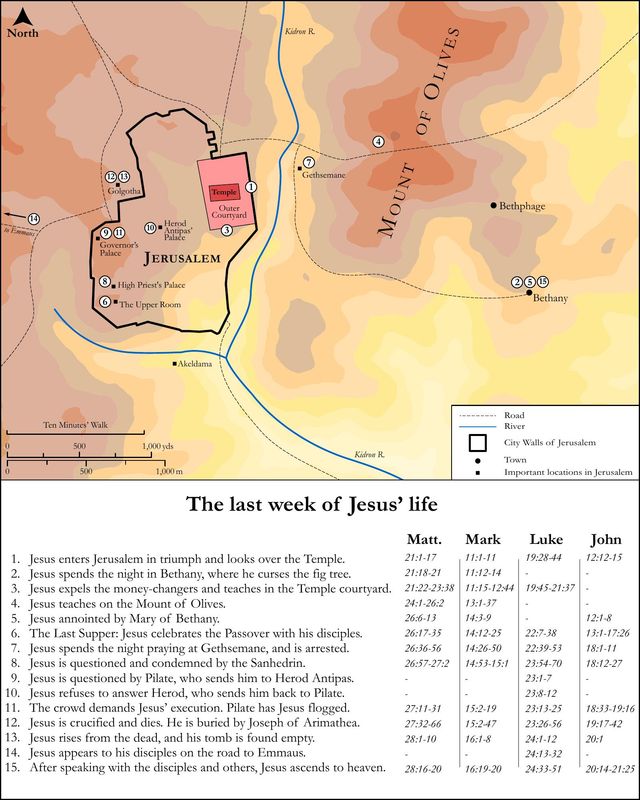
See on the biblical-era maps


Study this verse
Public-domain commentary
Matthew Henry
From his Commentary on the Whole Bible. Henry comments on passages, not single verses — this entry covers Mark 14:1–11. His three-level outline is real structure in the source text, so it is rendered as structure.
We have here instances,
I.Of the kindness of Christ's friends, and the provision made of respect and honour for him.
Some friends he had, even in and about Jerusalem, that loved him, and never thought they could do enough for him, among whom, though Israel be not gathered, he is, and will be, glorious.
1.Here was one friend, that was so kind as to invite him to sup with him; and he was so kind as to accept the invitation, Mar 14:3. Though he had a prospect of his death approaching, yet he did not abandon himself to a melancholy retirement from all company, but conversed as freely with his friends as usual.
2.Here was another friend, that was so kind as to anoint his head with very precious ointment as he sat at meat. This was an extraordinary piece of respect paid him by a good woman that thought nothing too good to bestow upon Christ, and to do him honour. Now the scripture was fulfilled, When the king sitteth at his table, my spikenard sendeth forth the smell thereof, Sol 1:12. Let us anoint Christ as our Beloved, kiss him with a kiss of affection; and anoint him as our Sovereign, kiss him with a kiss of allegiance. Did he pour out his soul unto death for us, and shall we think any box of ointment too precious to pour out upon him? It is observable that she took care to pour it all out upon Christ's head; she broke the box (so we read it); but because it was an alabaster box, not easily broken, nor was it necessary that it should be broken, to get out the ointment, some read it, she shook the box, or knocked it to the ground, to loosen what was in it, that it might be got out the better; or, she rubbed and scraped out all that stuck tot he sides of it. Christ must have been honoured with all we have, and we must not think to keep back any part of the price. Do we give him the precious ointment of our best affections? Let him have them all; love him with all the heart.
Now, (1.) There were those that put a worse construction upon this than it deserved. They called it a waste of the ointment, Mar 14:4. Because they could not have found their hearts to put themselves to such an expense for the honouring of Christ, they thought that she was prodigal, who did. Note, As the vile person ought to be called liberal, nor the churl said to be bountiful (Isa 32:5); so the liberal and bountiful ought not to be called wasteful. They pretend it might have been sold, and given to the poor, Mar 14:5. But as a common piety to the corban will not excuse from a particular charity to a poor parent (Mar 7:11), so a common charity to the poor will not excuse from a particular act of piety to the Lord Jesus. What thy hand finds to do, that is good, do it with thy might.
(2.)Our Lord Jesus put a better construction upon it than, for aught that appears, was designed. Probably, she intended no more, than to show the great honour she had for him, before all the company, and to complete his entertainment. But Christ makes it to be an act of great faith, as well as great love (Mar 14:8); "She is come aforehand, to anoint my body to the burying, as if she foresaw that my resurrection would prevent her doing it afterward." This funeral rite was a kind of presage of, or prelude to, his death approaching. See how Christ's heart was filled with the thoughts of his death, how every thing was construed with a reference to that, and how familiarly he spoke of it upon all occasions. It is usual for those who are condemned to die, to have their coffins prepared, and other provision made for their funerals, while they are yet alive; and so Christ accepted this. Christ's death and burial were the lowest steps of his humiliation, and therefore, though he cheerfully submitted to them, yet he would have some marks of honour to attend them, which might help to take off the offence of the cross, and be an intimation how precious in the sight of the Lord the death of his saints is. Christ never rode in triumph into Jerusalem, but when he came thither to suffer; nor had ever his head anointed, but for his burial.
(3.)He recommended this piece of heroic piety to the applause of the church in all ages; Wherever this gospel shall be preached, it shall be spoken of, for a memorial of her, Mar 14:9. Note, The honour which attends well-doing, even in this world, is sufficient to balance the reproach and contempt that are cast upon it. The memory of the just is blessed, and they that had trial of cruel mockings, yet obtained a good report, Heb 11:6, Heb 11:39. Thus was this good woman repaid for her box of ointment, Nec oleum perdidit nec operam - She lost neither her oil nor her labour. She got by it that good name which is better than precious ointment. Those that honour Christ he will honour.
II.Of the malice of Christ's enemies, and the preparation made by them to do him mischief.
1.The chief priests, his open enemies, consulted how they might put him to death, Mar 14:1, Mar 14:2. The feast of the passover was now at hand, and at that feast he must be crucified,
(1.)That his death and suffering might be the more public, and that all Israel, even those of the dispersion, who came from all parts to the feast, might be witnesses of it, and of the wonders that attended it.
(2.)That the Anti-type might answer to the type. Christ, our Passover, was sacrificed for us, and brought us out of the house of bondage, at the same time that the paschal lamb was sacrificed, and Israel's deliverance out of Egypt was commemorated.
Now see, [1.] How spiteful Christ's enemies were; they did not think it enough to banish or imprison him, for they aimed not only to silence him, and stop his progress for the future, but to be revenged on him for all the good he had done. [2.] How subtle they were; Not on the feast-day, when the people are together; they do not say, Lest they should be disturbed in their devotions, and diverted from them, but, Lest there should be an uproar (Mar 14:2); lest they should rise, and rescue him, and fall foul upon those that attempt any thing against him. They who desired nothing more than the praise of men, dreaded nothing more than the rage and displeasure of men.
2.Judas, his disguised enemy, contracted with them for the betraying of him, Mar 14:10, Mar 14:11. He is said to be one of the twelve that were Christ's family, intimate with him, trained up for the service of the kingdom; and he went to the chief priests, to tender his service in this affair.
(1.)That which he proposed to them, was, to betray Christ to them, and to give them notice when and where they might find him, and seize him, without making an uproar among the people, which they were afraid of, if they should seize him when he appeared in public, in the midst of his admirers. Did he know then what help it was they wanted, and where they were run aground in their counsels? It is probable that he did not, for the debate was held in their close cabal. Did they know that he had a mind to serve them, and make court to him? No, they could not imagine that any of his intimates should be so base; but Satan, who was entered into Judas, knew what occasion they had for him, and could guide him to be guide to them, who were contriving to take Jesus. Note, The spirit that works in all the children of disobedience, knows how to bring them in to the assistance one of another in a wicked project, and then to harden them in it, with the fancy that Providence favours them.
(2.)That which he proposed to himself, was, to get money by the bargain; he had what he aimed at, when they promised to give him money. Covetousness was Judas's master - lust, his own iniquity, and that betrayed him to the sin of betraying his Master; the devil suited his temptation to that, and so conquered him. It is not said, They promised him preferment (he was not ambitious of that), but, they promised him money. See what need we have to double our guard against the sin that most easily besets us. Perhaps it was Judas's covetousness that brought him at first to follow Christ, having a promise that he should be cash-keeper, or purser, to the society, and he loved in his heart to be fingering money; and now that there was money to be got on the other side, he was as ready to betray him as ever he had been to follow him. Note, Where the principle of men's profession of religion is carnal and worldly, and the serving of a secular interest, the very same principle, whenever the wind turns, will be the bitter root of a vile and scandalous apostasy.
(3.)Having secured the money, he set himself to make good his bargain; he sought how he might conveniently betray him, how he might seasonably deliver him up, so as to answer the intention of those who had hired him. See what need we have to be careful that we do not ensnare ourselves in sinful engagements. If at any time we be so ensnared in the words of our mouths, we are concerned to deliver ourselves by a speedy retreat, Pro 6:1-5. It is a rule in our law, as well as in our religion, that an obligation to do an evil thing is null and void; it binds to repentance, not to performance. See how the way of sin is down-hill - when men are in, they must be on; and what wicked contrivances many have in their sinful pursuits, to compass their designs conveniently; but such conveniences will prove mischiefs in the end.
Historical interpretation
Seven Centuries of Reception
6 surviving comments on this verse. Each one is dated, so this reads as a timeline rather than a list.
Select a marker to jump to its quote. Markers stagger vertically where authors wrote within a few decades of each other.
For the fawn amongst the stags ever comes back to his couch, that is, the Son, obedient to the Father even unto death, seeks for obedience from us.
Again in a mystic sense, Simon the leper means the world, first infidel, and afterwards converted, and the woman with the alabaster box, means the faith of the Church, who says, My spikenard sendeth forth its smell. It is called pistic nard, that is, faithful, and precious. (Cant. 1:12). The house filled with the smell of it is heaven and earth; the broken alabaster box is carnal desire, which is broken at the Head, from which the whole body is framed together, whilst He was reclining, that is, humbling Himself, that the faith of the sinner might be able to reach Him, for she went up from the feet to the head, and down from the head to the feet by faith, that is, to Christ and to His members. It goes on: And there were some that had indignation within themselves, and said, Why was this loss of the ointment? By the figure synecdoche, one is put for many, and many for one; for it is the lost Judas who finds loss in salvation; thus in the fruitful vine rises the snare of death. Under the cover of his avarice, however, the mystery of faith speaks; for our faith is bought for three hundred pence, in our ten senses, that is, (denarii i. e. ten asses.) our inward and outward senses which are again trebled by our body, soul, and spirit.
He says also, She hath wrought a good work on me, for whosoever believes on the Lord, it is counted unto Him for righteousness. For it is one thing to believe Him, and to believe on Him, that is, to cast ourselves entirely upon Him. It goes on: She hath done what she could, she is come aforehand to anoint my body to the burying.
The Persians, the Indians, Scythians, Thracians, Samaratians, the race of the Moors and the inhabitants of the British isles celebrate a deed, performed in a private family in Judea by a woman who had been a sinner.
(de Con. Evan. ii. 79) I however think that nothing else can be meant, but that the sinner who then came to the feet of Jesus was no other than the same Mary who did this twice; once, as Luke relates it, when coming for the first time with humility and tears she merited the remission of her sins. For John also relates this, when he began to speak of the raising of Lazarus before He came to Bethany, saying, It was that Mary which anointed the Lord with ointment, and wiped his feet with her hair, whose brother Lazarus was sick. (John 11:2) But what she again did at Bethany is another act, unrecorded by Luke, but mentioned in the same way by the other three Evangelists. In that therefore Matthew and Mark say that the head of the Lord was anointed by the woman, whilst John says the feet, we must understand that both the head and the feet were anointed by the woman. Unless because Mark has said that she broke the box in order to anoint His head, any one is so fond of cavilling as to deny that, because the box was broken, any could remain to anoint the feet of the Lord. But a man of a more pious spirit will contend that it was not broken so as to pour out the whole, or else that the feet were anointed before it was broken, so that there remained in the unbroken box enough to anoint the head.
(de Con. Evan. ii. 78) It may appear to be a contradiction, that Matthew and Mark after mentioning two days and the Passover, (John 12:1) add afterwards that Jesus was in Bethany, where that precious ointment is mentioned; whilst John, just before he speaks of the anointing, says, that Jesus came into Bethany six days before the feast. But those persons who are troubled by this, are not aware that Matthew and Mark do not place that anointing in Bethany immediately after that two days of which he foretold, but by way of recapitulation at the time when there were yet six days to the Passover.
Amen, I say to you, wherever this Gospel is proclaimed in the whole world, what she has done will also be told in memory of her. Pay attention to this knowledge of future events, that He knew He would suffer after a few days, and that His Gospel would be celebrated in the whole world. It should be noted that just as Mary has achieved glory throughout the world, wherever the holy Church has spread, because of the homage of devoted piety she showed to the Lord, so, conversely, the one who did not fear to detract from her homage with a reckless tongue, has been infamously known for his treachery far and wide, and deservedly made hateful to God and men alike. But the Lord, rewarding good with worthy praise, silently overlooked the future insults of the wicked.
(ubi sup.) The Lord when about to suffer for the whole world, and to redeem all nations with His blood, dwells in Bethany, that is, in the house of obedience; wherefore it is said, And being in Bethany in the house of Simon the leper, as he sat at meat, there came a woman.
(ubi sup.) He says of Simon the leper, not because he remained still a leper at that time, but because having once been such, he was healed by our Saviour; his former name is left, that the virtue of the Healer may be made manifest.
(ubi sup.) Alabaster is a sort of white marble, veined with various colours which is often hollowed out for boxes of ointment, because it keeps things of that nature most uncorrupt. Nard is an aromatic shrub of a large and thick root, but short, black, and brittle; though unctuous, it smells like cypress, and has a sharp taste, and small and dense leaves. Its tops spread themselves out like ears of corn, therefore, its gift being double, perfumers make much of the spikes and the leaves of the nard. And this is what is meant by Mark, when he says spikenard very precious, that is, the ointment which Mary brought for the Lord was not made of the root of nard, but even, what made it more precious, by the addition of the spikes and the leaves, the gratefulness of its smell and virtue was augmented.
(ubi sup.) And in that he says, And they murmured against her, we must not understand this to be spoken of the faithful Apostles, but rather of Judas mentioned in the plural.
(ubi sup.) To me, indeed, He seems to speak of His bodily presence, that He should by no means be with them after His resurrection, as He then was living with them in all familiarity.
(ubi sup.) As if the Lord said, What ye think is a waste of ointment is the service of my burial.
(ubi sup.) Observe also, that as Mary won glory throughout the whole world for the service which she rendered to the Lord, so, on the contrary, he who was bold enough to reprove her service, is held in infamy far and wide; but the Lord in rewarding the good with due praise has passed over in silence the future shame of the impious.
Nevertheless, Christ Himself had determined for Himself the day of His Passion; for He wished to be crucified on the Passover, because He was the true Passover.
But although the four Evangelists record the anointing by a woman, there were two women and not one; one described by John, the sister of Lazarus; it was she who six days before the Passover anointed the feet of Jesus; another described by the other three Evangelists. Nay, if you examine, you will find three; for one is described by John, another by Luke, a third by the other two. For that one described by Luke is said to be a sinner and to have come to Jesus during the time of His preaching; but this other described by Matthew and Mark is said to have come at the time of the Passion, nor did she confess that she had been a sinner.
Or as is said in Greek, of pistic nard, that is, faithful, because the ointment of the nard was made faithfully and without counterfeit. (Matt. 26:2)
Or else, it appears to be aptly implied that many disciples murmured against the woman, because they had often heard our Lord talking of alms. Judas, however, was indignant, but not with the same feeling, but on account of his love of money, and filthy gain; wherefore John also records him alone, as accusing the woman with a fraudulent intent. But he says, They murmured against her, meaning that they troubled her with reproaches, and hard words. Then our Lord reproves His disciples, for throwing obstacles against the wish of the woman. Wherefore it goes on: And Jesus said, Let her alone, why trouble ye her? For after she had brought her gift, they wished to prevent her purpose by their reproaches.
For she is come aforehand as though led by God to anoint my body, as a sign of my approaching burial; by which He confounds the traitor, as if He said, With what conscience canst thou confound the woman, who anoints my body to the burial, and dost not confound thyself, who wilt deliver me to death? But the Lord makes a double prophecy; one that the Gospel shall be preached over the whole world, another that the deed of the woman shall be praised. Wherefore it goes on: Verily I say unto you, Wheresoever this gospel shall be preached throughout the whole world, this also that she hath done shall be spoken of for a memorial of her.
Continue studying Mark 14:9 across the web’s major study libraries — every link below opens this exact verse, chapter, or book on the destination site.
Read & Compare
 BibleGatewayThis verse in more than 200 translations and 70 languages.
 Bible.comThe YouVersion reader — hundreds of translations, reading plans, and highlights.
 ESV.orgCrossway's official English Standard Version reader.
 NET BibleThe NET translation with 60,000+ translators' notes on every rendering decision.
 STEP BibleTyndale House's free study tool — original text, vocabulary, and scholarly resources.
 BibliaLogos Bible Software's free web reader.
 USCCBThe New American Bible (Revised Edition) with the U.S. bishops' study notes.
Commentaries
 BibleHub CommentariesDozens of classic commentaries on this verse, gathered on one page.
 StudyLightMore than 100 commentary sets — the largest collection on the web.
 BibleRefPlain-English commentary on what this verse means, verse by verse.
 Enduring WordDavid Guzik's free commentary on this chapter, widely used by Bible teachers.
 Bible Study ToolsVerse commentary alongside Greek and Hebrew study aids.
Original Language & Research
- BibleHub InterlinearThe verse word by word — original language, transliteration, and English.
- BibleHub LexiconEvery word's original-language definition and Strong's entry.
 Blue Letter BibleDeep-study tools — Strong's numbers, concordance, and word studies.
 CNTR CollationThe earliest Greek manuscripts of this verse, collated letter by letter.
Sermons, Hymns & Audio


TrulyRandomVerse is not affiliated with these sites and doesn’t control their content. They’re linked because they’re genuinely useful.
Summary
In Mark 14:9, Jesus pronounces a profound and prophetic declaration concerning an unnamed woman's act of devotion. He states with absolute certainty that wherever the good news of the gospel is proclaimed throughout the entire world, her sacrificial deed of anointing Him with costly perfume will also be recounted as an enduring memorial to her. This verse powerfully highlights the eternal significance of genuine faith and extravagant love demonstrated towards Christ, linking personal worship directly to the global mission of God.
Context
ShowHideLiterary Context
This declaration by Jesus is embedded within the intense narrative leading up to His crucifixion during Passover week. The immediate preceding verses (Mark 14:3-8) describe the scene: Jesus is in Bethany, at the home of Simon the Leper. A woman approaches Him with an alabaster flask containing very expensive pure nard perfume and pours it on His head. This act elicits indignant criticism from some of those present, who condemn it as a wasteful expenditure that could have benefited the poor. Jesus, however, sternly rebukes their criticism, defending the woman's action as a "beautiful work" (Mark 14:6) and explicitly interpreting it as a prophetic preparation for His burial, which was imminent. Verse 9 then serves as Jesus's concluding and most emphatic affirmation of the eternal significance of her deed, setting it apart from the disciples' earthly calculations.
Historical & Cultural Context
The setting is Bethany, a village near Jerusalem, just days before the Passover festival, a time of heightened religious and political tension. Anointing with oil or perfume was a common practice in Israel, used for hospitality, purification, healing, or burial preparation. However, the use of "pure nard," an extremely costly perfume imported from India, signified an act of extraordinary extravagance and honor. The disciples' indignation reflects a common cultural value of stewardship and charity, but they failed to grasp the unique, eschatological significance of Jesus's person and His approaching death. The act also carries echoes of prophetic anointing for kings or priests, subtly hinting at Jesus's true identity even in His final days.
Key Themes
ShowHideMark 14:9 contributes significantly to several major themes within the Gospel of Mark and the broader biblical narrative. It underscores the theme of Sacrificial Devotion, contrasting the woman's selfless, extravagant worship with the disciples' more pragmatic and critical perspective, echoing the call for discipleship that involves taking up one's cross (e.g., Mark 8:34). The verse also highlights Prophetic Foresight and Understanding, as the woman's act, perhaps unknowingly on her part, perfectly aligns with Jesus's impending burial, a truth the disciples struggled to comprehend despite Jesus's repeated predictions (e.g., Mark 10:32-34). Crucially, it emphasizes the Global Reach of the Gospel, as Jesus explicitly links her memorial to the worldwide proclamation of the good news, foreshadowing the Great Commission (e.g., Mark 16:15). Finally, it speaks to the Enduring Legacy of Faith, demonstrating that acts of genuine love and devotion to Christ are not forgotten but become an integral part of God's redemptive story.
Exposition and Analysis
ShowHideKey Word Analysis
ShowHideThis word, transliterated from Hebrew, signifies a solemn affirmation, underscoring the absolute truth and certainty of Jesus's declaration. It acts as a divine guarantee, lending immense weight and authority to His subsequent statement.
Meaning "good message" or "good news," this refers to the saving message of Jesus Christ's life, death, resurrection, and reign. It is the core message of salvation and redemption that is to be proclaimed to all nations.
This term denotes something that serves to keep a memory alive, a reminder or record. In this context, it ensures that the woman's extraordinary act of devotion would be perpetually remembered and recounted alongside the gospel itself, securing her legacy in the divine narrative.
Verse Breakdown
ShowHide"Verily I say unto you"
Jesus begins with a solemn and emphatic declaration, using the Hebrew "Amen" (translated "Verily"). This phrase signals a profound truth that is absolutely certain and demands attention, underscoring the divine authority behind His words. It sets His statement apart as a prophetic and unassailable truth.
"Wheresoever this gospel shall be preached throughout the whole world"
This clause establishes the universal and enduring scope of Jesus's prediction. The "gospel" (the good news of salvation through Christ) is destined to be proclaimed globally, reaching every corner of the "whole world" (Greek kósmos, referring to the ordered universe, often implying humanity). This foreshadows the Great Commission and the global expansion of Christianity.
"this also that she hath done shall be spoken of for a memorial of her"
Here, Jesus ties the woman's specific act of devotion directly to the universal proclamation of the gospel. Her deed, which was criticized as wasteful by others, is elevated by Jesus to an eternal status. It will not merely be remembered, but "spoken of" (Greek laléō, to talk, utter words) as an integral part of the gospel message itself, serving as a lasting "memorial" to her faith and love.
Literary Devices
ShowHideMark 14:9 employs several potent literary devices. Hyperbole is evident in Jesus's sweeping statement that her act will be spoken of "throughout the whole world," emphasizing the universal and enduring impact of her devotion, far beyond what might seem possible for a simple act of anointing. The verse also functions as a Prophecy, as Jesus foretells the global spread of the gospel and, remarkably, the inclusion of this specific act within that proclamation. This prophetic element underscores Jesus's divine foreknowledge and authority. Furthermore, there is profound Irony at play: while the disciples, who are meant to be the heralds of the gospel, misunderstand and criticize the woman, Jesus declares that her act will become an inseparable part of the very message they are to preach. Her seemingly small, personal act of devotion is given a grand, universal significance, serving as a Symbol of true worship and discipleship that transcends conventional wisdom and worldly valuations.
Theological and Thematic Connections
ShowHideMark 14:9 profoundly connects the individual act of devotion to the universal mission of God. It teaches that genuine, sacrificial love for Christ, even when misunderstood or criticized by others, holds eternal significance in God's eyes. This passage elevates acts of worship from mere ritual to an integral component of the gospel message itself, demonstrating the kind of radical, unreserved response that Christ inspires and values. The woman's deed becomes a timeless testament to faith that recognizes and responds to Jesus's unique identity and impending sacrifice, serving as an example for all who would follow Him.
Reflection and Application
ShowHideMark 14:9 challenges believers to consider the nature of their own devotion to Christ. The woman's act was not pragmatic or efficient by worldly standards, but it was profoundly sacrificial and beautiful in Jesus's eyes. This verse encourages us to offer our "best" to God, even if it seems extravagant or wasteful to others, because true worship flows from a heart completely surrendered to Him. Our acts of selfless love, generosity, and obedience, however small or unnoticed they may seem in the moment, are seen and treasured by God, and can have an eternal impact, contributing to the unfolding narrative of His redemptive work. It reminds us that God remembers and honors those who honor Him, weaving their stories into the fabric of His global mission.
Questions for Reflection
ShowHideFAQ
ShowHideWhy was the woman's act so important that Jesus said it would be remembered globally?
ShowHideThe woman's act was important because it was an extraordinary demonstration of sacrificial love, profound devotion, and perhaps even prophetic insight into Jesus's impending death and burial. While others, including some disciples, saw her act as a "waste" of expensive perfume, Jesus recognized it as a "beautiful work" (Mark 14:6) and a direct preparation for His burial. By linking her deed to the global proclamation of the "gospel" (the good news of His saving work), Jesus elevated her personal act of worship to an eternal, universal significance. It became a living illustration of the kind of radical faith and love that the gospel itself calls forth, demonstrating that true devotion to Christ transcends worldly calculations and is eternally valued by God. Her act serves as an enduring example of how to respond to the Messiah.
Christ-Centered Fulfillment
ShowHideMark 14:9 finds its ultimate fulfillment in Christ Himself, as the woman's act serves as a poignant foreshadowing and response to His identity and mission. The "gospel" that is to be preached throughout the world is precisely the good news of Jesus Christ—His life, death, and resurrection as the atoning sacrifice for sin. The woman's anointing of Jesus's head was a preparation for His burial, an act of profound reverence for the one who would become the "Lamb of God, who takes away the sin of the world!" (John 1:29). Her extravagant devotion, pouring out costly perfume, mirrors the immeasurable cost of Christ's own self-giving, as He poured out His life as a fragrant offering and sacrifice to God (Ephesians 5:2). Thus, her memorial is not merely about her, but about the Christ she honored, whose suffering and glory are the very heart of the message proclaimed to all nations. Her act becomes a timeless testimony to the worthiness of Jesus, inspiring generations to respond to Him with similar unreserved love and worship, recognizing Him as the King who died and rose again to reconcile the world to God (2 Corinthians 5:18-19).