


Mark 8:34
Bible text: King James Version (1769 Blayney text) · Public domain
Bible text: King James Version with Strong's numbers · Public domain
Bible text: Berean Standard Bible · Public domain
Bible text: American Standard Version (1901) · Public domain
Bible text: World English Bible, Messianic edition · Public domain
Bible text: Geneva Bible (1599) · Public domain
Bible text: Young's Literal Translation · Public domain
- καὶkaiAndG2532CONJConjunction
- προσκαλεσάμενοςproskalesamenoshaving called to [Him]G4341V-ADP-NSMVerb Aorist Middle Deponent Participle Nominative Singular Masculine
- τὸνtontheG3588T-ASMDefinite article Accusative Singular Masculine
- ὄχλονochloncrowdG3793N-ASMNoun Accusative Singular Masculine
- σὺνsunwithG4862PREPPreposition
- τοῖςtoistheG3588T-DPMDefinite article Dative Plural Masculine
- μαθηταῖςmathētaisdisciplesG3101N-DPMNoun Dative Plural Masculine
- αὐτοῦautouof HimG846P-GSMPersonal pronoun Genitive Singular Masculine
- εἶπενeipenHe saidG2036V-2AAI-3SVerb 2nd Aorist Active Indicative 3rd Singular
- αὐτοῖς·autoisto themG846P-DPMPersonal pronoun Dative Plural Masculine
- τιςtisanyoneG5100X-NSMIndefinite pronoun Nominative Singular Masculine
- θέλειtheleidesiresG2309V-PAI-3SVerb Present Active Indicative 3rd Singular
- ὀπίσωopisōafterG3694PREPPreposition
- μουmouMeG3165P-1GSPersonal pronoun Genitive 1st Singular
- ἀκολουθεῖνakoloutheinto followG190V-PANVerb Present Active Infinitive
- ἀπαρνησάσθωaparnēsasthōhe should denyG533V-ADM-3SVerb Aorist Middle Deponent Imperative 3rd Singular
- ἑαυτὸνhe'autonhimselfG1438F-3ASMReflexive pronoun Accusative 3rd Singular Masculine
- καὶkaiandG2532CONJConjunction
- ἀράτωaratōhe should take upG142V-AAM-3SVerb Aorist Active Imperative 3rd Singular
- τὸνtontheG3588T-ASMDefinite article Accusative Singular Masculine
- σταυρὸνstauroncrossG4716N-ASMNoun Accusative Singular Masculine
- αὐτοῦautouof himG846P-GSMPersonal pronoun Genitive Singular Masculine
- καὶkaiandG2532CONJConjunction
- ἀκολουθείτωakoloutheitōhe should followG190V-PAM-3SVerb Present Active Imperative 3rd Singular
- μοιmoiMeG3165P-1DSPersonal pronoun Dative 1st Singular
English is a literal word-by-word gloss of the Greek, not the KJV's wording. Why?
This is the original text the KJV's translators worked from — each Greek word with its own literal English meaning in this verse, prepared by scholars at Tyndale House, Cambridge. The KJV translates whole sentences, not word by word, so its wording differs: one Greek word can become several English words, and the KJV may choose “charity” where the gloss reads “love”. Both are faithful — they answer different questions. For the KJV's own rendering, switch to the KJV text.
Details
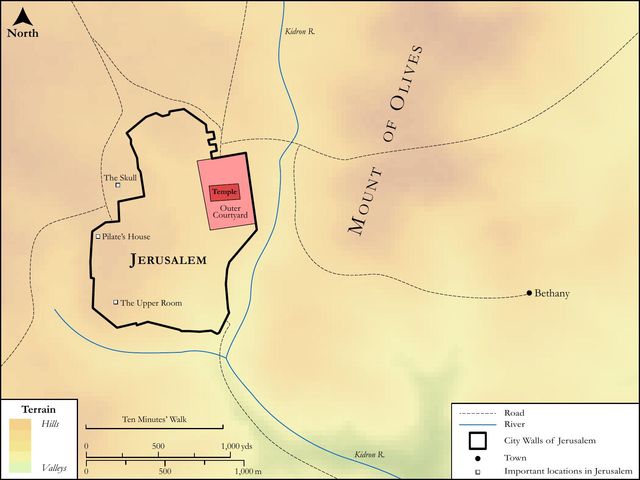
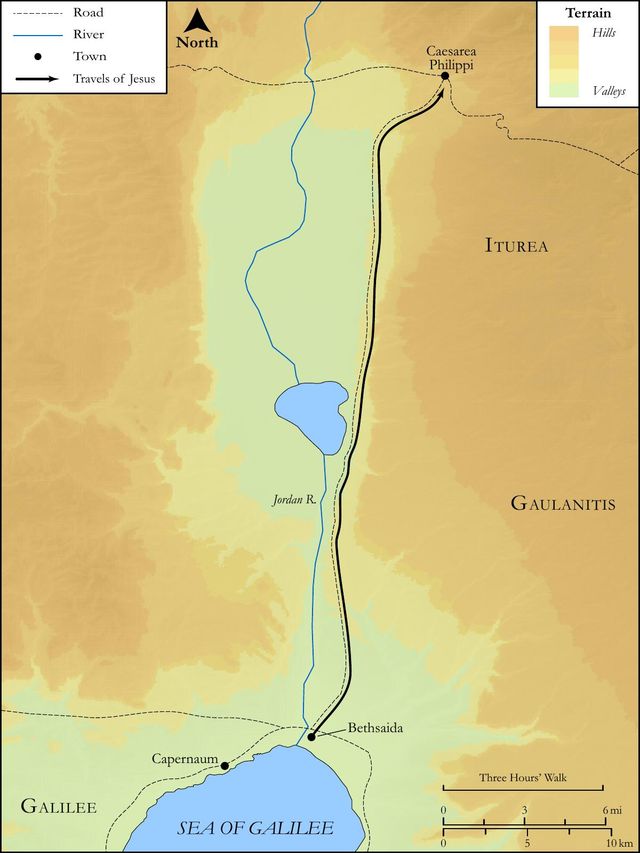
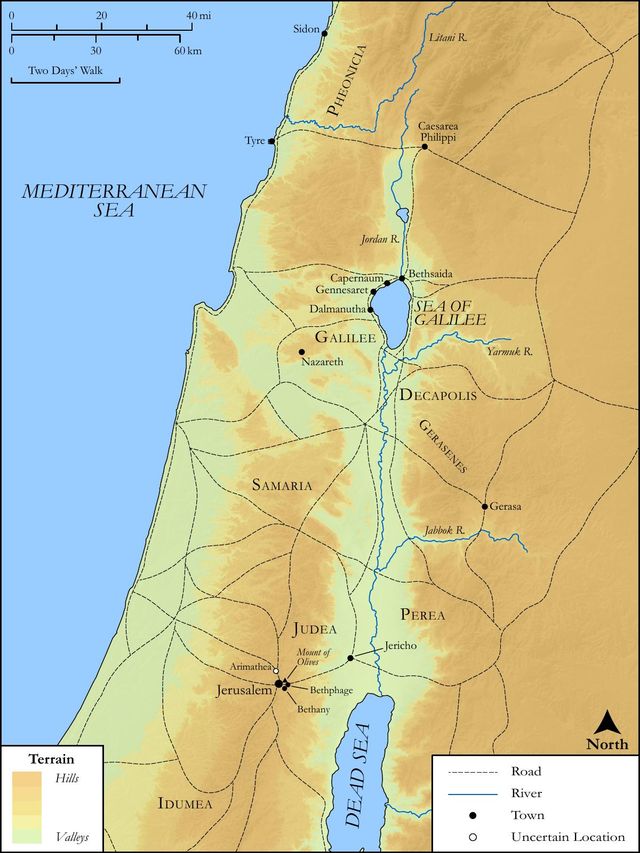
See on the biblical-era maps
Study this verse
Public-domain commentary
Matthew Henry
From his Commentary on the Whole Bible. Henry comments on passages, not single verses — this entry covers Mark 8:27–38. His three-level outline is real structure in the source text, so it is rendered as structure.
We have read a great deal of the doctrine Christ preached, and the miracles he wrought, which were many, and strange, and well-attested, of various kinds, and wrought in several places, to the astonishment of the multitudes that were eye-witnesses of them. It is now time for us to pause a little, and to consider what these things mean; the wondrous works which Christ then forbade the publishing of, being recorded in these sacred writings, are thereby published to all the world, to us, to all ages; now what shall we think of them? Is the record of those things designed only for an amusement, or to furnish us with matter for discourse? No, certainly these things are written, that we may believe that Jesus is the Christ the Son of God (Joh 20:31); and this discourse which Christ had with his disciples, will assist us in making the necessary reflections upon the miracles of Christ, and a right use of them. Three things we are here taught to infer from the miracles Christ wrought.
I.They prove that he is the true Messiah, the Son of God, and Saviour of the world:
this the works he did witnessed concerning him; and this his disciples, who were the eye-witnesses of those works, here profess their belief of; which cannot but be a satisfaction to us in making the same inference from them.
1.Christ enquired of them what the sentiments of the people were concerning him; Who did men say that I am? Mar 8:27. Note, Though it is a small thing for us to be judged of men, yet it may sometimes do us good to know what people say of us, not that we may seek our own glory, but that we may hear our faults. Christ asked them, not that he might be informed, but that they might observe it themselves, and inform one another.
2.The account they gave him, was such as plainly intimated the high opinion the people had of him. Though they came short of the truth, yet they were convinced by his miracles that he was an extraordinary person, sent from the invisible world with a divine commission. It is probable that they would have acknowledged him to be the Messiah, if they had not been possessed by their teachers with a notion that the Messiah must be a temporal Prince, appearing in external pomp and power, which the figure Christ made, would not comport with; yet (whatever the Pharisees said, whose copyhold was touched by the strictness and spirituality of his doctrine) none of the people said that he was a Deceiver, but some said that he was John Baptist, others Elias, others one of the prophets, Mar 8:28. All agreed that he was one risen from the dead.
3.The account they gave him of their own sentiments concerning him, intimated their abundant satisfaction in him, and in their having left all to follow him, which now, after some time of trial, they see no reason to repent; But whom say ye that I am? To this they have an answer ready, Thou art the Christ, the Messiah often promised, and long expected, Mar 8:29. To be a Christian indeed, is, sincerely to believe that Jesus is the Christ, and to act accordingly; and that he is so, plainly appears by his wondrous works. This they knew, and must shortly publish and maintain; but for the present they must keep it secret (Mar 8:30), till the proof of it was completed, and they were completely qualified to maintain it, by the pouring out of the Holy Ghost; and then let all the house of Israel know assuredly that God has made this same Jesus, whom ye crucified, both Lord and Christ, Act 2:36.
II.These miracles of Christ take off the offence of the cross, and assure us that Christ was, in it, not conquered, but a Conqueror.
Now that the disciples are convinced that Jesus is the Christ, they may bear to hear of his sufferings, which Christ now begins to give them notice of, Mar 8:31.
1.Christ taught his disciples that he must suffer many things, Though they had got over the vulgar error of the Messiah's being a temporal Prince, so far as to believe their Master to be the Messiah, notwithstanding his present meanness, yet still they retained it, so far as to expect that he would shortly appear in outward pomp and grandeur, and restore the kingdom to Israel; and therefore, to rectify that mistake, Christ here gives them a prospect of the contrary, that he must be rejected of the elders, and the chief priests, and the scribes, who, they expected, should be brought to own and prefer him; that, instead of being crowned, he must be killed, he must be crucified, and after three days he must rise again to a heavenly life, and to be no more in this world. This he spoke openly (Mar 8:32), parrēsia. He said it freely and plainly, and did not wrap it up in ambiguous expressions. The disciples might easily understand it, if they had not been very much under the power of prejudice: or, it intimates that he spoke it cheerfully and without any terror, and would have them to hear it so: he spoke that saying boldly, as one that not only knew he must suffer and die, but was resolved he would, and made it his own act and deed.
2.Peter opposed it; He took him, and began to rebuke him. Here Peter showed more love than discretion, a zeal for Christ and his safety, but not according to knowledge. He took him - proslabomenos. He took hold of him, as it were to stop and hinder him, took him in his arms, and embraced him (so some understand it); he fell on his neck, as impatient to hear that his dear Master should suffer such hard things; or he took him aside privately, and began to rebuke him. This was not the language of the least authority, but of the greatest affection, of that jealousy for the welfare of those we love, which is strong as death. Our Lord Jesus allowed his disciples to be free with him, but Peter here took too great a liberty.
3.Christ checked him for his opposition (Mar 8:33); He turned about, as one offended, and looked on his disciples, to see if the rest of them were of the same mind, and concurred with Peter in this, that, if they did, they might take the reproof to themselves, which he was now about to give to Peter; and he said, Get thee behind me, Satan. Peter little thought to have had such a sharp rebuke for such a kind dissuasive, but perhaps expected as much commendation now for his love as he had lately for his faith. Note, Christ sees that amiss in what we say and do, which we ourselves are not aware of, and knows what manner of spirit we are of, when we ourselves do not.
(1.)Peter spoke as one that did not rightly understand, nor had duly considered, the purposes and counsels of God. When he saw such proofs as he every day saw of the power of Christ, he might conclude that he could not be compelled to suffer; the most potent enemies could not overpower him whom diseases and deaths, whom winds and waves and devils themselves, were forced to obey and yield to: and when he saw so much of the wisdom of Christ every day, he might conclude that he would not choose to suffer but for some very great and glorious purposes; and therefore he ought not thus to have contradicted him, but to have acquiesced. He looked upon his death only as a martyrdom, like that of the prophets, which he thought might be prevented, if either he would take a little care not to provoke the chief priests, or to keep out of the way; but he knew not that the thing was necessary for the glory of God, the destruction of Satan, and the salvation of man, that the Captain of our salvation must be made perfect through sufferings, and so must bring many sons to glory. Note, The wisdom of man is perfect folly, when it pretends to give measures to the divine counsels. The cross of Christ, the great instance of God's power and wisdom, was to some a stumbling-block, and to others foolishness.
(2.)Peter spoke as one that did not rightly understand, nor had duly considered, the nature of Christ's kingdom; he took it to be temporal and human, whereas it is spiritual and divine. Thou savourest not the things that are of God, but those that are of men; ou phroneis - thou mindest not; so the word is rendered, Rom 8:5. Peter seemed to mind more the things that relate to the lower world, and the life that now is, than those which relate to the upper world, and the life to come. Minding the things of men more than the things of God, our own credit, ease, and safety, more than the things of God, and his glory and kingdom, is a very great sin, and the root of much sin, and very common among Christ's disciples; and it will appear in suffering times, those times of temptation, when those in whom the things of men have the ascendant, are in danger of falling off. Non sapis - Thou art not wise (so it may be read) in the things of God, but in the things of men. It is important to consider what generation we appear wise in, Luk 16:8. It seems policy to shun trouble, but if with that we shun duty, it is fleshly wisdom (Co2 1:12), and it will be folly in the end.
III.These miracles of Christ should engage us all to follow him, whatever it cost us, not only as they were confirmations of his mission, but as they were explications of his design, and the tendency of that grace which he came to bring; plainly intimating that by his Spirit he would do that for our blind, deaf, lame, leprous, diseased, possessed souls, which he did for the bodies of those many who in those distresses applied themselves to him. Frequent notice had been taken of the great flocking that there was to him for help in various cases: now this is written, that we may believe that he is the great Physician of souls, and may become his patients, and submit to his regimen; and here he tells us upon what terms we may be admitted; and he called all the people to him, to hear this, who modestly stood at some distance when he was in private conversation with his disciples. This is that which all are concerned to know, and consider, if they expect Christ should heal their souls.
1.They must not be indulgent of the ease of the body; for (Mar 8:34), "Whosoever will come after me for spiritual cures, as these people do for bodily cures, let him deny himself, and live a life of self-denial, mortification, and contempt of the world; let him not pretend to be his own physician, but renounce all confidence in himself and his own righteousness and strength, and let him take up his cross, conforming himself to the pattern of a crucified Jesus, and accommodating himself to the will of God in all the afflictions he lies under; and thus let him continue to follow me;" as many of those did, whom Christ healed. Those that will be Christ's patients must attend on him, converse with him, receive instruction and reproof from him, as those did that followed him, and must resolve they will never forsake him.
2.They must not be solicitous, no, not for the life of the body, when they cannot keep it without quitting Christ, Mar 8:35. Are we invited by the words and works of Christ to follow him? Let us sit down, and count the cost, whether we can prefer our advantages by Christ before life itself, whether we can bear to think of losing our life for Christ's sake and the gospel's. When the devil is drawing away disciples and servants after him, he conceals the worst of it, tells them only of the pleasure, but nothing of the peril, of his service; Ye shall not surely die; but what there is of trouble and danger in the service of Christ, he tells us of it before, tells us we shall suffer, perhaps we shall die, in the cause; and represents the discouragements not less, but greater, than commonly they prove, that it may appear he deals fairly with us, and is not afraid that we should know the worst; because the advantages of his service abundantly suffice to balance the discouragements, if we will but impartially set the one over against the other. In short,
(1.)We must not dread the loss of our lives, provided it be in the cause of Christ (Mar 8:35); Whosoever will save his life, by declining Christ, and refusing to come to him, or by disowning and denying him after he has in profession come to Christ, he shall lose it, shall lose the comfort of his natural life, the root and fountain of his spiritual life, and all his hopes of eternal life; such a bad bargain will he make for himself. But whosoever shall lose his life, shall be truly willing to lose it, shall venture it, shall lay it down when he cannot keep it without denying Christ, he shall save it, he shall be an unspeakable gainer; for the loss of his life shall be made up to him in a better life. It is looked upon to be some kind of recompence to those who lose their lives in the service of their prince and country, to have their memories honoured and their families provided for; but what is that to the recompence which Christ makes in eternal life to all that die for him?
(2.)We must dread the loss of our souls, yea, though we should gain the whole world by it (Mar 8:36, Mar 8:37); For what shall it profit a man, if he should gain the whole world, and all the wealth, honour, and pleasure, in it, by denying Christ, and lose his own soul? "True it is," said Bishop Hooper, the night before he suffered martyrdom, "that life is sweet, and death is bitter, but eternal death is more bitter, and eternal life is more sweet." As the happiness of heaven with Christ, is enough to countervail the loss of life itself for Christ, so the gain of all the world in sin, is not sufficient to countervail the ruin of the soul by sin.
What that is that men do, to save their lives, and gain the world, he tells us (Mar 8:38), and of what fatal consequence it will be to them; Whosoever therefore shall be ashamed of me, and of my words, in this adulterous and sinful generation, of him shall the Son of man be ashamed. Something like this we had, Mat 10:33. But it is here expressed more fully. Note, [1.] The disadvantage that the cause of Christ labours under this world, is, that it is to be owned and professed in an adulterous and sinful generation; such the generation of mankind is, gone a whoring from God, in the impure embraces of the world and the flesh, lying in wickedness; some ages, some places, are more especially adulterous and sinful, as that was in which Christ lived; in such a generation the cause of Christ is opposed and run down, and those that own it, are exposed to reproach and contempt, and every where ridiculed and spoken against. [2.] There are many, who, though they cannot but own that the cause of Christ is a righteous cause, are ashamed of it, because of the reproach that attends the professing of it; they are ashamed of their relation to Christ, and ashamed of the credit they cannot but give to his words; they cannot bear to be frowned upon and despised, and therefore throw off their profession, and go down the stream of a prevailing apostasy. [3.] There is a day coming, when the cause of Christ will appear as bright and illustrious as now it appears mean and contemptible; when the Son of man comes in the glory of his Father with his holy angels, as the true Shechinah, the brightness of his Father's glory, and the Lord of angels. [4.] Those that are ashamed of Christ in this world where he is despised, he will be ashamed of in that world where he is eternally adored. They shall not share with him in his glory then, that were not willing to share with him in his disgrace now.
Historical interpretation
Nine Centuries of Reception
16 surviving comments on this verse. Each one is dated, so this reads as a timeline rather than a list.
Select a marker to jump to its quote. Markers stagger vertically where authors wrote within a few decades of each other.
Or else, as a skilful pilot, foreseeing a storm in a calm, wishes his sailors to be prepared; so also the Lord says, If any one will follow me, &c.
If you wish to be the Lord's disciple, it is necessary you "take your cross, and follow the Lord: " your cross; that is, your own straits and tortures, or your body only, which is after the manner of a cross.
“Your cross” means your own anxieties and your sufferings in your own body, which itself is shaped in a way already like a cross.
(Hom. in Matt. 55) As if He would say to Peter, Thou indeed dost rebuke Me, who am willing to undergo My passion, but I tell thee, that not only is it wrong to prevent Me from suffering, but neither canst thou be saved unless thou thyself diest. Again He says, Whosoever wishes to come after me; as if He said, I call you to those good things which a man should wish for, I do not force you to evil and burdensome things; for he who does violence to his hearer, often stands in his way; but he who leaves him free, rather draws him to himself. And a man denies himself when he cares not for his body, so that whether it be scourged, or whatever of like nature it may suffer, he bears it patiently.
(ubi sup.) But He says not, a man should not spare himself, but what is more, that he should deny himself, as if he had nothing in common with himself, but face danger, and look upon such things as if another were suffering; and this is really to spare himself; for parents then most truly act kindly to their children, when they give them up to their masters, with an injunction not to spare them. Again, He shows the degree to which a man should deny himself, when He says, And take up his cross, by which He means, even to the most shameful death.
(ubi sup.) And this He says, because it may happen that a man may suffer and yet not follow Christ, that is, when he does not suffer for Christ's sake; for he follows Christ, who walks after Him, and conforms himself to His death, despising those principalities and powers under whose power, before the coming of Christ, he committed sin. Then there follows, For whosoever will save his life shall lose it; but whosoever shall lose his life for my sake and the Gospel's, the same shall save it. I give you these commands, as it were to spare you; for whosoever spares his son, brings him to destruction, but whosoever does not spare him, saves him. It is therefore right to be always prepared for death; for if in the battles of this world, he who is prepared for death fights better than others, though none can restore him to life after death, much more is this the case in spiritual battle, when so great a hope of resurrection is set before him, since he who gives up his soul unto death saves it.
(ubi sup.) As therefore He had said, For who so ever will save his life shall lose it, lest any one should suppose this loss to be equivalent to that salvation, He adds, For what shall it profit a man, if he shall gain the whole world, and lose his own soul, &c. As if He said, Think not that he has saved his soul, who has shunned the perils of the cross; for when a man, at the cost of his soul, that is, his life, gains the whole world, what has he besides, now that his soul is perishing? Has he another soul to give for his soul? For a man can give the price of his house in exchange for the house, but in losing his soul, he has not another soul to give. And it is with a purpose that He says, Or what shall a man give in exchange for his soul? for God, in exchange for our salvation, has given the precious blood of Jesus Christ.
(Hom. in Matt. 56) And He did not declare the names of those who were about to go up, lest the other disciples should feel some touch of human frailty, and He tells it to them beforehand, that they might come with minds better prepared to be taught all that concerned that vision.
How hard and painful does this appear! The Lord has required that “whoever will come after him must deny himself.” But what he commands is neither hard nor painful when he himself helps us in such a way so that the very thing he requires may be accomplished.… For whatever seems hard in what is enjoined, love makes easy.
Turn, rather, to these teachings, my very dear friend: take up your cross and follow the Lord. For, when I noticed that you were being slowed down in your divine purpose by your preoccupation with domestic cares, I felt that you were being carried and dragged along by your cross rather than that you were carrying it. What else does the cross mean than the mortality of this flesh? This is our very own cross which the Lord commands us to carry that we may be as well armed as possible in following him. We suffer momentarily until death is swallowed up in victory. Then this cross itself will be crucified. The cross will be nailed to the fear of God. We would hardly be able to carry it now if it forever resisted us with free and unfettered limbs. There is no other way for you to follow the Lord except by carrying it, for how can you follow him if you are not his?
(Vict. Ant. e Cat. in Marc.) He then who has learned this, is bound zealously to confess Christ without shame. And this generation is called adulterous, because it has left God the true Bridegroom of the soul, and has refused to follow the doctrine of Christ, but has prostrated itself to the devil and taken up the seeds of impiety, for which reason also it is called sinful. Whosoever therefore amongst them has denied the kingdom of Christ, and the words of God revealed in the Gospel, shall receive a reward befitting His impiety, when He hears in the second advent, I know you not. (Matt. 7:23)
(Orig. in Matt. tom. xii. 33, 35) But in a mystical sense, Christ is life, and the devil is death, and he tastes of death, who dwells in sin; even now every one, according as he has good or evil doctrines, tastes the bread either of life or of death. And indeed, it is a less evil to see death, a greater to taste of it, still worse to follow it, worst of all to be subject to it.
And life is to be taken in this place for the present life, and not for the substance itself of the soul.
What does this mean, “take up a cross”? It means he will bear with whatever is troublesome, and in this very act he will be following me. When he has begun to follow me according to my teaching and precepts, he will find many people contradicting him and standing in his way, many who not only deride but even persecute him. Moreover, this is true, not only of pagans who are outside the church, but also of those who seem to be in it visibly, but are outside of it because of the perversity of their deeds. Although these glory in merely the title of Christian, they continually persecute faithful Christians. Such belong to the members of the church in the same way that bad blood is in the body. Therefore, if you wish to follow Christ, do not delay in carrying his cross; tolerate sinners, but do not yield to them. Do not let the false happiness of the wicked corrupt you. You do well to despise all things for the sake of Christ, in order that you may be fit for his companionship.
What he commands is not difficult, since he helps to effect what he commands.… Just as we are lost through loving ourselves, so we are found by denying ourselves. Love of self was the ruin of the first man. If he had not loved himself in the wrong order, he would have been willing to be subject to God, preferring God to self.
Because our Lord and Redeemer came into the world as a new man, he gave new precepts to the world. For he set the newness of himself in opposition to our old life nourished in vices. For what did the old, what did the carnal man know except to hold onto his own things, to seize what belongs to others if he could, or to covet them if he could not? But the heavenly physician applies remedies that counteract each and every vice. For just as in the art of medicine hot things are cured by cold and cold things by hot, so our Lord set forth teachings contrary to sins, so that he might command continence to the unchaste, generosity to the greedy, gentleness to the wrathful, and humility to the proud. Certainly when he set forth new commandments to those following him, he said: "Unless someone renounces all that he possesses, he cannot be my disciple." As if he were saying openly: You who through your old life covet what belongs to others, through the pursuit of a new way of life give away even your own things. But let us hear what he says in this reading: "Whoever wishes to come after me, let him deny himself." There it is said that we should deny our possessions; here it is said that we should deny ourselves. And perhaps it is not difficult for a person to leave behind his possessions, but it is very difficult to leave behind himself. For it is a lesser thing to deny what one has, but it is a very great thing to deny what one is.
To those coming to him, the Lord commanded that we renounce our possessions, because all of us who come to the contest of faith take up a struggle against evil spirits. But evil spirits possess nothing of their own in this world. Therefore we must wrestle naked against those who are naked. For if someone clothed wrestles with someone naked, he is thrown to the ground more quickly because he has something by which he can be seized. For what are all earthly things except certain garments of the body? Therefore, whoever hastens to the contest against the devil should cast off his garments lest he be overcome. Let him possess nothing in this world by loving it; let him seek no pleasures of passing things, lest where he is covered according to his wish, he be seized for his fall from that very thing. Yet it is not enough to leave behind our possessions unless we also leave behind ourselves. What is it that we are saying: "Let us also leave behind ourselves"? For if we leave ourselves behind, where shall we go outside of ourselves? Or who is it that goes if he has abandoned himself? But we are one thing having fallen through sin, another thing as created by nature; one thing is what we have made ourselves, another is what we were made. Let us leave behind ourselves as we made ourselves by sinning, and let us remain ourselves as we were made through grace. For behold, if someone who was proud, having been converted to Christ, has become humble, he has left himself behind. If any lustful person has changed his life to continence, he has certainly denied what he was. If any greedy person has now ceased to grasp at things and has learned to give away his own possessions who previously seized what belonged to others, without doubt he has left himself behind. He himself indeed remains by nature, but he is not himself by malice. For thus it is written: "Turn the wicked, and they shall not be." For the wicked when converted shall not be—not because they shall not exist at all in essence, but surely they shall not be in the guilt of wickedness. Therefore we leave ourselves behind, we deny ourselves, when we avoid what we were through oldness and strive toward that to which we are called through newness. Let us consider how Paul had denied himself, who said: "Yet I live, now not I." For that savage persecutor had been extinguished, and the devout preacher had begun to live. For if he himself were still that same person, he would certainly not be devout. But let him who denies that he lives say from where it is that he proclaims holy words through the teaching of truth. He immediately adds: "But Christ lives in me." As if he were saying openly: I indeed have been extinguished from myself because I do not live carnally; yet I have not died essentially because I live spiritually in Christ. Therefore let the Truth speak, let him say: "If anyone wishes to come after me, let him deny himself." Because unless someone falls away from himself, he does not draw near to him who is above himself; nor is he able to grasp what is beyond himself if he does not know how to sacrifice what he is. So seedlings of vegetables are transplanted so that they may flourish, and, if I may say so, they are uprooted so that they may grow. So seeds of things perish when mixed with the earth, so that in the renewal of their kind they may rise up more abundantly. For from where they seem to have lost what they were, from there they receive the ability to appear as what they were not.
But he who now denies himself from vices must seek out the virtues in which he may grow. For when it was said: "Whoever wishes to come after me, let him deny himself," it is immediately added: "And let him take up his cross, and follow me." For the cross is taken up in two ways: either when the body is afflicted through abstinence, or when the mind is troubled through compassion for one's neighbor. Let us consider how Paul had borne his cross in both ways, who said: "I chastise my body and bring it into subjection, lest perhaps while preaching to others I myself should become a castaway." Behold, in the affliction of the body we have heard of the cross of the flesh; let us now hear of the cross of the mind in compassion for one's neighbor. For he says: "Who is weak, and I am not weak? Who is scandalized, and I am not on fire?" Indeed the perfect preacher, in order to give an example of abstinence, carried the cross in his body. And because he drew upon himself the losses of another's weakness, he carried the cross in his heart.
But because certain vices lie close to these very virtues, we must explain which vice besieges abstinence of the flesh and which besieges compassion of the mind. For vainglory often besieges abstinence of the flesh from nearby, because when thinness in the body and pallor in the face are observed, the revealed virtue is praised; and it pours itself outward all the more quickly, the more it appears to human eyes through the display of pallor. And it often happens that what is believed to be done for God's sake is done solely for human approval. This is well signified by that Simon who, found on the road, carries the Lord's cross under compulsion. For burdens belonging to another are carried under compulsion when something is done through the pursuit of vanity. Who then are designated by Simon, if not the abstinent and arrogant? They indeed afflict the flesh through abstinence, but they do not seek the fruit of abstinence within. Therefore Simon carries the Lord's cross under compulsion, because when he is not led to a good work by good will, a sinner performs the deed of a just man without fruit. Hence the same Simon carries the cross but does not die, because the abstinent and arrogant indeed afflict the body through abstinence, but through the desire for glory they live to the world. False piety, however, often secretly besieges compassion of the soul, so that it sometimes drags it down even to condoning vices, whereas one ought not to exercise compassion toward faults, but zeal. For compassion is owed to the person, and rectitude to the vices, so that in one and the same person we both love the good that he was made and pursue the evils that he has done, lest while we carelessly remit faults, we seem not to have shown compassion through charity, but to have fallen through negligence.
(Hom. 32. in Evang.) There are however some, who confess Christ, because they see that all men are Christians; for if the name of Christ were not at this day in such great glory, the Holy Church would not have so many professors. The voice of profession therefore is not sufficient for a trial of faith whilst the profession of the generality defends it from shame. In the time of peace therefore there is another way, by which we may be known to ourselves. We are ever fearful of being despised by our neighbours, we think it shame to bear injurious words; if perchance we have quarrelled with our neighbour, we blush to be the first to give satisfaction; for our carnal heart, in seeking the glory of this life, disdains humility.
And let him take up his cross and follow me. For indeed, the cross is taken up in two ways: either through the affliction of the body by abstinence, or through the affliction of the soul by compassion for one's neighbor. Let us consider how Paul bore his cross in both ways, who said: "I discipline my body and keep it under control, lest after preaching to others I myself should be disqualified" (I Cor. IX). Behold, in the affliction of the body we heard the cross of the flesh; now, in the compassion for one's neighbor, let us hear the cross of the mind. He says: "Who is weak, and I am not weak? Who is made to stumble, and I do not burn?" (II Cor. XI) Indeed, a perfect preacher, to give an example of abstinence, carried the cross in the body. And because he bore the sufferings of others in himself, he carried the cross in his heart.
And having called the crowd with his disciples, he said to them, "If anyone wishes to follow me, let him deny himself, etc." After showing his disciples the mystery of his passion and resurrection, he urges them together with the crowd to follow the example of his passion. And to all who suffer tribulation for his sake, he promises future salvation of their souls, but not to all, rather to the more perfect: how much he was to suffer, and that he would rise from the dead, he revealed. Here he established the form of teaching for the ministers of the word, so that, considering the capacity of their listeners, they might remember to instruct each one according to their ability, and not entrust deeper mysteries than they can comprehend to weak listeners. "If anyone wishes" (he says) "to follow me, let him deny himself." Now we deny ourselves when we avoid what we were through our former way of life and strive for that to which we are called through renewal. Let us consider how Paul had denied himself, who said, "And the life I now live, I live not by my own power” (Galatians 2). For that fierce persecutor had died and the pious preacher had begun to live. For if it were he, he would certainly not be pious. But let him who denies living by his own power, say whence it comes that he proclaims sacred words through the teaching of truth. Immediately he adds, "But Christ lives in me" (Ibid.). As if to say openly: Indeed, I am dead to myself, for I do not live carnally; yet I am not essentially dead, for I live spiritually in Christ. Let, therefore, Truth say, let it say, "If anyone wishes to follow me, let him deny himself." For unless someone withdraws from himself, he does not approach the one who is above him. Nor can he grasp what is beyond himself if he does not know how to mortify what is within him. But now, he who denies himself from vices must seek virtues in which he may grow. For when it is said, "If anyone wishes to follow me, let him deny himself," it immediately adds:
After showing to His disciples the mystery of His passion and resurrection, He exhorts them, as well as the multitude, to follow the example of His passion. Wherefore it goes on; And when he had called the people unto him with his disciples also, he said unto them, Whosoever wishes to come after me, let him deny himself.
(ubi sup.) For we deny ourselves, when we avoid what we were of old, and strive to reach that point, whither we are newly called. And the cross is taken up by us, when either our body is pained by abstinence, or our soul afflicted by fellow-feeling for our neighbour.
(in Marc. 2, 36) Or else He says this, because in time of persecution, our life is to be laid aside, but in time of peace, our earthly desires are to be broken, which He implies when He says, For what shall it profit a man, &c. But we are often hindered by a habit of shamefacedness, from expressing with our voice the rectitude which we preserve in our hearts; and therefore it is added, For whosoever shall confess me and my words in this adulterous and sinful generation, him also shall the Son of man confess, when he cometh in the glory of his Father with the holy angels.
(in Marc. 3. 36) Truly it was done with a loving foresight, in order that they, having tasted for a brief moment the contemplation of everlasting joy, might with the greater strength bear up under adversity.
(ubi sup.) Or else the present Church is called the kingdom of God; and some of the disciples were to live in the body until they should see the Church built up, and raised against the glory of the world; for it was right to make some promises concerning this life to the disciples who were uninstructed, that they might be built up with greater strength for the time to come.
He says that Peter savours the things which be of men, in that he in some way savoured carnal affections, for Peter wished that Christ should spare Himself and not be crucified.
For a man who denies another, be it brother or father, does not sympathize with him, nor grieve at his fate, though he be wounded and die; thus we ought to despise our body, so that if it should be wounded or hurt in any way, we should not mind its suffering.
For at that time the cross appeared shameful, because malefactors were fixed to it.
But because after the cross we must have a new strength, He adds, and follow me.
For that faith which only remains in the mind is not sufficient, but the Lord requires also the confession of the mouth; for when the soul is sanctified by faith, the body ought also to be sanctified by confession.
Him then who shall have confessed that his God was crucified, Christ Himself also shall confess, not here, where He is esteemed poor and wretched, but in His glory and with a multitude of Angels.
But because He had spoken of His glory, in order to show that His promises were not vain, He subjoins, Verily I say unto you, That there be some of them that stand here who shall not taste of death, till they have seen the kingdom of God come with power. As if He said, Some, that is, Peter, James, and John, shall not taste of death, until I show them, in my transfiguration, with what glory I am to come in my second advent; for the transfiguration was nothing else, but an announcement of the second coming of Christ, in which also Christ Himself and the Saints will shine.
Continue studying Mark 8:34 across the web’s major study libraries — every link below opens this exact verse, chapter, or book on the destination site.
Read & Compare
 BibleGatewayThis verse in more than 200 translations and 70 languages.
 Bible.comThe YouVersion reader — hundreds of translations, reading plans, and highlights.
 ESV.orgCrossway's official English Standard Version reader.
 NET BibleThe NET translation with 60,000+ translators' notes on every rendering decision.
 STEP BibleTyndale House's free study tool — original text, vocabulary, and scholarly resources.
 BibliaLogos Bible Software's free web reader.
 USCCBThe New American Bible (Revised Edition) with the U.S. bishops' study notes.
Commentaries
 BibleHub CommentariesDozens of classic commentaries on this verse, gathered on one page.
 StudyLightMore than 100 commentary sets — the largest collection on the web.
 BibleRefPlain-English commentary on what this verse means, verse by verse.
 Enduring WordDavid Guzik's free commentary on this chapter, widely used by Bible teachers.
 Bible Study ToolsVerse commentary alongside Greek and Hebrew study aids.
Original Language & Research
- BibleHub InterlinearThe verse word by word — original language, transliteration, and English.
- BibleHub LexiconEvery word's original-language definition and Strong's entry.
 Blue Letter BibleDeep-study tools — Strong's numbers, concordance, and word studies.
 CNTR CollationThe earliest Greek manuscripts of this verse, collated letter by letter.
Sermons, Hymns & Audio


TrulyRandomVerse is not affiliated with these sites and doesn’t control their content. They’re linked because they’re genuinely useful.
Summary
Jesus issues a profound and challenging call to His followers, extending it beyond the immediate circle of His disciples to include the surrounding crowd. This pivotal declaration outlines the radical nature of true discipleship, demanding complete self-denial, a willing embrace of suffering and potential death for His sake, and a continuous, active commitment to following His path. It serves as a foundational statement on the cost and character of Christian living, contrasting sharply with worldly ambitions and expectations of the Messiah's kingdom.
Context
ShowHideLiterary Context
Mark 8:34 is strategically placed immediately after two crucial events: Peter's confession of Jesus as the Christ at Caesarea Philippi and Jesus's subsequent, shocking prediction of His own suffering, death, and resurrection (Mark 8:31-33). Peter's immediate rebuke of Jesus ("Be it far from thee, Lord!") and Jesus's stern response ("Get thee behind me, Satan!") underscore the disciples' profound misunderstanding of the Messiah's true nature and mission. In light of this, Jesus's call in Mark 8:34 serves as a direct corrective, redefining Messiahship and discipleship in terms of suffering and sacrifice, rather than worldly power or glory. By calling "the people with his disciples also," Jesus emphasizes that this radical call is not just for an elite few, but for anyone who genuinely desires to follow Him.
Historical & Cultural Context
The imagery of "taking up his cross" would have held a stark and terrifying literal meaning for Jesus's 1st-century audience under Roman occupation. Crucifixion was a common and brutal form of capital punishment, reserved for the worst criminals, rebels, and slaves. The condemned person was often forced to carry the horizontal beam (patibulum) of their cross through the streets to the place of execution, a public spectacle designed to inflict maximum shame and terror as a deterrent. Therefore, to "take up one's cross" was not a metaphor for enduring general hardship or inconvenience, but a clear, unambiguous symbol of a condemned person's final journey to a shameful, agonizing death. This immediate and visceral understanding would have underscored the extreme cost and ultimate commitment Jesus was demanding from His potential followers, a willingness to face public disgrace and even execution for His sake.
Key Themes
ShowHideThis verse is central to several overarching themes in the Gospel of Mark and broader New Testament theology. Firstly, it profoundly articulates The True Nature of Discipleship, contrasting it sharply with popular expectations of a conquering Messiah and a comfortable life. Secondly, it introduces the theme of Radical Self-Denial, emphasizing that following Christ requires a complete reorientation of one's life away from self-centered desires and ambitions towards God's will. This is a foundational aspect of the new covenant, where the old self must die to allow the new life in Christ to flourish, as seen in Romans 6:6. Thirdly, the command to "take up his cross" highlights the theme of Embracing Suffering and Identification with Christ. It signifies a willingness to endure hardship, persecution, and even martyrdom for the sake of the Gospel, aligning one's life with the suffering path of Jesus Himself. This theme is further developed in passages like Philippians 3:10. Finally, the phrase "follow me" encapsulates the theme of Active Obedience and Imitation of Christ, signifying a continuous, deliberate commitment to walk in Jesus's footsteps, living out His teachings and participating in His mission, as exemplified by the call to discipleship found throughout the Gospels.
Exposition and Analysis
ShowHideKey Word Analysis
ShowHideThis word (G533) means "to deny utterly, i.e. disown, abstain." In this context, it signifies a complete and decisive renunciation of oneself, one's own will, desires, and ambitions. It's not merely a slight adjustment but a radical disowning of the self as the center of one's life, placing Christ and His will supremely above all else.
This verb (G142) means "to lift up; by implication, to take up or away." Here, it denotes a deliberate and active choice to embrace, rather than avoid, the cross. It implies a conscious decision to shoulder the burden and face the implications of discipleship, which for a 1st-century audience meant a willingness to face death and public shame.
This noun (G4716) refers to "a stake or post... a pole or cross (as an instrument of capital punishment)." Figuratively, it means "exposure to death, i.e. self-denial; by implication, the atonement of Christ." In Mark 8:34, it primarily refers to the literal instrument of execution, symbolizing the ultimate sacrifice and identification with Christ's suffering, leading to the death of the old self.
Verse Breakdown
ShowHide"And when he had called the people [unto him] with his disciples also, he said unto them"
This opening clause highlights the universal nature of Jesus's call. It's not just for the inner circle of disciples, but for "the people"—the broader crowd—signifying that the demands of true discipleship apply to anyone who claims to follow Him. Jesus deliberately gathers a wider audience to ensure the gravity and scope of His message are understood.
"Whosoever will come after me"
This phrase sets the condition for discipleship, indicating a voluntary choice. "Come after me" implies not merely intellectual assent, but a commitment to follow Jesus's path, to be His follower and apprentice, adopting His way of life and His mission. It is an invitation to a transformative journey.
"let him deny himself"
This is the first and foundational command. To "deny himself" means to utterly renounce one's own desires, ambitions, and will, dethroning the ego from the center of one's life. It is a radical reorientation where personal autonomy is surrendered to Christ's Lordship, prioritizing God's will above all else. This is a complete and ongoing act of self-abnegation.
"and take up his cross"
This is the second, equally challenging command. As discussed in the context, this is a stark metaphor for a willingness to embrace suffering, public shame, and even death for Christ's sake. It means identifying with Christ's suffering and being prepared to endure whatever hardships, persecution, or social rejection may come as a result of following Him. It is a daily, deliberate choice to die to one's own self-preservation and worldly comforts.
"and follow me"
This final command encapsulates the essence of discipleship. It is not a passive belief but an active, continuous, and obedient imitation of Jesus's life, teachings, and mission. It signifies walking in His footsteps, living out His priorities, and aligning one's entire existence with His purpose, even unto death.
Literary Devices
ShowHideThe verse employs powerful Metaphor and Symbolism, most notably in the phrase "take up his cross." The cross, a literal instrument of execution, becomes a profound symbol for the ultimate cost of discipleship: a willingness to embrace suffering, shame, and death for Christ's sake. This is not a casual burden but a life-ending commitment. The structure of the commands—"deny himself, and take up his cross, and follow me"—forms a Climax or progression, moving from an internal spiritual reorientation (self-denial) to an external, public commitment (cross-bearing) and culminating in a continuous, active lifestyle (following Jesus). The use of "Whosoever" indicates an Universal Reach in the call, making it clear that these radical demands apply to all who would claim to be His followers, not just a select few. The commands themselves are presented as Imperatives, conveying the non-negotiable and urgent nature of Jesus's requirements for true discipleship.
Theological and Thematic Connections
ShowHideMark 8:34 stands as a theological cornerstone, profoundly shaping our understanding of Christian discipleship. It dismantles any notion of a comfortable or self-serving faith, revealing that true adherence to Christ necessitates a radical reorientation of one's life. The call to "deny himself" speaks to the core of biblical anthropology, recognizing the fallen human tendency towards self-centeredness and asserting the necessity of submitting the ego to divine sovereignty. "Taking up his cross" directly connects discipleship to the redemptive work of Christ, implying that the follower must participate in the suffering that leads to new life, mirroring Jesus's own path to glory through the cross. This verse underscores the theme of identification with Christ, where the disciple's life becomes a living testament to the crucified and resurrected Lord. It is a call to total surrender, a daily dying to self that paradoxically leads to true life in Him.
Reflection and Application
ShowHideFor the contemporary believer, Mark 8:34 remains a challenging yet liberating truth. In a culture that often prioritizes self-fulfillment, personal comfort, and immediate gratification, Jesus's call to deny oneself is counter-cultural and profoundly transformative. It invites us to examine where our ultimate loyalties lie and whether our lives truly reflect Christ as supreme. "Taking up our cross" today may not always involve literal martyrdom, but it certainly means a willingness to endure social ostracism, professional setbacks, or personal discomfort for the sake of our convictions and for the advancement of God's Kingdom. It calls us to die daily to our pride, our selfish ambitions, our desire for control, and our attachment to worldly security. This radical self-surrender is not a path of misery, but the gateway to genuine freedom and the abundant life found in Christ, as we actively "follow Him" in obedience, service, and love, reflecting His character to a world in need.
Questions for Reflection
ShowHideFAQ
ShowHideWhat does "deny himself" truly mean in a practical sense for a modern Christian?
ShowHideTo "deny himself" (Greek: aparnéomai) means a radical reorientation of one's life from self-centeredness to Christ-centeredness. Practically, it involves a daily, conscious decision to surrender one's own desires, ambitions, comfort, and will to the will of God as revealed in Christ. It means prioritizing God's glory and the advancement of His Kingdom over personal gain, reputation, or convenience. For example, it could mean choosing humility over pride, generosity over greed, forgiveness over holding grudges, or obedience to God's Word even when it conflicts with societal norms or personal preferences. It's a continuous process of dying to the "old self" (see Romans 6:6) so that Christ's life can be lived through us.
Is "taking up his cross" just a metaphor for any hardship or difficulty in life?
ShowHideWhile life's hardships are real, Jesus's original audience would have understood "taking up his cross" (Greek: staurós) as a literal reference to carrying the instrument of execution to one's own death. It was a symbol of ultimate shame, suffering, and impending demise. Therefore, it is far more than a metaphor for general difficulties. It signifies a willingness to embrace suffering, persecution, and even death for the sake of Christ and the Gospel. It means identifying with Christ's own suffering and being prepared to face the ultimate cost of following Him, not just general burdens. While it encompasses enduring trials, its primary meaning points to a radical commitment to Christ that may lead to rejection, loss, or even physical death, as Jesus Himself experienced. It is a call to die to self, to one's own ego and worldly aspirations, just as Christ died for us.
Christ-Centered Fulfillment
ShowHideThe profound call in Mark 8:34 finds its ultimate fulfillment and perfect embodiment in Jesus Christ Himself. He is the one who perfectly "denied himself," setting aside His divine prerogatives and taking on the form of a servant, even to the point of death on a cross, as described in Philippians 2:6-8. Jesus, though innocent, willingly "took up His cross," embracing the ultimate shame and suffering of crucifixion, not for His own sin, but as the atoning sacrifice for the sins of the world (John 1:29). His journey to the cross was the ultimate act of "following" the Father's will, demonstrating perfect obedience even unto death (Hebrews 5:8). Therefore, when Jesus calls His disciples to deny themselves and take up their cross, He is not asking them to do something He Himself has not already done supremely. Rather, He invites them to participate in His life, death, and resurrection, to find their true life by losing it for His sake, and to experience the power of His resurrection by sharing in the fellowship of His sufferings (Philippians 3:10). Our ability to deny ourselves and bear our cross is not a self-generated strength but flows from Christ's completed work on the cross, enabling us to live a life that is no longer our own, but Christ living in us (Galatians 2:20).