


Mark 14:1
Bible text: King James Version (1769 Blayney text) · Public domain
Bible text: King James Version with Strong's numbers · Public domain
Bible text: Berean Standard Bible · Public domain
Bible text: American Standard Version (1901) · Public domain
Bible text: World English Bible, Messianic edition · Public domain
Bible text: Geneva Bible (1599) · Public domain
Bible text: Young's Literal Translation · Public domain
- ἮνĒnIt wasG1510V-IAI-3SVerb Imperfect Active Indicative 3rd Singular
- δὲdenowG1161CONJConjunction
- τὸtotheG3588T-NSNDefinite article Nominative Singular Neuter
- πάσχαpaschaPassoverG3957N-NSN-TNoun Nominative Singular Neuter Title
- καὶkaiandG2532CONJConjunction
- τὰtatheG3588T-NPNDefinite article Nominative Plural Neuter
- ἄζυμαazuma[Feast of] Unleavened BreadG106A-NPNAdjective Nominative Plural Neuter
- μετὰmetaafterG3326PREPPreposition
- δύοduotwoG1417A-NUIAdjective
- ἡμέραςhēmerasdaysG2250N-APFNoun Accusative Plural Feminine
- καὶkaiAndG2532CONJConjunction
- ἐζήτουνezētounwere seekingG2212V-IAI-3PVerb Imperfect Active Indicative 3rd Plural
- οἱhoitheG3588T-NPMDefinite article Nominative Plural Masculine
- ἀρχιερεῖςarchiereischief priestsG749N-NPMNoun Nominative Plural Masculine
- καὶkaiandG2532CONJConjunction
- οἱhoitheG3588T-NPMDefinite article Nominative Plural Masculine
- γραμματεῖςgrammateisscribesG1122N-NPMNoun Nominative Plural Masculine
- πῶςpōshowG4459PRT-IInterrogative Particle Interrogative
- αὐτὸνautonHimG846P-ASMPersonal pronoun Accusative Singular Masculine
- ἐνenbyG1722PREPPreposition
- δόλῳdolōstealthG1388N-DSMNoun Dative Singular Masculine
- κρατήσαντεςkratēsanteshaving takenG2902V-AAP-NPMVerb Aorist Active Participle Nominative Plural Masculine
- ἀποκτείνωσιν·apokteinōsinthey may kill [Him]G615V-AAS-3PVerb Aorist Active Subjunctive 3rd Plural
English is a literal word-by-word gloss of the Greek, not the KJV's wording. Why?
This is the original text the KJV's translators worked from — each Greek word with its own literal English meaning in this verse, prepared by scholars at Tyndale House, Cambridge. The KJV translates whole sentences, not word by word, so its wording differs: one Greek word can become several English words, and the KJV may choose “charity” where the gloss reads “love”. Both are faithful — they answer different questions. For the KJV's own rendering, switch to the KJV text.
Details
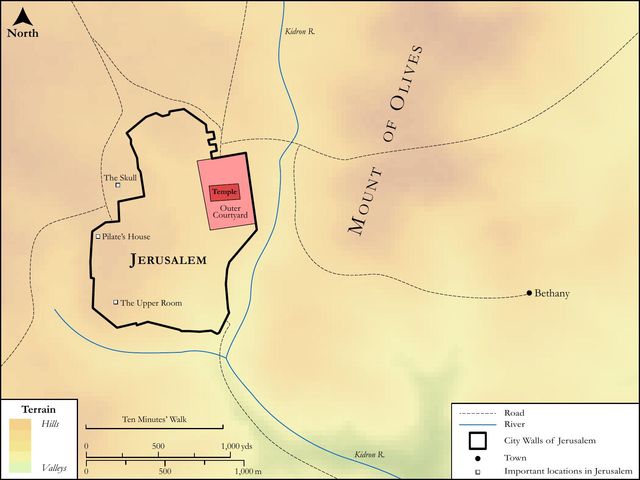
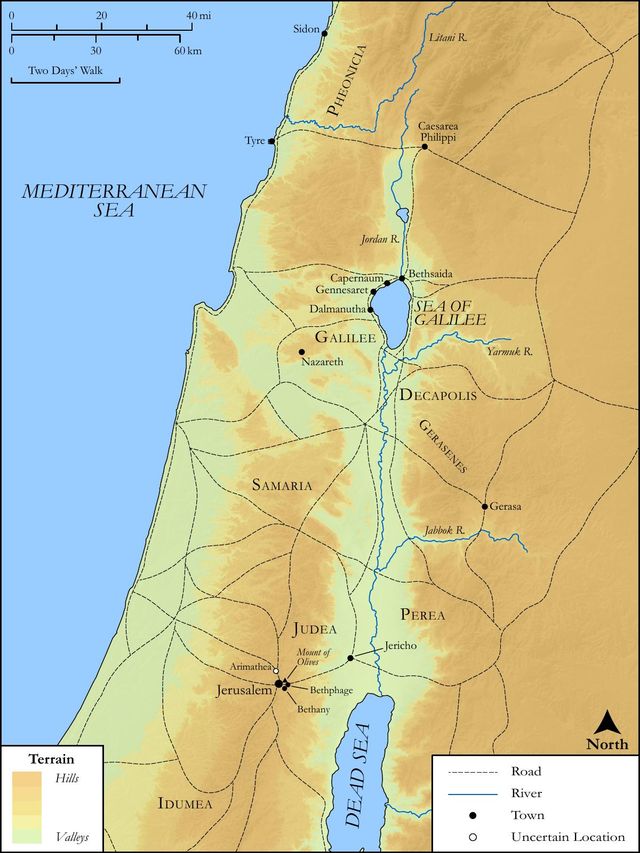
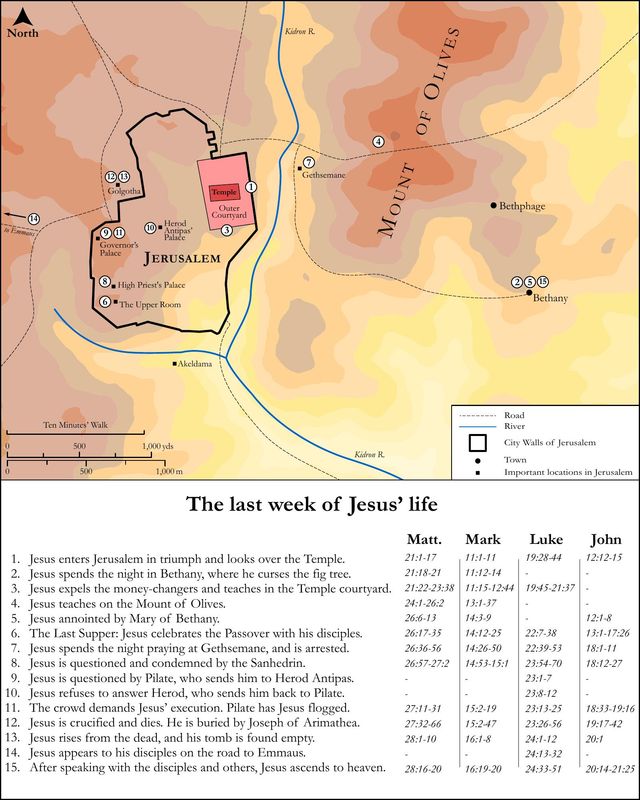
See on the biblical-era maps
Study this verse
Public-domain commentary
Matthew Henry
From his Commentary on the Whole Bible. Henry comments on passages, not single verses — this entry covers Mark 14:1–11. His three-level outline is real structure in the source text, so it is rendered as structure.
We have here instances,
I.Of the kindness of Christ's friends, and the provision made of respect and honour for him.
Some friends he had, even in and about Jerusalem, that loved him, and never thought they could do enough for him, among whom, though Israel be not gathered, he is, and will be, glorious.
1.Here was one friend, that was so kind as to invite him to sup with him; and he was so kind as to accept the invitation, Mar 14:3. Though he had a prospect of his death approaching, yet he did not abandon himself to a melancholy retirement from all company, but conversed as freely with his friends as usual.
2.Here was another friend, that was so kind as to anoint his head with very precious ointment as he sat at meat. This was an extraordinary piece of respect paid him by a good woman that thought nothing too good to bestow upon Christ, and to do him honour. Now the scripture was fulfilled, When the king sitteth at his table, my spikenard sendeth forth the smell thereof, Sol 1:12. Let us anoint Christ as our Beloved, kiss him with a kiss of affection; and anoint him as our Sovereign, kiss him with a kiss of allegiance. Did he pour out his soul unto death for us, and shall we think any box of ointment too precious to pour out upon him? It is observable that she took care to pour it all out upon Christ's head; she broke the box (so we read it); but because it was an alabaster box, not easily broken, nor was it necessary that it should be broken, to get out the ointment, some read it, she shook the box, or knocked it to the ground, to loosen what was in it, that it might be got out the better; or, she rubbed and scraped out all that stuck tot he sides of it. Christ must have been honoured with all we have, and we must not think to keep back any part of the price. Do we give him the precious ointment of our best affections? Let him have them all; love him with all the heart.
Now, (1.) There were those that put a worse construction upon this than it deserved. They called it a waste of the ointment, Mar 14:4. Because they could not have found their hearts to put themselves to such an expense for the honouring of Christ, they thought that she was prodigal, who did. Note, As the vile person ought to be called liberal, nor the churl said to be bountiful (Isa 32:5); so the liberal and bountiful ought not to be called wasteful. They pretend it might have been sold, and given to the poor, Mar 14:5. But as a common piety to the corban will not excuse from a particular charity to a poor parent (Mar 7:11), so a common charity to the poor will not excuse from a particular act of piety to the Lord Jesus. What thy hand finds to do, that is good, do it with thy might.
(2.)Our Lord Jesus put a better construction upon it than, for aught that appears, was designed. Probably, she intended no more, than to show the great honour she had for him, before all the company, and to complete his entertainment. But Christ makes it to be an act of great faith, as well as great love (Mar 14:8); "She is come aforehand, to anoint my body to the burying, as if she foresaw that my resurrection would prevent her doing it afterward." This funeral rite was a kind of presage of, or prelude to, his death approaching. See how Christ's heart was filled with the thoughts of his death, how every thing was construed with a reference to that, and how familiarly he spoke of it upon all occasions. It is usual for those who are condemned to die, to have their coffins prepared, and other provision made for their funerals, while they are yet alive; and so Christ accepted this. Christ's death and burial were the lowest steps of his humiliation, and therefore, though he cheerfully submitted to them, yet he would have some marks of honour to attend them, which might help to take off the offence of the cross, and be an intimation how precious in the sight of the Lord the death of his saints is. Christ never rode in triumph into Jerusalem, but when he came thither to suffer; nor had ever his head anointed, but for his burial.
(3.)He recommended this piece of heroic piety to the applause of the church in all ages; Wherever this gospel shall be preached, it shall be spoken of, for a memorial of her, Mar 14:9. Note, The honour which attends well-doing, even in this world, is sufficient to balance the reproach and contempt that are cast upon it. The memory of the just is blessed, and they that had trial of cruel mockings, yet obtained a good report, Heb 11:6, Heb 11:39. Thus was this good woman repaid for her box of ointment, Nec oleum perdidit nec operam - She lost neither her oil nor her labour. She got by it that good name which is better than precious ointment. Those that honour Christ he will honour.
II.Of the malice of Christ's enemies, and the preparation made by them to do him mischief.
1.The chief priests, his open enemies, consulted how they might put him to death, Mar 14:1, Mar 14:2. The feast of the passover was now at hand, and at that feast he must be crucified,
(1.)That his death and suffering might be the more public, and that all Israel, even those of the dispersion, who came from all parts to the feast, might be witnesses of it, and of the wonders that attended it.
(2.)That the Anti-type might answer to the type. Christ, our Passover, was sacrificed for us, and brought us out of the house of bondage, at the same time that the paschal lamb was sacrificed, and Israel's deliverance out of Egypt was commemorated.
Now see, [1.] How spiteful Christ's enemies were; they did not think it enough to banish or imprison him, for they aimed not only to silence him, and stop his progress for the future, but to be revenged on him for all the good he had done. [2.] How subtle they were; Not on the feast-day, when the people are together; they do not say, Lest they should be disturbed in their devotions, and diverted from them, but, Lest there should be an uproar (Mar 14:2); lest they should rise, and rescue him, and fall foul upon those that attempt any thing against him. They who desired nothing more than the praise of men, dreaded nothing more than the rage and displeasure of men.
2.Judas, his disguised enemy, contracted with them for the betraying of him, Mar 14:10, Mar 14:11. He is said to be one of the twelve that were Christ's family, intimate with him, trained up for the service of the kingdom; and he went to the chief priests, to tender his service in this affair.
(1.)That which he proposed to them, was, to betray Christ to them, and to give them notice when and where they might find him, and seize him, without making an uproar among the people, which they were afraid of, if they should seize him when he appeared in public, in the midst of his admirers. Did he know then what help it was they wanted, and where they were run aground in their counsels? It is probable that he did not, for the debate was held in their close cabal. Did they know that he had a mind to serve them, and make court to him? No, they could not imagine that any of his intimates should be so base; but Satan, who was entered into Judas, knew what occasion they had for him, and could guide him to be guide to them, who were contriving to take Jesus. Note, The spirit that works in all the children of disobedience, knows how to bring them in to the assistance one of another in a wicked project, and then to harden them in it, with the fancy that Providence favours them.
(2.)That which he proposed to himself, was, to get money by the bargain; he had what he aimed at, when they promised to give him money. Covetousness was Judas's master - lust, his own iniquity, and that betrayed him to the sin of betraying his Master; the devil suited his temptation to that, and so conquered him. It is not said, They promised him preferment (he was not ambitious of that), but, they promised him money. See what need we have to double our guard against the sin that most easily besets us. Perhaps it was Judas's covetousness that brought him at first to follow Christ, having a promise that he should be cash-keeper, or purser, to the society, and he loved in his heart to be fingering money; and now that there was money to be got on the other side, he was as ready to betray him as ever he had been to follow him. Note, Where the principle of men's profession of religion is carnal and worldly, and the serving of a secular interest, the very same principle, whenever the wind turns, will be the bitter root of a vile and scandalous apostasy.
(3.)Having secured the money, he set himself to make good his bargain; he sought how he might conveniently betray him, how he might seasonably deliver him up, so as to answer the intention of those who had hired him. See what need we have to be careful that we do not ensnare ourselves in sinful engagements. If at any time we be so ensnared in the words of our mouths, we are concerned to deliver ourselves by a speedy retreat, Pro 6:1-5. It is a rule in our law, as well as in our religion, that an obligation to do an evil thing is null and void; it binds to repentance, not to performance. See how the way of sin is down-hill - when men are in, they must be on; and what wicked contrivances many have in their sinful pursuits, to compass their designs conveniently; but such conveniences will prove mischiefs in the end.
Historical interpretation
Four Centuries of Reception
5 surviving comments on this verse. Each one is dated, so this reads as a timeline rather than a list.
Select a marker to jump to its quote. Markers stagger vertically where authors wrote within a few decades of each other.
Let us now sprinkle our book, and our thresholds with blood, and put the scarlet thread around the house of our prayers, and bind scarlet on our hand, as was done to Zarah, (Gen. 38:30) that we may be able to say that the red heifer is slain in the valley. (Num. 19:2, Deut. 21:4) For the Evangelist, being about to speak of the slaying of Christ, premises, After two days was the feast of the Passover, and of unleavened bread.
Or else phase is interpreted a passing over, but Pascha means sacrifice. In the sacrifice of the lamb, and the passing of the people through the sea, or through Egypt, the Passion of Christ is prefigured, and the redemption of the people from hell, when He visits us after two days, that is, when the moon is most full, and the age of Christ is perfect, that when no part at all of it is dark, we may eat the flesh of the Lamb without spot, who taketh away the sins of the world, in one house, that is, in the Catholic Church, shod with charity, and armed with virtue.
But iniquity came forth in Babylon from the princes, who ought to have purified the temple and the vessels, and themselves according to the law, in order to eat the lamb. Wherefore there follows: And the Chief Priests and the Scribes sought how they might take him by craft, and put him to death. Now when the head is slain, the whole body is rendered powerless, wherefore these wretched men slay the Head. But they avoid the feast day, which indeed befits them, for what feasting can there be for them, who have lost life and mercy? Wherefore it goes on: But they said, Not on the feast day, lest there be an uproar of the people.
(in Marc. iv. 43) Pascha which in Hebrew is phase, is not called from Passion, as many think, but from passing over, because the destroyer, seeing the blood on the doors of the Israelites, passed by them, and did not smite them; or the Lord Himself, bringing aid unto His people, walked above them.
(ubi sup.) The difference according to the Old Testament between the Passover and the feast of unleavened bread was, that the day alone on which the lamb was slain in the evening, that is, the fourteenth moon of the first month, was called Passover. But on the fifteenth moon, when they came out of Egypt, the feast of unleavened bread came on, which solemn time was appointed for seven days, that is, up to the twenty-first day of the same month in the evening. But the Evangelists indifferently use the day of unleavened bread for the Passover, and the Passover for the days of unleavened bread. Wherefore Mark also here says, After two days was the feast of the Passover, and of unleavened bread, because the day of the Passover was also ordered to be celebrated on the days of unleavened bread, and we also, as it were, keeping a continual passover, ought always to be passing out of this world.
(ubi sup.) Not indeed, as the words seem to imply, that they feared the uproar, but they were afraid lest He should be taken out of their hands by the aid of the people.
And the chief priests and scribes sought how they might take Him by craft and kill Him. But they said, Not on the feast day, lest there be an uproar among the people. Those who ought to have been preparing the sacrifices for the nearby Passover, cleaning the temple walls, sweeping the floors, cleansing the vessels, and purifying themselves according to the law so that they would be worthy to eat the lamb, gathered together, taking counsel on how to kill the Lord, not fearing a sedition, as the simple phrase shows, but avoiding that He be taken from their hands by the help of the people.
Now it was the Passover, and the unleavened bread after two days. Passover, which is called "phase" in Hebrew, is named not from suffering as many think, but from passing over, because the destroyer, seeing the blood on the doorposts of the Israelites, passed over and did not strike them, or the Lord Himself providing aid to His people passed over them. Explaining the sacrament of this word more sublimely, the evangelist John says: "Before the feast of the Passover, Jesus knowing that his hour had come that he should pass out of this world unto the Father" (John XIII). Where he clearly declares that the day of this solemnity is mystically called the Passover through the law because the Lamb of God who takes away the sins of the world, in it, would either pass from this world, or lead us out of the servitude of Egypt through a wholesome passage. Certainly, according to the scripture of the Old Testament, there is a distinction between Passover and unleavened bread, in that Passover itself is called the single day on which the lamb was killed in the evening, that is, the fourteenth moon of the first month. The fifteenth moon, however, when they left Egypt, followed the festival of unleavened bread, which for seven days, that is, until the twenty-first day of the same month in the evening, the solemnity was established. Indeed, the evangelists interchangeably use the day of unleavened bread for Passover and Passover for the days of unleavened bread. For Mark says: “Now the Passover and the unleavened bread were after two days” (Mark XIV). Luke says: “The festival day of the unleavened bread, which is called Passover” (Luke XXII). Also, John, when on the first day of the unleavened bread, that is, the fifteenth moon, the act was being carried out, says: "And they did not enter into the Praetorium, that they might not be defiled, but might eat the Passover" (John XVIII). They did this because the day of Passover is also commanded to be celebrated with unleavened bread, and we, as if making a perpetual Passover, are always commanded to pass from this world. For on the one day the lamb was sacrificed in the evening, and seven days of unleavened bread successively followed, because Christ Jesus, having once suffered for us in the fullness of time in the flesh, commanded that through the whole time of this age (which is conducted in seven days), we must live in the unleavened bread of sincerity and truth (I Cor. V), and always by every effort, we are admonished to flee earthly desires as the bindings of Egypt, and to undertake a secret solitude of virtues as if from worldly conversation.
Nevertheless, Christ Himself had determined for Himself the day of His Passion; for He wished to be crucified on the Passover, because He was the true Passover.
Continue studying Mark 14:1 across the web’s major study libraries — every link below opens this exact verse, chapter, or book on the destination site.
Read & Compare
 BibleGatewayThis verse in more than 200 translations and 70 languages.
 Bible.comThe YouVersion reader — hundreds of translations, reading plans, and highlights.
 ESV.orgCrossway's official English Standard Version reader.
 NET BibleThe NET translation with 60,000+ translators' notes on every rendering decision.
 STEP BibleTyndale House's free study tool — original text, vocabulary, and scholarly resources.
 BibliaLogos Bible Software's free web reader.
 USCCBThe New American Bible (Revised Edition) with the U.S. bishops' study notes.
Commentaries
 BibleHub CommentariesDozens of classic commentaries on this verse, gathered on one page.
 StudyLightMore than 100 commentary sets — the largest collection on the web.
 BibleRefPlain-English commentary on what this verse means, verse by verse.
 Enduring WordDavid Guzik's free commentary on this chapter, widely used by Bible teachers.
 Bible Study ToolsVerse commentary alongside Greek and Hebrew study aids.
Original Language & Research
- BibleHub InterlinearThe verse word by word — original language, transliteration, and English.
- BibleHub LexiconEvery word's original-language definition and Strong's entry.
 Blue Letter BibleDeep-study tools — Strong's numbers, concordance, and word studies.
 CNTR CollationThe earliest Greek manuscripts of this verse, collated letter by letter.
Sermons, Hymns & Audio


TrulyRandomVerse is not affiliated with these sites and doesn’t control their content. They’re linked because they’re genuinely useful.
Summary
Mark 14:1 sets the immediate temporal and conspiratorial stage for Jesus' passion, revealing that just two days before the pivotal Feast of Passover and Unleavened Bread, the leading Jewish religious authorities—the chief priests and scribes—were actively plotting to apprehend Jesus surreptitiously and execute Him. This verse underscores the escalating hostility against Jesus and foreshadows the climactic events of His betrayal, arrest, trial, and crucifixion, all unfolding against the backdrop of Israel's most sacred annual festival.
Context
ShowHideLiterary Context
Mark 14:1 marks a decisive turning point in Mark's Gospel, transitioning from Jesus' public ministry and teachings (culminating in His pronouncements about the temple's destruction and the end times in Mark 13) to the detailed narrative of His passion. The preceding chapters have consistently built tension, showcasing the growing opposition from religious authorities and Jesus' own predictions of His suffering and death (e.g., Mark 8:31). This verse, therefore, serves as the ominous opening to the "Passion Narrative," setting the stage for the Last Supper, Gethsemane, Judas's betrayal, Peter's denial, and the crucifixion, all of which unfold in rapid succession. The deliberate plotting described here stands in stark contrast to Jesus' willing submission to God's plan.
Historical & Cultural Context
The timing "After two days was the feast of the passover, and of unleavened bread" is critically important. Passover was the most significant Jewish festival, commemorating the Exodus from Egypt, and it drew hundreds of thousands of pilgrims to Jerusalem, making the city densely populated. The Feast of Unleavened Bread immediately followed Passover, extending the celebration for seven days, emphasizing purity and freedom from sin. During such a crowded festival, any public disturbance or riot could attract the swift and brutal intervention of the Roman authorities, who maintained a strong military presence in Jerusalem, especially during festivals, to quell potential uprisings. The chief priests and scribes, as leaders of the Sanhedrin, were acutely aware of this, which explains their desire to capture Jesus "by craft" rather than openly, fearing a popular uprising in support of Jesus whom many regarded as a prophet or even the Messiah.
Key Themes
ShowHideThis verse powerfully contributes to several overarching themes in Mark's Gospel. Firstly, it highlights the escalating conflict between Jesus and the religious establishment, who perceive Him as a profound threat to their authority and traditions, a theme woven throughout Mark's narrative (e.g., Mark 3:6). Secondly, it emphasizes divine sovereignty amidst human plotting; despite the meticulous plans of the chief priests and scribes to "put him to death," their actions ultimately serve to fulfill God's predetermined plan for salvation through Christ's sacrifice, as Jesus Himself had repeatedly foretold (e.g., Mark 10:45). Thirdly, the phrase "by craft" underscores the fear of the people held by the authorities, revealing their political astuteness and their deep concern for maintaining order and control during a volatile festival period.
Exposition and Analysis
ShowHideKey Word Analysis
ShowHideThis term refers to the annual Jewish festival commemorating God's deliverance of Israel from slavery in Egypt, specifically the night the angel of death "passed over" the homes marked with lamb's blood (Exodus 12:1-13). In Mark 14:1, it signifies not only the specific meal but the entire festival period, which was deeply significant for Jewish identity and worship, making it a highly charged time for any public action against Jesus.
These were professional interpreters and teachers of the Jewish Law, often associated with the Pharisees. They were experts in the Torah and traditions, holding significant influence over the people. Their inclusion alongside the chief priests indicates a broad, institutional opposition to Jesus, rooted in theological and legal disagreements as well as a perceived threat to their authority.
Derived from a verb meaning "to decoy," this word signifies deceit, guile, treachery, or a trick. Its use here reveals the underhanded and insidious nature of the religious leaders' plot. They were not seeking a just or open trial based on legitimate charges, but rather a clandestine and deceptive means to apprehend Jesus without public knowledge or interference, driven by malice rather than justice.
Verse Breakdown
ShowHide"After two days was the feast of the passover, and of unleavened bread"
This precise temporal marker anchors the narrative in a specific, highly significant moment in the Jewish calendar. The Passover and Feast of Unleavened Bread were intertwined, symbolizing deliverance and purification, and their imminent arrival heightens the tension, as these were times when Jerusalem swelled with pilgrims, making any public arrest of Jesus fraught with risk for the authorities.
"and the chief priests and the scribes sought how they might take him by craft"
This clause reveals the active, deliberate conspiracy of the highest religious authorities. "Sought" (Greek, zētéō) implies an earnest and persistent effort. Their method, "by craft" (dólos), signifies a deceptive, guileful, and surreptitious approach, driven by their fear of the crowds and desire to avoid public outcry, highlighting their manipulative and unrighteous intentions.
"and put him to death"
This stark declaration reveals the ultimate, murderous intent of the Jewish leaders. Their goal was not merely to silence Jesus or remove Him from public influence, but to eliminate Him entirely. This phrase underscores the gravity of the spiritual and political conflict, setting the stage for the violent culmination of Jesus' earthly ministry.
Literary Devices
ShowHideMark 14:1 employs several literary devices to set the tone for the passion narrative. Foreshadowing is prominent, as the verse immediately alerts the reader to the impending danger and the leaders' murderous intent, building suspense for the events that follow. The phrase "by craft" introduces irony, as the religious leaders, who were supposed to uphold justice and truth, resort to deceit and treachery. This also highlights a stark contrast between their devious plotting and Jesus' open ministry and eventual willing submission. The specific mention of the "Passover" feast also serves as symbolism, subtly connecting Jesus' impending sacrifice to the Passover lamb, a theme that will be more fully developed in the subsequent narrative.
Theological and Thematic Connections
ShowHideMark 14:1 powerfully illustrates the deep-seated opposition of the religious establishment to Jesus, revealing their fear, political maneuvering, and ultimate desire to eliminate Him. Theologically, it underscores the reality that human rebellion and plotting, even when driven by malice and self-preservation, cannot thwart the sovereign plan of God. While the chief priests and scribes believed they were taking control, their actions were, in fact, unwitting instruments in the divine drama of redemption. This verse sets the stage for Jesus' voluntary sacrifice, where He, as the true Passover Lamb, would lay down His life for the sins of the world, fulfilling ancient prophecies and God's eternal purpose. The clandestine nature of their plot highlights the darkness of human sin contrasting with the light of God's redemptive love.
Reflection and Application
ShowHideMark 14:1 serves as a stark reminder that even in the face of profound opposition and sinister plots, God's sovereign plan will prevail. For believers, this verse encourages us to trust in God's ultimate control, even when human events seem chaotic or unjust. The religious leaders, blinded by their power and fear, failed to recognize the Messiah and instead conspired against Him. This should prompt us to humbly examine our own hearts, ensuring that we are not allowing personal agendas, traditions, or fear to blind us to God's truth or to hinder His work. Just as Jesus willingly walked into the very plot designed to end His life, knowing it was the path to redemption, we are called to embrace God's will, even when it leads through difficulty or opposition. It also reminds us that true spiritual authority is not found in human power or cunning, but in humble obedience to God.
Questions for Reflection
ShowHideFAQ
ShowHideWhy were the chief priests and scribes so determined to kill Jesus?
ShowHideThe chief priests and scribes were determined to kill Jesus primarily because they perceived Him as a profound threat to their authority, their interpretation of the Law, and the established religious and social order. Jesus challenged their traditions, exposed their hypocrisy, and claimed an authority that they believed belonged only to God, which they considered blasphemous (Mark 2:7). His popularity with the common people also threatened their influence and control, and they feared His movement could provoke a Roman crackdown (John 11:48). Their desire was to eliminate this perceived threat and restore their unchallenged dominance.
Why did they want to take Him "by craft" rather than openly?
ShowHideThey sought to take Jesus "by craft" (secretly and deceptively) because of their fear of the large crowds who followed Jesus, especially during the Passover festival. Jerusalem was packed with pilgrims, many of whom admired Jesus as a prophet or even the Messiah. An open arrest could easily spark a riot or public uprising in His defense, which would not only undermine their authority but also risk attracting the attention and severe intervention of the Roman authorities (Matthew 26:5). They wanted to avoid any public disturbance that could lead to Roman repercussions, hence their preference for a clandestine operation.
Christ-Centered Fulfillment
ShowHideMark 14:1, though detailing a human plot, serves as a profound testament to the unfolding of God's redemptive plan through Christ. The chief priests and scribes, in their malice and fear, sought to "put him to death" by deceitful means, yet their very conspiracy became the means by which God's sovereign will was accomplished. Jesus, the true Lamb of God, was destined to be sacrificed at the time of Passover, not as a victim of human machinations, but as the willing fulfillment of divine prophecy. His knowledge of their plot and His deliberate movement towards Jerusalem, despite the danger, underscore His perfect obedience to the Father's will (John 10:17-18). The "craft" employed by His enemies ultimately highlighted the purity and innocence of Christ, who, though without sin, became sin for us (2 Corinthians 5:21). Thus, this verse, far from being a mere historical detail, sets the stage for the ultimate demonstration of God's love and justice in Christ's atoning death and resurrection, through which humanity finds reconciliation and eternal life (Romans 5:8).