


Acts 14:3
Bible text: King James Version (1769 Blayney text) · Public domain
Bible text: King James Version with Strong's numbers · Public domain
Bible text: Berean Standard Bible · Public domain
Bible text: American Standard Version (1901) · Public domain
Bible text: World English Bible, Messianic edition · Public domain
Bible text: Geneva Bible (1599) · Public domain
Bible text: Young's Literal Translation · Public domain
- ἹκανὸνHikanonA longG2425A-ASMAdjective Accusative Singular Masculine
- μὲνmenindeedG3303PRTParticle or Disjunctive
- οὖνounthereforeG3767CONJConjunction
- χρόνονchronontimeG5550N-ASMNoun Accusative Singular Masculine
- διέτριψανdietripsanthey stayedG1304V-AAI-3PVerb Aorist Active Indicative 3rd Plural
- παρρησιαζόμενοιparrēsiazomenoispeaking boldlyG3955V-PNP-NPMVerb Present Middle Or Passive Deponent Participle Nominative Plural Masculine
- ἐπὶepiaboutG1909PREPPreposition
- τῷtōtheG3588T-DSMDefinite article Dative Singular Masculine
- κυρίῳkuriōLordG2962N-DSM-TNoun Dative Singular Masculine Title
- τῷtōwhoG3588T-DSMDefinite article Dative Singular Masculine
- μαρτυροῦντιmarturountiis bearing witnessG3140V-PAP-DSMVerb Present Active Participle Dative Singular Masculine
- τῷtōtheG3588T-DSMDefinite article Dative Singular Masculine
- λόγῳlogōwordG3056N-DSMNoun Dative Singular Masculine
- τῆςtēsof theG3588T-GSFDefinite article Genitive Singular Feminine
- χάριτοςcharitosgraceG5485N-GSFNoun Genitive Singular Feminine
- αὐτοῦautouof HimG846P-GSMPersonal pronoun Genitive Singular Masculine
- καὶkaiandG2532CONJConjunction
- διδόντιdidontigrantingG1325V-PAP-DSMVerb Present Active Participle Dative Singular Masculine
- σημεῖαsēmeiasignsG4592N-APNNoun Accusative Plural Neuter
- καὶkaiandG2532CONJConjunction
- τέραταteratawondersG5059N-APNNoun Accusative Plural Neuter
- γίνεσθαιginesthaito be doneG1096V-PNNVerb Present Middle Or Passive Deponent Infinitive
- διὰdiathroughG1223PREPPreposition
- τῶνtōntheG3588T-GPFDefinite article Genitive Plural Feminine
- χειρῶνcheirōnhandsG5495N-GPFNoun Genitive Plural Feminine
- αὐτῶνautōnof themG846P-GPMPersonal pronoun Genitive Plural Masculine
English is a literal word-by-word gloss of the Greek, not the KJV's wording. Why?
This is the original text the KJV's translators worked from — each Greek word with its own literal English meaning in this verse, prepared by scholars at Tyndale House, Cambridge. The KJV translates whole sentences, not word by word, so its wording differs: one Greek word can become several English words, and the KJV may choose “charity” where the gloss reads “love”. Both are faithful — they answer different questions. For the KJV's own rendering, switch to the KJV text.
Details
See on the biblical-era maps
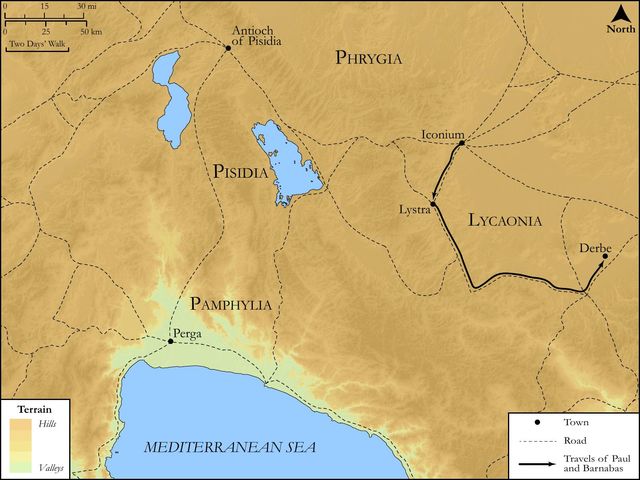
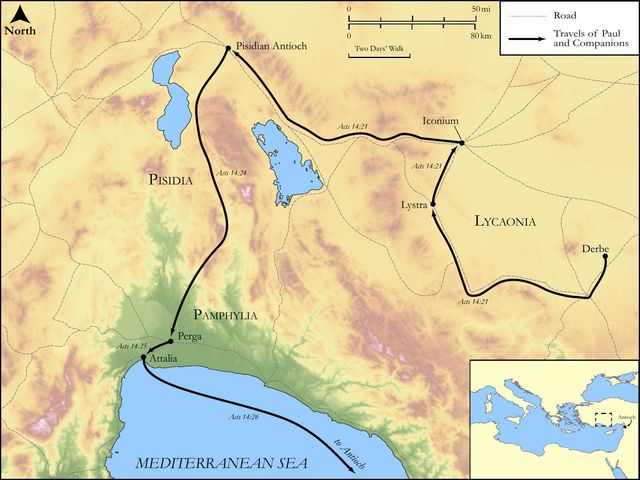
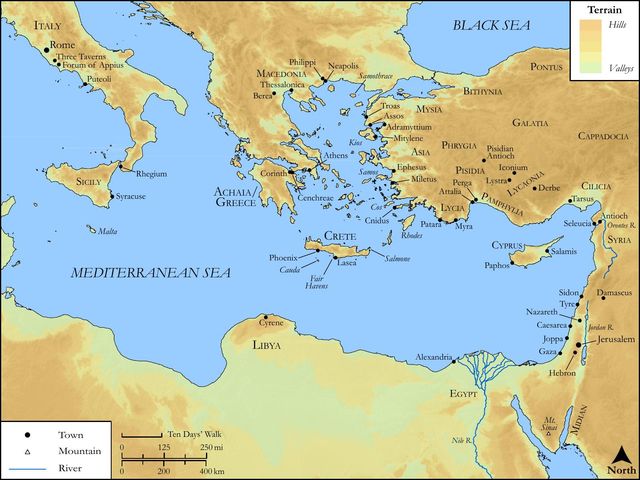
Study this verse
Public-domain commentary
Matthew Henry
From his Commentary on the Whole Bible. Henry comments on passages, not single verses — this entry covers Acts 14:1–7. His three-level outline is real structure in the source text, so it is rendered as structure.
In these verses we have,
I.The preaching of the gospel in Iconium, whither the apostles were forced to retire from Antioch.
As the blood of the martyrs has been the seed of the church, so the banishment of the confessors has helped to scatter that seed. Observe,
1.How they made the first offer of the gospel to the Jews in their synagogues; thither they went, not only as to a place of meeting, but as to a place of meeting with them, to whom, wherever they came, they were to apply themselves in the first place. Though the Jews at Antioch had used them barbarously, yet they did not therefore decline preaching the gospel to the Jews at Iconium, who perhaps might be better disposed. Let not those of any denomination be condemned in the gross, nor some suffer for others' faults; but let us do good to those who have done evil to us. Though the blood-thirsty hate the upright, yet the just seek their soul (Pro 29:10), seek the salvation of it.
2.How the apostles concurred herein. Notice is taken of this, that they went both together into the synagogue, to testify their unanimity and mutual affection, that people might say, See how they love one another, and might think the better of Christianity, and that they might strengthen one another's hands and confirm one another's testimony, and out of the mouth of two witnesses every word might be established. They did not go one one day and another another, nor one go at the beginning and the other some time after; but they went in both together.
II.The success of their preaching there:
They so spoke that a great multitude, some hundreds perhaps, if not thousands, both of the Jews and also of the Greeks, that is the Gentiles, believed. Observe here,
1.That the gospel was now preached to Jews and Gentiles together, and those of each denomination that believed came together into the church. In the close of the foregoing chapter it was preached first to the Jews, and some of them believed, and then to the Gentiles, and some of them believed; but here they are put together, being put upon the same level. The Jews have not so lost their preference as to be thrown behind, only the Gentiles are brought to stand upon even terms with them; both are reconciled to God in one body (Eph 2:16), and both together admitted into the church without distinction.
2.There seems to have been something remarkable in the manner of the apostles' preaching here, which contributed to their success: They so spoke that a great multitude believed - so plainly, so convincingly, with such an evidence and demonstration of the Spirit, and with such power; they so spoke, so warmly, so affectionately, and with such a manifest concern for the souls of men, that one might perceive they were not only convinced, but filled, with the things they spoke of, and that what they spoke came from the heart and therefore was likely to reach to the heart; they so spoke, so earnestly and so seriously, so boldly and courageously, that those who heard them could not but say that God was with them of a truth. Yet the success was not to be attributed to the manner of their preaching, but to the Spirit of God, who made use of that means.
III.The opposition that their preaching met with there, and the trouble that was created them; lest they should be puffed up with the multitude of their converts, there was given them this thorn in the flesh.
1.Unbelieving Jews were the first spring of their trouble here, as elsewhere (Act 14:2): they stirred up the Gentiles. The influence which the gospel had upon many of the Gentiles, and their embracing it, as it provoked some of the Jews to a holy jealousy and stirred them up to receive the gospel too (Rom 11:14), so it provoked others of them to a wicked jealousy, and exasperated them against the gospel. Thus as good instructions, so good examples, which to some are a savour of life unto life, to others are a savour of death unto death. See Co2 2:15, Co2 2:16.
2.Disaffected Gentiles, irritated by the unbelieving Jews, were likely to be the instruments of their trouble. The Jews, by false suggestions, which they were continually buzzing in the ears of the Gentiles, made their minds evil affected against the brethren, whom of themselves they were inclined to think favourably of. They not only took occasion in all companies, as it came in their way, but made it their business to go purposely to such as they had any acquaintance with, and said all that their wit or malice could invent to beget in them not only a mean but an ill opinion of Christianity, telling them how destructive it would certainly be to their pagan theology and worship; and, for their parts, they would rather be Gentiles than Christians. Thus they soured and embittered their spirits against both the converters and the converted. The old serpent did, by their poisonous tongues, infuse his venom against the seed of the woman into the minds of these Gentiles, and this was a root of bitterness in them, bearing gall and wormwood. It is no wonder if those who are ill affected towards good people wish ill to them, speak ill of them, and contrive ill against them; it is all owing to ill will. Ekakōsan, they molested and vexed the minds of the Gentiles (so some of the critics take it); they were continually teasing them with their impertinent solicitations. The tools of persecutors have a dog's life, set on continually.
IV.Their continuance in their work there, notwithstanding this opposition, and God's owning them in it, Act 14:3. We have here,
1.The apostles working for Christ, faithfully and diligently, according to the trust committed to them. Because the minds of the Gentiles were evil affected against them, one would think that therefore they should have withdrawn, and hastened out of the way, or, if they had preached, should have preached cautiously, for fear of giving further provocation to those who were already enough enraged. No; on the contrary, therefore they abode there a long time, speaking boldly in the Lord. The more they perceived the spite and rancour of the town against the new converts, the more they were animated to go on in their work, and the more needful they saw it to continue among them, to confirm them in the faith, and to comfort them. They spoke boldly, and were not afraid of giving offence to the unbelieving Jews. What God said to the prophet, with reference to the unbelieving Jews in his day, was now made good to the apostles: I have made thy face strong against their faces, Eze 3:7-9. But observe what it was that animated them: They spoke boldly in the Lord, in his strength, and trusting in him to bear them out; not depending upon any thing in themselves. They were strong in the Lord, and in the power of his might.
2.Christ working with the apostles, according to his promise, Lo, I am with you always. When they went on in his name and strength, he failed not to give testimony to the word of his grace. Note,
(1.)The gospel is a word of grace, the assurance of God's good will to us and the means of his good work in us. It is the word of Christ's grace, for it is in him alone that we find favour with God.
(2.)Christ himself has attested this word of grace, who is the Amen, the faithful witness; he has assured us that it is the word of God, and that we may venture our souls upon it. As it was said in general concerning the first preachers of the gospel that they had the Lord working with them, and confirming the word by signs following (Mar 16:20), so it is said particularly concerning the apostles here that the Lord confirmed their testimony, in granting signs and wonders to be done by their hands - in the miracles they wrought in the kingdom of nature - as well as the wonders done by their word, in the greater miracles wrought on men's minds by the power of divine grace. The Lord was with them, while they were with him, and abundance of good was done.
V.The division which this occasioned in the city (Act 14:4):
The multitude of the city was divided into two parties, and both active and vigorous. Among the rulers and persons of rank, and among the common people, there were some that held with the unbelieving Jews, and others that held with the apostles. Barnabas is here reckoned an apostle, though not one of the twelve, nor called in the extra-ordinary manner that Paul was, because set apart by special designation of the Holy Ghost to the service of the Gentiles. It seems, this business of the preaching of the gospel was so universally taken notice of with concern that every person, even of the multitude of the city, was either for it or against it; none stood neuter. "Either for us or for our adversaries, for God or Baal, for Christ or Beelzebub." 1. We may here see the meaning of Christ's prediction that he came not to send peace upon earth, but rather division, Luk 12:51-53. If all would have given in unanimously into his measures, there would have been universal concord; and, could men have agreed in this, there would have been no dangerous discord nor disagreement in other things; but, disagreeing here, the breach was wide as the sea. Yet the apostles must not be blamed for coming to Iconium, although before they came the city was united, and now it was divided; for it is better that part of the city go to heaven than all to hell. 2. We may here take the measures of our expectations; let us not think it strange if the preaching of the gospel occasion division, nor be offended at it; it is better to be reproached and persecuted as dividers for swimming against the stream than yield ourselves to be carried down the stream that leads to destruction. Let us hold with the apostles, and not fear those that hold with the Jews.
VI.The attempt made upon the apostles by their enemies.
Their evil affection against them broke out at length into violent outrages, Act 14:5. Observe,
1.Who the plotters were: Both the Gentiles and the Jews, with their rulers. The Gentiles and Jews were at enmity with one another, and yet united against Christians, like Herod and Pilate, Sadducees and Pharisees, against Christ; and like Gebal and Ammon and Amalek, of old, against Israel. If the church's enemies can thus unite for its destruction, shall not its friends, laying aside all personal feuds, unite for its preservation?
2.What the plot was. Having now got the rulers on their side, they doubted not but to carry their point, and their design was to use the apostles despitefully, to expose them to disgrace, and then to stone them, to put them to death; and thus they hoped to sink their cause. They aimed to take away both their reputation and their life, and this was all they had to lose which men could take from them, for they had neither lands nor goods.
VII.The deliverance of the apostles out of the hands of those wicked and unreasonable men, Act 14:6, Act 14:7.
They got away, upon notice given them of the design against them, or the beginning of the attempt upon them, of which they were soon aware, and they made an honourable retreat (for it was not an inglorious flight) to Lystra and Derbe; and there,
1.They found safety. Their persecutors in Iconium were for the present satisfied that they were thrust out of their borders, and pursued them no further. God has shelters for his people in a storm; nay, he is, and will be, himself their hiding place.
2.They found work, and this was what they went for. When the door of opportunity was shut against them at Iconium, it was opened at Lystra and Derbe. To these cities they went, and there, and in the region that lieth round about, they preached the gospel. In times of persecution ministers may see cause to quit the spot, when yet they do not quit the work.
Historical interpretation
Historical reception
2 surviving comments on this verse. Each one is dated, so this reads as a timeline rather than a list.
"Long time therefore abode they speaking boldly in the Lord, which gave testimony unto the word of His grace, and granted signs and wonders to be done by their hands." This caused their boldness; or rather, of their boldness indeed their own hearty good-will was the cause - therefore it is that for a long while they work no signs - while the conversion of the hearers was the effect of the signs, though their boldness also contributed somewhat.
And see how on all occasions he refers all to God. "Long time," he says, "abode they speaking boldly in the Lord, which gave testimony unto the word of His grace." Think not this expression, "Gave testimony," hath aught derogatory to the Lord's Divine Majesty: "Who witnessed," it is said, "before Pontius Pilate." Then the boldness - "and granted signs and wonders to be done by their hands." Here he speaks it as concerning their own nation.
Continue studying Acts 14:3 across the web’s major study libraries — every link below opens this exact verse, chapter, or book on the destination site.
Read & Compare
 BibleGatewayThis verse in more than 200 translations and 70 languages.
 Bible.comThe YouVersion reader — hundreds of translations, reading plans, and highlights.
 ESV.orgCrossway's official English Standard Version reader.
 NET BibleThe NET translation with 60,000+ translators' notes on every rendering decision.
 STEP BibleTyndale House's free study tool — original text, vocabulary, and scholarly resources.
 BibliaLogos Bible Software's free web reader.
 USCCBThe New American Bible (Revised Edition) with the U.S. bishops' study notes.
Commentaries
 BibleHub CommentariesDozens of classic commentaries on this verse, gathered on one page.
 StudyLightMore than 100 commentary sets — the largest collection on the web.
 BibleRefPlain-English commentary on what this verse means, verse by verse.
 Enduring WordDavid Guzik's free commentary on this chapter, widely used by Bible teachers.
 Bible Study ToolsVerse commentary alongside Greek and Hebrew study aids.
Original Language & Research
- BibleHub InterlinearThe verse word by word — original language, transliteration, and English.
- BibleHub LexiconEvery word's original-language definition and Strong's entry.
 Blue Letter BibleDeep-study tools — Strong's numbers, concordance, and word studies.
 CNTR CollationThe earliest Greek manuscripts of this verse, collated letter by letter.
Sermons, Hymns & Audio


TrulyRandomVerse is not affiliated with these sites and doesn’t control their content. They’re linked because they’re genuinely useful.
Summary
Acts 14:3 vividly portrays the sustained and courageous ministry of Paul and Barnabas in Iconium, where, despite escalating opposition, they continued to proclaim the Gospel with divine empowerment. This verse underscores the crucial partnership between human faithfulness in preaching "the word of his grace" and God's active validation through miraculous "signs and wonders" performed through their hands, authenticating their message and demonstrating His sovereign power.
Context
ShowHideLiterary Context
Acts 14:3 follows directly from the initial outreach of Paul and Barnabas in Iconium, as described in Acts 14:1-2. Having been forced to leave Antioch of Pisidia due to Jewish opposition, they arrived in Iconium and, true to their pattern, first preached in the synagogue. Their message, however, quickly divided the city, with some believing and others aligning with the unbelieving Jews to stir up hostility against the apostles. In this volatile atmosphere, Acts 14:3 highlights their remarkable perseverance, indicating they "abode a long time," continuing their bold proclamation despite the growing tension. This sustained ministry ultimately led to a violent plot against them, forcing their eventual departure to Lystra and Derbe, as detailed in Acts 14:5-6. The verse thus serves as a crucial bridge, emphasizing the period of intense, divinely affirmed evangelism before the inevitable escalation of persecution.
Historical & Cultural Context
Iconium was a significant city in the Roman province of Galatia, situated at the crossroads of important trade routes. Its population was a mix of Jews and Gentiles, typical of many cities where Paul and Barnabas ministered. The synagogue served as a natural starting point for their evangelism, providing an audience familiar with the Old Testament prophecies that pointed to Christ. Among the Gentiles of that day, the performance of "signs and wonders" was not entirely foreign, as various cults and philosophical schools claimed supernatural manifestations. However, the signs performed by the apostles were distinct in their purpose: they were not for personal gain or mere spectacle, but served as divine authentication of the monotheistic God of Israel and the Gospel message of His Son. This was particularly important in a polytheistic environment, where the power of the Christian God needed to be visibly demonstrated to challenge prevailing worldviews and validate the apostles' claims.
Key Themes
ShowHideThis verse powerfully encapsulates several recurring themes vital to the book of Acts and the broader New Testament. The first is Bold Proclamation (Parrhesia), evident in the phrase "speaking boldly in the Lord." This is not mere human courage but a divinely enabled confidence to declare the Gospel openly, even in the face of hostility, a theme frequently seen in the early church's witness, as when the apostles prayed for boldness in Acts 4:31. Secondly, the verse highlights Divine Confirmation, where God Himself "gave testimony unto the word of his grace." This underscores that the apostles' message was not simply human rhetoric but God's truth, validated by His own power. The "signs and wonders" were the tangible evidence of this divine endorsement, a pattern seen throughout the New Testament, confirming the word preached, as described in Mark 16:20 and Hebrews 2:4. Finally, the core of their message is identified as "the word of his grace," emphasizing that salvation is a free gift of God's unmerited favor, a central tenet of the Gospel that Paul passionately defended throughout his ministry, as articulated in Acts 20:24 and profoundly expounded in Ephesians 2:8-9.
Exposition and Analysis
ShowHideKey Word Analysis
ShowHideThis word literally means "to wear through (time)" and implies a prolonged stay or continued presence. It conveys the idea of tarrying or remaining for a significant duration. In Acts 14:3, it emphasizes the apostles' perseverance and commitment to their ministry in Iconium, indicating that their evangelistic efforts were not fleeting but sustained over a considerable period despite the mounting opposition.
This term signifies being "frank in utterance" or "confident in spirit and demeanor." It denotes a fearless, open, and unreserved declaration of truth, often in the face of adversity or potential danger. The boldness described here is not a natural human trait but is explicitly stated as being "in the Lord," indicating a divine enablement and empowerment for their courageous proclamation of the Gospel.
This verb means "to give" or "to bestow." In this context, it highlights God's active role as the giver and bestower of the signs and wonders. It underscores that these miraculous manifestations were not conjured by the apostles' own power or will, but were sovereignly given by God to confirm their message. This emphasizes the divine origin and authority behind the supernatural acts.
Verse Breakdown
ShowHide"Long time therefore abode they"
This phrase indicates a significant period of residence and ministry in Iconium. The "therefore" connects their continued presence to the preceding events of division and opposition (Acts 14:2), suggesting that despite the challenges, they chose to remain and persist in their mission. It speaks to their perseverance and commitment to the Gospel.
"speaking boldly in the Lord"
This describes the nature of their proclamation. "Speaking boldly" (parrhesia) denotes unreserved and courageous speech, particularly in the face of threats. The crucial qualifier "in the Lord" signifies that their boldness was not a product of their own strength or arrogance, but was empowered by and rooted in their relationship with Jesus Christ, indicating divine enablement for their witness.
"which gave testimony unto the word of his grace"
This clause reveals God's active participation in their ministry. The "which" refers to "the Lord," indicating that it was God Himself who bore witness or confirmed the message the apostles were preaching. The message itself is identified as "the word of his grace," emphasizing that the core of the Gospel is God's unmerited favor and salvation freely offered through Christ.
"and granted signs and wonders to be done by their hands"
This specifies the means by which God "gave testimony." God "granted" or allowed miraculous "signs" (semeia, pointing to meaning) and "wonders" (terata, causing awe) to occur. The phrase "by their hands" clarifies that the apostles were the instruments or channels through whom these divine acts were manifested, not the source of the power themselves, further emphasizing God's sovereign agency.
Literary Devices
ShowHideActs 14:3 employs several literary devices to convey its powerful message. The phrase "signs and wonders" (Greek: sēmeia kai terata) is a classic merism or hendiadys, a common biblical pairing that emphasizes the extraordinary, supernatural nature of the events, highlighting both their evidential purpose (signs) and their awe-inspiring quality (wonders). The use of the divine passive in "to be done by their hands" subtly but powerfully indicates that God is the ultimate agent behind the miracles, even though they are performed through the apostles. This emphasizes divine sovereignty and the apostles' role as instruments. Furthermore, the verse presents a juxtaposition between human action ("abode they speaking boldly") and divine action ("which gave testimony... and granted signs and wonders"), illustrating the essential partnership in ministry where human faithfulness is met with divine confirmation. The phrase "in the Lord" functions as a metonymy, where "the Lord" stands for the power, authority, and presence of Christ, who is the source of their boldness and the one who ultimately authenticates their message.
Theological and Thematic Connections
ShowHideActs 14:3 provides a profound theological insight into the nature of apostolic ministry and, by extension, all effective Christian witness: it is a synergistic work between human proclamation and divine power. The apostles' "speaking boldly in the Lord" was not a self-generated courage but a Spirit-empowered declaration, acknowledging that true spiritual impact flows from God's enabling presence. Furthermore, God's "testimony" through "signs and wonders" underscores the principle that the Gospel message is not merely human philosophy or persuasion, but a divine revelation that God Himself validates. While the overt display of miraculous signs may not be the normative experience for every believer today, the underlying principle remains: God continues to confirm His "word of grace" through transformed lives, the conviction of the Holy Spirit, and tangible evidence of His presence and power in the world. The focus is always on the message of grace, which is God's unmerited favor, the core of salvation, and the power that transforms hearts.
Reflection and Application
ShowHideActs 14:3 offers timeless encouragement and instruction for believers in every generation. The apostles' "long time" abode in Iconium, despite growing opposition, is a powerful testament to the necessity of perseverance in ministry. It reminds us that faithfulness often requires enduring through challenging seasons, trusting that God's timing and purposes will prevail. Their "speaking boldly in the Lord" challenges us to examine the source of our own courage in sharing our faith; true boldness is not born of human strength but is a divine enablement, rooted "in the Lord." This calls us to a deeper reliance on the Holy Spirit, recognizing that it is God who empowers our witness. Moreover, the divine confirmation through "signs and wonders" assures us that God is actively involved in authenticating His Word. While the specific manifestations may differ, God continues to confirm His message today through transformed lives, undeniable spiritual conviction, and answers to prayer, demonstrating His power to a skeptical world. Our mission remains to faithfully proclaim "the word of his grace," confident that as we do so, God will work alongside us, giving testimony to His truth.
Questions for Reflection
ShowHideFAQ
ShowHideWhat does "speaking boldly in the Lord" mean for believers today?
ShowHideFor believers today, "speaking boldly in the Lord" means proclaiming the truth of the Gospel with confidence, clarity, and conviction, not relying on our own strength or eloquence but on the empowerment of the Holy Spirit. It implies a fearless and unreserved declaration of God's Word, even when facing opposition, apathy, or ridicule. This boldness is rooted in our identity "in the Lord," meaning it flows from our relationship with Christ and His authority. It doesn't necessarily mean being loud or aggressive, but rather being unashamed of the Gospel and ready to share it, trusting that God will provide the words and the power, as seen in passages like Ephesians 6:19-20.
Were "signs and wonders" common in the early church, and do they still occur today?
ShowHideYes, "signs and wonders" (miracles, healings, exorcisms, prophetic utterances) were a common and integral part of the early church's ministry, particularly during the apostolic era. As Acts 14:3 shows, they served a crucial purpose: to authenticate the apostles' message and demonstrate God's power to a world unfamiliar with the Gospel. They were God's way of "giving testimony" to His Word. While there is theological debate on the frequency and nature of these phenomena today, many Christians believe that God continues to perform miraculous signs and wonders in various forms, though perhaps not with the same concentration as in the foundational period of the church. The Holy Spirit is still active, and God is sovereign to confirm His Word as He sees fit, often through transformed lives and powerful spiritual experiences, as suggested in 1 Corinthians 12:7-11.
What is "the word of his grace"?
ShowHide"The word of his grace" refers to the Gospel message, which centers on God's unmerited favor and benevolent love toward humanity, culminating in salvation through Jesus Christ. It emphasizes that salvation is not earned by human effort, good works, or adherence to the law, but is a free gift received by faith. This message highlights God's character as gracious and merciful, offering forgiveness and new life purely out of His boundless love. It is the core of the Christian message, contrasting with systems of earning favor or merit. Paul frequently emphasized this theme, as in Acts 20:24 and Ephesians 2:8-9.
Christ-Centered Fulfillment
ShowHideActs 14:3, though describing the ministry of Paul and Barnabas, finds its ultimate fulfillment and deepest meaning in Jesus Christ. The apostles' "speaking boldly in the Lord" is a direct continuation of Christ's own fearless proclamation of the Kingdom of God, empowered by the very Spirit He promised to send (Acts 1:8). Jesus Himself was the embodiment of "the word of his grace," for "grace and truth came through Jesus Christ" (John 1:17). He is the living Word, full of grace, who "became flesh and dwelt among us" (John 1:14). Moreover, the "signs and wonders" performed by the apostles were not arbitrary displays of power, but echoes of Christ's own miraculous ministry, which consistently validated His divine authority and the truth of His message (Luke 4:18-19). Just as God bore witness to Jesus's claims through mighty works, so too did He confirm the apostles' testimony to Jesus. Thus, Acts 14:3 powerfully illustrates that the early church's mission was fundamentally Christ-centered: they spoke boldly of Him, God gave testimony to His grace, and the signs and wonders were performed in His name and for His glory, demonstrating that Jesus Christ is "the same yesterday and today and forever" (Hebrews 13:8).