


Acts 14:4
Bible text: King James Version (1769 Blayney text) · Public domain
Bible text: Berean Standard Bible · Public domain
Bible text: American Standard Version (1901) · Public domain
Bible text: World English Bible, Messianic edition · Public domain
Bible text: Geneva Bible (1599) · Public domain
Bible text: Young's Literal Translation · Public domain
- ἐσχίσθηeschisthēWas dividedG4977V-API-3SVerb Aorist Passive Indicative 3rd Singular
- δὲdenowG1161CONJConjunction
- τὸtotheG3588T-NSNDefinite article Nominative Singular Neuter
- πλῆθοςplēthosmultitudeG4128N-NSNNoun Nominative Singular Neuter
- τῆςtēsof theG3588T-GSFDefinite article Genitive Singular Feminine
- πόλεωςpoleōscityG4172N-GSFNoun Genitive Singular Feminine
- καὶkaiandG2532CONJConjunction
- οἱhoisomeG3588T-NPMDefinite article Nominative Plural Masculine
- μὲνmenindeedG3303PRTParticle or Disjunctive
- ἦσανēsanwereG1510V-IAI-3PVerb Imperfect Active Indicative 3rd Plural
- σὺνsunwithG4862PREPPreposition
- τοῖςtoistheG3588T-DPMDefinite article Dative Plural Masculine
- ἸουδαίοιςIoudaioisJewsG2453N-DPM-PGNoun Dative Plural Masculine Individual Gentilic
- οἱhoisomeG3588T-NPMDefinite article Nominative Plural Masculine
- δὲdehoweverG1161CONJConjunction
- σὺνsunwithG4862PREPPreposition
- τοῖςtoistheG3588T-DPMDefinite article Dative Plural Masculine
- ἀποστόλοιςapostoloisapostlesG652N-DPMNoun Dative Plural Masculine
English is a literal word-by-word gloss of the Greek, not the KJV's wording. Why?
This is the original text the KJV's translators worked from — each Greek word with its own literal English meaning in this verse, prepared by scholars at Tyndale House, Cambridge. The KJV translates whole sentences, not word by word, so its wording differs: one Greek word can become several English words, and the KJV may choose “charity” where the gloss reads “love”. Both are faithful — they answer different questions. For the KJV's own rendering, switch to the KJV text.
Details
See on the biblical-era maps
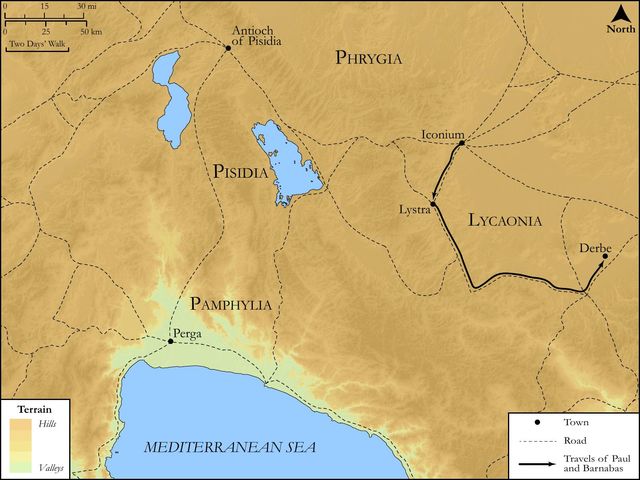
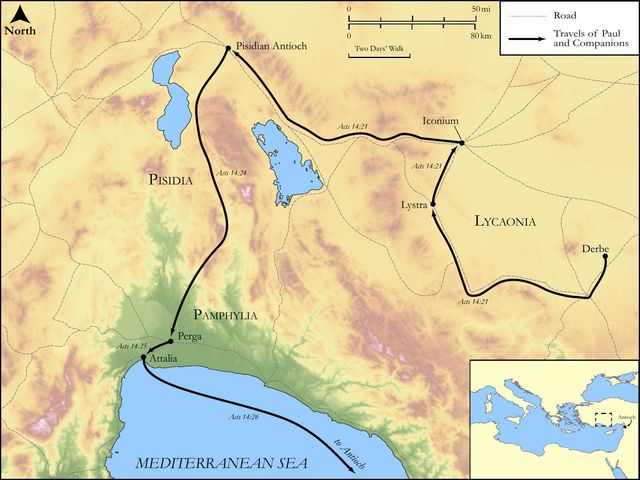
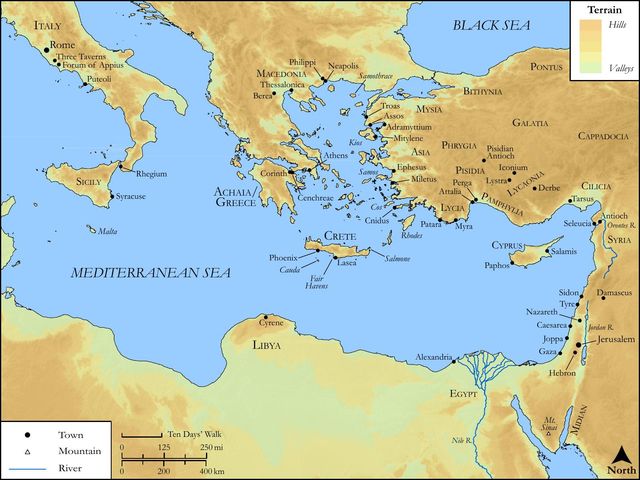
Study this verse
Public-domain commentary
Matthew Henry
From his Commentary on the Whole Bible. Henry comments on passages, not single verses — this entry covers Acts 14:1–7. His three-level outline is real structure in the source text, so it is rendered as structure.
In these verses we have,
I.The preaching of the gospel in Iconium, whither the apostles were forced to retire from Antioch.
As the blood of the martyrs has been the seed of the church, so the banishment of the confessors has helped to scatter that seed. Observe,
1.How they made the first offer of the gospel to the Jews in their synagogues; thither they went, not only as to a place of meeting, but as to a place of meeting with them, to whom, wherever they came, they were to apply themselves in the first place. Though the Jews at Antioch had used them barbarously, yet they did not therefore decline preaching the gospel to the Jews at Iconium, who perhaps might be better disposed. Let not those of any denomination be condemned in the gross, nor some suffer for others' faults; but let us do good to those who have done evil to us. Though the blood-thirsty hate the upright, yet the just seek their soul (Pro 29:10), seek the salvation of it.
2.How the apostles concurred herein. Notice is taken of this, that they went both together into the synagogue, to testify their unanimity and mutual affection, that people might say, See how they love one another, and might think the better of Christianity, and that they might strengthen one another's hands and confirm one another's testimony, and out of the mouth of two witnesses every word might be established. They did not go one one day and another another, nor one go at the beginning and the other some time after; but they went in both together.
II.The success of their preaching there:
They so spoke that a great multitude, some hundreds perhaps, if not thousands, both of the Jews and also of the Greeks, that is the Gentiles, believed. Observe here,
1.That the gospel was now preached to Jews and Gentiles together, and those of each denomination that believed came together into the church. In the close of the foregoing chapter it was preached first to the Jews, and some of them believed, and then to the Gentiles, and some of them believed; but here they are put together, being put upon the same level. The Jews have not so lost their preference as to be thrown behind, only the Gentiles are brought to stand upon even terms with them; both are reconciled to God in one body (Eph 2:16), and both together admitted into the church without distinction.
2.There seems to have been something remarkable in the manner of the apostles' preaching here, which contributed to their success: They so spoke that a great multitude believed - so plainly, so convincingly, with such an evidence and demonstration of the Spirit, and with such power; they so spoke, so warmly, so affectionately, and with such a manifest concern for the souls of men, that one might perceive they were not only convinced, but filled, with the things they spoke of, and that what they spoke came from the heart and therefore was likely to reach to the heart; they so spoke, so earnestly and so seriously, so boldly and courageously, that those who heard them could not but say that God was with them of a truth. Yet the success was not to be attributed to the manner of their preaching, but to the Spirit of God, who made use of that means.
III.The opposition that their preaching met with there, and the trouble that was created them; lest they should be puffed up with the multitude of their converts, there was given them this thorn in the flesh.
1.Unbelieving Jews were the first spring of their trouble here, as elsewhere (Act 14:2): they stirred up the Gentiles. The influence which the gospel had upon many of the Gentiles, and their embracing it, as it provoked some of the Jews to a holy jealousy and stirred them up to receive the gospel too (Rom 11:14), so it provoked others of them to a wicked jealousy, and exasperated them against the gospel. Thus as good instructions, so good examples, which to some are a savour of life unto life, to others are a savour of death unto death. See Co2 2:15, Co2 2:16.
2.Disaffected Gentiles, irritated by the unbelieving Jews, were likely to be the instruments of their trouble. The Jews, by false suggestions, which they were continually buzzing in the ears of the Gentiles, made their minds evil affected against the brethren, whom of themselves they were inclined to think favourably of. They not only took occasion in all companies, as it came in their way, but made it their business to go purposely to such as they had any acquaintance with, and said all that their wit or malice could invent to beget in them not only a mean but an ill opinion of Christianity, telling them how destructive it would certainly be to their pagan theology and worship; and, for their parts, they would rather be Gentiles than Christians. Thus they soured and embittered their spirits against both the converters and the converted. The old serpent did, by their poisonous tongues, infuse his venom against the seed of the woman into the minds of these Gentiles, and this was a root of bitterness in them, bearing gall and wormwood. It is no wonder if those who are ill affected towards good people wish ill to them, speak ill of them, and contrive ill against them; it is all owing to ill will. Ekakōsan, they molested and vexed the minds of the Gentiles (so some of the critics take it); they were continually teasing them with their impertinent solicitations. The tools of persecutors have a dog's life, set on continually.
IV.Their continuance in their work there, notwithstanding this opposition, and God's owning them in it, Act 14:3. We have here,
1.The apostles working for Christ, faithfully and diligently, according to the trust committed to them. Because the minds of the Gentiles were evil affected against them, one would think that therefore they should have withdrawn, and hastened out of the way, or, if they had preached, should have preached cautiously, for fear of giving further provocation to those who were already enough enraged. No; on the contrary, therefore they abode there a long time, speaking boldly in the Lord. The more they perceived the spite and rancour of the town against the new converts, the more they were animated to go on in their work, and the more needful they saw it to continue among them, to confirm them in the faith, and to comfort them. They spoke boldly, and were not afraid of giving offence to the unbelieving Jews. What God said to the prophet, with reference to the unbelieving Jews in his day, was now made good to the apostles: I have made thy face strong against their faces, Eze 3:7-9. But observe what it was that animated them: They spoke boldly in the Lord, in his strength, and trusting in him to bear them out; not depending upon any thing in themselves. They were strong in the Lord, and in the power of his might.
2.Christ working with the apostles, according to his promise, Lo, I am with you always. When they went on in his name and strength, he failed not to give testimony to the word of his grace. Note,
(1.)The gospel is a word of grace, the assurance of God's good will to us and the means of his good work in us. It is the word of Christ's grace, for it is in him alone that we find favour with God.
(2.)Christ himself has attested this word of grace, who is the Amen, the faithful witness; he has assured us that it is the word of God, and that we may venture our souls upon it. As it was said in general concerning the first preachers of the gospel that they had the Lord working with them, and confirming the word by signs following (Mar 16:20), so it is said particularly concerning the apostles here that the Lord confirmed their testimony, in granting signs and wonders to be done by their hands - in the miracles they wrought in the kingdom of nature - as well as the wonders done by their word, in the greater miracles wrought on men's minds by the power of divine grace. The Lord was with them, while they were with him, and abundance of good was done.
V.The division which this occasioned in the city (Act 14:4):
The multitude of the city was divided into two parties, and both active and vigorous. Among the rulers and persons of rank, and among the common people, there were some that held with the unbelieving Jews, and others that held with the apostles. Barnabas is here reckoned an apostle, though not one of the twelve, nor called in the extra-ordinary manner that Paul was, because set apart by special designation of the Holy Ghost to the service of the Gentiles. It seems, this business of the preaching of the gospel was so universally taken notice of with concern that every person, even of the multitude of the city, was either for it or against it; none stood neuter. "Either for us or for our adversaries, for God or Baal, for Christ or Beelzebub." 1. We may here see the meaning of Christ's prediction that he came not to send peace upon earth, but rather division, Luk 12:51-53. If all would have given in unanimously into his measures, there would have been universal concord; and, could men have agreed in this, there would have been no dangerous discord nor disagreement in other things; but, disagreeing here, the breach was wide as the sea. Yet the apostles must not be blamed for coming to Iconium, although before they came the city was united, and now it was divided; for it is better that part of the city go to heaven than all to hell. 2. We may here take the measures of our expectations; let us not think it strange if the preaching of the gospel occasion division, nor be offended at it; it is better to be reproached and persecuted as dividers for swimming against the stream than yield ourselves to be carried down the stream that leads to destruction. Let us hold with the apostles, and not fear those that hold with the Jews.
VI.The attempt made upon the apostles by their enemies.
Their evil affection against them broke out at length into violent outrages, Act 14:5. Observe,
1.Who the plotters were: Both the Gentiles and the Jews, with their rulers. The Gentiles and Jews were at enmity with one another, and yet united against Christians, like Herod and Pilate, Sadducees and Pharisees, against Christ; and like Gebal and Ammon and Amalek, of old, against Israel. If the church's enemies can thus unite for its destruction, shall not its friends, laying aside all personal feuds, unite for its preservation?
2.What the plot was. Having now got the rulers on their side, they doubted not but to carry their point, and their design was to use the apostles despitefully, to expose them to disgrace, and then to stone them, to put them to death; and thus they hoped to sink their cause. They aimed to take away both their reputation and their life, and this was all they had to lose which men could take from them, for they had neither lands nor goods.
VII.The deliverance of the apostles out of the hands of those wicked and unreasonable men, Act 14:6, Act 14:7.
They got away, upon notice given them of the design against them, or the beginning of the attempt upon them, of which they were soon aware, and they made an honourable retreat (for it was not an inglorious flight) to Lystra and Derbe; and there,
1.They found safety. Their persecutors in Iconium were for the present satisfied that they were thrust out of their borders, and pursued them no further. God has shelters for his people in a storm; nay, he is, and will be, himself their hiding place.
2.They found work, and this was what they went for. When the door of opportunity was shut against them at Iconium, it was opened at Lystra and Derbe. To these cities they went, and there, and in the region that lieth round about, they preached the gospel. In times of persecution ministers may see cause to quit the spot, when yet they do not quit the work.
Historical interpretation
Historical reception
2 surviving comments on this verse. Each one is dated, so this reads as a timeline rather than a list.
"But the multitude of the city was divided: and part held with the Jews, and part with the Apostles." No small matter this dividing. And this was what the Lord said, "I am not come to bring peace, but a sword."
"And the multitude of the city," etc. Accordingly they did not wait for it, but saw the intention of attacking them, and fled, on no occasion kindling their wrath.
Continue studying Acts 14:4 across the web’s major study libraries — every link below opens this exact verse, chapter, or book on the destination site.
Read & Compare
 BibleGatewayThis verse in more than 200 translations and 70 languages.
 Bible.comThe YouVersion reader — hundreds of translations, reading plans, and highlights.
 ESV.orgCrossway's official English Standard Version reader.
 NET BibleThe NET translation with 60,000+ translators' notes on every rendering decision.
 STEP BibleTyndale House's free study tool — original text, vocabulary, and scholarly resources.
 BibliaLogos Bible Software's free web reader.
 USCCBThe New American Bible (Revised Edition) with the U.S. bishops' study notes.
Commentaries
 BibleHub CommentariesDozens of classic commentaries on this verse, gathered on one page.
 StudyLightMore than 100 commentary sets — the largest collection on the web.
 BibleRefPlain-English commentary on what this verse means, verse by verse.
 Enduring WordDavid Guzik's free commentary on this chapter, widely used by Bible teachers.
 Bible Study ToolsVerse commentary alongside Greek and Hebrew study aids.
Original Language & Research
- BibleHub InterlinearThe verse word by word — original language, transliteration, and English.
- BibleHub LexiconEvery word's original-language definition and Strong's entry.
 Blue Letter BibleDeep-study tools — Strong's numbers, concordance, and word studies.
 CNTR CollationThe earliest Greek manuscripts of this verse, collated letter by letter.
Sermons, Hymns & Audio


TrulyRandomVerse is not affiliated with these sites and doesn’t control their content. They’re linked because they’re genuinely useful.
Summary
Acts 14:4 succinctly captures the immediate and polarizing effect of Paul and Barnabas's sustained ministry in Iconium, illustrating how the preaching of the gospel message, though bringing salvation to some, simultaneously creates sharp societal divisions as the populace is compelled to choose allegiance between the apostles and their Jewish opponents. This verse highlights the inherent power of the gospel to both unite and divide, revealing the spiritual battle unfolding in the city.
Context
ShowHideLiterary Context
This verse is embedded within the narrative of Paul and Barnabas's first missionary journey, specifically detailing their experiences in Iconium. Having faced significant opposition and expulsion from Antioch of Pisidia (Acts 13:50), they arrived in Iconium and immediately began preaching in the Jewish synagogue. Their bold proclamation of the gospel, accompanied by signs and wonders performed by the Lord (Acts 14:3), led to a significant number of both Jews and Greeks believing (Acts 14:1). However, the unbelieving Jews, unwilling to accept the message, actively stirred up the Gentiles and poisoned their minds against the apostles (Acts 14:2). Acts 14:4 serves as the direct consequence and culmination of this escalating tension, demonstrating the profound division that resulted from their impactful yet controversial ministry, setting the stage for the subsequent attempt on their lives (Acts 14:5).
Historical & Cultural Context
Iconium was a strategically important city in the Roman province of Galatia (modern-day Turkey), situated on a major trade route. Like many cities in the Roman Empire, it possessed a diverse population, including a significant Jewish community and various Gentile groups. Synagogues often served as cultural and religious hubs, attracting not only Jews but also "God-fearers" (Gentiles who were attracted to monotheism and Jewish ethical teachings). The Roman authorities generally tolerated established religions, including Judaism, but new movements, especially those that caused public unrest or challenged traditional social structures, could be viewed with suspicion. The preaching of a crucified Messiah, who claimed to be God, was often perceived as scandalous by Jews and foolishness by Greeks, naturally leading to strong reactions and societal fragmentation. The concept of "schism" or deep division was not uncommon in the multi-ethnic and multi-religious urban centers of the Roman world, where competing philosophies and religious claims frequently vied for allegiance.
Key Themes
ShowHideThe division described in Acts 14:4 powerfully illustrates several recurring themes in the book of Acts and the broader New Testament. Firstly, it highlights the inherently divisive nature of the Gospel message. While the gospel unites believers in Christ, it simultaneously separates those who accept its truth from those who reject it, fulfilling Jesus' own prophecy that He came "not to bring peace, but a sword" (Matthew 10:34). Secondly, the verse underscores the inevitability of opposition to faithful ministry. The apostles' commitment to proclaiming Christ often provoked hostility, demonstrating that the advance of God's kingdom frequently meets resistance from forces opposed to divine truth. This opposition is not merely external but can arise from within religious communities, as seen with the unbelieving Jews. Lastly, the verse emphasizes the theme of allegiance and decision. The gospel compels individuals to make a choice: to align themselves with the message of Christ and His apostles or with those who oppose it. This call to allegiance is a fundamental aspect of discipleship, demanding a clear stand for or against the truth of God.
Exposition and Analysis
ShowHideKey Word Analysis
ShowHideDerived from a word meaning "to fill," plēthos refers to a "fulness," signifying a large number, throng, or populace. In this context, it emphasizes that a significant portion of the city's inhabitants, not just a few individuals, was affected by the apostles' ministry and the ensuing conflict. It conveys a sense of the widespread impact and the broad societal scope of the division.
This verb means "to split or sever," either literally (as in tearing a garment or splitting wood) or figuratively. It is the root of the English word "schism." Its use here indicates not a mere disagreement or difference of opinion, but a profound, fundamental rupture or cleavage within the social fabric of Iconium. The city was not simply disagreeing; it was fundamentally rent into opposing factions.
From apostellō ("to send forth"), an apóstolos is a delegate, an ambassador, or one officially sent with a commission. Here, it refers specifically to Paul and Barnabas, who were commissioned by Christ (through the Holy Spirit) to preach the Gospel. The term highlights their divine authority and the legitimacy of their message, contrasting with the self-appointed opposition.
Verse Breakdown
ShowHide"But the multitude of the city was divided"
This opening clause immediately establishes the central conflict and its widespread nature. The conjunction "But" (G1161, dé) signals a contrast or shift, indicating that despite the positive response of many believers (Acts 14:1) and the Lord's confirmation of their message (Acts 14:3), the overall effect on the city was one of sharp polarization. The "multitude" (G4128, plēthos) underscores that this was a broad societal phenomenon, not limited to a small group. The verb "was divided" (G4977, schízō) vividly portrays a deep, fundamental rift within the urban population, a tearing apart of its social cohesion.
"and part held with the Jews"
This clause identifies one of the two opposing factions. The phrase "held with" translates the Greek ēn sýn (G2258, "was" + G4862, "with"), meaning they "were with" or "sided with" the Jews. This "part" (G3303, mén) refers to a segment of the populace, likely including unbelieving Jews who had stirred up opposition (Acts 14:2) and Gentiles whom they had influenced. This faction actively opposed the apostles and their message, aligning themselves with traditional Jewish leadership that rejected Jesus as the Messiah.
"and part with the apostles"
This final clause identifies the second faction, which sided with Paul and Barnabas. This "part" (G1161, dé, again contrasting with the previous "part") consisted of those who had believed the Gospel message preached by the apostles—a mix of Jews and Greeks (Acts 14:1). This indicates a clear line of demarcation, where the city's inhabitants were compelled to choose their allegiance based on their response to the Christian message and the authority of its messengers.
Literary Devices
ShowHideThe primary literary device at play in Acts 14:4 is Contrast. The verse explicitly sets up a dichotomy: "part held with the Jews, and part with the apostles," highlighting the stark opposition that the gospel message engendered. This creates a clear binary, emphasizing the irreconcilable differences between belief and unbelief, and between allegiance to traditional systems versus allegiance to the new way of Christ. Furthermore, the use of the word "divided" (from schízō) functions as Symbolism, where the literal splitting of the city's population symbolizes the inherent nature of the gospel to create a spiritual and social separation. This division is not accidental but a direct consequence of the truth of Christ confronting the world's systems and demanding a decisive response, thereby acting as a powerful symbol of the spiritual battle for human souls.
Theological and Thematic Connections
ShowHideActs 14:4 powerfully illustrates a profound theological truth: the gospel of Jesus Christ, while bringing reconciliation between God and humanity and uniting believers, inherently acts as a dividing force in the world. This division is not a flaw in the gospel but a testament to its radical nature, as it demands a fundamental reorientation of allegiance and a decisive response to God's truth. It exposes the spiritual battle between light and darkness, revealing the heart's true inclination towards or against God's saving grace. This pattern of division in response to divine truth is a consistent theme throughout biblical history, from the separation of Abraham's lineage to the prophetic calls that split Israel, culminating in Christ's own ministry which polarized crowds.
Reflection and Application
ShowHideActs 14:4 serves as a potent reminder that faithfulness to the gospel message often leads to division, not necessarily universal acceptance or harmony. For believers today, this verse challenges us to embrace the reality that proclaiming Christ's truth will inevitably provoke strong reactions, both positive and negative. It calls for courage and conviction, reminding us that our ultimate allegiance is to Christ and His kingdom, not to social cohesion or popular opinion at the expense of truth. We are to be prepared for the discomfort and opposition that may arise when the gospel's demands confront cultural norms or personal preferences. This passage encourages us to stand firm with "the apostles"—that is, with the unchanging truth of God's Word—even when it means being part of a minority or facing ostracization. It also prompts us to examine our own hearts: are we truly willing to embrace the full implications of the gospel, even when it requires us to make difficult choices that may divide us from others, including those we love?
Questions for Reflection
ShowHideFAQ
ShowHideWhy does the gospel cause division instead of unity?
ShowHideThe gospel inherently calls for a radical reorientation of one's life and allegiance, from self or worldly systems to Christ. This demand for repentance, faith, and submission to Jesus as Lord creates a fundamental distinction between those who accept and those who reject it. While the gospel unites believers in Christ, forming a new spiritual family, it divides humanity based on their response to God's saving grace. Jesus himself stated He came "not to bring peace, but a sword" (Matthew 10:34), signifying the spiritual and social separation His message would cause. This division is not due to malice on the part of believers, but due to the nature of truth confronting falsehood and the human heart's response to God's call.
What does "part held with the Jews" mean in this context?
ShowHideThis phrase indicates that a segment of the city's population, likely including both ethnic Jews who rejected Jesus as Messiah and some Gentiles who were influenced by these Jewish leaders, sided with those who opposed Paul and Barnabas. It signifies their rejection of the apostles' message and their alignment with the established religious authorities who sought to discredit or harm the nascent Christian movement. This opposition had been actively stirred up by "unbelieving Jews" who "poisoned the minds of the Gentiles against the brethren" (Acts 14:2), leading directly to the city's division.
Christ-Centered Fulfillment
ShowHideActs 14:4, depicting the sharp division in Iconium, profoundly points to Christ as the ultimate source and reason for such polarization. Jesus himself was the "stumbling stone and rock of offense" (1 Peter 2:8) upon whom people either built their lives or stumbled to their ruin. His earthly ministry consistently polarized crowds, with some hailing Him as the Messiah and Son of God (John 6:68-69) while others plotted His death (John 11:47-53). The division in Iconium is a direct continuation of the pattern established by Christ's own life and ministry, demonstrating that the truth of God's kingdom, embodied in the person of Jesus, forces a choice. The apostles, as Christ's ambassadors, simply extended this divine polarization, demonstrating that true allegiance to the King of Kings and Lord of Lords invariably separates those who embrace His reign from those who resist it, ultimately leading to the eternal division between those who are "in Christ" and those who are not (Matthew 25:31-46). The cross of Christ itself is the ultimate dividing line, separating humanity into those who find salvation and those who are lost (1 Corinthians 1:18).