


Acts 17:4
- καίkaiAndG2532CONJConjunction
- τινεςtinessomeG5100X-NPMIndefinite pronoun Nominative Plural Masculine
- ἐξexofG1537PREPPreposition
- αὐτῶνautōnthemG846P-GPMPersonal pronoun Genitive Plural Masculine
- ἐπείσθησανepeisthēsanwere obedientG3982V-API-3PVerb Aorist Passive Indicative 3rd Plural
- καὶkaiandG2532CONJConjunction
- προσεκληρώθησανproseklērōthēsanthey joined themselvesG4345V-API-3PVerb Aorist Passive Indicative 3rd Plural
- τῷtō<the>G3588T-DSMDefinite article Dative Singular Masculine
- ΠαύλῳPaulōto PaulG3972N-DSM-PNoun Dative Singular Masculine Individual
- καὶkaiandG2532CONJConjunction
- τῷtō<the>G3588T-DSMDefinite article Dative Singular Masculine
- ΣιλᾷSilato SilasG4609N-DSM-PNoun Dative Singular Masculine Individual
- τῶνtōn<the>G3588T-GPMDefinite article Genitive Plural Masculine
- τεtealong withG5037CONJConjunction
- σεβομένωνsebomenōnworshippingG4576V-PNP-GPMVerb Present Middle Or Passive Deponent Participle Genitive Plural Masculine
- ἙλλήνωνHellēnōnGreeksG1672N-GPM-LGNoun Genitive Plural Masculine Location Gentilic
- πλῆθοςplēthosa multitudeG4128N-NSNNoun Nominative Singular Neuter
- πολύpolugreatG4183A-NSNAdjective Nominative Singular Neuter
- γυναικῶνgunaikōnof womenG1135N-GPFNoun Genitive Plural Feminine
- τεtethenG5037CONJConjunction
- τῶνtōn<the>G3588T-GPFDefinite article Genitive Plural Feminine
- πρώτωνprōtōnleadingG4413A-GPFAdjective Genitive Plural Feminine
- οὐκouknotG3756PRT-NNegative Particle Negative
- ὀλίγαιoligaia fewG3641A-NPFAdjective Nominative Plural Feminine
English is a literal word-by-word gloss of the Greek, not the KJV's wording. Why?
This is the original text the KJV's translators worked from — each Greek word with its own literal English meaning in this verse, prepared by scholars at Tyndale House, Cambridge. The KJV translates whole sentences, not word by word, so its wording differs: one Greek word can become several English words, and the KJV may choose “charity” where the gloss reads “love”. Both are faithful — they answer different questions. For the KJV's own rendering, switch to the KJV text.
Details
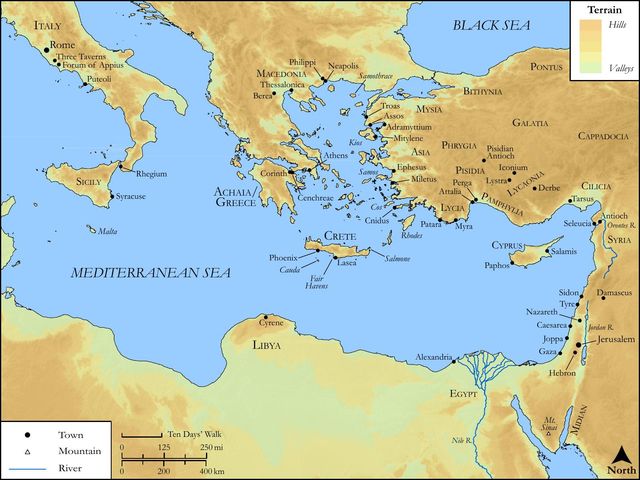
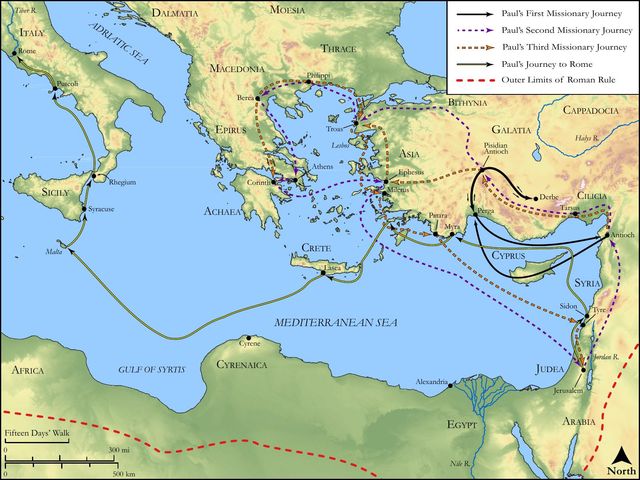
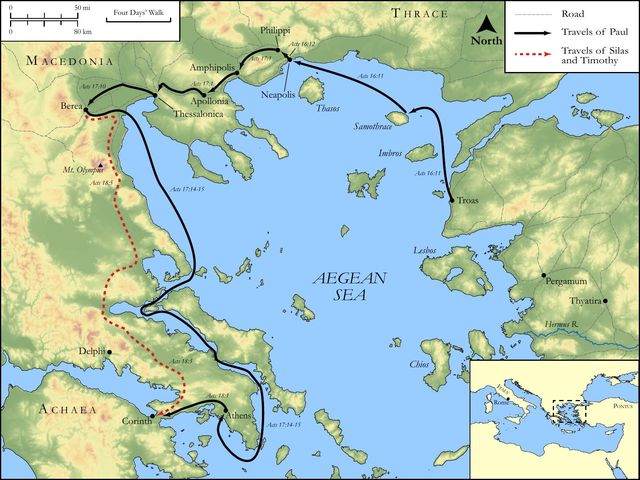
See on the biblical-era map
Study this verse
Public-domain commentary
Matthew Henry
From his Commentary on the Whole Bible. Henry comments on passages, not single verses — this entry covers Acts 17:1–9. His four-level outline is real structure in the source text, so it is rendered as structure.
Paul's two epistles to the Thessalonians, the first two he wrote by inspiration, give such a shining character of that church, that we cannot but be glad here in the history to meet with an account of the first founding of the church there.
I.Here is Paul's coming to Thessalonica, which was the chief city of this country, called at this day Salonech, in the Turkish dominions. Observe,
1.Paul went on with his work, notwithstanding the ill usage he had met with at Philippi; he did not fail, nor was discouraged. He takes notice of this in his first epistle to the church here (Th1 2:2): After we were shamefully treated at Philippi, yet we were bold in our God to speak unto you the gospel of God. The opposition and persecution that he met with made him the more resolute. Note of these things moved him; he could never have held out, and held on, as he did, if he had not been animated by a spirit of power from on high.
2.He did but pass through Amphipolis and Apollonia, the former a city near Philippi, the latter near Thessalonica; doubtless he was under divine direction, and was told by the Spirit (who, as the wind, bloweth where he listeth) what places he should pass through, and what he should rest in. Apollonia was a city of Illyricum, which, some think, illustrates that of Paul, that he had preached the gospel from Jerusalem, and round about unto Illyricum (Rom 15:19), that is, to the borders of Illyricum where he now was; and we may suppose though he is said only to pass through these cities, yet that he staid so long in them as to publish the gospel there, and to prepare the way for the entrance of other ministers among them, whom he would afterwards send.
II.His preaching to the Jews first, in their synagogue at Thessalonica.
He found a synagogue of the Jews there (Act 17:1), which intimates that one reason why he passed through those other cities mentioned, and did not continue long in them, was because there were no synagogues in them. But, finding one in Thessalonica, by it he made his entry.
1.It was always his manner to begin with the Jews, to make them the first offer of the gospel, and not to turn to the Gentiles till they had refused it, that their mouths might be stopped from clamouring against him because he preached to the Gentiles; for if they received the gospel they would cheerfully embrace the new converts; if they refused it, they might thank themselves if the apostles carried it to those that would bid it welcome. That command of beginning at Jerusalem was justly construed as a direction, wherever they came, to begin with the Jews.
2.He met them in their synagogue on the sabbath day, in their place and at their time of meeting, and thus he would pay respect to both. Sabbaths and solemn assemblies are always very precious to those to whom Christ is precious, Psa 84:10. It is good being in the house of the Lord on his day. This was Christ's manner, and Paul's manner, and has been the manner of all the saints, the good old way which they have walked in.
3.He reasoned with them out of the scriptures. They agreed with him to receive the scriptures of the Old Testament: so far they were of a mind. But they received the scripture, and therefore thought they had reason to reject Christ; Paul received the scripture, and therefore saw great reason to embrace Christ. It was therefore requisite, in order to their conviction, that he should, by reasoning with them, the Spirit setting with him, convince them that his inferences from the scripture were right and theirs were wrong. Note, The preaching of the gospel should be both scriptural preaching and rational; such Paul's was, for he reasoned out of the scriptures: we must take the scriptures for our foundation, our oracle, and touchstone, and then reason out of them and upon them, and against those who, though they pretend zeal for the scriptures, as the Jews did, yet wrest them to their own destruction. Reason must not be set up in competition with the scripture, but it must be made use of in explaining and applying the scripture.
4.He continued to do this three sabbath days successively. If he could not convince them the first sabbath, he would try the second and the third; for precept must be upon precept, and line upon line. God waits for sinners' conversion, and so must his ministers; all the labourers come not into the vineyard at the first hour, nor at the first call, nor are wrought upon so suddenly as the jailer.
5.The drift and scope of his preaching and arguing was to prove that Jesus is the Christ; this was that which he opened and alleged, Act 17:3. He first explained his thesis, and opened the terms, and then alleged it, and laid it down, as that which he would abide by, and which he summoned them in God's name to subscribe to. Paul had an admirable method of discourse; and showed he was himself both well apprized of the doctrine he preached and thoroughly understood it, and that he was fully assured of the truth of it, and therefore he opened it like one that believed it. He showed them,
(1.)That it was necessary the Messiah should suffer, and die, and rise again, that the Old Testament prophecies concerning the Messiah made it necessary he should. The great objection which the Jews made against Jesus being the Messiah was his ignominious death and sufferings. The cross of Christ was to the Jews a stumbling-block, because it did by no means agree with the idea they had framed of the Messiah; but Paul here alleges and makes it out undeniably, not only that it was possible he might be the Messiah, though he suffered, but that, being the Messiah, it was necessary he should suffer. He could not be made perfect but by sufferings; for, if he had not died, he could not have risen again from the dead. This was what Christ himself insisted upon (Luk 24:26): Ought not Christ to have suffered these things, and to enter into his glory? And again (v. 46): Thus it is written, and therefore thus it behoved Christ to suffer, and to rise from the dead. He must needs have suffered for us, because he could not otherwise purchase redemption for us; and he must needs have risen again because he could not otherwise apply the redemption to us.
(2.)That Jesus is the Messiah: "This Jesus whom I preach unto you, and call upon you to believe in, is Christ, is the Christ, is the anointed of the Lord, is he that should come, and you are to look for no other; for God has both by his word and by his works (the two ways of his speaking to the children of men), by the scriptures and by miracles, and the gift of the Spirit to make both effectual, borne witness to him." Note,
[1.]Gospel ministers should preach Jesus; he must be their principal subject; their business is to bring people acquainted with him.
[2.]That which we are to preach concerning Jesus is that he is Christ; and therefore we may hope to be saved by him and are bound to be ruled by him.
III.The success of his preaching there, Act 17:4.
1.Some of the Jews believed, notwithstanding their rooted prejudices against Christ and his gospel, and they consorted with Paul and Silas: they not only associated with them as friends and companions, but they gave up themselves to their direction, as their spiritual guides; they put themselves into their possession as an inheritance into the possession of the right owner, so the word signifies; they first gave themselves to the Lord, and then to them by the will of God, Co2 8:5. They adhered to Paul and Silas, and attended them wherever they went. Note, Those that believe in Jesus Christ come into communion with his faithful ministers, and associate with them.
2.Many more of the devout Greeks, and of the chief women, embraced the gospel. These were proselytes of the gate, the godly among the Gentiles (so the Jews called them), such as, though they did not submit to the law of Moses, yet renounced idolatry and immorality, worshipped the true God only, and did not man any wrong. These were hoi sebomenoi Hellēnes - the worshipping Gentiles; as in America they call those of the natives that are converted to the faith of Christ the praying Indians. These were admitted to join with the Jews in their synagogue-worship. Of these a great multitude believed, more of them than of the thorough-paced Jews, who were wedded to the ceremonial law. And not a few of the chief women of the city, that were devout and had a sense of religion, embraced Christianity. Particular notice is taken of this, for an example to the ladies, the chief women, and an encouragement to them to employ themselves in the exercises of devotion and to submit themselves to the commanding power of Christ's holy religion, in all the instances of it; for this intimates how acceptable it will be to God, what an honour to Christ, and what great influence it may have upon many, besides the advantages of it to their own souls. No mention is here made of their preaching the gospel to the Gentile idolaters at Thessalonica, and yet it is certain that they did, and that great numbers were converted; nay, it should seem that of the Gentile converts that church was chiefly composed, though notice is not taken of them here; for Paul writes to the Christians there as having turned to God from idols (Th1 1:9), and that at the first entering in of the apostles among them.
IV.The trouble that was given to Paul and Silas at Thessalonica.
Wherever they preached, they were sure to be persecuted; bonds and afflictions awaited them in every city. Observe,
1.Who were the authors of their trouble: the Jews who believed not, who were moved with envy, Act 17:5. The Jews were in all places the most inveterate enemies to the Christians, especially to those Jews that turned Christians, against whom they had a particular spleen, as deserters. Now see what that division was which Christ came to send upon earth; some of the Jews believed the gospel and pitied and prayed for those that did not; while those that did not envied and hated those that did. St. Paul in his epistle to this church takes notice of the rage and enmity of the Jews against the preachers of the gospel, as their measure-filling sin. Th1 2:15, Th1 2:16.
2.Who were the instruments of the trouble: the Jews made use of certain lewd persons of the baser sort, whom they picked up and got together, and who must undertake to give the sense of the city against the apostles. All wise and sober people looked upon them with respect, and valued them, and none would appear against them but such as were the scum of the city, a company of vile men, that were given to all manner of wickedness. Tertullian pleads this with those that opposed Christianity, that the enemies of it were generally the worst of men: Tales semper nobis insecutores, injusti, impii, turpes, quos, et ipsi damnare consuestis - Our persecutors are invariably unjust, impious, infamous, whom you yourselves have been accustomed to condemn. - Apologia, cap. 5. It is the honour of religion that those who hate it are generally the lewd fellows of the baser sort, that are lost to all sense of justice and virtue.
3.In what method they proceeded against them.
(1.)They set the city in an uproar, made a noise to put people in a fright, and then every body ran to see what the matter was; they began a riot, and then the mob was up presently. See who are the troublers of Israel - not the faithful preachers of the gospel, but the enemies of it. See how the devil carries on his designs; he sets cities in an uproar, sets souls in an uproar, and then fishes in troubled waters.
(2.)They assaulted the house of Jason, where the apostles lodged, with a design to bring them out to the people, whom they had incensed and enraged against them, and by whom they hoped to see them pulled to pieces. The proceedings here were altogether illegal; of Jason's house must be searched, it ought to be done by the proper officers, and not without a warrant: "A man's house," the law says, "is his castle," and for them in a tumultuous manner to assault a man's house, to put him and his family in fear, was but to show to what outrages men are carried by a spirit of persecution. If men have offended, magistrates are appointed to enquire into the offence, and to judge of it; but to make the rabble judges and executioners too (as these Jews designed to do) was to make truth fall in the street, to set servants on horseback, and leave princes to walk as servants on the earth - to depose equity, and enthrone fury.
(3.)When they could not get the apostles into their hands (whom they would have punished as vagabonds, and incensed the people against as strangers that came to spy out the land, and devour its strength, and eat the bread out of their mouths), then they fall upon an honest citizen of their own, who entertained the apostles in his house, his name Jason, a converted Jew, and drew him out with some others of the brethren to the rulers of the city. The apostles were advised to withdraw, for they were more obnoxious, Currenti cede furori - Retire before the torrent. But their friends were willing to expose themselves, being better able to weather this storm. For a good man, for such good men as the apostles were, some would even dare to die.
(4.)They accused them to the rulers, and represented them a dangerous persons, not fit to be tolerated; the crime charged upon Jason is receiving and harbouring the apostles (Act 17:7), countenancing them and promoting their interest. And what was the apostles' crime, that it should be no less than misprision of treason to give them lodging? Two very black characters are here given them, enough to make them odious to the people and obnoxious to the magistrates, if they had been just: - [1.] That they were enemies to the public peace, and threw every thing into disorder wherever they came: Those that have turned the world upside down are come hither also. In one sense it is true that wherever the gospel comes in its power to any place, to any soul, it works such a change there, gives such a wide change to the stream, so directly contrary to what it was, that it may be said to turn the world upside down in that place, in that soul. The love of the world is rooted out of the heart, and the way of the world contradicted in the life; so that the world turned upside down there. But in the sense in which they meant it, it is utterly false; they would have it thought that the preachers of the gospel were incendiaries and mischief makers wherever they came, that they sowed discord among relations, set neighbours together by the ears, obstructed commerce, and inverted all order and regularity. Because they persuaded people to turn from vice to virtue, from idols to the living and true God, from malice and envy to love and peace, they are charged with turning the world upside down, when it was only the kingdom of the devil in the world that they thus overturned. Their enemies set the city in an uproar, and then laid the blame upon them; as Nero set Rome on fire, and then charged it upon the Christians. If Christ's faithful ministers, even those that are most quiet in the land, be thus invidiously misrepresented and miscalled, let them not think it strange nor be exasperated by it; we are not better than Paul and Silas, who were thus abused. The accusers cry out, "They are come hither also; they have been doing all the mischief they could in other places, and now they have brought the infection hither; it is therefore time for us to bestir ourselves and make head against them." [2.] That they were enemies to the established government, and disaffected to that, and their principles and practices were destructive to monarchy and inconsistent with the constitution of the state (Act 17:7): They all do contrary to the decrees of Caesar; not to any particular decree, for there was as yet no law of the empire against Christianity, but contrary to Caesar's power in general to make decrees; for they say, There is another king, one Jesus, not only a king of the Jews, as our Saviour was himself charged before Pilate, but Lord of all; so Peter called him in the first sermon he preached to the Gentiles, Act 10:36. It is true the Roman government, both while it was a commonwealth and after it came into the Caesar's hands, was very jealous of any governor under their dominion taking upon him the title of king, and there was an express law against it. But Christ's kingdom was not of this world. His followers said indeed, Jesus is a king, but not an earthly king, not a rival with Caesar, nor his ordinances interfering with the decrees of Caesar, but who had made it a law of his kingdom to render unto Caesar the things that are Caesar's. There was nothing in the doctrine of Christ that tended to the dethroning of princes, nor the depriving them of any of their prerogatives. The Jews knew this very well, and it was against their consciences that they brought such a charge against the apostles; and of all people it ill became the Jews to do it, who hated Caesar and his government, and sought the ruin of him and it, and who expected a Messiah that should be a temporal prince, and overturn the thrones of kingdoms, and were therefore opposing our Lord Jesus because he did not appear under that character. Thus those have been most spiteful in representing God's faithful people as enemies to Caesar, and hurtful to kings and provinces, who have been themselves setting up imperium in imperio - a kingdom within a kingdom, a power not only in competition with Caesar's but superior to it, that of the papal supremacy.
4.The great uneasiness which this gave to this city (Act 17:8): They troubled the people and the rulers of the city, when they heard these things. They had no ill opinion of the apostles or their doctrine, could not apprehend any danger to the state from them, and therefore were willing to connive at them; but, if they be represented to them by the prosecutors as enemies to Caesar, they will be obliged to take cognizance of them, and to suppress them, for fear of the government, and this troubled them. Claudius, who then held the reins of government, is represented by Suetonius as a man very jealous of the least commotion and timorous to the last degree, which obliged the rulers under him to be watchful against every thing that looked dangerous, or gave the least cause of suspicion; and therefore it troubled them to be brought under a necessity of disturbing good men.
5.The issue of this troublesome affair. The magistrates had no mind to prosecute the Christians. Care was taken to secure the apostles; they absconded, and fled, and kept out of their hands; so that nothing was to be done but to discharge Jason and his friends upon bail, Act 17:9. The magistrates here were not so easily incensed against the apostles as the magistrates at Philippi were, but were more considerate and of better temper; so they took security of Jason and the other, bound them to their good behavior; and perhaps they gave bond for Paul and Silas, that they should be forthcoming when they were called for, if any thing should afterwards appear against them. Among the persecutors of Christianity, as there have been instances of the madness and rage of brutes, so there have been likewise of the prudence and temper of men; moderation has been a virtue.
Historical interpretation
Three Centuries of Reception
4 surviving comments on this verse. Each one is dated, so this reads as a timeline rather than a list.
Select a marker to jump to its quote. Markers stagger vertically where authors wrote within a few decades of each other.
And that they might not think that they did it all by their own strength, but rather that God permitted it, two things resulted, namely, "Some of them were persuaded," and others did the contrary: the Jews moved with envy. And from the fact that the being called was itself a matter of God's fore-ordering, they neither thought great things of themselves as if the triumph were their own, nor were terrified as being responsible for all.
The "devout Greeks" would include such as were Jewish proselytes and such as were worshippers of the true God and attended the synagogue services, without being connected with Judaism. The "first women" were probably female proselytes to Judaism. These heard the Apostle with interest, but the more ardent and fanatical Jews, reinforced by the baser element - the loungers from the market place, made a tumult of opposition.
"And some of them believed, and consorted with Paul and Silas; and of the devout Greeks a great multitude, and of the chief women not a few." The writer mentions only the sum and substance of the discoursing: he is not given to redundancy, and does not on every occasion report the sermons.
And a great multitude of worshipers and Gentiles; that is, both those who had exchanged their gentile rites for Judaism and those who had remained entirely Gentiles, many joined to Christ.
Continue studying Acts 17:4 across the web’s major study libraries — every link below opens this exact verse, chapter, or book on the destination site.
Read & Compare
 BibleGatewayThis verse in more than 200 translations and 70 languages.
 Bible.comThe YouVersion reader — hundreds of translations, reading plans, and highlights.
 ESV.orgCrossway's official English Standard Version reader.
 NET BibleThe NET translation with 60,000+ translators' notes on every rendering decision.
 STEP BibleTyndale House's free study tool — original text, vocabulary, and scholarly resources.
 BibliaLogos Bible Software's free web reader.
 USCCBThe New American Bible (Revised Edition) with the U.S. bishops' study notes.
Commentaries
 BibleHub CommentariesDozens of classic commentaries on this verse, gathered on one page.
 StudyLightMore than 100 commentary sets — the largest collection on the web.
 BibleRefPlain-English commentary on what this verse means, verse by verse.
 Enduring WordDavid Guzik's free commentary on this chapter, widely used by Bible teachers.
 Bible Study ToolsVerse commentary alongside Greek and Hebrew study aids.
Original Language & Research
- BibleHub InterlinearThe verse word by word — original language, transliteration, and English.
- BibleHub LexiconEvery word's original-language definition and Strong's entry.
 Blue Letter BibleDeep-study tools — Strong's numbers, concordance, and word studies.
 CNTR CollationThe earliest Greek manuscripts of this verse, collated letter by letter.
Sermons, Hymns & Audio


TrulyRandomVerse is not affiliated with these sites and doesn’t control their content. They’re linked because they’re genuinely useful.
Summary
Acts 17:4 describes the immediate and diverse impact of Paul and Silas's gospel ministry in Thessalonica, detailing the varied groups who responded positively to their preaching. Following Paul's custom of engaging with the Jewish community in the synagogue, the verse highlights that not only some Jews believed and closely associated with the apostles, but also a significant number of "devout Greeks" (Gentile God-fearers) and several prominent women embraced the message, demonstrating the broad appeal and inclusive nature of the early Christian movement across social, ethnic, and gender lines.
Context
ShowHideLiterary Context
Acts 17:4 immediately follows Paul's three-Sabbath ministry in the Thessalonian synagogue, as detailed in Acts 17:2-3. Paul, in accordance with his usual practice (Acts 13:5), first presented the Gospel to the Jews and God-fearing Gentiles, reasoning from the Old Testament Scriptures that the Messiah had to suffer and rise from the dead. This verse serves as the direct outcome of that synagogue ministry, showcasing the initial converts before the narrative shifts to the Jewish opposition that quickly arose (Acts 17:5). It sets the stage for the subsequent persecution and Paul and Silas's departure from the city.
Historical & Cultural Context
Thessalonica was a bustling Roman provincial capital and a major port city in Macedonia, strategically located on the Egnatian Way, a significant Roman road. Its diverse population included Roman citizens, Greeks, and a Jewish community with a synagogue. The presence of "devout Greeks" (also known as God-fearers) was common in synagogues throughout the Roman Empire. These were Gentiles who, while not fully converting to Judaism (e.g., through circumcision for men), embraced its monotheism, moral code, and attended synagogue services. Women in Roman society, particularly those of higher status, could hold significant influence, often managing households and participating in public life. Their inclusion among the converts underscores the Gospel's appeal beyond traditional societal boundaries and its transformative power within the existing social structures.
Key Themes
ShowHideThis verse powerfully illustrates several key themes prevalent in the book of Acts and the broader New Testament. Firstly, it highlights the universal appeal of the Gospel, demonstrating that the message of Christ transcends ethnic and social barriers, reaching both Jews and Gentiles, men and women, and people of varying social standing (Galatians 3:28). Secondly, it underscores the universal reach of the early church, showing how the nascent Christian community welcomed all who believed, forming a new spiritual family (Acts 2:42-47). Finally, it exemplifies the effectiveness of apostolic preaching, as Paul and Silas's reasoned and Spirit-empowered proclamation of the crucified and risen Christ directly led to genuine conversions and a committed fellowship, a pattern seen throughout the missionary journeys documented in Acts.
Exposition and Analysis
ShowHideKey Word Analysis
ShowHideMeaning "to convince (by argument, true or false); by analogy, to pacify or conciliate (by other fair means); reflexively or passively, to assent (to evidence or authority), to rely (by inward certainty)." In this context, it signifies a genuine conviction and trust in the message Paul and Silas proclaimed about Jesus as the Messiah, leading to a personal commitment and reliance on Him.
Meaning "to give a common lot to, i.e. (figuratively) to associate with." This word implies a deep commitment and close association. It's more than just attending meetings; it suggests that these new believers fully identified with Paul and Silas, sharing their mission, their company, and potentially their fate, indicating a profound integration into the burgeoning Christian community.
Meaning "to revere, i.e. adore." This term describes individuals who were reverent or religious, specifically referring to the "God-fearers" (Gentiles who worshiped the God of Israel and adhered to Jewish moral principles without full conversion). They were already seeking spiritual truth and were therefore particularly receptive to the Gospel message, having a foundational understanding of the Old Testament.
Verse Breakdown
ShowHide"And some of them believed"
This phrase refers to a portion of the Jewish community and perhaps some of the God-fearers who were already present in the synagogue. It indicates that while not everyone accepted the message, a significant segment was convinced by Paul's arguments from the Scriptures concerning Jesus as the Messiah. This highlights the initial, though partial, success within the traditional Jewish setting.
"and consorted with Paul and Silas"
This clause describes the profound commitment of the new believers. Their faith was not merely intellectual assent but led to a deep, active association with the apostles. This "consorting" implies joining their company, sharing their mission, and becoming part of the nascent Christian community, indicating a radical shift in their allegiances and lifestyle.
"and of the devout Greeks a great multitude"
This points to a much larger group of converts from among the "God-fearers"—Gentiles who had already been attracted to Judaism's monotheism and ethical teachings. Their prior spiritual seeking made them fertile ground for the Gospel, and their conversion in "great multitude" signifies a significant influx of Gentiles into the early church, demonstrating the expansive reach of the Good News beyond ethnic Judaism.
"and of the chief women not a few"
This final phrase emphasizes the conversion of women of high social standing, influence, or wealth in Thessalonica. The use of "not a few" (a litotes, meaning "many") indicates a substantial number. Their conversion is significant because it shows the Gospel's appeal across all social strata and highlights the important role women played in the early church, often providing resources, influence, and leadership within their spheres.
Literary Devices
ShowHideThe verse primarily employs Enumeration and Universal Reach to convey its message. The text lists distinct groups of converts: "some of them" (referring to Jews), "a great multitude" of "devout Greeks," and "not a few" of "chief women." This enumeration effectively demonstrates the broad and diverse appeal of the Gospel message. This listing, in turn, underscores the theme of Universal Reach, showcasing how the early Christian community transcended traditional societal divisions of ethnicity, social status, and gender. The implicit Contrast between the initial Jewish audience (from whom "some" believed) and the "great multitude" of Gentiles and "not a few" prominent women highlights the dramatic shift in the demographic of the nascent church, emphasizing the universal nature of salvation offered through Christ.
Theological and Thematic Connections
ShowHideActs 17:4 powerfully illustrates the transformative and unifying power of the Gospel, demonstrating its ability to bridge deep societal divides. The conversion of Jews, devout Greeks, and prominent women underscores the New Testament truth that in Christ, traditional distinctions of ethnicity, social standing, and gender are transcended, forming a new community bound by faith. This universal reach reflects God's universal redemptive plan, extending salvation to all who believe, regardless of their background. The immediate commitment of these new believers to "consort with Paul and Silas" also highlights the importance of fellowship and association with God's servants and the wider body of Christ, a vital aspect of discipleship and growth in the early church.
Reflection and Application
ShowHideActs 17:4 serves as a profound reminder of the Gospel's enduring power to attract and transform individuals from every walk of life. For believers today, this verse challenges us to cultivate churches that genuinely reflect the diverse tapestry of humanity, actively welcoming and integrating people from all ethnic, socioeconomic, and gender backgrounds. Just as the "devout Greeks" were seeking truth, we are called to be attentive to the spiritually curious in our communities, engaging them with the clear and compelling message of Christ. Furthermore, the commitment of these early converts to "consort with" Paul and Silas emphasizes the vital importance of deep, intentional fellowship within the body of Christ. True faith leads to active participation in the community of believers, where mutual support, encouragement, and shared mission are paramount. Recognizing that God uses every believer, regardless of their social standing or past, empowers us to embrace our unique roles in advancing His kingdom.
Questions for Reflection
ShowHideFAQ
ShowHideWho were the "devout Greeks" mentioned in Acts 17:4?
ShowHideThe "devout Greeks" (Greek: sebomai Hellēn) refers to a group often called "God-fearers" or "God-worshippers." These were Gentiles who, while not fully converting to Judaism (which would typically involve circumcision for men, adherence to all Mosaic laws, and ritual purity), had nevertheless embraced the monotheism of the Jewish faith, rejected polytheism, and often attended synagogue services. They were attracted to the ethical monotheism and moral framework of Judaism and revered the God of Israel. As such, they were already spiritually open and had a foundational understanding of the Old Testament Scriptures, making them particularly receptive to the Gospel message when it was proclaimed by Paul and Silas, as seen in other passages like Acts 13:43.
What was the significance of "chief women" believing in Thessalonica?
ShowHideThe phrase "chief women" (Greek: prōtos gynḗ) indicates women of high social standing, influence, or wealth in Thessalonica. Their conversion was highly significant for several reasons. Firstly, it demonstrates the Gospel's appeal across all social strata, not just to the lowly. Secondly, women of influence often had networks and resources that could greatly aid the nascent Christian community, potentially offering meeting places, financial support, and social connections. Thirdly, it highlights the prominent and active role women played in the early church, a theme seen elsewhere in Acts (e.g., Lydia in Philippi). Their conversion, "of the chief women not a few" (17:4), underscored the value of every believer, for all are "one in Christ Jesus" (Galatians 3:28).
Christ-Centered Fulfillment
ShowHideActs 17:4, with its depiction of diverse converts—Jews, devout Greeks, and prominent women—beautifully foreshadows the universal scope of Christ's redemptive work. Jesus's mission was not confined to a single ethnicity or social class; He came to reconcile all humanity to God. His death and resurrection broke down the dividing wall of hostility, creating one new humanity in Himself (Ephesians 2:14-16). The "great multitude" of devout Greeks and "not a few" chief women responding to the Gospel in Thessalonica is a tangible demonstration of the promise that Christ would draw all people to Himself (John 12:32). This verse points to the fulfillment of God's ancient covenant with Abraham, that through his offspring, all the families of the earth would be blessed (Genesis 12:3). The church, as the body of Christ, is meant to be a living testament to this truth, a community where "there is neither Jew nor Gentile, neither slave nor free, nor is there male and female, for you are all one in Christ Jesus" (Galatians 3:28). Thus, the conversions in Acts 17:4 are not merely historical events but a vibrant illustration of Christ's ongoing work to gather His redeemed people from every nation, tribe, and tongue into His glorious kingdom (Revelation 7:9).