


Acts 16:14
- ΚαίKaiAndG2532CONJConjunction
- τιςtisa certainG5100X-NSFIndefinite pronoun Nominative Singular Feminine
- γυνὴgunēwomanG1135N-NSFNoun Nominative Singular Feminine
- ὀνόματιonomatinamedG3686N-DSNNoun Dative Singular Neuter
- ΛυδίαLudiaLydiaG3070N-NSF-PNoun Nominative Singular Feminine Individual
- πορφυρόπωλιςporphuropōlisa seller of purpleG4211N-NSFNoun Nominative Singular Feminine
- πόλεωςpoleōsof [the] cityG4172N-GSFNoun Genitive Singular Feminine
- ΘυατείρωνThuateirōnof ThyatiraG2363N-GPN-LNoun Genitive Plural Neuter Location
- σεβομένηsebomenēworshipingG4576V-PNP-NSFVerb Present Middle Or Passive Deponent Participle Nominative Singular Feminine
- τὸνton<the>G3588T-ASMDefinite article Accusative Singular Masculine
- θεόνtheonGodG2316N-ASM-TNoun Accusative Singular Masculine Title
- ἤκουενēkouenwas listeningG191V-IAI-3SVerb Imperfect Active Indicative 3rd Singular
- ἧςhēsof whomG3739R-GSFRelative pronoun Genitive Singular Feminine
- ὁhotheG3588T-NSMDefinite article Nominative Singular Masculine
- κύριοςkuriosLordG2962N-NSM-TNoun Nominative Singular Masculine Title
- διήνοιξενdiēnoixenopenedG1272V-AAI-3SVerb Aorist Active Indicative 3rd Singular
- τὴνtēntheG3588T-ASFDefinite article Accusative Singular Feminine
- καρδίανkardianheartG2588N-ASFNoun Accusative Singular Feminine
- προσέχεινprosecheinto attendG4337V-PANVerb Present Active Infinitive
- τοῖςtoisto the [things]G3588T-DPNDefinite article Dative Plural Neuter
- λαλουμένοιςlaloumenoisbeing spokenG2980V-PPP-DPNVerb Present Passive Participle Dative Plural Neuter
- ὑπὸhupobyG5259PREPPreposition
- τοῦtou<the>G3588T-GSMDefinite article Genitive Singular Masculine
- ΠαύλουPaulouPaulG3972N-GSM-PNoun Genitive Singular Masculine Individual
English is a literal word-by-word gloss of the Greek, not the KJV's wording. Why?
This is the original text the KJV's translators worked from — each Greek word with its own literal English meaning in this verse, prepared by scholars at Tyndale House, Cambridge. The KJV translates whole sentences, not word by word, so its wording differs: one Greek word can become several English words, and the KJV may choose “charity” where the gloss reads “love”. Both are faithful — they answer different questions. For the KJV's own rendering, switch to the KJV text.
Details
See on the biblical-era map
Study this verse
Public-domain commentary
Matthew Henry
From his Commentary on the Whole Bible. Henry comments on passages, not single verses — this entry covers Acts 16:6–15. His four-level outline is real structure in the source text, so it is rendered as structure.
In these verses we have,
I.Paul's travels up and down to do good.
1.He and Silas his colleague went throughout Phrygia and the region of Galatia, where, it should seem, the gospel was already planted, but whether by Paul's hand or no is not mentioned; it is likely it was, for in his epistle to the Galatians he speaks of his preaching the gospel to them at the first, and how very acceptable he was among them, Gal 4:13-15. And it appears by that epistle that the judaizing teachers had then done a great deal of mischief to these churches of Galatia, had prejudiced them against Paul and drawn them from the gospel of Christ, for which he there severely reproves them. But probably that was a great while after this.
2.They were forbidden at this time to preach the gospel in Asia (the country properly so called), because it did not need, other hands being at work there; or because the people were not yet prepared to receive it, as they were afterwards (Act 19:10), when all those that dwelt in Asia heard the word of the Lord; or, as Dr. Lightfoot suggests, because at this time Christ would employ Paul in a piece of new work, which was to preach the gospel to a Roman colony at Philippi, for hitherto the Gentiles to whom he had preached were Greeks. The Romans were more particularly hated by the Jews than other Gentiles; their armies were the abomination of desolation; and therefore there is this among other things extraordinary in his call thither that he is forbidden to preach the gospel in Asia and other places, in order to his preaching it there, which is an intimation that the light of the gospel would in aftertimes be directed more westward than eastward. It was the Holy Ghost that forbade them, either by secret whispers in the minds of both of them, which, when they came to compare notes, they found to be the same, and to come from the same Spirit; or by some prophets who spoke to them from the Spirit. The removals of ministers, and the dispensing of the means of grace by them, are in a particular manner under a divine guidance and direction. We find an Old Testament minister forbidden to preach at all (Eze 3:26): Thou shalt be dumb. But these New Testament ministers are only forbidden to preach in one place, while they are directed to another where there is more need.
3.They would have gone into Bithynia, but were not permitted: the Spirit suffered them not, Act 16:7. They came to Mysia, and, as it should seem, preached the gospel there; for though it was a very mean contemptible country, even to a proverb (Mysorum ultimus, in Cicero, is a most despicable man), yet the apostles disdained not to visit it, owning themselves debtors both to the wise and to the unwise, Rom 1:14. In Bithynia was the city of Nice, where the first general council was held against the Arians; into these countries Peter sent his epistle (Pe1 1:1); and there were flourishing churches here, for, though they had not the gospel sent them now, they had it in their turn, not long after. Observe, Though their judgment and inclination were to go into Bithynia, yet, having then extraordinary ways of knowing the mind of God, they were overruled by them, contrary to their own mind. We must now follow providence, and submit to the guidance of that pillar of cloud and fire; and, if this suffer us not to do what we assay to do, we ought to acquiesce, and believe it for the best. The Spirit of Jesus suffered them not; so many ancient copies read it. The servants of the Lord Jesus ought to be always under the check and conduct of the Spirit of the Lord Jesus, by whom he governs men's minds.
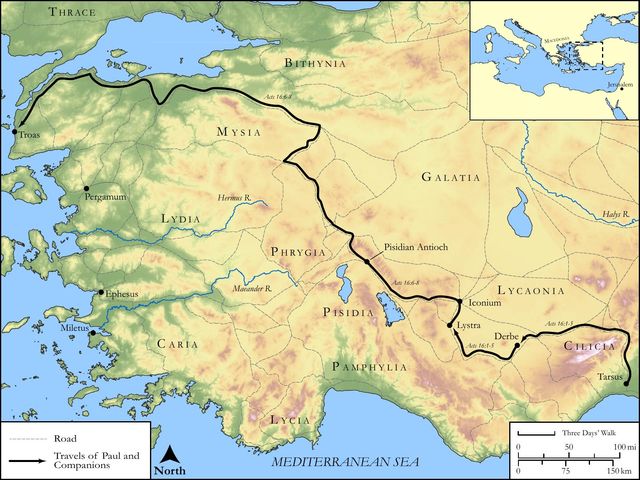
4.They passed by Mysia, or passed through it (so some), sowing good seed, we may suppose, as they went along; and they came down to Troas, the city of Troy, so much talked of, or the country thereabouts, which took its denomination from it. Here a church was planted; for here we find one in being, Act 20:6, Act 20:7, and probably planted at this time, and in a little time. It should seem that at Troas Luke fell in with Paul, and joined himself to his company; for henceforward, for the most part, when he speaks of Paul's journeys, he puts himself into the number of his retinue, we went, Act 16:10.
II.Paul's particular call to Macedonia, that is, to Philippi, the chief city, inhabited mostly by Romans, as appears, Act 16:21. Here we have,
1.The vision Paul had, Act 16:9. Paul had many visions, sometimes to encourage, sometimes, as here, to direct him in his work. An angel appeared to him, to intimate to him that it was the will of Christ he should go to Macedonia. Let him not be discouraged by the embargo laid upon him once and again, by which his designs were crossed; for, though he shall not go where he has a mind to go, he shall go where God has work for him to do. Now observe,
(1.)The person Paul saw. There stood by him a man of Macedonia, who by his habit or dialect seemed so to Paul, or who told him he was so. The angel, some think, assumed the shape of such a man; or, as others think, impressed upon Paul's fancy, when between asleep and awake, the image of such a man: he dreamt he saw such a one. Christ would have Paul directed to Macedonia, not as the apostles were at other times, by a messenger from heaven, to send him thither, but by a messenger thence to call him thither, because in this way he would afterwards ordinarily direct the motions of his ministers, by inclining the hearts of those who needed them to invite them. Paul shall be called to Macedonia by a man of Macedonia, and by him speaking in the name of the rest. Some make this man to be the tutelar angel of Macedonia, supposing angels to have charge of particular places as well as persons, and that so much is intimated Dan 10:20, where we read of the princes of Persia and Grecia, that seem to have been angels. But there is no certainty of this. There was presented either to Paul's eyes or to his mind a man of Macedonia. The angel must not preach the gospel himself to the Macedonians, but must bring Paul to them. Nor must he by the authority of an angel order him to go, but in the person of a Macedonian court him to come. A man of Macedonia, not a magistrate of the country, much less a priest (Paul was not accustomed to receive invitations from such) but an ordinary inhabitant of that country, a plain man, that carried in his countenance marks of probity and seriousness, that did not come to banter Paul nor trifle with him, but in good earnest and with all earnestness to importune his assistance.
(2.)The invitation given him. This honest Macedonian prayed him, saying, Come over into Macedonia, and help us; that is, "Come and preach the gospel to us; let us have the benefit of thy labours." [1.] "Thou hast helped many; we have heard of those in this and the other country to whom thou hast been very useful; and why may we not put in for a share? O come and help us." The benefits others have received from the gospel should quicken our enquiries, our further enquiries, after it. [2.] "It is thy business, and it is thy delight, to help poor souls; thou art a physician for the sick, that art to be ready at the call of every patient; O come and help us." [3.] "We have need of thy help, as much as any people; we in Macedonia are as ignorant and as careless in religion as any people in the world are, are as idolatrous and as vicious as any, and as ingenious and industrious to ruin ourselves as any; and therefore, O come, come with all speed among us. If thou canst do any thing, have compassion on us, and help us." [4.] "Those few among us that have any sense of divine things, and any concern for their own souls and the souls of others, have done what can be done, by the help of natural light; I have done my part for one. We have carried the matter as far as it will go, to persuade our neighbours to fear and worship God, but we can do little good among them. O come come, thou over, and help us. The gospel thou preachest has arguments and powers beyond those we have yet been furnished with." [5.] "Do not only help us with thy prayers here: this will not do; thou must come over and help us." Note, People have great need of help for their souls, and it is their duty to look out for it and invite those among them that can help them.
2.The interpretation made of the vision (Act 16:10): They gathered assuredly from this that the Lord had called them to preach the gospel there; and they were ready to go wherever God directed. Note, We may sometimes infer a call of God from a call of man. If a man of Macedonia says, Come and help us, Paul thence gathers assuredly that God says, Go an help them. Ministers may go on with great cheerfulness and courage in their work when they perceive Christ calling them, not only to preach the gospel, but to preach it at this time, in this place, to this people.
III.Paul's voyage to Macedonia hereupon:
He was not disobedient to the heavenly vision, but followed this divine direction much more cheerfully, and with more satisfaction, than he would have followed any contrivance or inclination of his own.
1.Thitherward he turned his thoughts. Now that he knows the mind of God in the matter he is determined, for this is all he wanted; now he thinks no more of Asia, nor Bithynia, but immediately we endeavoured to go into Macedonia. Paul only had the vision, but he communicated it to his companions, and they all, upon the credit of this, resolved for Macedonia. As Paul will follow Christ, so all his will follow him, or rather follow Christ with him. They are getting things in readiness for this expedition immediately, without delay. Note, God's calls must be complied with immediately. As our obedience must not be disputed, so it must not be deferred; do it today, lest thy heart be hardened. Observe, They could not immediately go into Macedonia; but they immediately endeavoured to go. If we cannot be so quick as we would be in our performances, yet we may be in our endeavours, and this shall be accepted.
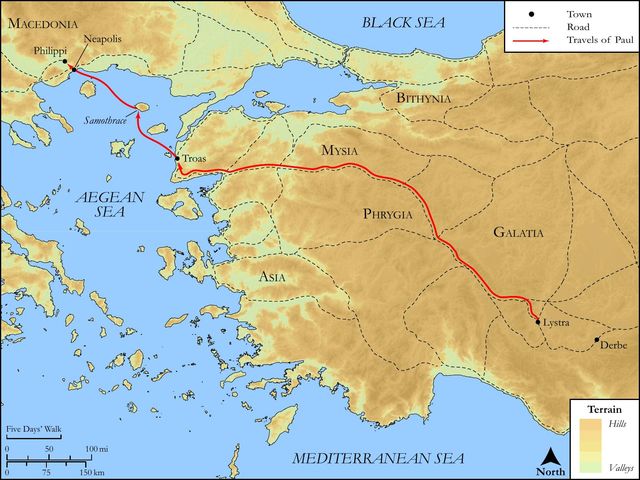
2.Thitherward he steered his course. They set sail by the first shipping and with the first fair wind from Troas; for they may be sure they have done what they had to do there when God calls them to another place. They came with a straight course, a prosperous voyage, to Samothracia; the next day they came to Neapolis, a city on the confines of Thrace and Macedonia; and at last they landed at Philippi, a city so called from Philip king of Macedon, the father of Alexander the Great; it is said (Act 16:12) to be,
(1.)The chief city of that part of Macedonia; or, as some read it, the first city, the first they came to when they came from Troas. As an army that lands in a country of which they design to make themselves masters begin with the reduction of the first place they come to, so did Paul and his assistants: they began with the first city, because, if the gospel were received there, it would the more easily spread thence all the country over.
(2.)It was a colony. The Romans not only had a garrison, but the inhabitants of the city were Romans, the magistrates at least, and the governing part. There were the greatest numbers and variety of people, and therefore the most likelihood of doing good.
IV.The cold entertainment which Paul and his companions met with at Philippi.
One would have expected that having such a particular call from God thither they would have had a joyful welcome there, as Peter had with Cornelius when the angel sent him thither. Where was the man of Macedonia that begged Paul to come thither with all speed? Why did not he stir up his countrymen, some of them at least, to go and meet him? Why was not Paul introduced with solemnity, and the keys of the city put into his hand? Here is nothing like this; for,
1.It is a good while before any notice at all is taken of him: We were in that city abiding certain days, probably at a public house and at their own charge, for they had no friend to invite them so much as to a meal's meat, till Lydia welcomed them. They had made all the haste they could thither, but, now that they are there, they are almost tempted to think they might as well have staid where they were. But so it was ordered for their trial whether they could bear the pain of silence and lying by, when this was their lot. Those eminent and useful men are not fit to live in this world that know not how to be slighted and overlooked. Let not ministers think it strange if they be first strongly invited to a place, and then looked shyly upon when they come.
2.When they have an opportunity of preaching it is in an obscure place, and to a mean and small auditory, Act 16:13. There was no synagogue of the Jews there, for aught that appears, to be a door of entrance to them, and they never went to the idol-temples of the Gentiles, to preach to the auditories there; but here, upon enquiry, they found out a little meeting of good women, that were proselytes of the gate, who would be thankful to them if they would give them a sermon. The place of this meeting is out of the city; there it was connived at, but would not be suffered any where within the walls. It was a place where prayer was wont to be made; proseuchē - where an oratory or house of prayer was (so some), a chapel, or smaller synagogue. But I rather take it, as we read it, where prayer was appointed or accustomed to be. Those that worshipped the true God, and would not worship idols, met there to pray together, and, according to the description of the most ancient and universal devotion, to call upon the name of the Lord. Each of them prayed apart every day; this was always the practice of those that worshipped God: but, besides this, they came together on the sabbath day. Though they were but a few and discountenanced by the town, though their meeting was at some distance, though, for aught that appears, there were none but women, yet a solemn assembly the worshippers of God must have, if by any means it be possible, on the sabbath day. When we cannot do as we would we must do as we can; if we have not synagogues, we must be thankful for more private places, and resort to them, not forsaking the assembling of ourselves together, according as our opportunities are. This place is said to be by a river side, which perhaps was chosen, as befriending contemplation. Idolaters are said to take their lot among the smooth stones of the stream, Isa 57:6. But these proselytes had in their eye, perhaps, the example of those prophets who had their visions, one by the river of Chebar (Eze 1:1), another by the great river Hiddekel, Dan 10:4. Thither Paul and Silas and Luke went, and sat down, to instruct the congregation, that they might the better pray with them. They spoke unto the women who resorted thither, encouraged them in practising according to the light they had, and led them on further to the knowledge of Christ.
V.The conversion of Lydia, who probably was the first that was wrought upon there to believe in Christ, though not the last.
In this story of the Acts, we have not only the conversion of places recorded, but of many particular persons; for such is the worth of souls that the reducing of one to God is a great matter. Nor have we only the conversions that were effected by miracle, as Paul's, but some that were brought about by the ordinary methods of grace, as Lydia's here. Observe,
1.Who this convert was that there is such particular notice taken of. Four things are recorded of her: -
(1.)Her name, Lydia. It is an honour to her to have her name recorded here in the book of God, so that wherever the scriptures are read there shall this be told concerning her. Note, The names of the saints are precious with God, and should be so with us; we cannot have our names recorded in the Bible, but, if God open our hearts, we shall find them written in the book of life, and this is better (Phi 4:3) and more to be rejoiced in, Luk 10:20.
(2.)Her calling. She was a seller of purple, either of purple dye or of purple cloth or silk. Observe,
[1.]She had a calling, an honest calling, which the historian takes notice of to her praise; she was none of those women that the apostle speaks of (Ti1 5:13), who learn to be idle, and not only idle, etc.
[2.]It was a mean calling. She was a seller of purple, not a wearer of purple, few such are called. The notice here taken of this is an intimation to those who are employed in honest callings, if they be honest in the management of them, not to be ashamed of them.
[3.]Though she had a calling to mind, yet she was a worshipper of God, and found time to improve advantages for her soul. The business of our particular callings may be made to consist very well with the business of religion, and therefore it will not excuse us from religious exercises alone, and in our families, or in solemn assemblies, to say, We have shops to look after, and a trade to mind; for have we not also a God to serve and a soul to look after? Religion does not call us from our business in the world, but directs us in it. Every thing in its time and place.
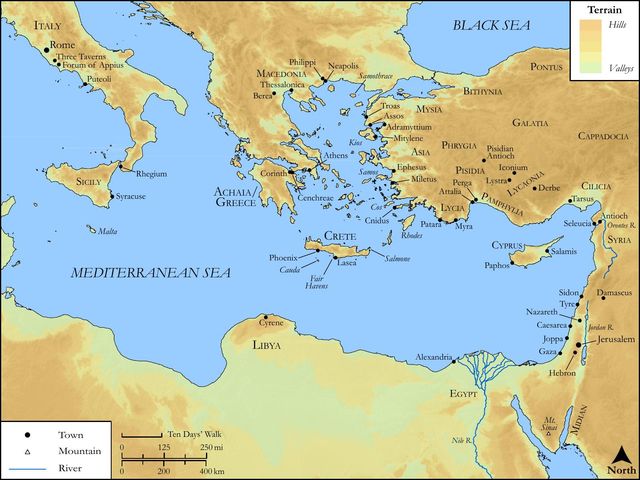
(3.)The place she was of - of the city of Thyatira, which was a great way from Philippi; there she was born and bred, but either married at Philippi, or brought by her trade to settle there. The providence of God, as it always appoints, so it often removes, the bounds of our habitation, and sometimes makes the change of our outward condition or place of our abode wonderfully subservient to the designs of his grace concerning our salvation. Providence brings Lydia to Philippi, to be under Paul's ministry, and there, where she met with it, she made a good use of it; so should we improve opportunities.
(4.)Her religion before the Lord opened her heart.
[1.]She worshipped God according to the knowledge she had; she was one of the devout women. Sometimes the grace of God wrought upon those who, before their conversion, were very wicked and vile, publicans and harlots; such were some of you, Co1 6:11. But sometimes it fastened upon those who were of a good character, who had some good in them, as the eunuch, Cornelius, and Lydia. Note, It is not enough to be worshippers of God, but we must be believers in Jesus Christ, for there is no coming to God as a Father, but by him as Mediator. But those who worshipped God according to the light they had stood fair for the discoveries of Christ, and his grace to them; for to him that has shall be given: and to them Christ would be welcome; for those that know what it is to worship God see their need of Christ, and know what use to make of his mediation.
[2.]She heard the apostles. Here, where prayer was made, when there was an opportunity, the word was preached; for hearing the word of God is a part of religious worship, and how can we expect God should hear our prayers if we will not hearken to his word? Those that worshipped God according to the light they had looked out for further light; we must improve the day of small things, but must not rest in it.
2.What the work was that was wrought upon her: Whose heart the Lord opened. Observe here,
(1.)The author of this work: it was the Lord, - the Lord Christ, to whom this judgment is committed, - the Spirit of the Lord, who is the sanctifier. Note, Conversion-work is God's work; it is he that works in us both to will and to do; not as if we had nothing to do, but of ourselves, without God's grace, we can do nothing; nor as if God were in the least chargeable with the ruin of those that perish, but the salvation of those that are saved must be wholly ascribed to him.
(2.)The seat of this work; it is in the heart that the change is made, it is to the heart that this blessed turn is given; it was the heart of Lydia that was wrought upon. Conversion-work is heart-work; it is a renewing of the heart, the inward man, the spirit of the mind.
(3.)The nature of the work; she had not only her heart touched, but her heart opened. An unconverted soul is shut up, and fortified against Christ, straitly shut up, as Jericho against Joshua, Jos 6:1. Christ, in dealing with the soul, knocks at the door that is shut against him (Rev 3:20); and, when a sinner is effectually persuaded to embrace Christ, then the heart is opened for the King of glory to come in - the understanding is open to receive the divine light, the will opened to receive the divine law, and the affections opened to receive the divine love. When the heart is thus opened to Christ, the ear is opened to his word, the lips opened in prayer, the hand opened in charity, and the steps enlarged in all manner of gospel obedience.
3.What were the effects of this work on the heart.
(1.)She took great notice of the word of God. Her heart was so opened that she attended to the things that were spoken by Paul; she not only gave attendance on Paul's preaching, but gave attention to it; she applied to herself (so some read it) the things that were spoken by Paul; and then only the word does us good, and makes an abiding impression upon us, when we apply it to ourselves. Now this was an evidence of the opening of her heart, and was the fruit of it; wherever the heart is opened by the grace of God, it will appear by a diligent attendance on, and attention to, the word of God, both for Christ's sake, whose word it is, and for our own sakes, who are so nearly interested in it.
(2.)She gave up her name to Jesus Christ, and took upon her the profession of his holy religion; She was baptized, and by this solemn rite was admitted a member of the church of Christ; and with her her household also was baptized, those of them that were infants in her right, for if the root be holy so are the branches, and those that were grown up by her influence and authority. She and her household were baptized by the same rule that Abraham and his household were circumcised, because the seal of the covenant belongs to the covenanters and their seed.
(3.)She was very kind to the ministers, and very desirous to be further instructed by them in the things pertaining to the kingdom of God: She besought us saying "If you have judged me to be faithful to the Lord, if you take me to be a sincere Christian, manifest your confidence in me by this, come into my house, and abide there." Thus she desired an opportunity,
[1.]To testify her gratitude to those who had been the instruments of divine grace in this blessed change that was wrought upon her. When her heart was open to Christ, her house was open to his ministers for his sake, and they were welcome to the best entertainment she had, which she did not think too good for those of whose spiritual things she had reaped so plentifully. Nay, they are not only welcome to her house, but she is extremely pressing and importunate with them: She constrained us; which intimates that Paul was very backward and unwilling to go, because he was afraid of being burdensome to the families of the young converts, and would study to make the gospel of Christ without charge (Co1 9:18; Act 20:34), that those who were without might have no occasion given them to reproach the preachers of the gospel as designing, self-seeking men, and that those who were within might have no occasion to complain of the expenses of their religion: but Lydia will have no nay; she will not believe that they take her to be a sincere Christian unless they will oblige her herein; like Abraham inviting the angels (Gen 18:3), If now I have found favour in thy sight, pass not away from thy servant.
[2.]She desired an opportunity of receiving further instruction. If she might but have them for awhile in her family, she might hear them daily (Pro 8:34), and not merely on sabbath days at the meeting. In her own house she might not only hear them, but ask them questions; and she might have them to pray with her daily, and to bless her household. Those that know something of Christ cannot but desire to know more, and seek opportunities of increasing their acquaintance with his gospel.
Historical interpretation
Three Centuries of Reception
2 surviving comments on this verse. Each one is dated, so this reads as a timeline rather than a list.
Select a marker to jump to its quote. Markers stagger vertically where authors wrote within a few decades of each other.
"And a certain woman": a woman and she of low condition, from her trade too: but mark in her a woman of elevated mind. In the first place, the fact of God's calling her bears testimony to her.
"And a certain woman, named Lydia, a seller of purple": observe how the writer of the history is not ashamed of the occupations of the converts: moreover neither was this city of the Philippians a great one. Having learnt these things, let us also be ashamed of no man. Peter abides with a tanner; Paul with a woman who was a seller of purple, and a foreigner. Where is pride? "Whose heart the Lord opened." Therefore we need God, to open the heart: but God opens the hearts that are willing: for there are hardened hearts to be seen. "So that she attended to the things which were spoken of Paul." The opening, then, was God's work, the attending was hers: so that it was both God's doing and man's.
And a certain woman named Lydia, a dealer in purple, of the city of Thyatira, a worshipper of God, heard, etc. He says “a dealer in purple” meaning a seller of purple, as we also find in another translation, which in Greek is called πορφυρόπωλις. Properly, however, the woman who first believed with the Apostle preaching in Illyricum is said to be a dealer in purple. It signifies the Church, which is accustomed to sell, as it were, purple, because it does not hesitate to shed its blood for Christ, so that through this it can obtain eternal life. Indeed, purple rightly designates the shedding and color of blood, and by the property of its nature, which is made from the blood of shellfish. Lydia, however, forced the Apostle and his companions to enter her house and to stay there, because the Church received the preaching of the gospel with internal devotion of the heart, despite being rejected by the Jews.
Continue studying Acts 16:14 across the web’s major study libraries — every link below opens this exact verse, chapter, or book on the destination site.
Read & Compare
 BibleGatewayThis verse in more than 200 translations and 70 languages.
 Bible.comThe YouVersion reader — hundreds of translations, reading plans, and highlights.
 ESV.orgCrossway's official English Standard Version reader.
 NET BibleThe NET translation with 60,000+ translators' notes on every rendering decision.
 STEP BibleTyndale House's free study tool — original text, vocabulary, and scholarly resources.
 BibliaLogos Bible Software's free web reader.
 USCCBThe New American Bible (Revised Edition) with the U.S. bishops' study notes.
Commentaries
 BibleHub CommentariesDozens of classic commentaries on this verse, gathered on one page.
 StudyLightMore than 100 commentary sets — the largest collection on the web.
 BibleRefPlain-English commentary on what this verse means, verse by verse.
 Enduring WordDavid Guzik's free commentary on this chapter, widely used by Bible teachers.
 Bible Study ToolsVerse commentary alongside Greek and Hebrew study aids.
Original Language & Research
- BibleHub InterlinearThe verse word by word — original language, transliteration, and English.
- BibleHub LexiconEvery word's original-language definition and Strong's entry.
 Blue Letter BibleDeep-study tools — Strong's numbers, concordance, and word studies.
 CNTR CollationThe earliest Greek manuscripts of this verse, collated letter by letter.
Sermons, Hymns & Audio


TrulyRandomVerse is not affiliated with these sites and doesn’t control their content. They’re linked because they’re genuinely useful.
Summary
Acts 16:14 records the pivotal conversion of Lydia in Philippi, marking the first documented Christian conversion in Europe during Paul's second missionary journey. This verse beautifully illustrates the interplay of divine sovereignty and human receptivity in salvation, as the Lord supernaturally prepared Lydia's heart to embrace the Gospel message proclaimed by Paul, leading to her immediate and attentive response.
Context
ShowHideLiterary Context
Acts 16:14 is situated within the narrative of Paul's second missionary journey, specifically after the "Macedonian Call" (Acts 16:9-10), where Paul received a vision urging him to preach in Macedonia. Following this divine directive, Paul, Silas, and Timothy traveled from Troas to Neapolis and then to Philippi, a significant Roman colony and the "foremost city of that part of Macedonia" (Acts 16:12). The immediate preceding verses (Acts 16:12-13) describe their arrival in Philippi and their custom of seeking out a place of prayer on the Sabbath, which led them to a river outside the city gate, where they encountered a group of women, including Lydia. This encounter sets the stage for the establishment of the church in Philippi, a community that would become a strong supporter of Paul's ministry (as seen later in Philippians 4:15-16). Lydia's conversion is foundational to the subsequent events in Philippi, including the conversion of the Philippian jailer (Acts 16:25-34) and the formation of the first European church.
Historical & Cultural Context
Philippi was a Roman colony, meaning it operated under Roman law and enjoyed certain privileges, with its citizens often having Roman citizenship. This status attracted Roman veterans and merchants, making it a bustling commercial center. The absence of a synagogue in Philippi, suggested by the women gathering by a river for prayer (a common practice when a minyan of ten Jewish men was not present), indicates a smaller Jewish population compared to other cities Paul visited. Lydia's background as a "seller of purple" from Thyatira is significant. Thyatira was renowned for its purple dye, derived from madder root, which produced a highly prized and expensive color. This suggests Lydia was a successful and likely wealthy businesswoman, dealing in a luxury commodity. Her designation as one "who worshipped God" identifies her as a "God-fearer"—a Gentile who had adopted the monotheistic beliefs and ethical practices of Judaism without undergoing full conversion (circumcision, strict adherence to Mosaic Law). Such individuals were often receptive to the Gospel as they were already familiar with the Old Testament prophecies and the concept of one true God.
Key Themes
ShowHideActs 16:14 contributes significantly to several key themes within the book of Acts and the broader New Testament. Foremost is the theme of Divine Initiative in Evangelism. Lydia's conversion is explicitly attributed to the Lord's action: "whose heart the Lord opened." This highlights that salvation is fundamentally a sovereign work of God, preparing hearts to receive the truth, a concept echoed in passages like John 6:44. Another crucial theme is Human Receptivity and Response. While God initiates, Lydia's active "attending unto the things which were spoken of Paul" demonstrates the necessary human response of listening, believing, and obeying. This interplay between divine grace and human responsibility is central to the conversion process. The verse also underscores the Global Reach of the Gospel, as it marks the expansion of Christianity into Europe, transcending geographical and cultural boundaries. Finally, Lydia's prominent role as the first European convert and the subsequent use of her home as a base for the Philippian church (Acts 16:15) illustrates the Significant Role of Women in Early Christianity, challenging conventional societal norms and demonstrating their vital contributions to the growth of the church, a pattern seen elsewhere in the early church's ministry.
Exposition and Analysis
ShowHideKey Word Analysis
ShowHideProperly, feminine of Ludios (of foreign origin) (a Lydian, in Asia Minor); Lydia, a Christian woman. This name identifies her origin or association with the region of Lydia, known for its purple dye, reinforcing her trade. Her inclusion by name signifies her individual importance and role in the early church's history.
From διά and ἀνοίγω; to open thoroughly, literally (as a first-born) or figuratively (to expound). In this context, it signifies a profound, spiritual opening of the mind and heart, enabling comprehension and reception of spiritual truth. It is a divine act, not merely human persuasion.
Prolonged from a primary (Latin cor, "heart"); the heart, i.e. (figuratively) the thoughts or feelings (mind); also (by analogy) the middle. Here, "heart" represents the inner person—the seat of intellect, will, emotion, and spiritual understanding. It is the core of one's being where spiritual transformation takes place.
From πρός and ἔχω; (figuratively) to hold the mind (3563 implied) towards, i.e. pay attention to, be cautious about, apply oneself to, adhere to. This word describes Lydia's active and deliberate engagement with Paul's message, indicating her serious consideration, focused listening, and subsequent acceptance.
Verse Breakdown
ShowHide"And a certain woman named Lydia, a seller of purple, of the city of Thyatira, which worshipped God, heard [us]:"
This opening clause introduces Lydia, providing key details about her identity, profession, origin, and religious background. Her name personalizes the narrative, while "seller of purple" highlights her economic standing and likely influence. Her origin from Thyatira connects her to a specific cultural and commercial context. Crucially, her being one "which worshipped God" establishes her as a "God-fearer," a Gentile already predisposed to monotheistic truth, making her a receptive audience for the Gospel. The phrase "heard us" indicates her physical presence and initial reception of Paul's preaching.
"whose heart the Lord opened,"
This is the theological lynchpin of the verse. It attributes the spiritual breakthrough directly to divine intervention. The Lord, Jesus Christ, is the active agent who supernaturally removes spiritual blindness and enables understanding. This "opening" is not a mere intellectual assent but a profound spiritual enlightenment, making the heart receptive to God's truth. It underscores the biblical principle that salvation is ultimately God's work.
"that she attended unto the things which were spoken of Paul."
This final clause describes the immediate and direct result of the Lord's action. Because her heart was divinely opened, Lydia was able to "attend" or "give heed" to Paul's message. This signifies a deliberate, focused, and willing reception of the Gospel. Her attentiveness was not passive but an active engagement that led to belief and subsequent action, as seen in her baptism and hospitality in the following verses (Acts 16:15).
Literary Devices
ShowHideThe narrative of Acts 16:14 employs several effective literary devices. Divine Action is central, with the phrase "whose heart the Lord opened" serving as the pivotal moment, clearly attributing the spiritual transformation to God's direct intervention. This contrasts with the human action of Paul speaking and Lydia hearing, emphasizing that true conversion is a supernatural work. There is also a clear Cause and Effect relationship established: the Lord's opening of her heart is the cause, and Lydia's attentive response to Paul's message is the effect. The detail about Lydia being a "seller of purple" and "of the city of Thyatira" provides Specific Detail and Characterization, grounding the narrative in a realistic setting and making Lydia a relatable and memorable figure. Her status as one "who worshipped God" functions as Foreshadowing, indicating her spiritual readiness and setting her apart from others who might have been less receptive.
Theological and Thematic Connections
ShowHideLydia's conversion profoundly illustrates the biblical truth that salvation is entirely a work of divine grace, initiated and accomplished by God, yet requiring a human response. The Lord's opening of her heart signifies that spiritual understanding and receptivity are not innate human capacities but gifts bestowed by God. This divine initiative does not negate human responsibility but enables it, allowing individuals to genuinely "attend unto" the Gospel message. This powerful interplay between divine sovereignty and human agency is a recurring theme in Scripture, emphasizing that while God draws and enables, individuals must still choose to respond in faith. Lydia's story thus serves as a foundational example of how God prepares hearts across diverse backgrounds and cultures for the transformative power of the Gospel.
Reflection and Application
ShowHideLydia's story in Acts 16:14 offers profound insights for contemporary believers regarding evangelism, personal spiritual growth, and the nature of true conversion. It reminds us that while we are called to faithfully proclaim the Gospel, the ultimate work of opening hearts belongs to the Lord. This truth should humble us, removing the burden of results from our shoulders and instilling confidence in God's sovereign power to draw people to Himself. It also highlights the importance of spiritual receptivity; just as Lydia's heart was prepared and she "attended" to Paul's words, we are called to cultivate a posture of attentiveness and obedience to God's Word. Furthermore, Lydia's immediate response of hospitality (Acts 16:15) demonstrates that genuine faith naturally overflows into practical expressions of love and service, embodying the transformative power of the Gospel in everyday life and community.
Questions for Reflection
ShowHideFAQ
ShowHideWho was Lydia, and why is her conversion significant?
ShowHideLydia was a successful businesswoman from Thyatira, a city known for its purple dye, and she was a "seller of purple." She was also a "God-fearer," meaning she was a Gentile who had embraced the monotheistic worship of the Jewish God without fully converting to Judaism. Her conversion is profoundly significant because it marks the first recorded Christian conversion in Europe, initiating the spread of the Gospel to the continent and leading to the establishment of the church in Philippi, a key early Christian community. Her story highlights the global reach of the Gospel and the Lord's work in opening hearts from diverse backgrounds, as seen in Acts 16:9-10.
What does it mean that "the Lord opened" Lydia's heart?
ShowHideThis phrase signifies a supernatural, divine act of grace. It means that God, through the Holy Spirit, removed spiritual blindness and enabled Lydia to understand and embrace the Gospel message that Paul was proclaiming. It implies more than mere intellectual comprehension; it speaks to a spiritual awakening and a willingness to believe and respond. This divine initiative is crucial for true conversion, as human hearts, left to themselves, are often resistant or unable to grasp spiritual truths, a concept explored in 1 Corinthians 2:14. It underscores that salvation is ultimately God's work.
What was a "seller of purple," and what does it tell us about Lydia?
ShowHideA "seller of purple" (Greek: porphyrópōlis) was a merchant dealing in purple dye or purple cloth. Thyatira, Lydia's hometown, was famous for its production of a rich, deep purple dye derived from madder root. Purple was an extremely valuable and expensive commodity, often associated with royalty, wealth, and high status. Lydia's profession suggests she was a woman of considerable means, influence, and business acumen. This detail highlights that the Gospel transcends socio-economic boundaries, reaching individuals from all walks of life, from the wealthy merchant to the humble servant, as demonstrated by the diverse conversions recorded throughout the book of Acts.
Christ-Centered Fulfillment
ShowHideLydia's conversion in Acts 16:14, where "the Lord opened" her heart, finds its ultimate fulfillment and meaning in the person and work of Jesus Christ. He is the divine "opener" of hearts and minds, the one through whom God's saving grace is mediated. Just as He "opened the minds" of His disciples to understand the Scriptures concerning Himself after His resurrection (as recounted in Luke 24:45), so too does He open the hearts of those who are called to salvation. Lydia's attentiveness to Paul's words was a direct result of Christ's sovereign work, demonstrating that true spiritual understanding and faith are gifts from Him. Her story foreshadows the ongoing work of Christ through His Spirit, who convicts the world of sin, righteousness, and judgment (as promised in John 16:8), drawing individuals to repentance and faith in the crucified and risen Savior. Lydia's new life and subsequent hospitality were tangible expressions of the new creation wrought by Christ, who transforms lives and builds His church, welcoming all who believe into His kingdom, regardless of their background or status, fulfilling the promise of a multi-ethnic people for God's glory (as envisioned in Revelation 7:9-10).