


Acts 20:6
- ἡμεῖςhēmeisWe ourselvesG3165P-1NPPersonal pronoun Nominative 1st Plural
- δὲdethenG1161CONJConjunction
- ἐξεπλεύσαμενexepleusamensailed awayG1602V-AAI-1PVerb Aorist Active Indicative 1st Plural
- μετὰmetaafterG3326PREPPreposition
- τὰςtastheG3588T-APFDefinite article Accusative Plural Feminine
- ἡμέραςhēmerasdaysG2250N-APFNoun Accusative Plural Feminine
- τῶνtōnof theG3588T-GPNDefinite article Genitive Plural Neuter
- ἀζύμωνazumōnUnleavened BreadG106A-GPNAdjective Genitive Plural Neuter
- ἀπὸapofromG575PREPPreposition
- ΦιλίππωνPhilippōnPhilippiG5375N-GPM-LNoun Genitive Plural Masculine Location
- καὶkaiandG2532CONJConjunction
- ἤλθομενēlthomenwe cameG2064V-2AAI-1PVerb 2nd Aorist Active Indicative 1st Plural
- πρὸςprostoG4314PREPPreposition
- αὐτοὺςautousthemG846P-APMPersonal pronoun Accusative Plural Masculine
- εἰςeisatG1519PREPPreposition
- τὴνtēn<the>G3588T-ASFDefinite article Accusative Singular Feminine
- ΤρῳάδαTrōadaTroasG5174N-ASF-LNoun Accusative Singular Feminine Location
- ἄχριachriwithinG891PREPPreposition
- ἡμερῶνhēmerōndaysG2250N-GPFNoun Genitive Plural Feminine
- πέντεpentefiveG4002A-NUIAdjective
- ὅπουhopouwhereG3699CONJConjunction
- διετρίψαμενdietripsamenwe stayedG1304V-AAI-1PVerb Aorist Active Indicative 1st Plural
- ἡμέραςhēmerasdaysG2250N-APFNoun Accusative Plural Feminine
- ἑπτάheptasevenG2033A-NUIAdjective
English is a literal word-by-word gloss of the Greek, not the KJV's wording. Why?
This is the original text the KJV's translators worked from — each Greek word with its own literal English meaning in this verse, prepared by scholars at Tyndale House, Cambridge. The KJV translates whole sentences, not word by word, so its wording differs: one Greek word can become several English words, and the KJV may choose “charity” where the gloss reads “love”. Both are faithful — they answer different questions. For the KJV's own rendering, switch to the KJV text.
Details
See on the biblical-era map
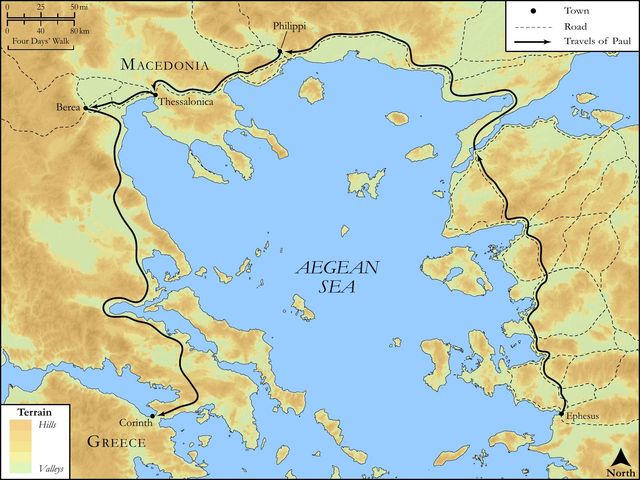
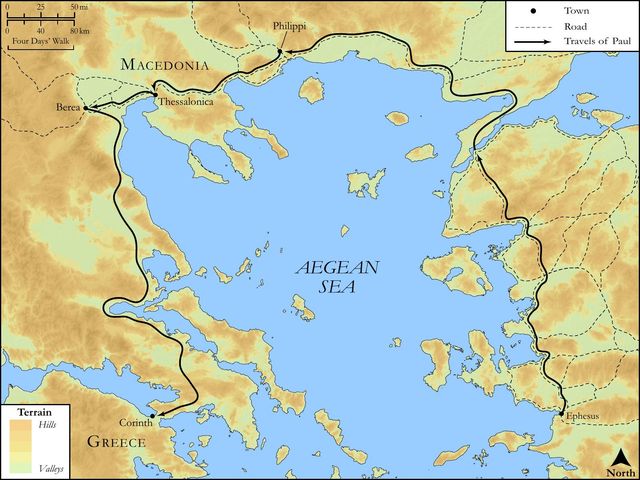
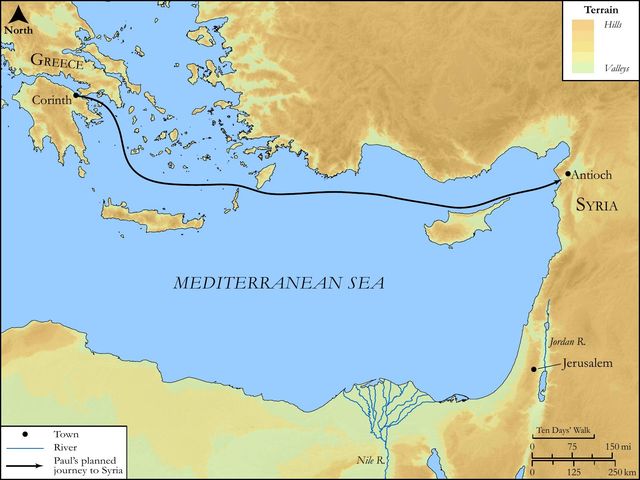
Study this verse
Public-domain commentary
Matthew Henry
From his Commentary on the Whole Bible. Henry comments on passages, not single verses — this entry covers Acts 20:1–6. His two-level outline is real structure in the source text, so it is rendered as structure.
These travels of Paul which are thus briefly related, if all in them had been recorded that was memorable and worthy to be written in letters of gold, the world would not contain the books that would have been written; and therefore we have only some general hints of occurrences, which therefore ought to be the more precious. Here is,
I.Paul's departure from Ephesus.
He had tarried there longer than he had done at any one place since he had been ordained to the apostleship of the Gentiles; and now it was time to think of removing, for he must preach in other cities also; but after this, to the end of the scripture-history of his life (which is all we can depend upon), we never find him breaking up fresh ground again, nor preaching the gospel where Christ had not been named, as hitherto he had done (Rom 15:20), for in the close of the next chapter we find him made a prisoner, and so continued, and so left, at the end of this book.
1.Paul left Ephesus soon after the uproar had ceased, looking upon the disturbance he met with there to be an indication of Providence to him not to stay there any longer, Act 20:1. His removal might somewhat appease the rage of his adversaries, and gain better quarter for the Christians there. Currenti cede furori - It is good to lie by in a storm. Yet some think that before he now left Ephesus he wrote the first epistle to the Corinthians, and that his fighting with beasts at Ephesus, which he mentions in that epistle, was a figurative description of this uproar; but I rather take that literally.
2.He did not leave them abruptly and in a fright, but took leave of them solemnly: He called unto him the disciples, the principal persons of the congregation, and embraced them, took leave of them (saith the Syriac) with the kiss of love, according to the usage of the primitive church. Loving friends know not how well they love one another till they come to part, and then it appears how near they lay to one another's hearts.
II.His visitation of the Greek churches, which he had planted, and more than once watered, and which appear to have laid very near his heart.
1.He went first to Macedonia (Act 20:1), according to his purpose before the uproar (Act 19:21); there he visited the churches of Philippi and Thessalonica, and gave them much exhortation, Act 20:2. Paul's visits to his friends were preaching visits, and his preaching was large and copious: He gave them much exhortation; he had a great deal to say to them, and did not stint himself in time; he exhorted them to many duties, in many cases, and (as some read it) with many reasonings. He enforced his exhortation with a great variety of motives and arguments.
2.He staid three months in Greece (Act 20:2, Act 20:3), that is, in Achaia, as some think, for thither also he purposed to go, to Corinth, and thereabouts (Act 19:21), and, no doubt, there also he gave the disciples much exhortation, to direct and confirm them, and engage them to cleave to the Lord.
III.The altering of his measures; for we cannot always stand to our purposes.
Accidents unforeseen put us upon new counsels, which oblige us to purpose with a proviso.
1.Paul was about to sail into Syria, to Antioch, whence he was first sent out into the service of the Gentiles, and which therefore in his journeys he generally contrived to take in his way; but he changed his mind, and resolved to return to Macedonia, the same way he came.
2.The reason was because the Jews, expecting he would steer that course as usual, had way-laid him, designing to be the death of him; since they could not get him out of the way by stirring up both mobs and magistrates against him, which they had often attempted, they contrived to assassinate him. Some think they laid wait for him, to rob him of the money that he was carrying to Jerusalem for the relief of the poor saints there; but, considering how very spiteful the Jews were against him, I suppose they thirsted for his blood more than for his money.
IV.His companions in his travels when he went into Asia; they are here named, Act 20:4.
Some of them were ministers, whether they were all so or no is not certain. Sopater of Berea, it is likely, is the same with Sosipater, who is mentioned Rom 16:21. Timothy is reckoned among them, for though Paul, when he departed from Ephesus (Act 20:1), left Timothy there, and afterwards wrote his first epistle to him thither, to direct him as an evangelist how to settle the church there, and in what hands to leave it (see Ti1 1:3; Ti1 3:14, Ti1 3:15), which epistle was intended for direction to Timothy what to do, not only at Ephesus where he now was, but also at other places where he should be in like manner left, or whither he should be sent to reside as an evangelist (and not to him only, but to the other evangelists that attended Paul, and were in like manner employed); yet he soon followed him, and accompanied him, with others here named. Now, one would think, this was no good husbandry, to have all these worthy men accompanying Paul, for there was more need of them where Paul was not than where he was; but so it was ordered,
1.That they might assist him in instructing such as by his preaching were awakened and startled; wherever Paul came, the waters were stirred, and then there was need of many hands to help the cripples in. It was time to strike when the iron was hot.
2.That they might be trained up by him, and fitted for future service, might fully know his doctrine and manner of life, Ti2 3:10. Paul's bodily presence was weak and despicable, and therefore these friends of his accompanied him, to put a reputation upon him, to keep him in countenance, and to intimate to strangers, who would be apt to judge by the sight of the eye, that he had a great deal in him truly valuable, which was not discovered upon the outward appearance.
V.His coming to Troas, where he had appointed a general rendezvous of his friends.
1.They went before, and staid for him at Troas (Act 20:5), designing to go along with him to Jerusalem, as Trophimus particularly did, Act 21:29. We should not think it hard to stay awhile for good company in a journey.
2.Paul made the best of his way thither; and, it should seem, Luke was now in company with him; for he says We sailed from Philippi (Act 20:6), and the first time we find him in his company was here at Troas, Act 16:11. The days of unleavened bread are mentioned only to describe the time, not to intimate that Paul kept the passover after the manner of the Jews; for just about this time he had written in his first epistle to the church at Corinth, and taught, that Christs is our Passover, and a Christian life our feast of unleavened bread (Co1 5:7, Co1 5:8), and when the substance was come the shadow was done away. He came to them to Troas, by sea, in five days, and when he was there staid but seven days. There is no remedy, but a great deal of time will unavoidably be lost in travelling to and fro, by those who go about doing good, yet it shall not be put upon the score of lost time. Paul thought it worth while to bestow five days in going to Troas, though it was but for an opportunity of seven days' stay there; but he knew, and so should we, how to redeem even journeying time, and make it turn to some good account.
Historical interpretation
Historical reception
2 surviving comments on this verse. Each one is dated, so this reads as a timeline rather than a list.
And yet Troas is not a large place: why then do they pass seven days in it? Perhaps it was large as regarded the number of believers. And after he had passed seven days there, on the following day he spent the night in teaching: so hard did he find it to tear himself away from them, and they from him.
"And we sailed away from Philippi after the days of unleavened bread, and came unto them to Troas in five days; where we abode seven days." For it seems to me that he made a point of keeping the feasts in the large cities. "From Philippi," where the affair of the prison had taken place. This was his third coming into Macedonia, and it is a high testimony that he bears to the Philippians, which is the reason why he makes some stay there.
Continue studying Acts 20:6 across the web’s major study libraries — every link below opens this exact verse, chapter, or book on the destination site.
Read & Compare
 BibleGatewayThis verse in more than 200 translations and 70 languages.
 Bible.comThe YouVersion reader — hundreds of translations, reading plans, and highlights.
 ESV.orgCrossway's official English Standard Version reader.
 NET BibleThe NET translation with 60,000+ translators' notes on every rendering decision.
 STEP BibleTyndale House's free study tool — original text, vocabulary, and scholarly resources.
 BibliaLogos Bible Software's free web reader.
 USCCBThe New American Bible (Revised Edition) with the U.S. bishops' study notes.
Commentaries
 BibleHub CommentariesDozens of classic commentaries on this verse, gathered on one page.
 StudyLightMore than 100 commentary sets — the largest collection on the web.
 BibleRefPlain-English commentary on what this verse means, verse by verse.
 Enduring WordDavid Guzik's free commentary on this chapter, widely used by Bible teachers.
 Bible Study ToolsVerse commentary alongside Greek and Hebrew study aids.
Original Language & Research
- BibleHub InterlinearThe verse word by word — original language, transliteration, and English.
- BibleHub LexiconEvery word's original-language definition and Strong's entry.
 Blue Letter BibleDeep-study tools — Strong's numbers, concordance, and word studies.
 CNTR CollationThe earliest Greek manuscripts of this verse, collated letter by letter.
Sermons, Hymns & Audio


TrulyRandomVerse is not affiliated with these sites and doesn’t control their content. They’re linked because they’re genuinely useful.
Summary
Acts 20:6 details a specific segment of Paul's third missionary journey, chronicling the precise timing and duration of his sea voyage from Philippi to Troas. Following the Jewish festival of Unleavened Bread, Paul and his companions, including the author Luke, embarked on a five-day journey by ship to Troas, where they then remained for seven days, setting the stage for significant ministry and fellowship with the local believers. This verse provides crucial chronological and geographical markers, underscoring the intentionality and practicalities of early apostolic missions.
Context
ShowHideLiterary Context
Acts 20:6 is situated within the "we" sections of the book of Acts, which indicate Luke's direct participation and eyewitness account of the events described. This verse immediately follows Paul's departure from Greece and Macedonia, particularly Philippi, after a period of significant ministry and encouragement to the churches there. It marks the beginning of Paul's return journey towards Jerusalem, a journey fraught with premonitions of suffering, as revealed in his later farewell speeches to the Ephesian elders in Acts 20:17-38. The verse sets the scene for the extended stay in Troas, which includes the notable incident of Eutychus falling from a window during Paul's lengthy sermon, recounted in Acts 20:7-12. The meticulous detail regarding travel time and duration of stay highlights Luke's commitment to historical accuracy and provides a clear narrative progression for Paul's final journey to Jerusalem.
Historical & Cultural Context
Philippi was a Roman colony in Macedonia, a significant center where Paul had established a strong church, as evidenced by his Epistle to the Philippians. Troas, located on the northwest coast of Asia Minor (modern-day Turkey), was a major port city and a strategic hub for travel between Europe and Asia. The reference to "after the days of unleavened bread" is a crucial chronological marker, indicating the timing of their departure immediately following the Jewish Passover festival, which typically occurred in early spring. This suggests that Paul either observed the festival with the Jewish Christians in Philippi or used it as a widely recognized calendar reference point, even for Gentile audiences. Sea travel was common for long distances, and the five-day journey to Troas, followed by a seven-day stay, reflects the typical pace of ancient travel and the intentionality of Paul's ministry, allowing for extended teaching and fellowship with local communities.
Key Themes
ShowHideThis verse contributes to several overarching themes in Acts and Paul's ministry. Firstly, it exemplifies Missionary Travel and Logistics, showcasing the practical aspects of spreading the Gospel across vast geographical distances, involving careful planning, sea voyages, and extended stays in strategic locations. Secondly, the mention of "the days of unleavened bread" highlights the Chronological Markers that often tied early Christian events to the Jewish calendar, even as the church grew increasingly Gentile. This demonstrates the continuity of God's redemptive plan from the Old Covenant to the New, and how early believers, whether Jewish or Gentile, understood time within this framework. Thirdly, the seven-day "abode" in Troas underscores the importance of Fellowship and Community in the early church, emphasizing the deliberate time spent in teaching, worship, and mutual encouragement with local believers, a practice central to Paul's pastoral approach as seen throughout his letters and travels. Finally, the "we" pronoun reinforces Luke's Eyewitness Testimony, lending historical credibility and a personal touch to the narrative of Paul's third missionary journey, affirming the reliability of the biblical account.
Exposition and Analysis
ShowHideKey Word Analysis
ShowHideFrom a negative particle and "leaven," referring to something "unleavened," which can figuratively mean "uncorrupted." In its neutral plural form, it specifically implies "the Passover week." This term precisely dates Paul's departure to the period immediately following the Passover festival, emphasizing the Jewish calendar's continued relevance for early Christian chronology.
Derived from "out of" and "to sail," this verb literally means "to depart by ship." It concisely describes the mode of travel Paul and his companions employed, highlighting the maritime nature of much of their missionary journeys and the reliance on sea routes for inter-regional travel in the Roman world.
Formed from "through" and a base meaning "to wear through (time)," this word signifies "to remain," "to continue," or "to tarry." It implies a deliberate and continuous stay for the specified duration, indicating that Paul and his team intentionally spent a full week in Troas for ministry, teaching, and fellowship, not merely a brief stopover.
Verse Breakdown
ShowHide"And we sailed away from Philippi after the days of unleavened bread,"
This clause establishes the starting point of this leg of the journey (Philippi), the mode of transport (sailing), and a precise chronological marker (after the Feast of Unleavened Bread). The "we" indicates Luke's presence, adding an eyewitness dimension to the narrative. The timing is significant, placing the journey in the spring, immediately following a major Jewish festival, which likely influenced travel patterns and the availability of ships.
"and came unto them to Troas in five days;"
This segment details the destination (Troas), the duration of the sea voyage (five days), and implies a reunion with "them," likely referring to members of Paul's wider traveling party or local believers who had gone ahead or were awaiting them. The five-day journey provides a concrete sense of the time and effort involved in ancient travel, emphasizing the commitment required for missionary endeavors.
"where we abode seven days."
This final clause specifies the length of their stay in Troas (seven days). This extended duration signifies more than a mere layover; it suggests a deliberate period dedicated to ministry, teaching, fellowship, and potentially worship with the local Christian community. This intentional allocation of time for spiritual nourishment and community building was characteristic of Paul's missionary strategy.
Literary Devices
ShowHideLuke's narrative in Acts 20:6 employs several effective Literary Devices. The use of the "we" pronoun is a prominent feature, serving as a powerful form of Eyewitness Testimony, lending unparalleled historical authenticity and immediacy to the account. This personal involvement of the author reinforces the reliability of the events described. The verse also utilizes Chronological Markers ("after the days of unleavened bread") and Geographical Detail ("from Philippi," "to Troas") to ground the narrative firmly in time and space, providing a precise framework for the journey. This meticulous detail contributes to the overall Narrative Progression, smoothly transitioning Paul's journey from Macedonia to Asia Minor and setting the stage for the significant events that follow in Troas, particularly the extended period of teaching and the incident involving Eutychus.
Theological and Thematic Connections
ShowHideActs 20:6, though seemingly a simple travelogue, carries profound theological and thematic weight, illustrating the disciplined and purposeful nature of early Christian mission. It highlights God's sovereignty over time and travel, as Paul's movements are precisely timed, often coinciding with significant Jewish festivals, subtly underscoring the continuity of God's redemptive plan. The deliberate seven-day stay in Troas emphasizes the foundational importance of Christian community, fellowship, and the consistent teaching of God's Word as central to the church's health and growth. This pattern of intentional engagement with local believers is a recurring theme in Paul's ministry, demonstrating that the spread of the Gospel was not merely about initial proclamation but also about nurturing and strengthening established communities.
Reflection and Application
ShowHideActs 20:6 invites us to reflect on the intentionality and endurance required for faithful Christian living and ministry. Paul's journey was not haphazard but strategically planned, demonstrating the importance of prayerful discernment and diligent execution in our own callings. The emphasis on "abiding" for seven days in Troas serves as a powerful reminder of the value of sustained community and deep fellowship. In a world that often prioritizes speed and superficial connections, this verse calls us to invest quality time in building up the body of Christ, engaging in consistent teaching, and sharing life with fellow believers. It also encourages us to trust in God's perfect timing, recognizing that just as Paul's movements were guided by divine providence, so too are our lives orchestrated by a sovereign God who works all things for His glory and our good.
Questions for Reflection
ShowHideFAQ
ShowHideWhy is the mention of "after the days of unleavened bread" significant?
ShowHideThe phrase "after the days of unleavened bread" is highly significant because it provides a precise chronological marker for Paul's departure from Philippi. The Feast of Unleavened Bread immediately followed Passover, typically occurring in the spring (March/April). This detail not only helps to date Paul's movements accurately within the broader timeline of his third missionary journey but also subtly connects the early Christian narrative to the Jewish calendar and its foundational festivals. For Jewish believers, this would have been a familiar and meaningful reference point, commemorating the Exodus from Egypt. For the expanding Gentile church, it served as a fixed point in time, demonstrating how early Christian life and travel were often interwoven with existing cultural and religious calendars. It also implies that Paul and his companions may have observed this festival, or at least waited until it concluded, before resuming their journey, underscoring the Jewish roots of the Christian faith.
What is the significance of Paul and his companions "abiding seven days" in Troas?
ShowHideThe decision to "abide seven days" in Troas indicates a deliberate and extended stay, signifying more than just a brief stopover for travel logistics. This duration was likely chosen to allow for substantial ministry, teaching, and fellowship with the local Christian community in Troas. In the early church, a week-long stay would provide ample opportunity for Paul to preach, teach, answer questions, encourage believers, and strengthen the nascent church. This practice aligns with Paul's broader missionary strategy, which involved not only evangelism but also the nurturing and discipling of new converts and established congregations. The events immediately following this verse, particularly the famous incident with Eutychus during Paul's lengthy sermon (Acts 20:7-12), confirm that this was a period of intense spiritual activity and communal gathering. It underscores the importance of intentional, in-depth engagement with local churches for their spiritual growth and stability.
Christ-Centered Fulfillment
ShowHideActs 20:6, though a seemingly mundane travel detail, subtly points to Christ in its chronological and communal implications. The departure "after the days of unleavened bread" is a profound Christ-centered marker. The Feast of Unleavened Bread, immediately following Passover, commemorated Israel's hasty departure from Egypt, leaving no time for leaven (a symbol of sin) in their bread. This Old Testament observance finds its ultimate fulfillment in Christ, who is our true Passover Lamb, sacrificed for our sins (1 Corinthians 5:7). Just as Israel was called to remove leaven, believers are called to live lives free from the "leaven of malice and evil," embracing the "unleavened bread of sincerity and truth" (1 Corinthians 5:8). Paul's journey, undertaken after this festival, signifies a life and ministry lived in the reality of Christ's perfect sacrifice and the new covenant purity it inaugurates. Furthermore, the seven-day "abode" in Troas, dedicated to fellowship and teaching, reflects Christ's own commitment to building His church (Matthew 16:18). Paul, as an apostle, was participating in Christ's ongoing mission to gather and nourish His people, preparing them for His glorious return (Ephesians 4:11-13). Thus, this verse, while detailing earthly travel, is deeply rooted in the redemptive work of Christ and the establishment of His kingdom.