


Exodus 23:15
- אֶת'et<obj.>H853DirObjMParticle Object Indicator
- חַגchag[the] festival ofH2282N-mscNoun Singular Masculine Construct
- הַמַּצּוֹתha·ma·tzOtthe unleavened bread<s>H4682Art ¦ N-fpNoun Plural Feminine Absoluteהַtheמַּצּוֹתunleavened bread<s>
- תִּשְׁמֹרtish·Moryou will keepH8104V-Qal-Imperf-2msVerb Qal Imperfect 2nd Singular Masculine
- שִׁבְעַתshiv·'AtsevenH7651Adj-cscAdjective Numerical Singular common gender Construct
- יָמִיםya·MimdaysH3117N-mpNoun Plural Masculine Absolute
- תֹּאכַלto·Khalyou will eatH398V-Qal-Imperf-2msVerb Qal Imperfect 2nd Singular Masculine
- מַצּוֹתma·Tzotunleavened bread<s>H4682N-fpNoun Plural Feminine Absolute
- כַּאֲשֶׁרka·'a·Sherjust asH834Prep-k ¦ RelParticle Relativeכַּjustאֲשֶׁרas
- צִוִּיתִךָtzi·vi·Ti·khaI commanded youH6680V-Piel-Perf-1cs ¦ 2msVerb Piel Perfect 1st Singular common genderצִוִּיתִI commandedךָyou
- לְמוֹעֵדle·mo·'Edto [the] appointed time ofH4150Prep-l ¦ N-mscNoun Singular Masculine Constructלְtoמוֹעֵד[the] appointed time of
- חֹדֶשׁCho·desh[the] month ofH2320N-mscNoun Singular Masculine Construct
- הָאָבִיבha·'a·Viv<the> AbibH24Art ¦ N-csNoun Title Singular common gender Absoluteהָ<the>אָבִיבAbib
- כִּיkiforH3588PrtParticle Conditional
- בוֹvoin <the> itPrep-b ¦ 3msSuffix Personal 3rd Singular Masculineבin <the>וֹit
- יָצָאתָya·Tza·tayou came outH3318V-Qal-Perf-2msVerb Qal Perfect 2nd Singular Masculine
- מִמִּצְרָיִםmi·mitz·Ra·yimfrom EgyptH4714Prep-m ¦ N-properNoun Proper LocationמִfromמִּצְרָיִםEgypt
- וְלֹאve·lo'and notH3808Conj-w ¦ NegParticle Negativeוְandלֹאnot
- יֵרָאוּye·ra·'Uthey will present themselvesH7200V-Niphal-Imperf-3mpVerb Niphal Imperfect 3rd Plural Masculine
- פָנַיfa·Naimy faceH6440N-mpc ¦ 1csNoun Plural Masculine Constructפָנַfaceיmy
- רֵיקָםrei·KamemptyH7387AdvAdverb
English is a literal word-by-word gloss of the Hebrew, not the KJV's wording. Why?
This is the original text the KJV's translators worked from — each Hebrew word with its own literal English meaning in this verse, prepared by scholars at Tyndale House, Cambridge. The KJV translates whole sentences, not word by word, so its wording differs: one Hebrew word can become several English words, and the KJV may choose “the LORD” where the gloss reads “Yahweh”. Both are faithful — they answer different questions. For the KJV's own rendering, switch to the KJV text.
Details
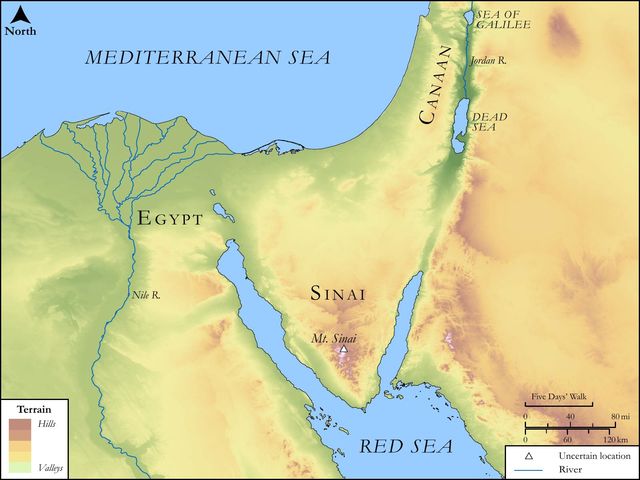
See on the biblical-era map

Study this verse
Public-domain commentary
Matthew Henry
From his Commentary on the Whole Bible. Henry comments on passages, not single verses — this entry covers Exodus 23:10–19. His two-level outline is real structure in the source text, so it is rendered as structure.
Here is, I. The institution of the sabbatical year, Exo 23:10, Exo 23:11. Every seventh year the land was to rest; they must not plough nor sow it at the beginning of the year, and then they could not expect any great harvest at the end of the year: but what the earth did produce of itself should be eaten from hand to mouth, and not laid up. Now this was designed, 1. To show what a plentiful land that was into which God was bringing them - that so numerous a people could have rich maintenance out of the produce of so small a country, without foreign trade, and yet could spare the increase of every seventh year. 2. To remind them of their dependence upon God their great landlord, and their obligation to use the fruit of their land as he should direct. Thus he would try their obedience in a matter that nearly touched their interest. Afterwards we find that their disobedience to this command was a forfeiture of the promises, Ch2 36:21. 3. To teach them a confidence in the divine Providence, while they did their duty - that, as the sixth day's manna served for two day's meat, so the sixth year's increase should serve for two years' subsistence. Thus they must learn not to take thought for their life, Mat 6:25. If we are prudent and diligent in our affairs, we may trust Providence to furnish us with the bread of the day in its day.
II.The repetition of the law of the fourth commandment concerning the weekly sabbath, Exo 23:12.
Even in the year of rest they must not think that the sabbath day was laid in common with the other days, but, even that year, it must be religiously observed; yet thus some have endeavoured to take away the observance of the sabbath, by pretending that every day must be a sabbath day.
III.All manner of respect to the gods of the heathen is here strictly forbidden, Exo 23:13.
A general caution is prefixed to this, which has reference to all these precepts: In all things that I have said unto you, be circumspect. We are in danger of missing our way on the right hand and on the left, and it is at our peril if we do; therefore we have need to look about us. A man may ruin himself through mere carelessness, but he cannot save himself without great care and circumspection: particularly, since idolatry was a sin which they were much addicted to, and would be greatly tempted to, they must endeavour to blot out the remembrance of the gods of the heathen, and must disuse and forget all their superstitious forms of speech, and never mention them but with detestation. In Christian schools and academies (for it is in vain to think of reforming the play-houses), it were to be wished that the names and stories of the heathen deities, or demons rather, were not so commonly and familiarly used as they are, even with intimations of respect, and sometimes with forms of invocation. Surely we have not so learned Christ.
IV.Their solemn religious attendance on God in the place which he should choose is here strictly required, Exo 23:14-17.
1.Thrice a year all their males must come together in a holy convocation, that they might the better know and love one another, and keep up their communion as a dignified and peculiar people.
2.They must come together before the Lord (Exo 23:17) to present themselves before him, looking towards the place where his honour dwelt, and to pay their homage to him as their great Lord, from and under whom they held all their enjoyments.
3.They must feast together before the Lord, eating and drinking together, in token of their joy in God and their grateful sense of his goodness to them; for a feast is made for laughter, Ecc 10:19. O what a good Master do we serve, who has made it our duty to rejoice before him, who feasts his servants when they are in waiting! Never let religion be called a melancholy thing, when its solemn services are solemn feasts.
4.They must not appear before God empty, Exo 23:15. Some free-will offering or other they must bring, in token of their respect and gratitude to their great benefactor; and, as they were not allowed to come empty-handed, so we must not come to worship God empty-hearted; our souls must be filled with grace, with pious and devout affections, holy desires towards him, and dedications of ourselves to him, for with such sacrifices God is well-pleased.
5.The passover, pentecost, and feast of tabernacles, in spring, summer, and autumn, were the three times appointed for their attendance: not in winter, because travelling was then uncomfortable; not in the midst of their harvest, because then they were otherwise employed; so that they had no reason to say that he made them to serve with an offering, or wearied them with incense.
V.Some particular directions are here given about the three feasts, though not so fully as afterwards.
1.As to the passover, it was not to be offered with leavened bread, for at that feast all leaven was to be cast out, nor was the fat of it to remain until the morning, lest it should become offensive, Exo 23:18.
2.At the feast of pentecost, when they were to begin their harvest, they must bring the first of their first-fruits to God, by the pious presenting of which the whole harvest was sanctified, Exo 23:19.
3.At the feast of ingathering, as it is called (Exo 23:16), they must give God thanks for the harvest-mercies they had received, and must depend upon him for the next harvest, and must not think to receive benefit by that superstitious usage of some of the Gentiles, who, it is said, at the end of their harvest, seethed a kid in its dam's milk, and sprinkled that milk-pottage, in a magical way, upon their gardens and fields, to make them more fruitful next year. But Israel must abhor such foolish customs.
Historical interpretation
Historical reception
1 surviving comment on this verse from the historical church.
“You shall not appear before the Lord empty,” that is, enter not into the temple without sacrifices. Now if it is not right to go into the house of God without sacrifices, much more ought we to enter the assembly accompanied by our brethren. For this sacrifice and offering is better than that, when you bring a soul with you into the church.
Continue studying Exodus 23:15 across the web’s major study libraries — every link below opens this exact verse, chapter, or book on the destination site.
Read & Compare
 BibleGatewayThis verse in more than 200 translations and 70 languages.
 Bible.comThe YouVersion reader — hundreds of translations, reading plans, and highlights.
 ESV.orgCrossway's official English Standard Version reader.
 NET BibleThe NET translation with 60,000+ translators' notes on every rendering decision.
 STEP BibleTyndale House's free study tool — original text, vocabulary, and scholarly resources.
 BibliaLogos Bible Software's free web reader.
 USCCBThe New American Bible (Revised Edition) with the U.S. bishops' study notes.
Commentaries
 BibleHub CommentariesDozens of classic commentaries on this verse, gathered on one page.
 StudyLightMore than 100 commentary sets — the largest collection on the web.
 BibleRefPlain-English commentary on what this verse means, verse by verse.
 Enduring WordDavid Guzik's free commentary on this chapter, widely used by Bible teachers.
 Bible Study ToolsVerse commentary alongside Greek and Hebrew study aids.
Original Language & Research
- BibleHub InterlinearThe verse word by word — original language, transliteration, and English.
- BibleHub LexiconEvery word's original-language definition and Strong's entry.
 Blue Letter BibleDeep-study tools — Strong's numbers, concordance, and word studies.
 SefariaThe Hebrew text with Rashi and centuries of Jewish commentary.
Sermons, Hymns & Audio


TrulyRandomVerse is not affiliated with these sites and doesn’t control their content. They’re linked because they’re genuinely useful.
Summary
Exodus 23:15, a foundational decree within the "Book of the Covenant," meticulously outlines the divine mandate for Israel to observe the Feast of Unleavened Bread. This pivotal annual pilgrimage festival, spanning seven days and precisely timed in the month of Abib, serves as an enduring memorial of God's miraculous liberation of His people from Egyptian bondage. Furthermore, the verse establishes a crucial principle for all who approach the Lord in worship: that no one should appear before Him empty-handed, signifying an expectation of reverence, gratitude, and tangible offerings as expressions of devotion.
Context
ShowHideLiterary Context
Exodus 23:15 is situated within the "Book of the Covenant" (Exodus 20:22-23:33), a comprehensive legal code immediately following the revelation of the Ten Commandments at Mount Sinai. This section provides detailed civil, social, and religious statutes intended to govern the nascent nation of Israel as they prepared for life in the Promised Land. Specifically, verses Exodus 23:14-19 delineate the three major annual pilgrimage festivals—the Feast of Unleavened Bread, the Feast of Harvest (Weeks/Pentecost), and the Feast of Ingathering (Booths/Tabernacles)—at which all Israelite males were required to appear before the Lord. The placement of these cultic instructions within a broader legal framework underscores that Israel's worship was not isolated but deeply integrated into their daily life and their covenant relationship with God, emphasizing obedience and remembrance as core tenets.
Historical & Cultural Context
At the time of this divine command, the Israelites were a recently emancipated people, having experienced the monumental Exodus from Egypt. They were encamped at Mount Sinai, undergoing a profound transformation from a nomadic slave population into a covenanted nation under the direct governance of Yahweh. The institution of the Feast of Unleavened Bread (Matzot) was inextricably linked to the Passover, commemorating their hasty departure from Egypt, which left no time for their bread dough to rise (Exodus 12:34). This feast served as a perpetual, tangible reminder of their miraculous liberation and the swiftness of God's salvation. Culturally, agricultural cycles were paramount in the ancient Near East, and the timing of this feast in the month of Abib (spring) connected it to the barley harvest, symbolizing new beginnings and God's faithful provision. The injunction to "none shall appear before me empty" reflects a widespread ancient practice where individuals approaching a superior, deity, or dignitary would bring a gift or offering, signifying respect, homage, and dependence. For Israel, this was not merely a cultural convention but a divine imperative, emphasizing that worship involved concrete, tangible expressions of devotion and thanksgiving to the God who had redeemed them.
Key Themes
ShowHideExodus 23:15 significantly contributes to several overarching themes within the book of Exodus and the broader Pentateuch. Central among these is the theme of Remembrance and Covenant Loyalty. The feast serves as a perpetual memorial of God's mighty act of deliverance, ensuring that future generations would recall their identity as God's redeemed people and remain faithful to His covenant. The consumption of unleavened bread for seven days also powerfully reinforces the theme of Holiness and Purity. Leaven, often a symbol of corruption or sin in Scripture, is purged, signifying Israel's call to be a holy nation, set apart from the "leaven" of Egypt and the surrounding pagan cultures (Exodus 19:6). Furthermore, the command to "none shall appear before me empty" highlights the theme of Worship as Responsive Gratitude and Obedience. It underscores that true worship is not passive but involves an active, tangible expression of thanksgiving and dependence upon God for His provision and blessings, a principle reiterated in passages like Deuteronomy 16:16-17.
Exposition and Analysis
ShowHideKey Word Analysis
ShowHideThis term, derived from a root meaning "to make a pilgrimage" or "to dance," refers to a solemn festival or pilgrimage. In the context of the Old Testament, a chag was a divinely appointed occasion of joyful celebration, often involving a journey to a central sanctuary (like Jerusalem) and sacrificial offerings. The use of chag here emphasizes the communal, celebratory, and pilgrimage nature of the Feast of Unleavened Bread, distinguishing it as a sacred assembly ordained by God.
Literally meaning "new moon," chôdesh signifies a month, as the beginning of each new month in the Israelite calendar was marked by the appearance of the new moon. Its inclusion here, specifically linked to "Abib," highlights the precise, divinely ordained timing of the festival, connecting it to both the lunar calendar and the agricultural cycle. This precision underscores God's meticulous ordering of Israel's worship life.
This word, meaning "green ear" or "young ear of grain," designates the first month of the Israelite religious calendar (later known as Nisan), corresponding to March-April. Its mention is crucial as it anchors the Feast of Unleavened Bread to the specific time of the barley harvest and, more significantly, to the exact historical season of Israel's exodus from Egypt. This connection ensures that the agricultural cycles and the redemptive history are intertwined in the Israelite consciousness.
This adverb means "emptily" or "without anything." The command "none shall appear before me empty" is a critical directive concerning the posture of worship. It signifies that when approaching the Lord, particularly at the pilgrimage festivals, the Israelites were expected to bring an offering. This was not merely a financial transaction but a tangible expression of gratitude, dependence, and reverence, acknowledging God's sovereignty and His provision for all blessings. It underscored the reciprocal nature of the covenant relationship, where God's faithfulness was met with Israel's obedient and thankful response.
Verse Breakdown
ShowHide"Thou shalt keep the feast of unleavened bread:"
This opening imperative establishes a direct, non-negotiable divine command for the perpetual observance of this specific festival. It underscores the feast's centrality to Israelite worship and its divine origin, emphasizing that it is a mandatory religious duty.
"(thou shalt eat unleavened bread seven days, as I commanded thee,"
This parenthetical clause provides the specific duration and nature of the observance. The eating of unleavened bread for a complete period of seven days is a reiteration of an earlier command, stressing consistency and unwavering adherence to divine instruction. The "seven days" symbolizes a thorough and sustained act of remembrance, purification, and separation.
"in the time appointed of the month Abib;"
This clause precisely specifies the timing of the feast, linking it to the agricultural calendar and the specific season of Israel's deliverance. The month of Abib, marking the beginning of spring and the barley harvest, highlights the connection between God's redemptive acts and the natural cycles of life and provision, demonstrating His sovereignty over both.
"for in it thou camest out from Egypt:"
This is the foundational theological rationale for the feast's observance. The command is explicitly tied to the historical reality of the Exodus, ensuring that future generations would never forget God's mighty act of liberation from slavery. The feast serves as a perpetual memorial, grounding Israel's identity in God's saving power and faithfulness.
"and none shall appear before me empty:)"
This final injunction establishes a fundamental principle of worship. It is a command that those who come into God's presence, especially at these pilgrimage festivals, must bring an offering. This signifies that worship is not merely a passive act of presence but an active expression of gratitude, honor, and dependence through tangible gifts, acknowledging God as the ultimate source of all blessings and the rightful recipient of their devotion.
Literary Devices
ShowHideExodus 23:15 is rich in literary devices that enhance its divine authority and theological depth. The most prominent is Imperative Mood, evident in phrases like "Thou shalt keep" and "none shall appear," which convey the absolute authority of God and the non-negotiable nature of these covenant stipulations. This direct, commanding tone emphasizes divine expectation and human obligation. Symbolism is deeply embedded in the command concerning "unleavened bread"; the absence of leaven (yeast) symbolizes purity, haste, and the removal of corruption, reflecting a spiritual cleansing and a commitment to a new, holy life set apart for God, free from the "leaven" of sin. The act of "appearing before me empty" also carries profound Symbolic weight, representing an improper posture of worship; conversely, it implies the necessity of bringing an offering as a tangible expression of gratitude, dependence, and honor. Furthermore, the verse employs Aetiology, providing the historical reason for the feast: "for in it thou camest out from Egypt." This links the ritual practice to a foundational, redemptive event in Israel's history, ensuring that the observance is understood not as an arbitrary rule but as a perpetual memorial of God's saving power and faithfulness. Finally, the repetition of "unleavened bread" throughout the verse serves as a form of Emphasis, highlighting the central element of the feast and reinforcing its significance in the Israelite calendar and spiritual life.
Theological and Thematic Connections
ShowHideExodus 23:15 profoundly connects to several core theological themes, chief among them being the remembrance of God's redemptive acts. The Feast of Unleavened Bread serves as a perpetual, tangible reminder of God's miraculous deliverance of Israel from Egyptian bondage, ensuring that this foundational event is never forgotten. This act of remembering is not merely historical recall but a re-engagement with God's faithfulness, fostering gratitude and reinforcing Israel's identity as His chosen people. The symbolism of unleavened bread also powerfully conveys the theme of holiness and separation from sin. Just as all leaven was to be purged from their homes, Israel was called to purge spiritual "leaven"—malice, wickedness, and corruption—from their lives, striving for purity in their covenant relationship with God. Finally, the injunction "none shall appear before me empty" underscores the theme of worship as an act of gratitude, dependence, and offering. True worship involves not just presence but a heartfelt expression of thanks and devotion, recognizing that all blessings flow from the Lord and are to be returned to Him in worship.
Reflection and Application
ShowHideExodus 23:15, though rooted in ancient Israelite practice, offers timeless spiritual lessons for believers today. Just as Israel was commanded to perpetually remember God's physical deliverance from Egypt, we are called to constantly remember and celebrate God's ultimate spiritual deliverance from the bondage of sin and death through Jesus Christ. This remembrance should cultivate a profound sense of gratitude and inspire a life of worship. The symbolism of unleavened bread encourages us to pursue holiness and purity, diligently examining our lives to remove the "leaven" of sin, malice, and hypocrisy. This is an ongoing process of sanctification, striving to live in a manner worthy of our calling and reflecting the new life we have in Christ. Furthermore, the principle of "none shall appear before me empty" challenges us to consider the nature of our worship. It reminds us that our approach to God should be marked by intentionality, generosity, and a spirit of offering—not just of material possessions, but of our time, talents, and indeed, our very selves, as a living sacrifice. Our worship should be a holistic expression of our love, dependence, and thanksgiving to the One who has given us everything.
Questions for Reflection
ShowHideFAQ
ShowHideWhat is the significance of eating unleavened bread for seven days?
ShowHideThe seven-day period for eating unleavened bread (matzah) is deeply symbolic and commemorative. Historically, it recalls the haste of Israel's departure from Egypt, where there was no time for their dough to rise before they fled (Exodus 12:34). Theologically, leaven (yeast) often symbolizes corruption or sin in biblical thought (e.g., 1 Corinthians 5:6-8). Therefore, eating unleavened bread for a complete period of seven days signifies a thorough purging of sin and a commitment to purity and holiness, marking a new, set-apart life in covenant with God. It emphasizes a complete separation from the old life of bondage and sin, embracing a life of sanctification.
What does "the month Abib" refer to?
ShowHide"Abib" (אָבִיב, ʼāḇîḇ) is the original Hebrew name for the first month of the Israelite religious calendar, which later became known as Nisan. It literally means "ear of grain" or "fresh ear," referring to the time in early spring (typically March-April) when the barley ripens. This timing connects the Feast of Unleavened Bread to the agricultural cycle, specifically the barley harvest, which marked the beginning of the harvest season. More profoundly, it firmly anchors the commemoration of the Exodus to a specific, divinely appointed season, highlighting God's faithfulness in both redemption and provision, linking the historical event to the rhythms of nature.
What does "none shall appear before me empty" mean in the context of this verse?
ShowHideThis phrase is a crucial directive regarding the proper posture and practice of worship. It means that when the Israelites came into the presence of the Lord, especially at the three annual pilgrimage festivals (including Unleavened Bread), they were not to come without an offering. This was not merely a financial requirement but a tangible expression of gratitude, reverence, dependence, and acknowledgment of God's sovereignty. It underscored that all blessings came from Him and that their worship should involve a sacrificial giving of their firstfruits or other appropriate offerings, demonstrating their honor and devotion to the Lord (Deuteronomy 16:16-17). It signifies that true worship is active, intentional, and involves a giving of oneself and one's resources back to God.
Christ-Centered Fulfillment
ShowHideExodus 23:15, with its profound emphasis on deliverance, purity, and worship, finds its ultimate and most glorious fulfillment in Jesus Christ. The Feast of Unleavened Bread, commemorating Israel's liberation from the physical bondage of Egypt, powerfully foreshadows the spiritual exodus accomplished by Christ. He is our true Passover Lamb, whose perfect and unblemished sacrifice on the cross delivers us from the far greater bondage of sin and death, just as the original Passover lamb secured Israel's freedom. The unleavened bread, symbolizing purity and the removal of sin, points directly to Christ's sinless life and His body, broken for us. As the "bread of life" (John 6:35), Jesus offers true spiritual sustenance and the means of our purity, enabling us to live a life free from the "old leaven" of malice and wickedness (1 Corinthians 5:8). Furthermore, the command "none shall appear before me empty" is transformed and perfectly fulfilled in Christ. We no longer come to God with animal sacrifices or grain offerings, for Jesus Himself is the perfect, once-for-all offering (Hebrews 10:10). Through His redemptive work, we are now enabled to approach God with boldness and confidence (Hebrews 4:16), offering ourselves as "living sacrifices, holy and pleasing to God" (Romans 12:1), and bringing the "fruit of lips that confess his name" (Hebrews 13:15). Thus, Christ not only embodies the historical deliverance but also fulfills the spiritual purity and perfect offering that the feast anticipated, enabling all believers to approach God with true, acceptable worship.