


Exodus 23:10
Bible text: King James Version (1769 Blayney text) · Public domain
Bible text: Berean Standard Bible · Public domain
Bible text: American Standard Version (1901) · Public domain
Bible text: World English Bible, Messianic edition · Public domain
Bible text: Geneva Bible (1599) · Public domain
Bible text: Young's Literal Translation · Public domain
- וְשֵׁשׁve·Sheshand sixH8337Conj-w ¦ Adj-csAdjective Numerical Singular common gender Absoluteוְandשֵׁשׁsix
- שָׁנִיםsha·NimyearsH8141N-mpNoun Plural Masculine Absolute
- תִּזְרַעtiz·Ra'you will sowH2232V-Qal-Imperf-2msVerb Qal Imperfect 2nd Singular Masculine
- אֶת'et<obj.>H853DirObjMParticle Object Indicator
- אַרְצֶךָ'ar·Tze·khayour landH776N-fsc ¦ 2msNoun Singular Feminine Constructאַרְצֶlandךָyour
- וְאָסַפְתָּve·'a·saf·Taand you will gatherH622Conj-w ¦ V-Qal-ConsecPerf-2msVerb Qal Consecutive Perfect 2nd Singular Masculineוְandאָסַפְתָּyou will gather
- אֶת'et<obj.>H853DirObjMParticle Object Indicator
- תְּבוּאָתָהּte·vu·'a·Tahits produceH8393N-fsc ¦ 3fsNoun Singular Feminine Constructתְּבוּאָתָproduceהּits
English is a literal word-by-word gloss of the Hebrew, not the KJV's wording. Why?
This is the original text the KJV's translators worked from — each Hebrew word with its own literal English meaning in this verse, prepared by scholars at Tyndale House, Cambridge. The KJV translates whole sentences, not word by word, so its wording differs: one Hebrew word can become several English words, and the KJV may choose “the LORD” where the gloss reads “Yahweh”. Both are faithful — they answer different questions. For the KJV's own rendering, switch to the KJV text.
Details
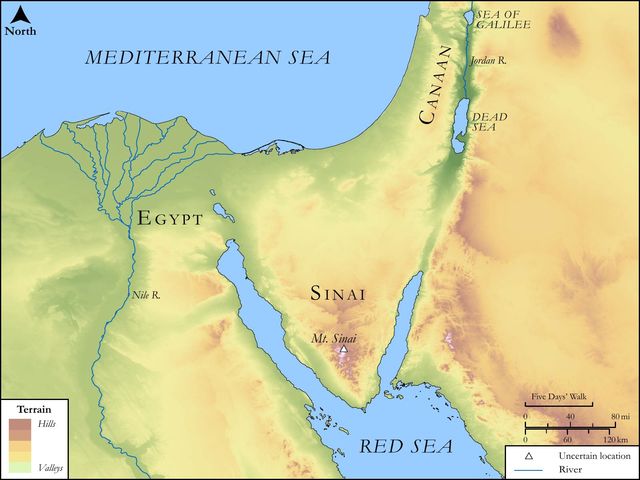
See on the biblical-era maps

Study this verse
Public-domain commentary
Matthew Henry
From his Commentary on the Whole Bible. Henry comments on passages, not single verses — this entry covers Exodus 23:10–19. His two-level outline is real structure in the source text, so it is rendered as structure.
Here is, I. The institution of the sabbatical year, Exo 23:10, Exo 23:11. Every seventh year the land was to rest; they must not plough nor sow it at the beginning of the year, and then they could not expect any great harvest at the end of the year: but what the earth did produce of itself should be eaten from hand to mouth, and not laid up. Now this was designed, 1. To show what a plentiful land that was into which God was bringing them - that so numerous a people could have rich maintenance out of the produce of so small a country, without foreign trade, and yet could spare the increase of every seventh year. 2. To remind them of their dependence upon God their great landlord, and their obligation to use the fruit of their land as he should direct. Thus he would try their obedience in a matter that nearly touched their interest. Afterwards we find that their disobedience to this command was a forfeiture of the promises, Ch2 36:21. 3. To teach them a confidence in the divine Providence, while they did their duty - that, as the sixth day's manna served for two day's meat, so the sixth year's increase should serve for two years' subsistence. Thus they must learn not to take thought for their life, Mat 6:25. If we are prudent and diligent in our affairs, we may trust Providence to furnish us with the bread of the day in its day.
II.The repetition of the law of the fourth commandment concerning the weekly sabbath, Exo 23:12.
Even in the year of rest they must not think that the sabbath day was laid in common with the other days, but, even that year, it must be religiously observed; yet thus some have endeavoured to take away the observance of the sabbath, by pretending that every day must be a sabbath day.
III.All manner of respect to the gods of the heathen is here strictly forbidden, Exo 23:13.
A general caution is prefixed to this, which has reference to all these precepts: In all things that I have said unto you, be circumspect. We are in danger of missing our way on the right hand and on the left, and it is at our peril if we do; therefore we have need to look about us. A man may ruin himself through mere carelessness, but he cannot save himself without great care and circumspection: particularly, since idolatry was a sin which they were much addicted to, and would be greatly tempted to, they must endeavour to blot out the remembrance of the gods of the heathen, and must disuse and forget all their superstitious forms of speech, and never mention them but with detestation. In Christian schools and academies (for it is in vain to think of reforming the play-houses), it were to be wished that the names and stories of the heathen deities, or demons rather, were not so commonly and familiarly used as they are, even with intimations of respect, and sometimes with forms of invocation. Surely we have not so learned Christ.
IV.Their solemn religious attendance on God in the place which he should choose is here strictly required, Exo 23:14-17.
1.Thrice a year all their males must come together in a holy convocation, that they might the better know and love one another, and keep up their communion as a dignified and peculiar people.
2.They must come together before the Lord (Exo 23:17) to present themselves before him, looking towards the place where his honour dwelt, and to pay their homage to him as their great Lord, from and under whom they held all their enjoyments.
3.They must feast together before the Lord, eating and drinking together, in token of their joy in God and their grateful sense of his goodness to them; for a feast is made for laughter, Ecc 10:19. O what a good Master do we serve, who has made it our duty to rejoice before him, who feasts his servants when they are in waiting! Never let religion be called a melancholy thing, when its solemn services are solemn feasts.
4.They must not appear before God empty, Exo 23:15. Some free-will offering or other they must bring, in token of their respect and gratitude to their great benefactor; and, as they were not allowed to come empty-handed, so we must not come to worship God empty-hearted; our souls must be filled with grace, with pious and devout affections, holy desires towards him, and dedications of ourselves to him, for with such sacrifices God is well-pleased.
5.The passover, pentecost, and feast of tabernacles, in spring, summer, and autumn, were the three times appointed for their attendance: not in winter, because travelling was then uncomfortable; not in the midst of their harvest, because then they were otherwise employed; so that they had no reason to say that he made them to serve with an offering, or wearied them with incense.
V.Some particular directions are here given about the three feasts, though not so fully as afterwards.
1.As to the passover, it was not to be offered with leavened bread, for at that feast all leaven was to be cast out, nor was the fat of it to remain until the morning, lest it should become offensive, Exo 23:18.
2.At the feast of pentecost, when they were to begin their harvest, they must bring the first of their first-fruits to God, by the pious presenting of which the whole harvest was sanctified, Exo 23:19.
3.At the feast of ingathering, as it is called (Exo 23:16), they must give God thanks for the harvest-mercies they had received, and must depend upon him for the next harvest, and must not think to receive benefit by that superstitious usage of some of the Gentiles, who, it is said, at the end of their harvest, seethed a kid in its dam's milk, and sprinkled that milk-pottage, in a magical way, upon their gardens and fields, to make them more fruitful next year. But Israel must abhor such foolish customs.
Continue studying Exodus 23:10 across the web’s major study libraries — every link below opens this exact verse, chapter, or book on the destination site.
Read & Compare
 BibleGatewayThis verse in more than 200 translations and 70 languages.
 Bible.comThe YouVersion reader — hundreds of translations, reading plans, and highlights.
 ESV.orgCrossway's official English Standard Version reader.
 NET BibleThe NET translation with 60,000+ translators' notes on every rendering decision.
 STEP BibleTyndale House's free study tool — original text, vocabulary, and scholarly resources.
 BibliaLogos Bible Software's free web reader.
 USCCBThe New American Bible (Revised Edition) with the U.S. bishops' study notes.
Commentaries
 BibleHub CommentariesDozens of classic commentaries on this verse, gathered on one page.
 StudyLightMore than 100 commentary sets — the largest collection on the web.
 BibleRefPlain-English commentary on what this verse means, verse by verse.
 Enduring WordDavid Guzik's free commentary on this chapter, widely used by Bible teachers.
 Bible Study ToolsVerse commentary alongside Greek and Hebrew study aids.
Original Language & Research
- BibleHub InterlinearThe verse word by word — original language, transliteration, and English.
- BibleHub LexiconEvery word's original-language definition and Strong's entry.
 Blue Letter BibleDeep-study tools — Strong's numbers, concordance, and word studies.
 SefariaThe Hebrew text with Rashi and centuries of Jewish commentary.
Sermons, Hymns & Audio


TrulyRandomVerse is not affiliated with these sites and doesn’t control their content. They’re linked because they’re genuinely useful.
Summary
Exodus 23:10 introduces the foundational agricultural rhythm for ancient Israel, commanding six years of diligent sowing and gathering of crops from their land. This seemingly simple instruction establishes the human responsibility in cultivation while simultaneously setting the stage for the divine principle of rest and provision embodied in the subsequent Sabbatical year, fostering a profound reliance on God's faithfulness rather than solely on human effort.
Context
ShowHideLiterary Context
This verse is situated within the "Book of the Covenant" (Exodus 20:22-23:33), a detailed collection of divine laws given to Moses at Mount Sinai immediately following the Ten Commandments. These statutes provided the foundational legal and ethical framework for Israel as they transitioned from a nomadic, enslaved people to a settled nation governed directly by God. The laws in Exodus 23, in particular, emphasize principles of justice, compassion, and ethical conduct towards neighbors, the vulnerable, and even animals, demonstrating God's holistic concern for a righteous society. The command to sow for six years is the precursor to the explicit instruction for the land to lie fallow in the seventh year (Exodus 23:11), highlighting a divinely ordained rhythm that mirrors the weekly Sabbath and extends it to the very land itself.
Historical & Cultural Context
Ancient Israel was predominantly an agrarian society, where land was the primary source of sustenance, wealth, and identity. Their very survival depended on successful harvests. This law gave the land its rest in the seventh year, rooted in divine command, "that the poor of thy people may eat" (23:11). The idea of a seven-year cycle, while recalling the seven years of plenty and the seven of famine in Pharaoh's dream, was uniquely applied by Yahweh to enforce a spiritual principle of trust and stewardship. Having recently been delivered from slavery in Egypt, where they were forced laborers, these laws provided a new societal structure based on covenant relationship with God, where even their agricultural practices were to reflect their dependence on Him. This law implicitly challenged their reliance on their own strength and foresight, directing their faith towards the ultimate Provider, particularly as they prepared to enter and settle the Promised Land.
Key Themes
ShowHideExodus 23:10 contributes significantly to several key themes woven throughout the Book of the Covenant and the broader Pentateuch. It underscores the theme of Divine Sovereignty and Provision, demonstrating that God, as the ultimate owner of the land and source of all sustenance, dictates the terms of its use. This naturally leads to the theme of Human Stewardship, highlighting Israel's responsibility to diligently work the land entrusted to them, but always within God's prescribed boundaries. Furthermore, it introduces the foundational principle of Sabbath and Rest, extending the rhythm of six days of labor followed by one day of rest (as seen in Exodus 20:8-11) to an annual agricultural cycle, thus emphasizing the importance of cessation from labor and reliance on God's sustaining power. This also touches on Justice, as the subsequent verse (Exodus 23:11) reveals that the produce of the Sabbatical year was for the poor and wild animals, ensuring provision for all.
Exposition and Analysis
ShowHideKey Word Analysis
ShowHideThis primitive root signifies the act of scattering seed or planting. In the context of Exodus 23:10, it emphasizes the human effort, labor, and intentionality involved in cultivating the land. It speaks to the active engagement required to prepare the ground and deposit the seeds that will yield future sustenance, establishing a period of diligent productivity.
Derived from a root likely meaning "to be firm," this term refers to the earth at large, or more specifically, a particular country or territory. Here, "thy land" refers to the specific territory God was granting to Israel. Its inclusion highlights the physical domain upon which the agricultural commands were to be exercised, underscoring the intimate connection between the people, their livelihood, and the divinely allocated inheritance.
This primitive root means to collect, harvest, or bring in for any purpose. In this verse, it refers to the culmination of the agricultural cycle – the ingathering of the produce. It signifies the expected outcome of the sowing, representing the blessing and provision that God grants through human labor. The phrase "gather in the fruits thereof" underscores the abundance and sustenance that would be enjoyed during the six years of active cultivation, providing a tangible reward for their diligent obedience.
Verse Breakdown
ShowHide"And six years thou shalt sow thy land"
This clause establishes a clear, divinely mandated duration for active agricultural work. It dictates a cycle of human labor and cultivation, emphasizing the responsibility of the Israelites to engage diligently with the land God had given them. The specificity of "six years" immediately sets up an expectation for a seventh, contrasting period, introducing a rhythmic pattern that would govern their agricultural life and foreshadowing the Sabbatical year.
"and shalt gather in the fruits thereof"
This part of the verse outlines the natural and expected outcome of the sowing – a successful harvest. It signifies the period of reaping the benefits of their labor, collecting the produce that sustains life. This phrase implies God's blessing upon their efforts, ensuring that their diligent work would yield sustenance, thereby reinforcing the covenantal promise of provision tied to obedience within this six-year cycle.
Literary Devices
ShowHideExodus 23:10 employs several literary devices that enhance its meaning and impact. The most prominent is Numerical Symbolism, specifically the use of "six years" which immediately evokes the pervasive seven-day week structure established in creation and the weekly Sabbath. This sets up an expectation for a contrasting "seventh" period, creating Anticipation for the Sabbatical year described in the very next verse (Exodus 23:11). The language is direct and declarative, characteristic of Legal Language found throughout the Book of the Covenant, underscoring the divine authority and mandatory nature of the command. There is also a strong element of Juxtaposition, as the active verbs "sow" and "gather" for six years inherently contrast with the implied rest and non-cultivation of the seventh, highlighting the rhythm of work and rest that God intends for His people and His creation.
Theological and Thematic Connections
ShowHideExodus 23:10, though simple in its phrasing, lays the groundwork for profound theological principles concerning God's sovereignty, human stewardship, and the nature of divine provision. It establishes a rhythm of work and rest that extends the Sabbath principle beyond individuals to the very land itself, demonstrating God's concern for the well-being of creation and the spiritual discipline of His people. The command to sow for six years and gather the fruit implies a trust in God's blessing on their labor, while simultaneously preparing them for the radical act of faith required to let the land lie fallow in the seventh year, relying entirely on God for their sustenance. This law fundamentally teaches that the land is not Israel's absolute possession but God's, and they are merely stewards, called to manage it according to His divine wisdom and purposes.
Reflection and Application
ShowHideThe ancient command to sow for six years and gather the fruits thereof, while rooted in an agrarian context, offers timeless principles for contemporary life. It first affirms the value of diligent labor and responsible engagement with the resources God has given us. We are called to be productive, to work hard, and to wisely manage our time, talents, and material possessions. However, this verse also implicitly sets the stage for the crucial principle of rest and reliance on God. Just as the land needed a Sabbath, so do our lives, our careers, and our pursuits. It challenges us to consider whether we are so consumed by continuous "sowing and gathering" that we neglect the necessary rhythms of rest, reflection, and spiritual renewal that God intends. Ultimately, it invites us to cultivate a deep trust in God's provision, recognizing that our ultimate sustenance comes not solely from our own efforts, but from His abundant grace and faithfulness.
Questions for Reflection
ShowHideFAQ
ShowHideWhat is the "Sabbatical year" or "Shemitah" mentioned in relation to this verse?
ShowHideThe "Sabbatical year," known in Hebrew as Shemitah (שמיטה), meaning "release," is the seventh year in a seven-year agricultural cycle commanded by God to ancient Israel. While Exodus 23:10 commands six years of sowing and gathering, the very next verse, Exodus 23:11, explicitly states that in the seventh year, the land was to lie fallow, uncultivated. This meant no sowing or pruning, and whatever grew of its own accord was to be left for the poor, the sojourner, and the wild animals. Leviticus 25:1-7 provides more detailed instructions for its observance, emphasizing land rest, trust in God's provision, and justice.
Why was this law important for ancient Israel?
ShowHideThis law was crucial for several reasons. Theologically, it reinforced God's ultimate ownership of the land (Leviticus 25:23), reminding Israel that they were stewards, not absolute proprietors. Spiritually, it cultivated profound trust in God's provision, as they had to believe He would provide enough in the sixth year to sustain them through the seventh (Leviticus 25:20-22). Agriculturally, it promoted sustainable farming practices, allowing the soil to rest and regenerate, preventing depletion. Socially, it provided for the poor and vulnerable, ensuring that even in the year of fallow, there was food available for those who could not cultivate their own land (Exodus 23:11).
Is this law still relevant today, given modern agricultural practices?
ShowHideWhile the literal observance of the Sabbatical year as an agricultural law may not be directly applicable to all modern contexts, the underlying principles remain profoundly relevant. The law teaches the importance of rest (for land, for people, for systems), challenging the relentless pursuit of productivity. It underscores the necessity of trust in God's provision over human effort alone, encouraging us to release control and depend on Him in all areas of life (finances, career, personal well-being). Furthermore, it highlights the call to responsible stewardship of creation and resources, reminding us that we are caretakers of God's world, not its owners, and should manage it sustainably and for the benefit of all.
Christ-Centered Fulfillment
ShowHideExodus 23:10, with its emphasis on a rhythm of work and rest culminating in divine provision, finds its ultimate and profound fulfillment in Jesus Christ. The Sabbatical principle, introduced here for the land, points to a deeper spiritual rest that only Christ can provide. He is the one who invites all who are weary and burdened to come to Him and find rest for their souls, a rest far surpassing any physical cessation from labor. Just as the land's rest in the seventh year demonstrated God's ability to provide supernaturally, Jesus continually demonstrated His power to provide abundantly, whether it was feeding the five thousand or offering Himself as the Bread of Life who satisfies all spiritual hunger. He is the true and ultimate "harvest" from God, the Lamb of God who takes away the sin of the world, providing eternal sustenance. In Christ, the old covenant's shadows concerning land, rest, and provision give way to the glorious reality of a new covenant where believers are united with Him, the true vine, enabling them to bear much fruit for God's glory, not through their own striving, but through abiding in Him. He is the Lord of the Sabbath, the one in whom all creation finds its purpose and its ultimate rest.