


John 6:11
Bible text: King James Version (1769 Blayney text) · Public domain
Bible text: King James Version with Strong's numbers · Public domain
Bible text: Berean Standard Bible · Public domain
Bible text: American Standard Version (1901) · Public domain
Bible text: World English Bible, Messianic edition · Public domain
Bible text: Geneva Bible (1599) · Public domain
Bible text: Young's Literal Translation · Public domain
- ἔλαβενelabenTookG2983V-2AAI-3SVerb 2nd Aorist Active Indicative 3rd Singular
- οὖνounthenG3767CONJConjunction
- τοὺςtoustheG3588T-APMDefinite article Accusative Plural Masculine
- ἄρτουςartousloavesG740N-APMNoun Accusative Plural Masculine
- ὁho<the>G3588T-NSMDefinite article Nominative Singular Masculine
- ἸησοῦςIēsousJesusG2424N-NSM-PNoun Nominative Singular Masculine Individual
- καὶkaiandG2532CONJConjunction
- εὐχαριστήσαςeucharistēsashaving given thanksG2168V-AAP-NSMVerb Aorist Active Participle Nominative Singular Masculine
- διέδωκενdiedōkenHe distributedG1239V-AAI-3SVerb Aorist Active Indicative 3rd Singular
- τοῖςtoisto theG3588T-DPMDefinite article Dative Plural Masculine
- μαθηταῖςmathētaisdisciplesG3101N-DPMNoun Dative Plural Masculine
- οἱhoi<the>G3588T-NPMDefinite article Nominative Plural Masculine
- δὲdenowG1161CONJConjunction
- μαθηταὶmathētaithe disciplesG3101N-NPMNoun Nominative Plural Masculine
- τοῖςtoisto thoseG3588T-DPMDefinite article Dative Plural Masculine
- ἀνακειμένοιςanakeimenoisrecliningG345V-PNP-DPMVerb Present Middle Or Passive Deponent Participle Dative Plural Masculine
- ὁμοίωςhomoiōslikewiseG3668ADVAdverb
- καὶkaialsoG2532CONJConjunction
- ἐκekofG1537PREPPreposition
- τῶνtōntheG3588T-GPNDefinite article Genitive Plural Neuter
- ὀψαρίωνopsariōnfishG3795N-GPNNoun Genitive Plural Neuter
- ὅσονhosonas much asG3745K-ASNCorrelative pronoun Accusative Singular Neuter
- ἤθελονēthelonthey were wishingG2309V-IAI-3PVerb Imperfect Active Indicative 3rd Plural
English is a literal word-by-word gloss of the Greek, not the KJV's wording. Why?
This is the original text the KJV's translators worked from — each Greek word with its own literal English meaning in this verse, prepared by scholars at Tyndale House, Cambridge. The KJV translates whole sentences, not word by word, so its wording differs: one Greek word can become several English words, and the KJV may choose “charity” where the gloss reads “love”. Both are faithful — they answer different questions. For the KJV's own rendering, switch to the KJV text.
Details
See on the biblical-era maps
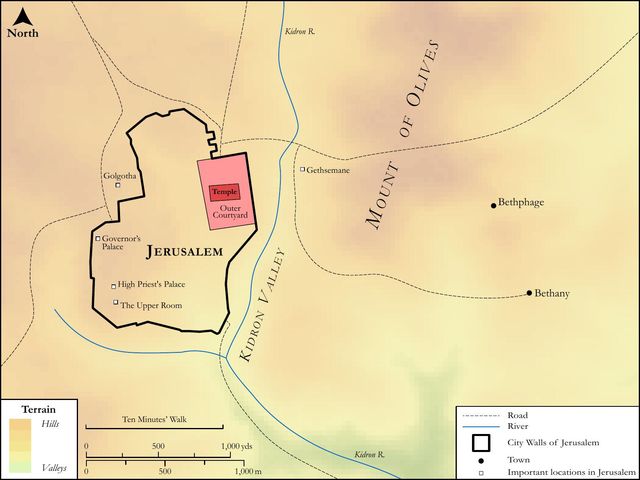
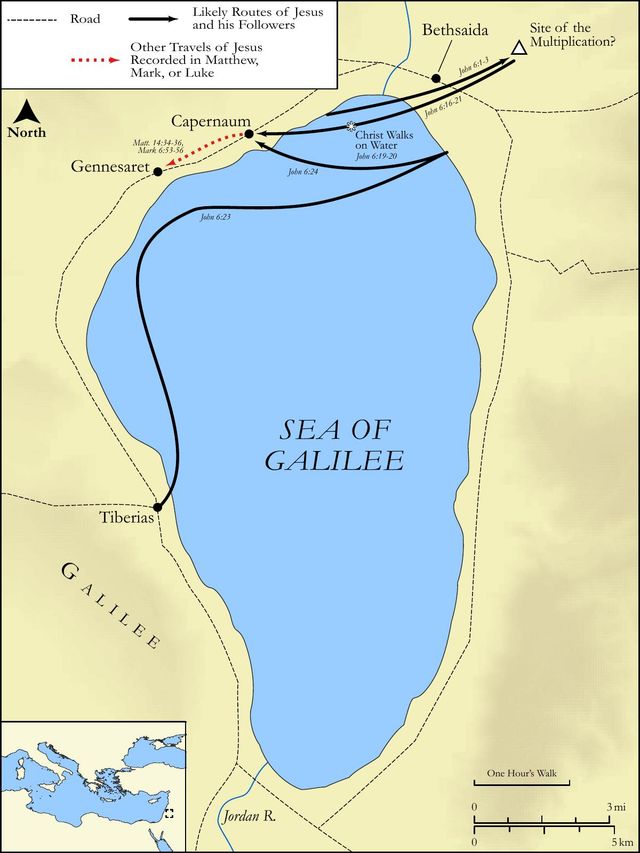
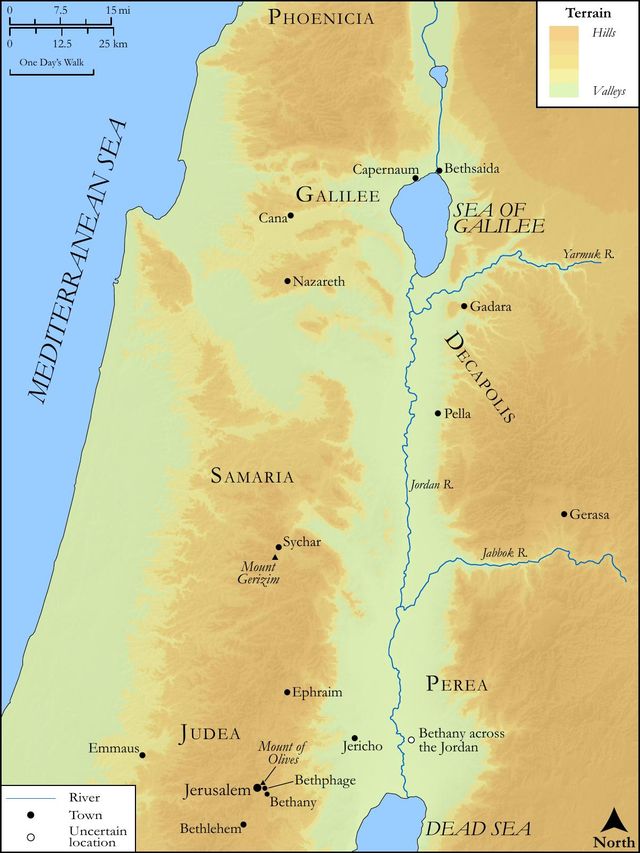
Study this verse
Public-domain commentary
Matthew Henry
From his Commentary on the Whole Bible. Henry comments on passages, not single verses — this entry covers John 6:1–14. His four-level outline is real structure in the source text, so it is rendered as structure.
We have here an account of Christ's feeding five thousand men with five loaves and two fishes, which miracle is in this respect remarkable, that it is the only passage of the actions of Christ's life that is recorded by all the four evangelists. John, who does not usually relate what had been recorded by those who wrote before him, yet relates this, because of the reference the following discourse has to it. Observe,
I.The place and time where and when this miracle was wrought, which are noted for the greater evidence of the truth of the story; it is not said that it was done once upon a time, nobody knows where, but the circumstances are specified, that the fact might be enquired into.
1.The country that Christ was in (Joh 6:1): He went over the sea of Galilee, called elsewhere the lake of Gennesareth, here the sea of Tiberias, from a city adjoining, which Herod had lately enlarged and beautified, and called so in honour of Tiberius the emperor, and probably had made his metropolis. Christ did not go directly over cross this inland sea, but made a coasting voyage to another place on the same side. It is not tempting God to choose to go by water, when there is convenience for it, even to those places whither we might go by land; for Christ never tempted the Lord his God, Mat 4:7.
2.The company that he was attended with: A great multitude followed him, because they saw his miracles, Joh 6:2. Note,
(1.)Our Lord Jesus, while he went about doing good, lived continually in a crowd, which gave him more trouble than honour. Good and useful men must not complain of a hurry of business, when they are serving God and their generation; it will be time enough to enjoy ourselves when we come to that world where we shall enjoy God.
(2.)Christ's miracles drew many after him that were not effectually drawn to him. They had their curiosity gratified by the strangeness of them, who had not their consciences convinced by the power of them.
3.Christ's posting himself advantageously to entertain them (Joh 6:3): He went up into a mountain, and there he sat with his disciples, that he might the more conveniently be seen and heard by the multitude that crowded after him; this was a natural pulpit, and not, like Ezra's, made for the purpose. Christ was now driven to be a field preacher; but his word was never the worse, nor the less acceptable, for that, to those who knew how to value it, who followed him still, not only when he went out to a desert place, but when he went up to a mountain, though up-hill be against heart. He sat there, as teachers do in cathedra - in the chair of instruction. He did not sit at ease, not sit in state, yet he sat as one having authority, sat ready to receive addresses that were made to him; whoever would might come, and find him there. He sat with his disciples; he condescended to take them to sit with him, to put a reputation upon them before the people, and give them an earnest of the glory in which they should shortly sit with him. We are said to sit with him, Eph 2:6.
4.The time when it was. The first words, After those things, do not signify that this immediately followed what was related in the foregoing chapter, for it was a considerable time after, and they signify no more than in process of time; but we are told (Joh 6:4) that it was when the passover was nigh, which is here noted,
(1.)Because, perhaps, that had brought in all the apostles from their respective expeditions, whither they were sent as itinerant preachers, that they might attend their Master to Jerusalem, to keep the feast.
(2.)Because it was a custom with the Jews religiously to observe the approach of the passover thirty days before, with some sort of solemnity; so long before they had it in their eye, repaired the roads, mended bridges, if there was occasion, and discoursed of the passover and the institution of it.
(3.)Because, perhaps, the approach of the passover, when every one knew Christ would go up to Jerusalem, and be absent for some time, made the multitude flock the more after him and attend the more diligently on him. Note, The prospect of losing our opportunities should quicken us to improve them with double diligence; and, when solemn ordinances are approaching, it is good to prepare for them by conversing with the word of Christ.
II.The miracle itself. And here observe,
1.The notice Christ took of the crowd that attended him (Joh 6:5): He lifted up his eyes, and saw a great company come to him, poor, mean, ordinary people, no doubt, for such make up the multitudes, especially in such remote corners of the country; yet Christ showed himself pleased with their attendance, and concerned for their welfare, to teach us to condescend to those of low estate, and not to set those with the dogs of our flock whom Christ hath set with the lambs of his. The souls of the poor are as precious to Christ, and should be so to us, as those of the rich.
2.The enquiry he made concerning the way of providing for them. He directed himself to Philip, who had been his disciple from the first, and had seen all his miracles, and particularly that of his turning water into wine, and therefore it might be expected that he should have said, "Lord, if thou wilt, it is easy to thee to feed them all." Those that, like Israel, have been witnesses of Christ's works, and have shared in the benefit of them, are inexcusable if they say, Can he furnish a table in the wilderness? Philip was of Bethsaida, in the neighbourhood of which town Christ now was, and therefore he was most likely to help them to provision at the best hand; and probably much of the company was known to him, and he was concerned for them. Now Christ asked, Whence shall we buy bread, that these may eat?
(1.)He takes it for granted that they must all eat with him. One would think that when he had taught and healed them he had done his part; and that now they should rather have been contriving how to treat him and his disciples, for some of the people were probably rich, and we are sure that Christ and his disciples were poor; yet he is solicitous to entertain them. Those that will accept Christ's spiritual gifts, instead of paying for them, shall be paid for their acceptance of them. Christ, having fed their souls with the bread of life, feeds their bodies also with food convenient, to show that the Lord is for the body, and to encourage us to pray for our daily bread, and to set us an example of compassion to the poor, Jam 2:15, Jam 2:16.
(2.)His enquiry is, Whence shall we buy bread? One would think, considering his poverty, that he should rather have asked, Where shall we have money to buy for them? But he will rather lay out all he has than they shall want. He will buy to give, and we must labour, that we may give, Eph 4:28.
3.The design of this enquiry; it was only to try the faith of Philip, for he himself knew what he would do, Joh 6:6. Note,
(1.)Our Lord Jesus is never at a loss in his counsels; but, how difficult soever the case is, he knows what he has to do and what course he will take, Act 15:18. He knows the thoughts he has towards his people (Jer 29:11) and is never at uncertainty; when we know not, he himself knows what he will do.
(2.)When Christ is pleased to puzzle his people, it is only with a design to prove them. The question put Philip to a nonplus, yet Christ proposed it, to try whether he would say, "Lord, if thou wilt exert thy power for them, we need not buy bread."
4.Philip's answer to this question: "Two hundred pennyworth of bread is not sufficient, Joh 6:7. Master, it is to no purpose to talk of buying bread for them, for neither will the country afford so much bread, nor can we afford to lay out so much money; ask Judas, who carries the bag." Two hundred pence of their money amount to about six pounds of ours, and, if they lay out all that at once, it will exhaust their fund, and break them, and they must starve themselves. Grotius computes that two hundred pennyworth of bread would scarcely reach to two thousand, but Philip would go as near hand as he could, would have every one to take a little; and nature, we say, is content with a little. See the weakness of Philip's faith, that in this strait, as if the Master of the family had been an ordinary person, he looked for supply only in an ordinary way. Christ might now have said to him, as he did afterwards, Have I been so long time with you, and yet hast thou not known me, Philip? Or, as God to Moses in a like case, Is the Lord's hand waxen short? We are apt thus to distrust God's power when visible and ordinary means fail, that is, to trust him no further than we can see him.
5.The information which Christ received from another of his disciples concerning the provision they had. It was Andrew, here said to be Simon Peter's brother; though he was senior to Peter in discipleship, and instrumental to bring Peter to Christ, yet Peter afterwards so far outshone him that he is described by his relation to Peter: he acquainted Christ with what they had at hand; and in this we may see,
(1.)The strength of his love to those for whom he saw his Master concerned, in that he was willing to bring out all they had, though he knew not but they might want themselves, and any one would have said, Charity begins at home. He did not go about to conceal it, under pretence of being a better husband of their provision than the master was, but honestly gives in an account of all they had. There is a lad here, paidarion - a little lad, probably one that used to follow this company, as settlers do the camp, with provisions to sell, and the disciples had bespoken what he had for themselves; and it was five barley-loaves, and two small fishes. Here,
[1.]The provision was coarse and ordinary; they were barley loaves. Canaan was a land of wheat (Deu 8:8); its inhabitants were commonly fed with the finest wheat (Psa 81:16), the kidneys of wheat (Deu 32:14); yet Christ and his disciples were glad of barley-bread. It does not follow hence that we should tie ourselves to such coarse fare, and place religion in it (when God brings that which is finer to our hands, let us receive it, and be thankful); but it does follow that therefore we must not be desirous of dainties (Psa 23:3); nor murmur if we be reduced to coarse fare, but be content and thankful, and well reconciled to it; barley-bread is what Christ had, and better than we deserve. Nor let us despise the mean provision of the poor, nor look upon it with contempt, remembering how Christ was provided for.
[2.]It was but short and scanty; there were but five loaves, and those so small that one little lad carried them all; and we find (Kg2 4:42, Kg2 4:43) that twenty barley-loaves, with some other provision to help out, would not dine a hundred men without a miracle. There were but two fishes, and those small ones (duo opsaria), so small that one of them was but a morsel, pisciculi assati. I take the fish to have been pickled, or soused, for they had not fire to dress them with. The provision of bread was little, but that of fish was less in proportion to it, so that many a bit of dry bread they must eat before they could make a meal of this provision; but they were content with it. Bread is meat for our hunger; but of those that murmured for flesh it is said, They asked meat for their lust, Psa 78:18. Well, Andrew was willing that the people should have this, as far as it would go. Note, A distrustful fear of wanting ourselves should not hinder us from needful charity to others.
(2.)See here the weakness of his faith in that word, "But what are they among so many? To offer this to such a multitude is but to mock them." Philip and he had not that actual consideration of the power of Christ (of which they had had such large experience) which they should have had. Who fed the camp of Israel in the wilderness? He that could make one man chase a thousand could make one loaf feed a thousand.
6.The directions Christ gave the disciples to seat the guests (Joh 6:10): "Make the men sit down, though you have nothing to set before them, and trust me for that." This was like sending providence to market, and going to buy without money: Christ would thus try their obedience. Observe,
(1.)The furniture of the dining-room: there was much grass in that place, though a desert place; see how bountiful nature is, it makes grass to grow upon the mountains, Psa 147:8. This grass was uneaten; God gives not only enough, but more then enough. Here was this plenty of grass where Christ was preaching; the gospel brings other blessings along with it: Then shall the earth yield her increase, Psa 67:6. This plenty of grass made the place the more commodious for those that must sit on the ground, and served them for cushions, or beds (as they called what they sat on at meat, Est 1:6), and, considering what Christ says of the grass of the field (Mat 6:29, Mat 6:30), these beds excelled those of Ahasuerus: nature's pomp is the most glorious.
(2.)The number of the guests: About five thousand: a great entertainment, representing that of the gospel, which is a feast for all nations (Isa 25:6), a feast for all comers.
7.The distribution of the provision, Joh 6:11. Observe,
(1.)It was done with thanksgiving: He gave thanks. Note,
[1.]We ought to give thanks to God for our food, for it is a mercy to have it, and we have it from the hand of God, and must receive it with thanksgiving, Ti1 4:4, Ti1 4:5. And this is the sweetness of our creature-comforts, that they will furnish us with matter, and give us occasion, for that excellent duty of thanksgiving.
[2.]Though our provision be coarse and scanty, though we have neither plenty nor dainty, yet we must give thanks to God for what we have.
(2.)It was distributed from the hand of Christ by the hands of his disciples, Joh 6:11. Note,
[1.]All our comforts come to us originally from the hand of Christ; whoever brings them, it is he that sends them, he distributes to those who distribute to us.
[2.]In distributing the bread of life to those that follow him, he is pleased to make use of the ministration of his disciples; they are the servitors at Christ's table, or rather rulers in his household, to give to every one his portion of meat in due season.
(3.)It was done to universal satisfaction. They did not every one take a little, but all had as much as they would; not a short allowance, but a full meal; and considering how long they had fasted, with what an appetite they sat down, how agreeable this miraculous food may be supposed to have been, above common food, it was not a little that served them when they ate as much as they would and on free cost. Those whom Christ feeds with the bread of life he does not stint, Psa 81:10. There were but two small fishes, and yet they had of them too as much as they would. He did not reserve them for the better sort of the guests, and put off the poor with dry bread, but treated them all alike, for they were all alike welcome. Those who call feeding upon fish fasting reproach the entertainment Christ here made, which was a full feast.
8.The care that was taken of the broken meat. (1.) The orders Christ gave concerning it (Joh 6:12): When they were filled, and every man had within him a sensible witness to the truth of the miracle, Christ said to the disciples, the servants he employed, Gather up the fragments. Note, We must always take care that we make no waste of any of God's good creatures; for the grant we have of them, though large and full, is with this proviso, wilful waste only excepted. It is just with God to bring us to the want of that which we make waste of. The Jews were very careful not to lose any bread, nor let it fall to the ground, to be trodden upon. Qui panem contemnit in gravem incidit paupertatem - He who despises bread falls into the depths of poverty, was a saying among them. Though Christ could command supplies whenever he pleased, yet he would have the fragments gathered up. When we are filled we must remember that others want, and we may want. Those that would have wherewith to be charitable must be provident. Had this broken meat been left upon the grass, the beasts and fowls would have gathered it up; but that which is fit to be meat for men is wasted and lost if it be thrown to the brute-creatures. Christ did not order the broken meat to be gathered up till all were filled; we must not begin to hoard and lay up till all is laid out that ought to be, for that is withholding more than is meet. Mr. Baxter notes here, "How much less should we lose God's word, or helps, or our time, or such greater mercies!" (2.) The observance of these orders (Joh 6:13): They filled twelve baskets with the fragments, which was an evidence not only of the truth of the miracle, that they were fed, not with fancy, but with real food (witness those remains), but of the greatness of it; they were not only filled, but there was all this over and above. See how large the divine bounty is; it not only fills the cup, but makes it run over; bread enough, and to spare, in our Father's house. The fragments filled twelve baskets, one for each disciple; they were thus repaid with interest for their willingness to part with what they had for public service; see Ch2 31:10. The Jews lay it as a law upon themselves, when they have eaten a meal, to be sure to leave a piece of bread upon the table, upon which the blessing after meat may rest; for it is a curse upon the wicked man (Job 20:21) that there shall none of his meat be left.
III.Here is the influence which this miracle had upon the people who tasted of the benefit of it (Joh 6:14): They said, This is of a truth that prophet. Note,
1.Even the vulgar Jews with great assurance expected the Messiah to come into the world, and to be a great prophet, They speak here with assurance of his coming. The Pharisees despised them as not knowing the law; but, it should seem, they knew more of him that is the end of the law than the Pharisees did.
2.The miracles which Christ wrought did clearly demonstrate that he was the Messiah promised, a teacher come from God, the great prophet, and could not but convince the amazed spectators that this was he that should come. There were many who were convinced he was that prophet that should come into the world who yet did not cordially receive his doctrine, for they did not continue in it. Such a wretched incoherence and inconsistency there is between the faculties of the corrupt unsanctified soul, that it is possible for men to acknowledge that Christ is that prophet, and yet to turn a deaf ear to him.
Historical interpretation
Eighteen Centuries of Reception
15 surviving comments on this verse. Each one is dated, so this reads as a timeline rather than a list.
Select a marker to jump to its quote. Markers stagger vertically where authors wrote within a few decades of each other.
For although the Lord had the power to supply wine to those feasting, independently of any created substance, and to fill with food those who were hungry, He did not adopt this course; but, taking the loaves which the earth had produced, and giving thanks,
So very mystically the five loaves are broken by the Savior, and fill the crowd of the listeners. For great is the crowd that keep to the things of the senses, as if they were the only things in existence. “Cast your eyes round, and see,” says Plato, “that none of the uninitiated listen.” Such are they who think that nothing else exists but what they can hold firmly with their hands; but do not admit as in the department of existence, actions and processes of generation, and the whole of the unseen. For such are those who keep by the five senses. But the knowledge of God is a thing inaccessible to the ears and other organs of the senses with this kind of people.
They saw a man, blind from his birth, proclaiming to them the God who had restored his sight. They saw a paralytic, who had grown up, as it were, and become one with his infirmity, at His bidding loosed from his disease. They saw Lazarus, who was made an exile from the region of death. They heard that He had walked on the sea. They heard of the wine that, without previous culture, was ministered; of the bread that was eaten at that spontaneous banquet; they heard that the demons had been put to flight; the sick restored to health. Their very streets proclaimed His deeds of wonder; their roads declared His healing power to those who journeyed on them.
Five loaves are then set before the multitude, and broken. While the apostles are dividing them, a succession of newly created portions passes—they cannot tell how—through their hands. The loaf which they are dividing does not grow smaller and yet their hands are continually full of the pieces. The speed of the process baffles the sight. You follow with the eye a hand full of portions, and in the meantime you see that the contents of the other hand are not diminished. And all the while the heap of pieces grows. The carvers are busy at their task, the eaters hard at work at theirs. The hungry are satisfied and the fragments fill twelve baskets. Neither sight nor any of the other senses can discover how such an amazing miracle happened. What did not exist was created; what we see passes our understanding. It only remains for us to believe that God can do all things.
(iii. de Trin. c. 18) Five loaves are then set before the multitude, and broken. The broken portions pass through into the hands of those who break, that from which they are broken all the time not at all diminishing. And yet there they are, the bits taken from it, in the hands of the persons breakingd. There is no catching by eye or touch the miraculous operation: that is, which was not, that is seen, which is not understood. It only remains for us to believe that God can do all things.
(Hom. xlii. 1) As missiles rebound with great force from a hard body, and fly off in all directions, whereas a softer material retains and stops them; so violent men are only excited to greater rage by violence on the side of their opponents, whereas gentleness softens them. Christ quieted the irritation of the Jews by retiring from Jerusalem. He went into Galilee, but not to Cana again, but beyond the sea: After these things Jesus went over the sea of Galilee, which is the sea of Tiberias.
(Hom. xlii. 1) Though favoured with such teaching, they were influenced less by it, than by the miracles; a sign of their low state of belief: for Paul says of tongues, that they are for a sign, not to them that believe, but to them that believe not. (1 Cor. 14:22) They were wiser of whom it is said, that they were astonished at His doctrine. (Matt. 7:28) The Evangelist does not say what miracles He wrought, the great object of his book being to give our Lord's discourses. It follows: And Jesus went up into a mountain, and there sat with His disciples. He went up into the mountain, on account of the miracle which was going to be done. That the disciples alone ascended with Him, implies that the people who stayed behind were in fault for not following. He went up to the mountain too, as a lesson to us to retire from the tumult and confusion of the world, and leave wisdom in solitude. And the passover, a feast of the Jews, was nigh. Observe, in a whole year, the Evangelist has told us of no miracles of Christ, except His healing the impotent man, and the nobleman's son. His object was to give not a regular history, but only a few of the principal acts of our Lord. But why did not our Lord go up to the feast? He was taking occasion, from the wickedness of the Jews, gradually to abolish the Law.
(Hom. xlii. 1) Nor did He only sit with His disciples, but conversed with them familiarly, and gained possession of their minds. Then He looked, and saw a crowd advancing. But why did He ask Philip that question? Because He knew that His disciples, and he especially, needed further teaching. For this Philip it was who said afterwards, show us the Father, and it sufficeth us. (c. 14:8) And if the miracle had been performed at once, without any introduction, the greatness of it would not have been seen. The disciples were made to confess their own inability, that they might see the miracle more clearly; And this He said to prove him.
(Hom. xlii. s. 1) Or they are two different occasions altogether.
(Hom. xlii. 2.) Probably He had some reason in his mind for this speech. He would know of Elijah's miracle, by which a hundred men were fed with twenty loaves. This was a great step; but here he stopped. He did not rise any higher. For his next words are, But what are these among so many? He thought that less could produce less in a miracle, and more more; a great mistake; inasmuch as it was as easy for Christ to feed the multitude from a few fishes as from many. He did not really want any material to work from, but only made use of created things for this purpose in order to show that no part of the creation was severed from His wisdom.
(Hom. xlii. 2.) And let those of us, who are given to pleasure, observe the plain and abstemious eating of those great and wonderful menb. He made the men sit down before the loaves appeared, to teach us that with Him, things that are not are as things that are; as Paul says, Who calleth those things that be not, as though they were. (Rom. 4:17.) The passage proceeds then: And Jesus said, Make the men sit down.
(Hom. xlii. 2.) But why when He is going to heal the impotent, to raise the dead, to calm the sea, does He not pray, but here does give thanks? To teach us to give thanks to God, whenever we sit down to eat. And He prays more in lesser matters, in order to show that He does not pray from any motive of need. For had prayer been really necessary to supply His wants, His praying would have been in proportion to the importance of each particular work. But acting, as He does, on His own authority, it is evident, He only prays out of condescension to us. And, as a great multitude was collected, it was an opportunity of impressing on them, that His coming was in accordance with God's will. Accordingly, when a miracle was private, He did not pray; when numbers were present, He did.
(Hom. xlii. 3) Observe the difference between the servant and the lord. The Prophets received grace, as it were, by measure, and according to that measure performed their miracles: whereas Christ, working this by His own absolute power, produces a kind of superabundant result. When they were filled, He said unto His disciples, Gather up the fragments that remain, that nothing be lost. Therefore they gathered them together, and filled twelve baskets with the fragments. This was not done for needless ostentation, but to prevent men from thinking the whole a delusion; which was the reason why He made use of an existing material to work from. But why did He give the fragments to His disciples to carry away, and not to the multitude? Because the disciples were to be the teachers of the world, and therefore it was most important that the truth should be impressed upon them. Wherefore I admire not only the multitude of the loaves which were made, but the definite quantity of the fragments; neither more nor less than twelve baskets full, and corresponding to the number of the twelve Apostles.
Their expression, that should come into the world, shows that they expected the arrival of some great Prophet. And this is why they say, This is of a truth that Prophet: the article being put in the Greek, to show that He was distinct from other Prophets.
"And He gave to them that were set down, and they were filled." Seest thou how great is the interval between the servants and the Master? They having grace by measure, wrought their miracles accordingly, but God, who acteth with free power, did all most abundantly.
But why when He was about to restore the paralytic did He not pray, nor when He was raising the dead, or bridling the sea, while He doth so here over the loaves? It was to show that when we begin our meals, we ought to give thanks unto God. Moreover, He doth it especially in a lesser matter, that thou mayest learn that He doth it not as having any need; for were this the case, much more would He have done so in greater things; but when He did them by His own authority, it is clear that it was through condescension that He acted as He did in the case of the lesser.
(Tr. xxiv. s. 1.) He multiplied in His hands the five loaves, just as He produces harvest out of a few grains. There was a power in the hands of Christ; and those five loaves were, as it were, seeds, not indeed committed to the earth, but multiplied by Him who made the earth.
(Tr. xxiv. s. 5) By the act of breaking He multiplied the five loaves. The five books of Moses, when expounded by breaking, i. e. unfolding them, made many books.
(lib. lxxxiii. Quæst. qu. 61) Our Lord by breaking, as it were, what was hard in the Law, and opening what was shut, that time when He opened the Scriptures to the disciples after the resurrection, brought the Law out in its full meaning.
For who now feeds the whole world, but He who out of a few seeds creates the harvests? He wrought, therefore, as God. For by the same power whereby He multiplies the stores of grain from a few seeds, did He multiply in His hands the five loaves. For power was in the hands of Christ, and those five loaves were as seeds, not indeed committed to the earth, but multiplied by Him who made the earth.
He gives thanks, as an ensample to us and a pattern of the piety which ought to be in us: and attributes again as Man the Power of the miracle to the Divine Nature. For this was His custom, both helping by an example of piety, as we have said, those to whom He was manifested as a Teacher of what is most excellent, and by an economy concealing yet His God-befitting Dignity, till the time of His Passion should be at hand: for it was His earnest care that it should be hid from the prince of this world. For this reason, doth He elsewhere too use words befitting men, as a Man, and heals again the understanding of His hearers, sometimes making most wise alluring as in the words, Father, I thank Thee that Thou heardest Me. Seest thou in how human guise His speech, and well calculated to trouble the understanding of the more simple? But when He says this, as Man, then again He straightway unfolds the mode of the economy, and the object of His will to lie hid, by most excellent arrangement fortifying the mind of the more simple which had received a shock. For I knew (He saith) that Thou hearest Me always. Why then dost Thou speak these things? Because of the multitude which stood by I said it, that they may believe (saith He) that Thou sentest Me. Is it not then hereby plain, that with a view manifoldly to assist us, and to fulfill, as befitted Him, the secret economy with Flesh, He sometimes speaks more lowlily, than He really is? As therefore in that passage, I thank Thee, is taken economically, so here too. [He blessed is understood of the bread.]
But we must observe that instead of gave thanks, Matthew has said, blessed, but the edition of the saints will in no wise differ. For Paul will show that they are both one, saying that every meat 9 of God is good, and nothing to be refused: for it is sanctified by the word of God and prayer. But that which is sanctified through the prayer in supplication, which we are wont ever to make over the table, is surely blessed..
But since it is fit that nothing profitable be left uninvestigated by us; come let us say a little of the five loaves which the lad had and of the two little fishes: for both the species itself, and besides the numbers are replete with mystery. For why (will some more studious person say) were not the loaves rather five, and the fishes three? why not five, and the fishes four? what occasion was there at all for recounting the number found, and why did not he rather say more simply and absolutely that the innumerable multitude of them that followed Him were fed off exceeding few chance things? But the fact that the blessed Evangelist recounted very diligently these things too, gives us something surely to think of, which we must needs search into.
He says then that the loaves are five, and they of barley, and the fishes two, and with these Christ feedeth them that love Him. And I think (and let the lover of wisdom look out for something better) that by the five barley loaves are signified the five-fold book of the all-wise Moses, that is, the whole Law, bringing in as it were coarser food, that by the letter and history. For this the barley hints at. But by the little fishes is signified the food got through the fishermen, that is, the more delicate books of the disciples of the Saviour; and these two (he says), the apostolic and Evangelic preaching, shine forth among us. And both these are draughts and spiritual writings of the fishermen. The Saviour therefore mingling the new with the old, by the Law and the teachings of the New Testament nourishes the souls of them that believe on Him, unto life, plainly eternal life. That the disciples were of fishermen, is (I suppose) plain and clear: and though all were not so, yet since there are some such among them, our argument will not recede from truth in what has been said.
Christ had brought to Him the five loaves of bread,
And straightway, lifting His eyes to the Father, He said:
“I am doing Thy deeds; for I am Thy Son;
For in the beginning, I created the whole world
Together with Thee and the Holy Spirit; for I am
The heavenly bread of immortality.”
Behold how the masters, the servants of Christ, were arranged and attended
The Servant, Jesus; and they found Him at once.
For the Lord blessed the five loaves of bread,
Speaking to them as follows in spiritual fashion:
“Grow and multiply perceptibly,
And nourish now all who are assembled here.”
And immediately the loaves obeyed the Lord;
They multiplied invisibly
As Christ spoke to them, for He is
The heavenly bread of immortality.
Mystically, the sea signifies this tumultuous world. In the fulness of time, when Christ had entered the sea of our mortality by His birth, trodden it by His death, passed over it by His resurrectionf, then followed Him crowds of believers, both from the Jews and Gentiles.
His leaving the multitude below, and ascending the heights with His disciples, signifies, that lesser precepts are to be given to beginners, higher to the more matured. His refreshing the people shortly before the Passover signifies our refreshment by the bread of the divine word; and the body and blood, i. e. our spiritual passover, by which we pass over from vice to virtue. And the Lord's eyes are spiritual gifts, which he mercifully bestows on His Elect. He turns His eyes upon them, i. e. has compassionate respect unto them.
Baskets are used for servile work. The baskets here are the Apostles and their followers, who, though despised in this present life, are within filled with the riches of spiritual sacraments. The Apostles too are represented as baskets, because, that through them, the doctrine of the Trinity was to be preached in the four parts of the world. His not making new loaves, but multiplying what there were, means that He did not reject the Old Testament, but only developed and explained it.
i. e. green grass. It was the time of the Passover, which was kept the first month of the spring. So the men sat down in number about five thousand. The Evangelist only counts the men, following the direction in the law. Moses numbered the people from twenty years old and upwards, making no mention of the women; to signify that the manly and juvenile character is especially honourable in God's eyes. And Jesus took the loaves; and when He had given thanks, He distributed to them that were sat down: and likewise of the fishes as much as they would.
We learn too from this miracle, not to be pusillanimous in the greatest straits of poverty.
There is an activity of God displayed throughout creation, a wholesale activity let us say which men refuse to recognize. The miracles done by God incarnate, living as a man in Palestine, perform the very same things as this wholesale activity, but at a different speed and on a smaller scale. One of their chief purposes is that men, having seen a thing done by personal power on the small scale, may recognize, when they see the same thing done on the large scale, that the power behind it is also personal – is indeed the very same person who lived among us two thousand years ago. The miracles in fact are a retelling in small letters of the very same story which is written across the whole world in letters too large for some of us to see...
Every year God makes a little corn into much corn: the seed is sown and there is an increase, and men, according to the fashion of their age, say “It is Ceres, it is Adonis, it is the Corn-King,” or else “It is the laws of Nature.” The close-up, the translation, of this annual wonder is the feeding of the five thousand. Bread is not made there of nothing. Bread is not made of stones, as the Devil once suggested to Our Lord in vain. A little bread is made into much bread. The Son will do nothing but what He sees the Father do. There is, so to speak, a family style...
When He fed the thousands He multiplied fish as well as bread. Look in every bay and almost every river. This swarming, pulsating fecundity shows He is still at work. The ancients had a god called Genius – the god of animal and human fertility, the presiding spirit of gynecology, embryology, or the marriage bed – the “genial bed” as they called it after its god Genius. As the miracles of wine and bread and healing showed who Bacchus really was, who Ceres, who Apollo, and that all were one, so this miraculous multiplication of fish reveals the real Genius.
Continue studying John 6:11 across the web’s major study libraries — every link below opens this exact verse, chapter, or book on the destination site.
Read & Compare
 BibleGatewayThis verse in more than 200 translations and 70 languages.
 Bible.comThe YouVersion reader — hundreds of translations, reading plans, and highlights.
 ESV.orgCrossway's official English Standard Version reader.
 NET BibleThe NET translation with 60,000+ translators' notes on every rendering decision.
 STEP BibleTyndale House's free study tool — original text, vocabulary, and scholarly resources.
 BibliaLogos Bible Software's free web reader.
 USCCBThe New American Bible (Revised Edition) with the U.S. bishops' study notes.
Commentaries
 BibleHub CommentariesDozens of classic commentaries on this verse, gathered on one page.
 StudyLightMore than 100 commentary sets — the largest collection on the web.
 BibleRefPlain-English commentary on what this verse means, verse by verse.
 Enduring WordDavid Guzik's free commentary on this chapter, widely used by Bible teachers.
 Bible Study ToolsVerse commentary alongside Greek and Hebrew study aids.
Original Language & Research
- BibleHub InterlinearThe verse word by word — original language, transliteration, and English.
- BibleHub LexiconEvery word's original-language definition and Strong's entry.
 Blue Letter BibleDeep-study tools — Strong's numbers, concordance, and word studies.
 CNTR CollationThe earliest Greek manuscripts of this verse, collated letter by letter.
Sermons, Hymns & Audio


TrulyRandomVerse is not affiliated with these sites and doesn’t control their content. They’re linked because they’re genuinely useful.
Summary
John 6:11 describes the pivotal moment in the miraculous feeding of over five thousand people, where Jesus, after taking the available loaves and fish and giving thanks, orchestrated their distribution through His disciples to the seated multitude, ensuring everyone received as much as they desired. This act not only demonstrated His divine power to provide abundantly but also highlighted His methodical approach and the disciples' role as conduits of His blessing, setting the stage for deeper theological truths about spiritual nourishment.
Context
ShowHideLiterary Context
John 6:11 is situated within the broader narrative of Jesus' ministry in Galilee, specifically following His withdrawal to the other side of the Sea of Galilee (also known as the Sea of Tiberias) and the large crowd that followed Him because they saw His signs (miracles) (John 6:1-2). Prior to this verse, Jesus had initiated a conversation with Philip, testing his faith regarding how to feed such a vast multitude (John 6:5-6). Andrew then pointed out a boy with five barley loaves and two small fish, highlighting the inadequacy of these provisions in human terms (John 6:8-9). Verse 10 details Jesus' instruction for the people to sit down, emphasizing the orderly nature of the impending miracle. Thus, verse 11 is the immediate fulfillment of the need, showcasing Jesus' divine power in action before the subsequent collection of the fragments (John 6:12-13) and the crowd's reaction (John 6:14-15).
Historical & Cultural Context
The feeding of the five thousand took place in a "desert place" (Matthew 14:15, Mark 6:35) or "much grass" (John 6:10), likely on the eastern shore of the Sea of Galilee, a relatively unpopulated area. Large gatherings for teaching were common, but providing food for such a multitude was an immense logistical challenge, especially in a remote location. The practice of reclining at meals, indicated by the phrase "them that were set down" (ἀνακεῖμαι, anakeîmai), reflects typical dining customs of the Greeks, the Romans and the Jews of that time, where people would recline on mats or cushions. The act of giving thanks before a meal was a deeply ingrained Jewish tradition, particularly for the head of the household, acknowledging God as the source of all provision. This custom is seen throughout the Old Testament and continued into the New Testament, notably at the Last Supper (Matthew 26:26-27).
Key Themes
ShowHideThis verse is central to several key themes in John's Gospel and the broader biblical narrative. It powerfully illustrates Jesus' divine authority and power over creation, demonstrating His ability to transcend natural limitations and provide for human needs. The miracle also serves as a profound sign of divine provision and abundance, showing that God not only meets needs but does so generously ("as much as they would"). The act of Jesus giving thanks before the distribution underscores the theme of gratitude and dependence on God, modeling a posture of thankfulness even in the face of scarcity. Furthermore, the involvement of the disciples in the distribution highlights the theme of discipleship and service, portraying them as agents through whom Jesus' blessings flow to the multitude. This miracle, along with Jesus' subsequent discourse, lays foundational groundwork for understanding Jesus as the true "Bread of Life" (John 6:35), emphasizing that His provision extends beyond physical sustenance to spiritual and eternal life.
Exposition and Analysis
ShowHideKey Word Analysis
ShowHideThis verb signifies Jesus' active grasping or receiving of the loaves. It implies a deliberate action, not a passive acceptance. In this context, Jesus takes hold of the meager provisions, which are then transformed through His divine power. It highlights His initiative in the miracle.
This word is crucial, meaning "to be grateful" or "to express gratitude," specifically "to say grace at a meal." Jesus' act of giving thanks before the miracle fully unfolds is a profound theological statement. It demonstrates His complete dependence on and communion with the Father, acknowledging God as the ultimate source of all provision, even before the multiplication occurs. This act transforms the ordinary into the sacred and sets a pattern for believers.
This compound verb means "to give throughout a crowd" or "to deal out." It emphasizes the systematic and orderly dissemination of the food. Jesus did not directly hand out the food to each person but used His disciples as intermediaries, signifying a structured and communal approach to meeting needs, and foreshadowing the role of the apostles in the early church.
Verse Breakdown
ShowHide"And Jesus took the loaves;"
This clause establishes Jesus' direct involvement and initiative. He takes possession of the meager offering of five barley loaves, indicating His acceptance of what is available, no matter how insufficient it appears from a human perspective. This act is the first step in the miraculous multiplication.
"and when he had given thanks,"
This is a critical theological moment. Before any distribution or multiplication, Jesus expresses gratitude. This act of thanksgiving (eucharistéō) is not a mere formality but a profound acknowledgment of God the Father as the ultimate provider and source of all blessings. It demonstrates Jesus' perfect communion with the Father and His dependence on divine power.
"he distributed to the disciples,"
This reveals Jesus' method of distribution. Instead of directly feeding the multitude, He passes the multiplied food to His disciples. This highlights the disciples' role as channels of His blessing and underscores the orderly nature of the miracle. It also implicitly teaches a lesson about leadership and service within the community of faith.
"and the disciples to them that were set down;"
This further clarifies the chain of distribution. The disciples, having received from Jesus, then serve the vast crowd who were already seated in an orderly fashion. This emphasizes the communal aspect of the miracle and the disciples' active participation in Jesus' work, serving as His hands and feet.
"and likewise of the fishes as much as they would."
This final clause confirms that the miraculous provision extended to both the loaves and the fish. The phrase "as much as they would" (hósos thélō) signifies not just sufficiency but abundance. Everyone received to their full satisfaction, demonstrating God's overflowing generosity and Jesus' power to provide beyond all human expectation or limitation.
Literary Devices
ShowHideThe narrative of John 6:11 employs several significant literary devices. Narrative Progression is evident as the verse moves from Jesus' initial action of taking the loaves to His act of thanksgiving, then to the distribution process through the disciples, and finally to the abundant outcome for the crowd. This progression builds anticipation and highlights the methodical nature of the miracle. Emphasis is placed on Jesus' act of "giving thanks," which is not merely a detail but a profound theological statement, transforming the ordinary meal into a sacred event and underscoring His reliance on the Father. Furthermore, the entire miracle, encapsulated in this verse, functions as Symbolism. The physical bread and fish symbolize Jesus Himself as the ultimate spiritual nourishment, foreshadowing His later discourse about being the "Bread of Life" (John 6:35). The abundance ("as much as they would") also serves as a symbol of God's overflowing grace and provision, not just for physical needs but for spiritual ones as well.
Theological and Thematic Connections
ShowHideJohn 6:11 is a profound demonstration of God's character as a sovereign and benevolent provider. Jesus' act of giving thanks before the miraculous multiplication underscores the theological truth that all provision, whether physical or spiritual, originates from God. This miracle serves as a tangible sign of God's capacity to meet human needs abundantly, transcending natural limitations. It foreshadows the ultimate spiritual nourishment found in Christ, who offers Himself as the "Bread of Life" to satisfy the deepest longings of the human soul. The disciples' role in distributing the food also highlights the principle of divine blessing flowing through human instruments, a pattern seen throughout salvation history where God uses His people to extend His grace to others.
Reflection and Application
ShowHideJohn 6:11 offers timeless lessons for believers today, inviting us to cultivate a posture of gratitude, trust, and service. Jesus' example of giving thanks, even before the full manifestation of the miracle, calls us to practice thanksgiving in all circumstances, recognizing God's hand in our lives regardless of apparent scarcity. This act of faith transforms our perspective and opens us to receiving God's blessings. The miracle itself encourages us to trust in God's boundless provision, reminding us that when we surrender our limited resources to Christ, He can multiply them beyond our imagination to meet not only our needs but also the needs of others. Furthermore, the disciples' role in distributing the food challenges us to be active conduits of God's grace and resources to those around us. We are called to serve, to share, and to be instruments through whom God's love and provision flow into the world, participating in His redemptive work by meeting both physical and spiritual needs.
Questions for Reflection
ShowHideFAQ
ShowHideWhy did Jesus give thanks before performing the miracle?
ShowHideJesus' act of giving thanks (eucharistéō) before the miracle was not merely a polite custom but a profound theological statement. It demonstrated His complete dependence on and perfect communion with God the Father as the ultimate source of all provision. By giving thanks, Jesus acknowledged the Father's sovereignty and power, transforming the meager loaves and fish into instruments of divine abundance. This act also served as a model for His disciples and for us, teaching us to approach God with gratitude and faith, recognizing that all blessings come from Him, even before we see their full manifestation. This posture of thanksgiving is consistent with Jesus' character throughout the Gospels, showing His constant reliance on the Father (John 5:19).
What is the significance of the disciples distributing the food instead of Jesus doing it directly?
ShowHideThe fact that Jesus distributed the food "to the disciples, and the disciples to them that were set down" carries significant meaning. Firstly, it demonstrates Jesus' orderly and methodical approach, even in a miraculous event. Secondly, it highlights the disciples' role as His chosen instruments and co-laborers. They were not merely spectators but active participants in His ministry. This foreshadows their future role in the early church, where they would be responsible for distributing spiritual nourishment (the Word of God) and ministering to the physical needs of the community (Acts 6:1-4). It teaches us that God often chooses to work through His people to extend His blessings and grace to the world.
Christ-Centered Fulfillment
ShowHideJohn 6:11, detailing the miraculous feeding, finds its ultimate Christ-centered fulfillment not merely in the abundance of physical bread, but in Jesus Himself as the true and eternal "Bread of Life." The temporary satisfaction of the crowd's hunger foreshadows the spiritual nourishment Jesus offers to all who believe in Him. Just as the loaves and fish were multiplied to sustain physical bodies, Jesus' own body, broken on the cross, was given to provide eternal life for the world (John 6:51). His act of giving thanks before the distribution points to His perfect communion with the Father and His willingness to offer Himself as the ultimate sacrifice, a theme powerfully echoed at the Last Supper (Luke 22:19), where He again gave thanks for the bread, symbolizing His body. The abundance ("as much as they would") speaks to the limitless grace and provision found in Christ, who fully satisfies the deepest spiritual hunger and thirst of humanity, offering a life that never perishes (John 4:14). Thus, John 6:11 is not just a story of a meal, but a profound sign pointing to Jesus as the all-sufficient Savior who provides eternal sustenance for His people.