


Exodus 12:39
Bible text: King James Version (1769 Blayney text) · Public domain
Bible text: King James Version with Strong's numbers · Public domain
Bible text: Berean Standard Bible · Public domain
Bible text: American Standard Version (1901) · Public domain
Bible text: World English Bible, Messianic edition · Public domain
Bible text: Geneva Bible (1599) · Public domain
Bible text: Young's Literal Translation · Public domain
- וַיֹּאפוּvai·yo·Fuand they bakedH644Conj-w ¦ V-Qal-ConsecImperf-3mpVerb Qal Consecutive Imperfect 3rd Plural Masculineוַandיֹּאפוּthey baked
- אֶת'et<obj.>H853DirObjMParticle Object Indicator
- הַבָּצֵקha·ba·Tzekthe doughH1217Art ¦ N-msNoun Singular Masculine Absoluteהַtheבָּצֵקdough
- אֲשֶׁר'a·SherwhichH834RelParticle Relative
- הוֹצִיאוּho·Tzi·'uthey had brought outH3318V-Hiphil-Perf-3cpVerb Hiphil Perfect 3rd Plural common gender
- מִמִּצְרַיִםmi·mitz·Ra·yimfrom EgyptH4714Prep-m ¦ N-properNoun Proper LocationמִfromמִּצְרַיִםEgypt
- עֻגֹת'u·Gotbread cakesH5692N-fpNoun Plural Feminine Absolute
- מַצּוֹתma·Tzotunleavened bread<s>H4682N-fpNoun Plural Feminine Absolute
- כִּיkiforH3588PrtParticle Conditional
- לֹאlo'notH3808NegParticle Negative
- חָמֵץcha·Metzit was leavenedH2556V-Qal-Perf-3msVerb Qal Perfect 3rd Singular Masculine
- כִּיkiforH3588PrtParticle Conditional
- גֹרְשׁוּgo·re·Shuthey had been driven outH1644V-Pual-Perf-3cpVerb Pual Perfect 3rd Plural common gender
- מִמִּצְרַיִםmi·mitz·Ra·yimfrom EgyptH4714Prep-m ¦ N-properNoun Proper LocationמִfromמִּצְרַיִםEgypt
- וְלֹאve·Lo'and notH3808Conj-w ¦ NegParticle Negativeוְandלֹאnot
- יָכְלוּya·khe·Luthey had been ableH3201V-Qal-Perf-3cpVerb Qal Perfect 3rd Plural common gender
- לְהִתְמַהְמֵהַּle·hit·mah·Me·ahto delayH4102Prep-l ¦ V-Hithpael-InfVerb Hithpael Infinitive Constructלְtoהִתְמַהְמֵהַּdelay
- וְגַםve·gamand alsoH1571Conj-w ¦ AdvAdverbוְandגַםalso
- צֵדָהtze·Dahprovision[s]H6720N-fsNoun Singular Feminine Absolute
- לֹאlo'notH3808NegParticle Negative
- עָשׂוּ'a·Suthey had madeH6213V-Qal-Perf-3cpVerb Qal Perfect 3rd Plural common gender
- לָהֶםla·Hemfor <the> themselvesPrep-l ¦ 3mpSuffix Personal 3rd Plural Masculineלָfor <the>הֶםthemselves
English is a literal word-by-word gloss of the Hebrew, not the KJV's wording. Why?
This is the original text the KJV's translators worked from — each Hebrew word with its own literal English meaning in this verse, prepared by scholars at Tyndale House, Cambridge. The KJV translates whole sentences, not word by word, so its wording differs: one Hebrew word can become several English words, and the KJV may choose “the LORD” where the gloss reads “Yahweh”. Both are faithful — they answer different questions. For the KJV's own rendering, switch to the KJV text.
Details
See on the biblical-era maps

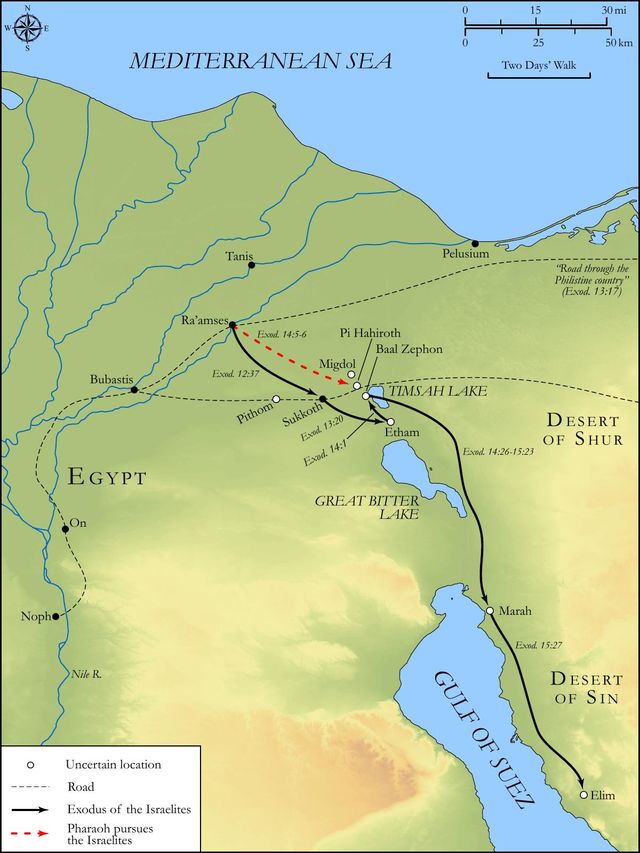
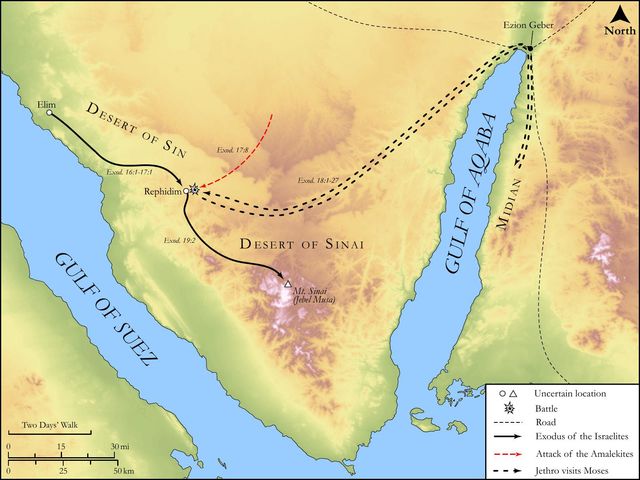
Study this verse
Public-domain commentary
Matthew Henry
From his Commentary on the Whole Bible. Henry comments on passages, not single verses — this entry covers Exodus 12:37–42.
Here is the departure of the children of Israel out of Egypt; having obtained their dismission, they set forward without delay, and did not defer to a more convenient season. Pharaoh was now in a good mind; but they had reason to think he would not long continue so, and therefore it was no time to linger. We have here an account, 1. Of their number, about 600,000 men (Exo 12:37), besides women and children, which I think, we cannot suppose to make less than 1,200,000 more. What a vast increase was this, to arise from seventy souls in little more than 200 years' time! See the power and efficacy of that blessing, when God commands it, Be fruitful and multiply. This was typical of the multitudes that were brought into the gospel church when it was first founded; so mightily grew the word of God, and prevailed. 2. Of their retinue (Exo 12:38): A mixed multitude went up with them, hangers on to that great family, some perhaps willing to leave their country, because it was laid waste by the plagues, and to seek their fortune, as we say, with the Israelites; others went out of curiosity, to see the solemnities of Israel's sacrifice to their God, which had been so much talked of, and expecting to see some glorious appearances of their God to them in the wilderness, having seen such glorious appearances of their God for them in the field of Zoan, Psa 78:12. Probably the greatest part of this mixed multitude were but a rude unthinking mob, that followed the crowd they knew not why; we afterwards find that they proved a snare to them (Num 11:4), and it is probable that when, soon afterwards, they understood that the children of Israel were to continue forty years in the wilderness, they quitted them, and returned to Egypt. Note, There were always those among the Israelites that were not Israelites, and there are still hypocrites in the church, who make a deal of mischief, but will be shaken off at last. 3. Of their effects. They had with them flocks and herds, even very much cattle. This is taken notice of because it was long before Pharaoh would give them leave to remove their effects, which were chiefly cattle, Gen 46:32. 4. Of the provision made for the camp, which was very poor and slender. They brought some dough with them out of Egypt in their knapsacks, Exo 12:34. They had prepared to bake, the next day, in order to their removal, understanding it was very near; but, being hastened away sooner than they thought of, by some hours, they took the dough as it was, unleavened; when they came to Succoth, their first stage, they baked unleavened cakes, and, though these were of course insipid, yet the liberty they were brought into made this the most joyful meal they had ever eaten in their lives. Note, The servants of God must not be slaves to their appetites, nor solicitous to wind up all the delights of sense to their highest pitch. We should be willing to take up with dry bread, nay, with unleavened bread, rather than neglect or delay any service we have to do for God, as those whose meat and drink it is to do his will. 5. Of the date of this great event: it was just 430 years from the promise made to Abraham (as the apostle explains it, Gal 3:17) at his first coming into Canaan, during all which time the children of Israel, that is, the Hebrews, the distinguished chosen seed, were sojourners in a land that was not theirs, either Canaan or Egypt. So long the promise God made to Abraham of a settlement lay dormant and unfulfilled, but now, at length, it revived, and things began to work towards the accomplishment of it. The first day of the march of Abraham's seed towards Canaan was just 430 years (it should seem to a day) from the promise made to Abraham, Gen 12:2, I will make of thee a great nation. See how punctual God is to his time; though his promises be not performed quickly, they will be accomplished in their season. 6. Of the memorableness of it: It is a night to be much observed, Exo 12:42. (1.) The providences of that first night were very observable; memorable was the destruction of the Egyptians, and the deliverance of the Israelites by it; God herein made himself taken notice of. (2.) The ordinances of that night, in the annual return of it, were to be carefully observed: This is that night of the Lord, that remarkable night, to be celebrated in all generations. Note, The great things God does for his people are not to be a nine days' wonder, as we say, but the remembrance of them is to be perpetuated throughout all ages, especially the work of our redemption by Christ. This first passover-night was a night of the Lord much to be observed; but the last passover-night, in which Christ was betrayed (and in which the passover, with the rest of the ceremonial institutions, was superseded and abolished), was a night of the Lord much more to be observed, when a yoke heavier than that of Egypt was broken from off our necks, and a land better than that of Canaan set before us. That was a temporal deliverance to be celebrated in their generation; this is an eternal redemption to be celebrated in the praises of glorious saints, world without end.
Continue studying Exodus 12:39 across the web’s major study libraries — every link below opens this exact verse, chapter, or book on the destination site.
Read & Compare
 BibleGatewayThis verse in more than 200 translations and 70 languages.
 Bible.comThe YouVersion reader — hundreds of translations, reading plans, and highlights.
 ESV.orgCrossway's official English Standard Version reader.
 NET BibleThe NET translation with 60,000+ translators' notes on every rendering decision.
 STEP BibleTyndale House's free study tool — original text, vocabulary, and scholarly resources.
 BibliaLogos Bible Software's free web reader.
 USCCBThe New American Bible (Revised Edition) with the U.S. bishops' study notes.
Commentaries
 BibleHub CommentariesDozens of classic commentaries on this verse, gathered on one page.
 StudyLightMore than 100 commentary sets — the largest collection on the web.
 BibleRefPlain-English commentary on what this verse means, verse by verse.
 Enduring WordDavid Guzik's free commentary on this chapter, widely used by Bible teachers.
 Bible Study ToolsVerse commentary alongside Greek and Hebrew study aids.
Original Language & Research
- BibleHub InterlinearThe verse word by word — original language, transliteration, and English.
- BibleHub LexiconEvery word's original-language definition and Strong's entry.
 Blue Letter BibleDeep-study tools — Strong's numbers, concordance, and word studies.
 SefariaThe Hebrew text with Rashi and centuries of Jewish commentary.
Sermons, Hymns & Audio


TrulyRandomVerse is not affiliated with these sites and doesn’t control their content. They’re linked because they’re genuinely useful.
Summary
Exodus 12:39 vividly depicts the Israelites' urgent, divinely orchestrated departure from Egypt, highlighting their immediate need to bake unleavened bread from their unrisen dough because they were forcibly expelled and had no time for normal preparations or provisions. This verse underscores God's powerful deliverance and the Israelites' complete dependence on His leading, establishing a foundational symbol for future remembrance of their liberation.
Context
ShowHideLiterary Context
This verse immediately follows the climactic Passover events, specifically the tenth and final plague—the death of the firstborn—which finally broke Pharaoh's stubborn resistance (Exodus 12:29-30). Pharaoh, now desperate, commanded Moses and Aaron to leave immediately with all the Israelites and their possessions (Exodus 12:31-32). The Egyptians themselves urged the Israelites to leave quickly, fearing they would all die (Exodus 12:33). The Israelites, carrying their dough and borrowed valuables, set out from Rameses (Exodus 12:34-37). This verse explains why their bread was unleavened, setting the stage for their journey into the wilderness and the subsequent institution of the Feast of Unleavened Bread.
Historical & Cultural Context
In that day, travel, especially for a large group like the Israelites (estimated at 600,000 men, plus women and children, Exodus 12:37), required extensive preparation, particularly for food and supplies. Baking bread, a staple of their diet, typically involved leavening the dough overnight or for several hours to make it rise, resulting in a lighter, more palatable loaf. The sudden, forceful expulsion ("thrust out") described in this verse meant there was no time for this customary process. This urgency was not merely a logistical challenge but a direct consequence of divine judgment and Pharaoh's panicked capitulation, underscoring the miraculous and non-negotiable nature of their liberation. The unleavened bread, therefore, became a tangible, daily reminder of this unprecedented, swift act of God.
Key Themes
ShowHideThis verse contributes significantly to several overarching themes in the book of Exodus. Primarily, it highlights the theme of Divine Deliverance and Sovereignty, demonstrating God's absolute power over Pharaoh and the forces of Egypt, fulfilling His promise to bring His people out with a mighty hand (Exodus 6:1). Secondly, it underscores Human Dependence and Divine Provision, as the Israelites departed utterly unprepared, signifying their complete reliance on God for sustenance in the wilderness, a theme echoed later in the manna provision (Exodus 16). Finally, the unleavened bread itself becomes a central symbol of Remembrance and Identity, serving as a perpetual ordinance to recall the haste and miraculous nature of their liberation from bondage, foundational to Israel's national and religious identity (Exodus 12:14).
Exposition and Analysis
ShowHideKey Word Analysis
ShowHideThis term (H1217) refers to the unfermented mixture of flour and water that the Israelites carried with them. It implies a state of unpreparedness for baking in the usual manner, as it had not yet undergone the process of fermentation (swelling by leaven). The fact that they brought forth "the dough" rather than prepared bread emphasizes the extreme haste of their departure.
Derived from H4682, this word specifically denotes bread made without yeast or any leavening agent. Here, it is not a dietary choice but a direct consequence of the immediate, forced expulsion from Egypt. Its significance transcends the culinary, becoming a perpetual symbol of the swiftness of God's deliverance and the abrupt break from their life of slavery.
This primitive root (H1644) conveys a forceful, decisive expulsion or driving out. It emphasizes that the Israelites' departure was not a planned emigration or a negotiated release, but an urgent, non-negotiable command from Pharaoh, compelled by the overwhelming power of God's judgments. This highlights God's irresistible power in overcoming Pharaoh's stubborn resistance.
This word (H4102) signifies to question, hesitate, or be reluctant, implying a delay. The phrase "could not tarry" stresses the absolute impossibility of any delay in their departure. It underscores the urgency and the lack of opportunity for any further preparation, reinforcing the idea that their exodus was a divinely orchestrated, immediate event.
Verse Breakdown
ShowHide"And they baked unleavened cakes of the dough which they brought forth out of Egypt"
The Israelites, in their haste, carried their unrisen dough with them, rather than leavened bread. This highlights their immediate need for sustenance and the improvisational nature of their first meal as free people. The unleavened nature was not a choice but a necessity dictated by the circumstances of their departure.
"for it was not leavened"
This clause provides the direct, practical reason for the unleavened bread. There was simply no time for the leavening process, which typically takes hours. This detail emphasizes the speed and urgency of their departure, a direct consequence of the divine judgment that had fallen upon Egypt.
"because they were thrust out of Egypt, and could not tarry"
This explains why the dough was not leavened. The phrase "thrust out" powerfully conveys the divine compulsion behind their exodus; Pharaoh and the Egyptians were so desperate for them to leave that they literally drove them out, allowing no delay. "Could not tarry" reinforces this absolute lack of time, underscoring the immediate and irresistible nature of God's deliverance.
"neither had they prepared for themselves any victual"
This final clause underscores their complete unpreparedness for a journey of such magnitude. They had no pre-packed food or provisions, relying entirely on the raw dough they carried. This detail emphasizes their utter dependence on God for future provision in the wilderness, setting the stage for subsequent miraculous provisions like manna.
Literary Devices
ShowHideThe passage employs a strong sense of Causality and Consequence, directly linking the unleavened bread to the haste and forced nature of their departure, explaining that one event was a direct result of the other. Symbolism is paramount, transforming a practical necessity (unleavened bread) into a lasting theological reminder of God's swift and powerful deliverance and the break from the old life of slavery. The Repetition of the theme of haste and lack of preparation ("not leavened," "thrust out," "could not tarry," "neither had they prepared") reinforces the extraordinary, divinely orchestrated nature of the Exodus, emphasizing the urgency and the complete reliance on God.
THEOLOGICAL AND THEMATIC CONNECTIONS
ShowHideExodus 12:39 teaches several profound theological truths.
Reflection and Application
ShowHideExodus 12:39 offers timeless lessons for believers today. It reminds us that God's plans often unfold with a divine urgency that transcends our human timelines and preparations. Just as the Israelites were "thrust out" and had no time to prepare, we may find ourselves in situations where God calls us to step out in faith without having all the answers or resources. This verse encourages us to trust in God's perfect timing and His ability to provide, even when we feel unprepared or overwhelmed. It also calls us to remember God's past acts of deliverance in our lives and in history, allowing those memories to fuel our faith in present challenges and to cultivate a posture of readiness for His sudden, decisive movements.
Questions for Reflection
ShowHideFAQ
ShowHideWhy was it so important that the bread was unleavened?
ShowHideThe unleavened nature of the bread was a direct consequence of the extreme haste of the Israelites' departure. Leaven (yeast) requires time to make dough rise, and the Israelites were "thrust out" so quickly that they had no time for this process. Beyond practical necessity, the unleavened bread (matzah) became a powerful, permanent symbol of their swift deliverance from slavery and a central element of the Passover commemoration, reminding generations of God's urgent and decisive act of liberation.
Does "thrust out of Egypt" mean God didn't want them to leave willingly?
ShowHideThe phrase "thrust out" (Hebrew: gârash) emphasizes the divine compulsion and the overwhelming power of God's judgments that forced Pharaoh's hand. It signifies that Israel's departure was not a negotiated settlement or a voluntary emigration on Pharaoh's part, but a forced expulsion driven by God's wrath and Pharaoh's terror after the tenth plague. It underscores God's absolute sovereignty in fulfilling His promise to bring His people out of bondage, demonstrating that His will is irresistible.
Christ-Centered Fulfillment
ShowHideThe unleavened bread of Exodus 12:39, born of necessity and consecrated as a memorial, finds profound Christ-centered fulfillment. In the New Testament, leaven often symbolizes sin or corruption (Matthew 16:6; Galatians 5:9), while unleavened bread, therefore, represents purity and freedom from sin. Jesus Christ is presented as the ultimate Passover Lamb, sacrificed for the sins of the world. Just as the original Passover lamb was eaten with unleavened bread, signifying a break from the old life of slavery, Christ, our Passover, is celebrated as one "without leaven"—that is, without sin (1 Corinthians 5:7-8). His sacrifice brings about a new exodus, delivering believers from the bondage of sin and death with a divine urgency that calls for immediate repentance and faith, leaving no time for the "leaven" of old ways. The haste of the original Exodus foreshadows the decisive, once-for-all nature of Christ's redemptive work, which provides immediate and complete liberation for all who believe, ushering them into a new life of purity and freedom.