


Exodus 12:38
- וְגַםve·gamand alsoH1571Conj-w ¦ AdvAdverbוְandגַםalso
- עֵרֶב'E·reva mixed companyH6154N-msNoun Singular Masculine Absolute
- רַבravnumerousH7227Adj-msAdjective Singular Masculine Absolute
- עָלָה'a·Lahit went upH5927V-Qal-Perf-3msVerb Qal Perfect 3rd Singular Masculine
- אִתָּם'i·Tamwith themH854Prep ¦ 3mpPreposition Definiteאִתָּwithםthem
- וְצֹאןve·Tzonand flock[s]H6629Conj-w ¦ N-csNoun Singular common gender Absoluteוְandצֹאןflock[s]
- וּבָקָרu·va·Karand herd[s]H1241Conj-w ¦ N-csNoun Singular common gender Absoluteוּandבָקָרherd[s]
- מִקְנֶהmik·NehlivestockH4735N-msNoun Singular Masculine Absolute
- כָּבֵדka·VednumerousH3515Adj-msAdjective Singular Masculine Absolute
- מְאֹדme·'OdveryH3966Adj-msAdjective Numerical Singular Masculine Absolute
English is a literal word-by-word gloss of the Hebrew, not the KJV's wording. Why?
This is the original text the KJV's translators worked from — each Hebrew word with its own literal English meaning in this verse, prepared by scholars at Tyndale House, Cambridge. The KJV translates whole sentences, not word by word, so its wording differs: one Hebrew word can become several English words, and the KJV may choose “the LORD” where the gloss reads “Yahweh”. Both are faithful — they answer different questions. For the KJV's own rendering, switch to the KJV text.
Details
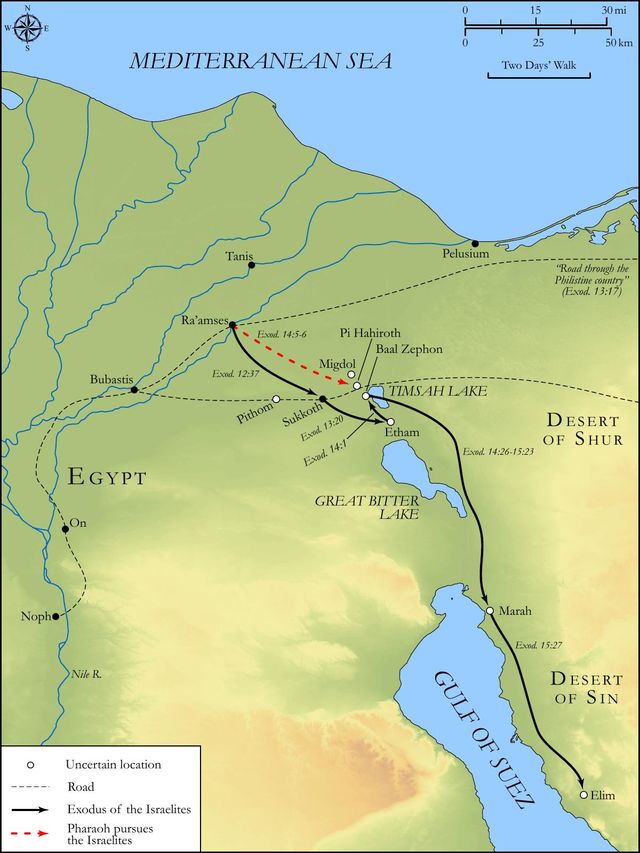
See on the biblical-era map

Study this verse
Public-domain commentary
Matthew Henry
From his Commentary on the Whole Bible. Henry comments on passages, not single verses — this entry covers Exodus 12:37–42.
Here is the departure of the children of Israel out of Egypt; having obtained their dismission, they set forward without delay, and did not defer to a more convenient season. Pharaoh was now in a good mind; but they had reason to think he would not long continue so, and therefore it was no time to linger. We have here an account, 1. Of their number, about 600,000 men (Exo 12:37), besides women and children, which I think, we cannot suppose to make less than 1,200,000 more. What a vast increase was this, to arise from seventy souls in little more than 200 years' time! See the power and efficacy of that blessing, when God commands it, Be fruitful and multiply. This was typical of the multitudes that were brought into the gospel church when it was first founded; so mightily grew the word of God, and prevailed. 2. Of their retinue (Exo 12:38): A mixed multitude went up with them, hangers on to that great family, some perhaps willing to leave their country, because it was laid waste by the plagues, and to seek their fortune, as we say, with the Israelites; others went out of curiosity, to see the solemnities of Israel's sacrifice to their God, which had been so much talked of, and expecting to see some glorious appearances of their God to them in the wilderness, having seen such glorious appearances of their God for them in the field of Zoan, Psa 78:12. Probably the greatest part of this mixed multitude were but a rude unthinking mob, that followed the crowd they knew not why; we afterwards find that they proved a snare to them (Num 11:4), and it is probable that when, soon afterwards, they understood that the children of Israel were to continue forty years in the wilderness, they quitted them, and returned to Egypt. Note, There were always those among the Israelites that were not Israelites, and there are still hypocrites in the church, who make a deal of mischief, but will be shaken off at last. 3. Of their effects. They had with them flocks and herds, even very much cattle. This is taken notice of because it was long before Pharaoh would give them leave to remove their effects, which were chiefly cattle, Gen 46:32. 4. Of the provision made for the camp, which was very poor and slender. They brought some dough with them out of Egypt in their knapsacks, Exo 12:34. They had prepared to bake, the next day, in order to their removal, understanding it was very near; but, being hastened away sooner than they thought of, by some hours, they took the dough as it was, unleavened; when they came to Succoth, their first stage, they baked unleavened cakes, and, though these were of course insipid, yet the liberty they were brought into made this the most joyful meal they had ever eaten in their lives. Note, The servants of God must not be slaves to their appetites, nor solicitous to wind up all the delights of sense to their highest pitch. We should be willing to take up with dry bread, nay, with unleavened bread, rather than neglect or delay any service we have to do for God, as those whose meat and drink it is to do his will. 5. Of the date of this great event: it was just 430 years from the promise made to Abraham (as the apostle explains it, Gal 3:17) at his first coming into Canaan, during all which time the children of Israel, that is, the Hebrews, the distinguished chosen seed, were sojourners in a land that was not theirs, either Canaan or Egypt. So long the promise God made to Abraham of a settlement lay dormant and unfulfilled, but now, at length, it revived, and things began to work towards the accomplishment of it. The first day of the march of Abraham's seed towards Canaan was just 430 years (it should seem to a day) from the promise made to Abraham, Gen 12:2, I will make of thee a great nation. See how punctual God is to his time; though his promises be not performed quickly, they will be accomplished in their season. 6. Of the memorableness of it: It is a night to be much observed, Exo 12:42. (1.) The providences of that first night were very observable; memorable was the destruction of the Egyptians, and the deliverance of the Israelites by it; God herein made himself taken notice of. (2.) The ordinances of that night, in the annual return of it, were to be carefully observed: This is that night of the Lord, that remarkable night, to be celebrated in all generations. Note, The great things God does for his people are not to be a nine days' wonder, as we say, but the remembrance of them is to be perpetuated throughout all ages, especially the work of our redemption by Christ. This first passover-night was a night of the Lord much to be observed; but the last passover-night, in which Christ was betrayed (and in which the passover, with the rest of the ceremonial institutions, was superseded and abolished), was a night of the Lord much more to be observed, when a yoke heavier than that of Egypt was broken from off our necks, and a land better than that of Canaan set before us. That was a temporal deliverance to be celebrated in their generation; this is an eternal redemption to be celebrated in the praises of glorious saints, world without end.
Continue studying Exodus 12:38 across the web’s major study libraries — every link below opens this exact verse, chapter, or book on the destination site.
Read & Compare
 BibleGatewayThis verse in more than 200 translations and 70 languages.
 Bible.comThe YouVersion reader — hundreds of translations, reading plans, and highlights.
 ESV.orgCrossway's official English Standard Version reader.
 NET BibleThe NET translation with 60,000+ translators' notes on every rendering decision.
 STEP BibleTyndale House's free study tool — original text, vocabulary, and scholarly resources.
 BibliaLogos Bible Software's free web reader.
 USCCBThe New American Bible (Revised Edition) with the U.S. bishops' study notes.
Commentaries
 BibleHub CommentariesDozens of classic commentaries on this verse, gathered on one page.
 StudyLightMore than 100 commentary sets — the largest collection on the web.
 BibleRefPlain-English commentary on what this verse means, verse by verse.
 Enduring WordDavid Guzik's free commentary on this chapter, widely used by Bible teachers.
 Bible Study ToolsVerse commentary alongside Greek and Hebrew study aids.
Original Language & Research
- BibleHub InterlinearThe verse word by word — original language, transliteration, and English.
- BibleHub LexiconEvery word's original-language definition and Strong's entry.
 Blue Letter BibleDeep-study tools — Strong's numbers, concordance, and word studies.
 SefariaThe Hebrew text with Rashi and centuries of Jewish commentary.
Sermons, Hymns & Audio


TrulyRandomVerse is not affiliated with these sites and doesn’t control their content. They’re linked because they’re genuinely useful.
Summary
Exodus 12:38 vividly captures the immediate aftermath of the Passover, depicting the Israelites' swift departure from Egypt. This pivotal moment is characterized by two significant details: the unexpected inclusion of a "mixed multitude" of non-Israelites joining their ranks, and the vast quantity of livestock—flocks and herds—they brought with them. This verse underscores God's profound faithfulness in delivering His people from bondage and His abundant provision for their journey, fulfilling His ancient promises as they embarked on their momentous journey to freedom.
Context
ShowHideLiterary Context
This verse is strategically placed immediately following the climactic tenth plague, the devastating death of the firstborn throughout Egypt, which finally broke Pharaoh's stubborn resistance and compelled him to release the Israelites (Exodus 12:29-32). The preceding narrative meticulously details the institution of the Passover, a foundational covenantal event that forever marked Israel's identity and their deliverance from slavery. Exodus 12:38 then serves as the crucial transition point, setting the stage for the physical exodus itself. It depicts the entire nation, now liberated, commencing their journey out of bondage, with subsequent verses detailing their initial movements and God's unwavering guidance as they journeyed from Rameses to Succoth (Exodus 12:39-42).
Historical & Cultural Context
In the ancient Near East, livestock represented immense wealth, serving as a primary source of sustenance, trade, and sacrificial offerings. For a population as vast as the Israelites, estimated to be in the millions, departing with "very much cattle" was absolutely vital for their survival in the harsh wilderness and foundational for establishing their future economy as a nascent nation. The presence of a "mixed multitude" is also profoundly culturally significant. It suggests that the overwhelming demonstration of the God of Israel's power through the plagues was so compelling that even non-Egyptians or Egyptians themselves chose to abandon their former lives and deities to follow the Israelites. This was highly unusual for a departing slave population, who would typically be impoverished and forced to flee in secrecy. The fact that they left openly, laden with wealth, speaks volumes about the divine intervention and the Egyptians' desperate desire for them to leave, even if it meant enriching their former slaves.
Key Themes
ShowHideExodus 12:38 contributes significantly to several major theological and narrative themes within the book of Exodus and the broader Pentateuch. It powerfully illustrates God's sovereign power and faithfulness in delivering His people and fulfilling His promises, particularly the promise made to Abraham that his descendants would leave Egypt with great possessions (Genesis 15:14). The inclusion of the "mixed multitude" introduces the theme of the universal reach of God's redemptive acts, hinting that His saving work extends beyond ethnic Israel, a concept further developed in the New Testament. Furthermore, the sheer quantity of livestock underscores the theme of God's abundant provision, demonstrating His ability to sustain His people even in the most challenging circumstances. This verse also subtly foreshadows the challenges of community and unity within the journey, as the diverse composition of the group would later lead to internal strife and complaining in the wilderness, as seen in the episode of the craving for meat (Numbers 11:4-6).
Exposition and Analysis
ShowHideExodus 12:38 provides a concise yet deeply meaningful snapshot of the Exodus event, highlighting both the diverse composition of the departing group and the tangible evidence of God's comprehensive provision.
Key Word Analysis
ShowHideThis word, translated "mixed" in "mixed multitude," derives from a root meaning "to mix" or "to mingle." It denotes a heterogeneous group, a mixture of people, implying those who were not ethnically Israelite. This could have included Egyptians who had come to fear the Lord, other foreign slaves, or even nomadic peoples residing in Egypt. Their presence underscores the universal impact of God's judgment on Egypt and the compelling nature of His power, drawing even those outside the Abrahamic covenant into the sphere of His redemptive work.
Translated "multitude" in "mixed multitude," this word means "abundant," "numerous," or "great." When combined with 'êreb, it emphasizes not just the mixed nature but also the significant size of this non-Israelite contingent. Their "great mixture" highlights that God's powerful acts of deliverance resonated beyond the covenant people, attracting a substantial number of others who witnessed His might.
This term, translated "cattle" (and encompassing "flocks, and herds"), refers broadly to all kinds of livestock or domestic animals, particularly those acquired as property. The phrase "flocks, and herds, even very much cattle" (using mᵉʼôd for "very" and kâbêd for "much," meaning heavy or numerous) underscores the immense quantity of animals taken. In an agrarian and pastoral society, livestock was the primary form of wealth, sustenance, and a means of sacrifice. Their departure with such vast resources directly fulfilled God's promise that Israel would not leave Egypt empty-handed (Exodus 3:21-22).
Verse Breakdown
ShowHide"And a mixed multitude went up also with them;"
This clause introduces a crucial detail: the Exodus was not exclusively an Israelite affair. The presence of the "mixed multitude" signifies that God's powerful acts of deliverance resonated beyond the covenant people, drawing others who witnessed His might and desired to escape Egypt's oppression. This group, though initially joining in the excitement of freedom, would later prove to be a source of trouble and discontent in the wilderness, influencing the Israelites negatively and leading to significant challenges to their faith and obedience (Numbers 11:4-6).
"and flocks, and herds, [even] very much cattle."
This phrase emphasizes the substantial material wealth the Israelites carried out of Egypt. Far from leaving as impoverished slaves, they departed with significant assets. This was not merely their own possessions but also the "plunder" from the Egyptians, who, in their haste and fear, willingly gave the Israelites whatever they asked for—silver, gold, and clothing—as God had promised (Exodus 12:35-36). This abundance was essential for their survival in the harsh wilderness and for establishing their economy as a nascent nation, demonstrating God's comprehensive provision for their journey.
Literary Devices
ShowHideThe phrase "flocks, and herds, [even] very much cattle" employs a powerful form of cumulative emphasis or pleonasm, where multiple, somewhat overlapping terms are used to express a single, amplified idea—the immense quantity of livestock. This repetition serves to underscore the extent of God's provision and the wealth with which Israel departed, contrasting sharply with their former status as impoverished slaves and highlighting the miraculous nature of their departure. The use of "very much" further intensifies this emphasis, ensuring the reader grasps the extraordinary nature of their departure.
Theological and Thematic Connections
ShowHideExodus 12:38 powerfully illustrates several profound theological truths. First, it highlights God's sovereign power and unwavering faithfulness in delivering His people and meticulously fulfilling His promises. He not only freed them from the chains of bondage but also ensured they left with abundant resources, demonstrating His comprehensive and generous provision. Second, the "mixed multitude" points to the broad scope of God's redemptive work, which, even in the Old Testament, was not exclusively limited to ethnic Israel. While the Abrahamic covenant was primarily with Abraham's descendants, God's mighty acts could draw others to Himself, foreshadowing the eventual inclusion of Gentiles into the family of God. Third, the verse subtly introduces the significant theme of community and its inherent challenges. The diverse composition of the traveling group, while initially a testament to God's universal appeal, would later become a source of internal strife and temptation for Israel, underscoring the need for spiritual unity and discernment within God's people. This verse connects to the broader biblical narrative by affirming God's covenant promises to Abraham, particularly that his descendants would be a great nation and possess great wealth (Genesis 12:2 and Genesis 15:14). The Exodus itself is the foundational redemptive event of the Old Testament, setting the pattern for God's salvation. The provision of livestock and the inclusion of others also echo God's desire for His blessings to extend beyond a single people, ultimately culminating in the global reach of the gospel.
Reflection and Application
ShowHideExodus 12:38 offers several powerful reflections for contemporary life and faith. It reminds us that God's deliverance is truly comprehensive; He not only frees us from spiritual and physical bondage but also abundantly provides for our journey, often in ways that far exceed our expectations. In times of significant transition, uncertainty, or when embarking on new phases of life, we can find profound encouragement in God's unwavering provision, trusting that He equips us for the path ahead. Furthermore, the "mixed multitude" serves as a potent reminder of the diverse nature of God's people today. The church, like the Exodus community, is often comprised of individuals from vastly varied backgrounds, cultures, ethnicities, and past experiences. This beautiful diversity is a testament to God's broad call and the universal appeal of His salvation, yet it also presents inherent challenges for unity, mutual understanding, and common purpose. We are called to embrace this God-ordained diversity while remaining steadfastly focused on the core truths of our faith and the unified mission God has entrusted to us, being ever mindful of influences that might lead us astray from His purposes.
Questions for Reflection
ShowHideFAQ
ShowHideWho exactly was the "mixed multitude" that joined the Israelites?
ShowHideThe "mixed multitude" (Hebrew: erev rav) was a diverse group of non-Israelites who chose to leave Egypt with the Israelites. While the Bible doesn't provide a precise demographic breakdown, it likely included Egyptians who had witnessed God's overwhelming power through the plagues and had come to believe in Him, other foreign slaves or residents in Egypt who saw an unprecedented opportunity for freedom, or even people of mixed heritage who had integrated into Egyptian society. Their decision to join the Exodus was a profound testament to the undeniable evidence of God's might and the compelling nature of His deliverance.
Why did God allow non-Israelites to join His covenant people in their departure?
ShowHideGod's plan of salvation, while initially focused on Israel as His chosen people and the conduit of His covenant, has always possessed a broader, universal dimension. The plagues were not merely for Israel's deliverance but were also intended to demonstrate God's supreme power and authority to all nations, including Egypt. The inclusion of the "mixed multitude" illustrates that God's redemptive acts can draw people from all backgrounds to Himself, even before the formal establishment of the Mosaic Law. It subtly foreshadows the New Testament inclusion of Gentiles into the Church, demonstrating that salvation is available to anyone who believes, regardless of their ethnic or national origin, through faith in Christ.
Was it right for the Israelites to take "very much cattle" and other possessions from the Egyptians? Wasn't that stealing?
ShowHideThe biblical narrative presents this not as an act of stealing, but as the direct fulfillment of God's explicit command and promise. God had told Moses much earlier that the Israelites would "plunder" the Egyptians, ensuring they would not leave empty-handed (Exodus 3:21-22). Furthermore, the Egyptians, utterly terrified and desperate for the Israelites to leave after the devastating tenth plague, willingly gave them their silver, gold, and clothing upon request (Exodus 12:35-36). This was God's divinely ordained way of compensating His people for centuries of brutal forced labor and oppression, demonstrating His justice, sovereignty, and abundant provision.
Christ-Centered Fulfillment
ShowHideExodus 12:38, though detailing a specific historical event in the Old Testament, finds profound fulfillment and amplification in the person and redemptive work of Jesus Christ. The Exodus itself stands as the quintessential Old Testament type of salvation, powerfully foreshadowing the far greater and ultimate deliverance from the bondage of sin and death accomplished by Christ. Just as God miraculously delivered His people from Egyptian slavery, Jesus delivers all humanity from the spiritual slavery to sin and its eternal consequences.
The "mixed multitude" in Exodus 12:38 serves as a remarkable Old Testament foreshadowing of the inclusion of the Gentiles into God's covenant people. While the Old Covenant was primarily established with Israel, the New Covenant, inaugurated by Christ's sacrificial death and glorious resurrection, extends God's boundless saving grace to all nations. Jesus's redemptive work fundamentally breaks down the dividing wall of hostility between Jew and Gentile, creating "one new humanity" in Himself, thereby making peace (Ephesians 2:14-16). The church, the body of Christ, is the ultimate "mixed multitude," comprised of believers from "every tribe and language and people and nation" who stand before the throne, redeemed by the Lamb's blood (Revelation 5:9).
Furthermore, the abundant provision of "very much cattle" for the Israelites' arduous journey points to Christ as the ultimate and inexhaustible provider. He is the "Bread of Life" who spiritually sustains His people, ensuring they never hunger or thirst for righteousness (John 6:35). Through His perfect sacrifice and divine power, He has graciously granted believers "everything we need for a godly life" (2 Peter 1:3). The material wealth taken from Egypt, which enabled Israel's survival and future prosperity, profoundly symbolizes the immeasurable spiritual riches and the glorious eternal inheritance believers receive in Christ, far surpassing any earthly possessions or temporary provisions.