


Exodus 12:42
Bible text: King James Version (1769 Blayney text) · Public domain
Bible text: King James Version with Strong's numbers · Public domain
Bible text: Berean Standard Bible · Public domain
Bible text: American Standard Version (1901) · Public domain
Bible text: World English Bible, Messianic edition · Public domain
Bible text: Geneva Bible (1599) · Public domain
Bible text: Young's Literal Translation · Public domain
- לֵילleil[was] a night ofH3915N-mscNoun Singular Masculine Construct
- שִׁמֻּרִיםshi·mu·Rimvigil<s>H8107N-mpNoun Plural Masculine Absolute
- הוּאhu'itH1931Pro-3msPronoun Personal 3rd Singular Masculine
- לַיהוָהla·Yah·wehfor YahwehH3068Prep-l ¦ N-properNoun Proper TitleלַforיהוָהYahweh
- לְהוֹצִיאָםle·ho·tzi·'Amto bring out themH3318Prep-l ¦ V-Hiphil-Inf ¦ 3mpVerb Hiphil Infinitive Constructלְtoהוֹצִיאָbring outםthem
- מֵאֶרֶץme·'E·retzfrom [the] land ofH776Prep-m ¦ N-fscNoun Singular Feminine Constructמֵfromאֶרֶץ[the] land of
- מִצְרָיִםmitz·Ra·yimEgyptH4714N-properNoun Proper Location
- הוּאhu'itH1931Pro-3msPronoun Personal 3rd Singular Masculine
- הַלַּיְלָהha·Lay·lahthe nightH3915Art ¦ N-msNoun Singular Masculine Absoluteהַtheלַּיְלָהnight
- הַזֶּהha·Zeh<the> thisH2088Art ¦ PrtParticle Demonstrativeהַ<the>זֶּהthis
- לַיהוָהla·Yah·wehfor YahwehH3068Prep-l ¦ N-properNoun Proper TitleלַforיהוָהYahweh
- שִׁמֻּרִיםshi·mu·Rimvigil<s>H8107N-mpNoun Plural Masculine Absolute
- לְכָלle·kholfor allH3605Prep-l ¦ N-mscNoun Singular Masculine Constructלְforכָלall
- בְּנֵיbe·Nei[the] people ofH1121N-mpcNoun Plural Masculine Construct
- יִשְׂרָאֵלYis·ra·'ElIsraelH3478N-properNoun Proper Location
- לְדֹרֹתָםle·do·ro·Tamto their generationsH1755Prep-l ¦ N-fpc ¦ 3mpNoun Plural Feminine Constructלְtoדֹרֹתָgenerationsםtheir
English is a literal word-by-word gloss of the Hebrew, not the KJV's wording. Why?
This is the original text the KJV's translators worked from — each Hebrew word with its own literal English meaning in this verse, prepared by scholars at Tyndale House, Cambridge. The KJV translates whole sentences, not word by word, so its wording differs: one Hebrew word can become several English words, and the KJV may choose “the LORD” where the gloss reads “Yahweh”. Both are faithful — they answer different questions. For the KJV's own rendering, switch to the KJV text.
Details
See on the biblical-era maps

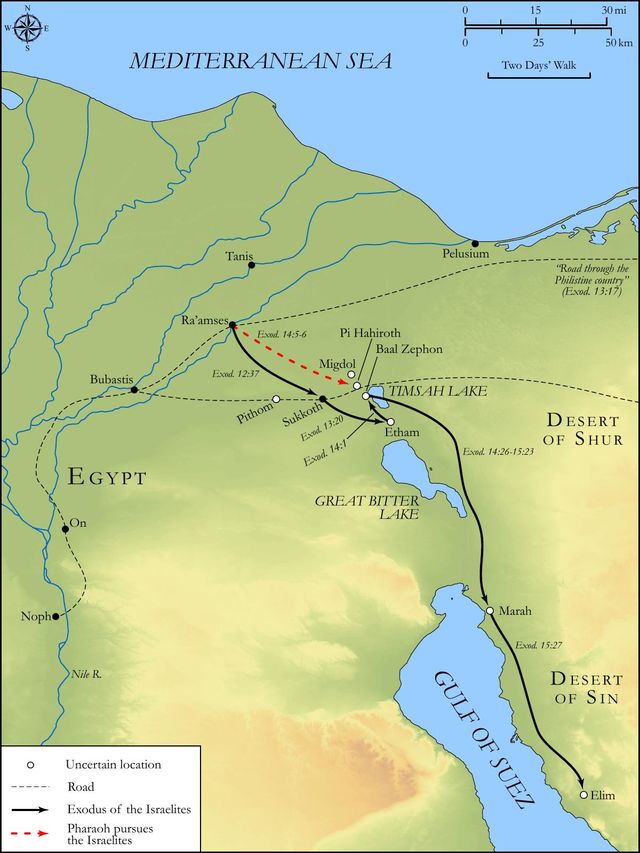
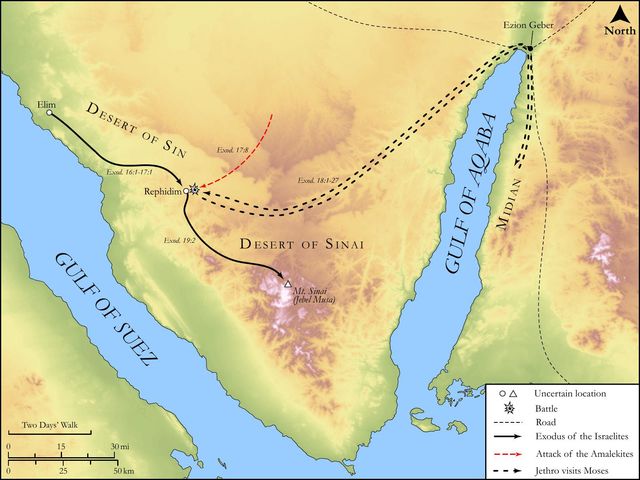
Study this verse
Public-domain commentary
Matthew Henry
From his Commentary on the Whole Bible. Henry comments on passages, not single verses — this entry covers Exodus 12:37–42.
Here is the departure of the children of Israel out of Egypt; having obtained their dismission, they set forward without delay, and did not defer to a more convenient season. Pharaoh was now in a good mind; but they had reason to think he would not long continue so, and therefore it was no time to linger. We have here an account, 1. Of their number, about 600,000 men (Exo 12:37), besides women and children, which I think, we cannot suppose to make less than 1,200,000 more. What a vast increase was this, to arise from seventy souls in little more than 200 years' time! See the power and efficacy of that blessing, when God commands it, Be fruitful and multiply. This was typical of the multitudes that were brought into the gospel church when it was first founded; so mightily grew the word of God, and prevailed. 2. Of their retinue (Exo 12:38): A mixed multitude went up with them, hangers on to that great family, some perhaps willing to leave their country, because it was laid waste by the plagues, and to seek their fortune, as we say, with the Israelites; others went out of curiosity, to see the solemnities of Israel's sacrifice to their God, which had been so much talked of, and expecting to see some glorious appearances of their God to them in the wilderness, having seen such glorious appearances of their God for them in the field of Zoan, Psa 78:12. Probably the greatest part of this mixed multitude were but a rude unthinking mob, that followed the crowd they knew not why; we afterwards find that they proved a snare to them (Num 11:4), and it is probable that when, soon afterwards, they understood that the children of Israel were to continue forty years in the wilderness, they quitted them, and returned to Egypt. Note, There were always those among the Israelites that were not Israelites, and there are still hypocrites in the church, who make a deal of mischief, but will be shaken off at last. 3. Of their effects. They had with them flocks and herds, even very much cattle. This is taken notice of because it was long before Pharaoh would give them leave to remove their effects, which were chiefly cattle, Gen 46:32. 4. Of the provision made for the camp, which was very poor and slender. They brought some dough with them out of Egypt in their knapsacks, Exo 12:34. They had prepared to bake, the next day, in order to their removal, understanding it was very near; but, being hastened away sooner than they thought of, by some hours, they took the dough as it was, unleavened; when they came to Succoth, their first stage, they baked unleavened cakes, and, though these were of course insipid, yet the liberty they were brought into made this the most joyful meal they had ever eaten in their lives. Note, The servants of God must not be slaves to their appetites, nor solicitous to wind up all the delights of sense to their highest pitch. We should be willing to take up with dry bread, nay, with unleavened bread, rather than neglect or delay any service we have to do for God, as those whose meat and drink it is to do his will. 5. Of the date of this great event: it was just 430 years from the promise made to Abraham (as the apostle explains it, Gal 3:17) at his first coming into Canaan, during all which time the children of Israel, that is, the Hebrews, the distinguished chosen seed, were sojourners in a land that was not theirs, either Canaan or Egypt. So long the promise God made to Abraham of a settlement lay dormant and unfulfilled, but now, at length, it revived, and things began to work towards the accomplishment of it. The first day of the march of Abraham's seed towards Canaan was just 430 years (it should seem to a day) from the promise made to Abraham, Gen 12:2, I will make of thee a great nation. See how punctual God is to his time; though his promises be not performed quickly, they will be accomplished in their season. 6. Of the memorableness of it: It is a night to be much observed, Exo 12:42. (1.) The providences of that first night were very observable; memorable was the destruction of the Egyptians, and the deliverance of the Israelites by it; God herein made himself taken notice of. (2.) The ordinances of that night, in the annual return of it, were to be carefully observed: This is that night of the Lord, that remarkable night, to be celebrated in all generations. Note, The great things God does for his people are not to be a nine days' wonder, as we say, but the remembrance of them is to be perpetuated throughout all ages, especially the work of our redemption by Christ. This first passover-night was a night of the Lord much to be observed; but the last passover-night, in which Christ was betrayed (and in which the passover, with the rest of the ceremonial institutions, was superseded and abolished), was a night of the Lord much more to be observed, when a yoke heavier than that of Egypt was broken from off our necks, and a land better than that of Canaan set before us. That was a temporal deliverance to be celebrated in their generation; this is an eternal redemption to be celebrated in the praises of glorious saints, world without end.
Continue studying Exodus 12:42 across the web’s major study libraries — every link below opens this exact verse, chapter, or book on the destination site.
Read & Compare
 BibleGatewayThis verse in more than 200 translations and 70 languages.
 Bible.comThe YouVersion reader — hundreds of translations, reading plans, and highlights.
 ESV.orgCrossway's official English Standard Version reader.
 NET BibleThe NET translation with 60,000+ translators' notes on every rendering decision.
 STEP BibleTyndale House's free study tool — original text, vocabulary, and scholarly resources.
 BibliaLogos Bible Software's free web reader.
 USCCBThe New American Bible (Revised Edition) with the U.S. bishops' study notes.
Commentaries
 BibleHub CommentariesDozens of classic commentaries on this verse, gathered on one page.
 StudyLightMore than 100 commentary sets — the largest collection on the web.
 BibleRefPlain-English commentary on what this verse means, verse by verse.
 Enduring WordDavid Guzik's free commentary on this chapter, widely used by Bible teachers.
 Bible Study ToolsVerse commentary alongside Greek and Hebrew study aids.
Original Language & Research
- BibleHub InterlinearThe verse word by word — original language, transliteration, and English.
- BibleHub LexiconEvery word's original-language definition and Strong's entry.
 Blue Letter BibleDeep-study tools — Strong's numbers, concordance, and word studies.
 SefariaThe Hebrew text with Rashi and centuries of Jewish commentary.
Sermons, Hymns & Audio


TrulyRandomVerse is not affiliated with these sites and doesn’t control their content. They’re linked because they’re genuinely useful.
Summary
Exodus 12:42 profoundly establishes the night of Israel's deliverance from Egyptian bondage as a perpetual "night of watching" or "observance" dedicated to the LORD. This pivotal moment underscores God's vigilant protection and decisive action in bringing His people out of slavery, thereby ordaining it as a foundational event to be faithfully remembered and celebrated by all generations of Israel. The verse encapsulates the enduring significance of the Exodus as a divine act of redemption, serving as a cornerstone of Israel's identity and faith, demanding ongoing recognition and grateful commemoration.
Context
ShowHideLiterary Context
Exodus 12:42 functions as a theological capstone to the elaborate instructions concerning the Passover and the Feast of Unleavened Bread, detailed from Exodus 12:1. It immediately follows the specific commands for the Passover meal and the application of the blood on the doorposts, which served as a sign for divine protection against the tenth plague, the death of the firstborn (Exodus 12:21-27). The verse anticipates the actual execution of the tenth plague and the subsequent urgent departure of the Israelites from Egypt (Exodus 12:29-39). By emphasizing the night's unique status as "a night to be much observed unto the LORD," it elevates the historical event into a perpetual, divinely mandated ordinance, solidifying its enduring theological and communal significance for Israel's future.
Historical & Cultural Context
Among the nations of that day, the liberation of a people from a dominant power was often attributed to the superior strength of their deity. The Exodus, particularly the Passover night, dramatically demonstrated Yahweh's unparalleled power and faithfulness, directly intervening in history to liberate His people from the most formidable empire of the day. This act of "bringing them out" was not merely a military or political victory but a profound act of divine judgment against Egypt's gods and a singular display of sovereign care for Israel. The command for perpetual observance was crucial for maintaining collective memory and identity in a primarily oral culture. Such rituals ensured that future generations understood their origins as a people redeemed by God, not by their own might or by the benevolence of other nations or deities. This annual observance would serve as a constant reminder of their unique covenant relationship with Yahweh, distinguishing them from surrounding nations.
Key Themes
ShowHideThis verse powerfully contributes to several major theological themes within Exodus and the broader Pentateuch. Foremost is the theme of Divine Deliverance and Redemption, where God actively intervenes to save His people from bondage, establishing Himself as their liberator. It also highlights Covenant Faithfulness, as God remembers and acts upon His promises made to Abraham, Isaac, and Jacob (Genesis 15:13-14). The concept of Remembrance and Observance is central, mandating that Israel never forget this foundational act of salvation, thereby shaping their collective identity and worship. This theme is echoed throughout the Law, particularly in the repeated commands to "remember the day you came out of Egypt" (Deuteronomy 16:1). Finally, it underscores God's Sovereignty and Judgment over all earthly powers and false gods, as demonstrated by the plagues and the ultimate defeat of Pharaoh's army at the Red Sea (Exodus 14).
Exposition and Analysis
ShowHideKey Word Analysis
ShowHideThis word signifies the period of darkness, from sunset to sunrise. In this context, it refers to the specific, historical night when the tenth plague struck Egypt and Israel was delivered. Figuratively, as the Strong's data notes, it can also represent "adversity." Here, it is a night of adversity for Egypt, but a night of salvation and vigilance for Israel, highlighting the contrasting experiences under God's judgment and protection.
Derived from the root shamar (שָׁמַר), meaning "to keep," "to guard," "to watch," or "to observe." The term "much observed" (or leil shimmurim) carries a profound dual meaning. Firstly, it denotes God's active "watching" or "guarding" over Israel, protecting them from the plague while executing judgment on Egypt. Secondly, it mandates Israel's reciprocal "observance" or "keeping watch" in perpetual remembrance and celebration of God's redemptive act, thereby ensuring the memory of this divine intervention is preserved across generations.
This is the sacred, covenant name of God, often translated as "Jehovah" or "the LORD." It signifies the "self-Existent" or "Eternal" One. Its presence here emphasizes that the night's significance derives entirely from God's personal, sovereign action. It was not a random event or a human achievement, but a night defined by the direct intervention of the covenant-keeping God of Israel, highlighting His unique identity and power.
Verse Breakdown
ShowHide"It [is] a night to be much observed unto the LORD for bringing them out from the land of Egypt:"
This initial clause establishes the divine origin and purpose of the night. The phrase "unto the LORD" (לַיהוָה, la-YHWH) signifies that this night is consecrated to Him, an act initiated and accomplished by His power and for His glory. The explicit reason for its special status is God's mighty act of "bringing them out from the land of Egypt." This underscores that the Exodus was not a human escape but a divine rescue, a powerful demonstration of God's sovereignty over Pharaoh and all the gods of Egypt. The "night to be much observed" here refers primarily to God's active vigilance and protective watch over Israel.
"this [is] that night of the LORD to be observed of all the children of Israel in their generations."
The second clause reiterates and expands upon the command for human observance. The demonstrative "this" points back to the specific, historical night of the Exodus, anchoring the command in a concrete event. It is explicitly called "that night of the LORD," reinforcing its unique status as a night defined by God's action and ownership. The command to "be observed of all the children of Israel in their generations" transforms a singular historical event into a perpetual, communal ordinance. It mandates that every future generation of Israelites must participate in this remembrance, ensuring that the foundational act of redemption remains central to their collective identity and faith, fostering ongoing gratitude and covenant loyalty.
Literary Devices
ShowHideThe verse employs significant repetition and emphasis. The phrase "night to be much observed" (or "night of the LORD to be observed") appears twice, serving to underscore its profound importance and dual nature: God's watchful care and Israel's required remembrance. This repetition creates a powerful chiasm (A-B-B'-A' structure) in the broader context of the Passover narrative, where God's action (A) leads to Israel's response (B), which is then reiterated as a perpetual command (B') based on God's continuing faithfulness (A'). The use of "all the children of Israel in their generations" provides hyperbole and universal reach, emphasizing the universal and perpetual nature of this command across time and throughout the entire community, ensuring the enduring significance of the Passover as a foundational event for the entire nation.
Theological and Thematic Connections
ShowHideExodus 12:42 teaches profound theological truths about God's character and His relationship with His people. It reveals God as a vigilant, active, and faithful deliverer who intervenes decisively in history to fulfill His covenant promises. The verse underscores the theme of divine redemption as the absolute basis for Israel's existence and identity. God's "watching" over Israel signifies His protective care and His unwavering commitment to His covenant with Abraham (Genesis 15:13). This act of salvation establishes a paradigm for understanding God's nature as both just (in judgment) and merciful (in deliverance).
The command for perpetual observance highlights the importance of corporate memory and worship. Remembering God's past acts of salvation is not merely historical recollection but a vital act of worship that shapes a people's understanding of who God is and who they are in relation to Him. This theme resonates throughout the Old Testament, where Israel is constantly reminded to "remember the day you came out of Egypt" (Deuteronomy 16:1). The Passover became the quintessential annual celebration of God's redemptive power, a recurring narrative that taught each new generation about God's faithfulness and their unique status as His chosen people. The vigilance required of Israel in observing this night mirrors God's own vigilance, establishing a reciprocal relationship of faithfulness and remembrance that sustains the covenant.
Reflection and Application
ShowHideFor believers today, Exodus 12:42 serves as a powerful and enduring reminder of the importance of remembering God's faithfulness and mighty acts of salvation, both in biblical history and in our personal lives. Just as the Passover shaped Israel's identity, so too should the story of God's redemption shape ours. We are called to cultivate a spirit of grateful remembrance, recognizing that our freedom from sin and death is entirely due to God's vigilant and decisive intervention. This verse encourages us to intentionally observe and celebrate the foundational truths of our faith, ensuring they are passed down to future generations. It challenges us to look for and acknowledge God's "watching" over us in our daily lives, fostering trust and dependence on His sovereign care, even in times of adversity. Our spiritual vigilance, like Israel's, becomes a response to God's prior and ongoing watchfulness over His people.
Questions for Reflection
ShowHideFAQ
ShowHideWhy is this night called "the night of the LORD"?
ShowHideIt is called "the night of the LORD" because it was the night when the LORD Himself acted decisively and powerfully. It was God's initiative, His judgment, and His deliverance that defined this night. The phrase emphasizes His direct involvement and ownership of the event, rather than it being a human-orchestrated escape. It highlights God's unique sovereignty and His active role as the deliverer of His people from bondage in Egypt.
Does "to be much observed" mean Israel had to stay awake all night?
ShowHideWhile the Hebrew phrase leil shimmurim can imply a literal "watching" or "vigil," its primary meaning here is one of careful, perpetual observance and remembrance. It signifies that the night is to be set apart and remembered with great significance throughout all generations, rather than necessarily requiring a literal all-night vigil, though some Jewish traditions later developed practices of staying awake during parts of the Passover Seder. The emphasis is on the profound importance of the event and the command to never forget it, ensuring its theological meaning is transmitted and celebrated continuously.
Is this command for observation only for the ancient Israelites?
ShowHideThe immediate command was for "all the children of Israel in their generations," establishing the Passover as a perpetual ordinance for the Jewish people. However, for Christians, the theological significance of the Passover is fulfilled in Jesus Christ. While Christians do not observe the literal Passover Seder as a commandment, the principles of remembering God's redemptive acts, celebrating deliverance, and passing on faith are universally applicable. The Christian observance of the Lord's Supper (Communion) is understood as the New Covenant fulfillment of this theme of remembrance, as Jesus Himself instituted it on the night He was betrayed, connecting it to the Passover meal (Luke 22:7-20).
Christ-Centered Fulfillment
ShowHideExodus 12:42, like the entire Passover narrative, finds its ultimate fulfillment and deepest meaning in the person and work of Jesus Christ. The Passover night, when the blood of a lamb protected Israel from death, powerfully foreshadows the atoning sacrifice of Jesus. He is identified by the New Testament as "Christ, our Passover lamb" (1 Corinthians 5:7). Just as the original Passover marked Israel's liberation from Egyptian bondage and the judgment of God passing over those covered by the lamb's blood, so Jesus's death on the cross delivers humanity from the bondage of sin and the righteous judgment of God. His shed blood, like the Passover blood, provides atonement and protection for all who believe. The "night of the LORD" for Israel was a night of deliverance into physical freedom; for believers in Christ, His death and resurrection constitute the ultimate "night of the LORD," ushering in spiritual freedom and entrance into a new covenant relationship with God (Luke 22:19-20). The perpetual observance commanded in Exodus 12:42 is echoed in Jesus's command to "do this in remembrance of me" (Luke 22:19) when instituting the Lord's Supper, inviting all generations of His followers to remember and celebrate His redemptive sacrifice, which is the greater Exodus from sin, death, and the power of darkness (Colossians 1:13-14).