


Exodus 12:43
Bible text: King James Version (1769 Blayney text) · Public domain
Bible text: Berean Standard Bible · Public domain
Bible text: American Standard Version (1901) · Public domain
Bible text: World English Bible, Messianic edition · Public domain
Bible text: Geneva Bible (1599) · Public domain
Bible text: Young's Literal Translation · Public domain
- וַיֹּאמֶרvai·Yo·merand he saidH559Conj-w ¦ V-Qal-ConsecImperf-3msVerb Qal Consecutive Imperfect 3rd Singular Masculineוַandיֹּאמֶרhe said
- יְהוָהYah·wehYahwehH3068N-properNoun Proper Title
- אֶל'eltoH413PrepPreposition
- מֹשֶׁהmo·ShehMosesH4872N-proper-mNoun Proper Masculine
- וְאַהֲרֹןve·'a·ha·Ronand AaronH175Conj-w ¦ N-proper-mNoun Proper MasculineוְandאַהֲרֹןAaron
- זֹאתzotthisH2063PrtParticle Demonstrative
- חֻקַּתchu·Kat[is] [the] statute ofH2708N-fscNoun Singular Feminine Construct
- הַפָּסַחha·Pa·sachthe passoverH6453Art ¦ N-msNoun Title Singular Masculine Absoluteהַtheפָּסַחpassover
- כָּלkolanyH3605N-mscNoun Singular Masculine Construct
- בֶּןbenson ofH1121N-mscNoun Singular Masculine Construct
- נֵכָרne·KharforeignnessH5236N-msNoun Singular Masculine Absolute
- לֹאlo'notH3808NegParticle Negative
- יֹאכַלYo·khalhe will eatH398V-Qal-Imperf-3msVerb Qal Imperfect 3rd Singular Masculine
- בּוֹboin <the> itPrep-b ¦ 3msSuffix Personal 3rd Singular Masculineבּin <the>וֹit
English is a literal word-by-word gloss of the Hebrew, not the KJV's wording. Why?
This is the original text the KJV's translators worked from — each Hebrew word with its own literal English meaning in this verse, prepared by scholars at Tyndale House, Cambridge. The KJV translates whole sentences, not word by word, so its wording differs: one Hebrew word can become several English words, and the KJV may choose “the LORD” where the gloss reads “Yahweh”. Both are faithful — they answer different questions. For the KJV's own rendering, switch to the KJV text.
Details
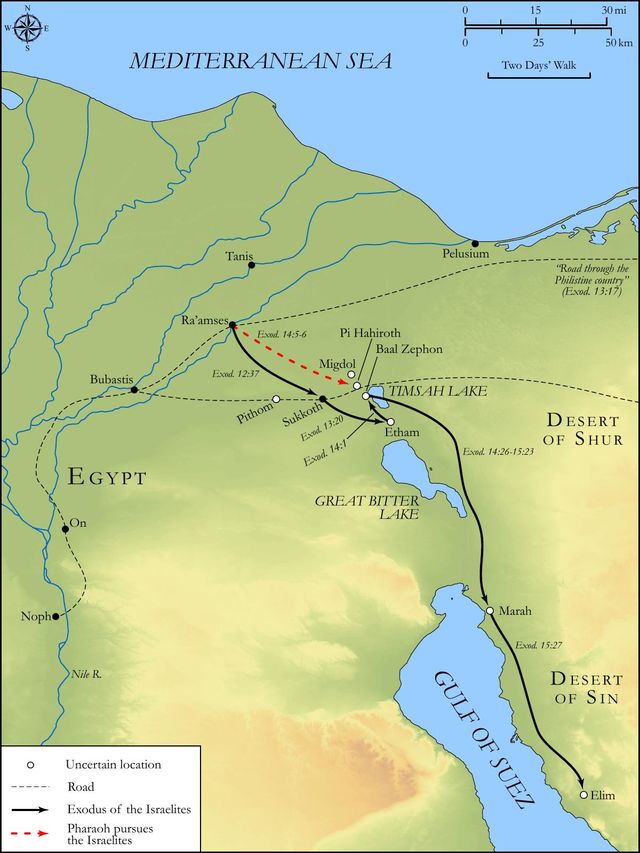
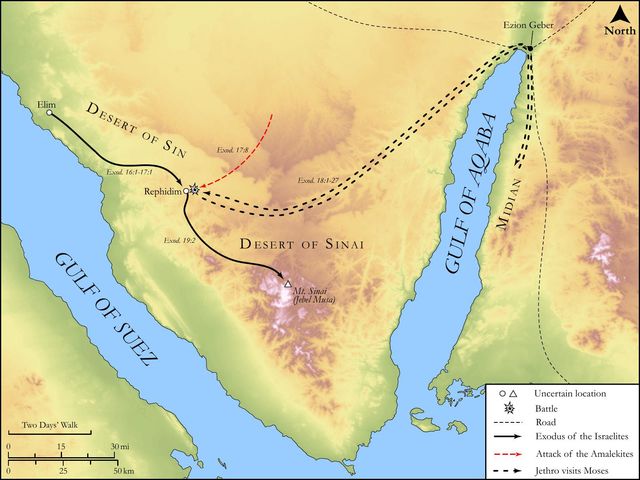
See on the biblical-era maps

Study this verse
Public-domain commentary
Matthew Henry
From his Commentary on the Whole Bible. Henry comments on passages, not single verses — this entry covers Exodus 12:43–51. His two-level outline is real structure in the source text, so it is rendered as structure.
Some further precepts are here given concerning the passover, as it should be observed in times to come.
I.All the congregation of Israel must keep it, Exo 12:47.
All that share in God's mercies should join in thankful praises for them. Though it was observed in families apart, yet it is looked upon as the act of the whole congregation; for the smaller communities constituted the greater. The New Testament passover, the Lord's supper, ought not to be neglected by any who are capable of celebrating it. He is unworthy the name of an Israelite that can contentedly neglect the commemoration of so great a deliverance.
1.No stranger that was uncircumcised might be admitted to eat of it, Exo 12:43, Exo 12:45, Exo 12:48. None might sit at the table but those that came in by the door; nor may any now approach to the improving ordinance of the Lord's supper who have not first submitted to the initiating ordinance of baptism. We must be born again by the word ere we can be nourished by it. Nor shall any partake of the benefit of Christ's sacrifice, or feast upon it, who are not first circumcised in heart, Col 2:11.
2.Any stranger that was circumcised might be welcome to eat of the passover, even servants, Exo 12:44. If, by circumcision, they would make themselves debtors to the law in its burdens, they were welcome to share in the joy of its solemn feasts, and not otherwise. Only it is intimated (Exo 12:48) that those who were masters of families must not only be circumcised themselves, but have all their males circumcised too. If in sincerity, and with that zeal which the thing required and deserves, we give up ourselves to God, we shall, with ourselves, give up all we have to him, and do our utmost that all ours may be his too. Here is an early indication of favour to the poor Gentiles, that the stranger, if circumcised, stands upon the same level with the home-born Israelite. One law for both, Exo 12:49. This was a mortification to the Jews, and taught them that it was their dedication to God, not their descent from Abraham, that entitled them to their privileges. A sincere proselyte was as welcome to the passover as a native Israelite, Isa 56:6, Isa 56:7.
II.In one house shall it be eaten (Exo 12:46), for good-fellowship sake, that they might rejoice together, and edify one another in the eating of it. None of it must be carried to another place, nor left to another time; for God would not have them so taken up with care about their departure as to be indisposed to take the comfort of it, but to leave Egypt, and enter upon a wilderness, with cheerfulness, and, in token of that, to eat a good hearty meal. The papists' carrying their consecrated host from house to house is not only superstitious in itself, but contrary to this typical law of the passover, which directed that no part of the lamb should be carried abroad.
The chapter concludes with a repetition of the whole matter, that the children of Israel did as they were bidden, and God did for them as he promised (Exo 12:50, Exo 12:51); for he will certainly be the author of salvation to those that obey him.
Historical interpretation
Historical reception
1 surviving comment on this verse from the historical church.
But the deceitful, and he that is not pure of heart and possesses nothing that is pure (as Proverbs says, “To a deceitful man there is nothing good”) shall assuredly, being a stranger and of a different race from the saints, be accounted unworthy to eat the Passover, for “a foreigner shall not eat of it.” Thus Judas, when he thought he kept the Passover, because he plotted deceit against the Savior, was estranged from the city which is above and from the apostolic company. For the law commanded the Passover to be eaten with due observance. But he, while eating it, was sifted of the devil, who had entered his soul.
Continue studying Exodus 12:43 across the web’s major study libraries — every link below opens this exact verse, chapter, or book on the destination site.
Read & Compare
 BibleGatewayThis verse in more than 200 translations and 70 languages.
 Bible.comThe YouVersion reader — hundreds of translations, reading plans, and highlights.
 ESV.orgCrossway's official English Standard Version reader.
 NET BibleThe NET translation with 60,000+ translators' notes on every rendering decision.
 STEP BibleTyndale House's free study tool — original text, vocabulary, and scholarly resources.
 BibliaLogos Bible Software's free web reader.
 USCCBThe New American Bible (Revised Edition) with the U.S. bishops' study notes.
Commentaries
 BibleHub CommentariesDozens of classic commentaries on this verse, gathered on one page.
 StudyLightMore than 100 commentary sets — the largest collection on the web.
 BibleRefPlain-English commentary on what this verse means, verse by verse.
 Enduring WordDavid Guzik's free commentary on this chapter, widely used by Bible teachers.
 Bible Study ToolsVerse commentary alongside Greek and Hebrew study aids.
Original Language & Research
- BibleHub InterlinearThe verse word by word — original language, transliteration, and English.
- BibleHub LexiconEvery word's original-language definition and Strong's entry.
 Blue Letter BibleDeep-study tools — Strong's numbers, concordance, and word studies.
 SefariaThe Hebrew text with Rashi and centuries of Jewish commentary.
Sermons, Hymns & Audio


TrulyRandomVerse is not affiliated with these sites and doesn’t control their content. They’re linked because they’re genuinely useful.
Summary
Exodus 12:43 introduces a crucial divine stipulation for the Passover, declaring that "no stranger" is permitted to partake in this foundational covenant meal. This command underscores the sacred and exclusive nature of the Passover as an ordinance reserved for those in covenant relationship with God, establishing a clear boundary for participation that solidified Israel's identity as a distinct and holy people.
Context
ShowHideLiterary Context
This verse is part of the extensive instructions for the first Passover and its perpetual observance, detailed in Exodus 12. Immediately preceding Exodus 12:43, the Lord has given the primary commands for the Passover lamb, its blood as a sign, and the eating of unleavened bread, along with its significance as a perpetual memorial, spanning Exodus 12:1-20. Following this verse, Exodus 12:44-48 elaborates on who can eat the Passover, specifically detailing that a circumcised servant or sojourner may partake, clarifying that the barrier is not race but covenant initiation through circumcision. This immediate context reveals a careful delineation of participation, emphasizing the covenantal nature of the feast and the importance of belonging to God's chosen community.
Historical & Cultural Context
The Passover was not merely a historical commemoration but a covenantal meal that profoundly defined Israel's identity as God's redeemed people. In Scripture, communal meals often signified shared identity, allegiance, and covenant, as when Jacob and Laban ate bread together after their covenant on the mount. The restriction on the "stranger" (Hebrew: ben-nêkâr, literally "son of a foreigner") was not primarily about ethnicity but about covenant status. Uncircumcised foreigners were outside the covenant community of Israel. Circumcision was the physical sign of the Abrahamic covenant, marking one as belonging to God's chosen people, as established in Genesis 17:9-14. Therefore, the command in Exodus 12:43 reinforced the concept of a distinct, holy nation set apart by God, whose access to His redemptive acts was mediated through a specific covenant relationship. This established a critical boundary between "insiders" and "outsiders" in the nascent nation of Israel, emphasizing the sanctity of the Passover as a unique divine institution.
Key Themes
ShowHideThis verse significantly contributes to several major theological and narrative themes within Exodus and the broader Pentateuch. Firstly, it underscores the theme of God's holiness and His demand for separation. The Passover, as a sacred act of worship and remembrance, required participants to be consecrated and set apart. Secondly, it highlights the theme of covenant identity and membership. Participation in the Passover was a public affirmation of one's belonging to the covenant community of Israel, distinct from the surrounding nations. This theme is further developed in later laws concerning Israel's unique status among the nations, as seen in Deuteronomy 7:6. Thirdly, it introduces the nuanced theme of inclusion and exclusion based on covenant, not solely ethnicity. While initially appearing exclusive, the subsequent verses (Exodus 12:44-48) clarify that foreigners could partake if they entered the covenant through circumcision, demonstrating that God's redemptive plan was open to those who formally joined His people, a principle echoed in passages like Isaiah 56:3-7.
Exposition and Analysis
ShowHideExodus 12:43 presents a concise but profound declaration regarding the Passover's observance: "And the LORD said unto Moses and Aaron, This [is] the ordinance of the passover: There shall no stranger eat thereof."
Key Word Analysis
ShowHideThis Hebrew term (H2708) denotes a statute, a prescribed rule, or a fixed custom. It emphasizes that this command is not a suggestion or a temporary guideline but a divinely established, non-negotiable law. It is part of the foundational statutes for Israel's worship and national life, indicating its permanent and binding nature within the Old Covenant, an "enactment" or "appointed custom" from the Lord.
The primitive root (H398) "to eat" here signifies more than mere physical consumption. In the context of a sacred meal like the Passover, "eating" implies participation, communion, and identification with the act and its meaning. To "eat thereof" is to partake in the covenant, its blessings, and its responsibilities. The prohibition against a "stranger" eating directly restricts their participation in this profound act of covenantal communion.
This crucial phrase is composed of bên (H1121, "son," or "one belonging to") and nêkâr (H5236, "foreign," or "foreigner"). Thus, "ben-nekar" literally means "son of a foreigner" or "foreign son." As clarified by the subsequent verses (Exodus 12:44-48), this refers specifically to an uncircumcised foreigner, someone who has not entered into the Abrahamic covenant. The term emphasizes being "alien" or "foreign" in a covenantal sense, not merely ethnically. This distinguishes ben-nêkâr from other Hebrew terms for foreigners (like ger, a resident alien) who could participate if circumcised. The emphasis is on covenant membership, not ethnic origin.
Verse Breakdown
ShowHide"And the LORD said unto Moses and Aaron,"
This opening clause establishes the divine authority and origin of the command. It is not a human regulation but a direct word from Yahweh (H3068), delivered through His chosen mediators, Moses (H4872) and Aaron (H175), to the people of Israel. This highlights the sacred and binding nature of the instruction, emphasizing that this is a divine mandate to be strictly observed.
"This [is] the ordinance of the passover:"
This declarative statement formally introduces a new, specific regulation concerning the Passover. The use of "ordinance" (chuqqâh, H2708) reinforces its status as a divinely mandated statute, emphasizing its importance and permanence within Israel's religious life. It signals that what follows is a non-negotiable aspect of the Passover celebration, a fixed custom for all generations.
"There shall no stranger eat thereof:"
This is the core prohibition of the verse, setting a clear boundary for participation in the Passover meal. The prohibition is absolute: "no stranger" (literally, "no son of a foreigner" or "no foreign son"). The "stranger" is defined by their lack of covenant initiation (circumcision), not merely by their foreign nationality. Eating the Passover was an act of covenant participation and identification with God's redemptive work. To allow an uncircumcised "stranger" to partake would undermine the covenant's exclusivity and the distinct identity of God's people. This restriction ensured that the Passover remained a sacred meal for those who had formally entered into relationship with Yahweh, underscoring the holiness and separation required of His chosen nation.
Literary Devices
ShowHideThe verse employs a direct, declarative style, typical of legal and instructional texts in the Pentateuch. The clear prohibition ("There shall no stranger eat thereof") serves as a strong boundary marker, using contrast to define who belongs and who does not in the context of this sacred meal. The repetition of "ordinance" (implied by the Hebrew term chuqqâh) throughout the Passover instructions reinforces the emphasis on the divine authority and permanence of these commands.
THEOLOGICAL AND THEMATIC CONNECTIONS
ShowHideExodus 12:43 reveals several profound theological truths:
This theme of covenant membership and access to God's blessings resonates throughout the biblical narrative:
Reflection and Application
ShowHideWhile the specific command of Exodus 12:43 applies to the Old Covenant Passover, its underlying principles offer timeless lessons for believers today. It reminds us that participation in God's redemptive acts and spiritual blessings has always required a relationship with Him. In the New Covenant, this relationship is established through faith in Jesus Christ.
For modern believers, this verse prompts us to consider:
Questions for Reflection
ShowHideFAQ
ShowHideWas God being exclusive or racist by restricting the Passover to "strangers"?
ShowHideNo, the restriction was not based on race or ethnicity but on covenant relationship. The Hebrew phrase ben-nêkâr (literally "son of a foreigner") in this context refers specifically to an uncircumcised person, meaning someone who had not entered into the Abrahamic covenant. Exodus 12:44-48 explicitly states that any foreigner, slave, or sojourner who was circumcised could partake in the Passover. This demonstrates that God's plan was always open to people from all backgrounds, provided they committed to His covenant. The barrier was spiritual and covenantal, not racial or ethnic.
What is the difference between a "stranger" (ben-nêkâr) and a "sojourner" (ger) in the Old Testament?
ShowHideWhile both terms refer to non-Israelites, ben-nêkâr (stranger) generally denotes someone unauthorized or outside the consecrated group, specifically an uncircumcised foreigner with no covenant ties to Israel. Ger refers to a resident alien or sojourner who lived among the Israelites. While gerim were often subject to specific laws and protections, they, too, had to undergo circumcision to participate in the Passover, as clarified in Exodus 12:48. The distinction highlights that the key criterion for Passover participation was covenant membership, signified by circumcision, not merely physical presence in the land.
Does this verse imply that non-believers should not attend church services or observe Christian rituals today?
ShowHideThis verse applies to the specific covenant meal of the Old Covenant Passover. In the New Covenant, the church joyfully welcomes all people, including non-believers, to hear the gospel and attend services. However, participation in specific ordinances like the Lord's Supper (Communion) is generally understood to be for those who have professed faith in Christ and are in covenant with Him, similar to how the Passover was reserved for covenant members. This is based on New Testament teachings about discerning the body of Christ (1 Corinthians 11:27-29) and the spiritual significance of the meal. The church's doors are open to all to hear the good news, but its sacred rites are for those who belong to the covenant of grace through faith in Jesus Christ.
Christ-Centered Fulfillment
ShowHideExodus 12:43 and the Passover as a whole are profoundly fulfilled in Jesus Christ. The Passover lamb, whose blood saved Israel from death, prefigured Jesus, "the Lamb of God who takes away the sin of the world" (John 1:29). His sacrifice on the cross is the ultimate act of redemption, delivering humanity from the bondage of sin and death. The restriction on the "stranger" in the Old Covenant Passover highlights the exclusive nature of salvation under the law, which was tied to physical descent and circumcision. However, Jesus's work inaugurates the New Covenant, which radically redefines "insiders" and "outsiders." This includes Universal Access through Christ: in Christ, the physical and ethnic barriers are broken down. The "stranger" is no longer defined by uncircumcision of the flesh but by spiritual alienation from God. Through faith in Jesus, anyone—Jew or Gentile, slave or free—can be circumcised in heart (Romans 2:29) and brought into God's family (Ephesians 2:11-13). Jesus Himself is our Passover Lamb, sacrificed for us (1 Corinthians 5:7). Furthermore, The Lord's Supper as the New Covenant Meal: The Passover foreshadowed the Lord's Supper (Communion), which Jesus instituted on the night He was betrayed (Luke 22:19-20). This New Covenant meal commemorates Christ's body broken and blood shed for the forgiveness of sins. While the Old Covenant Passover was for those physically circumcised, the Lord's Supper is for those spiritually regenerate—those who have put their faith in Christ and are part of His body, the Church. Thus, the "stranger" who cannot partake is now the one who is a stranger to the covenant of grace through faith in Jesus. Finally, From Physical to Spiritual Belonging: Jesus's fulfillment shifts the focus from physical lineage and ritual to spiritual transformation and faith. He is the ultimate "door" (John 10:9) through whom all who believe, regardless of their former status as "strangers" or "outsiders," can enter into full participation in God's redemptive blessings and become fellow heirs with Christ, united in His new covenant.