


Exodus 12:37
Bible text: King James Version (1769 Blayney text) · Public domain
Bible text: Berean Standard Bible · Public domain
Bible text: American Standard Version (1901) · Public domain
Bible text: World English Bible, Messianic edition · Public domain
Bible text: Geneva Bible (1599) · Public domain
Bible text: Young's Literal Translation · Public domain
- וַיִּסְעוּvai·yis·'Uand they set outH5265Conj-w ¦ V-Qal-ConsecImperf-3mpVerb Qal Consecutive Imperfect 3rd Plural Masculineוַandיִּסְעוּthey set out
- בְנֵיve·nei[the] people ofH1121N-mpcNoun Plural Masculine Construct
- יִשְׂרָאֵלYis·ra·'ElIsraelH3478N-properNoun Proper Location
- מֵרַעְמְסֵסme·ra'·me·Sesfrom RamesesH7486Prep-m ¦ N-properNoun Proper LocationמֵfromרַעְמְסֵסRameses
- סֻכֹּתָהsu·Ko·tahSuccoth towardsH5523N-proper ¦ SfxNoun Proper LocationסֻכֹּתָSuccothהtowards
- כְּשֵׁשׁke·shesh[were] about sixH8337Prep-k ¦ Adj-cscAdjective Numerical Singular common gender Constructכְּ[were] aboutשֵׁשׁsix
- מֵאוֹתme·'othundred<s>H3967Adj-fpcAdjective Numerical Plural Feminine Construct
- אֶלֶף'E·lefthousandH505Adj-csAdjective Numerical Singular common gender Absolute
- רַגְלִיrag·Lifoot soldier[s]H7273Adj-msAdjective Singular Masculine Absolute
- הַגְּבָרִיםha·ge·va·Rimthe menH1397Art ¦ N-mpNoun Plural Masculine Absoluteהַtheגְּבָרִיםmen
- לְבַדle·Vad<to> apartH905Prep-l ¦ N-msNoun Singular Masculine Absoluteלְ<to>בַדapart
- מִטָּףmi·Taffrom little one[s]H2945Prep-m ¦ N-msNoun Singular Masculine Absoluteמִfromטָּףlittle one[s]
English is a literal word-by-word gloss of the Hebrew, not the KJV's wording. Why?
This is the original text the KJV's translators worked from — each Hebrew word with its own literal English meaning in this verse, prepared by scholars at Tyndale House, Cambridge. The KJV translates whole sentences, not word by word, so its wording differs: one Hebrew word can become several English words, and the KJV may choose “the LORD” where the gloss reads “Yahweh”. Both are faithful — they answer different questions. For the KJV's own rendering, switch to the KJV text.
Details
See on the biblical-era maps

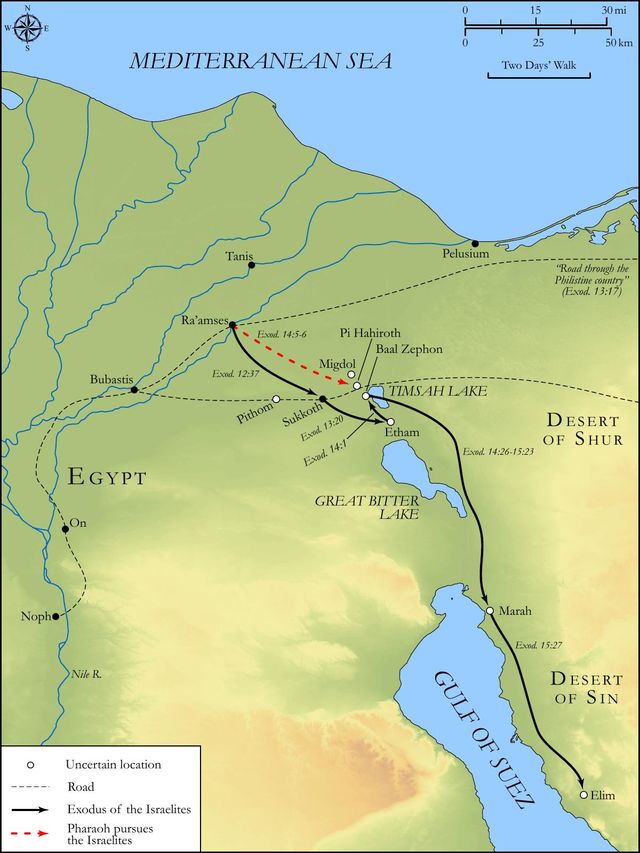
Study this verse
Public-domain commentary
Matthew Henry
From his Commentary on the Whole Bible. Henry comments on passages, not single verses — this entry covers Exodus 12:37–42.
Here is the departure of the children of Israel out of Egypt; having obtained their dismission, they set forward without delay, and did not defer to a more convenient season. Pharaoh was now in a good mind; but they had reason to think he would not long continue so, and therefore it was no time to linger. We have here an account, 1. Of their number, about 600,000 men (Exo 12:37), besides women and children, which I think, we cannot suppose to make less than 1,200,000 more. What a vast increase was this, to arise from seventy souls in little more than 200 years' time! See the power and efficacy of that blessing, when God commands it, Be fruitful and multiply. This was typical of the multitudes that were brought into the gospel church when it was first founded; so mightily grew the word of God, and prevailed. 2. Of their retinue (Exo 12:38): A mixed multitude went up with them, hangers on to that great family, some perhaps willing to leave their country, because it was laid waste by the plagues, and to seek their fortune, as we say, with the Israelites; others went out of curiosity, to see the solemnities of Israel's sacrifice to their God, which had been so much talked of, and expecting to see some glorious appearances of their God to them in the wilderness, having seen such glorious appearances of their God for them in the field of Zoan, Psa 78:12. Probably the greatest part of this mixed multitude were but a rude unthinking mob, that followed the crowd they knew not why; we afterwards find that they proved a snare to them (Num 11:4), and it is probable that when, soon afterwards, they understood that the children of Israel were to continue forty years in the wilderness, they quitted them, and returned to Egypt. Note, There were always those among the Israelites that were not Israelites, and there are still hypocrites in the church, who make a deal of mischief, but will be shaken off at last. 3. Of their effects. They had with them flocks and herds, even very much cattle. This is taken notice of because it was long before Pharaoh would give them leave to remove their effects, which were chiefly cattle, Gen 46:32. 4. Of the provision made for the camp, which was very poor and slender. They brought some dough with them out of Egypt in their knapsacks, Exo 12:34. They had prepared to bake, the next day, in order to their removal, understanding it was very near; but, being hastened away sooner than they thought of, by some hours, they took the dough as it was, unleavened; when they came to Succoth, their first stage, they baked unleavened cakes, and, though these were of course insipid, yet the liberty they were brought into made this the most joyful meal they had ever eaten in their lives. Note, The servants of God must not be slaves to their appetites, nor solicitous to wind up all the delights of sense to their highest pitch. We should be willing to take up with dry bread, nay, with unleavened bread, rather than neglect or delay any service we have to do for God, as those whose meat and drink it is to do his will. 5. Of the date of this great event: it was just 430 years from the promise made to Abraham (as the apostle explains it, Gal 3:17) at his first coming into Canaan, during all which time the children of Israel, that is, the Hebrews, the distinguished chosen seed, were sojourners in a land that was not theirs, either Canaan or Egypt. So long the promise God made to Abraham of a settlement lay dormant and unfulfilled, but now, at length, it revived, and things began to work towards the accomplishment of it. The first day of the march of Abraham's seed towards Canaan was just 430 years (it should seem to a day) from the promise made to Abraham, Gen 12:2, I will make of thee a great nation. See how punctual God is to his time; though his promises be not performed quickly, they will be accomplished in their season. 6. Of the memorableness of it: It is a night to be much observed, Exo 12:42. (1.) The providences of that first night were very observable; memorable was the destruction of the Egyptians, and the deliverance of the Israelites by it; God herein made himself taken notice of. (2.) The ordinances of that night, in the annual return of it, were to be carefully observed: This is that night of the Lord, that remarkable night, to be celebrated in all generations. Note, The great things God does for his people are not to be a nine days' wonder, as we say, but the remembrance of them is to be perpetuated throughout all ages, especially the work of our redemption by Christ. This first passover-night was a night of the Lord much to be observed; but the last passover-night, in which Christ was betrayed (and in which the passover, with the rest of the ceremonial institutions, was superseded and abolished), was a night of the Lord much more to be observed, when a yoke heavier than that of Egypt was broken from off our necks, and a land better than that of Canaan set before us. That was a temporal deliverance to be celebrated in their generation; this is an eternal redemption to be celebrated in the praises of glorious saints, world without end.
Historical interpretation
Historical reception
2 surviving comments on this verse. Each one is dated, so this reads as a timeline rather than a list.
Select a marker to jump to its quote. Markers stagger vertically where authors wrote within a few decades of each other.
Joseph came into Egypt alone, and soon thereafter six hundred thousand depart from Egypt. What is more marvelous than this? What greater proof of the generosity of God, when from persons without means he wills to supply the means for public affairs?
From their single ancestor, in not much more than four hundred years, the Hebrew people became so numerous that at the time of the exodus from Egypt there were, we are told, six hundred thousand men of military age. This number does not include the Idumeans, who were not reckoned with the people of Israel, although they were descended from Israel’s brother Esau, who was a grandson of Abraham. Nor does it include those other descendants of Abraham who were not of the line of his wife Sarah.
Continue studying Exodus 12:37 across the web’s major study libraries — every link below opens this exact verse, chapter, or book on the destination site.
Read & Compare
 BibleGatewayThis verse in more than 200 translations and 70 languages.
 Bible.comThe YouVersion reader — hundreds of translations, reading plans, and highlights.
 ESV.orgCrossway's official English Standard Version reader.
 NET BibleThe NET translation with 60,000+ translators' notes on every rendering decision.
 STEP BibleTyndale House's free study tool — original text, vocabulary, and scholarly resources.
 BibliaLogos Bible Software's free web reader.
 USCCBThe New American Bible (Revised Edition) with the U.S. bishops' study notes.
Commentaries
 BibleHub CommentariesDozens of classic commentaries on this verse, gathered on one page.
 StudyLightMore than 100 commentary sets — the largest collection on the web.
 BibleRefPlain-English commentary on what this verse means, verse by verse.
 Enduring WordDavid Guzik's free commentary on this chapter, widely used by Bible teachers.
 Bible Study ToolsVerse commentary alongside Greek and Hebrew study aids.
Original Language & Research
- BibleHub InterlinearThe verse word by word — original language, transliteration, and English.
- BibleHub LexiconEvery word's original-language definition and Strong's entry.
 Blue Letter BibleDeep-study tools — Strong's numbers, concordance, and word studies.
 SefariaThe Hebrew text with Rashi and centuries of Jewish commentary.
Sermons, Hymns & Audio


TrulyRandomVerse is not affiliated with these sites and doesn’t control their content. They’re linked because they’re genuinely useful.
Summary
Exodus 12:37 marks the dramatic and divinely orchestrated departure of the Israelites from Egypt, detailing their initial leg of the journey from Rameses to Succoth. This pivotal verse underscores the sheer scale of the Exodus—approximately 600,000 adult men, implying a total population of over two million—signifying the miraculous fulfillment of God's covenant promises to Abraham and the birth of Israel as a liberated nation.
Context
ShowHideLiterary Context
This verse immediately follows the devastating tenth plague—the death of the firstborn in Egypt—and the institution of the Passover. Pharaoh, finally broken by God's overwhelming judgment, urgently commanded Moses and Aaron to take the Israelites and leave Egypt, even requesting a blessing (Exodus 12:31-32). Exodus 12:37 describes the Israelites' prompt and organized obedience, detailing their initial movement as a newly liberated people. The subsequent verse, Exodus 12:38, mentions the "mixed multitude" who joined them, further emphasizing the diverse composition of this new nation on the move and setting the stage for the challenges of leading such a heterogeneous group.
Historical & Cultural Context
Rameses (also known as Pi-Ramesse) was a major capital and storage city in the eastern Nile Delta, likely where many Israelites were forced to labor on massive building projects for the pharaohs, as mentioned in Exodus 1:11. Their departure from this hub of Egyptian power highlights the completeness and finality of their liberation from centuries of bondage. Succoth (meaning "booths" or "tents") was likely a temporary encampment, signifying their transition from settled slaves to nomadic wanderers, a precursor to their forty years in the wilderness. The mention of "six hundred thousand on foot [that were] men" is crucial for understanding the scale. In Israel, censuses often counted adult males capable of military service, typically those aged 20 and above, as in the numbering of the tribes in the wilderness. This number would have represented the potential fighting force, but it also implies a much larger total population, including women, children, and the elderly, potentially exceeding two million people. Leading such a vast, diverse multitude through the wilderness immediately after centuries of slavery was an unprecedented logistical and social challenge, underscoring the divine orchestration and miraculous nature of the Exodus.
Key Themes
ShowHideThis verse powerfully contributes to several major theological and narrative themes within Exodus and the broader Pentateuch. Foremost is the theme of Divine Deliverance and Redemption, as God fulfills His promise to rescue His people from oppression, demonstrating His unparalleled power over the mightiest empire. It also highlights the theme of Covenant Faithfulness, as God remembers His promises to Abraham to multiply his descendants into a great nation (Genesis 12:2) and bring them into the Promised Land. The sheer number of people underscores the theme of Israel's Growth and Identity as a Nation, transitioning from a family to a vast multitude, now on the path to receiving the Law and establishing their unique identity. Finally, it introduces the theme of The Journey of Faith and Dependence, as the Israelites embark on a perilous journey, entirely reliant on God's miraculous provision and guidance.
Exposition and Analysis
ShowHideKey Word Analysis
ShowHideThis city, of Egyptian origin, was a significant administrative and storage center, famously built by Israelite slave labor (Exodus 1:11). Its mention as the starting point emphasizes the immediate and complete break from their bondage, marking their departure from the very heart of Egyptian oppression and the symbol of their servitude.
Meaning "booths" or "tents," this name suggests a temporary, makeshift encampment. It marks the first stop on their journey, a place of transition from the structured, albeit oppressive, life in Egypt to the uncertain, nomadic existence in the wilderness. This name foreshadows the Feast of Tabernacles (Sukkot), commemorating their wilderness wanderings and God's provision in temporary dwellings.
From the root meaning "to be strong" or "to prevail," this term properly refers to a valiant man or warrior, but generally signifies a person, especially an adult male. In this context, "six hundred thousand on foot that were men" specifically designates adult males, likely those aged 20 and above, capable of warfare or counted in a census. This detail is vital for understanding the population estimate, as it implies a total number far greater than 600,000, demonstrating the miraculous growth of Jacob's descendants into a vast nation.
Verse Breakdown
ShowHide"And the children of Israel journeyed from Rameses to Succoth,"
This clause marks the momentous physical act of departure, the first concrete step in Israel's journey to nationhood and freedom. It is a direct and immediate response to Pharaoh's desperate command and God's powerful deliverance, signifying the transition from a place of intense bondage (Rameses) to a place of temporary rest and transition (Succoth).
"about six hundred thousand on foot [that were] men,"
This provides a crucial demographic detail, indicating the immense scale of the Exodus. The number "six hundred thousand" refers specifically to adult males, likely those aged 20 and above, who would be counted in later censuses (Numbers 1:46). The phrase "on foot" emphasizes that this was a mass migration of an entire people, not a military expedition with chariots or horses, thereby highlighting their vulnerability and complete reliance on divine protection and guidance.
"beside children."
This clarifies that the 600,000 figure explicitly excludes the younger generation, and by implication, also women. This means the total number of people leaving Egypt was significantly larger, potentially well over two million individuals, including the "mixed multitude" mentioned in the following verse (Exodus 12:38). This detail underscores the miraculous multiplication of Abraham's descendants and the logistical marvel of God leading such a vast, diverse population.
Literary Devices
ShowHideThe sheer magnitude of the number "six hundred thousand" in this verse serves as a powerful hyperbole or, more accurately, a vivid numerical emphasis, to underscore the miraculous growth of the Israelite population despite centuries of brutal oppression. It highlights God's faithfulness to His covenant promises of multiplication and His unparalleled ability to deliver a vast multitude. This scale also sets the stage for the immense logistical challenges and the subsequent divine provisions—such as manna, water from the rock, and the pillar of cloud and fire—that will characterize their wilderness journey, further magnifying God's power and care.
Theological and Thematic Connections
ShowHideExodus 12:37 powerfully illustrates several core theological truths. Primarily, it showcases God's sovereign power and unwavering faithfulness to His covenant promises. Despite centuries of brutal slavery and the might of the Egyptian empire, God remembered His people and acted decisively to liberate them, demonstrating His ability to overcome any obstacle. This verse is the physical manifestation of God's "strong hand and outstretched arm" (Deuteronomy 5:15). Secondly, it marks the birth of Israel as a nation. From a family of seventy souls who entered Egypt (Genesis 46:27), they had multiplied into a vast multitude, fulfilling God's promise to Abraham to make his descendants a great nation (Genesis 12:2). This immense number also underscores the miraculous nature of God's provision and guidance for such a large group in the challenging wilderness. The journey itself becomes a central theme of salvation history, symbolizing the pilgrimage of faith and the transition from bondage to freedom.
Reflection and Application
ShowHideExodus 12:37 reminds us that God is a God of liberation who actively leads His people out of bondage. Just as He freed Israel from physical slavery, He offers spiritual freedom from the dominion of sin, fear, and despair today. This verse encourages us to trust in God's ability to guide and sustain us, even when the journey ahead seems daunting or the challenges overwhelming. The sheer scale of the Exodus should inspire profound confidence that God is capable of leading and providing for His entire church, no matter how large or diverse, through any wilderness. It also challenges us to take that first step of faith, leaving behind what holds us captive and embarking on the journey God has uniquely prepared for us, trusting that His presence and provision will be sufficient for every step.
Questions for Reflection
ShowHideFAQ
ShowHideIs the number "six hundred thousand" a literal figure, or is it symbolic?
ShowHideThe consensus among scholars is that the number refers to adult males fit for military service, consistent with ancient census practices (e.g., Numbers 1:46). While some scholars debate the exact literalness of the figure due to the immense logistical challenges implied for wilderness travel, the biblical text consistently presents it as a historical count. Even if understood as a rounded or symbolic representation of a very large number, it undeniably conveys the miraculous growth of Israel and the immense scale of God's deliverance. The Bible consistently portrays the Exodus as a massive movement of people, emphasizing divine power.
Why is it important that they journeyed "on foot"?
ShowHideThe phrase "on foot" (literally "with their feet") emphasizes that this was a mass exodus of ordinary people, not a military campaign equipped with horses and chariots. It highlights their vulnerability and their complete reliance on God for protection, provision, and guidance. It underscores that their liberation was a divine act, not a human military victory achieved through military might. It also paints a vivid picture of the sheer physical effort and collective movement of such a vast multitude.
What is the significance of Rameses and Succoth as the starting and first stopping points?
ShowHideRameses was a major city built by Israelite slave labor (Exodus 1:11), symbolizing the heart of their oppression and the seat of Pharaoh's power. Departing from Rameses signifies a complete and decisive break from their bondage. Succoth, meaning "booths" or "tents," was a temporary encampment, marking their immediate transition from settled slaves to nomadic wanderers. It represents the first step of their journey into the unknown, reliant on God's leading, and foreshadows their entire wilderness experience, which would later be commemorated by the Feast of Tabernacles (Sukkot).
Christ-Centered Fulfillment
ShowHideExodus 12:37, depicting the physical liberation of Israel from Egyptian bondage, finds its ultimate fulfillment and deeper meaning in the person and work of Jesus Christ. The Exodus is the quintessential Old Testament story of salvation, and Christ is the greater deliverer, leading a new and eternal Exodus. Just as God led His people out of slavery to Pharaoh, Jesus liberates humanity from the far more pervasive and destructive bondage of sin and death (John 8:34-36). The "six hundred thousand" men, representing a vast multitude delivered by God's mighty hand, prefigure the countless "multitude that no one could number" from every nation, tribe, people, and language, who are redeemed through Christ's sacrifice (Revelation 7:9-10). Jesus, as the true Passover Lamb (1 Corinthians 5:7), secures the liberation that the original Passover only foreshadowed, offering not just physical freedom but spiritual adoption into God's family (Galatians 4:4-7). The journey from Rameses to the Promised Land symbolizes the believer's journey of faith, led by Christ, from the kingdom of darkness to the kingdom of light, culminating in the new heavens and new earth—our ultimate promised land of eternal rest and communion with God (Revelation 21:1-4).