


Numbers 11:21
Bible text: King James Version (1769 Blayney text) · Public domain
Bible text: King James Version with Strong's numbers · Public domain
Bible text: Berean Standard Bible · Public domain
Bible text: American Standard Version (1901) · Public domain
Bible text: World English Bible, Messianic edition · Public domain
Bible text: Geneva Bible (1599) · Public domain
Bible text: Young's Literal Translation · Public domain
- וַיֹּאמֶרvai·yo·Merand he saidH559Conj-w ¦ V-Qal-ConsecImperf-3msVerb Qal Consecutive Imperfect 3rd Singular Masculineוַandיֹּאמֶרhe said
- מֹשֶׁהmo·ShehMosesH4872N-proper-mNoun Proper Masculine
- שֵׁשׁshesh[are] sixH8337Adj-cscAdjective Numerical Singular common gender Construct
- מֵאוֹתme·'othundred<s>H3967Adj-fpcAdjective Numerical Plural Feminine Construct
- אֶלֶף'e·lefthousandH505Adj-csAdjective Numerical Singular common gender Absolute
- רַגְלִיrag·Lifoot soldier[s]H7273Adj-msAdjective Singular Masculine Absolute
- הָעָםha·'Amthe peopleH5971Art ¦ N-msNoun Singular Masculine Absoluteהָtheעָםpeople
- אֲשֶׁר'a·SherwhichH834RelParticle Relative
- אָנֹכִי'a·no·KhiIH595Pro-1csPronoun Personal 1st Singular common gender
- בְּקִרְבּוֹbe·kir·Bo[am] in its midstH7130Prep-b ¦ N-msc ¦ 3msNoun Singular Masculine Constructבְּ[am] inקִרְבּmidstוֹits
- וְאַתָּהve·'a·Tahand youH859Conj-w ¦ Pro-2msPronoun Personal 2nd Singular Masculineוְandאַתָּהyou
- אָמַרְתָּ'a·Mar·tayou have saidH559V-Qal-Perf-2msVerb Qal Perfect 2nd Singular Masculine
- בָּשָׂרba·SarmeatH1320N-msNoun Singular Masculine Absolute
- אֶתֵּן'e·TenI will giveH5414V-Qal-Imperf-1csVerb Qal Imperfect 1st Singular common gender
- לָהֶםla·Hemto <the> themPrep-l ¦ 3mpSuffix Personal 3rd Plural Masculineלָto <the>הֶםthem
- וְאָכְלוּve·'a·khe·Luand they will eatH398Conj-w ¦ V-Qal-ConsecPerf-3cpVerb Qal Consecutive Perfect 3rd Plural common genderוְandאָכְלוּthey will eat
- חֹדֶשׁCho·desha month ofH2320N-mscNoun Singular Masculine Construct
- יָמִיםya·MimdaysH3117N-mpNoun Plural Masculine Absolute
English is a literal word-by-word gloss of the Hebrew, not the KJV's wording. Why?
This is the original text the KJV's translators worked from — each Hebrew word with its own literal English meaning in this verse, prepared by scholars at Tyndale House, Cambridge. The KJV translates whole sentences, not word by word, so its wording differs: one Hebrew word can become several English words, and the KJV may choose “the LORD” where the gloss reads “Yahweh”. Both are faithful — they answer different questions. For the KJV's own rendering, switch to the KJV text.
Details
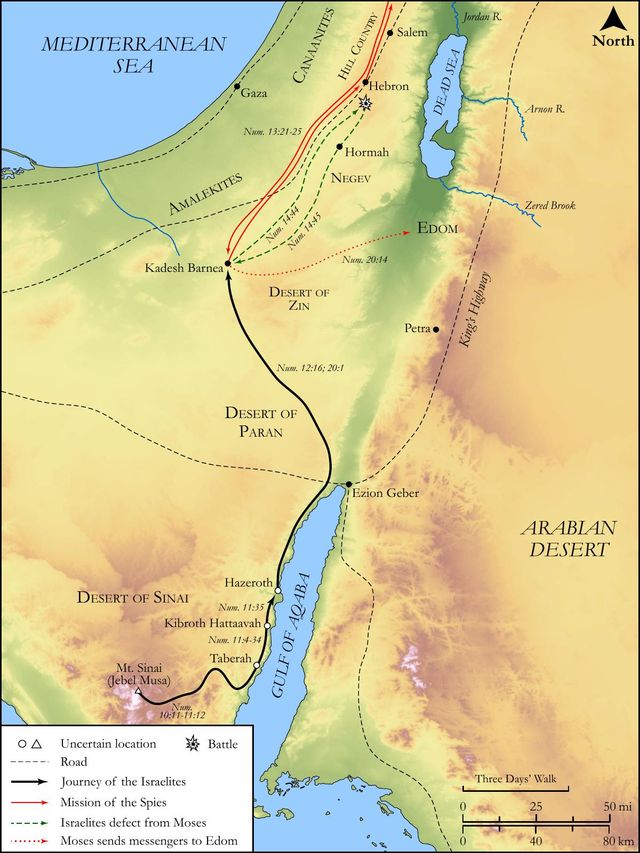
See on the biblical-era map
Study this verse
Public-domain commentary
Matthew Henry
From his Commentary on the Whole Bible. Henry comments on passages, not single verses — this entry covers Numbers 11:16–23. His three-level outline is real structure in the source text, so it is rendered as structure.
We have here God's gracious answer to both the foregoing complaints, wherein his goodness takes occasion from man's badness to appear so much the more illustrious.
I.Provision is made for the redress of the grievances Moses complains of.
If he find the weight of government lie too heavy upon him, though he was a little too passionate in his remonstrance, yet he shall be eased, not by being discarded from the government himself, as he justly might have been if God had been extreme to mark what he said amiss, but by having assistants appointed him, who should be, as the apostle speaks (Co1 12:28), helps, governments (that is, helps in government), not at all to lesson or eclipse his honour, but to make the work more easy to him, and to bear the burden of the people with him. And that this provision might be both agreeable and really serviceable,
1.Moses is directed to nominate the persons, Num 11:16. The people were too hot and heady and tumultuous to be entrusted with the election; Moses must please himself in the choice, that he may not afterwards complain. The number he is to choose is seventy men, according to the number of the souls that went down into Egypt. He must choose such as he knew to be elders, that is, wise and experienced men. Those that had acquitted themselves best, as rulers of thousands and hundreds (Exo 18:25), purchase to themselves now this good degree. "Choose such as thou knowest to be elders indeed, and not in name only, officers that execute their office." We read of the same number of elders (Exo 24:1) that went up with Moses to Mount Sinai, but they were distinguished only for that occasion, these for a perpetuity; and, according to this constitution, the Sanhedrim, or great council of the Jews, which in after ages sat at Jerusalem, and was the highest court of judgment among them, consisted of seventy men. Our Saviour seems to have had an eye to it in the choice of seventy disciples, who were to be assistants to the apostles, Lu. 10.
2.God promises to qualify them. If they were not found fit for the employ, they should be made fit, else they might prove more a hindrance than a help to Moses, Num 11:17. Though Moses had talked too boldly with God, yet God does not therefore break off communion with him; he bears a great deal with us, and we must with one another: I will come down (said God) and talk with thee, when thou art more calm and composed; and I will take of the same spirit of wisdom, and piety, and courage, that is upon thee, and put it upon them. Not that Moses had the less of the Spirit for their sharing, nor that they were hereby made equal with him; Moses was still unequalled (Deu 34:10), but they were clothed with a spirit of government proportionable to their place, and with a spirit of prophecy to prove their divine call to it, the government being a Theocracy. Note,
(1.)Those whom God employs in any service he qualifies for it, and those that are not in some measure qualified cannot think themselves duly called.
(2.)All good qualifications are from God; every perfect gift is from the Father of lights.
II.Even the humour of the discontented people shall be gratified too, that every mouth may be stopped.
They are ordered to sanctify themselves (Num 11:18), that is, to put themselves into a posture to receive such a proof of God's power as should be a token both of mercy and judgment. Prepare to meet thy God, O Israel, Amo 4:12.
1.God promises (shall I say?) - he threatens rather, that they shall have their fill of flesh, that for a month together they shall not only be fed, but feasted, with flesh, besides their daily manna; and, if they have not a better government of their appetites than now it appears they have they shall be surfeited with it (Num 11:19, Num 11:20): You shall eat till it come out at your nostrils, and become loathsome to you. See here,
(1.)The vanity of all the delights of sense; they will cloy, but not satisfy: spiritual pleasures are the contrary. As the world passes away, so do the lusts of it, Jo1 2:17. What was greedily coveted in a little time comes to be nauseated.
(2.)What brutish sins (and worse than brutish) gluttony and drunkenness are; they put a force upon nature, and make that the sickness of the body which should be its health; they are sins that are their own punishments, and yet not the worst that attend them.
(3.)What a righteous thing it is with God to make that loathsome to men which they have inordinately lusted after. God could make them despise flesh as much as they had despised manna.
2.Moses objects the improbability of making good this word, Num 11:21, Num 11:22. It is an objection like that which the disciples made, Mar 8:4, Whence can a man satisfy these men? Some excuse Moses here, and construe what he says as only a modest enquiry which way the supply must be expected; but it savours too much of diffidence and distrust of God to be justified. He objects the number of the people, as if he that provided bread for them all could not, by the same unlimited power, provide flesh too. He reckons it must be the flesh either of beasts or fishes, because they are the most bulky animals, little thinking that the flesh of birds, little birds, should serve the purpose. God sees not as man sees, but his thoughts are above ours. He objects the greediness of the people's desires in that word, to suffice them. Note, Even true and great believers sometimes find it hard to trust God under the discouragements of second causes, and against hope to believe in hope. Moses himself could scarcely forbear saying, Can God furnish a table in the wilderness? when this had become the common cry. No doubt this was his infirmity.
3.God gives a short but sufficient answer to the objection in that question, Has the Lord's hand waxed short? Num 11:23. If Moses had remembered the years of the right hand of the Most High, he would not have started all these difficulties; therefore God reminds him of them, intimating that this objection reflected upon the divine power, of which he himself had been so often, not only the witness, but the instrument. Had he forgotten what wonders the divine power had wrought for that people, when it inflicted the plagues of Egypt, divided the sea, broached the rock, and rained bread from heaven? Had that power abated? Was God weaker than he used to be? Or was he tired with what he had done? Whatever our unbelieving hearts may suggest to the contrary, it is certain,
(1.)That God's hand is not short; his power cannot be restrained in the exerting of itself by any thing but his own will; with him nothing is impossible. That hand is not short which measures the waters, metes out the heavens (Isa 40:12), and grasps the winds, Pro 30:4.
(2.)That it has not waxed short. He is as strong as ever he was, fainteth not, neither is weary. And this is sufficient to silence all our distrusts when means fail us, Is any thing too hard for the Lord? God here brings Moses to this first principle, sets him back in his lesson, to learn the ancient name of God, The Lord God Almighty, and puts the proof upon the issue: Thou shalt see whether my word shall come to pass or not. This magnifies God's word above all his name, that his works never come short of it. If he speaks, it is done.
Continue studying Numbers 11:21 across the web’s major study libraries — every link below opens this exact verse, chapter, or book on the destination site.
Read & Compare
 BibleGatewayThis verse in more than 200 translations and 70 languages.
 Bible.comThe YouVersion reader — hundreds of translations, reading plans, and highlights.
 ESV.orgCrossway's official English Standard Version reader.
 NET BibleThe NET translation with 60,000+ translators' notes on every rendering decision.
 STEP BibleTyndale House's free study tool — original text, vocabulary, and scholarly resources.
 BibliaLogos Bible Software's free web reader.
 USCCBThe New American Bible (Revised Edition) with the U.S. bishops' study notes.
Commentaries
 BibleHub CommentariesDozens of classic commentaries on this verse, gathered on one page.
 StudyLightMore than 100 commentary sets — the largest collection on the web.
 BibleRefPlain-English commentary on what this verse means, verse by verse.
 Enduring WordDavid Guzik's free commentary on this chapter, widely used by Bible teachers.
 Bible Study ToolsVerse commentary alongside Greek and Hebrew study aids.
Original Language & Research
- BibleHub InterlinearThe verse word by word — original language, transliteration, and English.
- BibleHub LexiconEvery word's original-language definition and Strong's entry.
 Blue Letter BibleDeep-study tools — Strong's numbers, concordance, and word studies.
 SefariaThe Hebrew text with Rashi and centuries of Jewish commentary.
Sermons, Hymns & Audio


TrulyRandomVerse is not affiliated with these sites and doesn’t control their content. They’re linked because they’re genuinely useful.
Summary
Numbers 11:21 captures Moses' profound human doubt and incredulity in the face of an extraordinary divine promise. Overwhelmed by the sheer scale of the Israelite population, estimated at six hundred thousand footmen, and the seemingly impossible logistical challenge of feeding them meat for an entire month, Moses questions how the Lord could possibly fulfill such a vast and extended provision. This moment highlights the tension between human limitation and God's boundless power during the wilderness journey, serving as a poignant illustration of the perennial struggle between faith and sight.
Context
ShowHideLiterary Context
Numbers 11:21 is situated within a critical narrative segment (Numbers 11:4-35) detailing the Israelites' persistent complaining in the wilderness. Following their miraculous deliverance from Egypt and sustained provision of manna (as referenced in Exodus 16:35), the people, described as a "rabble" among them, begin to lament their diet, craving the fish, cucumbers, melons, leeks, onions, and garlic of Egypt, despising the daily manna. This grumbling deeply grieves Moses, who expresses his overwhelming burden to the Lord, and it provokes God's anger. In response to their insatiable craving for meat, God, though displeased, promises to provide an abundance of quail—so much that they will eat it for a whole month until it becomes loathsome to them. Moses' statement in verse 21 is his immediate, human reaction to the enormity of this divine pledge, expressing his skepticism about the feasibility of feeding such a vast multitude. This doubt is directly answered by God in Numbers 11:23, who asks, "Is the Lord's hand waxed short?" The subsequent fulfillment of God's promise, despite Moses' doubt, underscores divine power and faithfulness.
Historical & Cultural Context
The Israelites were a nomadic people recently freed from slavery in Egypt, traversing a barren wilderness. Their diet would have been simple, and the miraculous provision of manna was a daily testament to God's care. The number "six hundred thousand footmen" (Hebrew: ragli) refers to adult males capable of military service, typically aged 20 and above, as seen in census accounts like Numbers 1:46. This figure implies a total population, including women, children, and the elderly, of perhaps two to three million people. Feeding such a massive population in a desert environment, even with basic provisions, was an immense logistical challenge. Providing meat, a luxury, for an entire month would have been an unprecedented feat, far beyond any human capability or historical precedent for a nomadic group of this size. The people's longing for the "flesh pots" of Egypt reflects a common human tendency to romanticize past comforts, even those associated with bondage, when faced with present hardship and the discipline of faith.
Key Themes
ShowHideThis verse powerfully contributes to several overarching themes within the book of Numbers and the broader Pentateuch. It highlights the profound tension between human limitation and divine omnipotence, as Moses' finite understanding clashes with God's infinite capacity for provision. It underscores the pervasive theme of human unbelief and complaint despite overwhelming evidence of God's faithfulness, a recurring motif throughout Israel's wilderness journey. Conversely, it showcases God's steadfast, though sometimes disciplinary, provision for His people, even when they are undeserving. Finally, it illuminates the immense burden of leadership borne by Moses, who frequently intercedes for a rebellious people and struggles with his own faith under the weight of their demands, as evidenced by his earlier plea in Numbers 11:11-15. The eventual provision of quail in Numbers 11:31 serves as a dramatic demonstration of God's ability to fulfill His word, even to the point of judgment for their greed.
Exposition and Analysis
ShowHideKey Word Analysis
ShowHideThis term specifically denotes adult males capable of marching or serving in an army, emphasizing their physical readiness and implying a military-aged population. In the context of the wilderness census, this figure of "six hundred thousand" refers to those numbered for military service (Numbers 1:46), effectively representing the male heads of households. Moses' use of this term underscores the sheer magnitude of the population for whom God promised provision, making the task seem humanly impossible from a logistical standpoint.
While "flesh" can refer to meat in general, in this context, it specifically refers to the animal protein the Israelites craved, contrasting sharply with the manna they had been receiving. Their desire for bâsâr was not merely for sustenance but for a luxury, a symbol of their former life in Egypt, and it became a point of contention and rebellion against God's daily, sufficient provision.
This word, often used in conjunction with "days" (yamim) to mean "a full month" or "a whole month," emphasizes the duration and scale of the promised provision. It's not a one-time meal or a few days' supply, but a sustained, continuous provision of meat for an entire lunar cycle. This extended period amplifies the logistical impossibility from a human perspective, highlighting the extraordinary nature of God's promise and Moses' subsequent doubt.
Verse Breakdown
ShowHide"And Moses said, The people, among whom I [am, are] six hundred thousand footmen;"
This opening clause immediately establishes the speaker and the immense scale of the challenge. Moses, as the leader, is intimately aware of the vast number of people under his charge, specifically highlighting the adult male population. His statement is not merely an observation but an expression of his incredulity and the human impossibility of the task. The parenthetical "[am, are]" in the KJV reflects a textual nuance, but the meaning clearly conveys the presence of this vast multitude with Moses. This numerical emphasis underscores the human perspective of an insurmountable logistical problem.
"and thou hast said, I will give them flesh, that they may eat a whole month."
This second clause directly quotes or paraphrases God's promise from Numbers 11:18. Moses reiterates the divine promise back to God, not in faith, but in a tone of bewildered questioning. The juxtaposition of the immense population ("six hundred thousand footmen") with the extravagant and sustained promise ("flesh... a whole month") forms the core of Moses' dilemma, emphasizing the chasm between finite human capacity and infinite divine declaration. It highlights the perceived absurdity of the promise from a purely human standpoint.
Literary Devices
ShowHideThe verse employs several powerful literary devices. Irony is prominent, as Moses, who has witnessed countless miracles of divine provision (e.g., the parting of the Red Sea, the daily manna), now struggles to believe God's ability to provide meat. This underscores the persistent human tendency to doubt even after experiencing God's faithfulness. Hyperbole is used by Moses to emphasize the overwhelming scale of the population and the duration of the promised provision, making the task seem utterly unachievable by human means. This serves to highlight the dramatic contrast between finite human understanding and infinite divine power. The implicit anthropomorphism in God "giving" flesh, while common, here emphasizes God's direct and personal involvement in the provision, despite Moses' skepticism. The entire exchange functions as a dialogue of doubt, where human limitation confronts divine omnipotence, setting the stage for God's powerful rhetorical question in Numbers 11:23: "Is the Lord's hand waxed short?"
Theological and Thematic Connections
ShowHideNumbers 11:21 serves as a poignant reminder of the enduring tension between human doubt and divine omnipotence. Despite witnessing God's miraculous provision and deliverance repeatedly, Moses, a man of profound faith, momentarily succumbs to human logic and limitation when confronted with a promise that defies natural explanation. This episode underscores that even great leaders can falter in their trust, highlighting the constant need for faith in the face of the seemingly impossible. It also powerfully affirms God's boundless capacity to fulfill His word, even when His people are undeserving or when the means seem utterly unattainable from a human perspective. God's subsequent provision of quail, though accompanied by judgment for the people's greed, unequivocally demonstrates that His power is not constrained by human numbers or desert scarcity.
Reflection and Application
ShowHideMoses' moment of doubt in Numbers 11:21 offers a deeply relatable human experience for believers today. We, too, often find ourselves in situations where God's promises or His expected provision seem utterly impossible given our circumstances, resources, or understanding. This verse challenges us to examine the limits we place on God based on our finite perspective. It calls us to remember that the God who delivered Israel from Egypt, sustained them with manna, and promised to provide meat for millions in a barren wilderness is the same God who works in our lives. Our faith is not in our ability to comprehend God's methods, but in His unfailing character and boundless power. When faced with overwhelming odds or promises that seem too good to be true, we are invited to move beyond our human calculations and trust in the God for whom nothing is impossible. This passage encourages us to cultivate a posture of expectant faith, even when our logic fails.
Questions for Reflection
ShowHideFAQ
ShowHideWhy did Moses doubt God's ability to provide, given all the miracles he had witnessed?
ShowHideMoses' doubt, while seemingly surprising given his direct experience with God's power, highlights the persistent human tendency to rely on logic and visible circumstances rather than absolute faith, especially under immense pressure. He had just endured the people's incessant complaining and felt the overwhelming burden of leadership (Numbers 11:11-15). His question in Numbers 11:21 reflects the sheer scale of the logistical challenge: feeding millions of people meat for a month in a desert. Even after witnessing the parting of the Red Sea (Exodus 14) and the daily provision of manna (Exodus 16), the specific nature and scale of this new demand pushed him to the limits of his human comprehension. It serves as a reminder that faith is a continuous journey, and even the strongest believers can have moments of struggle.
What was the significance of the "six hundred thousand footmen" figure?
ShowHideThe figure of "six hundred thousand footmen" (Hebrew: ragli) refers to the adult males capable of military service, typically those aged 20 and above, as enumerated in the census accounts (e.g., Numbers 1:46). This number is significant because it represents the fighting force of Israel, implying a total population, including women, children, and the elderly, of approximately two to three million people. Moses emphasizes this vast number to underscore the human impossibility of providing meat for such a multitude for an entire month in a barren wilderness. It sets up a dramatic contrast between the immense scale of human need and the seemingly impossible divine promise, highlighting God's miraculous power when He fulfills it.
How did God ultimately respond to Moses' doubt and the people's craving?
ShowHideGod responded to Moses' doubt with a powerful rhetorical question: "Is the Lord's hand waxed short?" (Numbers 11:23), affirming His limitless power. To the people's craving, God indeed provided an immense quantity of quail, so much that it piled up two cubits high around the camp for a day's journey in every direction (Numbers 11:31-32). However, this provision came with a severe judgment. Because the people had craved meat out of greed and disdain for God's provision, and not out of genuine need, a plague struck them while the meat was still in their mouths, resulting in many deaths. This event is memorialized at a place called Kibroth-hattaavah, meaning "graves of craving" (Numbers 11:33-34).
Christ-Centered Fulfillment
ShowHideNumbers 11:21, with Moses' human doubt concerning God's ability to provide flesh for millions, finds its ultimate Christ-centered fulfillment in Jesus, who is the divine provision for humanity's deepest needs. While Israel craved physical meat in the wilderness, Jesus declares Himself the true "bread of life" who came down from heaven, offering eternal sustenance that far surpasses manna or quail (John 6:35). Just as God's hand was not "waxed short" in providing for Israel's physical hunger, so too is His power limitless in providing for our spiritual hunger through Christ. Jesus' miraculous feeding of the five thousand (Matthew 14:13-21) echoes the wilderness provisions, demonstrating His divine authority and boundless capacity to meet human need, both physical and spiritual. Ultimately, the "flesh" God provided in the wilderness pointed forward to the ultimate sacrifice of the Lamb of God, whose body was broken and whose blood was shed to provide eternal life and reconciliation for all who believe (John 6:51). Thus, what seemed impossible to Moses—feeding millions with flesh—is infinitely surpassed by Christ, who offers His very self as the life-giving provision for all humanity, satisfying a hunger far deeper than any physical craving.