


Numbers 11:20
Bible text: King James Version (1769 Blayney text) · Public domain
Bible text: King James Version with Strong's numbers · Public domain
Bible text: Berean Standard Bible · Public domain
Bible text: American Standard Version (1901) · Public domain
Bible text: World English Bible, Messianic edition · Public domain
Bible text: Geneva Bible (1599) · Public domain
Bible text: Young's Literal Translation · Public domain
- עַד'aduntilH5704PrepPreposition
- חֹדֶשׁCho·desha month ofH2320N-mscNoun Singular Masculine Construct
- יָמִיםya·MimdaysH3117N-mpNoun Plural Masculine Absolute
- עַד'aduntilH5704PrepPreposition
- אֲשֶׁר'a·SherthatH834RelParticle Relative
- יֵצֵאye·Tze'it will come outH3318V-Qal-Imperf-3msVerb Qal Imperfect 3rd Singular Masculine
- מֵאַפְּכֶםme·'a·pe·Khemfrom your noseH639Prep-m ¦ N-msc ¦ 2mpNoun Singular Masculine Constructמֵfromאַפְּnoseכֶםyour
- וְהָיָהve·ha·Yahand it will becomeH1961Conj-w ¦ V-Qal-ConsecPerf-3msVerb Qal Consecutive Perfect 3rd Singular Masculineוְandהָיָהit will become
- לָכֶםla·Khemfor <the> youPrep-l ¦ 2mpSuffix Personal 2nd Plural Masculineלָfor <the>כֶםyou
- לְזָרָאle·za·Ra'<into> a loathsome thingH2214Prep-l ¦ N-fsNoun Singular Feminine Absoluteלְ<into>זָרָאa loathsome thing
- יַעַןYa·'anbecauseH3282ConjConjunction
- כִּיkiforH3588PrtParticle Conditional
- מְאַסְתֶּםme·'as·Temyou have rejectedH3988V-Qal-Perf-2mpVerb Qal Perfect 2nd Plural Masculine
- אֶת'et<obj.>H853DirObjMParticle Object Indicator
- יְהוָהYah·wehYahwehH3068N-properNoun Proper Title
- אֲשֶׁר'a·SherwhoH834RelParticle Relative
- בְּקִרְבְּכֶםbe·kir·be·Khem[is] in your midstH7130Prep-b ¦ N-msc ¦ 2mpNoun Singular Masculine Constructבְּ[is] inקִרְבְּmidstכֶםyour
- וַתִּבְכּוּva·tiv·Kuand you have weptH1058Conj-w ¦ V-Qal-ConsecImperf-2mpVerb Qal Consecutive Imperfect 2nd Plural Masculineוַandתִּבְכּוּyou have wept
- לְפָנָיוle·fa·Nav<to> before himH6440Prep-l ¦ N-mpc ¦ 3msNoun Plural Masculine Constructלְ<to>פָנָיbeforeוhim
- לֵאמֹרle·Mor<to> sayingH559Prep-l ¦ V-Qal-InfVerb Qal Infinitive Constructלֵ<to>אמֹרsaying
- לָמָּהLa·mah<to> why?H4100Prep-l ¦ InterrogPronoun Interrogativeלָ<to>מָּהwhy?
- זֶּהzehthisH2088PrtParticle Demonstrative
- יָצָאנוּya·Tza·nudid we come outH3318V-Qal-Perf-1cpVerb Qal Perfect 1st Plural common gender
- מִמִּצְרָיִםmi·mitz·Ra·yimfrom EgyptH4714Prep-m ¦ N-properNoun Proper LocationמִfromמִּצְרָיִםEgypt
English is a literal word-by-word gloss of the Hebrew, not the KJV's wording. Why?
This is the original text the KJV's translators worked from — each Hebrew word with its own literal English meaning in this verse, prepared by scholars at Tyndale House, Cambridge. The KJV translates whole sentences, not word by word, so its wording differs: one Hebrew word can become several English words, and the KJV may choose “the LORD” where the gloss reads “Yahweh”. Both are faithful — they answer different questions. For the KJV's own rendering, switch to the KJV text.
Details
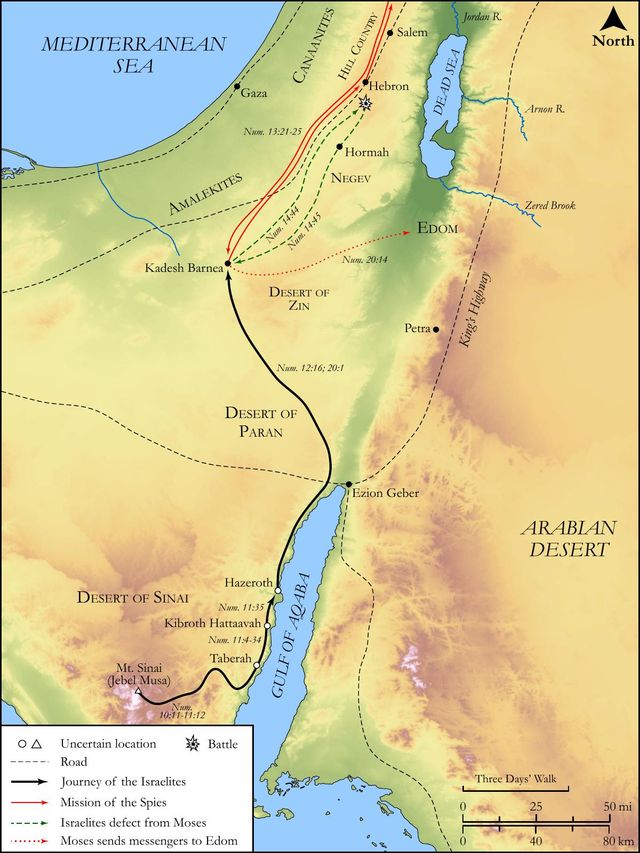
See on the biblical-era map
Study this verse
Public-domain commentary
Matthew Henry
From his Commentary on the Whole Bible. Henry comments on passages, not single verses — this entry covers Numbers 11:16–23. His three-level outline is real structure in the source text, so it is rendered as structure.
We have here God's gracious answer to both the foregoing complaints, wherein his goodness takes occasion from man's badness to appear so much the more illustrious.
I.Provision is made for the redress of the grievances Moses complains of.
If he find the weight of government lie too heavy upon him, though he was a little too passionate in his remonstrance, yet he shall be eased, not by being discarded from the government himself, as he justly might have been if God had been extreme to mark what he said amiss, but by having assistants appointed him, who should be, as the apostle speaks (Co1 12:28), helps, governments (that is, helps in government), not at all to lesson or eclipse his honour, but to make the work more easy to him, and to bear the burden of the people with him. And that this provision might be both agreeable and really serviceable,
1.Moses is directed to nominate the persons, Num 11:16. The people were too hot and heady and tumultuous to be entrusted with the election; Moses must please himself in the choice, that he may not afterwards complain. The number he is to choose is seventy men, according to the number of the souls that went down into Egypt. He must choose such as he knew to be elders, that is, wise and experienced men. Those that had acquitted themselves best, as rulers of thousands and hundreds (Exo 18:25), purchase to themselves now this good degree. "Choose such as thou knowest to be elders indeed, and not in name only, officers that execute their office." We read of the same number of elders (Exo 24:1) that went up with Moses to Mount Sinai, but they were distinguished only for that occasion, these for a perpetuity; and, according to this constitution, the Sanhedrim, or great council of the Jews, which in after ages sat at Jerusalem, and was the highest court of judgment among them, consisted of seventy men. Our Saviour seems to have had an eye to it in the choice of seventy disciples, who were to be assistants to the apostles, Lu. 10.
2.God promises to qualify them. If they were not found fit for the employ, they should be made fit, else they might prove more a hindrance than a help to Moses, Num 11:17. Though Moses had talked too boldly with God, yet God does not therefore break off communion with him; he bears a great deal with us, and we must with one another: I will come down (said God) and talk with thee, when thou art more calm and composed; and I will take of the same spirit of wisdom, and piety, and courage, that is upon thee, and put it upon them. Not that Moses had the less of the Spirit for their sharing, nor that they were hereby made equal with him; Moses was still unequalled (Deu 34:10), but they were clothed with a spirit of government proportionable to their place, and with a spirit of prophecy to prove their divine call to it, the government being a Theocracy. Note,
(1.)Those whom God employs in any service he qualifies for it, and those that are not in some measure qualified cannot think themselves duly called.
(2.)All good qualifications are from God; every perfect gift is from the Father of lights.
II.Even the humour of the discontented people shall be gratified too, that every mouth may be stopped.
They are ordered to sanctify themselves (Num 11:18), that is, to put themselves into a posture to receive such a proof of God's power as should be a token both of mercy and judgment. Prepare to meet thy God, O Israel, Amo 4:12.
1.God promises (shall I say?) - he threatens rather, that they shall have their fill of flesh, that for a month together they shall not only be fed, but feasted, with flesh, besides their daily manna; and, if they have not a better government of their appetites than now it appears they have they shall be surfeited with it (Num 11:19, Num 11:20): You shall eat till it come out at your nostrils, and become loathsome to you. See here,
(1.)The vanity of all the delights of sense; they will cloy, but not satisfy: spiritual pleasures are the contrary. As the world passes away, so do the lusts of it, Jo1 2:17. What was greedily coveted in a little time comes to be nauseated.
(2.)What brutish sins (and worse than brutish) gluttony and drunkenness are; they put a force upon nature, and make that the sickness of the body which should be its health; they are sins that are their own punishments, and yet not the worst that attend them.
(3.)What a righteous thing it is with God to make that loathsome to men which they have inordinately lusted after. God could make them despise flesh as much as they had despised manna.
2.Moses objects the improbability of making good this word, Num 11:21, Num 11:22. It is an objection like that which the disciples made, Mar 8:4, Whence can a man satisfy these men? Some excuse Moses here, and construe what he says as only a modest enquiry which way the supply must be expected; but it savours too much of diffidence and distrust of God to be justified. He objects the number of the people, as if he that provided bread for them all could not, by the same unlimited power, provide flesh too. He reckons it must be the flesh either of beasts or fishes, because they are the most bulky animals, little thinking that the flesh of birds, little birds, should serve the purpose. God sees not as man sees, but his thoughts are above ours. He objects the greediness of the people's desires in that word, to suffice them. Note, Even true and great believers sometimes find it hard to trust God under the discouragements of second causes, and against hope to believe in hope. Moses himself could scarcely forbear saying, Can God furnish a table in the wilderness? when this had become the common cry. No doubt this was his infirmity.
3.God gives a short but sufficient answer to the objection in that question, Has the Lord's hand waxed short? Num 11:23. If Moses had remembered the years of the right hand of the Most High, he would not have started all these difficulties; therefore God reminds him of them, intimating that this objection reflected upon the divine power, of which he himself had been so often, not only the witness, but the instrument. Had he forgotten what wonders the divine power had wrought for that people, when it inflicted the plagues of Egypt, divided the sea, broached the rock, and rained bread from heaven? Had that power abated? Was God weaker than he used to be? Or was he tired with what he had done? Whatever our unbelieving hearts may suggest to the contrary, it is certain,
(1.)That God's hand is not short; his power cannot be restrained in the exerting of itself by any thing but his own will; with him nothing is impossible. That hand is not short which measures the waters, metes out the heavens (Isa 40:12), and grasps the winds, Pro 30:4.
(2.)That it has not waxed short. He is as strong as ever he was, fainteth not, neither is weary. And this is sufficient to silence all our distrusts when means fail us, Is any thing too hard for the Lord? God here brings Moses to this first principle, sets him back in his lesson, to learn the ancient name of God, The Lord God Almighty, and puts the proof upon the issue: Thou shalt see whether my word shall come to pass or not. This magnifies God's word above all his name, that his works never come short of it. If he speaks, it is done.
Continue studying Numbers 11:20 across the web’s major study libraries — every link below opens this exact verse, chapter, or book on the destination site.
Read & Compare
 BibleGatewayThis verse in more than 200 translations and 70 languages.
 Bible.comThe YouVersion reader — hundreds of translations, reading plans, and highlights.
 ESV.orgCrossway's official English Standard Version reader.
 NET BibleThe NET translation with 60,000+ translators' notes on every rendering decision.
 STEP BibleTyndale House's free study tool — original text, vocabulary, and scholarly resources.
 BibliaLogos Bible Software's free web reader.
 USCCBThe New American Bible (Revised Edition) with the U.S. bishops' study notes.
Commentaries
 BibleHub CommentariesDozens of classic commentaries on this verse, gathered on one page.
 StudyLightMore than 100 commentary sets — the largest collection on the web.
 BibleRefPlain-English commentary on what this verse means, verse by verse.
 Enduring WordDavid Guzik's free commentary on this chapter, widely used by Bible teachers.
 Bible Study ToolsVerse commentary alongside Greek and Hebrew study aids.
Original Language & Research
- BibleHub InterlinearThe verse word by word — original language, transliteration, and English.
- BibleHub LexiconEvery word's original-language definition and Strong's entry.
 Blue Letter BibleDeep-study tools — Strong's numbers, concordance, and word studies.
 SefariaThe Hebrew text with Rashi and centuries of Jewish commentary.
Sermons, Hymns & Audio


TrulyRandomVerse is not affiliated with these sites and doesn’t control their content. They’re linked because they’re genuinely useful.
Summary
Numbers 11:20 delivers a severe divine judgment against the Israelites, who, despite miraculous deliverance and daily provision of manna, expressed profound discontent and longing for the "fleshpots of Egypt." This verse climaxes God's furious response, promising to sate their craving for meat to the point of utter revulsion and sickness, precisely because their grumbling was perceived not merely as a complaint about food but as a deep-seated despising of the Lord Himself, who was faithfully present and providing among them.
Context
ShowHideLiterary Context
Numbers 11:20 concludes God's direct and fiery response to the Israelites' intense craving for meat, a desire that escalated into weeping and open lament against their liberation from Egypt. The immediate preceding verses (Numbers 11:4-10) detail how a "mixed multitude" among them, and subsequently the Israelites themselves, began to "lust exceedingly," expressing profound dissatisfaction with the manna and recalling the seemingly better food of Egyptian bondage. Moses himself became overwhelmed by their incessant complaints, leading him to express his own burden to the Lord (Numbers 11:11-15). God's promise in Numbers 11:18-20 is a direct, ironic fulfillment of their sinful desire, turning their craving into a source of punishment, culminating in the graphic imagery of the meat becoming "loathsome" due to their rejection of His presence and provision. This episode sets the stage for the subsequent provision of quail and the devastating plague (Numbers 11:31-34), underscoring the severe consequences of their rebellion.
Historical & Cultural Context
The Israelites were in the wilderness, a harsh and barren environment, having been miraculously delivered from centuries of slavery in Egypt. Their journey was not merely a physical trek but a period of spiritual formation under God's direct leadership, symbolized by the pillar of cloud and fire and the Tabernacle in their midst. In this context, their longing for the "fleshpots" and "fish" of Egypt (Numbers 11:5) was not just a desire for a varied diet but a nostalgic idealization of their past bondage, completely overlooking the oppression and suffering they endured. Their "weeping" was a culturally significant expression of deep lament and protest, indicating a profound rejection of their current circumstances and, by extension, the divine hand that led them. This act was particularly egregious given God's consistent provision of manna and water, demonstrating a profound lack of trust and an ungrateful spirit towards their covenant Lord.
Key Themes
ShowHideThis verse powerfully contributes to several overarching themes in the book of Numbers and the Pentateuch. Firstly, it highlights the danger of discontentment and grumbling against divine provision and leadership, portraying it not as a minor annoyance but as a direct affront to God's character and authority. Secondly, it underscores the theme of divine judgment as a consequence of rebellion. God's response is not arbitrary but a direct, ironic fulfillment of their sinful desire, demonstrating that sometimes the severest judgment is to give people exactly what their rebellious hearts crave, allowing it to become their undoing. This is echoed in passages like Psalm 78:30-31. Thirdly, the phrase "ye have despised the LORD which is among you" articulates the central theme of despising God's presence and covenant faithfulness. Their complaint about food was a symptom of a deeper spiritual ailment: a profound lack of faith and an ungrateful rejection of the God who had redeemed them, was present with them, and was leading them to the Promised Land. This rejection of God's immediate presence is a recurring motif, also seen in their refusal to enter the land in Numbers 14.
Exposition and Analysis
ShowHideKey Word Analysis
ShowHideThis word (H2214) conveys a strong sense of disgust, abhorrence, or nausea. It implies a visceral, sickening revulsion, suggesting that the meat will become so utterly repulsive that they will be physically unable to tolerate it. The imagery of the meat "coming out at your nostrils" combined with this word paints a vivid picture of extreme physical and emotional aversion, emphasizing the severity of the consequence. It's not just that they will be tired of the meat, but they will be utterly repulsed by it, to the point of vomiting or expelling it from their bodies.
The Hebrew verb (H3988) is a powerful term meaning to scorn, contemn, spurn, or blaspheme. It signifies a severe affront to God's honor, authority, and character. It's not merely a casual disregard but an active, deliberate act of treating God with contempt. This word reveals the true nature of the Israelites' complaint: it was not just about dietary preferences but a profound spiritual rebellion and a rejection of the very God who was present among them, providing for their every need. Their grumbling was a direct insult to His sovereignty and goodness.
This primitive root (H1058) means to weep, generally to bemoan or make lamentation. In this context, their weeping was not a sign of repentance or sorrow for sin, but rather an expression of deep discontent and self-pity, bordering on accusation against God. It was a lament born of ingratitude and a desire for a perceived better past, rather than a humble plea for God's mercy or a recognition of His faithful provision.
Verse Breakdown
ShowHide"[But] even a whole month, until it come out at your nostrils, and it be loathsome unto you"
This clause describes the duration and intensity of God's judgment. The meat will be provided in such an overwhelming abundance and for such a prolonged period ("a whole month," combining H2320 chôdesh for "month" and H3117 yôwm for "day" or "time") that it will become utterly repulsive. The graphic imagery of it "coming out at your nostrils" (H639 ʼaph, "nostril") is a hyperbolic expression of extreme nausea and disgust, suggesting that they will be so overwhelmed by the meat that they will expel it from every orifice, unable to stomach it any longer. This is a direct, ironic fulfillment of their insatiable craving, turning their desire into a source of profound physical and emotional revulsion.
"because that ye have despised the LORD which [is] among you"
This is the core accusation and the theological rationale (H3282 yaʻan, "because") for the judgment. Their incessant grumbling and longing for Egypt are interpreted by God as a direct act of contempt and scorn (H3988 mâʼaç, "despised") against Him (H3068 Yᵉhôvâh, "the LORD"). The phrase "which is among you" (H7130 qereb, "midst" or "among") highlights the profound ingratitude and rebellion: they despised the very God who had miraculously delivered them, was faithfully present in their midst (via the Tabernacle and His guiding presence), and was sustaining them daily with manna. Their dissatisfaction with His provision was a rejection of His wisdom, power, and love.
"and have wept before him, saying, Why came we forth out of Egypt?"
This clause specifies the nature of their despising. Their "weeping" (H1058 bâkâh, "wept") "before him" (H6440 pânîym, "face" or "presence") was not a lament of repentance but a lament of regret and accusation, expressing a desire to return to their former bondage. This question, "Why came we forth out of Egypt?" (H3318 yâtsâʼ, "came forth"; H4714 Mitsrayim, "Egypt"), encapsulates their spiritual amnesia and ungratefulness (H559 ʼâmar, "saying"), dismissing God's mighty acts of liberation and implicitly accusing Him of leading them into a worse situation. It signifies a complete lack of trust and a preference for perceived earthly comforts over divine freedom and provision.
Literary Devices
ShowHideNumbers 11:20 employs several powerful literary devices to convey its message and underscore the severity of God's judgment. Hyperbole is vividly present in the imagery of the meat "coming out at your nostrils," an extreme exaggeration designed to emphasize the overwhelming degree of revulsion and disgust the Israelites would experience. This dramatic overstatement underscores the intensity of their future suffering and the divine displeasure. There is also a strong element of Irony, as God grants the Israelites the very thing they craved—meat—but in such a way that it becomes a source of profound misery and punishment rather than satisfaction. Their sinful desire for flesh leads to an overwhelming surfeit that turns into a curse. Furthermore, the passage contains Anthropomorphism, attributing human-like emotions and actions to God, as He is described as being "despised" and having the Israelites "wept before Him." This helps humanize the divine interaction and makes God's righteous indignation more relatable and impactful to the audience, highlighting the personal offense taken by their rebellion.
Theological and Thematic Connections
ShowHideNumbers 11:20 profoundly illustrates the truth that God sometimes grants sinful desires as a form of judgment, allowing the very object of illicit craving to become a source of misery. This principle reveals God's justice in allowing individuals to experience the logical, often bitter, consequences of their rebellion and ungratefulness. The Israelites' despising of the Lord, who was present among them and faithfully providing, highlights the spiritual blindness that often accompanies discontentment. Their focus on perceived lack rather than abundant provision exposed a deeper distrust in God's goodness and sovereignty, demonstrating that true faith involves trusting God's wisdom even when His ways differ from our immediate desires. This episode serves as a powerful warning against the dangers of preferring the fleeting comforts of the world (symbolized by the "fleshpots of Egypt") over the liberating and sustaining presence of God.
Reflection and Application
ShowHideNumbers 11:20 stands as a stark warning for believers today, reminding us of the profound spiritual danger inherent in discontentment and ungratefulness. The Israelites' grumbling, though seemingly about food, was interpreted by God as a direct despising of His presence, provision, and leadership. This teaches us that our complaints, even about seemingly minor inconveniences, can quickly escalate from dissatisfaction with circumstances to a deeper rejection of God's perfect will and sovereign care for our lives. We are called to cultivate a spirit of gratitude, recognizing God's faithfulness in every season and trusting that His provision, even when it differs from our immediate desires, is always for our ultimate good. This verse challenges us to examine our hearts: are we truly content in Christ, or are we secretly longing for the "fleshpots" of a past life or worldly comforts that distract us from His abundant grace? The narrative underscores that sometimes, receiving exactly what we selfishly crave can lead to bitter consequences, far worse than the perceived lack we initially lamented. It compels us to seek satisfaction in God alone, lest our desires become our undoing.
Questions for Reflection
ShowHideFAQ
ShowHideWhy was God so angry over a complaint about food?
ShowHideGod's anger was not merely about a complaint over food but about what that complaint revealed about the Israelites' hearts. As Numbers 11:20 explicitly states, their weeping and longing for Egypt demonstrated that they "have despised the LORD which is among you." Their dissatisfaction with manna, God's miraculous daily provision, was a profound rejection of His wisdom, power, and loving care. It showed a lack of faith in His ability to sustain them and an ungrateful spirit for their liberation from Egyptian bondage. Their desire to return to Egypt, even in their minds, was a spiritual rebellion against the covenant God who had redeemed them and was faithfully leading them. This was a pattern of unbelief that continued to manifest throughout their wilderness journey, ultimately preventing that generation from entering the Promised Land (see Hebrews 3:17-19).
Did God truly give them what they wanted just to punish them?
ShowHideYes, in a sense, God gave them what they wanted as a form of ironic judgment. The text indicates that God would provide them meat "even a whole month, until it come out at your nostrils, and it be loathsome unto you." This was not an act of benevolent provision but a severe consequence. God allowed their sinful craving to be fulfilled to an extreme degree, turning the very object of their desire into a source of disgust and, ultimately, a plague (Numbers 11:31-34). This illustrates a biblical principle where God sometimes gives people over to their desires, allowing the natural, destructive consequences of sin to unfold (e.g., Romans 1:24-28). It highlights that not every "answered prayer" or fulfilled desire is a blessing, especially when it stems from a heart of rebellion and contempt for God.
Christ-Centered Fulfillment
ShowHideNumbers 11:20, with its depiction of Israel's rejection of God's provision and their longing for the "fleshpots" of Egypt, finds profound Christ-centered fulfillment in the New Testament. The Israelites' contempt for the manna, the "bread from heaven" (Exodus 16:4), foreshadows humanity's deeper rejection of the true Bread of Life, Jesus Christ. Just as Israel despised the Lord who was "among them," humanity often despises and rejects the incarnate God who came to dwell among us (John 1:14). Their longing for the slavery of Egypt over the freedom offered by God in the wilderness mirrors the human tendency to prefer the bondage of sin and worldly comforts over the liberating grace and abundant life found in Christ (Galatians 5:1). However, unlike the temporary and ultimately unsatisfying provision of quail that led to judgment, Christ offers Himself as the living bread, providing eternal satisfaction and true life to all who believe, so that they "will never be hungry" (John 6:35). The judgment upon Israel for their unbelief serves as a solemn warning, yet it also points to Christ as the one who perfectly trusted and obeyed the Father, providing the ultimate sacrifice to atone for our grumbling, ungrateful hearts, and leading us into a true and eternal rest not found in any earthly "fleshpots" but in Him alone (Hebrews 4:1-11).