


Exodus 18:25
Bible text: King James Version (1769 Blayney text) · Public domain
Bible text: King James Version with Strong's numbers · Public domain
Bible text: Berean Standard Bible · Public domain
Bible text: American Standard Version (1901) · Public domain
Bible text: World English Bible, Messianic edition · Public domain
Bible text: Geneva Bible (1599) · Public domain
Bible text: Young's Literal Translation · Public domain
- וַיִּבְחַרvai·yiv·Charand he choseH977Conj-w ¦ V-Qal-ConsecImperf-3msVerb Qal Consecutive Imperfect 3rd Singular Masculineוַandיִּבְחַרhe chose
- מֹשֶׁהmo·ShehMosesH4872N-proper-mNoun Proper Masculine
- אַנְשֵׁי'an·sheimen ofH582N-mpcNoun Plural Masculine Construct
- חַיִלcha·yilabilityH2428N-msNoun Singular Masculine Absolute
- מִכָּלmi·kolfrom allH3605Prep-m ¦ N-mscNoun Singular Masculine Constructמִfromכָּלall
- יִשְׂרָאֵלYis·ra·'ElIsraelH3478N-properNoun Proper Location
- וַיִּתֵּןvai·yi·Tenand he appointedH5414Conj-w ¦ V-Qal-ConsecImperf-3msVerb Qal Consecutive Imperfect 3rd Singular Masculineוַandיִּתֵּןhe appointed
- אֹתָם'o·Tam<obj.> themH853DirObjM ¦ 3mpParticle Object Indicatorאֹתָ<obj.>םthem
- רָאשִׁיםra·ShimchiefsH7218N-mpNoun Plural Masculine Absolute
- עַל'aloverH5921PrepPreposition
- הָעָםha·'Amthe people ofH5971Art ¦ N-mscNoun Singular Masculine Constructהָtheעָםpeople of
- שָׂרֵיsa·Reiicials ofH8269N-mpcNoun Plural Masculine Construct
- אֲלָפִים'a·la·FimthousandsH505Adj-cpAdjective Numerical Plural common gender Absolute
- שָׂרֵיsa·Reiofficials ofH8269N-mpcNoun Plural Masculine Construct
- מֵאוֹתme·'othundredsH3967Adj-fpAdjective Numerical Plural Feminine Absolute
- שָׂרֵיsa·Reiofficials ofH8269N-mpcNoun Plural Masculine Construct
- חֲמִשִּׁיםcha·mi·ShimfiftiesH2572Adj-mpAdjective Numerical Plural Masculine Absolute
- וְשָׂרֵיve·sa·Reiand officials ofH8269Conj-w ¦ N-mpcNoun Plural Masculine Constructוְandשָׂרֵיofficials of
- עֲשָׂרֹת'a·sa·RottensH6235N-fpNoun Plural Feminine Absolute
English is a literal word-by-word gloss of the Hebrew, not the KJV's wording. Why?
This is the original text the KJV's translators worked from — each Hebrew word with its own literal English meaning in this verse, prepared by scholars at Tyndale House, Cambridge. The KJV translates whole sentences, not word by word, so its wording differs: one Hebrew word can become several English words, and the KJV may choose “the LORD” where the gloss reads “Yahweh”. Both are faithful — they answer different questions. For the KJV's own rendering, switch to the KJV text.
Details
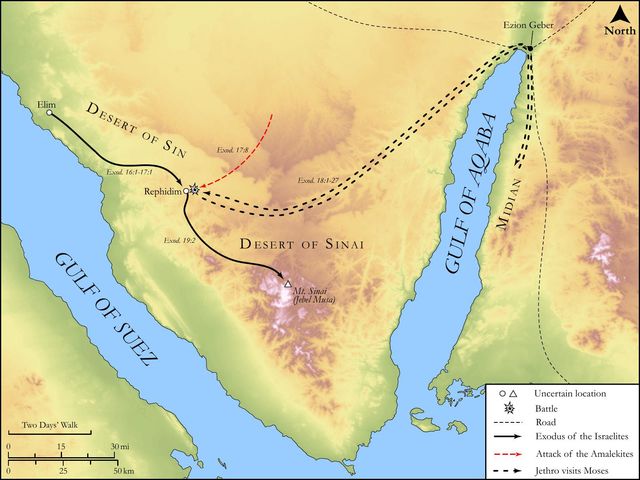
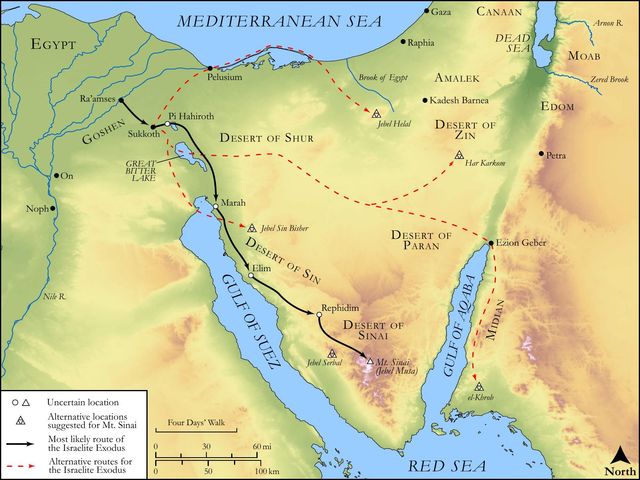
See on the biblical-era maps

Study this verse
Public-domain commentary
Matthew Henry
From his Commentary on the Whole Bible. Henry comments on passages, not single verses — this entry covers Exodus 18:13–27. His four-level outline is real structure in the source text, so it is rendered as structure.
Here is, I. The great zeal and industry of Moses as a magistrate.
1.Having been employed to redeem Israel out of the house of bondage, herein he is a further type of Christ, that he is employed as a lawgiver and a judge among them.
(1.)He was to answer enquiries, to acquaint them with the will of God in doubtful cases, and to explain the laws of God that were already given them, concerning the sabbath, the man, etc., beside the laws of nature, relating both to piety and equity, Exo 18:15. They came to enquire of God; and happy it was for them that they had such an oracle to consult: we are ready to wish, many a time, that we had some such certain way of knowing God's mind when we are at a loss what to do. Moses was faithful both to him that appointed him and to those that consulted him, and made them know the statutes of God and his laws, Exo 18:16. His business was, not to make laws, but to make known God's laws; his place was but that of a servant.
(2.)He was to decide controversies, and determine matters in variance, judging between a man and his fellow, Exo 18:16. And, if the people were as quarrelsome one with another as they were with God, no doubt he had a great many causes brought before him, and the more because their trials put them to no expense, nor was the law costly to them. When a quarrel happened in Egypt, and Moses would have reconciled the contenders, they asked, Who made thee a prince and a judge? But now it was past dispute that God had made him one; and they humbly attend him whom they had then proudly rejected.
2.Such was the business Moses was called to, and it appears that he did it,
(1.)With great consideration, which, some think, is intimated in his posture: he sat to judge (Exo 18:13), composed and sedate.
(2.)With great condescension to the people, who stood by him, Exo 18:14. He was very easy of access; the meanest Israelite was welcome himself to bring his cause before him.
(3.)With great constancy and closeness of application.
[1.]Though Jethro, his father-in-law, was with him, which might have given him a good pretence for a vacation (he might have adjourned the court for that day, or at least have shortened it), yet he sat, even the next day after his coming, from morning till evening. Note, Necessary business must always take place of ceremonious attentions. It is too great a compliment to our friends to prefer the enjoyment of their company before our duty to God, which ought to be done, while yet the other is not left undone.
[2.]Though Moses was advanced to great honour, yet he did not therefore take his case and throw upon others the burden of care and business; no, he thought his preferment, instead of discharging him from service, made it more obligatory upon him. Those think of themselves above what is meet who think it below them to do good. It is the honour even of angels themselves to be serviceable.
[3.]Though the people had been provoking to him, and were ready to stone him (Exo 17:4), yet still he made himself the servant of all. Note, Though others fail in their duty to us, yet we must not therefore neglect ours to them.
[4.]Though he was an old man, yet he kept to his business from morning to night, and made it his meat and drink to do it. God had given him great strength both of body and mind, which enabled him to go through a great deal of work with ease and pleasure; and, for the encouragement of others to spend and be spent in the service of God, it proved that after all his labours his natural force was not diminished. Those that wait on the Lord and his service shall renew their strength.
II.The great prudence and consideration of Jethro as a friend.
1.He disliked the method that Moses took, and was so free with him as to tell him so, Exo 18:14, Exo 18:17, Exo 18:18. He thought it was too much business for Moses to undertake alone, that it would be a prejudice to his health and too great a fatigue to him, and also that it would make the administration of justice tiresome to the people; and therefore he tells him plainly, It is not good. Note, There may be over-doing even in well-doing, and therefore our zeal must always be governed by discretion, that our good may not be evil spoken of. Wisdom is profitable to direct, that we may neither content ourselves with less than our duty nor over-task ourselves with that which is beyond our strength.
2.He advised him to such a model of government as would better answer the intention, which was,
(1.)That he should reserve to himself all applications to God (Exo 18:19): Be thou for them to God-ward; that was an honour in which it was not fit any other should share with him, Num 12:6-8. Also whatever concerned the whole congregation in general must pass through his hand, Exo 18:20. But,
(2.)That he should appoint judges in the several tribes and families, who should try causes between man and man, and determine them, which would be done with less noise, and more despatch, than in the general assembly wherein Moses himself presided. Thus they must be governed as a nation by a king as supreme, and inferior magistrates sent and commissioned by him, Pe1 2:13, Pe1 2:14. Thus many hands would make light work, causes would be sooner heard, and the people eased by having justice thus brought to their tent-doors. Yet,
(3.)An appeal might lie, if there were just cause for it, from these inferior courts to Moses himself; at least if the judges were themselves at a loss: Every great matter they shall bring unto thee, Exo 18:22. Thus that great man would be the more serviceable by being employed only in great matters. Note, Those whose gifts and stations are most eminent may yet be greatly furthered in their work by the assistance of those that are every way their inferiors, whom therefore they should not despise. The head has need of the hands and feet, Co1 12:21. Great men should not only study to be useful themselves, but contrive how to make others useful, according as their capacity is. Such is Jethro's advice, by which it appears that though Moses excelled him in prophecy he excelled Moses in politics; yet,
3.He adds two qualifications to his counsel: - (1.) That great care should be taken in the choice of the persons who should be admitted into this trust (Exo 18:21); they must be able men, etc. It was requisite that they should be men of the very best character, [1.] For judgment and resolution - able men, men of good sense, that understood business, and bold men, that would not be daunted by frowns or clamours. Clear heads and stout hearts make good judges. [2.] For piety and religion - such as fear God, as believe there is a God above them, whose eye is upon them, to whom they are accountable, and of whose judgment they stand in awe. Conscientious men, that dare not do a base thing, though they could do it ever so secretly and securely. The fear of God is that principle which will best fortify a man against all temptations to injustice, Neh 5:15; Gen 42:18. [3.] For integrity and honesty - men of truth, whose word one may take, and whose fidelity one may rely upon, who would not for a world tell a lie, betray a trust, or act an insidious part. [4.] For noble and generous contempt of worldly wealth - hating covetousness, not only not seeking bribes nor aiming to enrich themselves, but abhorring the thought of it; he is fit to be a magistrate, and he alone, who despiseth the gain of oppressions, and shaketh his hands from the holding of bribes, Isa 33:15. (2.) That he should attend God's direction in the case (Exo 18:23): If thou shalt do this thing, and God command thee so. Jethro knew that Moses had a better counsellor than he was, and to his counsel he refers him. Note, Advice must be given with a humble submission to the word and providence of God, which must always overrule.
Now Moses did not despise this advice because it came from one not acquainted, as he was, with the words of God and the visions of the Almighty; but he hearkened to the voice of his father-in-law, Exo 18:24. When he came to consider the thing, he saw the reasonableness of what his father-in-law proposed and resolved to put it in practice, which he did soon afterwards, when he had received directions from God in the matter. Note, Those are not so wise as they would be thought to be who think themselves too wise to be counselled; for a wise man (one who is truly so) will hear, and will increase learning, and not slight good counsel, though given by an inferior. Moses did not leave the election of the magistrates to the people, who had already done enough to prove themselves unfit for such a trust; but he chose them, and appointed them, some for greater, others for less division, the less probably subordinate to the greater. We have reason to value government as a very great mercy, and to thank God for laws and magistrates, so that we are not like the fishes of the sea, where the greater devour the less.
III.Jethro's return to his own land, Exo 18:27.
No doubt he took home with him the improvements he had made in the knowledge of God, and communicated them to his neighbours for their instruction. It is supposed that the Kenites (mentioned in Sa1 15:6) were the posterity of Jethro (compare Jdg 1:16), and they are there taken under special protection, for the kindness their ancestor here showed to Israel. The good-will shown to God's people, even in the smallest instances, shall in no wise lose its reward, but shall be recompensed, at furthest, in the resurrection.
Continue studying Exodus 18:25 across the web’s major study libraries — every link below opens this exact verse, chapter, or book on the destination site.
Read & Compare
 BibleGatewayThis verse in more than 200 translations and 70 languages.
 Bible.comThe YouVersion reader — hundreds of translations, reading plans, and highlights.
 ESV.orgCrossway's official English Standard Version reader.
 NET BibleThe NET translation with 60,000+ translators' notes on every rendering decision.
 STEP BibleTyndale House's free study tool — original text, vocabulary, and scholarly resources.
 BibliaLogos Bible Software's free web reader.
 USCCBThe New American Bible (Revised Edition) with the U.S. bishops' study notes.
Commentaries
 BibleHub CommentariesDozens of classic commentaries on this verse, gathered on one page.
 StudyLightMore than 100 commentary sets — the largest collection on the web.
 BibleRefPlain-English commentary on what this verse means, verse by verse.
 Enduring WordDavid Guzik's free commentary on this chapter, widely used by Bible teachers.
 Bible Study ToolsVerse commentary alongside Greek and Hebrew study aids.
Original Language & Research
- BibleHub InterlinearThe verse word by word — original language, transliteration, and English.
- BibleHub LexiconEvery word's original-language definition and Strong's entry.
 Blue Letter BibleDeep-study tools — Strong's numbers, concordance, and word studies.
 SefariaThe Hebrew text with Rashi and centuries of Jewish commentary.
Sermons, Hymns & Audio


TrulyRandomVerse is not affiliated with these sites and doesn’t control their content. They’re linked because they’re genuinely useful.
Summary
Exodus 18:25 chronicles Moses' decisive action to implement Jethro's counsel, establishing a foundational system of delegated authority within the nascent nation of Israel. Recognizing the unsustainable burden of single-handedly judging every dispute, Moses selected "able men" from among the Israelites and formally appointed them as tiered leaders—rulers over thousands, hundreds, fifties, and tens. This strategic administrative restructuring not only ensured more efficient and accessible dispute resolution but also distributed leadership responsibilities across the community, laying crucial groundwork for Israel's future governance and societal order.
Context
ShowHideLiterary Context
Exodus 18:25 serves as the climactic action following Jethro's insightful administrative reform proposal to Moses. The preceding verses vividly portray Moses' overwhelming workload, as he sat "from morning until evening" (Exodus 18:13) to judge the countless disputes among the people. Jethro, observing this unsustainable practice, astutely warned Moses that "the thing that you do is not good; you will surely wear out, both you and this people who are with you, for the thing is too heavy for you; you are not able to perform it alone" (Exodus 18:17-18). Jethro's comprehensive advice, detailed in Exodus 18:19-23, proposed that Moses retain his unique role as mediator between God and the people, teaching them God's statutes and laws, but delegate the judgment of lesser matters to capable individuals. Only the most difficult cases would then be brought to Moses. Verse 25 explicitly records Moses' immediate and obedient implementation of this sound advice, marking a pivotal transition from a highly centralized, single-point-of-failure leadership model to a more distributed and sustainable administrative structure, crucial for the functioning of a vast population.
Historical & Cultural Context
At this juncture, the Israelites were a vast, newly liberated people, recently delivered from centuries of slavery in Egypt. They were navigating the challenging wilderness environment as a burgeoning nation, yet they lacked any established governmental or judicial systems. Every legal, administrative, and even personal dispute was brought directly to Moses, making him the sole arbiter and authority. With a population potentially numbering in the millions (considering the "600,000 men on foot" mentioned in Exodus 12:37), managing daily grievances, enforcing divine laws, and maintaining societal order was an immense, humanly impossible task for one individual. The nomadic lifestyle in the wilderness further necessitated a flexible yet robust system of governance to ensure justice was accessible and that the practical needs of the people were met efficiently. Jethro's advice, and Moses' subsequent action, provided the essential infrastructure for this burgeoning society to function, establishing a framework for a covenant community to live justly and orderly under God's law, a system that would be further developed and recounted in later texts like Deuteronomy 1.
Key Themes
ShowHideThis verse powerfully contributes to several key themes within Exodus and the broader Pentateuch. Firstly, it highlights the theme of wise leadership and delegation. Moses, despite his unique divine calling, demonstrates humility and wisdom by accepting and implementing Jethro's counsel, acknowledging his human limitations and the necessity of empowering others. This contrasts with a solo, autocratic leadership style, emphasizing shared responsibility. Secondly, the passage underscores the theme of divine order and justice. God desires an orderly society where justice is accessible to all, and this administrative reform provides the practical means for that to occur. The tiered system ensures that disputes can be resolved efficiently at various levels. Thirdly, it emphasizes the importance of character in leadership. The "able men" chosen were not merely competent but possessed specific moral and spiritual qualifications (as detailed in Exodus 18:21), reinforcing the idea that those who administer justice for God's people must embody integrity, truth, and a fear of God. This foundational act of governance sets a precedent for the future organization of Israel as a covenant nation.
Exposition and Analysis
ShowHideKey Word Analysis
ShowHideThis word signifies more than mere competence or physical strength. It denotes a comprehensive excellence, encompassing valor, strength, wealth, virtue, and integrity. When applied to men, as here, it refers to individuals of excellent moral character, trustworthiness, courage, and substance. As specified in Exodus 18:21, these were men who "fear God, men of truth, hating covetousness." This emphasizes that the selection criteria were not just about administrative skill but primarily about spiritual and ethical uprightness, essential for those entrusted with dispensing justice and leading God's people.
This primitive root is remarkably broad in its application, meaning "to give" but extending to "put, make, appoint, assign, bestow." In this context, it signifies Moses' active role in formally appointing and commissioning these individuals. It's not a passive act but a deliberate, authoritative investiture of power and responsibility, transforming them from ordinary men into designated leaders. This word underscores the intentionality and formal nature of the delegation.
This term denotes a head person of any rank or class, often translated as captain, chief, governor, or prince. Here, it explicitly defines the authoritative position these men held. They were not merely assistants but designated "rulers," indicating a significant transfer of responsibility and a recognized leadership role within the community. This term highlights the decentralization of power and the establishment of a new, legitimate chain of command under Moses.
Verse Breakdown
ShowHide"And Moses chose able men out of all Israel"
This initial clause underscores Moses' proactive and discerning role in the selection process. It demonstrates his obedience to Jethro's wise counsel and his careful identification of qualified individuals. The phrase "out of all Israel" is significant, emphasizing the representative nature of these leaders; they were drawn from across the entire spectrum of the Israelite population, ensuring broad representation and accessibility to justice for all tribes and families.
"and made them heads over the people"
This segment signifies the formal appointment and commissioning of the chosen individuals into positions of authority. The term "heads" (H7218, ro'sh) further reinforces their elevated status and leadership role, indicating that they were not just assistants but recognized leaders with significant responsibility. This act effectively decentralized power from Moses alone and established a new, structured chain of command within the community.
"rulers of thousands, rulers of hundreds, rulers of fifties, and rulers of tens"
This detailed enumeration describes the precise, hierarchical, and decimal-based administrative structure implemented by Moses. This system was ingeniously designed for maximum efficiency and scalability. It allowed disputes to be resolved at the lowest possible level, with minor issues handled by "rulers of tens," while progressively more complex cases would ascend through "rulers of fifties," then "hundreds," and "thousands," with only the most difficult matters requiring Moses' direct intervention. This tiered approach ensured that justice was both accessible to the vast population and manageable for the leadership.
Literary Devices
ShowHideExodus 18:25 effectively employs several literary devices to convey the meticulous and comprehensive nature of Moses' administrative reform. The most prominent is Merism, evident in the precise enumeration of "rulers of thousands, rulers of hundreds, rulers of fifties, and rulers of tens." This device uses a series of contrasting or complementary terms (here, the largest and smallest units of governance) to represent a complete range or a whole. By listing these specific tiers, the text implies a comprehensive and orderly system that covers every level of the Israelite population, from the smallest family unit to the largest tribal division. This detailed listing also demonstrates Gradation, highlighting the systematic and ascending nature of the judicial structure. Furthermore, the Repetition of "rulers of" powerfully reinforces the establishment of a consistent and pervasive leadership structure throughout the entire nation, emphasizing the uniformity and widespread implementation of this new system. The passage also exemplifies Praxis, moving directly from Jethro's theoretical counsel (in preceding verses) to Moses' immediate and practical implementation, showcasing the wisdom of applying sound advice and the direct cause-and-effect relationship between counsel and action.
Theological and Thematic Connections
ShowHideExodus 18:25 is profoundly significant for its theological and thematic implications, underscoring God's wisdom in establishing order and governance among His covenant people. It beautifully illustrates the divine principle of delegated authority, recognizing that even divinely appointed leaders like Moses have human limitations and greatly benefit from wise counsel and shared responsibility. This act of delegation is not a sign of weakness but rather a demonstration of strength, humility, and trust in God's provision of capable individuals within the community. It highlights that effective leadership, particularly within a spiritual context, involves empowering others, fostering a sense of shared ownership, and creating structures that facilitate justice, well-being, and spiritual flourishing for all. The emphasis on selecting "able men" who "fear God, men of truth, hating covetousness" (Exodus 18:21) prefigures the enduring importance of character, integrity, and spiritual uprightness in all forms of leadership, a theme consistently echoed throughout the entirety of Scripture.
Reflection and Application
ShowHideExodus 18:25 offers enduring and profound principles for leadership, organization, and the distribution of responsibility that remain highly relevant for any community, especially within the context of the church and Christian organizations today. It serves as a powerful challenge to leaders to recognize their own human limitations and the absolute necessity of empowering others, fostering a culture of shared leadership rather than attempting to bear every burden alone. For those in positions of authority, it is a poignant call to humility, actively seeking wise counsel, and discerningly delegating tasks to qualified and character-driven individuals. For every member of a community, this passage underscores the profound importance of developing "able" character—cultivating integrity, truthfulness, and a genuine fear of God—so that they might be prepared and trustworthy to serve when called upon. Ultimately, this passage reminds us that effective governance, whether in a family, a business, or a church, thrives on a well-structured team where responsibilities are appropriately distributed, ensuring that no single person is overwhelmed and that all members contribute meaningfully to the common good and the flourishing of the collective.
Questions for Reflection
ShowHideFAQ
ShowHideWhat was the primary problem that led to Moses delegating authority?
ShowHideThe primary problem was Moses' unsustainable and overwhelming workload. He was single-handedly judging every dispute among the millions of Israelites, from morning till evening (Exodus 18:13). This exhaustive labor was not only wearing him out but also causing the people to stand idle for long periods, unable to receive timely justice. Jethro wisely observed that "the thing that you do is not good; you will surely wear out, both you and this people who are with you, for the thing is too heavy for you; you are not able to perform it alone" (Exodus 18:17-18).
What were the specific qualifications for the "able men" Moses chose?
ShowHideWhile Exodus 18:25 simply states "able men," the preceding verse, Exodus 18:21, provides the crucial qualifications outlined by Jethro: they were to be "able men, such as fear God, men of truth, hating covetousness." This indicates that their selection was based not only on administrative competence but, more importantly, on their profound moral and spiritual character. They needed to be individuals who deeply reverenced God, were honest and trustworthy in all their dealings, and were free from the corrupting influence of greed, thereby ensuring impartial and just judgments for the people.
How does this administrative structure reflect God's character or principles?
ShowHideThe administrative structure established in Exodus 18:25 reflects God's character and principles in several profound ways. Firstly, it demonstrates God's inherent commitment to order and justice. A chaotic and disorganized society cannot thrive, and God, as a God of perfect order, provides a systematic means for the fair and efficient resolution of disputes. Secondly, it highlights God's principle of wise stewardship and delegation of responsibility. God empowers His servants and enables them to share burdens, preventing burnout and promoting the flourishing and well-being of the entire community. Thirdly, the emphasis on leaders who "fear God, men of truth, hating covetousness" (Exodus 18:21) powerfully underscores God's unwavering demand for integrity, righteousness, and moral purity in those who represent Him and administer justice among His people. This divinely inspired system was designed to make God's justice accessible, efficient, and equitable for a vast and growing nation.
Christ-Centered Fulfillment
ShowHideExodus 18:25, with its depiction of Moses delegating authority to "able men" for the just governance of Israel, serves as a powerful foreshadowing that finds its ultimate and perfect fulfillment in the person and redemptive work of Jesus Christ and the establishment of His Church. While Moses, as a human leader, was limited by his mortality and capacity, necessitating delegation, Christ, the perfect and all-sufficient Head of the Church, perfectly embodies the ultimate wise leader who both bears all burdens and sovereignly empowers His people. He is the true "Ruler of thousands," indeed, the King over all creation (Revelation 19:16), who perfectly administers divine justice, truth, and grace. In the New Covenant, Jesus establishes a new administrative structure, not through a rigid, earthly hierarchy, but through the outpouring and gifting of the Holy Spirit to His body, the Church. He commissions His apostles to "make disciples of all nations" (Matthew 28:19) and then empowers all believers with diverse spiritual gifts for the common good and the building up of the body of Christ (1 Corinthians 12:4-11). Just as Moses chose "able men" of character, Christ calls, equips, and sends believers, making them "able ministers of a new covenant" (2 Corinthians 3:6), empowering them to share the burden of ministry, proclaim the gospel of the Kingdom, and live justly, thereby reflecting His perfect leadership and the divine order of His eternal and ever-expanding kingdom.