


Nehemiah 5:15
- וְהַפַּחוֹתve·ha·pa·chOtand the governorsH6346Conj-w ¦ Art ¦ N-fpNoun Plural Feminine Absoluteוְandהַtheפַּחוֹתgovernors
- הָרִאשֹׁנִיםha·ri·sho·Nim<the> formerH7223Art ¦ Adj-mpAdjective Numerical Position Plural Masculine Absoluteהָ<the>רִאשֹׁנִיםformer
- אֲשֶׁר'a·SherwhoH834RelParticle Relative
- לְפָנַיle·fa·Nai[were] <to> before meH6440Prep-l ¦ N-mpc ¦ 1csNoun Plural Masculine Constructלְ[were] <to>פָנַbeforeיme
- הִכְבִּידוּhikh·Bi·duthey made heavyH3513V-Hiphil-Perf-3cpVerb Hiphil Perfect 3rd Plural common gender
- עַל'alonH5921PrepPreposition
- הָעָםha·'Amthe peopleH5971Art ¦ N-msNoun Singular Masculine Absoluteהָtheעָםpeople
- וַיִּקְחוּvai·yik·Chuand they tookH3947Conj-w ¦ V-Qal-ConsecImperf-3mpVerb Qal Consecutive Imperfect 3rd Plural Masculineוַandיִּקְחוּthey took
- מֵהֶםme·Hemfrom themPrep-m ¦ 3mpSuffix Personal 3rd Plural Masculineמֵfromהֶםthem
- בְּלֶחֶםbe·Le·chem<in> foodH3899Prep-b ¦ N-msNoun Singular Masculine Absoluteבְּ<in>לֶחֶםfood
- וָיַיִןva·Ya·yinand wineH3196Conj-w ¦ N-msNoun Singular Masculine Absoluteוָandיַיִןwine
- אַחַר'a·CharafterH310Adj-msAdjective Numerical Singular Masculine Absolute
- כֶּסֶףke·sefsilverH3701N-msNoun Singular Masculine Absolute
- שְׁקָלִיםshe·ka·LimshekelsH8255N-mpNoun Plural Masculine Absolute
- אַרְבָּעִים'ar·ba·'ImfortyH705Adj-mpAdjective Numerical Plural Masculine Absolute
- גַּםgamalsoH1571AdvAdverb
- נַעֲרֵיהֶםna·'a·rei·Hemtheir servantsH5288N-mpc ¦ 3mpNoun Plural Masculine Constructנַעֲרֵיservantsהֶםtheir
- שָׁלְטוּshal·Tuthey domineeredH7980V-Qal-Perf-3cpVerb Qal Perfect 3rd Plural common gender
- עַל'aloverH5921PrepPreposition
- הָעָםha·'Amthe peopleH5971Art ¦ N-msNoun Singular Masculine Absoluteהָtheעָםpeople
- וַאֲנִיva·'a·Niand IH589Conj-w ¦ Pro-1csPronoun Personal 1st Singular common genderוַandאֲנִיI
- לֹאlo'notH3808NegParticle Negative
- עָשִׂיתִי'a·Si·tiI didH6213V-Qal-Perf-1csVerb Qal Perfect 1st Singular common gender
- כֵןKhenthusH3651AdvAdverb
- מִפְּנֵיmi·pe·Nei<from> because ofH6440Prep-m ¦ N-mpcNoun Plural Masculine Constructמִ<from>פְּנֵיbecause of
- יִרְאַתyir·'At[the] fear ofH3374N-fscNoun Singular Feminine Construct
- אֱלֹהִים'E·lo·HimGodH430N-mpNoun Plural Masculine Absolute
English is a literal word-by-word gloss of the Hebrew, not the KJV's wording. Why?
This is the original text the KJV's translators worked from — each Hebrew word with its own literal English meaning in this verse, prepared by scholars at Tyndale House, Cambridge. The KJV translates whole sentences, not word by word, so its wording differs: one Hebrew word can become several English words, and the KJV may choose “the LORD” where the gloss reads “Yahweh”. Both are faithful — they answer different questions. For the KJV's own rendering, switch to the KJV text.
Details
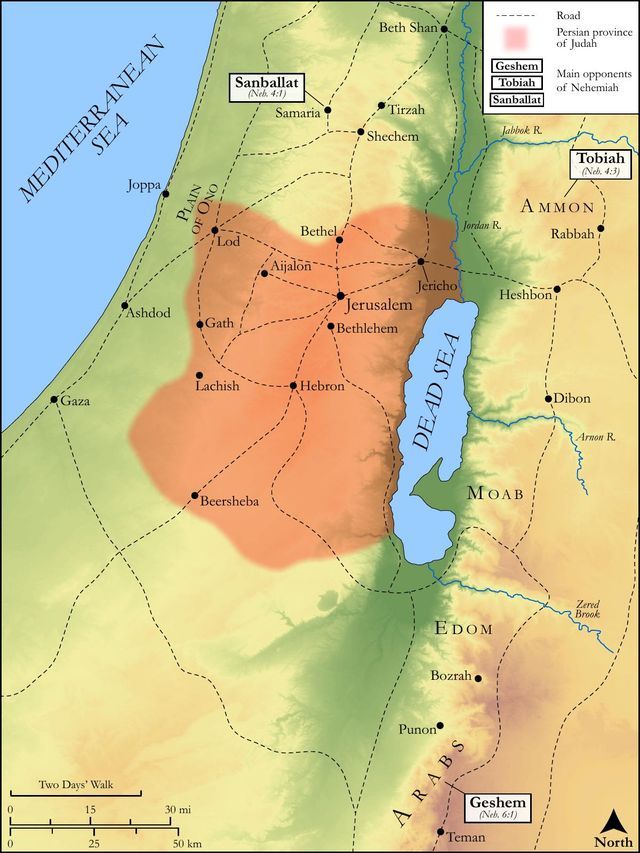
See on the biblical-era map
Study this verse
Public-domain commentary
Matthew Henry
From his Commentary on the Whole Bible. Henry comments on passages, not single verses — this entry covers Nehemiah 5:14–19. His four-level outline is real structure in the source text, so it is rendered as structure.
Nehemiah had mentioned his own practice, as an inducement to the nobles not to burden the poor, no, not with just demands; here he relates more particularly what his practice was, not inn pride or vain-glory, nor to pass a compliment upon himself, but as an inducement both to his successors and to the inferior magistrates to be as tender as might be of the people's ease.
I.He intimates what had been the way of his predecessors, Neh 5:15.
He does not name them, because what he had to say of them was not to their honour, and in such a case it is good to spare names; but the people knew how chargeable they had been, and how dearly the country paid for all the benefit of their government. The government allowed them forty shekels of silver, which was nearly five pounds (so much a day, it is probable); but, besides that, they obliged the people to furnish them with bread and wine, which they claimed as perquisites of their office; and not only so, but they suffered their servants to squeeze the people, and to get all they could out of them. Note,
1.It is no new thing for those who are in public places to seek themselves more than the public welfare, any, and to serve themselves by the public loss.
2.Masters must be accountable for all the acts of fraud and injustice, violence and oppression, which they connive at in their servants.
II.He tells us what had been his own way.
1.In general, he had not done as the former governors did; he would not, he durst not, because of the fear of God. He had an awe of God's majesty and a dread of his wrath. And,
(1.)The fear of God restrained him from oppressing the people. Those that truly fear God will not dare to do any thing cruel or unjust.
(2.)It was purely that which restrained him. He was thus generous, not that he might have praise of men, or serve a turn by his interest in the people, but purely for conscience' sake, because of the fear of God. This will not only be a powerful, but an acceptable principle both of justice and charity. What a good hand his predecessors made of their place appeared by the estates they raised; but Nehemiah, for his part, got nothing, except the satisfaction of doing good: Neither bought we any land, Neh 5:16. Say not then that he was a bad husband, but that he was a good governor, who aimed not to feather his own nest. Let us remember the words of the Lord, how he said, It is more blessed to give than to receive, Act 20:35.
2.More particularly, observe here,
(1.)How little Nehemiah received of what he might have required. He did the work of the governor, but he did not eat the bread of the governor (Neh 5:14), did not require it, Neh 5:18. So far was he from extorting more than his due that he never demanded that, but lived upon what he had got in the king of Persia's court and his own estate in Judea: the reason he gives for this piece of self-denial is, Because the bondage was heavy upon the people. He might have used the common excuse for rigour in such cases, that it would be a wrong to his successors not to demand his dues; but let them look to themselves: he considered the afflicted state of the Jews, and, while they groaned under so much hardship, he could not find it in his heart to add to their burden, but would rather lessen his own estate than ruin them. note, In our demands we must consider not only the justice of them, but the ability of those on whom we make them; where there is nothing to be had we know who loses his right.
(2.)How much he gave which he might have withheld.
[1.]His servants' work, Neh 5:16. The servants of princes think themselves excused from labour; but Nehemiah's servants, by his order no doubt, were all gathered to the work. Those that have many servants should contrive how they may do good with them and keep them well employed.
[2.]His own meat, Neh 5:17, Neh 5:18. He kept a very good table, not on certain days, but constantly; he had many honourable guests, at least 150 of his own countrymen, persons of the first rank, besides strangers that came to him upon business; and he had plentiful provisions for his guests, beef, and mutton, and fowl, and all sorts of wine. Let those in public places remember that they were preferred to do good, not to enrich themselves; and let people in humbler stations learn to use hospitality one to another without grudging, Pe1 4:9.
III.He concludes with a prayer (Neh 5:19): Think upon me, my God, for good.
1.Nehemiah here mentions what he had done for this people, not in pride, as boasting of himself, nor in passion, as upbraiding them, nor does it appear that he had occasion to do it in his own vindication, as Paul had to relate his like self-denying tenderness towards the Corinthians, but to shame the rulers out of their oppressions; let them learn of him to be neither greedy in their demands nor paltry in their expenses, and then they would have the credit and comfort of their liberality, as he had.
2.He mentions it to God in prayer, not as if he thought he had hereby merited any favour from God, as a debt, but to show that he looked not for any recompence of his generosity from men, but depended upon God only to make up to him what he had lost and laid out for his honour; and he reckoned the favour of God reward enough. "If God do but think upon me for good, I have enough." His thoughts to us-ward are our happiness, Psa 40:5. He refers it to God to recompense him in such a manner as he pleased. "If men forget me, let my God think on me, and I desire no more."
Continue studying Nehemiah 5:15 across the web’s major study libraries — every link below opens this exact verse, chapter, or book on the destination site.
Read & Compare
 BibleGatewayThis verse in more than 200 translations and 70 languages.
 Bible.comThe YouVersion reader — hundreds of translations, reading plans, and highlights.
 ESV.orgCrossway's official English Standard Version reader.
 NET BibleThe NET translation with 60,000+ translators' notes on every rendering decision.
 STEP BibleTyndale House's free study tool — original text, vocabulary, and scholarly resources.
 BibliaLogos Bible Software's free web reader.
 USCCBThe New American Bible (Revised Edition) with the U.S. bishops' study notes.
Commentaries
 BibleHub CommentariesDozens of classic commentaries on this verse, gathered on one page.
 StudyLightMore than 100 commentary sets — the largest collection on the web.
 BibleRefPlain-English commentary on what this verse means, verse by verse.
 Enduring WordDavid Guzik's free commentary on this chapter, widely used by Bible teachers.
 Bible Study ToolsVerse commentary alongside Greek and Hebrew study aids.
Original Language & Research
- BibleHub InterlinearThe verse word by word — original language, transliteration, and English.
- BibleHub LexiconEvery word's original-language definition and Strong's entry.
 Blue Letter BibleDeep-study tools — Strong's numbers, concordance, and word studies.
 SefariaThe Hebrew text with Rashi and centuries of Jewish commentary.
Sermons, Hymns & Audio


TrulyRandomVerse is not affiliated with these sites and doesn’t control their content. They’re linked because they’re genuinely useful.
Summary
Nehemiah 5:15 serves as a profound testament to Nehemiah's unparalleled integrity and selfless leadership, starkly contrasting his righteous conduct with the exploitative practices of previous governors in Judah. This verse reveals Nehemiah's unwavering refusal to burden the impoverished people with excessive taxes and provisions, even foregoing his rightful allowance, all motivated by a deep and abiding reverence for God. It powerfully illustrates how a practical and profound "fear of God" can compel leaders to act with unwavering justice, compassion, and integrity, prioritizing the welfare of the community over any personal gain or entitlement.
Context
ShowHideLiterary Context
Nehemiah 5:15 is strategically positioned within a pivotal chapter that addresses a severe internal crisis among the Jewish people during the arduous task of rebuilding Jerusalem's walls. Immediately preceding this verse, Nehemiah 5:1-5 details the desperate plight of the populace: many had been forced to mortgage their lands, vineyards, and homes, and even sell their children into slavery, simply to pay royal taxes and procure food amidst a famine. Nehemiah's swift and decisive response, recorded in Nehemiah 5:6-13, involved confronting the wealthy nobles and officials who were charging exorbitant interest on loans to their own kinsmen. He vehemently called for an immediate cessation of this oppression and the return of all mortgaged properties. Following this, Nehemiah 5:14 reveals Nehemiah's personal sacrifice: for twelve years, from the twentieth year of King Artaxerxes to his thirty-second year, he and his household did not partake of the customary governor's allowance, further emphasizing his commitment to the people's well-being. Verse 15 then explicitly contrasts this exemplary conduct with the corrupt practices of the former governors, providing the crucial theological underpinning for Nehemiah's integrity.
Historical & Cultural Context
During the vast expanse of the Persian Empire, governors of provinces were customarily entitled to a substantial allowance, often collected as taxes or provisions directly from the local populace, intended to cover their administrative expenses and maintain their household. This system, while legitimate in principle, was highly susceptible to abuse, as vividly demonstrated by the "former governors" mentioned in this verse. These officials, likely appointed by the Persian king, were expected to maintain a certain standard of living and entertain foreign dignitaries, which necessitated significant resources. The "bread and wine" and "forty shekels of silver" represent a substantial daily or regular levy, imposed in addition to the standard tribute paid to the Persian crown. The alarming detail that "even their servants bare rule over the people" indicates a profound level of corruption and unchecked oppression, where even the governor's subordinates exercised tyrannical authority, likely extorting additional resources or labor from the already struggling populace. Nehemiah, arriving as the newly appointed governor (Tirshatha), stepped into a context where such exploitative practices were normalized but deeply detrimental to the morale, economic stability, and spiritual health of the Jewish community.
Key Themes
ShowHideThis verse powerfully contributes to several overarching themes woven throughout the book of Nehemiah. Firstly, it serves as a prime example of Righteous Leadership, showcasing Nehemiah as an unparalleled model of integrity, self-sacrifice, and ethical governance, in stark contrast to the corrupt leaders who preceded him. His actions unequivocally demonstrate that true leadership, especially in the context of God's work, is characterized by humble service and stewardship, not by personal enrichment or exploitation. Secondly, the theme of Justice and Compassion for the Vulnerable is central, as Nehemiah actively works to alleviate the crushing burdens of the poor and oppressed, aligning perfectly with the prophetic calls for justice found throughout the Old Testament, such as in Amos 5:24. Finally, and most pivotally, the verse highlights The Fear of God as a Motivator for Ethical Conduct. Nehemiah's radical decision to forgo his entitlements and act justly is explicitly attributed to his "fear of God." This "fear" is not a cowering terror, but a profound reverence, awe, and respectful submission to God's holiness, His divine commands, and His ultimate authority, leading to an earnest desire to live in a way that honors Him and protects His covenant people. This concept is a foundational principle for wisdom and righteous living throughout Scripture, as powerfully articulated in Proverbs 9:10.
Exposition and Analysis
ShowHideKey Word Analysis
ShowHideThe Hebrew verb כָּבַד (kābad, H3513) literally means "to be heavy," "to be weighty," or "to be burdensome." In this specific context, it signifies that the former governors imposed a heavy burden or oppressive financial weight upon the people. It implies an excessive, unjust, and severe imposition of taxes, demands, and levies, far beyond what was reasonable or sustainable, leading directly to the people's impoverishment and distress.
The Hebrew noun יִרְאַת (yirʼâh, H3374) denotes fear, but in a moral and theological sense, it signifies reverence, awe, and profound respect. When applied to God, as here, it is not a cowering terror but a deep, spiritual apprehension of God's holiness, power, and righteous character. This "fear" serves as a moral compass, leading to obedience, integrity, and a fervent desire to please God by living righteously and justly.
The Hebrew noun אֱלֹהִים (ʼĕlôhîym, H430) is the plural form of God, often used to refer to the supreme God. In this context, it refers to the one true God of Israel. When combined with "fear" (yirʼâh), it emphasizes that Nehemiah's motivation was rooted in his relationship with and profound respect for the sovereign, covenant-keeping God, to whom he felt ultimately accountable.
Verse Breakdown
ShowHide"But the former governors that [had been] before me were chargeable unto the people"
This opening clause immediately establishes a stark and critical contrast. "Former governors" refers to those who held the office of governor in Judah prior to Nehemiah's appointment. The phrase "were chargeable unto the people" means they imposed heavy financial burdens and obligations upon the populace, exploiting their positions of authority for personal gain, directly contrary to the welfare and economic stability of the community.
"and had taken of them bread and wine, beside forty shekels of silver"
This segment specifies the precise nature and extent of the exploitation. While governors were entitled to provisions, these individuals took excessive amounts of essential staple goods ("bread and wine") and a substantial sum of money ("forty shekels of silver"). This highlights the direct, systematic, and significant financial drain on the people, indicating a pervasive pattern of wealth extraction that contributed to their destitution.
"yea, even their servants bare rule over the people"
This clause further underscores the profound depth of the abuse of power and pervasive corruption. It suggests that not only the governors themselves but even their subordinates and household staff exercised oppressive authority, likely extorting additional resources or labor, and acting with impunity due to their association with the governor. This points to a widespread culture of unchecked corruption and a severe lack of accountability at multiple levels of governance.
"but so did not I"
This is Nehemiah's direct, emphatic, and powerful declaration of his contrasting conduct. It serves as the pivotal turning point of the verse, highlighting his personal integrity, moral fortitude, and resolute refusal to participate in or perpetuate such exploitative and unjust practices. This statement is a powerful assertion of his selfless and exemplary leadership.
"because of the fear of God"
This climactic phrase provides the ultimate and most profound motivation for Nehemiah's righteous actions. His unwavering refusal to exploit the people was not driven by political expediency, personal ambition, or a desire for popularity, but stemmed from a deep, reverential awe and profound respect for God. This "fear" compelled him to live justly, act with integrity, and prioritize the well-being of God's people, knowing that he was ultimately accountable to a higher divine authority.
Literary Devices
ShowHideNehemiah 5:15 masterfully employs Contrast as its primary literary device. The verse directly juxtaposes the corrupt, burdensome, and oppressive practices of the "former governors" with Nehemiah's exemplary, selfless, and just leadership. This sharp distinction, emphatically stated with "but so did not I," serves to highlight Nehemiah's moral superiority and the divine principle guiding his actions. Furthermore, the verse functions as an Exemplum, presenting Nehemiah's conduct as a profound model of righteous governance, particularly for those entrusted with positions of power and authority. The concluding phrase, "because of the fear of God," acts as both a Climax and a powerful Explanation, providing the ultimate theological rationale for Nehemiah's integrity. It elevates his actions from mere ethical behavior to a profound demonstration of true piety, underscoring that a deep and reverent relationship with God is the wellspring of genuine justice, compassion, and unwavering moral fortitude.
Theological and Thematic Connections
ShowHideNehemiah 5:15 offers profound theological insights into the very nature of godly leadership and the practical outworking of authentic faith. Nehemiah's actions embody the quintessential biblical call for justice and righteousness, particularly in the treatment of the poor and vulnerable within the community. His resolute refusal to exploit his privileged position, even when legally entitled to do so, reflects a deep and transformative understanding that all authority is a sacred stewardship from God, to be exercised for the welfare and flourishing of others, never for personal gain or self-enrichment. The "fear of God" is presented not as a passive sentiment or a cowering dread, but as an active, dynamic, and transformative force that profoundly shapes moral choices and compels individuals to align their conduct with divine principles of equity, compassion, and integrity. This verse powerfully underscores that genuine reverence for God leads inevitably to ethical living and an unwavering commitment to justice, demonstrating unequivocally that true piety is intrinsically and inseparably linked to practical righteousness in every sphere of life.
Reflection and Application
ShowHideNehemiah 5:15 provides a timeless and compelling blueprint for leadership and personal integrity applicable to any sphere of influence, from the personal to the professional, from the familial to the communal. In a world too often characterized by pervasive self-interest, unchecked greed, and the rampant abuse of power, Nehemiah's example challenges us profoundly to consider the true source of our motivations and the ultimate standard by which our actions are judged. His "fear of God" was not a detached theological concept or a mere intellectual assent, but a living, breathing, and active principle that dictated his daily choices, even when those choices demanded significant personal sacrifice and the relinquishing of entitlements. For us today, this means that our faith must translate into tangible, demonstrable acts of justice, compassion, humility, and selflessness, especially when we find ourselves in positions where we could potentially benefit ourselves at the expense of others. It calls us to deeply examine whether our decisions are truly driven by a genuine reverence for God's holy character and His profound concern for the vulnerable, or by worldly aspirations for wealth, status, or popularity. Nehemiah powerfully reminds us that true spiritual maturity and authentic faith are most profoundly evidenced by how we treat those under our authority or influence, and by our willingness to forgo personal entitlements for the greater good, knowing with certainty that our ultimate accountability is to God alone.
Questions for Reflection
ShowHideFAQ
ShowHideWhat does "forty shekels of silver" represent in this context?
ShowHideForty shekels of silver was a very significant sum in ancient times, likely representing a substantial daily or regular levy that the former governors extracted from the people. While the exact value fluctuated based on the period and specific economic conditions, it would have constituted a considerable and oppressive financial burden, especially on an already impoverished populace. This amount, alongside the demands for "bread and wine," indicates the systematic, substantial, and oppressive financial demands placed on the community, directly contributing to their economic distress and forcing many into debt or servitude, as vividly described earlier in Nehemiah 5.
What is the meaning of "the fear of God" and how did it motivate Nehemiah?
ShowHide"The fear of God" (Hebrew: yirʼat Elohim) in biblical terms does not signify being terrified or cowering in dread of God, but rather a profound, reverential awe, deep respect, and humble submission to His holiness, omnipotence, and moral authority. It is an active, guiding principle that leads to moral uprightness, faithful obedience to His commands, and an earnest desire to live in a way that honors Him in all things. For Nehemiah, this deep reverence meant recognizing that his position as governor was a sacred stewardship entrusted to him by God, and he was ultimately accountable to God for how he treated His people. This profound "fear" compelled him to act with unwavering justice, to refrain from any form of exploitation, and to prioritize the welfare of the community over any personal gain, even when it demanded significant personal sacrifice, as further detailed in Nehemiah 5:14.
Christ-Centered Fulfillment
ShowHideNehemiah's exemplary leadership, characterized by profound selflessness and an unwavering "fear of God," finds its ultimate, perfect, and complete fulfillment in the person and redemptive work of Jesus Christ. Nehemiah, though a righteous and commendable governor, was nonetheless a flawed human leader; Jesus, however, is the perfect King, the ultimate Servant Leader, and God incarnate. Nehemiah refused to burden his people with oppressive demands, but Christ bore the ultimate and crushing burden of humanity's sin, becoming "chargeable" for our transgressions, as the prophet Isaiah 53:6 so poignantly prophesied. While Nehemiah sacrificially gave up his rightful allowance, Jesus, "though he was in the form of God, did not count equality with God a thing to be grasped, but emptied himself, by taking the form of a servant, being born in the likeness of men" (Philippians 2:6-7). His entire earthly life was a perfect demonstration of serving others rather than being served, culminating in His sacrificial death on the cross as a ransom for many (Mark 10:45). The "fear of God" that profoundly motivated Nehemiah finds its truest and most perfect expression in Christ's unwavering and perfect obedience to the Father, even to the agonizing point of death (Hebrews 5:7-8). Thus, Nehemiah stands as a powerful Old Testament shadow, a foreshadowing pointing to the One who perfectly embodied selfless leadership, divine justice, and boundless compassion, not merely because of the fear of God, but as God incarnate, who willingly laid down His life for His sheep (John 10:11).