


Nehemiah 5:14
- גַּםgamalsoH1571AdvAdverb
- מִיּוֹםmi·Yomfrom [the] dayH3117Prep-m ¦ N-msNoun Singular Masculine Absoluteמִfromיּוֹם[the] day
- אֲשֶׁר'a·SherwhenH834RelParticle Relative
- צִוָּהtzi·Vahsomeone appointedH6680V-Piel-Perf-3msVerb Piel Perfect 3rd Singular Masculine
- אֹתִי'o·Ti<obj.> meH853DirObjM ¦ 1csParticle Object Indicatorאֹתִ<obj.>יme
- לִהְיוֹתlih·Yotto beH1961Prep-l ¦ V-Qal-InfVerb Qal Infinitive Constructלִtoהְיוֹתbe
- פֶּחָםpe·Chamtheir governorH6346N-fsc ¦ 3mpNoun Singular Feminine Constructפֶּחָgovernorםtheir
- בְּאֶרֶץbe·'E·retzin [the] land ofH776Prep-b ¦ N-fscNoun Singular Feminine Constructבְּinאֶרֶץ[the] land of
- יְהוּדָהye·hu·DahJudahH3063N-properNoun Proper Location
- מִשְּׁנַתmi·she·Natfrom yearH8141Prep-m ¦ N-fscNoun Singular Feminine Constructמִfromשְּׁנַתyear
- עֶשְׂרִים'es·RimtwentyH6242Adj-mpAdjective Numerical Plural Masculine Absolute
- וְעַדVe·'adand untilH5704Conj-w ¦ PrepPrepositionוְandעַדuntil
- שְׁנַתshe·NatyearH8141N-fscNoun Singular Feminine Construct
- שְׁלֹשִׁיםshe·lo·ShimthirtyH7970Adj-mpAdjective Numerical Plural Masculine Absolute
- וּשְׁתַּיִםu·she·Ta·yimand twoH8147Conj-w ¦ Adj-fdAdjective Numerical Dual Feminine Absoluteוּandשְׁתַּיִםtwo
- לְאַרְתַּחְשַׁסְתְּאle·'ar·tach·Shast'of ArtaxerxesH783Prep-l ¦ N-proper-mNoun Proper MasculineלְofאַרְתַּחְשַׁסְתְּאArtaxerxes
- הַמֶּלֶךְha·Me·lekhthe kingH4428Art ¦ N-msNoun Singular Masculine Absoluteהַtheמֶּלֶךְking
- שָׁנִיםsha·NimyearsH8141N-mpNoun Plural Masculine Absolute
- שְׁתֵּיםshe·Teimtwo [plus]H8147Adj-fdAdjective Numerical Dual Feminine Absolute
- עֶשְׂרֵה'es·RehtenH6240Adj-csAdjective Numerical Singular common gender Absolute
- אֲנִי'a·NiIH589Pro-1csPronoun Personal 1st Singular common gender
- וְאַחַיve·'a·Chaiand my brothersH251Conj-w ¦ N-mpc ¦ 1csNoun Plural Masculine Constructוְandאַחַbrothersיmy
- לֶחֶםLe·chem[the] food ofH3899N-mscNoun Singular Masculine Construct
- הַפֶּחָהha·Pe·chahthe governorH6346Art ¦ N-fsNoun Singular Feminine Absoluteהַtheפֶּחָהgovernor
- לֹאlo'notH3808NegParticle Negative
- אָכַלְתִּי'a·Khal·tiI ateH398V-Qal-Perf-1csVerb Qal Perfect 1st Singular common gender
English is a literal word-by-word gloss of the Hebrew, not the KJV's wording. Why?
This is the original text the KJV's translators worked from — each Hebrew word with its own literal English meaning in this verse, prepared by scholars at Tyndale House, Cambridge. The KJV translates whole sentences, not word by word, so its wording differs: one Hebrew word can become several English words, and the KJV may choose “the LORD” where the gloss reads “Yahweh”. Both are faithful — they answer different questions. For the KJV's own rendering, switch to the KJV text.
Details
See on the biblical-era map
Study this verse
Public-domain commentary
Matthew Henry
From his Commentary on the Whole Bible. Henry comments on passages, not single verses — this entry covers Nehemiah 5:14–19. His four-level outline is real structure in the source text, so it is rendered as structure.
Nehemiah had mentioned his own practice, as an inducement to the nobles not to burden the poor, no, not with just demands; here he relates more particularly what his practice was, not inn pride or vain-glory, nor to pass a compliment upon himself, but as an inducement both to his successors and to the inferior magistrates to be as tender as might be of the people's ease.
I.He intimates what had been the way of his predecessors, Neh 5:15.
He does not name them, because what he had to say of them was not to their honour, and in such a case it is good to spare names; but the people knew how chargeable they had been, and how dearly the country paid for all the benefit of their government. The government allowed them forty shekels of silver, which was nearly five pounds (so much a day, it is probable); but, besides that, they obliged the people to furnish them with bread and wine, which they claimed as perquisites of their office; and not only so, but they suffered their servants to squeeze the people, and to get all they could out of them. Note,
1.It is no new thing for those who are in public places to seek themselves more than the public welfare, any, and to serve themselves by the public loss.
2.Masters must be accountable for all the acts of fraud and injustice, violence and oppression, which they connive at in their servants.
II.He tells us what had been his own way.
1.In general, he had not done as the former governors did; he would not, he durst not, because of the fear of God. He had an awe of God's majesty and a dread of his wrath. And,
(1.)The fear of God restrained him from oppressing the people. Those that truly fear God will not dare to do any thing cruel or unjust.
(2.)It was purely that which restrained him. He was thus generous, not that he might have praise of men, or serve a turn by his interest in the people, but purely for conscience' sake, because of the fear of God. This will not only be a powerful, but an acceptable principle both of justice and charity. What a good hand his predecessors made of their place appeared by the estates they raised; but Nehemiah, for his part, got nothing, except the satisfaction of doing good: Neither bought we any land, Neh 5:16. Say not then that he was a bad husband, but that he was a good governor, who aimed not to feather his own nest. Let us remember the words of the Lord, how he said, It is more blessed to give than to receive, Act 20:35.
2.More particularly, observe here,
(1.)How little Nehemiah received of what he might have required. He did the work of the governor, but he did not eat the bread of the governor (Neh 5:14), did not require it, Neh 5:18. So far was he from extorting more than his due that he never demanded that, but lived upon what he had got in the king of Persia's court and his own estate in Judea: the reason he gives for this piece of self-denial is, Because the bondage was heavy upon the people. He might have used the common excuse for rigour in such cases, that it would be a wrong to his successors not to demand his dues; but let them look to themselves: he considered the afflicted state of the Jews, and, while they groaned under so much hardship, he could not find it in his heart to add to their burden, but would rather lessen his own estate than ruin them. note, In our demands we must consider not only the justice of them, but the ability of those on whom we make them; where there is nothing to be had we know who loses his right.
(2.)How much he gave which he might have withheld.
[1.]His servants' work, Neh 5:16. The servants of princes think themselves excused from labour; but Nehemiah's servants, by his order no doubt, were all gathered to the work. Those that have many servants should contrive how they may do good with them and keep them well employed.
[2.]His own meat, Neh 5:17, Neh 5:18. He kept a very good table, not on certain days, but constantly; he had many honourable guests, at least 150 of his own countrymen, persons of the first rank, besides strangers that came to him upon business; and he had plentiful provisions for his guests, beef, and mutton, and fowl, and all sorts of wine. Let those in public places remember that they were preferred to do good, not to enrich themselves; and let people in humbler stations learn to use hospitality one to another without grudging, Pe1 4:9.
III.He concludes with a prayer (Neh 5:19): Think upon me, my God, for good.
1.Nehemiah here mentions what he had done for this people, not in pride, as boasting of himself, nor in passion, as upbraiding them, nor does it appear that he had occasion to do it in his own vindication, as Paul had to relate his like self-denying tenderness towards the Corinthians, but to shame the rulers out of their oppressions; let them learn of him to be neither greedy in their demands nor paltry in their expenses, and then they would have the credit and comfort of their liberality, as he had.
2.He mentions it to God in prayer, not as if he thought he had hereby merited any favour from God, as a debt, but to show that he looked not for any recompence of his generosity from men, but depended upon God only to make up to him what he had lost and laid out for his honour; and he reckoned the favour of God reward enough. "If God do but think upon me for good, I have enough." His thoughts to us-ward are our happiness, Psa 40:5. He refers it to God to recompense him in such a manner as he pleased. "If men forget me, let my God think on me, and I desire no more."
Historical interpretation
Historical reception
1 surviving comment on this verse from the historical church.
From the day on which he commanded me to be their leader, etc. Explaining this typologically, the Apostle says: “For the Lord has ordained that those who preach the Gospel should live by the Gospel; but I have used none of these things” (I Cor. IX). Nehemiah, along with his brothers, lived in such a way for twelve years during his leadership that they did not consume the provisions owed to the leaders, thereby mystically indicating that it is an apostolic work when someone promoted to the governance of the people of God nobly exercises the work of leadership by building up the Church, but does not seek material gain from those he governs by preaching and living well.
Continue studying Nehemiah 5:14 across the web’s major study libraries — every link below opens this exact verse, chapter, or book on the destination site.
Read & Compare
 BibleGatewayThis verse in more than 200 translations and 70 languages.
 Bible.comThe YouVersion reader — hundreds of translations, reading plans, and highlights.
 ESV.orgCrossway's official English Standard Version reader.
 NET BibleThe NET translation with 60,000+ translators' notes on every rendering decision.
 STEP BibleTyndale House's free study tool — original text, vocabulary, and scholarly resources.
 BibliaLogos Bible Software's free web reader.
 USCCBThe New American Bible (Revised Edition) with the U.S. bishops' study notes.
Commentaries
 BibleHub CommentariesDozens of classic commentaries on this verse, gathered on one page.
 StudyLightMore than 100 commentary sets — the largest collection on the web.
 BibleRefPlain-English commentary on what this verse means, verse by verse.
 Enduring WordDavid Guzik's free commentary on this chapter, widely used by Bible teachers.
 Bible Study ToolsVerse commentary alongside Greek and Hebrew study aids.
Original Language & Research
- BibleHub InterlinearThe verse word by word — original language, transliteration, and English.
- BibleHub LexiconEvery word's original-language definition and Strong's entry.
 Blue Letter BibleDeep-study tools — Strong's numbers, concordance, and word studies.
 SefariaThe Hebrew text with Rashi and centuries of Jewish commentary.
Sermons, Hymns & Audio


TrulyRandomVerse is not affiliated with these sites and doesn’t control their content. They’re linked because they’re genuinely useful.
Summary
Nehemiah 5:14 stands as a powerful testament to Nehemiah's exemplary integrity and selfless leadership during his extended tenure as governor of Judah. In an era where provincial governors customarily levied significant provisions from the populace, and amidst severe economic distress and exploitation among the Jewish returnees, Nehemiah deliberately chose to forgo all personal entitlements and official allowances for twelve years. This profound act of self-denial not only alleviated the financial burden on a struggling community but also established a compelling standard of righteous governance rooted in sacrificial service, unwavering commitment to justice, and a deep, active trust in divine provision, setting him apart from his predecessors and many contemporaries.
Context
ShowHideLiterary Context
Nehemiah 5:14 is strategically placed within Nehemiah chapter 5, which addresses a severe internal crisis of oppression among the Jewish returnees. Prior to this verse, Nehemiah confronts the wealthy Jewish nobles and officials who were exploiting their impoverished brethren through usury, forcing them to mortgage their lands and even sell their children into slavery to pay taxes and acquire food, as vividly described in Nehemiah 5:1-5. Nehemiah's righteous indignation, expressed in Nehemiah 5:6, leads him to rebuke these oppressors and demand the immediate restoration of what was taken and the cessation of usurious practices (Nehemiah 5:7-13). Verse 14 then serves as Nehemiah's personal declaration, providing irrefutable evidence that he himself embodied the ethical standards he demanded of others. It highlights the authenticity of his leadership by contrasting his own self-sacrifice with the greed he had just condemned, thereby reinforcing his moral authority before his concluding prayer in Nehemiah 5:19.
Historical & Cultural Context
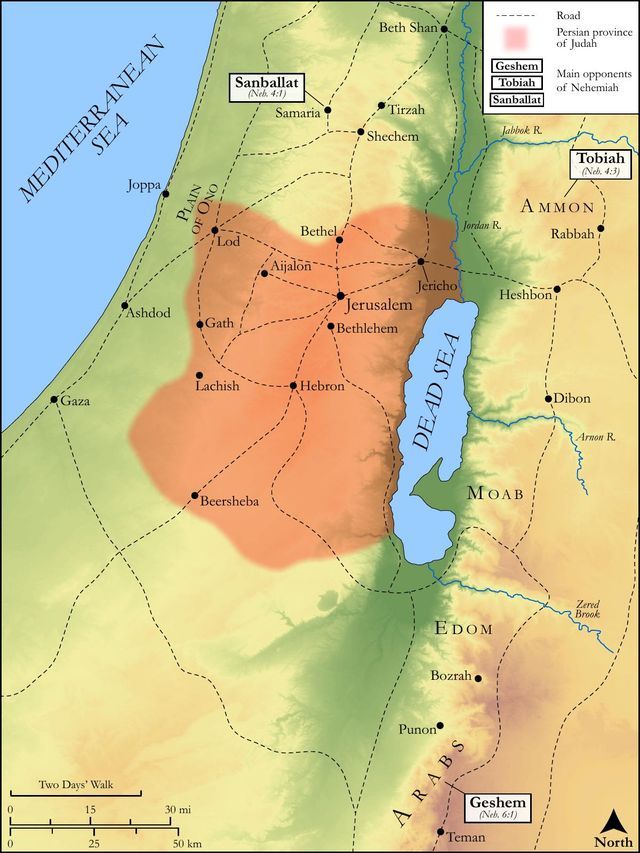
Nehemiah's governorship occurred during the Achaemenid Persian Empire's dominion over Judah, a satrapy within their vast realm. Under Persian administrative policy, provincial governors were typically entitled to substantial provisions, taxes, and allowances drawn directly from the local populace to support themselves, their extensive households, and their administrative staff. This was a customary, albeit often burdensome, practice. The period in Judah was particularly challenging; the returning exiles were engaged in the arduous and costly task of rebuilding Jerusalem's walls and city, facing not only external opposition but also internal economic hardship exacerbated by famine, heavy Persian taxation, and the general difficulties of re-establishing their society. The practice of usury, charging interest on loans, was explicitly prohibited among Israelites by Mosaic Law for loans to fellow Israelites (e.g., Exodus 22:25 and Deuteronomy 23:19-20), making the actions of the wealthy Jewish nobles a clear transgression of divine law and a profound oppression. Nehemiah's specified tenure, from the 20th to the 32nd year of Artaxerxes I (445-433 BC), underscores a remarkable and consistent period of personal sacrifice.
Key Themes
ShowHideThis verse profoundly contributes to several overarching themes within the book of Nehemiah and the broader biblical narrative. Firstly, it exemplifies Selfless Leadership and Integrity, showcasing Nehemiah's unwavering commitment to prioritizing the welfare of his people over any personal gain, standing in stark contrast to the corrupt practices of previous governors mentioned in Nehemiah 5:15. Secondly, it powerfully underscores the theme of Sacrifice for the Common Good, as Nehemiah's forfeiture of his rightful allowance not only offered tangible financial relief to the struggling populace but also served as a potent moral example for all leaders, both then and now. Thirdly, the verse highlights Justice and Righteousness, demonstrating that true leadership involves upholding ethical standards, actively combating exploitation, and pleading the cause of the vulnerable, aligning with the prophetic calls for justice found throughout the Old Testament. Finally, it subtly points to Trust in Divine Provision, as Nehemiah's actions imply a deep reliance on God for his needs rather than the entitlements of his office, reflecting a profound faith in God's ability to sustain him even in self-denial.
Exposition and Analysis
ShowHideKey Word Analysis
ShowHideThis term (H6346) refers to a Persian provincial governor, an official appointed by the king to administer a region. The office typically carried significant administrative authority, and crucially, substantial entitlements and provisions (such as food, wine, and silver) that were customarily drawn from the local populace. Nehemiah's use of this title here emphasizes the customary rights and privileges that he, by deliberate choice, chose to forgo, highlighting the magnitude of his sacrifice.
While literally meaning "bread" (H3899), in this specific context, "the bread of the governor" functions as a metonymy for the entire range of provisions, salary, allowances, and perquisites that were customarily due to a governor for his sustenance and the maintenance of his household and staff. Nehemiah's emphatic statement that he and his brethren "have not eaten" this bread signifies a complete and sustained abstention from drawing on public funds for their support, distinguishing his administration from those who exploited their position.
Verse Breakdown
ShowHide"Moreover from the time that I was appointed to be their governor in the land of Judah"
This opening clause precisely establishes the commencement of Nehemiah's official tenure and defines the specific geographical scope of his authority. It sets the crucial stage for his subsequent declaration by reminding the audience of his legitimate, entitled position, thereby magnifying the significance of his later act of self-denial.
"from the twentieth year even unto the two and thirtieth year of Artaxerxes the king, [that is], twelve years"
This highly precise chronological detail underscores the remarkable longevity and unwavering consistency of Nehemiah's self-denial. Spanning a full twelve years, this was not merely a temporary gesture or a short-term act of piety, but a sustained, decade-plus commitment. This extended period highlights the profound depth of his sacrifice and integrity over a significant and challenging period of leadership, demonstrating a steadfast character.
"I and my brethren have not eaten the bread of the governor"
This is the core, declarative statement of the verse. "I and my brethren" refers to Nehemiah himself and his immediate retinue, staff, or perhaps even his extended family who served with him. The phrase "have not eaten the bread of the governor" unequivocally states that they did not avail themselves of the official provisions, salary, or customary entitlements that were legally due to his office. This was a deliberate, significant, and sustained act of financial abstinence, profoundly underscoring Nehemiah's dedication to not burdening the people he served, especially during a time of widespread economic hardship and oppression.
Literary Devices
ShowHideNehemiah 5:14 masterfully employs several powerful literary devices to convey its message. Contrast is paramount, as Nehemiah's actions stand in stark opposition to the corrupt and exploitative practices of the previous governors and the wealthy Jewish nobles he has just condemned in the preceding verses. This sharp contrast profoundly highlights his unique moral authority and authentic leadership. The phrase "eaten the bread of the governor" is a clear example of metonymy, where "bread" serves as a representative term for the entire system of official provisions, salary, and entitlements associated with the governorship. The verse also functions as a personal testimony or public declaration, where Nehemiah transparently articulates his own ethical conduct, serving as an exemplification of the righteous and sacrificial leadership he advocates. Finally, the precise numerical detail of "twelve years" adds a strong sense of verisimilitude and underscores the sustained and unwavering nature of his sacrifice, making his integrity all the more compelling and credible to his audience.
Theological and Thematic Connections
ShowHideNehemiah's refusal to accept the customary provisions of his office transcends mere financial prudence; it is a profound theological statement on the nature of leadership and stewardship within God's covenant community. His actions demonstrate that true authority, particularly among God's people, is not to be leveraged for personal enrichment or power accumulation but is to be exercised as sacrificial service for the welfare and flourishing of the community. This aligns with a consistent biblical emphasis on seeking justice for the poor and vulnerable, and a strong condemnation of those who exploit their positions for personal gain. Nehemiah's integrity served as a powerful witness to the people and a potent rebuke to the corrupt, illustrating that genuine leadership flows from a heart committed to God's standards of righteousness, even at significant personal cost. His example prefigures the New Testament call for spiritual leaders to shepherd the flock "not for dishonest gain, but eagerly" (1 Peter 5:2).
Reflection and Application
ShowHideNehemiah's example in this verse remains profoundly relevant for all forms of leadership today, whether in government, business, or the church. It challenges us to critically re-evaluate prevailing models of leadership that often prioritize personal gain, status, or power above the well-being of those being led. Nehemiah demonstrates that authentic leadership is fundamentally characterized by self-denial, profound empathy, and a genuine willingness to bear the burdens of those under one's care. His personal sacrifice not only provided tangible relief to a struggling populace but also built immense trust and credibility, inspiring others to follow his ethical directives and participate in the rebuilding effort. For contemporary leaders, this means cultivating a spirit of stewardship over exploitation, leading by example rather than mere command, and consistently prioritizing the holistic well-being of the community over personal entitlements or comfort. It calls us to examine our own use of resources, influence, and authority, prompting us to ask whether our actions truly serve others or ourselves, and whether we are willing to make sacrifices for the greater good.
Questions for Reflection
ShowHideFAQ
ShowHideWhat does "eaten the bread of the governor" mean?
ShowHideThe phrase "eaten the bread of the governor" is an idiomatic expression that refers to receiving the official salary, provisions, or entitlements that were customarily provided to a provincial governor by the people he governed. Under the Persian administrative system, governors and their extensive households were typically supported by contributions, taxes, and allowances from the local populace, which could represent a significant financial burden on the people. Nehemiah's declaration that he and his brethren "have not eaten the bread of the governor" means they deliberately chose not to draw on these public funds for their sustenance or privileges during his entire twelve-year tenure, opting instead to support themselves.
Why was this act of self-denial so significant?
ShowHideNehemiah's act of self-denial was profoundly significant for several compelling reasons. Firstly, it demonstrated extraordinary integrity, empathy, and solidarity with the people, especially given the severe economic distress they faced, including debt, famine, and even the selling of children into slavery, as detailed in Nehemiah 5:1-5. By refusing his rightful provisions, Nehemiah not only alleviated their financial burden but also showed he truly shared in their suffering. Secondly, it sharply contrasted with the corrupt practices of previous governors, who "laid heavy burdens on the people and took from them food and wine and forty shekels of silver" (Nehemiah 5:15). Nehemiah's actions provided a powerful moral example, lending immense credibility and authority to his demands for justice and ethical conduct from the wealthy nobles he confronted. It unequivocally underscored that his leadership was for the people's benefit and God's glory, not for his own personal gain.
Christ-Centered Fulfillment
ShowHideNehemiah's sacrificial leadership, marked by his refusal of customary entitlements and his unwavering commitment to serving the people at personal cost, stands as a powerful Old Testament foreshadowing of the ultimate servant leader, Jesus Christ. While Nehemiah forfeited earthly provisions for the temporary, earthly kingdom of Judah, Jesus, though "in the form of God, did not count equality with God a thing to be grasped, but emptied himself, by taking the form of a servant, being born in the likeness of men" (Philippians 2:6-7). He did not come to be served, but to serve, and to give his life as a ransom for many (Mark 10:45). Unlike Nehemiah, who abstained from the "bread of the governor" to alleviate physical burdens, Jesus declared Himself to be the true "bread of life" (John 6:35), offering eternal sustenance that requires no payment or burden from humanity, only faith. Nehemiah's temporary, ethical sacrifice points to Christ's eternal, redemptive sacrifice, where He bore the ultimate burden of humanity's sin, not for twelve years, but for all eternity, ensuring that those who believe in Him never hunger or thirst spiritually (John 6:35) and receive life abundant.