


Nehemiah 13:6
- וּבְכָלu·ve·Kholand in allH3605Conj-w ¦ Prep-b ¦ N-msNoun Singular Masculine Absoluteוּandבְinכָלall
- זֶהzehthisH2088PrtParticle Demonstrative
- לֹאlo'notH3808NegParticle Negative
- הָיִיתִיha·Yi·tiI wasH1961V-Qal-Perf-1csVerb Qal Perfect 1st Singular common gender
- בִּירוּשָׁלִָםbi·ru·sha·Limin JerusalemH3389Prep-b ¦ N-properNoun Proper LocationבִּinירוּשָׁלִָםJerusalem
- כִּיkiforH3588PrtParticle Conditional
- בִּשְׁנַתbish·Natin yearH8141Prep-b ¦ N-fscNoun Singular Feminine Constructבִּinשְׁנַתyear
- שְׁלֹשִׁיםshe·lo·ShimthirtyH7970Adj-mpAdjective Numerical Plural Masculine Absolute
- וּשְׁתַּיִםu·she·Ta·yimand twoH8147Conj-w ¦ Adj-fdAdjective Numerical Dual Feminine Absoluteוּandשְׁתַּיִםtwo
- לְאַרְתַּחְשַׁסְתְּאle·'ar·tach·Shast'of ArtaxerxesH783Prep-l ¦ N-proper-mNoun Proper MasculineלְofאַרְתַּחְשַׁסְתְּאArtaxerxes
- מֶלֶךְMe·lekh[the] king ofH4428N-mscNoun Singular Masculine Construct
- בָּבֶלba·VelBabylonH894N-properNoun Proper Location
- בָּאתִיBa·tiI had goneH935V-Qal-Perf-1csVerb Qal Perfect 1st Singular common gender
- אֶל'eltoH413PrepPreposition
- הַמֶּלֶךְha·Me·lekhthe kingH4428Art ¦ N-msNoun Singular Masculine Absoluteהַtheמֶּלֶךְking
- וּלְקֵץu·le·Ketzand to [the] end ofH7093Conj-w ¦ Prep-l ¦ N-mscNoun Singular Masculine Constructוּandלְtoקֵץ[the] end of
- יָמִיםya·MimdaysH3117N-mpNoun Plural Masculine Absolute
- נִשְׁאַלְתִּיnish·'Al·tiI requested leave of absenceH7592V-Niphal-Perf-1csVerb Niphal Perfect 1st Singular common gender
- מִןminfromH4480PrepPreposition
- הַמֶּלֶךְha·Me·lekhthe kingH4428Art ¦ N-msNoun Singular Masculine Absoluteהַtheמֶּלֶךְking
English is a literal word-by-word gloss of the Hebrew, not the KJV's wording. Why?
This is the original text the KJV's translators worked from — each Hebrew word with its own literal English meaning in this verse, prepared by scholars at Tyndale House, Cambridge. The KJV translates whole sentences, not word by word, so its wording differs: one Hebrew word can become several English words, and the KJV may choose “the LORD” where the gloss reads “Yahweh”. Both are faithful — they answer different questions. For the KJV's own rendering, switch to the KJV text.
Details
See on the biblical-era map
Study this verse
Public-domain commentary
Matthew Henry
From his Commentary on the Whole Bible. Henry comments on passages, not single verses — this entry covers Nehemiah 13:1–9. His four-level outline is real structure in the source text, so it is rendered as structure.
It was the honour of Israel, and the greatest preservation of their holiness, that they were a peculiar people, and were so to keep themselves, and not to mingle with the nations, nor suffer any of them to incorporate with them. Now here we have,
I.The law to this purport, which happened to be read on that day, in the audience of the people (Neh 13:1), on the day of the dedication of the wall, as it should seem, for with their prayers and praises they joined the reading of the word; and though it was long after that the other grievances, here mentioned, were redressed by Nehemiah's power, yet this of the mixed multitude might be redressed then by the people's own act, for so it seems to be, Neh 13:3. Or, perhaps, it was on the anniversary commemoration of that day, some years after, and therefore said to be on that day. They found a law, that the Ammonites and Moabites should not be naturalized, should not settle among them, nor unite with them, Neh 13:1. The reason given is because they had been injurious and ill-natured to the Israel of God (Neh 13:2), had not shown them common civility, but sought their ruin, though they not only did them no harm, but were expressly forbidden to do them any. This law we have, with this reason, Deu 23:3-5.
II.The people's ready compliance with this law, Neh 13:3.
See the benefit of the public reading of the word of God; when it is duly attended to it discovers to us sin and duty, good and evil, and shows us wherein we have erred. Then we profit by the discovery when by it we are wrought upon to separate ourselves from all that evil to which we had addicted ourselves. They separated from Israel all the mixed multitude, which had of old been a snare to them, for the mixed multitude fell a lusting, Num 11:4. These inmates they expelled, as usurpers and dangerous.
III.The particular case of Tobiah, who was an Ammonite, and to whom, it is likely, the historian had an eye in the recital of the law (Neh 13:1), and the reason of it, Neh 13:2. For he had the same enmity to Israel that his ancestors had, the spirit of an Ammonite, witness his indignation at Nehemiah (Neh 2:10) and the opposition he had given to his undertakings, Neh 4:7, Neh 4:8. Observe,
1.How basely Eliashib the chief priest took this Tobiah in to be a lodger even in the courts of the temple.
(1.)He was allied to Tobiah (Neh 13:4), by marriage first and then by friendship. His grandson had married Sanballat's daughter, Neh 13:28. Probably some other of his family had married Tobiah's, and (would you think it?) the high priest thought the alliance an honour to his family, and was very proud of it, though really it was his greatest disgrace, and what he had reason to be ashamed of. It was expressly provided by the law that the high priest should marry one of his own people, else he profanes his seed among his people, Lev 21:14, Lev 21:15. And for Eliashib to contract an alliance with an Ammonite, a servant (for so he is called) and to value himself upon it, probably because he has a wit and a beau, and cried up for a fine gentleman (Neh 6:19), was such a contempt of the crown of his consecration as one would not wish should be told in Gath or published in the streets of Ashkelon.
(2.)Being allied to him, he must be acquainted with him. Tobiah, being a man of business, has often occasion to be at Jerusalem, I doubt upon no good design. Eliashib is fond of his new kinsman, pleased with his company, and must have him as near him as he can. He has not a room for him stately enough in his own apartment, in the courts of the temple; therefore, out of several little chambers which had been used for store-chambers, by taking down the partitions, he contrived to make one great chamber, a state-room for Tobiah, Neh 13:5. A wretched thing it was,
[1.]That Tobiah the Ammonite should be entertained with respect in Israel, and have a magnificent reception.
[2.]That the high priest, who should have taught the people the law and set them a good example, should, contrary to the law, give him entertainment, and make use of the power he had, as overseer of the chambers of the temple, for that purpose.
[3.]That he should lodge him in the courts of God's house, as if to confront God himself; this was next to setting up an idol there, as the wicked kings of old had done. An Ammonite must not come into the congregation; and shall one of the worst and vilest of the Ammonites be courted into the temple itself, and caressed there?
[4.]That he should throw out the stores of the temple, to make room for him, and so expose them to be lost, wasted, and embezzled, though they were the portions of the priests, merely to gratify Tobiah. Thus did he corrupt the covenant of Levi, as Malachi complained at this time, Mal 2:8. Well might Nehemiah add (Neh 13:6), But all this time was not I at Jerusalem. If he had been there, the high priest durst not have done such a thing. The envious one, who sows tares in God's field, knows how to take an opportunity to do it when the servants sleep or are absent, Mat 13:25. The golden calf was made when Moses was in the mount.
2.How bravely Nehemiah, the chief governor, threw him out, and all that belonged to him, and restored the chambers to their proper use. When he came to Jerusalem, and was informed by the good people who were troubled at it what an intimacy had grown between their chief priest and their chief enemy, it grieve him sorely (Neh 13:7, Neh 13:8) that God's house should be so profaned, his enemies so caressed and trusted, and his cause betrayed by him that should have been its protector and patron. Nothing grieves a good man, a good magistrate, more than to see the ministers of God's house do any wicked thing. Nehemiah has power and he will use it for God.
(1.)Tobiah shall be expelled. He fears not disobliging him, fears not his resentments, or Eliashib's, nor excuses himself from interposing in an affair that lay within the jurisdiction of the high priest; but, like one zealously affected in a good thing, he expels the intruder, by casting forth all his household stuff. He did not seize it for his own use, but cast it out, that Tobiah, who it is probable was now absent, when he came again, might have no conveniences for his reception there. Our Saviour thus cleansed the temple, that the house of prayer might not be a den of thieves. And thus those that would expel sin out of their hearts, those living temples, must throw out its household stuff and all the provision made for it, strip it, starve it, and take away all those things that are the food and fuel of lust; this is, in effect, to mortify it.
(2.)The temple stores shall be brought in again, and the vessels of the house of God put in their places; but the chambers must first be sprinkled with the water of purification, and so cleansed, because they had been profaned. Thus, when sin is cast out of the heart by repentance, let the blood of Christ be applied to it by faith, and then let it be furnished with the graces of God's Spirit for every good work.
Continue studying Nehemiah 13:6 across the web’s major study libraries — every link below opens this exact verse, chapter, or book on the destination site.
Read & Compare
 BibleGatewayThis verse in more than 200 translations and 70 languages.
 Bible.comThe YouVersion reader — hundreds of translations, reading plans, and highlights.
 ESV.orgCrossway's official English Standard Version reader.
 NET BibleThe NET translation with 60,000+ translators' notes on every rendering decision.
 STEP BibleTyndale House's free study tool — original text, vocabulary, and scholarly resources.
 BibliaLogos Bible Software's free web reader.
 USCCBThe New American Bible (Revised Edition) with the U.S. bishops' study notes.
Commentaries
 BibleHub CommentariesDozens of classic commentaries on this verse, gathered on one page.
 StudyLightMore than 100 commentary sets — the largest collection on the web.
 BibleRefPlain-English commentary on what this verse means, verse by verse.
 Enduring WordDavid Guzik's free commentary on this chapter, widely used by Bible teachers.
 Bible Study ToolsVerse commentary alongside Greek and Hebrew study aids.
Original Language & Research
- BibleHub InterlinearThe verse word by word — original language, transliteration, and English.
- BibleHub LexiconEvery word's original-language definition and Strong's entry.
 Blue Letter BibleDeep-study tools — Strong's numbers, concordance, and word studies.
 SefariaThe Hebrew text with Rashi and centuries of Jewish commentary.
Sermons, Hymns & Audio


TrulyRandomVerse is not affiliated with these sites and doesn’t control their content. They’re linked because they’re genuinely useful.
Summary
Nehemiah 13:6 serves as a crucial narrative pivot, explaining Nehemiah's temporary absence from Jerusalem and his mandated return to King Artaxerxes in Susa. This verse elucidates the critical twelve-year period during which the spiritual and moral reforms he had painstakingly established began to unravel, setting the stage for the urgent and decisive actions he would undertake upon his subsequent return to Judah, thereby highlighting both his accountability to the Persian monarch and God's sovereign orchestration of events for the continued restoration of His people.
Context
ShowHideLiterary Context
Nehemiah 13:6 functions as a significant narrative transition within the book of Nehemiah. The preceding chapters (Nehemiah 8-12) meticulously detail Nehemiah's initial arrival in Jerusalem, the successful completion of the city walls, and the implementation of extensive spiritual and reforms, including the public reading of the Law, a profound covenant renewal ceremony, and the establishment of proper temple procedures and support for the Levites. These chapters depict a period of remarkable spiritual revival and communal order. Verse 6, by noting Nehemiah's departure from Jerusalem, provides the essential explanation for the rapid decline and widespread abuses that subsequently emerged. It directly precedes the detailed catalogue of backsliding—such as the defilement of the Temple by Tobiah, the neglect of tithes leading to the abandonment of the Levites, widespread Sabbath breaking, and the resurgence of forbidden intermarriage—that Nehemiah discovers and rigorously confronts upon his return, initiating a second, more forceful wave of reforms described throughout Nehemiah 13.
Historical & Cultural Context
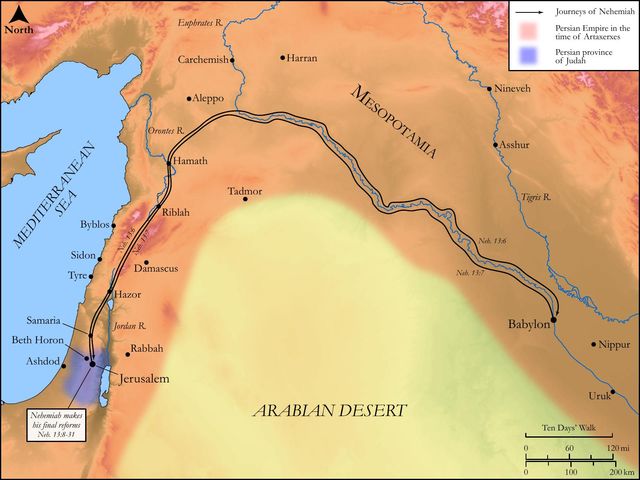
Nehemiah's initial commission from King Artaxerxes I, granted in the 20th year of his reign (c. 445 BC), was for a specific, though initially unstated, duration (Nehemiah 2:6). Verse 6 reveals that Nehemiah returned to Artaxerxes in the 32nd year of his reign, which corresponds to approximately 433/432 BC. This indicates that Nehemiah had served as governor in Jerusalem for about twelve years. Persian administrative policy typically required provincial governors to periodically return to the royal court to report on their activities, renew their commissions, and ensure their continued loyalty to the king. This practice was crucial for maintaining control over the vast Achaemenid Empire. The reference to Artaxerxes as "king of Babylon" is a customary royal title adopted by Persian monarchs after their conquest of the Neo-Babylonian Empire (539 BC), signifying their legitimate dominion over that historically significant territory, rather than indicating a change in the Persian capital or a shift in power dynamics. Nehemiah's departure created a leadership vacuum, allowing the spiritual and social decay to take root among the Jewish community, particularly among the very leaders who had previously committed to upholding the covenant in Nehemiah 10.
Key Themes
ShowHideThis verse subtly underscores several profound themes. Firstly, it highlights the accountability of leadership, demonstrating that even those serving God's purposes are often subject to earthly authorities, as Nehemiah dutifully returned to his patron king. Secondly, it implicitly emphasizes the critical importance of consistent, vigilant leadership in maintaining spiritual integrity and communal righteousness. Nehemiah's absence directly correlates with the community's swift decline, illustrating the fragility of reforms without sustained oversight and the human tendency to drift from covenant obligations when watchful leadership is removed. This echoes prophetic warnings against spiritual complacency and the dire need for faithful shepherds, as powerfully articulated in passages like Ezekiel 34. Finally, the verse subtly points to divine providence, as Nehemiah's return to the king was not merely a bureaucratic duty but also a divinely orchestrated event that allowed him to secure permission to return to Jerusalem, thus enabling God's continued work of restoration and purification among His people, preventing complete apostasy and fulfilling His covenant promises, as seen in Deuteronomy 30:1-10.
Exposition and Analysis
ShowHideKey Word Analysis
ShowHideVerse Breakdown
ShowHide"But in all this [time] was not I at Jerusalem:"
This opening clause immediately establishes Nehemiah's physical absence from Jerusalem during the period when the spiritual and social decline, detailed in the subsequent verses of chapter 13, began to manifest. The phrase "in all this [time]" refers to the duration of the abuses (e.g., Tobiah's presence in the Temple, neglect of tithes, Sabbath desecration), highlighting the direct correlation between Nehemiah's departure and the community's backsliding from the covenant.
"for in the two and thirtieth year of Artaxerxes king of Babylon came I unto the king,"
This clause provides the precise chronological marker for Nehemiah's return to the Persian court. The 32nd year of Artaxerxes I (c. 433/432 BC) indicates that Nehemiah had been in Jerusalem for approximately twelve years since his initial appointment in the 20th year of Artaxerxes (c. 445 BC). His journey "unto the king" implies a return to Susa, the Persian capital, fulfilling his administrative obligations as a royal official and governor.
"and after certain days obtained I leave of the king:"
This final clause reveals the crucial outcome of Nehemiah's visit to Artaxerxes: he successfully petitioned for and received official permission to return to Jerusalem. The phrase "after certain days" suggests a period of waiting, negotiation, or perhaps deliberation on the king's part, during which Nehemiah likely presented his case for returning to Judah. This demonstrates God's continued favor upon Nehemiah and His people, as the king's permission was absolutely essential for Nehemiah to resume his vital work of restoration and spiritual purification.
Literary Devices
ShowHideNehemiah 13:6 employs several subtle but effective literary devices that enhance its narrative and thematic impact. It functions as a Narrative Shift, marking a distinct transition from the triumphant accounts of wall rebuilding and covenant renewal (Nehemiah 8-12) to the stark reality of spiritual decline and the urgent need for renewed reform (Nehemiah 13). This verse provides the crucial explanation for why things went wrong, acting as a powerful Causal Link between Nehemiah's absence and the subsequent problems that plagued the community. There is also an Implicit Contrast established: the order, devotion, and adherence to the Law meticulously described in earlier chapters are implicitly contrasted with the disorder, apostasy, and moral decay that flourished in Nehemiah's absence, thereby highlighting the indispensable role of his vigilant leadership. Finally, the verse contains an element of Foreshadowing, as Nehemiah's successful "obtaining leave of the king" subtly anticipates his imminent return to Jerusalem and the dramatic, confrontational actions he is about to undertake to purge the entrenched evils he discovers.
Theological and Thematic Connections
ShowHideNehemiah 13:6 profoundly illustrates the enduring theological truth that spiritual vigilance and faithful, consistent leadership are indispensable for maintaining covenant fidelity within a community. Nehemiah's temporary absence created a vacuum that allowed the seeds of apostasy and compromise to sprout rapidly, demonstrating the human propensity to drift from God's standards without consistent accountability and strong, godly oversight. This highlights the ongoing need for both individual and communal commitment to the covenant, recognizing that initial reforms, no matter how profound, require sustained effort and a willingness to confront sin when it resurfaces. The verse also underscores God's sovereign hand in human affairs, as He providentially orchestrated Nehemiah's return to the king and his subsequent re-commissioning, ensuring that His purposes for His people in Jerusalem would continue to be fulfilled despite their failings and the challenges they faced.
Reflection and Application
ShowHideNehemiah 13:6 serves as a potent reminder for believers today about the critical importance of sustained spiritual vigilance, both personally and communally. Just as Nehemiah's absence led to a rapid decline in Jerusalem, our own spiritual lives and the health of our communities can falter without consistent attention to God's Word, active participation in righteous living, and faithful, watchful leadership. This verse challenges us to consider whether we are merely passive observers or active participants in upholding biblical standards and maintaining spiritual integrity. It emphasizes that spiritual reforms, once initiated, require ongoing commitment and diligent maintenance, not just a one-time effort. We are called to be vigilant stewards of our faith, recognizing that spiritual health demands continuous effort, a willingness to confront sin and compromise, and a readiness to return to God's standards when we stray. This commitment aligns with the New Testament call to "walk circumspectly, not as fools but as wise, making the most of the time" (Ephesians 5:15-16), understanding that spiritual complacency is a dangerous path that can quickly lead to decay.
Questions for Reflection
ShowHideFAQ
ShowHideWhy is Artaxerxes called "king of Babylon" when Persia was the dominant power?
ShowHideThe title "king of Babylon" for Artaxerxes I is a reflection of the Persian Empire's vastness and its administrative practices. After Cyrus the Great conquered Babylon in 539 BC, Persian kings often adopted the titles of previous rulers of conquered territories, particularly prestigious ones like Babylon, to legitimize their rule and assert their dominion over that significant region. This was a common practice among ancient Near Eastern monarchs to signify universal sovereignty. It does not mean that Babylon was the capital of Persia or that there was a shift in power, but rather highlights Artaxerxes' claim to rule over all the former Neo-Babylonian territories, including Judah.
How long was Nehemiah absent from Jerusalem, and why is this significant?
ShowHideNehemiah was absent from Jerusalem for an unspecified period after his initial twelve years of governorship. He returned to King Artaxerxes in the 32nd year of the king's reign (c. 433/432 BC), having initially arrived in Jerusalem in the 20th year (c. 445 BC). The significance of his absence lies in the rapid spiritual and moral decline that occurred in Jerusalem during this time. Without Nehemiah's vigilant leadership, the reforms he had painstakingly implemented began to unravel, leading to issues like the defilement of the Temple, neglect of the Levites, Sabbath breaking, and intermarriage (as detailed in Nehemiah 13:7-31). This underscores the critical role of consistent, godly leadership in maintaining the spiritual health and covenant fidelity of a community.
Christ-Centered Fulfillment
ShowHideNehemiah 13:6, while detailing a specific historical event, profoundly points forward to the ultimate and perfect "return" of a greater Governor: Jesus Christ. Nehemiah's temporary departure from Jerusalem and subsequent return to the king to "obtain leave" to come back to his people foreshadows Christ's ascension to the Father and His promised second coming. Just as Nehemiah left Jerusalem for a time, entrusting the community to its established leaders, so too did Jesus ascend to heaven after His earthly ministry, leaving His disciples with the Great Commission and the empowering presence of the Holy Spirit (Acts 1:8-9). During Nehemiah's absence, the community in Jerusalem began to backslide, illustrating the human tendency toward spiritual drift and compromise without the immediate, visible presence of a strong, righteous leader. Similarly, in the "absence" of Christ's physical presence, the Church is called to remain vigilant and faithful, resisting the temptations of the world and the decay of spiritual compromise (1 Peter 5:8). However, unlike Nehemiah who had to "obtain leave" from an earthly king, Christ's return is sovereignly determined and absolutely assured by His divine authority (John 14:3). His present intercession at the right hand of God (Romans 8:34) ensures that His people are sustained and preserved until His glorious return, when He will fully and finally restore all things, bringing an end to all spiritual compromise and establishing His eternal kingdom in perfect righteousness and peace (Revelation 21:1-5).