


Nehemiah 13:3
- וַיְהִיvay·Hiand it wasH1961Conj-w ¦ V-Qal-ConsecImperf-3msVerb Qal Consecutive Imperfect 3rd Singular Masculineוַandיְהִיit was
- כְּשָׁמְעָםke·sha·me·'Amwhen they heardH8085Prep-k ¦ V-Qal-Inf ¦ 3mpVerb Qal Infinitive Constructכְּwhenשָׁמְעָheardםthey
- אֶת'et<obj.>H853DirObjMParticle Object Indicator
- הַתּוֹרָהha·to·Rahthe lawH8451Art ¦ N-fsNoun Singular Feminine Absoluteהַtheתּוֹרָהlaw
- וַיַּבְדִּילוּvai·yav·Di·luand they separatedH914Conj-w ¦ V-Hiphil-ConsecImperf-3mpVerb Hiphil Consecutive Imperfect 3rd Plural Masculineוַandיַּבְדִּילוּthey separated
- כָלkholeveryH3605N-mscNoun Singular Masculine Construct
- עֵרֶב'E·revperson of mixed ancestryH6154N-msNoun Singular Masculine Absolute
- מִיִּשְׂרָאֵלmi·Yis·ra·'Elfrom IsraelH3478Prep-m ¦ N-properNoun Proper LocationמִfromיִּשְׂרָאֵלIsrael
English is a literal word-by-word gloss of the Hebrew, not the KJV's wording. Why?
This is the original text the KJV's translators worked from — each Hebrew word with its own literal English meaning in this verse, prepared by scholars at Tyndale House, Cambridge. The KJV translates whole sentences, not word by word, so its wording differs: one Hebrew word can become several English words, and the KJV may choose “the LORD” where the gloss reads “Yahweh”. Both are faithful — they answer different questions. For the KJV's own rendering, switch to the KJV text.
Details
See on the biblical-era map
Study this verse
Public-domain commentary
Matthew Henry
From his Commentary on the Whole Bible. Henry comments on passages, not single verses — this entry covers Nehemiah 13:1–9. His four-level outline is real structure in the source text, so it is rendered as structure.
It was the honour of Israel, and the greatest preservation of their holiness, that they were a peculiar people, and were so to keep themselves, and not to mingle with the nations, nor suffer any of them to incorporate with them. Now here we have,
I.The law to this purport, which happened to be read on that day, in the audience of the people (Neh 13:1), on the day of the dedication of the wall, as it should seem, for with their prayers and praises they joined the reading of the word; and though it was long after that the other grievances, here mentioned, were redressed by Nehemiah's power, yet this of the mixed multitude might be redressed then by the people's own act, for so it seems to be, Neh 13:3. Or, perhaps, it was on the anniversary commemoration of that day, some years after, and therefore said to be on that day. They found a law, that the Ammonites and Moabites should not be naturalized, should not settle among them, nor unite with them, Neh 13:1. The reason given is because they had been injurious and ill-natured to the Israel of God (Neh 13:2), had not shown them common civility, but sought their ruin, though they not only did them no harm, but were expressly forbidden to do them any. This law we have, with this reason, Deu 23:3-5.
II.The people's ready compliance with this law, Neh 13:3.
See the benefit of the public reading of the word of God; when it is duly attended to it discovers to us sin and duty, good and evil, and shows us wherein we have erred. Then we profit by the discovery when by it we are wrought upon to separate ourselves from all that evil to which we had addicted ourselves. They separated from Israel all the mixed multitude, which had of old been a snare to them, for the mixed multitude fell a lusting, Num 11:4. These inmates they expelled, as usurpers and dangerous.
III.The particular case of Tobiah, who was an Ammonite, and to whom, it is likely, the historian had an eye in the recital of the law (Neh 13:1), and the reason of it, Neh 13:2. For he had the same enmity to Israel that his ancestors had, the spirit of an Ammonite, witness his indignation at Nehemiah (Neh 2:10) and the opposition he had given to his undertakings, Neh 4:7, Neh 4:8. Observe,
1.How basely Eliashib the chief priest took this Tobiah in to be a lodger even in the courts of the temple.
(1.)He was allied to Tobiah (Neh 13:4), by marriage first and then by friendship. His grandson had married Sanballat's daughter, Neh 13:28. Probably some other of his family had married Tobiah's, and (would you think it?) the high priest thought the alliance an honour to his family, and was very proud of it, though really it was his greatest disgrace, and what he had reason to be ashamed of. It was expressly provided by the law that the high priest should marry one of his own people, else he profanes his seed among his people, Lev 21:14, Lev 21:15. And for Eliashib to contract an alliance with an Ammonite, a servant (for so he is called) and to value himself upon it, probably because he has a wit and a beau, and cried up for a fine gentleman (Neh 6:19), was such a contempt of the crown of his consecration as one would not wish should be told in Gath or published in the streets of Ashkelon.
(2.)Being allied to him, he must be acquainted with him. Tobiah, being a man of business, has often occasion to be at Jerusalem, I doubt upon no good design. Eliashib is fond of his new kinsman, pleased with his company, and must have him as near him as he can. He has not a room for him stately enough in his own apartment, in the courts of the temple; therefore, out of several little chambers which had been used for store-chambers, by taking down the partitions, he contrived to make one great chamber, a state-room for Tobiah, Neh 13:5. A wretched thing it was,
[1.]That Tobiah the Ammonite should be entertained with respect in Israel, and have a magnificent reception.
[2.]That the high priest, who should have taught the people the law and set them a good example, should, contrary to the law, give him entertainment, and make use of the power he had, as overseer of the chambers of the temple, for that purpose.
[3.]That he should lodge him in the courts of God's house, as if to confront God himself; this was next to setting up an idol there, as the wicked kings of old had done. An Ammonite must not come into the congregation; and shall one of the worst and vilest of the Ammonites be courted into the temple itself, and caressed there?
[4.]That he should throw out the stores of the temple, to make room for him, and so expose them to be lost, wasted, and embezzled, though they were the portions of the priests, merely to gratify Tobiah. Thus did he corrupt the covenant of Levi, as Malachi complained at this time, Mal 2:8. Well might Nehemiah add (Neh 13:6), But all this time was not I at Jerusalem. If he had been there, the high priest durst not have done such a thing. The envious one, who sows tares in God's field, knows how to take an opportunity to do it when the servants sleep or are absent, Mat 13:25. The golden calf was made when Moses was in the mount.
2.How bravely Nehemiah, the chief governor, threw him out, and all that belonged to him, and restored the chambers to their proper use. When he came to Jerusalem, and was informed by the good people who were troubled at it what an intimacy had grown between their chief priest and their chief enemy, it grieve him sorely (Neh 13:7, Neh 13:8) that God's house should be so profaned, his enemies so caressed and trusted, and his cause betrayed by him that should have been its protector and patron. Nothing grieves a good man, a good magistrate, more than to see the ministers of God's house do any wicked thing. Nehemiah has power and he will use it for God.
(1.)Tobiah shall be expelled. He fears not disobliging him, fears not his resentments, or Eliashib's, nor excuses himself from interposing in an affair that lay within the jurisdiction of the high priest; but, like one zealously affected in a good thing, he expels the intruder, by casting forth all his household stuff. He did not seize it for his own use, but cast it out, that Tobiah, who it is probable was now absent, when he came again, might have no conveniences for his reception there. Our Saviour thus cleansed the temple, that the house of prayer might not be a den of thieves. And thus those that would expel sin out of their hearts, those living temples, must throw out its household stuff and all the provision made for it, strip it, starve it, and take away all those things that are the food and fuel of lust; this is, in effect, to mortify it.
(2.)The temple stores shall be brought in again, and the vessels of the house of God put in their places; but the chambers must first be sprinkled with the water of purification, and so cleansed, because they had been profaned. Thus, when sin is cast out of the heart by repentance, let the blood of Christ be applied to it by faith, and then let it be furnished with the graces of God's Spirit for every good work.
Historical interpretation
Historical reception
1 surviving comment on this verse from the historical church.
Now it came to pass when they heard the law, etc. Hearing the law about the two enemy nations to be anathematized, the faithful people immediately separated all foreigners from themselves; because it is necessary for us to attend to the hearing of the truth in such a way that when we are prohibited by divine reading from any single vice, we immediately purge not only that particular vice concerning which the discourse may have occurred, but also everything whatsoever of vice we find soiling us, both from our actions and our conscience.
Continue studying Nehemiah 13:3 across the web’s major study libraries — every link below opens this exact verse, chapter, or book on the destination site.
Read & Compare
 BibleGatewayThis verse in more than 200 translations and 70 languages.
 Bible.comThe YouVersion reader — hundreds of translations, reading plans, and highlights.
 ESV.orgCrossway's official English Standard Version reader.
 NET BibleThe NET translation with 60,000+ translators' notes on every rendering decision.
 STEP BibleTyndale House's free study tool — original text, vocabulary, and scholarly resources.
 BibliaLogos Bible Software's free web reader.
 USCCBThe New American Bible (Revised Edition) with the U.S. bishops' study notes.
Commentaries
 BibleHub CommentariesDozens of classic commentaries on this verse, gathered on one page.
 StudyLightMore than 100 commentary sets — the largest collection on the web.
 BibleRefPlain-English commentary on what this verse means, verse by verse.
 Enduring WordDavid Guzik's free commentary on this chapter, widely used by Bible teachers.
 Bible Study ToolsVerse commentary alongside Greek and Hebrew study aids.
Original Language & Research
- BibleHub InterlinearThe verse word by word — original language, transliteration, and English.
- BibleHub LexiconEvery word's original-language definition and Strong's entry.
 Blue Letter BibleDeep-study tools — Strong's numbers, concordance, and word studies.
 SefariaThe Hebrew text with Rashi and centuries of Jewish commentary.
Sermons, Hymns & Audio


TrulyRandomVerse is not affiliated with these sites and doesn’t control their content. They’re linked because they’re genuinely useful.
Summary
Nehemiah 13:3 records the immediate and decisive action of the post-exilic community in Jerusalem to separate themselves from "all the mixed multitude" upon hearing the specific prohibitions of God's Law. This act of purification was a direct response to Nehemiah's reforms, aiming to restore the spiritual integrity and covenantal distinctiveness of Israel by removing foreign elements that threatened their devotion and identity as God's chosen people, thereby safeguarding their unique relationship with Yahweh.
Context
ShowHideLiterary Context
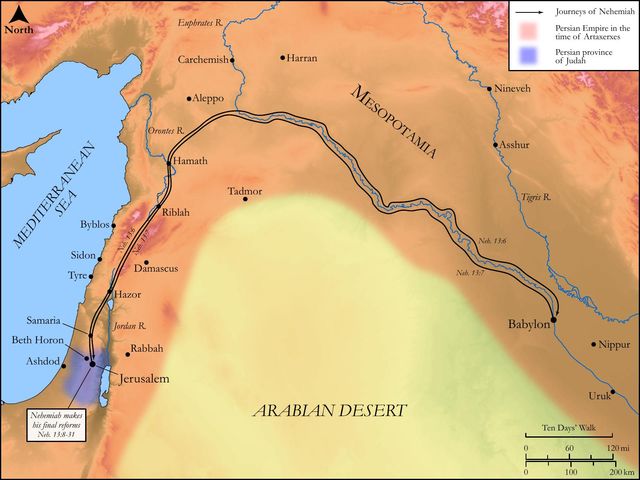
Nehemiah 13:3 is situated within the concluding chapter of the book of Nehemiah, which chronicles Nehemiah's second governorship and his vigorous efforts to rectify the spiritual and social backsliding that had occurred during his absence from Jerusalem. Chapters 8-10 detail a significant period of spiritual revival, marked by a solemn covenant renewal and a communal pledge of obedience to the Law. However, upon his return to Jerusalem, likely after 433 BC as indicated in Nehemiah 13:6, Nehemiah discovered widespread compromises. These included the egregious desecration of the temple by Tobiah the Ammonite (Nehemiah 13:4-9), the neglect of financial support for the Levites (Nehemiah 13:10-14), rampant Sabbath desecration (Nehemiah 13:15-22), and pervasive intermarriage with foreign women (Nehemiah 13:23-27). The specific "law" heard by the people in Nehemiah 13:1-2 explicitly forbade Ammonites and Moabites from entering the assembly of the Lord, directly preceding and prompting the decisive action described in verse 3. Thus, this verse represents an initial, pivotal step in Nehemiah's renewed campaign to purify the covenant community and restore its fidelity.
Historical & Cultural Context
The post-exilic period, following the return from Babylonian captivity (after 538 BC), was a crucial era for the Jewish people, as they sought to re-establish their national and religious identity under the Mosaic Covenant. While the Persian Empire, which governed Judea, granted a degree of autonomy, allowing for the rebuilding of the temple and city walls, the surrounding peoples—such as the Ammonites, Moabites, Samaritans, and Ashdodites—frequently opposed these efforts and exerted significant cultural and religious pressure. The "mixed multitude" refers to non-Israelites who had either settled among the Jews or had intermarried with them. Historically, the Law, particularly Deuteronomy 23:3-6, explicitly prohibited Ammonites and Moabites from entering "the assembly of the Lord forever," citing their historical hostility towards Israel during the Exodus and their hiring of Balaam to curse them. This prohibition underscored the imperative of maintaining the purity of Israel's worship and covenant relationship with Yahweh, as foreign influences consistently led to idolatry and syncretism, which had been a primary catalyst for their previous exile.
Key Themes
ShowHideThis verse powerfully illustrates several key themes central to the book of Nehemiah and the broader Old Testament narrative. Firstly, Obedience to God's Word is paramount; the immediate separation demonstrates that hearing the Law was not merely an intellectual exercise but a call to decisive action and practical application. This echoes the fundamental covenantal call for Israel to live by God's statutes, as seen throughout the book of Deuteronomy. Secondly, the Purity of the Covenant Community is a driving concern. The separation of the "mixed multitude" was a crucial step in preserving Israel's spiritual and national identity, protecting the covenant people from the corrupting influences of idolatry and practices contrary to God's commands, which foreign associations often brought. This theme is deeply rooted in the concept of Israel as a "holy nation" set apart for God (Exodus 19:6). Finally, the principle of Separation for Holiness is emphasized. This act underscores the biblical imperative to distance oneself from influences that would compromise one's devotion to God, ensuring that Israel remained distinct and undefiled in their worship and way of life, a principle reiterated in passages like Leviticus 11:44-45.
Exposition and Analysis
ShowHideKey Word Analysis
ShowHideThis Hebrew verb implies more than passive hearing; it denotes active listening with the intent to obey. In the biblical context, "hearing" the law often carries the expectation of a responsive action, a commitment to live according to its precepts. It signifies a receptive heart and mind that acknowledges the divine authority of the word spoken, leading to practical compliance.
This verb means "to divide," "to distinguish," or "to set apart." It is the same root used in the creation account where God "separated" light from darkness (Genesis 1:4) and waters from waters (Genesis 1:6-7). Here, it signifies a deliberate and decisive act of distinguishing the covenant community from those who posed a spiritual threat, emphasizing the importance of distinctness and purity for Israel's identity and their covenant fidelity.
This term literally means "a mixture" or "mongrel race." It first appears in Exodus 12:38, referring to the non-Israelites who joined the Exodus from Egypt. While some may have sincerely joined Israel's faith, historically, this "mixed multitude" often became a source of trouble and rebellion, contributing to spiritual decline, as seen in their craving for other foods and leading Israel into sin in Numbers 11:4. In Nehemiah, it refers to those foreign elements within the community who were not fully committed to the covenant and whose presence, especially through intermarriage, threatened the spiritual integrity and distinctness of the people of Israel.
Verse Breakdown
ShowHide"Now it came to pass, when they had heard the law,"
This opening clause establishes the immediate catalyst for the subsequent action. The people's response was not arbitrary but directly prompted by the public reading and understanding of God's revealed will, specifically the prohibitions concerning foreign elements detailed in Nehemiah 13:1-2. This highlights the authoritative power of the Word of God as the foundational basis for communal action and reform, demonstrating that true hearing leads to responsive obedience.
"that they separated from Israel"
This phrase describes the decisive and collective action taken by the community. The verb "separated" (וַיַּבְדִּילוּ) implies a deliberate and active process of drawing a clear line, distinguishing between those who belonged to the covenant community and those who did not, based on the explicit criteria of the Law. This was a communal act of purification, reflecting a renewed commitment to their covenant identity and holiness.
"all the mixed multitude."
This specifies the target of the separation. It refers to the non-Israelite elements within the community who, by their presence and influence (especially through intermarriage and the introduction of foreign practices), compromised Israel's distinct covenant identity and spiritual purity. The term encompasses those who, though living among Israel, were not fully integrated into the covenant faith and posed a significant threat to its integrity and the people's exclusive devotion to Yahweh.
Literary Devices
ShowHideThe verse primarily employs Cause and Effect, where the hearing of the Law (the cause) directly leads to the separation of the mixed multitude (the effect), powerfully emphasizing the transformative and commanding power of divine revelation when met with genuine obedience. The act of "separation" itself functions as potent Symbolism, representing the community's renewed commitment to holiness and distinctness in their covenant relationship with God. It visually underscores the theological principle of being "set apart" for Yahweh, reflecting His own holy character. Furthermore, the narrative action serves as a Didactic Example, illustrating for future generations the paramount importance of adhering to God's commands regarding purity and the inherent dangers of compromise with foreign influences that threaten spiritual integrity. The phrase "mixed multitude" also carries significant Intertextual Allusion, directly referencing the similar group that accompanied Israel out of Egypt, subtly reminding the reader of the historical challenges this group posed to Israel's faithfulness and the recurring need for vigilance against spiritual dilution.
Theological and Thematic Connections
ShowHideNehemiah 13:3 stands as a powerful testament to the enduring biblical principle of separation for holiness. Theologically, it underscores God's consistent call for His people to be distinct, set apart from the nations and their practices, in order to maintain a pure worship and an unadulterated covenant relationship. This is not merely an ethnic or social segregation, but a profound spiritual one, aimed at preserving the integrity of their faith and preventing the syncretism that historically led Israel astray from their exclusive devotion to Yahweh. The immediate obedience of the people demonstrates the dynamic relationship between divine revelation and human response, where hearing God's Word necessitates decisive action to align life with His will. This commitment to purity reflects God's own holy character, inviting His people to reflect His nature in their communal life and to guard the sanctity of their covenant.
Reflection and Application
ShowHideNehemiah 13:3 offers profound and enduring lessons for contemporary believers and communities. Just as the Israelites were called to a radical act of separation based on God's revealed Law, we too are called to discern and separate ourselves from influences that compromise our devotion to Christ and the purity of our faith. This does not imply physical isolation from the world, but rather a spiritual and moral distinctness. It challenges us to critically examine our associations, entertainment, values, and practices, ensuring they align with biblical truth rather than worldly standards. For Christian communities, it emphasizes the vital importance of upholding biblical standards, exercising spiritual discernment, and safeguarding the spiritual health of the fellowship by addressing practices or influences that contradict God's revealed will. True obedience to God's Word often requires courageous, sometimes uncomfortable, action to maintain holiness and protect the integrity of the body of Christ, ensuring that our collective witness remains unblemished.
Questions for Reflection
ShowHideFAQ
ShowHideWas this act of separation xenophobic or racist?
ShowHideFrom a biblical perspective, the separation described in Nehemiah 13:3 was not primarily about ethnicity or race in a modern sense, but about religious and covenantal purity. The Law's prohibitions against certain groups like the Ammonites and Moabites (Deuteronomy 23:3-6) were rooted in their historical hostility towards Israel and their pagan religious practices, which posed a direct threat to Israel's unique covenant relationship with Yahweh. The "mixed multitude" represented those who, despite living among Israel, were not committed to the God of Israel and whose foreign practices (especially through intermarriage) led to idolatry and moral compromise, as seen in Nehemiah 13:23-27. The intent was to protect the spiritual integrity of the covenant community, not to promote racial prejudice. Indeed, individuals from any nation who genuinely converted and embraced the God of Israel, like Ruth the Moabitess (Ruth 1:16), were welcomed into the assembly and became part of Israel.
Christ-Centered Fulfillment
ShowHideWhile Nehemiah 13:3 describes a physical and communal separation to maintain Old Covenant purity, it finds its ultimate fulfillment and spiritual transformation in Christ. The Law's demand for a "separated" people, free from defiling influences, foreshadows the spiritual purity achieved not by human effort or physical expulsion, but by the atoning work of Jesus Christ. He is the ultimate purifier, whose precious blood cleanses us from all sin (1 John 1:7) and makes us holy. In the New Covenant, the "assembly of the Lord" is the Church, a spiritual body comprising people from "every tribe and language and people and nation" (Revelation 5:9) who are united in Christ. The call to "separation" for believers is no longer primarily a physical removal from non-believers, but a spiritual separation from the sin and corrupting values of the world system (Romans 12:2). Christ himself prayed not that His disciples would be taken out of the world, but that they would be kept from the evil one (John 17:15). Through faith in Him, we are made holy and set apart for God's purposes, becoming a "holy nation, a people for his own possession" (1 Peter 2:9), thus fulfilling the spirit of the Law's demand for purity in a new and greater way.