


Nehemiah 6:19
Bible text: King James Version (1769 Blayney text) · Public domain
Bible text: Berean Standard Bible · Public domain
Bible text: American Standard Version (1901) · Public domain
Bible text: World English Bible, Messianic edition · Public domain
Bible text: Geneva Bible (1599) · Public domain
Bible text: Young's Literal Translation · Public domain
- גַּםgamalsoH1571AdvAdverb
- טוֹבֹתָיוto·o·Tavhis good deedsH2896N-fpc ¦ 3msNoun Plural Feminine Constructטוֹבֹתָיgood deedsוhis
- הָיוּha·Yuthey wereH1961V-Qal-Perf-3cpVerb Qal Perfect 3rd Plural common gender
- אֹמְרִים'o·me·RimtellingH559V-Qal-Prtcpl-mpVerb Qal Participle Plural Masculine Absolute
- לְפָנַיle·fa·Nai<to> before meH6440Prep-l ¦ N-mpc ¦ 1csNoun Plural Masculine Constructלְ<to>פָנַbeforeיme
- וּדְבָרַיu·de·va·Raiand my wordsH1697Conj-w ¦ N-mpc ¦ 1csNoun Plural Masculine Constructוּandדְבָרַwordsיmy
- הָיוּha·Yuthey wereH1961V-Qal-Perf-3cpVerb Qal Perfect 3rd Plural common gender
- מוֹצִיאִיםmo·tzi·'Imsending outH3318V-Hiphil-Prtcpl-mpVerb Hiphil Participle Plural Masculine Absolute
- לוֹloto himPrep-l ¦ 3msSuffix Personal 3rd Singular Masculineלtoוֹhim
- אִגְּרוֹת'i·ge·RotlettersH107N-fpNoun Plural Feminine Absolute
- שָׁלַחsha·Lachhe sentH7971V-Qal-Perf-3msVerb Qal Perfect 3rd Singular Masculine
- טוֹבִיָּהtoi·YahTobiahH2900N-proper-mNoun Proper Masculine
- לְיָרְאֵנִיle·Ya·re·'E·nito make afraid meH3372Prep-l ¦ V-Piel-Inf ¦ 1csVerb Piel Infinitive Constructלְtoיָרְאֵmake afraidנִיme
English is a literal word-by-word gloss of the Hebrew, not the KJV's wording. Why?
This is the original text the KJV's translators worked from — each Hebrew word with its own literal English meaning in this verse, prepared by scholars at Tyndale House, Cambridge. The KJV translates whole sentences, not word by word, so its wording differs: one Hebrew word can become several English words, and the KJV may choose “the LORD” where the gloss reads “Yahweh”. Both are faithful — they answer different questions. For the KJV's own rendering, switch to the KJV text.
Details
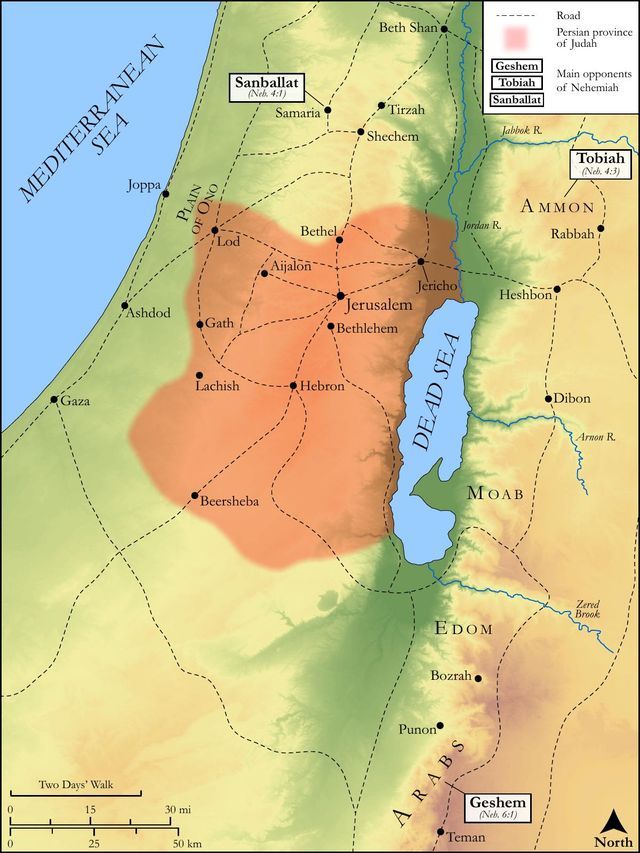
See on the biblical-era map
Study this verse
Public-domain commentary
Matthew Henry
From his Commentary on the Whole Bible. Henry comments on passages, not single verses — this entry covers Nehemiah 6:15–19. His two-level outline is real structure in the source text, so it is rendered as structure.
Nehemiah is here finishing the wall of Jerusalem, and yet still has trouble created him by his enemies.
I.Tobiah, and the other adversaries of the Jews, had the mortification to see the wall built up, notwithstanding all their attempts to hinder it. The wall was begun and finished in fifty-two days, and yet we have reason to believe they rested on the sabbaths, Neh 6:15. Many were employed, and there was room for them; what they did they did cheerfully, and minded their business because they loved it. The threats of their enemies, which were intended to weaken them, it is likely, quickened them to go on with their work the more vigorously, that they might get it done before the enemy came. Thus out of the eater came forth meat. See what a great deal of work may be done in a little time if we would set about it in earnest and keep close to it. When the enemies heard that the wall was finished before they thought it was well begun, and, when they doubted not but to put a stop to it, they were much cast down in their own eyes, Neh 6:16.
1.They were ashamed of their own confidence that they should cause the work to cease; they were crest-fallen upon the disappointment.
2.They envied the prosperity and success of the Jews, grieved to see the walls of Jerusalem built, while, it may be, the kings of Persia had not permitted them thus to fortify the cities of Samaria. When Cain envied his brother his countenance fell, Gen 4:5.
3.They despaired of ever doing them the mischief they designed them, of bringing them down and making a prey of them; and well they might, for they perceived, by the wonderful success, that the work was wrought of God. Even these heathens had so much sense as, [1.] To see a special providence of God conversant about the affairs of the church when they did remarkably prosper. They said among the heathen, The Lord has done great things for them; it is his doing, Psa 126:2. God fighteth for Israel and worketh with them. [2.] To believe that God's work would be perfect. When the perceived that the work was of God they expected no other than that it would go on and prosper. [3.] To conclude that, if it were of God, it was to no purpose to think of opposing it; it would certainly prevail and be victorious.
II.Nehemiah had the vexation, notwithstanding this, to see some of his own people treacherously corresponding with Tobiah and serving his interest; and a great grief and discouragement, no doubt, it was to him.
1.Even of the nobles of Judah there were those who had so little sense of honour and their country's good as to communicate with Tobiah by letter, Neh 6:17. They wrote with all the freedom and familiarity of friends to him, and welcomed his letters to them. Could nobles do a thing so mean? Nobles of Judah so wicked a thing? It seems great men are not always wise, not always honest.
2.Many in Judah were in a strict but secret confederacy with him to advance the interest of his country, though it would certainly be the ruin of their own. They were sworn unto him, not as their prince, but as their friend and ally, because both he and his son had married daughters of Israel, Neh 6:18. See the mischief of marrying with strangers; for one heathen that was converted by it ten Jews were perverted. When once they became akin to Tobiah they soon became sworn to him. A sinful love leads to a sinful league.
3.They had the impudence to court Nehemiah himself into a friendship with him: "They reported his good deeds before me, represented him as an intelligent gentleman and well worthy my acquaintance, an honest gentleman and one that I might confide in." We are indeed required to speak ill of no man, but never to speak well of bad men. Those that forsake the law praise the wicked, Pro 28:4.
4.They were so false as to betray Nehemiah's counsels to him; they uttered Nehemiah's words to him, perverting them, no doubt, and putting false constructions upon them, which furnished Tobiah with matter for letters to put him in fear and so drive him from his work and discourage him in it. Thus were all their thoughts against him for evil, yet God thought upon him for good.
Continue studying Nehemiah 6:19 across the web’s major study libraries — every link below opens this exact verse, chapter, or book on the destination site.
Read & Compare
 BibleGatewayThis verse in more than 200 translations and 70 languages.
 Bible.comThe YouVersion reader — hundreds of translations, reading plans, and highlights.
 ESV.orgCrossway's official English Standard Version reader.
 NET BibleThe NET translation with 60,000+ translators' notes on every rendering decision.
 STEP BibleTyndale House's free study tool — original text, vocabulary, and scholarly resources.
 BibliaLogos Bible Software's free web reader.
 USCCBThe New American Bible (Revised Edition) with the U.S. bishops' study notes.
Commentaries
 BibleHub CommentariesDozens of classic commentaries on this verse, gathered on one page.
 StudyLightMore than 100 commentary sets — the largest collection on the web.
 BibleRefPlain-English commentary on what this verse means, verse by verse.
 Enduring WordDavid Guzik's free commentary on this chapter, widely used by Bible teachers.
 Bible Study ToolsVerse commentary alongside Greek and Hebrew study aids.
Original Language & Research
- BibleHub InterlinearThe verse word by word — original language, transliteration, and English.
- BibleHub LexiconEvery word's original-language definition and Strong's entry.
 Blue Letter BibleDeep-study tools — Strong's numbers, concordance, and word studies.
 SefariaThe Hebrew text with Rashi and centuries of Jewish commentary.
Sermons, Hymns & Audio


TrulyRandomVerse is not affiliated with these sites and doesn’t control their content. They’re linked because they’re genuinely useful.
Summary
Nehemiah 6:19 exposes a profound layer of internal treachery that Nehemiah faced, even as the monumental task of rebuilding Jerusalem's walls neared completion. Certain Jewish nobles, compromised by their deep-seated alliances with Tobiah, acted as insidious double agents. They actively presented Tobiah in a favorable light to Nehemiah, while simultaneously relaying Nehemiah's private counsel, strategies, and even personal sentiments directly to the enemy. This calculated betrayal was orchestrated by Tobiah, who leveraged these insider reports and his own intimidating letters as a potent psychological weapon, aiming to instill paralyzing fear in Nehemiah and ultimately derail the divinely appointed work of restoration.
Context
ShowHideLiterary Context
This verse is strategically positioned at the very cusp of the wall's completion, as recounted in Nehemiah 6:15. The preceding chapters, particularly Nehemiah 4 and Nehemiah 6, meticulously chronicle the escalating opposition Nehemiah endured. This began with ridicule and scorn (Nehemiah 4:1-3), progressed to armed threats and plots to attack (Nehemiah 4:7-8), and culminated in cunning schemes to assassinate Nehemiah or lure him away from the city (Nehemiah 6:1-9). Having failed in these overt and covert attempts, the adversaries, particularly Tobiah, resorted to a more insidious form of psychological warfare: leveraging internal treachery. The revelation of the nobles' complicity immediately follows Nehemiah's unwavering refusal to be intimidated by Shemaiah's false prophecy in Nehemiah 6:10-14, highlighting his steadfast resolve even as betrayal surfaces from within his own ranks. This internal corruption foreshadows Nehemiah's later, more comprehensive reforms against such compromises in Nehemiah 13.
Historical & Cultural Context
The "nobles of Judah" referenced in Nehemiah 6:17, who are the "they" in verse 19, represented influential families with significant social and political standing within post-exilic Judah. Their compromise with Tobiah the Ammonite, a prominent figure in the Transjordan region and a relentless adversary of the Jewish restoration (Nehemiah 2:10, 19), stemmed from established intermarriage and financial ties. Such alliances, frequently driven by political expediency, economic gain, or social status, were a recurring problem in post-exilic Judah, as evidenced by Ezra's reforms against foreign intermarriage (Ezra 9-10) and Nehemiah's own later expulsion of Tobiah from the temple precincts (Nehemiah 13:4-7). The practice of sending letters was a common and authoritative form of communication and diplomacy in that day, often employed for official pronouncements, negotiations, or, as in this instance, for intimidation and psychological manipulation. Tobiah's strategic use of letters, combined with the critical insider information provided by the nobles, demonstrates a sophisticated and calculated approach to undermine Nehemiah's leadership and morale.
Key Themes
ShowHideThis verse powerfully illustrates several crucial themes pertinent to the broader narrative of Nehemiah and the spiritual life. Firstly, it highlights Internal Betrayal and Compromise, revealing that opposition to God's work is not solely external but can arise insidiously from within the very community meant to support it. The "nobles of Judah," who should have been Nehemiah's staunchest allies, were compromised, acting as conduits for enemy intelligence, underscoring the danger of divided loyalties. Secondly, it showcases Psychological Warfare and Intimidation. Tobiah's ultimate aim, "to put me in fear," reveals a deliberate strategy to break Nehemiah's spirit and paralyze his leadership through mental and emotional assault rather than direct physical confrontation. The letters, combined with insider information, were meticulously designed to sow doubt, undermine confidence, and exhaust Nehemiah's resolve. Thirdly, the verse underscores the Pervasiveness and Insidiousness of Opposition. The challenges Nehemiah faced were not merely overt but deeply embedded in the social and political fabric of Judah, demonstrating how compromise and unholy alliances can subtly corrupt a community and hinder divine purposes. Finally, it implicitly speaks to Nehemiah's Discernment and Resilience. Despite the profound betrayal and constant fear tactics, Nehemiah remained steadfast, his ability to identify and record such plots demonstrating his sharp spiritual discernment and unwavering reliance on God's strength and wisdom, as exemplified by his prayerful watchfulness in Nehemiah 4:9.
Exposition and Analysis
ShowHideKey Word Analysis
ShowHideThis verb (H559) means "to say" or "to declare" with a wide range of applications, including to "report" or "publish." In this context, it signifies a deliberate act of disclosure and advocacy. The nobles were actively "saying" or "declaring" Tobiah's supposed "good deeds" to Nehemiah, likely with the intention of influencing Nehemiah's perception, softening his stance towards Tobiah, or justifying their own compromised alliances. This was not a passive observation but an active communication designed to manipulate.
This verb (H3318) literally means "to go out" or "to bring out." Here, it signifies the act of bringing forth or revealing Nehemiah's words. The nobles were acting as spies, causing Nehemiah's private "words"—his plans, strategies, concerns, or even personal thoughts and sentiments—to "go out" from his inner circle directly to Tobiah. This was a profound breach of trust and a severe security leak, providing the enemy with critical intelligence that could be used against Nehemiah and the rebuilding effort.
This word (H3372) denotes the emotional state of being "afraid" or "dreadful," but it can also imply reverence. In this context, it refers to the specific emotional and psychological state Tobiah sought to induce in Nehemiah. It was a calculated, deliberate psychological tactic to cause Nehemiah to abandon his mission, to be intimidated into submission, or to lose his resolve and courage, thereby halting the progress of the wall's construction.
Verse Breakdown
ShowHide"Also they reported his good deeds before me"
The "they" refers to the "nobles of Judah" (as established in Nehemiah 6:17-18) who were bound to Tobiah through intermarriage and oaths. "His good deeds" refers to Tobiah's supposed commendable qualities or actions, which the nobles actively promoted in Nehemiah's presence. This indicates a concerted effort to manipulate Nehemiah's perception, perhaps to legitimize Tobiah's standing, portray him as less of a threat, or even to subtly pressure Nehemiah into a more favorable view of his adversary, thereby undermining Nehemiah's vigilance and trust.
"and uttered my words to him"
This clause reveals the core of the nobles' insidious betrayal. They were acting as double agents, systematically relaying Nehemiah's private counsel, strategic discussions, personal sentiments, or even confidential intelligence directly to Tobiah. This provided Tobiah with invaluable, real-time intelligence, enabling him to anticipate Nehemiah's moves, tailor his opposition tactics, and exploit Nehemiah's vulnerabilities. This profound breach of trust compromised Nehemiah's security, leadership, and the overall integrity of the restoration project.
"[And] Tobiah sent letters to put me in fear"
This final clause unveils the ultimate strategic purpose behind the internal espionage. Tobiah's letters, now informed by Nehemiah's own words and strategies, were designed to be highly effective instruments of psychological warfare. Their content likely included specific threats, false accusations, attempts to discredit Nehemiah among his own people, or other intimidating messages. The calculated intent was to break Nehemiah's morale, sow doubt, and cause him to abandon the work out of sheer intimidation and fear, rather than through direct military confrontation.
Literary Devices
ShowHideNehemiah 6:19 is rich in literary devices that amplify its profound message. Irony is powerfully employed, as the "nobles of Judah," who should have been Nehemiah's loyal compatriots and fellow laborers in the sacred task of rebuilding Jerusalem, are exposed as betrayers, actively aiding the very enemy seeking to thwart God's work. This subversion of expected loyalty creates a stark and unsettling contrast. The verse also utilizes Foreshadowing, subtly hinting at the deeper internal corruption and compromise within the community that Nehemiah would later address more forcefully and directly, particularly in Nehemiah 13, where Tobiah's pervasive influence is found even within the temple precincts. The entire scenario is a masterful depiction of Psychological Warfare, where the enemy's primary weapon is not brute force or overt military action, but the calculated manipulation of information, perception, and trust to induce fear and undermine leadership from within. The phrase "uttered my words to him" highlights the profound Violation of Trust, emphasizing the deeply personal nature of the betrayal and the acute sense of vulnerability it would have instilled in Nehemiah, making the opposition all the more insidious.
Theological and Thematic Connections
ShowHideNehemiah 6:19 offers a stark and enduring theological lesson: opposition to God's work is not always external and overt; often, the most dangerous and insidious threats emerge from within, through subtle compromise, divided loyalties, and outright betrayal. This verse underscores the pervasive reality of spiritual warfare, where the enemy seeks to undermine divine purposes not just through direct confrontation but by sowing discord, instilling fear, and leveraging human weakness, self-interest, or unholy alliances. It highlights the critical need for acute spiritual discernment in leadership, recognizing that not everyone who appears to be an ally truly shares the same unwavering commitment to God's kingdom. The treachery of the nobles serves as a sobering cautionary tale about the pervasive nature of sin and the constant vigilance required to protect the integrity and purity of God's people and their mission from internal decay.
Reflection and Application
ShowHideNehemiah 6:19 provides profound and enduring lessons for contemporary believers and leaders alike. It challenges us to cultivate acute spiritual discernment, recognizing that opposition to God's work can manifest in subtle, unexpected ways, often from sources we might least suspect, including those within our own communities or circles of influence. We are called to be vigilant against the temptation to compromise our core values, spiritual integrity, or loyalties for personal gain, social acceptance, or perceived security, as the nobles did in their alliance with Tobiah. The verse also underscores the critical importance of guarding our words, plans, and strategies, exercising wisdom and discretion, especially in sensitive spiritual endeavors or leadership roles. Furthermore, it calls us to stand firm against fear and intimidation tactics, whether they originate from external pressures, manipulative individuals, or internal whispers of doubt and anxiety. Like Nehemiah, our resolve must be deeply rooted in unwavering faith in God's sovereignty, protection, and ultimate purpose, enabling us to persevere with courage and integrity even when facing profound betrayal or psychological warfare. In a world where information can be weaponized and trust is often fragile, this passage encourages us to build communities founded on unshakeable integrity, steadfast loyalty to Christ, and a shared, uncompromising commitment to His kingdom, while remaining prayerfully aware of the spiritual battles that rage around and within us.
Questions for Reflection
ShowHideFAQ
ShowHideWho were "they" who reported Tobiah's deeds and uttered Nehemiah's words?
ShowHideThe "they" refers to the "nobles of Judah" mentioned in Nehemiah 6:17. These were influential Jewish families who had established marriage alliances and sworn oaths of loyalty with Tobiah the Ammonite, a key adversary of Nehemiah. Despite being part of Nehemiah's own people and ostensibly part of the restoration effort, their loyalties were deeply divided. This led them to act as double agents, both promoting Tobiah's perceived virtues to Nehemiah and betraying Nehemiah's private communications, strategies, and even personal thoughts directly to Tobiah, providing the enemy with critical intelligence.
Why would Tobiah send letters to Nehemiah after other attempts to stop the wall's construction had failed?
ShowHideTobiah's persistent sending of letters, especially after his more overt attempts (such as armed threats in Nehemiah 4:7-8 and cunning plots to assassinate or lure Nehemiah away in Nehemiah 6:1-9) had failed, indicates a strategic shift to a sophisticated form of psychological warfare. The goal was no longer merely physical harm or disruption, but mental and emotional breakdown. These letters, likely filled with false accusations, specific threats, or attempts to discredit Nehemiah among his own people, combined with the precise insider information provided by the nobles, were designed to instill paralyzing fear, undermine Nehemiah's confidence, and break his morale, hoping he would abandon the divinely appointed project out of intimidation.
What does this verse teach us about leadership in the face of adversity?
ShowHideThis verse provides crucial and timeless lessons for leadership. It teaches the vital importance of discernment, as leaders must be acutely aware of and able to identify threats that come not only from external enemies but also from within their own ranks, even from seemingly trusted individuals. It highlights the profound need for vigilance against subtle and insidious forms of opposition, such as psychological warfare, misinformation, and internal betrayal, which can often be more damaging and demoralizing than overt attacks. Furthermore, it underscores the absolute necessity of resilience and unwavering focus on the God-given mission, even when facing profound personal betrayal and calculated attempts to instill fear. Nehemiah's example demonstrates that true leadership relies on God's protection, wisdom, and steadfastness to navigate complex internal and external challenges, remaining committed to the divine purpose despite all odds.
Christ-Centered Fulfillment
ShowHideNehemiah 6:19, with its stark depiction of internal betrayal and psychological warfare aimed at instilling fear, powerfully foreshadows the ultimate experience of Jesus Christ. Just as Nehemiah faced treachery from within his own people, the Jewish nobles, Jesus endured the profound and ultimate betrayal by one of His closest disciples, Judas Iscariot, who delivered Him into the hands of His enemies. The "uttering of words" to the enemy finds its chilling parallel in the false testimonies and accusations brought against Jesus during His trials, meticulously designed to condemn Him and incite fear and abandonment among His followers (Mark 14:55-59). Tobiah's calculated aim "to put me in fear" resonates deeply with the constant intimidation, psychological pressure, and threats Jesus faced from religious and political authorities throughout His ministry, culminating in the "hour of darkness" when He was delivered to His adversaries (Luke 22:53). Yet, unlike Nehemiah who recorded the plots and persevered, Jesus willingly submitted to the Father's will, conquering fear and death itself through His perfect obedience. Through His sacrificial death on the cross, Christ disarmed the principalities and powers, triumphing over them in it (Colossians 2:15), and by His death, He destroyed him who has the power of death, that is, the devil, and freed those who through fear of death were subject to lifelong slavery (Hebrews 2:14-15). Thus, the spiritual warfare and internal betrayal Nehemiah faced find their ultimate resolution and complete victory in the steadfast, fear-conquering work of Christ, who perfectly fulfilled His divine mission despite all opposition, securing eternal freedom for His people.