


Nehemiah 4:7
Bible text: King James Version (1769 Blayney text) · Public domain
Bible text: King James Version with Strong's numbers · Public domain
Bible text: Berean Standard Bible · Public domain
Bible text: American Standard Version (1901) · Public domain
Bible text: World English Bible, Messianic edition · Public domain
Bible text: Geneva Bible (1599) · Public domain
Bible text: Young's Literal Translation · Public domain
- וַיְהִיvay·Hiand it wasH1961Conj-w ¦ V-Qal-ConsecImperf-3msVerb Qal Consecutive Imperfect 3rd Singular Masculineוַandיְהִיit was
- כַאֲשֶׁרkha·'a·Sherjust whenH834Prep-k ¦ RelParticle Relativeכַjustאֲשֶׁרwhen
- שָׁמַעsha·Ma'he heardH8085V-Qal-Perf-3msVerb Qal Perfect 3rd Singular Masculine
- סַנְבַלַּטsan·va·LatSanballatH5571N-proper-mNoun Proper Masculine
- וְטוֹבִיָּהVe·toi·yahand TobiahH2900Conj-w ¦ N-proper-mNoun Proper MasculineוְandטוֹבִיָּהTobiah
- וְהָעַרְבִיםve·ha·'ar·Vimand the ArabsH6163Conj-w ¦ Art ¦ N-mpNoun Gentilic Plural Masculine AbsoluteוְandהָtheעַרְבִיםArabs
- וְהָעַמֹּנִיםve·ha·'a·mo·Nimand the AmmonitesH5984Conj-w ¦ Art ¦ N-mpNoun Gentilic Plural Masculine AbsoluteוְandהָtheעַמֹּנִיםAmmonites
- וְהָאַשְׁדּוֹדִיםve·ha·'ash·do·Dimand the AshdoditesH796Conj-w ¦ Art ¦ N-mpNoun Gentilic Plural Masculine AbsoluteוְandהָtheאַשְׁדּוֹדִיםAshdodites
- כִּיkithatH3588PrtParticle Conditional
- עָלְתָה'al·Tahit had gone upH5927V-Qal-Perf-3fsVerb Qal Perfect 3rd Singular Feminine
- אֲרוּכָה'a·ru·Khah[the] repairH724N-fsNoun Singular Feminine Absolute
- לְחֹמוֹתle·cho·Motof [the] walls ofH2346Prep-l ¦ N-fpcNoun Plural Feminine Constructלְofחֹמוֹת[the] walls of
- יְרוּשָׁלִַםye·ru·sha·LimJerusalemH3389N-properNoun Proper Location
- כִּיkithatH3588PrtParticle Conditional
- הֵחֵלּוּhe·Che·luthey had begunH2490V-Hiphil-Perf-3cpVerb Hiphil Perfect 3rd Plural common gender
- הַפְּרֻצִיםha·pe·ru·Tzimthe broken down [parts]H6555Art ¦ V-Qal-PassPrtcpl-mpVerb Qal Participle Passive Plural Masculine Absoluteהַtheפְּרֻצִיםbroken down [parts]
- לְהִסָּתֵםle·hi·sa·Temto be closedH5640Prep-l ¦ V-Niphal-InfVerb Niphal Infinitive Constructלְtoהִסָּתֵםbe closed
- וַיִּחַרvai·Yi·charand it burnedH2734Conj-w ¦ V-Qal-ConsecImperf-3msVerb Qal Consecutive Imperfect 3rd Singular Masculineוַandיִּחַרit burned
- לָהֶםla·Hemto themPrep-l ¦ 3mpSuffix Personal 3rd Plural Masculineלָtoהֶםthem
- מְאֹדme·'OdexceedinglyH3966Adj-msAdjective Numerical Singular Masculine Absolute
English is a literal word-by-word gloss of the Hebrew, not the KJV's wording. Why?
This is the original text the KJV's translators worked from — each Hebrew word with its own literal English meaning in this verse, prepared by scholars at Tyndale House, Cambridge. The KJV translates whole sentences, not word by word, so its wording differs: one Hebrew word can become several English words, and the KJV may choose “the LORD” where the gloss reads “Yahweh”. Both are faithful — they answer different questions. For the KJV's own rendering, switch to the KJV text.
Details
See on the biblical-era map
Study this verse
Public-domain commentary
Matthew Henry
From his Commentary on the Whole Bible. Henry comments on passages, not single verses — this entry covers Nehemiah 4:7–15. His three-level outline is real structure in the source text, so it is rendered as structure.
We have here,
I.The conspiracy which the Jews' enemies formed against them, to stay the building by slaying the builders.
The conspirators were not only Sanballat and Tobiah, but other neighbouring people whom they had drawn into the plot. They flattered themselves with a fancy that the work would soon stand still of itself; but, when they heard that it went on a prospered, they were angry at the Jews for being so hasty to push the work forward and angry at themselves for being so slow in opposing it (Neh 4:7): They were very wroth. Cursed be their anger, for it was fierce, and their wrath, for it was cruel. Nothing would serve but they would fight against Jerusalem, Neh 4:8. Why, what quarrel had they with the Jews? Had they done them any wrong? Or did they design them any? No, they lived peaceably by them; but it was merely out of envy and malice; they hated the Jews' piety, and were therefore vexed at their prosperity and sought their ruin. Observe,
1.How unanimous they were: They conspired all of them together, though of different interests among themselves, yet one in their opposition to the work of God.
2.How close they were; they said, "They shall not know, neither see, till we have them at our mercy." Thus they took crafty counsel, and digged deep to hide it from the Lord, and promised themselves security and success from the secresy of their management.
3.How cruel they were: We will come and slay them. If nothing less than the murder of the workmen will put a stop to the work, they will not stick at that; nay, it is their blood they thirst for, and they are glad of any pretence to glut themselves with it.
4.What the design was and how confident they were of success: it was to cause the work to cease (Neh 4:11), and this they were confident that they should effect. The hindering of good work is that which bad men aim at and promise themselves; but good work is God's work, and it shall prosper.
II.The discouragements which the builders themselves laboured under.
At the very time when the adversaries said, Let us cause the work to cease, Judah said, "Let us even let it fall, for we are not able to go forward with it," Neh 4:10. They represent the labourers as tired, and the remaining difficulties, even of that first part of their work, the removing of the rubbish, as insuperable, and therefore they think it advisable to desist for the present. Can Judah, that warlike valiant tribe, sneak thus? Active leading men have many times as much ado to grapple with the fears of their friends as with the terrors of their enemies.
III.The information that was brought to Nehemiah of the enemies' designs, Neh 4:12.
There were Jews that dwelt by them, in the country, who, though they had not zeal enough to bring them to Jerusalem to help their brethren in building the wall, yet, having by their situation opportunity to discover the enemies' motions, had so much honesty and affection to the cause as to give intelligence of them; nay, that their intelligence might be the more credited, they came themselves to give it, and they said it ten times, repeating it as men in earnest, and under a concern, and the report was confirmed by many witnesses. The intelligence they gave is expressed abruptly, and finds work for the critics to make out the sense of it, which perhaps is designed to intimate that they gave this intelligence as men out of breath and in confusion, whose very looks would make up the deficiencies of their words. I think it may be read, without supplying any thing: "Whatever place you turn to, they are against us, so that you have need to be upon your guard on all sides," Note, God has many ways of bringing to light, and so bringing to nought, the devices and designs of his and his church's enemies. Even the cold and feeble Jews that contentedly dwell by them shall be made to serve as spies upon them; nay, rather than fail, a bird of the air shall carry their voice.
IV.The pious and prudent methods which Nehemiah, hereupon, took to baffle the design, and to secure his work and workmen.
1.It is said (Neh 4:14) he looked.
(1.)He looked up, engaged God for him, and put himself and his cause under the divine protection (Neh 4:9): We made our prayer unto our God. That was the way of this good man, and should be our way; all his cares, all his griefs, all his fears, he spread before God, and thereby made himself easy. This was the first thing he did; before he used any means, he made his prayer to God, for with him we must always begin.
(2.)He looked about him. Having prayed, he set a watch against them. The instructions Christ has given us in our spiritual warfare agree with this example, Mat 26:41. Watch and pray. If we think to secure ourselves by prayer only, without watchfulness, we are slothful and tempt God; if by watchfulness, without prayer, we are proud and slight God; and, either way, we forfeit his protection.
2.Observe,
(1.)How he posted the guards, Neh 4:13. In the lower places he set them behind the wall, that they might annoy the enemy over it, as a breast-work; but in the higher places, where the wall was raised to its full height, he set them upon it, that from the top of it they might throw down stones or darts upon the heads of the assailants: he set them after their families, that mutual relation might engage them to mutual assistance.
(2.)How he animated and encouraged the people, Neh 4:14. He observed even the nobles and rulers themselves, as well as the rest of the people, to be in a great consternation upon the intelligence that was brought them, and ready to conclude that they were all undone, by which their hands were weakened both for work and war, and therefore, he endeavours to silence their fears. "Come," says he, "be not afraid of them, but behave yourselves valiantly, considering, [1.] Whom you fight under. You cannot have a better captain: Remember the Lord, who is great and terrible; you think your enemies great and terrible, but what are they in comparison with God, especially in opposition to him? He is great above them to control them, and will be terrible to them when he comes to reckon with them." Those that with an eye of faith see the church's God to be great and terrible will see the church's enemies to be mean and despicable. The reigning fear of God is the best antidote against the ensnaring fear of man. He that is afraid of a man that shall die forgets the Lord his Maker, Isa 51:12, Isa 51:13. [2.] "Whom you fight for. You cannot have a better cause; you fight for your brethren (Psa 122:8), your sons, and your daughters. All that is dear to you in their world lies at stake; therefore behave yourselves valiantly."
V.The happy disappointment which this gave to the enemies, Neh 4:15.
When they found that their design was discovered, and that the Jews were upon their guard, they concluded that it was to no purpose to attempt any thing, but that God had brought their counsel to nought. They knew they could not gain their point but by surprise, and, if their plot was known, it was quashed. The Jews hereupon returned every one to his work, with so much the more cheerfulness because they saw plainly that God owned it and owned them in the doing of it. Note, God's care of our safety should engage and encourage us to go on with vigour in our duty. As soon as ever a danger is over let us return to our work, and trust God another time.
Continue studying Nehemiah 4:7 across the web’s major study libraries — every link below opens this exact verse, chapter, or book on the destination site.
Read & Compare
 BibleGatewayThis verse in more than 200 translations and 70 languages.
 Bible.comThe YouVersion reader — hundreds of translations, reading plans, and highlights.
 ESV.orgCrossway's official English Standard Version reader.
 NET BibleThe NET translation with 60,000+ translators' notes on every rendering decision.
 STEP BibleTyndale House's free study tool — original text, vocabulary, and scholarly resources.
 BibliaLogos Bible Software's free web reader.
 USCCBThe New American Bible (Revised Edition) with the U.S. bishops' study notes.
Commentaries
 BibleHub CommentariesDozens of classic commentaries on this verse, gathered on one page.
 StudyLightMore than 100 commentary sets — the largest collection on the web.
 BibleRefPlain-English commentary on what this verse means, verse by verse.
 Enduring WordDavid Guzik's free commentary on this chapter, widely used by Bible teachers.
 Bible Study ToolsVerse commentary alongside Greek and Hebrew study aids.
Original Language & Research
- BibleHub InterlinearThe verse word by word — original language, transliteration, and English.
- BibleHub LexiconEvery word's original-language definition and Strong's entry.
 Blue Letter BibleDeep-study tools — Strong's numbers, concordance, and word studies.
 SefariaThe Hebrew text with Rashi and centuries of Jewish commentary.
Sermons, Hymns & Audio


TrulyRandomVerse is not affiliated with these sites and doesn’t control their content. They’re linked because they’re genuinely useful.
Summary
Nehemiah 4:7 marks a significant escalation in the opposition faced by Nehemiah and the Jewish people as they diligently rebuilt the walls of Jerusalem. Following initial scorn and ridicule, the adversaries—Sanballat, Tobiah, and their allied peoples—became intensely enraged upon hearing that substantial progress had been made, with the walls being significantly restored and critical breaches actively sealed. This verse powerfully highlights the deep-seated fury provoked by the tangible advancement of God's work, signaling a dangerous shift from mere verbal harassment to the plotting of more aggressive, potentially violent, countermeasures against the builders.
Context
ShowHideLiterary Context
This verse is strategically positioned within the unfolding narrative of Nehemiah's monumental task of rebuilding Jerusalem's walls. Chapters 1-2 meticulously detail Nehemiah's fervent prayer, his profound burden for Jerusalem's desolate state, and his successful petition to King Artaxerxes to return and lead the restoration effort. Chapter 3 then provides a meticulous account of the collective and organized nature of the work, listing the various families and groups participating in the construction, emphasizing unity and purpose. Nehemiah 4:1-6 describes the initial, contemptuous reaction of Sanballat and Tobiah, characterized by mockery and scorn, which Nehemiah countered with prayer and unwavering commitment to the labor. Verse 7, therefore, represents a critical turning point: the adversaries' contempt gives way to furious wrath because their initial tactics of ridicule and intimidation have demonstrably failed to halt the work. This intensifying opposition sets the stage for the subsequent verses, where the enemies conspire to launch a direct attack on Jerusalem, compelling Nehemiah to implement defensive measures alongside the ongoing construction, as seen in Nehemiah 4:8-12.
Historical & Cultural Context
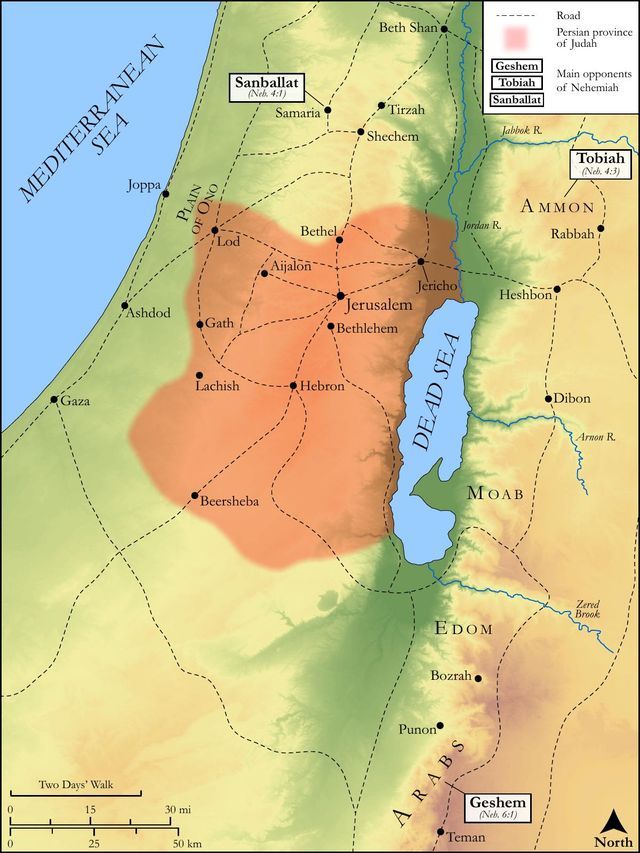
The events of Nehemiah unfold in the mid-5th century BCE, during the expansive rule of the Persian Empire. Following the Babylonian exile, many Jews had returned to Jerusalem, but the city remained vulnerable, its walls in ruins. Rebuilding these walls was far more than a mere construction project; it was a profound act of national and religious restoration, symbolizing renewed security, sovereignty, and the re-establishment of a distinct Jewish identity in their ancestral homeland. Sanballat, the governor of Samaria to the north, Tobiah, an influential Ammonite official to the east, and Geshem the Arabian, a powerful tribal leader to the south, along with the Ashdodites from the Philistine city-state to the west, formed a formidable coalition. This ring of hostile neighbors perceived a strong, fortified Jerusalem as a direct threat to their regional power and influence, which they had long exercised over trade routes, resources, and political dominance in the Trans-Euphrates province. Their intense anger stemmed from the perceived loss of their ability to exploit Jerusalem's vulnerability and maintain their regional hegemony, viewing the city's resurgence as a challenge to their established order.
Key Themes
ShowHideNehemiah 4:7 powerfully illustrates several enduring themes pertinent to God's work and the believer's journey. Firstly, it underscores the Escalation of Opposition to God's purposes; as genuine progress is made in spiritual endeavors, adversaries often intensify their attacks, moving from mere scorn to outright hostility. This mirrors a consistent pattern throughout biblical history, where those faithfully pursuing God's will encounter resistance, as exemplified by Paul's experiences in Acts 19:23-41. Secondly, it highlights the theme of Perseverance Amidst Adversity. Despite the growing anger and explicit threats, the builders continued their work, demonstrating remarkable resilience and unwavering commitment to their divine calling. This steadfastness is a testament to faith in the face of daunting challenges, echoing the biblical injunction to not grow weary in doing good. Thirdly, the intense wrath of the enemies points to the underlying reality of Spiritual Warfare. The opposition was not solely political or territorial; it was a deeper spiritual battle against God's sovereign plan for the restoration of His people and their covenant identity, a battle against the establishment of His kingdom on earth.
Exposition and Analysis
ShowHideKey Word Analysis
ShowHide(chôwmâh), feminine active participle of an unused root apparently meaning to join; a wall of protection; wall, walled. In this context, "walls" refers to the physical fortifications of Jerusalem, which were being reconstructed. The term signifies not just a barrier, but specifically a protective structure, emphasizing the renewed security and defense that the rebuilding effort was bringing to the city. The progress on these walls directly threatened the adversaries' ability to exploit Jerusalem's vulnerability.
(pârats), a primitive root; to break out (in many applications, direct and indirect, literal and figurative); [idiom] abroad, (make a) breach, break (away, down, -er, forth, in, up), burst out, come (spread) abroad, compel, disperse, grow, increase, open, press, scatter, urge. The term "breaches" refers to the large, gaping holes and significant damage in the wall that had rendered Jerusalem utterly indefensible since its destruction. The fact that these critical points of vulnerability "began to be stopped" indicates that they were actively being filled and repaired, making the city less accessible to invaders and signaling the imminent completion of a secure perimeter.
(chârâh), a primitive root (compare חָרַר); to glow or grow warm; figuratively (usually) to blaze up, of anger, zeal, jealousy; be angry, burn, be displeased, [idiom] earnestly, fret self, grieve, be (wax) hot, be incensed, kindle, [idiom] very, be wroth. This word, combined with "very" (H3966, mᵉʼôd), conveys an extreme, burning fury. It describes a deep-seated and desperate rage that indicates their previous tactics of ridicule had failed and the situation was now perceived as dire for them, igniting a passionate, almost uncontrollable anger.
Verse Breakdown
ShowHide"But it came to pass, that when Sanballat, and Tobiah, and the Arabians, and the Ammonites, and the Ashdodites, heard"
This opening clause immediately establishes the widespread and formidable nature of the opposition. It was not merely two individuals but a powerful coalition of regional powers—Sanballat (governor of Samaria), Tobiah (an influential Ammonite official), the Arabians (likely led by Geshem), the Ammonites (from the east), and the Ashdodites (from the west)—all united in their hostility. Their "hearing" signifies that the progress on the walls was undeniable and widely known, a concrete reality that could no longer be dismissed as mere rumor or insignificant effort.
"that the walls of Jerusalem were made up, and that the breaches began to be stopped"
This is the precise and crucial trigger for their intense wrath. The adversaries were not merely upset by the abstract idea of rebuilding; they were infuriated by the tangible, visible evidence of significant progress. The phrase "walls of Jerusalem were made up" means that substantial sections of the fortifications were nearing completion, rising significantly from their ruined state. Furthermore, "the breaches began to be stopped" indicates that the most critical weak points, the large gaps that rendered the city defenseless, were being actively sealed. This meant Jerusalem was rapidly becoming a fortified city, capable of defending itself, thereby posing a direct and undeniable threat to the regional dominance and political aspirations of these hostile neighbors.
"then they were very wroth"
This concluding phrase vividly describes the extreme emotional response of the adversaries. Their previous scorn and ridicule, as detailed in Nehemiah 4:1, had escalated into a burning, intense fury. This wrath was born of frustration, fear, and a profound sense of desperation as their attempts to thwart God's work were clearly failing. It foreshadows their subsequent shift from verbal attacks and mockery to plotting direct military intervention, as recorded in the very next verse, Nehemiah 4:8.
Literary Devices
ShowHideNehemiah 4:7 masterfully employs several potent literary devices to convey the escalating tension and the profound significance of the moment. There is a clear Climax in the narrative, as the opposition's reaction intensifies dramatically from the initial scorn of Nehemiah 4:1 to the "very wroth" of this verse, signaling a decisive turning point towards more aggressive action. The verse also utilizes Antithesis, juxtaposing the diligent, successful progress of the Jewish builders ("walls... made up," "breaches began to be stopped") with the furious, desperate reaction of their enemies ("very wroth"). This stark contrast powerfully highlights the spiritual nature of the conflict, where righteous endeavor and divine blessing provoke unrighteous anger and human resistance. Furthermore, the "walls of Jerusalem" function as a powerful Symbol, representing not just physical security but also the restoration of Israel's national identity, its covenant relationship with God, and its spiritual vitality. The adversaries' fury is thus not merely against stone and mortar but against the resurgence of God's people and His purposes. Finally, the enumeration of the various hostile groups—Sanballat, Tobiah, Arabians, Ammonites, and Ashdodites—serves as a form of Enumeration or List, emphasizing the formidable, widespread, and unified nature of the opposition faced by Nehemiah and the builders.
Theological and Thematic Connections
ShowHideNehemiah 4:7 offers profound theological insight into the nature of opposition to God's work. It reveals that genuine progress in God's kingdom often provokes intense resistance from spiritual adversaries. Just as the physical rebuilding of Jerusalem's walls, a tangible symbol of God's covenant faithfulness and the restoration of His people, incited burning wrath, so too does any significant advancement of God's purposes in the world. This opposition is not merely human in origin but often reflects a deeper spiritual conflict against the divine will. The adversaries' fury stemmed from their inability to stop what God was clearly accomplishing through His faithful servants. This pattern reminds believers that when diligently pursuing God's call, whether in personal sanctification, ministry, or societal impact, one should anticipate resistance, for the enemy of souls is enraged by the light and truth of God's kingdom.
Reflection and Application
ShowHideNehemiah 4:7 serves as a powerful mirror for contemporary believers, reminding us that progress in God's work often attracts intensified opposition. Whether in our personal spiritual growth, our family's pursuit of righteousness, or our church's efforts to advance the Gospel, when tangible steps are taken and visible fruit begins to appear, we should not be surprised when resistance escalates from mere annoyance or ridicule to outright hostility and fierce anger. This verse encourages us to recognize that such "wroth" is often a sign that we are indeed making a significant difference for the kingdom of God, striking at the heart of the enemy's domain. It calls us to cultivate spiritual discernment, understanding that opposition is not always a sign of being off track, but often a confirmation that we are on the right path. Our response, like Nehemiah's, should be characterized by unwavering perseverance, continued labor, and a deepening reliance on God's protection and provision, knowing that His plans cannot ultimately be thwarted by human or spiritual adversaries.
Questions for Reflection
ShowHideFAQ
ShowHideWhy were Sanballat and Tobiah, along with their allies, so intensely angry at the progress on Jerusalem's walls?
ShowHideTheir intense anger stemmed from a complex combination of factors related to power, control, and wounded pride. Sanballat, Tobiah, and their allied groups (Arabians, Ammonites, Ashdodites) had enjoyed significant regional influence and control while Jerusalem remained weak and vulnerable. A rebuilt, fortified Jerusalem directly threatened their political and economic interests, potentially disrupting established trade routes and challenging their long-held authority in the Trans-Euphrates province. They viewed the restoration of Jerusalem as a declaration of Jewish autonomy and a resurgence of a strong, independent entity in their sphere of influence, which they perceived as a direct threat to their own power base. Their initial tactics of ridicule and scorn, as described in Nehemiah 4:1-3, had failed to deter Nehemiah and the builders. When they heard that the walls were not just being started but were "made up" and the critical "breaches began to be stopped," it meant their efforts to stop the work had been futile, and Jerusalem was rapidly becoming defensible. This tangible, undeniable progress ignited a desperate, burning fury, as their worst fears of a revitalized, secure Jerusalem were becoming a reality.
Christ-Centered Fulfillment
ShowHideThe furious wrath of Sanballat and his allies against the rebuilding of Jerusalem's walls serves as a powerful foreshadowing of the inherent opposition to God's ultimate redemptive work, culminating in Christ. Just as the physical walls symbolized the restoration of God's people and their secure dwelling, so Christ came to build an eternal kingdom, a spiritual "wall" of salvation and security for all who believe. The intense anger of Nehemiah's enemies mirrors the deep-seated hostility of the world and spiritual forces against the person and work of Jesus Christ. From Herod's desperate attempt to kill the infant Messiah (Matthew 2:16) to the religious leaders' relentless efforts to discredit and crucify Him (John 19:1-16), the progress of God's ultimate plan of salvation has always provoked fierce opposition. However, just as the walls of Jerusalem were completed despite the adversaries' rage, Christ declared that the gates of Hades would not prevail against His Church (Matthew 16:18). He is the true Cornerstone upon whom His spiritual temple is built (Ephesians 2:20-22), and through His death and resurrection, He disarmed the principalities and powers, triumphing over them (Colossians 2:15). The "breaches" of sin and death, which separated humanity from God, were ultimately stopped by the perfect sacrifice of the Lamb of God, who takes away the sin of the world, securing eternal peace and an unshakable kingdom that will one day be fully realized in the New Jerusalem, a city with walls of salvation and gates of praise (Revelation 21:10-27).