


Nehemiah 13:5
- וַיַּעַשׂvai·Ya·'asand he madeH6213Conj-w ¦ V-Qal-ConsecImperf-3msVerb Qal Consecutive Imperfect 3rd Singular Masculineוַandיַּעַשׂhe made
- לוֹlofor himPrep-l ¦ 3msSuffix Personal 3rd Singular Masculineלforוֹhim
- לִשְׁכָּהlish·Kaha roomH3957N-fsNoun Singular Feminine Absolute
- גְדוֹלָהge·do·LahlargeH1419Adj-fsAdjective Singular Feminine Absolute
- וְשָׁםve·Shamand thereH8033Conj-w ¦ AdvAdverbוְandשָׁםthere
- הָיוּha·Yupeople wereH1961V-Qal-Perf-3cpVerb Qal Perfect 3rd Plural common gender
- לְפָנִיםle·fa·Nim<to> beforeH6440Prep-l ¦ N-mpNoun Plural Masculine Absoluteלְ<to>פָנִיםbefore
- נֹתְנִיםNo·te·nimputtingH5414V-Qal-Prtcpl-mpVerb Qal Participle Plural Masculine Absolute
- אֶת'et<obj.>H853DirObjMParticle Object Indicator
- הַמִּנְחָהha·min·Chahthe grain offeringH4503Art ¦ N-fsNoun Singular Feminine Absoluteהַtheמִּנְחָהgrain offering
- הַלְּבוֹנָהha·le·vo·Nahthe frankincenseH3828Art ¦ N-fsNoun Singular Feminine Absoluteהַtheלְּבוֹנָהfrankincense
- וְהַכֵּלִיםve·ha·ke·Limand the utensilsH3627Conj-w ¦ Art ¦ N-mpNoun Plural Masculine Absoluteוְandהַtheכֵּלִיםutensils
- וּמַעְשַׂרu·ma'·Sarand [the] tithe ofH4643Conj-w ¦ N-mscNoun Singular Masculine Constructוּandמַעְשַׂר[the] tithe of
- הַדָּגָןha·da·Ganthe grainH1715Art ¦ N-msNoun Singular Masculine Absoluteהַtheדָּגָןgrain
- הַתִּירוֹשׁha·ti·Ro·oshthe new wineH8492Art ¦ N-msNoun Singular Masculine Absoluteהַtheתִּירוֹשׁnew wine
- וְהַיִּצְהָרve·hai·yitz·Harand the fresh oilH3323Conj-w ¦ Art ¦ N-msNoun Singular Masculine Absoluteוְandהַtheיִּצְהָרfresh oil
- מִצְוַתmitz·Vat[the] commandment ofH4687N-fscNoun Singular Feminine Construct
- הַלְוִיִּםhal·vi·Yimthe LevitesH3881Art ¦ N-mpNoun Gentilic Plural Masculine AbsoluteהַtheלְוִיִּםLevites
- וְהַמְשֹׁרְרִיםve·ham·sho·re·Rimand the singersH7891Conj-w ¦ Art ¦ V-Piel-Prtcpl-mpVerb Piel Participle Plural Masculine Absoluteוְandהַtheמְשֹׁרְרִיםsingers
- וְהַשֹּׁעֲרִיםve·ha·sho·'a·Rimand the gatekeepersH7778Conj-w ¦ Art ¦ N-mpNoun Plural Masculine Absoluteוְandהַtheשֹּׁעֲרִיםgatekeepers
- וּתְרוּמַתu·te·ru·Matand [the] contribution ofH8641Conj-w ¦ N-fscNoun Singular Feminine Constructוּandתְרוּמַת[the] contribution of
- הַכֹּהֲנִיםha·ko·ha·Nimthe priestsH3548Art ¦ N-mpNoun Plural Masculine Absoluteהַtheכֹּהֲנִיםpriests
English is a literal word-by-word gloss of the Hebrew, not the KJV's wording. Why?
This is the original text the KJV's translators worked from — each Hebrew word with its own literal English meaning in this verse, prepared by scholars at Tyndale House, Cambridge. The KJV translates whole sentences, not word by word, so its wording differs: one Hebrew word can become several English words, and the KJV may choose “the LORD” where the gloss reads “Yahweh”. Both are faithful — they answer different questions. For the KJV's own rendering, switch to the KJV text.
Details
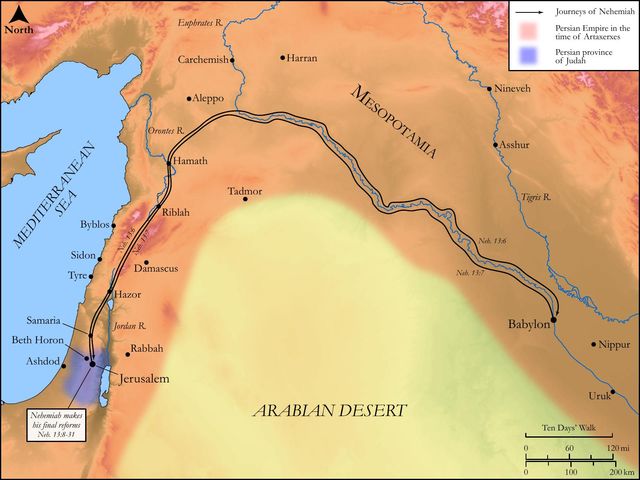
See on the biblical-era map
Study this verse
Public-domain commentary
Matthew Henry
From his Commentary on the Whole Bible. Henry comments on passages, not single verses — this entry covers Nehemiah 13:1–9. His four-level outline is real structure in the source text, so it is rendered as structure.
It was the honour of Israel, and the greatest preservation of their holiness, that they were a peculiar people, and were so to keep themselves, and not to mingle with the nations, nor suffer any of them to incorporate with them. Now here we have,
I.The law to this purport, which happened to be read on that day, in the audience of the people (Neh 13:1), on the day of the dedication of the wall, as it should seem, for with their prayers and praises they joined the reading of the word; and though it was long after that the other grievances, here mentioned, were redressed by Nehemiah's power, yet this of the mixed multitude might be redressed then by the people's own act, for so it seems to be, Neh 13:3. Or, perhaps, it was on the anniversary commemoration of that day, some years after, and therefore said to be on that day. They found a law, that the Ammonites and Moabites should not be naturalized, should not settle among them, nor unite with them, Neh 13:1. The reason given is because they had been injurious and ill-natured to the Israel of God (Neh 13:2), had not shown them common civility, but sought their ruin, though they not only did them no harm, but were expressly forbidden to do them any. This law we have, with this reason, Deu 23:3-5.
II.The people's ready compliance with this law, Neh 13:3.
See the benefit of the public reading of the word of God; when it is duly attended to it discovers to us sin and duty, good and evil, and shows us wherein we have erred. Then we profit by the discovery when by it we are wrought upon to separate ourselves from all that evil to which we had addicted ourselves. They separated from Israel all the mixed multitude, which had of old been a snare to them, for the mixed multitude fell a lusting, Num 11:4. These inmates they expelled, as usurpers and dangerous.
III.The particular case of Tobiah, who was an Ammonite, and to whom, it is likely, the historian had an eye in the recital of the law (Neh 13:1), and the reason of it, Neh 13:2. For he had the same enmity to Israel that his ancestors had, the spirit of an Ammonite, witness his indignation at Nehemiah (Neh 2:10) and the opposition he had given to his undertakings, Neh 4:7, Neh 4:8. Observe,
1.How basely Eliashib the chief priest took this Tobiah in to be a lodger even in the courts of the temple.
(1.)He was allied to Tobiah (Neh 13:4), by marriage first and then by friendship. His grandson had married Sanballat's daughter, Neh 13:28. Probably some other of his family had married Tobiah's, and (would you think it?) the high priest thought the alliance an honour to his family, and was very proud of it, though really it was his greatest disgrace, and what he had reason to be ashamed of. It was expressly provided by the law that the high priest should marry one of his own people, else he profanes his seed among his people, Lev 21:14, Lev 21:15. And for Eliashib to contract an alliance with an Ammonite, a servant (for so he is called) and to value himself upon it, probably because he has a wit and a beau, and cried up for a fine gentleman (Neh 6:19), was such a contempt of the crown of his consecration as one would not wish should be told in Gath or published in the streets of Ashkelon.
(2.)Being allied to him, he must be acquainted with him. Tobiah, being a man of business, has often occasion to be at Jerusalem, I doubt upon no good design. Eliashib is fond of his new kinsman, pleased with his company, and must have him as near him as he can. He has not a room for him stately enough in his own apartment, in the courts of the temple; therefore, out of several little chambers which had been used for store-chambers, by taking down the partitions, he contrived to make one great chamber, a state-room for Tobiah, Neh 13:5. A wretched thing it was,
[1.]That Tobiah the Ammonite should be entertained with respect in Israel, and have a magnificent reception.
[2.]That the high priest, who should have taught the people the law and set them a good example, should, contrary to the law, give him entertainment, and make use of the power he had, as overseer of the chambers of the temple, for that purpose.
[3.]That he should lodge him in the courts of God's house, as if to confront God himself; this was next to setting up an idol there, as the wicked kings of old had done. An Ammonite must not come into the congregation; and shall one of the worst and vilest of the Ammonites be courted into the temple itself, and caressed there?
[4.]That he should throw out the stores of the temple, to make room for him, and so expose them to be lost, wasted, and embezzled, though they were the portions of the priests, merely to gratify Tobiah. Thus did he corrupt the covenant of Levi, as Malachi complained at this time, Mal 2:8. Well might Nehemiah add (Neh 13:6), But all this time was not I at Jerusalem. If he had been there, the high priest durst not have done such a thing. The envious one, who sows tares in God's field, knows how to take an opportunity to do it when the servants sleep or are absent, Mat 13:25. The golden calf was made when Moses was in the mount.
2.How bravely Nehemiah, the chief governor, threw him out, and all that belonged to him, and restored the chambers to their proper use. When he came to Jerusalem, and was informed by the good people who were troubled at it what an intimacy had grown between their chief priest and their chief enemy, it grieve him sorely (Neh 13:7, Neh 13:8) that God's house should be so profaned, his enemies so caressed and trusted, and his cause betrayed by him that should have been its protector and patron. Nothing grieves a good man, a good magistrate, more than to see the ministers of God's house do any wicked thing. Nehemiah has power and he will use it for God.
(1.)Tobiah shall be expelled. He fears not disobliging him, fears not his resentments, or Eliashib's, nor excuses himself from interposing in an affair that lay within the jurisdiction of the high priest; but, like one zealously affected in a good thing, he expels the intruder, by casting forth all his household stuff. He did not seize it for his own use, but cast it out, that Tobiah, who it is probable was now absent, when he came again, might have no conveniences for his reception there. Our Saviour thus cleansed the temple, that the house of prayer might not be a den of thieves. And thus those that would expel sin out of their hearts, those living temples, must throw out its household stuff and all the provision made for it, strip it, starve it, and take away all those things that are the food and fuel of lust; this is, in effect, to mortify it.
(2.)The temple stores shall be brought in again, and the vessels of the house of God put in their places; but the chambers must first be sprinkled with the water of purification, and so cleansed, because they had been profaned. Thus, when sin is cast out of the heart by repentance, let the blood of Christ be applied to it by faith, and then let it be furnished with the graces of God's Spirit for every good work.
Historical interpretation
Historical reception
1 surviving comment on this verse from the historical church.
He made for himself a large treasury, etc. This statement, where Nehemiah writes that he was not in Jerusalem, does not seem to pertain to the matters narrated above up to this point, but only to the present location; for the previous matters were seen to have been done or spoken at the time when the city was built and dedicated, when Nehemiah was still residing in Jerusalem; with those things diligently completed, he returned to the king, and while he was absent, Eliashib made a large treasury in which were stored those things necessary either for the ministry of the house of the Lord or for the use of the ministers. He was not afraid to place certain unlawful things in the treasury of the house of the Lord; because when Nehemiah returned to Jerusalem, he immediately strove to disrupt those things. For it follows:
Continue studying Nehemiah 13:5 across the web’s major study libraries — every link below opens this exact verse, chapter, or book on the destination site.
Read & Compare
 BibleGatewayThis verse in more than 200 translations and 70 languages.
 Bible.comThe YouVersion reader — hundreds of translations, reading plans, and highlights.
 ESV.orgCrossway's official English Standard Version reader.
 NET BibleThe NET translation with 60,000+ translators' notes on every rendering decision.
 STEP BibleTyndale House's free study tool — original text, vocabulary, and scholarly resources.
 BibliaLogos Bible Software's free web reader.
 USCCBThe New American Bible (Revised Edition) with the U.S. bishops' study notes.
Commentaries
 BibleHub CommentariesDozens of classic commentaries on this verse, gathered on one page.
 StudyLightMore than 100 commentary sets — the largest collection on the web.
 BibleRefPlain-English commentary on what this verse means, verse by verse.
 Enduring WordDavid Guzik's free commentary on this chapter, widely used by Bible teachers.
 Bible Study ToolsVerse commentary alongside Greek and Hebrew study aids.
Original Language & Research
- BibleHub InterlinearThe verse word by word — original language, transliteration, and English.
- BibleHub LexiconEvery word's original-language definition and Strong's entry.
 Blue Letter BibleDeep-study tools — Strong's numbers, concordance, and word studies.
 SefariaThe Hebrew text with Rashi and centuries of Jewish commentary.
Sermons, Hymns & Audio


TrulyRandomVerse is not affiliated with these sites and doesn’t control their content. They’re linked because they’re genuinely useful.
Summary
Nehemiah 13:5 unveils a shocking act of spiritual compromise and administrative corruption within the post-exilic Jerusalem temple. During Nehemiah's absence, Eliashib the high priest, in a grave breach of his sacred duty, had converted a large chamber—originally designated for the storage of holy offerings, frankincense, vessels, and the vital tithes intended for the sustenance of the Levites and temple workers—into a private residence for Tobiah the Ammonite, a notorious adversary of Israel. This egregious misuse of consecrated space and diversion of essential resources exposed a severe breakdown in leadership integrity and adherence to God's commands, directly undermining the sanctity and functioning of temple worship and the support system for its ministers.
Context
ShowHideLiterary Context
This verse serves as the dramatic opening to Nehemiah's account of his second return to Jerusalem, meticulously detailed in Nehemiah 13. Following a period of significant spiritual renewal, national confession, and a solemn covenant commitment to uphold God's law, including the support of the temple and its personnel (Nehemiah 9-10), Nehemiah returns to find widespread apostasy. The shocking revelation of Tobiah's occupation of a temple chamber is the first and arguably most flagrant transgression Nehemiah confronts. It immediately sets a tone of profound disillusionment and underscores the fragility of spiritual revival without consistent vigilance and faithful leadership, laying the groundwork for Nehemiah's subsequent zealous reforms concerning tithes, Sabbath observance, and intermarriage.
Historical & Cultural Context
The events described transpire in Jerusalem during the Persian period, approximately 433-424 BC, after the initial return from Babylonian exile. The Second Temple, though rebuilt, was still the spiritual and communal epicenter for the Jewish remnant. The system of tithes and offerings was not merely a religious custom but a divinely mandated economic structure (e.g., Numbers 18:21-24) crucial for the financial and practical support of the Levites, singers, porters, and priests. This support enabled them to dedicate themselves fully to their sacred duties, ensuring the continuity of temple worship. Eliashib, as the high priest, held the paramount spiritual office, bearing the weighty responsibility of maintaining the sanctity of the Temple and upholding God's laws. Tobiah the Ammonite, in stark contrast, was a persistent and vocal adversary of Nehemiah and the Jewish people's efforts to rebuild Jerusalem's walls and restore its spiritual life, frequently employing mockery, conspiracy, and intimidation (Nehemiah 2:10 and Nehemiah 4:7-8). His familial connection to Eliashib through marriage (specifically, Tobiah's son had married a daughter of Meshullam, who was related to Eliashib, as noted in Nehemiah 13:4) provided the illicit leverage for this egregious breach of sacred space and protocol.
Key Themes
ShowHideNehemiah 13:5 powerfully illustrates several critical themes. Firstly, it highlights the desecration of sacred space and resources. The chamber was not merely a storeroom but a consecrated space within the temple precincts, specifically dedicated to the Lord's provisions for His ministers. Allowing an uncircumcised Ammonite, an avowed enemy of Israel and the Lord, to reside there was a profound affront to God's holiness and a defilement of His house. Secondly, it exposes corruption in leadership. High Priest Eliashib's actions demonstrate a severe lapse in spiritual integrity and a prioritization of personal alliances over divine duty. His compromise with Tobiah directly undermined the sanctity of the temple and the proper functioning of its services, revealing the insidious dangers of spiritual leaders succumbing to worldly pressures and familial ties that contradict God's law. Finally, the verse points to the neglect of temple support and its devastating consequences. By diverting the tithes and offerings from their intended purpose, Eliashib effectively disrupted the divinely ordained system of support for the Levites and temple workers. This neglect would inevitably lead to their abandonment of temple duties to seek livelihoods elsewhere, as Nehemiah later discovers in Nehemiah 13:10, threatening the very continuity of temple worship and the spiritual life of the community.
Exposition and Analysis
ShowHideKey Word Analysis
ShowHideOr גָּדֹל; (shortened) from גָּדַל; great (in any sense); hence, older; also insolent; [phrase] aloud, elder(-est), [phrase] exceeding(-ly), [phrase] far, (man of) great (man, matter, thing,-er,-ness), high, long, loud, mighty, more, much, noble, proud thing, [idiom] sore, ([idiom]) very. The term "great" here emphasizes the significant size and importance of the chamber. This was not a minor closet but a substantial space, indicating the magnitude of the provisions it was meant to hold and, consequently, the severity of its misappropriation. The "greatness" of the chamber amplifies the brazenness of Eliashib's act.
From an unused root of uncertain meaning; a room in a building (whether for storage, eating, or lodging); chamber, parlour. Compare נִשְׁכָּה. This term refers to a specific, often dedicated room or cell within the temple complex. It implies a space with a designated function, distinct from a common storage area. In this context, its use for sacred provisions underscores its inherent holiness and the gravity of its desecration. The designation as a "chamber" rather than a mere "storeroom" hints at its more formal and perhaps even residential potential, which Eliashib exploited.
Or מַעֲשַׂר; and (in plural) feminine מַעֲשְׂרָה; from עָשָׂר; a tenth; especially a tithe; tenth (part), tithe(-ing). Derived from the root meaning "tenth," maʻăsêr refers to the divinely commanded tenth part of agricultural produce, livestock, and other income that the Israelites were required to give. This system, detailed in various Mosaic laws (e.g., Leviticus 27:30 and Deuteronomy 14:22), was the primary means of support for the Levites and priests, ensuring they could dedicate themselves fully to their sacred service without needing to farm or engage in other trades. The diversion of these tithes was not merely a financial impropriety but a direct violation of God's established order for the upkeep of His house and ministry, leading to the neglect of the temple and its personnel.
A primitive root; to do or make, in the broadest sense and widest application; accomplish, advance, appoint, apt, be at, become, bear, bestow, bring forth, bruise, be busy, [idiom] certainly, have the charge of, commit, deal (with), deck, [phrase] displease, do, (ready) dress(-ed), (put in) execute(-ion), exercise, fashion, [phrase] feast, (fight-) ing man, [phrase] finish, fit, fly, follow, fulfill, furnish, gather, get, go about, govern, grant, great, [phrase] hinder, hold (a feast), [idiom] indeed, [phrase] be industrious, [phrase] journey, keep, labour, maintain, make, be meet, observe, be occupied, offer, [phrase] officer, pare, bring (come) to pass, perform, pracise, prepare, procure, provide, put, requite, [idiom] sacrifice, serve, set, shew, [idiom] sin, spend, [idiom] surely, take, [idiom] thoroughly, trim, [idiom] very, [phrase] vex, be (warr-) ior, work(-man), yield, use. The verb "prepared" (or "made") indicates a deliberate and active arrangement by Eliashib. It suggests intentionality and forethought, not an accidental or passive occurrence. Eliashib did not merely allow Tobiah to occupy the space; he actively "made" or "prepared" it for him, underscoring his complicity and the premeditated nature of this sacrilege.
Verse Breakdown
ShowHide"And he had prepared for him a great chamber"
This opening clause immediately identifies the primary agent of the transgression, "he" (Eliashib, the high priest), and his deliberate, active role in orchestrating the sacrilege. The phrase "great chamber" not only highlights the physical size of the space but also implicitly emphasizes the significant volume of sacred provisions it was designed to hold, making its misappropriation all the more severe and impactful.
"where aforetime they laid the meat offerings, the frankincense, and the vessels"
This segment explicitly details the original, sacred purpose and contents of the chamber. "Meat offerings" (more accurately, grain offerings, minchâh), "frankincense," and "vessels" were not merely mundane items; they were integral components of temple worship, representing the people's devotion, the aromatic presence of God, and the instruments of sacred service. Their designated storage in this chamber underscores its consecrated nature and the profound disrespect inherent in its re-purposing.
"and the tithes of the corn, the new wine, and the oil"
This clause specifies the most critical contents of the chamber—the agricultural tithes. These provisions, derived from the land's bounty, were the economic lifeblood of the temple's daily operations and the divinely ordained sustenance for its dedicated staff. Their mention here highlights the severe economic and spiritual disruption caused by their removal and diversion.
"which was commanded [to be given] to the Levites, and the singers, and the porters; and the offerings of the priests"
This final, crucial clause explicitly states the divine mandate behind these provisions and identifies their intended beneficiaries. It emphasizes that the diversion was not merely a logistical error or a minor administrative oversight, but a direct and deliberate violation of God's clear command. By depriving those who served Him—the Levites, singers, porters, and priests—of their rightful support, Eliashib jeopardized the continuity and integrity of temple ministry itself.
Literary Devices
ShowHideNehemiah 13:5 employs several potent literary devices to underscore the gravity of Eliashib's actions and the depth of the spiritual decline. Juxtaposition is profoundly evident, contrasting the chamber's sacred, divinely ordained purpose—storing holy offerings and vital tithes for the sustenance of temple service—with its profane, illicit use as a dwelling for Tobiah, an uncircumcised Ammonite and an avowed enemy of God's people. This stark contrast powerfully highlights the extent of the desecration. There is also a biting sense of irony, as the High Priest, Eliashib, the very guardian of the Temple's sanctity and the integrity of its worship, is the one who facilitates its defilement. This egregious subversion of his sacred role is central to the verse's impact, exposing a catastrophic failure of spiritual leadership. Furthermore, the "great chamber" itself functions as a powerful metonymy or synecdoche, representing not just a physical space but the broader sanctity of the Temple, the integrity of its operations, the faithfulness of its leadership, and the very covenant relationship between God and Israel. Its violation, therefore, signifies a deeper, pervasive spiritual decay. Finally, the incident serves as a clear foreshadowing of the wider spiritual and administrative breakdown Nehemiah will discover and zealously address, including the widespread neglect of the Levites and the abandonment of temple duties due to lack of support (Nehemiah 13:10), which directly resulted from such diversions.
Theological and Thematic Connections
ShowHideNehemiah 13:5 serves as a stark and enduring theological reminder of the sanctity of God's house, the non-negotiable integrity required of spiritual leadership, and the critical importance of faithful stewardship of divine resources. The high priest's actions demonstrate a profound disrespect for the divine order and a dangerous compromise with ungodliness, prioritizing personal alliances over covenant fidelity. This incident underscores that the purity of worship and the effectiveness of ministry are inextricably tied to the faithfulness and integrity of those entrusted with leadership and the proper management of God's provisions. When sacred spaces are profaned and divinely ordained provisions are diverted from their intended purpose, it not only impacts the physical operations of the temple but also reflects a deeper spiritual malaise, indicating a departure from covenant faithfulness and a disregard for God's glory. The verse calls believers to vigilant discernment against compromise and to uphold the holiness of God's work and His people, recognizing that every aspect of our lives and resources can either honor or dishonor Him.
Reflection and Application
ShowHideNehemiah 13:5 offers timeless and profound lessons for believers today, emphasizing the critical importance of maintaining spiritual integrity and protecting what is sacred from compromise and defilement. Just as the physical temple chamber was a holy space, so too are our churches, our personal lives, and the resources entrusted to us meant to be set apart for God's purposes and glory. This verse challenges us to examine whether we, individually and corporately, are allowing "Tobiahs"—representing compromise with worldly values, ungodly influences, or personal agendas—to occupy "chambers" (areas of our lives, our time, our finances, or our church's resources) meant exclusively for God's glory and the support of His kingdom work. It calls leaders to a higher standard of accountability, reminding them that their personal alliances, decisions, and integrity can have profound ripple effects on the spiritual health, operational effectiveness, and moral standing of the community they serve. Faithful stewardship of resources, whether time, talent, or treasure, is not merely an administrative task but a spiritual discipline that directly impacts the flourishing of God's kingdom and the authenticity of our worship. We are called to be zealous for the Lord's house, both physically and spiritually.
Questions for Reflection
ShowHideFAQ
ShowHideWho was Tobiah and why was his presence in the temple so offensive?
ShowHideTobiah was an Ammonite official and a long-standing adversary of Nehemiah and the Jewish people's efforts to rebuild Jerusalem. His presence in a sacred temple chamber was deeply offensive for several reasons. First, Ammonites were explicitly excluded from the assembly of the Lord by Mosaic Law (Deuteronomy 23:3-6), making his residence in the temple a direct violation of divine command and a defilement of the holy space. Second, he was a known enemy of God's people, actively opposing their spiritual and physical restoration (Nehemiah 4:1-3). Allowing him to occupy a space meant for holy offerings and the sustenance of God's ministers was a profound act of desecration, symbolizing the infiltration of ungodliness and opposition into the very heart of Jewish worship and national identity.
What was the significance of the "tithes" and why was their removal problematic?
ShowHideThe "tithes" (a tenth of agricultural produce, new wine, and oil) were a divinely commanded provision for the Levites, singers, porters, and priests who served in the temple. This system, established by God (e.g., Numbers 18:21), ensured that those dedicated to temple ministry could focus entirely on their sacred duties without needing to engage in farming or other trades for sustenance. Their removal or diversion, as happened in Nehemiah 13:5, was problematic because it directly violated God's established order for the upkeep of His house and ministry. As Nehemiah later discovers in Nehemiah 13:10, this neglect led to the Levites abandoning their temple service to seek livelihoods elsewhere, causing the temple worship to falter and the spiritual life of the community to decline. It was an act of "robbing God" (Malachi 3:8).
What does this incident reveal about Eliashib's character?
ShowHideThe incident reveals a severe compromise of Eliashib's character and a profound failure in his role as high priest. As the chief spiritual leader, he was entrusted with protecting the sanctity of the temple and upholding God's laws. However, his personal alliance with Tobiah (likely through a marriage connection, as mentioned in Nehemiah 13:4) superseded his sacred duties. His act of "preparing" the chamber for Tobiah demonstrates a deliberate and profound lack of spiritual integrity, prioritizing worldly relationships and personal convenience over his divine calling and the purity of God's house. It indicates a spiritual blindness, a willingness to profane sacred space, and a neglect of the very people he was called to serve, all for the sake of an unholy alliance.
Christ-Centered Fulfillment
ShowHideNehemiah's zealous action in cleansing the temple chamber of Tobiah's defiling presence and restoring it to its sacred purpose powerfully foreshadows the ultimate cleansing and purification brought by Jesus Christ. While Nehemiah dealt with external corruption and the misuse of physical space, Christ's redemptive work addresses the deeper defilement of the human heart and the spiritual temple of God's people. Jesus, as the true and perfect High Priest (as seen in Hebrews 4:14-16), perfectly upholds the sanctity of God's dwelling place. His passionate cleansing of the temple in Jerusalem, where He drove out those who profaned God's house by turning it into a "den of thieves" (recorded in John 2:13-17 and Matthew 21:12-13), echoes Nehemiah's zeal but with divine authority and a comprehensive scope. More profoundly, Christ's ultimate sacrifice on the cross serves as the perfect "offering" that cleanses humanity from the defilement of sin, making us a holy temple for the Holy Spirit (1 Corinthians 6:19-20). Through His atoning work, the "tithes" and "offerings" of our lives—our worship, service, and very being—are made acceptable to God, not through physical provisions, but by His grace and the indwelling Spirit. He ensures that God's people, the Church, become the true spiritual house, built on Him as the cornerstone, where God's presence dwells and His purposes are perfectly fulfilled (Ephesians 2:19-22).