


2 Chronicles 34:11
- וַיִּתְּנוּvai·yi·te·Nuand they gave [it]H5414Conj-w ¦ V-Qal-ConsecImperf-3mpVerb Qal Consecutive Imperfect 3rd Plural Masculineוַandיִּתְּנוּthey gave [it]
- לֶחָרָשִׁיםle·cha·ra·Shimto the craftsmenH2796Prep-l ¦ N-mpNoun Plural Masculine Absoluteלֶto theחָרָשִׁיםcraftsmen
- וְלַבֹּנִיםve·la·bo·Nimand to the buildersH1129Conj-w ¦ Prep-l ¦ V-Qal-Prtcpl-mpVerb Qal Participle Plural Masculine Absoluteוְandלַto theבֹּנִיםbuilders
- לִקְנוֹתlik·nOtto buyH7069Prep-l ¦ V-Qal-InfVerb Qal Infinitive Constructלִtoקְנוֹתbuy
- אַבְנֵי'av·Neistones ofH68N-fpcNoun Plural Feminine Construct
- מַחְצֵבmach·TzevhewingH4274N-msNoun Singular Masculine Absolute
- וְעֵצִיםve·'e·Tzimand wood<s>H6086Conj-w ¦ N-mpNoun Plural Masculine Absoluteוְandעֵצִיםwood<s>
- לַמְחַבְּרוֹתlam·cha·be·Rotfor the clampsH4226Prep-l ¦ N-fpNoun Plural Feminine Absoluteלַfor theמְחַבְּרוֹתclamps
- וּלְקָרוֹתu·le·ka·rOtand to make beams forH7136Conj-w ¦ Prep-l ¦ V-Piel-InfVerb Piel Infinitive Constructוּandלְtoקָרוֹתmake beams for
- אֶת'et<obj.>H853DirObjMParticle Object Indicator
- הַבָּתִּיםha·Ba·Timthe housesH1004Art ¦ N-mpNoun Plural Masculine Absoluteהַtheבָּתִּיםhouses
- אֲשֶׁר'a·SherwhichH834RelParticle Relative
- הִשְׁחִיתוּhish·Chi·tuthey had ruinedH7843V-Hiphil-Perf-3cpVerb Hiphil Perfect 3rd Plural common gender
- מַלְכֵיmal·Khei[the] kings ofH4428N-mpcNoun Plural Masculine Construct
- יְהוּדָהye·hu·DahJudahH3063N-properNoun Proper Location
English is a literal word-by-word gloss of the Hebrew, not the KJV's wording. Why?
This is the original text the KJV's translators worked from — each Hebrew word with its own literal English meaning in this verse, prepared by scholars at Tyndale House, Cambridge. The KJV translates whole sentences, not word by word, so its wording differs: one Hebrew word can become several English words, and the KJV may choose “the LORD” where the gloss reads “Yahweh”. Both are faithful — they answer different questions. For the KJV's own rendering, switch to the KJV text.
Details
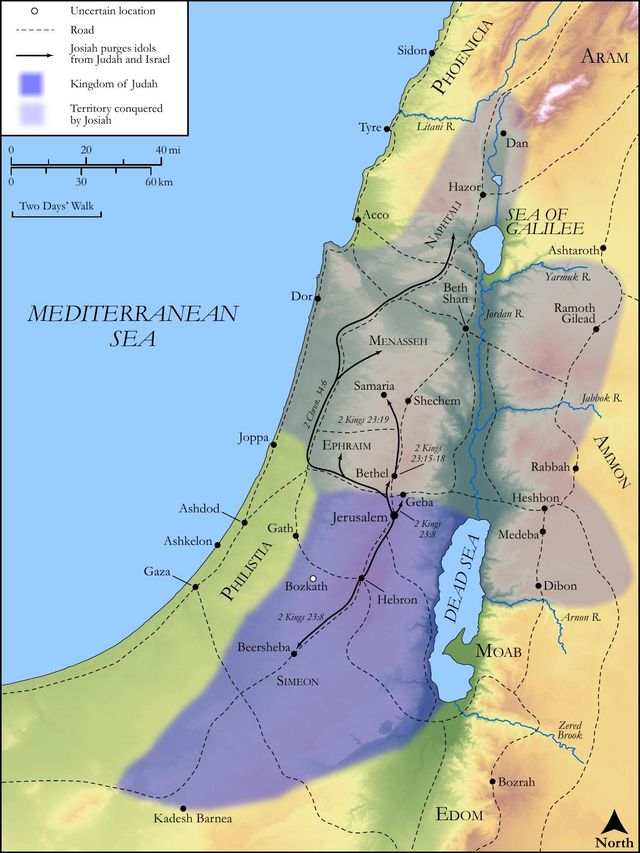
See on the biblical-era map
Study this verse
Public-domain commentary
Matthew Henry
From his Commentary on the Whole Bible. Henry comments on passages, not single verses — this entry covers 2 Chronicles 34:8–13.
Here, 1. Orders are given by the king for the repair of the temple, Ch2 34:8. When he had purged the house of the corruptions of it he began to fit it up for the services that were to be performed in it. Thus we must do by the spiritual temple of the heart, get it cleansed from the pollutions of sin, and then renewed, so as to be transformed into the image of God. Josiah, in this order, calls God the Lord his God. Those that truly love God will love the habitation of his house. 2. Care is taken about it, effectual care. The Levites went about the country and gathered money towards it, which was returned to the three trustees mentioned, Ch2 34:8. They brought it to Hilkiah the high priest (Ch2 34:9), and he and they put it into the hands of workmen, both overseers and labourers, who undertook to do it by the great, as we say, or in the gross, Ch2 34:10, Ch2 34:11. It is observed that the workmen were industrious and honest: They did the work faithfully (Ch2 34:12); and workmen are not completely faithful if they are not both careful and diligent, for a confidence is reposed in them that they will be so. It is also intimated that the overseers were ingenious; for it is said that all those were employed to inspect this work who were skilful in instruments of music; not that their skill in music could be of any use in architecture, but it was an evidence that they were men of sense and ingenuity, and particularly that their genius lay towards the mathematics, which qualified them very much for this trust. Witty men are then wise men when they employ their wit in doing good, in helping their friends, and, as they have opportunity, in serving the public. Observe, in this work, how God dispenses his gifts variously; here were some that were bearers of burdens, cut out for bodily labour and fit to work. Here were others (made meliori luto - of finer materials) that had skill in music, and they were overseers of those that laboured, and scribes and officers. The former were the hands: these were the heads. They had need of one another, and the work needed both. Let not the overseers of the work despise the bearers of burdens, nor let those that work in the service grudge at those whose office it is to direct; but let each esteem and serve the other in love, and let God have the glory and the church the benefit of the different gifts and dispositions of both.
Continue studying 2 Chronicles 34:11 across the web’s major study libraries — every link below opens this exact verse, chapter, or book on the destination site.
Read & Compare
 BibleGatewayThis verse in more than 200 translations and 70 languages.
 Bible.comThe YouVersion reader — hundreds of translations, reading plans, and highlights.
 ESV.orgCrossway's official English Standard Version reader.
 NET BibleThe NET translation with 60,000+ translators' notes on every rendering decision.
 STEP BibleTyndale House's free study tool — original text, vocabulary, and scholarly resources.
 BibliaLogos Bible Software's free web reader.
 USCCBThe New American Bible (Revised Edition) with the U.S. bishops' study notes.
Commentaries
 BibleHub CommentariesDozens of classic commentaries on this verse, gathered on one page.
 StudyLightMore than 100 commentary sets — the largest collection on the web.
 BibleRefPlain-English commentary on what this verse means, verse by verse.
 Enduring WordDavid Guzik's free commentary on this chapter, widely used by Bible teachers.
 Bible Study ToolsVerse commentary alongside Greek and Hebrew study aids.
Original Language & Research
- BibleHub InterlinearThe verse word by word — original language, transliteration, and English.
- BibleHub LexiconEvery word's original-language definition and Strong's entry.
 Blue Letter BibleDeep-study tools — Strong's numbers, concordance, and word studies.
 SefariaThe Hebrew text with Rashi and centuries of Jewish commentary.
Sermons, Hymns & Audio


TrulyRandomVerse is not affiliated with these sites and doesn’t control their content. They’re linked because they’re genuinely useful.
Summary
2 Chronicles 34:11 meticulously details the practical allocation of resources—specifically, funds for skilled labor and construction materials like hewn stone and timber—to facilitate the extensive restoration of the temple and other significant structures in Judah. This verse underscores the tangible commitment of King Josiah's widespread reform movement, illustrating the diligent, hands-on effort required to reverse generations of neglect and idolatry, thereby preparing the physical space for a profound spiritual renewal.
Context
ShowHideLiterary Context
This verse is situated within the narrative of King Josiah's remarkable reign, particularly during his eighteenth year, a period marked by profound spiritual reformation. Having already initiated a sweeping purge of idolatry from Judah and Israel, Josiah turns his attention to the physical restoration of the temple in Jerusalem. The preceding verses detail the collection of funds from the people, entrusted to the Levites, which sets the stage for the practical expenditure described here. This meticulous accounting of materials and labor highlights the seriousness and thoroughness of the restoration effort, directly preceding the pivotal discovery of the Book of the Law within the temple by Hilkiah the high priest, an event that further propelled Josiah's reforms and the nation's return to God's covenant. The restoration of the physical house of God thus serves as a crucial precursor and symbol of the spiritual restoration of the people.
Historical & Cultural Context
King Josiah ascended to the throne at a young age and, unlike many of his predecessors, faithfully pursued God from his youth, as noted in 2 Chronicles 34:3. His reign followed decades of severe apostasy under kings like Manasseh and Amon, who not only permitted but actively promoted idolatry, even desecrating the temple itself. The "houses which the kings of Judah had destroyed" likely refers to the temple complex and possibly other royal or public buildings that had fallen into disrepair or were actively damaged due to neglect, disuse, or even the removal of materials for pagan worship structures. The temple was not merely a building but the central place of worship, symbolizing God's presence among His people. Its dilapidated state reflected the spiritual decay of the nation. Josiah's initiative to repair it was a bold statement of his commitment to restoring pure worship and national integrity, aligning himself with the righteous kings of Judah's past.
Key Themes
ShowHideThe primary themes embedded in this passage revolve around Diligent Restoration and Godly Leadership. The detailed mention of "artificers," "builders," "hewn stone," and "timber for couplings" underscores that genuine spiritual renewal is not merely an internal sentiment but demands tangible, practical effort to rebuild and repair what has been broken or neglected. This verse exemplifies how King Josiah's unwavering commitment to God translated directly into concrete actions that benefited the entire nation, actively undoing the damage caused by previous wicked kings who had "destroyed" or allowed the deterioration of sacred and public structures. Furthermore, the emphasis on quality materials like "hewn stone" and the specific purpose "to floor the houses" (or roof them) highlights the Reverence for God's House and the seriousness with which the temple and other structures were being restored, ensuring they were structurally sound and functional again, reflecting a renewed commitment to God's dwelling place. This act of physical restoration foreshadows the spiritual renewal that would sweep through Judah, demonstrating that outward obedience often accompanies inward transformation, as seen in the broader narrative of 2 Chronicles 34.
Exposition and Analysis
ShowHideKey Word Analysis
ShowHideThis term (H2796) refers to highly skilled craftsmen or artisans, encompassing specialists like masons, carpenters, and metalworkers. Their involvement signifies the meticulous and expert workmanship required for the temple's restoration, emphasizing a commitment to precision and quality befitting the sacred house of God.
While "artificers" (H2796) denote specialized craftsmen, "builders" (derived from H1129, bânâh) refers to those actively engaged in the general construction process, overseeing the assembly and erection of structures. This term encompasses the broader workforce responsible for implementing the plans and utilizing the materials, highlighting the comprehensive nature of the project, involving both specialized skill and general labor.
The Hebrew verb qârâh (H7136) specifically means "to impose timbers (for roof or floor)." In the context of ancient construction, this often refers to the crucial stage of laying the roof beams and covering, or installing the floor. Therefore, "to floor the houses" (as translated in KJV) signifies the completion of the structures, making them enclosed, protected, and functional. This implies the buildings were so dilapidated they lacked proper roofs or floors, rendering them unusable and exposed to the elements.
Verse Breakdown
ShowHide"Even to the artificers and builders gave they [it]"
This clause specifies the recipients of the collected funds, highlighting that the money was not merely stored but actively disbursed for practical purposes. The "they" refers to the officials appointed by King Josiah (Shaphan, Maaseiah, Joah, and Hilkiah, as mentioned in 2 Chronicles 34:8-10), who were responsible for overseeing the temple repairs. The emphasis on "artificers and builders" underscores the necessity of skilled labor for such a significant and sacred undertaking.
"to buy hewn stone, and timber for couplings"
This details the specific, high-quality materials purchased. "Hewn stone" (אֶבֶן גָּזִית, ʾeven gāzît) refers to carefully cut and shaped stones, indicating precision and durability, contrasting with rough, unworked stones. "Timber for couplings" (עֵץ מְחַבְּרֹת, ʿēṣ məḥabberōṯ) refers to wooden beams or planks specifically prepared to join or connect structural elements, essential for the stability and integrity of a building's framework, especially for roofing or flooring. The choice of these materials reflects a commitment to restoring the temple to a state of strength and beauty, not just a superficial patch-up.
"and to floor the houses which the kings of Judah had destroyed"
This final clause clarifies the ultimate purpose of the materials and labor: to complete and make functional the structures that had been ruined. The phrase "kings of Judah had destroyed" is significant. While some kings might have actively demolished parts of the temple for pagan altars (e.g., Manasseh), "destroyed" can also imply severe neglect leading to ruin. This highlights the stark contrast between the apostasy of previous reigns and Josiah's zealous commitment to restoring the sacred spaces, symbolizing a national return to God's covenant.
Literary Devices
ShowHideThe verse employs several literary devices to convey its message effectively. Contrast is prominent, setting Josiah's diligent restoration efforts against the destructive neglect of "the kings of Judah" who preceded him. This highlights the profound shift in leadership and national priorities. Detailing or Specification is also evident, as the verse meticulously lists the specific types of labor ("artificers and builders") and materials ("hewn stone, and timber for couplings"), which lends a sense of realism and thoroughness to the account. This precise enumeration emphasizes the practical and comprehensive nature of the work. Finally, Synecdoche or Metonymy can be observed in the phrase "the houses which the kings of Judah had destroyed." While literally referring to physical structures, these "houses" (especially the temple) also stand metonymically for the spiritual and moral state of the nation. Their destruction and subsequent restoration thus symbolize the spiritual decay and revival of Judah under Josiah's leadership.
Theological and Thematic Connections
ShowHideThis verse, detailing the practicalities of temple restoration, resonates deeply with broader biblical themes of spiritual renewal and the tangible expression of faith. It underscores that genuine revival is not merely an abstract concept but requires diligent, often laborious, effort to mend what is broken, purify what is defiled, and rebuild what has fallen into disrepair. Just as the physical temple was central to Israel's worship and identity, its restoration under Josiah symbolized a national turning back to God, acknowledging that the state of God's house often reflects the spiritual health of His people. This act of physical rebuilding serves as a powerful metaphor for the ongoing need for spiritual restoration in individual lives and communities, where the "old self" must be put off and the "new self" built up in righteousness. It reminds us that stewardship of sacred spaces and resources is an act of worship, reflecting a heart devoted to God's glory and the flourishing of His kingdom.
Reflection and Application
ShowHideThe meticulous details of 2 Chronicles 34:11 offer profound lessons for contemporary believers. It teaches us that faith is not solely an internal, contemplative exercise but often manifests through practical, diligent work. Just as Josiah initiated the physical repair of God's house, we are called to engage in the work of "building up" and restoring, whether it applies to our personal spiritual lives, our families, our communities, or the church. This might involve repairing relationships, restoring neglected disciplines, or contributing to the physical and spiritual health of our local congregations. The commitment to using "hewn stone" and "timber for couplings" speaks to the importance of quality and intentionality in our service to God—not offering Him what is cheap or convenient, but our best efforts and resources. This verse serves as a powerful reminder that authentic faith often manifests in tangible efforts to bring order, beauty, and functionality out of disarray and decay, reflecting God's own character as a restorer and builder.
Questions for Reflection
ShowHideFAQ
ShowHideWhat was the significance of "hewn stone" and "timber for couplings" in ancient construction?
ShowHide"Hewn stone" (אֶבֶן גָּזִית, ʾeven gāzît) referred to stones that had been carefully cut, shaped, and dressed by skilled masons. Unlike rough, unworked fieldstones, hewn stones were precisely fitted together, creating strong, stable, and aesthetically pleasing structures. Their use indicated a commitment to quality, durability, and a high standard of craftsmanship, especially for important buildings like the temple. "Timber for couplings" (עֵץ מְחַבְּרֹת, ʿēṣ məḥabberōṯ) referred to prepared wooden beams or planks specifically designed to join or connect structural elements, particularly for roofing or flooring. These were crucial for the structural integrity of a building, ensuring stability and protection from the elements. The mention of these specific, high-quality materials emphasizes the thoroughness and reverence with which Josiah's team approached the restoration of God's house and other public structures.
Why is it mentioned that previous kings "destroyed" the houses?
ShowHideThe phrase "which the kings of Judah had destroyed" highlights the stark contrast between Josiah's righteous reign and the apostasy of his predecessors, particularly Manasseh and Amon. While it might imply active demolition in some cases (e.g., Manasseh's pagan altars in the temple, as referenced in 2 Kings 21:4-5), "destroyed" can also encompass severe neglect that led to ruin and decay. Under ungodly kings, the temple and other sacred structures were often abandoned, desecrated, or allowed to fall into disrepair, symbolizing the spiritual decline of the nation. Josiah's restoration effort was therefore a direct reversal of this destructive legacy, a tangible sign of Judah's return to covenant faithfulness and reverence for God's dwelling place.
Was this restoration solely for the Temple?
ShowHideWhile the primary focus of Josiah's reform was the purification and repair of the Jerusalem Temple, the phrase "the houses which the kings of Judah had destroyed" (הַבָּתִּים, habbāttîm) can encompass more than just the main temple structure. It likely refers to the entire temple complex, including its various courts, chambers, and associated buildings, which would have fallen into disrepair. It could also potentially include other significant royal or public buildings within Judah that had suffered similar neglect or damage under previous ungodly reigns. The overarching goal was to restore order, functionality, and sacredness to the central places of national and religious life, demonstrating a comprehensive commitment to reversing the decay caused by generations of apostasy, as detailed in 2 Chronicles 34.
Christ-Centered Fulfillment
ShowHideThe physical restoration of the temple under King Josiah, as detailed in 2 Chronicles 34:11, serves as a powerful foreshadowing of the ultimate spiritual restoration accomplished through Jesus Christ. Just as Josiah diligently worked to repair the physical dwelling place of God, Jesus came to rebuild and purify the true temple—not one made with hands, but the spiritual temple of God's people, the Church. He is the ultimate "artificer" and "builder," who, through His sacrifice and resurrection, provides the "hewn stone" of His own perfect life and the "timber for couplings" in the form of His Spirit, binding believers together into a holy dwelling place for God (Ephesians 2:19-22). Where sin had "destroyed" humanity's relationship with God, leaving spiritual structures in ruins, Christ, as the Lamb of God (John 1:29), took away the sin of the world, restoring us to fellowship and making us living stones in His spiritual house (1 Peter 2:5). His work is not merely a repair but a new creation, transforming hearts and lives into vibrant, functional dwelling places for the Holy Spirit, far surpassing any physical temple, as He Himself declared He would rebuild the temple in three days (John 2:19-21).