


2 Chronicles 34:10
Bible text: King James Version (1769 Blayney text) · Public domain
Bible text: King James Version with Strong's numbers · Public domain
Bible text: Berean Standard Bible · Public domain
Bible text: American Standard Version (1901) · Public domain
Bible text: World English Bible, Messianic edition · Public domain
Bible text: Geneva Bible (1599) · Public domain
Bible text: Young's Literal Translation · Public domain
- וַיִּתְּנוּvai·yi·te·Nuand they gave [it]H5414Conj-w ¦ V-Qal-ConsecImperf-3mpVerb Qal Consecutive Imperfect 3rd Plural Masculineוַandיִּתְּנוּthey gave [it]
- עַל'alonH5921PrepPreposition
- יַדyad[the] hand ofH3027N-cscNoun Singular common gender Construct
- עֹשֵׂה'o·Seh[the] doer ofH6213V-Qal-Prtcpl-msVerb Qal Participle Singular Masculine Construct
- הַמְּלָאכָהha·me·la·Khahthe workH4399Art ¦ N-fsNoun Singular Feminine Absoluteהַtheמְּלָאכָהwork
- הַמֻּפְקָדִיםha·muf·ka·Dimwho were appointedH6485Art ¦ V-Hophal-PassPrtcpl-mpVerb Hophal Participle Passive Plural Masculine Absoluteהַwhoמֻּפְקָדִיםwere appointed
- בְּבֵיתbe·Veitin [the] house ofH1004Prep-b ¦ N-mscNoun Singular Masculine Constructבְּinבֵית[the] house of
- יְהוָהYah·wehYahwehH3068N-properNoun Proper Title
- וַיִּתְּנוּvai·yi·te·Nuand they gaveH5414Conj-w ¦ V-Qal-ConsecImperf-3mpVerb Qal Consecutive Imperfect 3rd Plural Masculineוַandיִּתְּנוּthey gave
- אֹתוֹ'o·To<obj.> itH853DirObjM ¦ 3msParticle Object Indicatorאֹת<obj.>וֹit
- עוֹשֵׂיo·Sei[the] doers ofH6213V-Qal-Prtcpl-mpVerb Qal Participle Plural Masculine Construct
- הַמְּלָאכָהha·me·la·Khahthe workH4399Art ¦ N-fsNoun Singular Feminine Absoluteהַtheמְּלָאכָהwork
- אֲשֶׁר'a·SherwhoH834RelParticle Relative
- עֹשִׂים'o·Sim[were] workingH6213V-Qal-Prtcpl-mpVerb Qal Participle Plural Masculine Absolute
- בְּבֵיתbe·Veitin [the] house ofH1004Prep-b ¦ N-mscNoun Singular Masculine Constructבְּinבֵית[the] house of
- יְהוָהYah·wehYahwehH3068N-properNoun Proper Title
- לִבְדּוֹקliv·Dokto mendH918Prep-l ¦ V-Qal-InfVerb Qal Infinitive Constructלִtoבְדּוֹקmend
- וּלְחַזֵּקu·le·cha·Zekand to repairH2388Conj-w ¦ Prep-l ¦ V-Piel-InfVerb Piel Infinitive Constructוּandלְtoחַזֵּקrepair
- הַבָּיִתha·Ba·yitthe houseH1004Art ¦ N-msNoun Singular Masculine Absoluteהַtheבָּיִתhouse
English is a literal word-by-word gloss of the Hebrew, not the KJV's wording. Why?
This is the original text the KJV's translators worked from — each Hebrew word with its own literal English meaning in this verse, prepared by scholars at Tyndale House, Cambridge. The KJV translates whole sentences, not word by word, so its wording differs: one Hebrew word can become several English words, and the KJV may choose “the LORD” where the gloss reads “Yahweh”. Both are faithful — they answer different questions. For the KJV's own rendering, switch to the KJV text.
Details
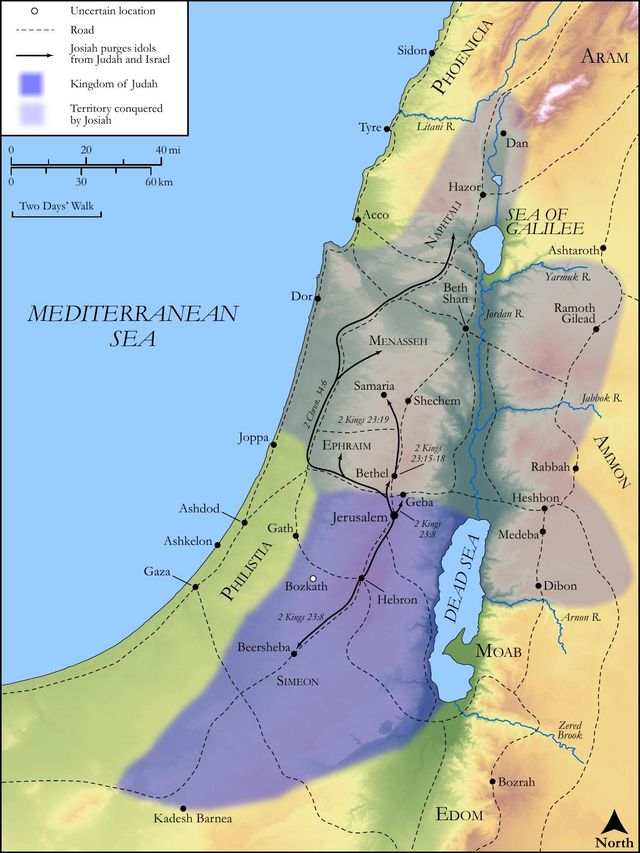
See on the biblical-era map
Study this verse
Public-domain commentary
Matthew Henry
From his Commentary on the Whole Bible. Henry comments on passages, not single verses — this entry covers 2 Chronicles 34:8–13.
Here, 1. Orders are given by the king for the repair of the temple, Ch2 34:8. When he had purged the house of the corruptions of it he began to fit it up for the services that were to be performed in it. Thus we must do by the spiritual temple of the heart, get it cleansed from the pollutions of sin, and then renewed, so as to be transformed into the image of God. Josiah, in this order, calls God the Lord his God. Those that truly love God will love the habitation of his house. 2. Care is taken about it, effectual care. The Levites went about the country and gathered money towards it, which was returned to the three trustees mentioned, Ch2 34:8. They brought it to Hilkiah the high priest (Ch2 34:9), and he and they put it into the hands of workmen, both overseers and labourers, who undertook to do it by the great, as we say, or in the gross, Ch2 34:10, Ch2 34:11. It is observed that the workmen were industrious and honest: They did the work faithfully (Ch2 34:12); and workmen are not completely faithful if they are not both careful and diligent, for a confidence is reposed in them that they will be so. It is also intimated that the overseers were ingenious; for it is said that all those were employed to inspect this work who were skilful in instruments of music; not that their skill in music could be of any use in architecture, but it was an evidence that they were men of sense and ingenuity, and particularly that their genius lay towards the mathematics, which qualified them very much for this trust. Witty men are then wise men when they employ their wit in doing good, in helping their friends, and, as they have opportunity, in serving the public. Observe, in this work, how God dispenses his gifts variously; here were some that were bearers of burdens, cut out for bodily labour and fit to work. Here were others (made meliori luto - of finer materials) that had skill in music, and they were overseers of those that laboured, and scribes and officers. The former were the hands: these were the heads. They had need of one another, and the work needed both. Let not the overseers of the work despise the bearers of burdens, nor let those that work in the service grudge at those whose office it is to direct; but let each esteem and serve the other in love, and let God have the glory and the church the benefit of the different gifts and dispositions of both.
Continue studying 2 Chronicles 34:10 across the web’s major study libraries — every link below opens this exact verse, chapter, or book on the destination site.
Read & Compare
 BibleGatewayThis verse in more than 200 translations and 70 languages.
 Bible.comThe YouVersion reader — hundreds of translations, reading plans, and highlights.
 ESV.orgCrossway's official English Standard Version reader.
 NET BibleThe NET translation with 60,000+ translators' notes on every rendering decision.
 STEP BibleTyndale House's free study tool — original text, vocabulary, and scholarly resources.
 BibliaLogos Bible Software's free web reader.
 USCCBThe New American Bible (Revised Edition) with the U.S. bishops' study notes.
Commentaries
 BibleHub CommentariesDozens of classic commentaries on this verse, gathered on one page.
 StudyLightMore than 100 commentary sets — the largest collection on the web.
 BibleRefPlain-English commentary on what this verse means, verse by verse.
 Enduring WordDavid Guzik's free commentary on this chapter, widely used by Bible teachers.
 Bible Study ToolsVerse commentary alongside Greek and Hebrew study aids.
Original Language & Research
- BibleHub InterlinearThe verse word by word — original language, transliteration, and English.
- BibleHub LexiconEvery word's original-language definition and Strong's entry.
 Blue Letter BibleDeep-study tools — Strong's numbers, concordance, and word studies.
 SefariaThe Hebrew text with Rashi and centuries of Jewish commentary.
Sermons, Hymns & Audio


TrulyRandomVerse is not affiliated with these sites and doesn’t control their content. They’re linked because they’re genuinely useful.
Summary
2 Chronicles 34:10 meticulously details the administrative process of allocating funds for the restoration of the Temple during King Josiah's reign. This verse highlights the transparent and accountable transfer of resources from the initial collectors to the various categories of skilled laborers and overseers responsible for the physical renovation and repair of the neglected house of the LORD, underscoring the diligence and integrity essential for sacred undertakings.
Context
ShowHideLiterary Context
This verse is situated within the expansive narrative of King Josiah's reign, specifically focusing on his profound spiritual and physical reforms. The preceding verses in 2 Chronicles 34 establish Josiah's early piety, beginning his reforms at a young age by purging idolatry from Judah and Jerusalem (2 Chronicles 34:3-7). Following this spiritual cleansing, Josiah turns his attention to the physical restoration of the Temple, which had suffered generations of neglect and desecration under his predecessors. Verses 2 Chronicles 34:8-9 describe the collection of money from the people and its delivery to Hilkiah the high priest. Verse 10 then marks the critical next administrative step: the precise allocation of these funds to the specific individuals and groups tasked with carrying out the extensive renovation work. This sets the stage for the actual repairs described in the subsequent verses (2 Chronicles 34:11-13), emphasizing the meticulous planning and integrity involved in this sacred project.
Historical & Cultural Context
King Josiah reigned over Judah from 640-609 BC, a period characterized by the waning power of the Neo-Assyrian Empire. This geopolitical vacuum provided a unique opportunity for Judah to reassert its religious and national identity, free from foreign domination. Josiah's reforms represented a radical departure from the widespread idolatry and moral decay fostered by his grandfather Manasseh and father Amon, who had allowed the Temple, the very heart of Israelite worship and God's dwelling place, to fall into severe disrepair. The Temple's physical condition was a stark reflection of the nation's spiritual health. The collection of funds from "all Israel" (2 Chronicles 34:9) for its repair was not merely a financial transaction but a communal act of repentance, rededication, and a return to covenant faithfulness. This act echoes earlier Temple restoration projects, such as those initiated by King Joash (2 Kings 12:4-16). The meticulous oversight and distribution of funds, as detailed in verse 10, were vital for ensuring accountability, preventing corruption, and maintaining public trust in such a significant national endeavor, a concern that had marked the repairs under Joash, when the men who received the money "dealt faithfully."
Key Themes
ShowHide2 Chronicles 34:10 contributes significantly to several overarching themes within 2 Chronicles 34 and the broader Chronicler's history. Firstly, it underscores the theme of Restoration and Renewal, both physical and spiritual. The repair of the Temple symbolizes Judah's return to its covenant relationship with God after generations of apostasy, signifying a comprehensive spiritual revival. Secondly, Stewardship and Accountability are prominently featured, as the careful handling and transparent distribution of the collected funds demonstrate a high degree of integrity in managing resources dedicated to God's service. This commitment to ethical administration is a recurring principle throughout biblical wisdom literature. Thirdly, the verse highlights Diligence and Order in sacred work. The clear distinction between "workmen that had the oversight" and "workmen that wrought" indicates a structured, organized approach to the massive task of renovation, emphasizing the intrinsic value of proper administration and excellence in service to God. Finally, Josiah's initiative in repairing the Temple, as described in this context, powerfully exemplifies a profound Commitment to God's House and True Worship, serving as a model for both national and individual devotion and obedience.
Exposition and Analysis
ShowHideKey Word Analysis
ShowHideThis term, H3027, signifies more than a mere physical appendage; it represents power, means, direction, and authority. In this context, "put in the hand" denotes the transfer of control and responsibility for the funds. It implies entrusting resources to those with the authority and capability to manage them effectively, emphasizing accountability in the chain of command.
Derived from H6485, this word means "to visit," "to oversee," "to muster," or "to charge." It refers to individuals specifically appointed and entrusted with a supervisory role, indicating their reliability, skill, and integrity. Their function was to ensure the responsible management of funds and the effective execution of the work, highlighting a robust system of accountability in the Temple restoration project.
This primitive root means "to fasten upon," "to seize," "to be strong," or "to strengthen." In the context of the Temple, it signifies a thorough and foundational renovation, making the structure sound and robust. This verb suggests more than superficial patching; it implies a comprehensive renewal, pointing to the deep spiritual and structural restoration Josiah aimed for, not merely outward appearances.
Verse Breakdown
ShowHide"And they put [it] in the hand of the workmen that had the oversight of the house of the LORD"
This initial clause describes the first critical transfer of the collected money. "They" refers to Hilkiah the high priest and the king's officials (Shaphan, Ahikam, Abdon) who had received the funds from the Levites. The money was not retained by these initial recipients but immediately entrusted to the "workmen that had the oversight," who functioned as project managers or foremen. This highlights a clear chain of command and accountability, ensuring that the funds reached those directly responsible for managing the renovation.
"and they gave it to the workmen that wrought in the house of the LORD"
This second clause indicates a further, subsequent distribution of the funds. The "workmen that had the oversight" (the supervisors) then disbursed the money to the various "workmen that wrought" (the laborers, craftsmen, or artisans) who were actively engaged in the physical work of repairing the Temple. This distinction emphasizes the organized and hierarchical nature of the project, with different tiers of responsibility for the management and execution of the work, ensuring efficiency and proper allocation.
"to repair and amend the house"
This final clause articulates the ultimate purpose of the entire administrative and logistical process: the comprehensive restoration of the Temple. The use of two strong, complementary verbs, "repair" (to strengthen or restore) and "amend" (to mend or reinforce), underscores the thoroughness and completeness of the intended renovation. It was not a superficial fix but a deep, structural renewal designed to bring the house of the LORD back to its proper state of glory, functionality, and sanctity for worship.
Literary Devices
ShowHideThe verse employs several literary devices to convey its profound message. Metonymy is evident in the phrase "the house of the LORD," which refers not just to the physical structure but also to the entire institution of Israelite worship, the covenant relationship, and God's presence among His people. The act of repairing the physical building thus becomes powerful Symbolism for the spiritual restoration and renewal of the nation under Josiah's leadership, signifying a turning away from idolatry and neglect back to true devotion. The careful enumeration of different groups of "workmen"—those with "oversight" and those who "wrought"—illustrates Synecdoche, where specific parts (the distinct roles of workers) represent the whole (the entire, complex, and collaborative effort of the Temple restoration project). Furthermore, the precise and purposeful language, particularly the double verbs "repair and amend," exhibits Emphasis, highlighting the thoroughness, dedication, and comprehensive nature required for such a sacred and monumental task.
Theological and Thematic Connections
ShowHideThe meticulous process described in 2 Chronicles 34:10, from the collection of funds to their precise distribution for the Temple's repair, is rich with theological significance. It fundamentally underscores the divine expectation for integrity, diligence, and accountability in handling resources dedicated to God's work. The physical restoration of the Temple serves as a powerful metaphor for spiritual renewal, reminding us that just as a physical structure can fall into disrepair through neglect, so too can our spiritual lives, communities, and institutions. Josiah's commitment to the Temple reflects a profound understanding that outward actions of obedience and faithful stewardship are integral to a vibrant and authentic relationship with God. This verse, therefore, calls believers to a similar commitment to excellence, transparency, and active participation in the work of God's kingdom, whether in managing financial resources, serving in leadership, or performing the diligent labor required for spiritual and communal flourishing.
Reflection and Application
ShowHide2 Chronicles 34:10 offers profound insights for contemporary believers concerning stewardship, service, and the ongoing need for spiritual renewal. Just as the funds for the Temple were handled with transparency, accountability, and a clear chain of command, we are called to be faithful stewards of all resources God entrusts to us—our time, talents, finances, and spiritual gifts. This verse encourages us to approach every task, especially those undertaken in service to God's kingdom, with diligence, integrity, and a spirit of excellence, recognizing that even seemingly mundane administrative tasks contribute to a greater divine purpose. Furthermore, the physical repair of the Temple serves as a powerful reminder of the ongoing need for spiritual "repair and amendment" in our own lives and in the church. We are prompted to examine areas of neglect, compromise, or disrepair in our walk with God and actively seek His renewal, allowing Him to strengthen and mend us for His glory. The collaborative effort of officials, overseers, and workmen also highlights the importance of teamwork and diverse roles in accomplishing God's work, affirming that every member of the body of Christ has a vital part to play in building up the spiritual house.
Questions for Reflection
ShowHideFAQ
ShowHideWhy was the Temple in disrepair, necessitating such extensive repairs?
ShowHideThe Temple had fallen into severe disrepair primarily due to generations of neglect and deliberate desecration by previous kings of Judah, particularly Manasseh and Amon, Josiah's immediate predecessors. These kings had actively promoted widespread idolatry and pagan worship, even going so far as to set up altars to Baal and Asherah poles within the sacred Temple courts (2 Chronicles 33:3-7). This pervasive apostasy led to the neglect of the Temple, the central place of true worship, resulting in its structural weakening and defilement of its sacred spaces. Josiah's reforms, including the comprehensive Temple repair, were a direct and radical reversal of these policies, aiming to restore the purity, functionality, and sanctity of God's house as an integral part of a national spiritual revival.
Who were the "workmen that had the oversight" and the "workmen that wrought"?
ShowHideThe "workmen that had the oversight" (Hebrew: pĕqidim) were the supervisors, foremen, or project managers. They were trusted, appointed individuals responsible for managing the overall repair project, ensuring the funds were used correctly, and overseeing the quality and progress of the work. They acted as a crucial layer of accountability. The "workmen that wrought" were the actual laborers, craftsmen, and artisans—including carpenters, masons, and plasterers—who performed the physical, hands-on work of repairing and restoring the Temple structure. This distinction highlights an organized and efficient system of project management, with clear roles and responsibilities, ensuring the massive undertaking was carried out effectively and with integrity (2 Chronicles 34:11-13).
Christ-Centered Fulfillment
ShowHideWhile 2 Chronicles 34:10 meticulously details the physical restoration of a building, its deeper significance points toward the ultimate and eternal restoration found in Jesus Christ. The Temple, as the dwelling place of God among His people, served as a powerful type and shadow of Christ Himself, who is the true and perfect Temple, the ultimate embodiment of God's presence on earth (John 2:19-21). Just as the physical Temple had fallen into disrepair due to human sin and neglect, humanity itself was in a state of profound spiritual ruin, alienated from a holy God. Christ, through His atoning sacrifice on the cross, undertook the ultimate "repair and amend" work, not of a physical structure, but of our broken relationship with God, reconciling us to the Father (Colossians 1:19-20). Furthermore, in the New Covenant, individual believers are collectively the "temple of the Holy Spirit" (1 Corinthians 6:19) and are being built together into a "spiritual house" (1 Peter 2:5), with Christ Himself as the foundational cornerstone (Ephesians 2:20-22). The diligence, integrity, and collaborative effort shown in 2 Chronicles 34:10 thus serve as a model for how we, as living stones, are called to participate in the ongoing work of building up the body of Christ, His spiritual Temple, until His glorious return (Ephesians 4:11-16).