


2 Kings 22:6
Bible text: King James Version (1769 Blayney text) · Public domain
Bible text: Berean Standard Bible · Public domain
Bible text: American Standard Version (1901) · Public domain
Bible text: World English Bible, Messianic edition · Public domain
Bible text: Geneva Bible (1599) · Public domain
Bible text: Young's Literal Translation · Public domain
- לֶחָרָשִׁיםle·Cha·ra·Shimto the craftsmenH2796Prep-l ¦ N-mpNoun Plural Masculine Absoluteלֶto theחָרָשִׁיםcraftsmen
- וְלַבֹּנִיםve·la·bo·Nimand to the buildersH1129Conj-w ¦ Prep-l ¦ V-Qal-Prtcpl-mpVerb Qal Participle Plural Masculine Absoluteוְandלַto theבֹּנִיםbuilders
- וְלַגֹּדְרִיםve·la·go·de·Rimand to the masonsH1443Conj-w ¦ Prep-l ¦ V-Qal-Prtcpl-mpVerb Qal Participle Plural Masculine Absoluteוְandלַto theגֹּדְרִיםmasons
- וְלִקְנוֹתve·lik·Notand to acquireH7069Conj-w ¦ Prep-l ¦ V-Qal-InfVerb Qal Infinitive Constructוְandלִtoקְנוֹתacquire
- עֵצִים'e·Tzimwood<s>H6086N-mpNoun Plural Masculine Absolute
- וְאַבְנֵיve·'av·Neiand stones ofH68Conj-w ¦ N-fpcNoun Plural Feminine Constructוְandאַבְנֵיstones of
- מַחְצֵבmach·TzevhewingH4274N-msNoun Singular Masculine Absolute
- לְחַזֵּקle·cha·Zekto repairH2388Prep-l ¦ V-Piel-InfVerb Piel Infinitive Constructלְtoחַזֵּקrepair
- אֶת'et<obj.>H853DirObjMParticle Object Indicator
- הַבָּיִתha·Ba·yitthe houseH1004Art ¦ N-msNoun Singular Masculine Absoluteהַtheבָּיִתhouse
English is a literal word-by-word gloss of the Hebrew, not the KJV's wording. Why?
This is the original text the KJV's translators worked from — each Hebrew word with its own literal English meaning in this verse, prepared by scholars at Tyndale House, Cambridge. The KJV translates whole sentences, not word by word, so its wording differs: one Hebrew word can become several English words, and the KJV may choose “the LORD” where the gloss reads “Yahweh”. Both are faithful — they answer different questions. For the KJV's own rendering, switch to the KJV text.
Details
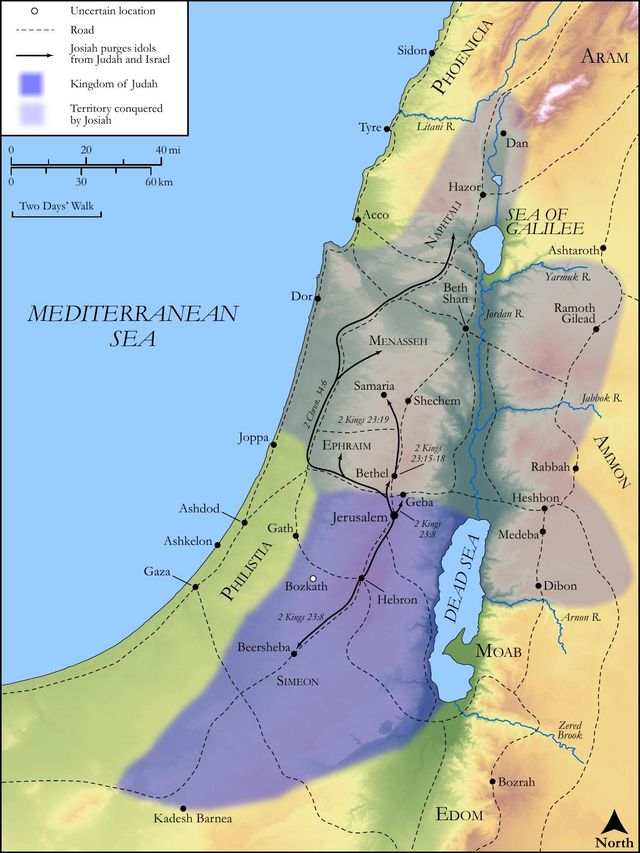
See on the biblical-era map
Study this verse
Public-domain commentary
Matthew Henry
From his Commentary on the Whole Bible. Henry comments on passages, not single verses — this entry covers 2 Kings 22:1–10. His two-level outline is real structure in the source text, so it is rendered as structure.
Concerning Josiah we are here told,
I.That he was very young when he began to reign (Kg2 22:1), only eight years old.
Solomon says, Woe unto thee, O land! when thy king is a child; but happy art thou, O land! when thy king is such a child. Our English Israel had once a king that was such a child, Edward VI. Josiah, being young, had not received any bad impressions from the example of his father and grandfather, but soon saw their errors, and God gave his grace to take warning by them. See Eze 18:14, etc.
II.That he did that which was right in the sight of the Lord, Kg2 22:2.
See the sovereignty of divine grace - the father passed by and left to perish in his sin, the son a chosen vessel. See the triumphs of that grace - Josiah born of a wicked father, no good education nor good example given him, but many about him who no doubt advised him to tread in his father's steps and few that gave him any good counsel, and yet the grace of God made him an eminent saint, cut him off from the wild olive and grafted him into the good olive, Rom 11:24. Nothing is too hard for that grace to do. He walked in a good way, and turned not aside (as some of his predecessors had done who began well) to the right hand nor to the left. There are errors on both hands, but God kept him in the right way; he fell neither into superstition nor profaneness.
III.That he took care for the repair of the temple.
This he did in the eighteenth year of his reign, Kg2 22:3. Compare Ch2 34:8. He began much sooner to seek the Lord (as appears, Ch2 34:3), but it is to be feared the work of reformation went slowly on and met with much opposition, so that he could not effect what he desired and designed, till his power was thoroughly confirmed. The consideration of the time we unavoidably lost in our minority should quicken us, when we have come to years, to act with so much the more vigour in the service of God. Having begun late we have need work hard. He sent Shaphan, the secretary of state, to Hilkiah the high priest, to take an account of the money that was collected for this use by the door-keepers (Kg2 22:4); for, it seems, they took much the same way of raising the money that Joash took, Kg2 12:9. When people gave by a little at a time the burden was insensible, and, the contribution being voluntary, it was not complained of. This money, so collected, he ordered him to lay out for the repair of the temple, Kg2 22:5, Kg2 22:6. And now, it seems, the workmen (as in the days of Joash) acquitted themselves so well that there was no reckoning made with them (Kg2 22:7), which is certainly mentioned to the praise of the workmen, that they gained such a reputation for honesty, but whether to the praise of those that employed them I know not; a man should count money (we say) after his own father; it would not have been amiss to have reckoned with the workmen, that others also might be satisfied of their honesty.
IV.That, in repairing the temple, the book of the law was happily found and brought to the king, Kg2 22:8, Kg2 22:10.
Some think this book was the autograph, or original manuscript, of the five books of Moses, under his own hand; others think it was only an ancient and authentic copy. Most likely it was that which, by the command of Moses, was laid up in the most holy place, Deu 31:24, etc.
1.It seems, this book of the law was lost or missing. Perhaps it was carelessly mislaid and neglected, thrown by into a corner (as some throw their Bibles), by those that knew not the value of it, and forgotten there; or it was maliciously concealed by some of the idolatrous kings, or their agents, who were restrained by the providence of God or their own consciences from burning and destroying it, but buried it, in hopes it would never see the light again; or, as some think, it was carefully laid up by some of its friends, lest it should fall into the hands of its enemies. Whoever were the instruments of its preservation, we ought to acknowledge the hand of God in it. If this was the only authentic copy of the Pentateuch then in being, which had (as I may say) so narrow a turn for its life and was so near perishing, I wonder the hearts of all good people did not tremble for that sacred treasure, as Eli's for the ark, and I am sure we now have reason to thank God, upon our knees, for that happy providence by which Hilkiah found this book at this time, found it when he sought it not, Isa 65:1. If the holy scriptures had not been of God, they would not have been in being at this day; God's care of the Bible is a plain indication of his interest in it.
2.Whether this was the only authentic copy in being or no, it seems the things contained in it were new both to the king himself and to the high priest; for the king, upon the reading of it, rent his clothes. We have reason to think that neither the command for the king's writing a copy of the law, nor that for the public reading of the law every seventh year (Deu 17:18; Deu 31:10, Deu 31:11), had been observed for a long time; and when the instituted means of keeping up religion are neglected religion itself will soon go to decay. Yet, on the other hand, if the book of the law was lost, it seems difficult to determine what rule Josiah went by in doing that which was right in the sight of the Lord, and how the priests and people kept up the rites of their religion. I am apt to think that the people generally took up with abstracts of the law, like our abridgements of the statutes, which the priests, to save themselves the trouble of writing and the people of reading the book at large, had furnished them with - a sort of ritual, directing them in the observances of their religion, but leaving out what they thought fit, and particularly the promises and threatenings (Lev. 26 and Deu. 28, etc.), for I observe that these were the portions of the law which Josiah was so much affected with (Kg2 22:13), for these were new to him. No summaries, extracts, or collections, out of the Bible (though they may have their use) can be effectual to convey and preserve the knowledge of God and his will like the Bible itself. It was no marvel that the people were so corrupt when the book of the law was such a scarce thing among them; where that vision is not the people perish. Those that endeavoured to debauch them no doubt used all the arts they could to get that book out of their hands. The church of Rome could not keep up the use of images but by forbidding the use of the scripture.
3.It was a great instance of God's favour, and a token for good to Josiah and his people, that the book of the law was thus seasonably brought to light, to direct and quicken that blessed reformation which Josiah had begun. It is a sign that God has mercy in store for a people when he magnifies his law among them and makes that honourable, and furnishes them with means for the increase of scripture-knowledge. The translating of the scriptures into vulgar tongues was the glory, strength, and joy of the Reformation from Popery. It is observable that they were about a good work, repairing the temple, when they found the book of the law. Those that do their duty according to their knowledge shall have their knowledge increased. To him that hath shall be given. The book of the law was an abundant recompence for all their care and cost about the repair of the temple.
4.Hilkiah the priest was exceedingly well pleased with the discovery. "O," says he to Shaphan, "rejoice with me, for I have found the book of the law, heurēka, heurēka, - I have found, I have found, that jewel of inestimable value. Here, carry it to the king; it is the richest jewel of his crown. Read it before him. He walks in the way of David his father, and, if he be like him, he will love the book of the law and bid that welcome; that will be his delight and his counsellor."
Historical interpretation
Historical reception
1 surviving comment on this verse from the historical church.
“Josiah was eight years old when he began to reign; and he did what was right in the sight of the Lord” for the thirty-one years in which he reigned. In the eighteenth year from the beginning of his rule, he began to purify Judah and the inhabitants of Jerusalem. In fact, he removed the foreign religions introduced by Manasseh and overturned the sanctuaries and altars. In the same eighteenth year he ordered an expiation of the temple and commanded the priests to make repairs. He brought in workers, gathered stones, materials and other things useful to building and supplied the money for the expected expenses, and in this case he religiously emulated the pious zeal of his great-grandfather Jehoash. And at that time the refurbishment of the temple was not less necessary than it had been before, because for the fifty years in which Manasseh had reigned, it had been neglected or given to profane uses.
Continue studying 2 Kings 22:6 across the web’s major study libraries — every link below opens this exact verse, chapter, or book on the destination site.
Read & Compare
 BibleGatewayThis verse in more than 200 translations and 70 languages.
 Bible.comThe YouVersion reader — hundreds of translations, reading plans, and highlights.
 ESV.orgCrossway's official English Standard Version reader.
 NET BibleThe NET translation with 60,000+ translators' notes on every rendering decision.
 STEP BibleTyndale House's free study tool — original text, vocabulary, and scholarly resources.
 BibliaLogos Bible Software's free web reader.
 USCCBThe New American Bible (Revised Edition) with the U.S. bishops' study notes.
Commentaries
 BibleHub CommentariesDozens of classic commentaries on this verse, gathered on one page.
 StudyLightMore than 100 commentary sets — the largest collection on the web.
 BibleRefPlain-English commentary on what this verse means, verse by verse.
 Enduring WordDavid Guzik's free commentary on this chapter, widely used by Bible teachers.
 Bible Study ToolsVerse commentary alongside Greek and Hebrew study aids.
Original Language & Research
- BibleHub InterlinearThe verse word by word — original language, transliteration, and English.
- BibleHub LexiconEvery word's original-language definition and Strong's entry.
 Blue Letter BibleDeep-study tools — Strong's numbers, concordance, and word studies.
 SefariaThe Hebrew text with Rashi and centuries of Jewish commentary.
Sermons, Hymns & Audio


TrulyRandomVerse is not affiliated with these sites and doesn’t control their content. They’re linked because they’re genuinely useful.
Summary
Second Kings 22:6 meticulously details the practical allocation of funds collected for the extensive repair of the Lord's Temple during King Josiah's righteous reign. This verse highlights the careful stewardship of resources, specifying that money was designated for skilled laborers—carpenters, builders, and masons—and for the procurement of essential high-quality materials like timber and hewn stone, all aimed at restoring the dilapidated sacred structure in Jerusalem.
Context
ShowHideLiterary Context
This verse is embedded within the pivotal account of King Josiah's eighteenth regnal year, a period marked by profound religious reform. Having begun his reign at a tender age and consistently doing "that which was right in the sight of the LORD" throughout his life (2 Kings 22:2), Josiah initiates a long-overdue renovation of the Temple. The preceding verses (2 Kings 22:3-5) describe the king's command to Shaphan the scribe to collect the money brought into the Temple and entrust it to Hilkiah the high priest and the overseers of the work. Verse 6 then specifies the exact expenditures, detailing the types of skilled labor and materials required, demonstrating the thoroughness of the project. This practical preparation for the Temple's physical restoration directly precedes the momentous discovery of the Book of the Law (2 Kings 22:8), which subsequently ignites a widespread spiritual revival throughout Judah.
Historical & Cultural Context
Josiah reigned over Judah from 640-609 BCE, a tumultuous period following decades of significant spiritual decline and idolatry under his grandfather Manasseh and father Amon. The Temple, once the magnificent center of Yahweh worship, had likely fallen into severe disrepair, neglect, and possibly even defilement due to the introduction of pagan practices. In Israel, skilled tradesmen like carpenters, builders, and masons were highly respected and essential for any major construction or renovation project, especially one of the scale and sacred importance of the Temple. The mention of "hewn stone" (as opposed to rough, unworked stone) indicates the use of prepared, high-quality materials, signifying the reverence and investment dedicated to God's dwelling place. This restoration effort was not merely a construction project but a symbolic act of returning to Yahweh and purifying the nation's worship.
Key Themes
ShowHideThe primary theme is Restoration and Renewal, where the physical repair of God's house serves as a tangible precursor and symbol of a deeper spiritual and national renewal. Josiah's diligent efforts to restore the Temple underscore the theme of Diligent Stewardship, demonstrating meticulous and responsible management of resources dedicated to sacred work. The detailed allocation of funds to specific tradesmen and materials highlights a profound Reverence for God's Dwelling, contrasting sharply with the neglect of previous reigns. Furthermore, the verse subtly introduces the theme of The Value of Skilled Labor in God's Service, acknowledging that diverse professional skills are vital and consecrated when applied to divine purposes. This entire undertaking sets the stage for the dramatic Spiritual Revival that follows the discovery of the Law, emphasizing that physical preparation can often precede and facilitate profound spiritual breakthroughs, as seen in the broader narrative of 2 Kings 22.
Exposition and Analysis
ShowHideKey Word Analysis
ShowHideThis term broadly refers to a skilled craftsman or artificer, but in this specific context, it denotes those who work with wood. Their expertise would have been vital for repairing the Temple's wooden beams, doors, and interior elements, which would have suffered from decay and neglect.
Derived from a root meaning "to wall in or around," this term refers to those skilled in working with stone, specifically in building or repairing walls. Their role involved shaping and setting the hewn stones to ensure the structural integrity and aesthetic quality of the Temple's stone edifice.
This verb, used here in its causative sense, means "to strengthen, mend, or fortify." It implies not just superficial patching but a thorough restoration to a strong and sound condition. The extensive semantic range of châzaq highlights the comprehensive nature of the Temple's renovation, aiming for structural integrity and renewed sacredness.
Verse Breakdown
ShowHide"Unto carpenters, and builders, and masons"
This opening phrase specifies the primary recipients of the Temple funds: skilled laborers. It emphasizes that the work was not to be done haphazardly but by professionals with the necessary expertise in construction and craftsmanship. The inclusion of "builders" (Hebrew: bonim) as a general term alongside the more specific "carpenters" and "masons" suggests a comprehensive approach to securing all necessary construction expertise for the sacred project.
"and to buy timber and hewn stone"
This clause details the essential materials required for the renovation. "Timber" (Hebrew: etzim) would have been used for structural elements, roofing, and interior finishing, while "hewn stone" (Hebrew: avnei gazit) signifies the use of precisely cut and prepared stone for walls and foundations, ensuring the longevity and grandeur of the restored structure. This highlights the practical and material investment in the sacred space, emphasizing quality and durability.
"to repair the house"
This concluding phrase states the clear and singular purpose of all the allocated funds, labor, and materials: the restoration of "the house," which unequivocally refers to the Temple of the Lord in Jerusalem. It underscores the ultimate goal of Josiah's initiative—to restore the physical dwelling place of God's presence among His people, reflecting a renewed commitment to proper worship.
Literary Devices
ShowHideThe verse employs several literary devices to convey its message effectively. Enumeration is prominent, with the explicit listing of "carpenters, and builders, and masons, and to buy timber and hewn stone." This detailed listing emphasizes the thoroughness and meticulous planning involved in the Temple repair, underscoring the comprehensive nature of the undertaking. The use of Merism is also evident, where the specific categories of skilled labor and materials represent the entirety of what was needed for the construction project. By naming these key components, the text implies the full scope of the work without needing to list every single detail. Furthermore, the phrase "the house" functions as a form of Metonymy, where a part or attribute stands for the whole; "the house" clearly refers to the Temple, God's dwelling place, thereby imbuing the physical structure with profound theological significance beyond mere architecture.
Theological and Thematic Connections
ShowHideThe practical details of 2 Kings 22:6 transcend mere administrative record-keeping; they reveal profound theological truths about stewardship, reverence, and the nature of sacred work. Josiah's commitment to physically restoring the Temple reflects a deep understanding that the condition of God's dwelling place often mirrors the spiritual health of His people. The meticulous allocation of resources to skilled laborers and quality materials demonstrates a principle of offering God our best—not just in spiritual devotion, but also in the practical management of resources and the application of human skill. This passage implicitly teaches that all honest labor, when directed towards God's purposes, becomes consecrated and valuable in His sight. The physical repair of the Temple was an act of worship, preparing the way for a deeper spiritual encounter.
Reflection and Application
ShowHideThe account of Josiah's Temple repair in 2 Kings 22:6 offers timeless lessons for believers today. Just as Josiah prioritized the physical upkeep of the Temple as a reflection of his reverence for God, we are called to be diligent stewards of the resources God has entrusted to us, whether financial, material, or skills. This includes caring for our physical places of worship, ensuring they are maintained as spaces conducive to honoring God and fostering community. Beyond physical structures, the verse reminds us that all our labor, regardless of its perceived sacredness, can be consecrated to God. The skills of carpenters, builders, and masons were essential to the Temple's restoration, illustrating that God uses diverse gifts and professions to advance His kingdom. Our daily work, when done with integrity, excellence, and a heart for God, contributes to His purposes. Moreover, this physical act of restoration paved the way for a profound spiritual revival, reminding us that diligence in practical matters can often open doors for deeper spiritual breakthroughs and a renewed commitment to God's Word.
Questions for Reflection
ShowHideFAQ
ShowHideWhy was the Temple in such disrepair during Josiah's reign?
ShowHideThe Temple's dilapidated state was a direct consequence of decades of spiritual apostasy and neglect under previous kings, particularly Manasseh and Amon. Manasseh, Josiah's grandfather, reigned for 55 years and actively promoted idolatry, even setting up altars to Baal and Asherah poles within the Temple courts (2 Kings 21:3-7). His son Amon continued these wicked practices (2 Kings 21:19-22). During these periods, resources and attention were diverted away from the worship of Yahweh and the maintenance of His house, leading to its physical decay and spiritual defilement. Josiah's repair project was thus a significant step in reversing this long period of national spiritual decline.
What is the significance of "hewn stone" being specified for the repair?
ShowHideThe specification of "hewn stone" (Hebrew: avnei gazit) is highly significant. It refers to stones that have been carefully cut, shaped, and dressed, as opposed to rough, unworked stones. This detail indicates a commitment to using high-quality, prepared materials for the Temple's restoration. In ancient construction, hewn stone was more expensive and required skilled labor to produce and lay, signifying the importance, durability, and sacredness of the structure being built or repaired. It reflects Josiah's desire to restore the Temple to its former glory and to honor God with the very best, contrasting with any haphazard or cheap repair.
Christ-Centered Fulfillment
ShowHideWhile 2 Kings 22:6 describes the physical restoration of a material temple, it profoundly foreshadows the ultimate and spiritual restoration found in Jesus Christ. The Temple in Jerusalem was the dwelling place of God's presence among His people, a physical representation of His covenant faithfulness. Yet, its need for constant repair and eventual destruction pointed to its temporary nature. Jesus, in His ministry, declared Himself to be the true and ultimate Temple, famously stating, "Destroy this temple, and in three days I will raise it up" (John 2:19). He was speaking of the temple of His body, which would be destroyed through crucifixion and raised in resurrection, becoming the new and living way to God (Hebrews 10:19-20). Furthermore, the New Testament reveals that through Christ, believers themselves become the spiritual temple of God, individually and corporately, indwelt by the Holy Spirit (1 Corinthians 6:19-20; Ephesians 2:19-22). Just as skilled laborers were needed to repair the physical Temple, Christ, as the Master Builder (Matthew 16:18), continues to build His church, using the diverse gifts and skills of His people to edify and grow the spiritual house (Ephesians 4:11-16). Ultimately, the need for any earthly temple will cease in the New Jerusalem, where God and the Lamb are its temple, signifying the complete and eternal presence of God with His redeemed people (Revelation 21:22).