


2 Kings 12:11
Bible text: King James Version (1769 Blayney text) · Public domain
Bible text: King James Version with Strong's numbers · Public domain
Bible text: Berean Standard Bible · Public domain
Bible text: American Standard Version (1901) · Public domain
Bible text: World English Bible, Messianic edition · Public domain
Bible text: Geneva Bible (1599) · Public domain
Bible text: Young's Literal Translation · Public domain
- וְנָתְנוּve·na·te·Nuand they putH5414Conj-w ¦ V-Qal-ConsecPerf-3cpVerb Qal Consecutive Perfect 3rd Plural common genderוְandנָתְנוּthey put
- אֶת'et<obj.>H853DirObjMParticle Object Indicator
- הַכֶּסֶףha·Ke·sefthe moneyH3701Art ¦ N-msNoun Singular Masculine Absoluteהַtheכֶּסֶףmoney
- הַמְתֻכָּןham·tu·Kan<the> weighed outH8505Art ¦ V-Pual-PassPrtcpl-msVerb Pual Participle Passive Singular Masculine Absoluteהַ<the>מְתֻכָּןweighed out
- עַל'alonH5921PrepPreposition
- יְדֵיyad[the] hands ofH3027N-cdcNoun Dual common gender Construct
- עֹשֵׂי'o·Sei[the] doers ofH6213V-Qal-Prtcpl-mpVerb Qal Participle Plural Masculine Construct
- הַמְּלָאכָהha·me·la·Khahthe workH4399Art ¦ N-fsNoun Singular Feminine Absoluteהַtheמְּלָאכָהwork
- הַמֻּפְקָדִיםha·pe·ku·dimwho were appointedH6485Art ¦ V-Hophal-PassPrtcpl-mpVerb Hophal Participle Passive Plural Masculine Absoluteהַwhoמֻּפְקָדִיםwere appointed
- בֵּיתbeit[the] house ofH1004N-mscNoun Singular Masculine Construct
- יְהוָהYah·wehYahwehH3068N-properNoun Proper Title
- וַיּוֹצִיאֻהוּvai·yo·tzi·'U·huand they brought out itH3318Conj-w ¦ V-Hiphil-ConsecImperf-3mp ¦ 3msVerb Hiphil Consecutive Imperfect 3rd Plural Masculineוַandיּוֹצִיאֻthey brought outהוּit
- לְחָרָשֵׁיle·cha·ra·Sheito [the] craftsmen ofH2796Prep-l ¦ N-mpcNoun Plural Masculine Constructלְtoחָרָשֵׁי[the] craftsmen of
- הָעֵץha·'Etz<the> woodH6086Art ¦ N-msNoun Singular Masculine Absoluteהָ<the>עֵץwood
- וְלַבֹּנִיםve·la·bo·Nimand to the buildersH1129Conj-w ¦ Prep-l ¦ V-Qal-Prtcpl-mpVerb Qal Participle Plural Masculine Absoluteוְandלַto theבֹּנִיםbuilders
- הָעֹשִׂיםha·'o·Simwho were working onH6213Art ¦ V-Qal-Prtcpl-mpVerb Qal Participle Plural Masculine Absoluteהָwhoעֹשִׂיםwere working on
- בֵּיתbeit[the] house ofH1004N-mscNoun Singular Masculine Construct
- יְהוָהYah·wehYahwehH3068N-properNoun Proper Title
English is a literal word-by-word gloss of the Hebrew, not the KJV's wording. Why?
This is the original text the KJV's translators worked from — each Hebrew word with its own literal English meaning in this verse, prepared by scholars at Tyndale House, Cambridge. The KJV translates whole sentences, not word by word, so its wording differs: one Hebrew word can become several English words, and the KJV may choose “the LORD” where the gloss reads “Yahweh”. Both are faithful — they answer different questions. For the KJV's own rendering, switch to the KJV text.
Details
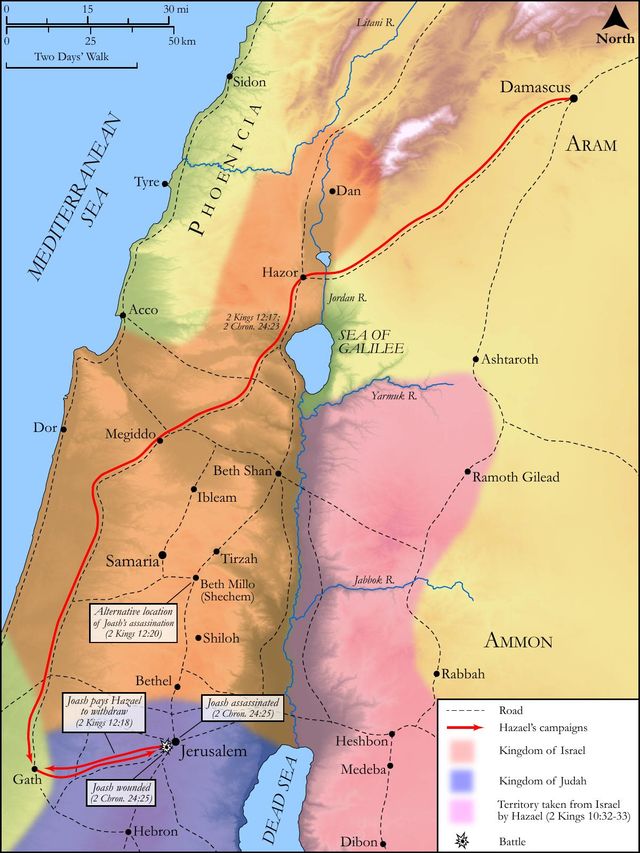
See on the biblical-era map
Study this verse
Public-domain commentary
Matthew Henry
From his Commentary on the Whole Bible. Henry comments on passages, not single verses — this entry covers 2 Kings 12:4–16. His four-level outline is real structure in the source text, so it is rendered as structure.
We have here an account of the repairing of the temple in the reign of Joash.
I.It seems, the temple had gone out of repair.
Though Solomon built it very strong, of the best materials and in the best manner, yet in time it went to decay, and there were breaches found in it (Kg2 12:5), in the roofs, or walls, or floors, the ceiling, or wainscoting, or windows, or the partitions of the courts. Even temples themselves are the worse for the wearing; but the heavenly temple will never wax old. Yet it was not only the teeth of time that made these breaches, the sons of Athaliah had broken up the house of God (Ch2 24:7), and, out of enmity to the service of the temple, had damaged the buildings of it, and the priests had not taken care to repair the breaches in time, so that they went worse and worse. Unworthy were those husbandmen to have this valuable vineyard let out to them upon such easy terms who could not afford to keep the winepress in due and tenantable repair, Mat 21:33. Justly did their great Lord sue them for this permissive waste, and by his judgments recover locum vastatum - for dilapidations (as the law speaks), when this neglected temple was laid even with the ground.
II.The king himself was (as it should seem) the first and forwardest man that took care for the repair of it.
We do not find that the priests complained of it or that Jehoiada himself was active in it, but the king was zealous in the matter,
1.Because he was king, and God expects and requires from those who have power that they use it for the maintenance and support of religion, the redress of grievances, and reparation of decays, for the exciting and engaging of ministers to do their part and people theirs.
2.Because the temple had been both his nursery and his sanctuary when he was a child, in a grateful remembrance of which he now appeared zealous for the honour of it. Those who have experienced the comfort and benefit of religious assemblies will make the reproach of them their burden (Zep 3:18), the support of them their care, and the prosperity of them their chief joy.
III.The priests were ordered to collect money for these repairs, and to take care that the work was done.
The king had the affairs of his kingdom to mind, and could not himself inspect this affair, but he employed the priests to manage it, the fittest persons, and most likely, one would think, to be hearty in it.
1.He gave them orders for the levying of the money of the dedicated things. They must not stay till it was paid in, but they must call for it where they knew it was due, in their respective districts, as redemption-money (by virtue of the law, Lev 27:2, Lev 27:3), or as a free-will offering, Kg2 12:4. This they were to gather every man of his acquaintance, and it was supposed that there was no man but had acquaintance with some or other of the priests. Note, We should take the opportunity that God gives us of exciting those we have a particular acquaintance with to that which is good.
2.He gave them orders for laying out the money they had levied in repairing the breaches of the house, Kg2 12:5.
IV.This method did not answer the intention, Kg2 12:6.
Little money was raised. Either the priests were careless, and did not call on the people to pay in their dues, or the people had so little confidence in the priests' management that they were backward to pay money into their hands; if they were distrusted without cause, it was the people's shame; if with, it was more theirs. But what money was raised was not applied to the proper use: The breaches of the house were not repaired; the priests thought it might serve as well as it had done, and therefore put off repairing from time to time. Church work is usually slow work, but it is a pity that churchmen, of all men, should be slow at it. Perhaps what little money they raised they thought it necessary to use for the maintenance of the priests, which must needs fall much short when ten tribes had wholly revolted and the other two were wretchedly corrupted.
V.Another method was therefore taken.
The king had his heart much set upon having the breaches of the house repaired, Kg2 12:7. His apostasy, at last, gives us cause to question whether he had as good an affection for the service of the temple as he had for the structure. Many have been zealous for building and beautifying churches, and for other forms of godliness, who yet have been strangers to the power of it. However, we commend his zeal, and blame him not for reproving even his tutor Jehoiada himself when he saw him remiss; and so convincing was his reproof that the priests owned themselves unworthy to be any longer employed, and consented to the taking of some other measures, and the giving up of the money they had received into other hands, Kg2 12:8. It was honestly done, when they found they had not spirit to do it themselves, not to hinder other people from doing it. Another course was taken,
1.For raising money, Kg2 12:9, Kg2 12:10. The money was not paid into private hands, but put into a public chest, and then people brought it in readily and in great abundance, not only their dues, but their free-will offerings for so good a work. The high priest and the secretary of state counted the money out of the chest, and laid it by in specie for the use to which it was appropriated. When public distributions are made faithfully public contributions will be made cheerfully. The money that was given,
(1.)Was dropped into the chest through a hole in the lid, past recall, to intimate that what has been once resigned to God must never be resumed. Every man, as he purposeth in his heart, so let him give.
(2.)The chest was put on the right hand as they went in, which, some think, is alluded to in that rule of charity which our Saviour gives, Let not thy left hand know what thy right hand doeth. But, while they were getting all they could for the repair of the temple, they did not break in upon that which was the stated maintenance of the priests, Kg2 12:16. The trespass-money and the sin-money (which were given to them by that law, Lev 5:15, Lev 5:16) were reserved to them. Let not the servants of the temple be starved under colour of repairing the breaches of it.
2.For laying out the money that was raised.
(1.)They did not put it into the hands of the priests, who were not versed in affairs of this nature, having other work to mind, but into the hands of those that did the work, or at least had the oversight of it, Kg2 12:11. Those were fittest to be entrusted with this business whose employment lay that way. Tractant fabrilia fabri - Every artist has his trade assigned; but let not those who are called to war the holy warfare entangle themselves in the affairs of this life. Those that were thus entrusted did the business,
[1.]Carefully, purchasing materials and paying workmen, Kg2 12:12. Business is done with expedition when those are employed in it that understand it and know which way to go about it.
[2.]Faithfully; such a reputation they got for honesty that there was no occasion to examine their bills or audit their accounts. Let all that are entrusted with public money, or public work, learn hence to deal faithfully, as those that know God will reckon with them, whether men do or no. Those that think it is no sin to cheat the government, cheat the country, or cheat the church, will be of another mind when God shall set their sins in order before them.
(2.)They did not lay it out in ornaments for the temple, in vessels of gold or silver, but in necessary repairs first (Kg2 12:13), whence we may learn, in all our expenses to give that the preference which is most needful, and, in dealing for the public, to deal as we would for ourselves. After the repairs were finished we find the overplus turned into plate for the service of the temple, Ch2 24:14.
Continue studying 2 Kings 12:11 across the web’s major study libraries — every link below opens this exact verse, chapter, or book on the destination site.
Read & Compare
 BibleGatewayThis verse in more than 200 translations and 70 languages.
 Bible.comThe YouVersion reader — hundreds of translations, reading plans, and highlights.
 ESV.orgCrossway's official English Standard Version reader.
 NET BibleThe NET translation with 60,000+ translators' notes on every rendering decision.
 STEP BibleTyndale House's free study tool — original text, vocabulary, and scholarly resources.
 BibliaLogos Bible Software's free web reader.
 USCCBThe New American Bible (Revised Edition) with the U.S. bishops' study notes.
Commentaries
 BibleHub CommentariesDozens of classic commentaries on this verse, gathered on one page.
 StudyLightMore than 100 commentary sets — the largest collection on the web.
 BibleRefPlain-English commentary on what this verse means, verse by verse.
 Enduring WordDavid Guzik's free commentary on this chapter, widely used by Bible teachers.
 Bible Study ToolsVerse commentary alongside Greek and Hebrew study aids.
Original Language & Research
- BibleHub InterlinearThe verse word by word — original language, transliteration, and English.
- BibleHub LexiconEvery word's original-language definition and Strong's entry.
 Blue Letter BibleDeep-study tools — Strong's numbers, concordance, and word studies.
 SefariaThe Hebrew text with Rashi and centuries of Jewish commentary.
Sermons, Hymns & Audio


TrulyRandomVerse is not affiliated with these sites and doesn’t control their content. They’re linked because they’re genuinely useful.
Summary
This verse meticulously details the transparent and accountable process established during King Joash's reign for disbursing the funds collected for the repair of the Jerusalem temple. It describes how the precisely counted money was entrusted to the appointed overseers of the restoration project, who then directly paid the skilled craftsmen—carpenters and builders—responsible for the physical labor, thereby ensuring efficient and proper utilization of resources for the sacred task of restoring the House of the LORD.
Context
ShowHideLiterary Context
2 Kings 12 begins by establishing King Joash's righteous reign, particularly his fervent desire to restore the dilapidated temple of the LORD. The preceding verses 2 Kings 12:4-8 recount Joash's initial, unsuccessful attempt to have the priests collect and manage the repair funds. This failure led to a revised, more effective system detailed in 2 Kings 12:9-10. Under this new arrangement, a chest was placed at the temple entrance for public donations, and the collected money was regularly counted by the king's scribe and the high priest. Verse 2 Kings 12:11 directly follows, describing the crucial final step of this new process: the transfer of these verified funds to the project managers and subsequently to the laborers, ensuring that the resources were promptly and properly applied to the physical restoration of the sacred edifice.
Historical & Cultural Context
The temple, originally built by King Solomon, had suffered significant neglect and even desecration over the centuries, particularly during the reign of the idolatrous Queen Athaliah, Joash's grandmother, as recounted in 2 Kings 11. Joash, having been miraculously preserved and raised by the priest Jehoiada, ascended the throne at a young age (7 years old) and, under Jehoiada's faithful guidance, initiated a significant religious reform. Central to this reform was the comprehensive restoration of the temple, a symbol of Judah's covenant relationship with God. The detailed method of collecting and disbursing funds described in this chapter reflects the administrative practices of Judah's kings, where large-scale public works or religious projects necessitated structured financial management to prevent corruption and ensure efficiency. The emphasis on meticulous counting and direct payment underscores a practical concern for transparency and accountability, vital for such a major national and sacred undertaking.
Key Themes
ShowHideThis verse powerfully contributes to several overarching themes within 2 Kings. Foremost is the theme of Stewardship and Accountability, highlighted by the meticulous counting ("being told") and direct distribution of funds. This system contrasts sharply with the earlier, less effective method and underscores the importance of integrity and responsible oversight in managing resources dedicated to God's work. It demonstrates that faithfulness in small matters leads to faithfulness in larger ones, as seen in Luke 16:10. The overarching theme of Restoration and Reverence for God's House is also central; the entire chapter, culminating in the actions of this verse, demonstrates a renewed national commitment to the physical upkeep and spiritual sanctity of the temple, reflecting a desire to honor God's dwelling place among His people after a period of decline and idolatry. Furthermore, the direct allocation of resources to "carpenters and builders" emphasizes the Value of Diligent Labor and the practical application of faith through tangible acts of service in God's kingdom, showcasing that spiritual devotion often manifests in practical, hands-on work.
Exposition and Analysis
ShowHideKey Word Analysis
ShowHideMeaning "to balance, i.e. measure out (by weight or dimension); figuratively, arrange, equalize, through the idea of levelling (ment. estimate, test)." In this context, "being told" signifies that the money was meticulously counted, weighed, or measured, ensuring precision and transparency. It was not an approximation but a verified amount, underscoring the integrity and accountability of the financial process established by King Joash and Jehoiada for the temple repairs.
Meaning "to visit (with friendly or hostile intent); by analogy, to oversee, muster, charge, care for, miss, deposit, etc." Here, pâqad refers to those appointed with the responsibility of supervision, management, and care. These individuals were not merely recipients of funds but were entrusted with a significant charge, implying a position of authority and trust. They were responsible for managing the labor, materials, and overall progress of the temple's restoration, acting as crucial intermediaries between the collected funds and the actual work being performed.
Meaning "to go (causatively, bring) out, in a great variety of applications, literally and figuratively, direct and proxim.; ...lay (lie) out..." This term specifically describes the action of disbursing or paying out the money. It highlights the direct and purposeful transfer of funds from the overseers to the craftsmen. The use of "laid it out" emphasizes the practical, efficient, and immediate application of the collected money to its intended purpose—funding the actual labor and materials required for the temple's restoration.
Verse Breakdown
ShowHide"And they gave the money, being told, into the hands of them that did the work, that had the oversight of the house of the LORD"
This initial clause describes the first stage of the fund distribution. "They" refers to the king's scribe and the high priest (as established in 2 Kings 12:10), who were responsible for counting the collected donations. The phrase "being told" emphasizes the meticulous and verified nature of the funds, ensuring accuracy and preventing misappropriation. The money was then transferred "into the hands" of the project managers, described as "them that did the work" and "that had the oversight of the house of the LORD." This indicates a structured, hierarchical system where trusted individuals were appointed to manage the restoration, rather than the funds being given directly to individual laborers initially.
"and they laid it out to the carpenters and builders, that wrought upon the house of the LORD"
This second clause details the subsequent and final stage of the fund distribution. The "they" here refers to the overseers who had received the money in the previous step. They "laid it out," meaning they disbursed or paid the funds directly to the skilled craftsmen—specifically "the carpenters and builders"—who were actively engaged in the physical labor of repairing and restoring the temple. This direct payment system ensured that the funds reached the workers efficiently, facilitating the progress of the restoration without unnecessary intermediaries or delays, and affirming the value of their specialized labor in this sacred endeavor.
Literary Devices
ShowHideThe verse employs Metonymy in the phrase "into the hands of them that did the work," where "hands" represents the direct control, authority, and responsibility of the project managers over the funds. The participial phrase "being told" functions as an Adverbial Phrase, emphasizing the meticulous, precise, and transparent nature of the financial management process, thereby highlighting the integrity and accountability of Joash's system. The repeated phrase "the house of the LORD" serves as a form of Repetition and Emphasis, underscoring the central focus and sacred purpose of the entire endeavor—the restoration of God's dwelling place. Furthermore, the specific mention of "carpenters and builders" uses Synecdoche, where these particular trades represent all the various skilled laborers and craftsmen involved in the comprehensive temple restoration, highlighting the practical, hands-on nature of the work required.
Theological and Thematic Connections
ShowHideThis verse offers a profound illustration of biblical principles concerning stewardship, accountability, and the proper management of resources dedicated to God's work. The meticulous counting and direct distribution of funds for the temple's repair emphasize that God values order, transparency, and integrity in handling sacred trusts. It teaches that those entrusted with leadership and financial oversight in God's kingdom are called to operate with the utmost diligence and faithfulness, ensuring that resources are applied efficiently and purposefully for the advancement of His glory and the well-being of His people. This commitment to responsible management reflects a deep reverence for God and His purposes, recognizing that all resources ultimately belong to Him and are to be used for His honor.
Reflection and Application
ShowHideThe detailed account of financial management in 2 Kings 12:11 serves as a timeless model for modern believers and ministries. It challenges us to consider the integrity and transparency with which we handle resources—whether time, talent, or financial treasure—that are dedicated to God's kingdom. Just as the money for the temple was "told" or meticulously counted, we are called to operate with clear accountability in our personal finances and, even more so, in the stewardship of church or ministry funds. This verse reminds us that faithful stewardship is not merely about giving, but also about the diligent, honest, and efficient management of what has been given, ensuring that resources are directed purposefully towards their intended, God-glorifying ends. It also underscores the value of every contribution, from the donor's generous gift to the laborer's skilled effort, in building up God's work. We are all called to be good stewards of the manifold grace of God, applying our gifts and resources diligently for His glory.
Questions for Reflection
ShowHideFAQ
ShowHideWhy was such a detailed system for handling money necessary for the temple repairs?
ShowHideThe detailed system, including the meticulous counting of funds ("being told") and direct distribution to overseers and then to laborers, was crucial for several reasons. Historically, large-scale projects, especially those funded by public donations, were susceptible to mismanagement, corruption, or accusations of impropriety. This meticulous process ensured financial transparency and accountability, building trust among the people who donated and demonstrating integrity on the part of King Joash and the priests. It also ensured that the money was efficiently and directly applied to its intended purpose—the actual repair work—without being diverted or delayed, thereby facilitating the successful and timely restoration of the House of the LORD. This level of oversight reflects a deep commitment to responsible stewardship of sacred resources and a desire to honor God through diligent administration.
Christ-Centered Fulfillment
ShowHideWhile 2 Kings 12:11 describes the physical restoration of an earthly temple, it subtly points to the greater, spiritual temple that is built through Christ. The meticulous care in managing funds for the physical structure foreshadows the divine precision and ultimate sacrifice involved in the building of God's true dwelling place—His people, the Church. Just as the money was directly applied to the "carpenters and builders" for the temple's repair, Christ Himself is the ultimate builder of His Church (as declared in Matthew 16:18), and He employs His Spirit and His people in this ongoing work. The integrity and accountability seen in Joash's project find their perfect fulfillment in Christ, who perfectly managed the resources of His divine life, culminating in His death and resurrection, to accomplish the ultimate restoration and reconciliation between God and humanity. He is the cornerstone (as referenced in Ephesians 2:20), and believers are living stones being built into a spiritual house (as described in 1 Peter 2:5), a temple where God's Spirit dwells. The earthly temple's repair, funded by the people's offerings, serves as a shadow of the infinitely greater work of redemption, purchased not with perishable things like silver or gold but with the precious blood of Christ (as stated in 1 Peter 1:18-19), to build a spiritual edifice that will endure for eternity.