


2 Chronicles 24:11
Bible text: King James Version (1769 Blayney text) · Public domain
Bible text: King James Version with Strong's numbers · Public domain
Bible text: Berean Standard Bible · Public domain
Bible text: American Standard Version (1901) · Public domain
Bible text: World English Bible, Messianic edition · Public domain
Bible text: Geneva Bible (1599) · Public domain
Bible text: Young's Literal Translation · Public domain
- וַיְהִיvay·Hiand it wasH1961Conj-w ¦ V-Qal-ConsecImperf-3msVerb Qal Consecutive Imperfect 3rd Singular Masculineוַandיְהִיit was
- בְּעֵתbe·'Etat [the] timeH6256Prep-b ¦ N-csNoun Singular common gender Absoluteבְּatעֵת[the] time
- יָבִיאya·Vi'[when] someone broughtH935V-Hiphil-Imperf-3msVerb Hiphil Imperfect 3rd Singular Masculine
- אֶת'et<obj.>H853DirObjMParticle Object Indicator
- הָאָרוֹןha·'a·Ronthe chestH727Art ¦ N-msNoun Singular Masculine Absoluteהָtheאָרוֹןchest
- אֶל'eltoH413PrepPreposition
- פְּקֻדַּתpe·ku·Dat[the] overseer ofH6486N-fscNoun Singular Feminine Construct
- הַמֶּלֶךְha·me·leKhthe kingH4428Art ¦ N-msNoun Singular Masculine Absoluteהַtheמֶּלֶךְking
- בְּיַדbe·Yadby [the] hand ofH3027Prep-b ¦ N-cscNoun Singular common gender Constructבְּbyיַד[the] hand of
- הַלְוִיִּםhal·vi·Yimthe LevitesH3881Art ¦ N-mpNoun Gentilic Plural Masculine AbsoluteהַtheלְוִיִּםLevites
- וְכִרְאוֹתָםve·khir·'o·Tamand just as they sawH7200Conj-w ¦ Prep-k ¦ V-Qal-Inf ¦ 3mpVerb Qal Infinitive Constructוְandכִjust asרְאוֹתָsawםthey
- כִּיkithatH3588PrtParticle Conditional
- רַבrav[was] muchH7227Adj-msAdjective Singular Masculine Absolute
- הַכֶּסֶףha·Ke·sefthe moneyH3701Art ¦ N-msNoun Singular Masculine Absoluteהַtheכֶּסֶףmoney
- וּבָאu·Va'and he cameH935Conj-w ¦ V-Qal-ConsecPerf-3msVerb Qal Consecutive Perfect 3rd Singular Masculineוּandבָאhe came
- סוֹפֵרso·Fer[the] scribe ofH5608N-mscNoun Singular Masculine Construct
- הַמֶּלֶךְha·Me·lekhthe kingH4428Art ¦ N-msNoun Singular Masculine Absoluteהַtheמֶּלֶךְking
- וּפְקִידu·fe·Kidand [the] officer ofH6496Conj-w ¦ N-mscNoun Singular Masculine Constructוּandפְקִיד[the] officer of
- כֹּהֵןko·Hen[the] priest ofH3548N-mscNoun Singular Masculine Construct
- הָרֹאשׁha·Roshthe headH7218Art ¦ N-msNoun Singular Masculine Absoluteהָtheרֹאשׁhead
- וִיעָרוּvi·'A·ruso they may pour outH6168Conj-w ¦ V-Piel-ConjImperf-3mpVerb Piel Conjunction+Imperfect 3rd Plural Masculineוִsoיעָרוּthey may pour out
- אֶת'et<obj.>H853DirObjMParticle Object Indicator
- הָאָרוֹןha·'a·Ronthe chestH727Art ¦ N-msNoun Singular Masculine Absoluteהָtheאָרוֹןchest
- וְיִשָּׂאֻהוּve·yi·sa·'U·huand they took itH5375Conj-w ¦ V-Qal-ConjImperf-3mp ¦ 3msVerb Qal Conjunction+Imperfect 3rd Plural Masculineוְandיִשָּׂאֻthey tookהוּit
- וִישִׁיבֻהוּvi·shi·Vu·huand they returned itH7725Conj-w ¦ V-Hiphil-ConjImperf-3mp ¦ 3msVerb Hiphil Conjunction+Imperfect 3rd Plural Masculineוִandישִׁיבֻthey returnedהוּit
- אֶל'eltoH413PrepPreposition
- מְקֹמוֹme·ko·Moits placeH4725N-msc ¦ 3msNoun Singular Masculine Constructמְקֹמplaceוֹits
- כֹּהkohthusH3541AdvAdverb
- עָשׂוּ'a·Suthey didH6213V-Qal-Perf-3cpVerb Qal Perfect 3rd Plural common gender
- לְיוֹםle·Yomto a dayH3117Prep-l ¦ N-msNoun Singular Masculine Absoluteלְtoיוֹםa day
- בְּיוֹםbe·Yomin a dayH3117Prep-b ¦ N-msNoun Singular Masculine Absoluteבְּinיוֹםa day
- וַיַּאַסְפוּvai·ya·'as·fuand they gatheredH622Conj-w ¦ V-Qal-ConsecImperf-3mpVerb Qal Consecutive Imperfect 3rd Plural Masculineוַandיַּאַסְפוּthey gathered
- כֶסֶףKhe·sefmoneyH3701N-msNoun Singular Masculine Absolute
- לָרֹבla·Roto abundanceH7230Prep-l ¦ N-msNoun Singular Masculine Absoluteלָtoרֹבabundance
English is a literal word-by-word gloss of the Hebrew, not the KJV's wording. Why?
This is the original text the KJV's translators worked from — each Hebrew word with its own literal English meaning in this verse, prepared by scholars at Tyndale House, Cambridge. The KJV translates whole sentences, not word by word, so its wording differs: one Hebrew word can become several English words, and the KJV may choose “the LORD” where the gloss reads “Yahweh”. Both are faithful — they answer different questions. For the KJV's own rendering, switch to the KJV text.
Details
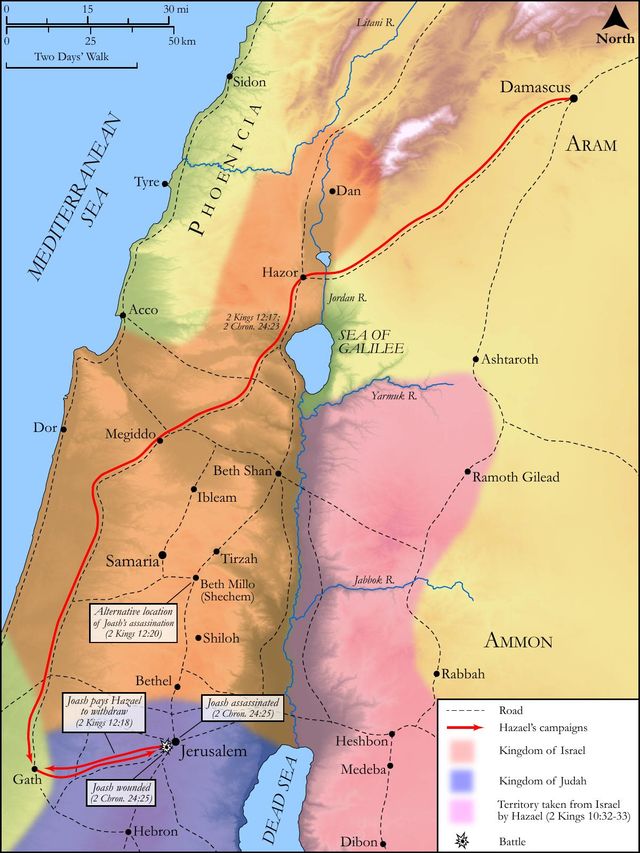
See on the biblical-era map
Study this verse
Public-domain commentary
Matthew Henry
From his Commentary on the Whole Bible. Henry comments on passages, not single verses — this entry covers 2 Chronicles 24:1–14.
This account of Joash's good beginnings we had as it stands here Kg2 12:1, etc., though the latter part of this chapter, concerning his apostasy, we had little of there. What is good in men we should take all occasions to speak of and often repeat it; what is evil we should make mention of but sparingly, and no more than is needful. We shall here only observe, 1. That it is a happy thing for young people, when they are setting out in the world, to be under the direction of those that are wise and good and faithful to them, as Joash was under the influence of Jehoiada, during whose time he did that which was right. Let those that are young reckon it a blessing to them, and not a burden and check upon them, to have those with them that will caution them against that which is evil and advise and quicken them to that which is good; and let them reckon it not a mark of weakness and subjection, but of wisdom and discretion, to hearken to such. He that will not be counselled cannot be helped. It is especially prudent for young people to take advice in their marriages, as Joash did, who left it to his guardian to choose him his wives, because Jezebel and Athaliah had been such plagues, Ch2 24:3. This is a turn of life which often proves either the making or marring of young people, and therefore should be attended to with great care. 2. Men may go far in the external performances of religion, and keep long to them, merely by the power of their education and the influence of their friends, who yet have no hearty affection for divine things nor any inward relish of them. Foreign inducements may push men on to that which is good who are not actuated by a living principle of grace in their hearts. 3. In the outward expressions of devotion it is possible that those who have only the form of godliness may out-strip those who have the power of it. Joash is more solicitous and more zealous about the repair of the temple than Jehoiada himself, whom he reproves for his remissness in that matter, Ch2 24:6. It is easier to build temples than to be temples to God. 4. The repairing of churches is a good work, which all in their places should promote, for the decency and conveniency of religious assemblies. The learned tell us that in the Christian church, anciently, part of the tithes were applied that way. 5. Many a good work would be done that now lies undone if there were but a few active men to stir in it and to put it forward. When Joash found the money did not come in as he expected in one way he tried another way, and that answered the intention. Many have honesty enough to follow that have not zeal enough to lead in that which is good. The throwing of money into a chest, through a hole in the lid of it, was a way that had not been used before, and perhaps the very novelty of the thing made it a successful expedient for the raising of money; a great deal was thrown in and with a great deal of cheerfulness: they all rejoiced, Ch2 24:10. An invention to please people's humour may sometimes bring them to their duty. Wisdom herein is profitable to direct. 6. Faithfulness is the greatest praise and will be the greatest comfort of those that are entrusted with public treasure or employed in public business. The king and Jehoiada faithfully paid the money to the workmen, who faithfully did the work, Ch2 24:12, Ch2 24:13.
Continue studying 2 Chronicles 24:11 across the web’s major study libraries — every link below opens this exact verse, chapter, or book on the destination site.
Read & Compare
 BibleGatewayThis verse in more than 200 translations and 70 languages.
 Bible.comThe YouVersion reader — hundreds of translations, reading plans, and highlights.
 ESV.orgCrossway's official English Standard Version reader.
 NET BibleThe NET translation with 60,000+ translators' notes on every rendering decision.
 STEP BibleTyndale House's free study tool — original text, vocabulary, and scholarly resources.
 BibliaLogos Bible Software's free web reader.
 USCCBThe New American Bible (Revised Edition) with the U.S. bishops' study notes.
Commentaries
 BibleHub CommentariesDozens of classic commentaries on this verse, gathered on one page.
 StudyLightMore than 100 commentary sets — the largest collection on the web.
 BibleRefPlain-English commentary on what this verse means, verse by verse.
 Enduring WordDavid Guzik's free commentary on this chapter, widely used by Bible teachers.
 Bible Study ToolsVerse commentary alongside Greek and Hebrew study aids.
Original Language & Research
- BibleHub InterlinearThe verse word by word — original language, transliteration, and English.
- BibleHub LexiconEvery word's original-language definition and Strong's entry.
 Blue Letter BibleDeep-study tools — Strong's numbers, concordance, and word studies.
 SefariaThe Hebrew text with Rashi and centuries of Jewish commentary.
Sermons, Hymns & Audio


TrulyRandomVerse is not affiliated with these sites and doesn’t control their content. They’re linked because they’re genuinely useful.
Summary
Second Chronicles 24:11 meticulously details the successful and transparent process of collecting funds for the vital restoration of the Lord's Temple during the reign of King Joash. This verse highlights the practical implementation of a divinely inspired system that fostered accountability and efficiency, showcasing the diligent collaboration between royal and priestly officials in managing the abundant contributions of a spiritually reawakened populace towards a sacred cause.
Context
ShowHideLiterary Context
This verse is situated within the narrative of King Joash's reign, specifically detailing the efforts to repair the Temple, which had fallen into disrepair and even desecration under the wicked Queen Athaliah, his grandmother, as recounted in 2 Chronicles 24:7. Joash, guided by the righteous High Priest Jehoiada, initiated this restoration project, as described in 2 Chronicles 24:4-5. Initially, the Levites were tasked with collecting money but were slow to act, a delay noted in 2 Chronicles 24:5. Jehoiada then devised a new, more effective system: a chest with a hole in its lid was placed at the Temple gate, where people could deposit their offerings directly, a crucial innovation introduced in 2 Chronicles 24:8. Verse 11 precisely describes the daily, meticulous execution of this new system, demonstrating its immediate success and the abundance of contributions, leading directly into the description of the actual repair work in 2 Chronicles 24:12-14.
Historical & Cultural Context
The Temple in Jerusalem was not merely a religious edifice but the spiritual, civic, and even economic heart of Judah, symbolizing God's covenant presence among His people. Its desecration under Athaliah was not merely structural damage but a profound spiritual crisis, reflecting a departure from covenant faithfulness and a period of apostasy. The restoration effort under Joash and Jehoiada, therefore, was more than a construction project; it was a national spiritual revival, a deliberate return to Yahweh worship and covenant fidelity. The system of collecting funds, involving both the king's scribe and the high priest's officer, underscores the unique co-regency and shared authority between the monarchy and the priesthood during Joash's early reign, a period of relative stability and faithfulness. The public display of the chest and the transparent, dual-oversight process of emptying it would have fostered immense trust among the populace, encouraging their participation in this vital national undertaking. This public accountability was crucial in a society where religious offerings were often managed by priests, sometimes without clear oversight, and served to prevent suspicion and ensure integrity.
Key Themes
ShowHideThis verse powerfully illustrates several key themes prevalent in 2 Chronicles and broader biblical narratives. It highlights the importance of effective leadership and administration in sacred endeavors, as Jehoiada's innovative system, endorsed by the king, ensured the project's success where previous methods failed. The "abundance" of money collected points to the theme of generosity and community support, reflecting a renewed spiritual zeal among the people who eagerly contributed to God's house, a theme echoed in other restoration accounts like that of Nehemiah, where the people's heart for God's work led to overwhelming contributions for the wall's rebuilding, as seen in Nehemiah 7:70-72. Furthermore, the diligent, "day by day" emptying of the chest by royal and priestly officials underscores the critical importance of diligence, transparency, and accountability in handling sacred resources, serving as a model for faithful stewardship. Ultimately, the successful provision of funds can be seen as an expression of God's provision for His people when they commit to honoring Him and His dwelling place, a principle seen throughout the Old Testament, such as in the wilderness tabernacle construction, where the people gave so abundantly that they had to be restrained (Exodus 36:5-7).
Exposition and Analysis
ShowHideKey Word Analysis
ShowHideThis term (H727) refers to a box or ark, specifically the collection box designed by Jehoiada, which had a hole in its lid (2 Chronicles 24:8). Unlike a general treasury, this was a dedicated, visible, and accessible receptacle for public offerings. Its design and placement outside the Temple gate symbolized accessibility and transparency, allowing all to see the process of giving and ensuring that funds were specifically for the Temple repair, not general priestly support. The use of this specific term highlights the innovative and practical solution implemented to address previous inefficiencies in fund collection.
This word (H3701), meaning "silver" and by implication "money," is significant here due to its quantity—"much money" and "money in abundance." This emphasizes the tangible outcome of the new system and the people's enthusiastic response. The accumulation of "much money" was not merely about financial resources but represented the collective faith, devotion, and sacrificial giving of the people of Judah towards the restoration of their spiritual center. It underscores the material manifestation of spiritual commitment and the value placed on God's house.
This term (H7230) signifies not just sufficiency but an overflowing, more-than-enough quantity of funds in any respect. Appearing twice in the verse implicitly ("much money") and explicitly ("gathered money in abundance"), this repetition is crucial. This abundance testifies to the effectiveness of Jehoiada's system, the diligence of the officials, and, most importantly, the widespread generosity and spiritual revival among the people. It implies divine blessing upon their unified effort, demonstrating God's provision when His people are faithful and committed to His work.
Verse Breakdown
ShowHide"Now it came to pass, that at what time the chest was brought unto the king's office by the hand of the Levites,"
This clause describes the regular procedure for handling the collection chest. The Levites (H3881), who were responsible for the Temple's upkeep and often served as gatekeepers, would transport the chest (H727) from its public location at the Temple gate to a designated "king's office" (H6486) or treasury. This indicates a formal and organized process, ensuring that the collected funds were moved securely and under official oversight, bridging the gap between public contribution and official management. The phrase "by the hand" (H3027, yâd) emphasizes the direct involvement and responsibility of the Levites in this transport.
"and when they saw that [there was] much money,"
This phrase highlights the immediate and visible success of the new collection method. The "they" refers to the officials responsible for emptying the chest. The observation that there was "much money" (H3701, H7227) indicates that the chest was not merely receiving contributions, but was consistently overflowing, signaling the widespread and generous participation of the people. This visual confirmation of abundance would have reinforced trust and encouraged continued giving. The verb "saw" (H7200, râʼâh) implies a careful inspection and recognition of the significant quantity.
"the king's scribe and the high priest's officer came and emptied the chest,"
This is a pivotal detail, emphasizing the collaborative and transparent nature of the process. The presence of both a royal official (the king's (H4428) scribe (H5608, çâphar)) and a priestly official (the high (H7218) priest's (H3548, kôhên) officer (H6496, pâqîyd)) ensured dual oversight and accountability. This joint effort prevented misappropriation and built confidence among the people that their contributions were being handled with integrity by both secular and religious authorities. Their act of "emptying" (H6168, ʻârâh) signifies the regular and thorough processing of the funds.
"and took it, and carried it to his place again."
This indicates the completion of the daily collection cycle. After being emptied (H6168), the chest was "took" (H5375, nâsâʼ) and "carried it to his place" (H4725, mâqôwm) "again" (H7725, shûwb), meaning it was returned to its designated position at the Temple gate. This routine, day-by-day practice ensured continuous collection and maintained the system's efficiency and accessibility for the people's ongoing contributions. It speaks to the meticulousness and dedication of those involved in the process.
"Thus they did day by day, and gathered money in abundance."
This concluding statement summarizes the consistent and highly successful nature of the operation. The phrase "day by day" (H3117, yôwm) underscores the regularity and diligence of the collection efforts. The repetition of "gathered (H622, ʼâçaph) money (H3701) in abundance" (H7230) reinforces the theme of overflowing generosity and divine blessing, confirming that the system not only worked but yielded exceptional results, providing ample resources for the Temple's much-needed restoration. The verb "did" (H6213, ʻâsâh) encompasses the entire process of managing and collecting the funds.
Literary Devices
ShowHideThe verse employs several effective literary devices to convey its message. Narrative Detail is prominent, with the text providing specific, almost procedural, steps of how the money was collected and handled. This meticulous detail emphasizes the transparency and accountability of the process, building confidence in the reader about the integrity of the Temple's restoration efforts. The device of Repetition is also key, particularly with the phrase "much money" and "gathered money in abundance," and the action being performed "day by day." This repetition underscores the consistent success and the overflowing generosity of the people, highlighting the sustained nature of the revival. While not explicit Symbolism, the chest itself functions as a powerful symbol of communal devotion and the conduit through which the people's collective faith and resources flowed towards a sacred purpose, representing the tangible expression of their spiritual commitment to God's dwelling place. The Synecdoche of "hand of the Levites" (H3027, yâd) uses a part (hand) to represent the whole (the Levites' agency and responsibility in transporting the chest), further emphasizing their direct involvement.
Theological and Thematic Connections
ShowHide2 Chronicles 24:11 offers profound insights into the principles of stewardship, communal responsibility, and divine provision. The meticulous and transparent handling of the offerings by both royal and priestly officials underscores God's expectation of integrity and accountability from those entrusted with His resources. The "abundance" of money collected testifies to the power of a unified community responding to a clear vision for God's work, demonstrating that when hearts are stirred by spiritual renewal, generosity flows freely. This narrative serves as a timeless reminder that faithful stewardship, characterized by diligence and transparency, not only builds trust within the community but also honors God, enabling His purposes to be fulfilled through the willing contributions of His people.
Reflection and Application
ShowHideThis verse provides a powerful blueprint for how God's work can be accomplished when leadership is faithful, systems are transparent, and the people are willing to give generously. The "day by day" diligence of the officials and the "abundance" of the people's offerings remind us that effective ministry requires both meticulous administration and fervent, heartfelt participation. For believers today, this passage calls us to consider our own stewardship—not just of finances, but of all resources, time, and talents—with the same integrity and generosity. It encourages us to support the work of the church and kingdom initiatives with cheerful hearts, trusting that God will bless our collective efforts when they are offered for His glory. Furthermore, it challenges leaders within spiritual communities to cultivate environments of trust through transparent and accountable practices, fostering a culture where giving is a joyful act of worship rather than a mere obligation, thereby building up the body of Christ and extending His kingdom.
Questions for Reflection
ShowHideFAQ
ShowHideWhy was a new system for collecting money needed for the Temple repairs?
ShowHideThe initial system for collecting funds, where the Levites were tasked with gathering money, proved ineffective and slow, as noted in 2 Chronicles 24:5. King Joash and High Priest Jehoiada recognized that the Temple's repair was urgent, and the existing method was not yielding sufficient or timely results. The new system, detailed in 2 Chronicles 24:8, involved placing a public collection chest with a hole in its lid at the Temple gate. This innovation made giving more accessible, visible, and direct, fostering greater trust and encouraging the people's immediate and abundant contributions, as seen in 2 Chronicles 24:10. It shifted from a potentially coercive or delayed collection by Levites to a voluntary, transparent, and public offering system, which proved remarkably successful in gathering "money in abundance."
Christ-Centered Fulfillment
ShowHideThe diligent repair of the physical Temple in 2 Chronicles 24:11, facilitated by abundant offerings and meticulous stewardship, beautifully foreshadows the ultimate and eternal restoration accomplished through Jesus Christ. While the people of Judah contributed to a structure made with hands, Christ Himself is the true and living Temple, the dwelling place of God among humanity, as He declared in John 2:19-21. The "abundance" of money collected for the Temple's physical restoration points to the immeasurable "abundance" of grace and truth that came through Jesus Christ, as John 1:16-17 proclaims. His perfect life, atoning death on the cross, and glorious resurrection constitute the ultimate, once-for-all offering that perfectly atones for sin and brings about true spiritual repair and reconciliation between God and humanity, a sacrifice far superior to any Old Testament offering, as expounded in Hebrews 9:11-14. Furthermore, just as the king's scribe and high priest's officer ensured the integrity of the offerings, Christ, our great High Priest, continually intercedes for us, ensuring the efficacy of His sacrifice and the purity of our worship before God's throne (Hebrews 7:24-25). The New Testament church, as the body of Christ, becomes the spiritual temple, built on the foundation of the apostles and prophets, with Christ Jesus Himself as the cornerstone, a living edifice where God's Spirit dwells (Ephesians 2:19-22). Our "offerings" in the New Covenant are not merely financial, but our very lives, presented as living sacrifices in worship, empowered by the Spirit who dwells within us, transforming us from the inside out (Romans 12:1-2).