


2 Chronicles 24:7
Bible text: King James Version (1769 Blayney text) · Public domain
Bible text: King James Version with Strong's numbers · Public domain
Bible text: Berean Standard Bible · Public domain
Bible text: American Standard Version (1901) · Public domain
Bible text: World English Bible, Messianic edition · Public domain
Bible text: Geneva Bible (1599) · Public domain
Bible text: Young's Literal Translation · Public domain
- כִּיkiforH3588PrtParticle Conditional
- עֲתַלְיָהוּ'a·tal·Ya·huAthaliahH6271N-proper-fNoun Proper Feminine
- הַמִּרְשַׁעַתha·mir·Sha·'atthe wickednessH4849Art ¦ N-fsNoun Singular Feminine Absoluteהַtheמִּרְשַׁעַתwickedness
- בָּנֶיהָba·Nei·haher sonsH1121N-mpc ¦ 3fsNoun Plural Masculine Constructבָּנֶיsonsהָher
- פָרְצוּfa·re·Tzuthey had broken intoH6555V-Qal-Perf-3cpVerb Qal Perfect 3rd Plural common gender
- אֶת'et<obj.>H853DirObjMParticle Object Indicator
- בֵּיתbeit[the] house ofH1004N-mscNoun Singular Masculine Construct
- הָאֱלֹהִיםha·'E·lo·Him<the> GodH430Art ¦ N-mpNoun Plural Masculine Absoluteהָ<the>אֱלֹהִיםGod
- וְגַםve·Gamand alsoH1571Conj-w ¦ AdvAdverbוְandגַםalso
- כָּלkolallH3605N-mscNoun Singular Masculine Construct
- קָדְשֵׁיka·de·Shei[the] holy things ofH6944N-mpcNoun Plural Masculine Construct
- בֵיתveit[the] house ofH1004N-mscNoun Singular Masculine Construct
- יְהוָהYah·wehYahwehH3068N-properNoun Proper Title
- עָשׂוּ'a·Suthey had usedH6213V-Qal-Perf-3cpVerb Qal Perfect 3rd Plural common gender
- לַבְּעָלִיםla·be·'a·Limfor the BaalsH1168Prep-l ¦ N-mpNoun Title Plural Masculine Absoluteלַfor theבְּעָלִיםBaals
English is a literal word-by-word gloss of the Hebrew, not the KJV's wording. Why?
This is the original text the KJV's translators worked from — each Hebrew word with its own literal English meaning in this verse, prepared by scholars at Tyndale House, Cambridge. The KJV translates whole sentences, not word by word, so its wording differs: one Hebrew word can become several English words, and the KJV may choose “the LORD” where the gloss reads “Yahweh”. Both are faithful — they answer different questions. For the KJV's own rendering, switch to the KJV text.
Details
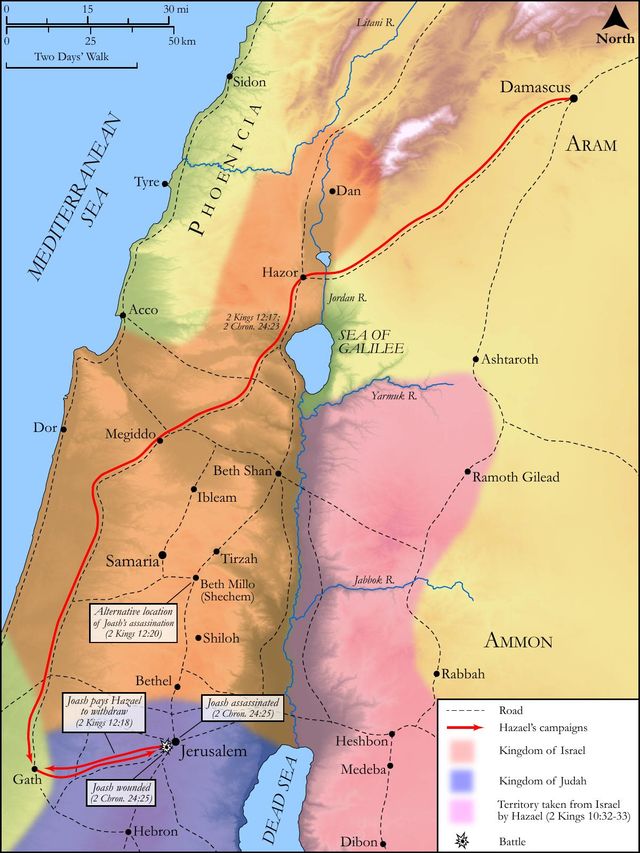
See on the biblical-era map
Study this verse
Public-domain commentary
Matthew Henry
From his Commentary on the Whole Bible. Henry comments on passages, not single verses — this entry covers 2 Chronicles 24:1–14.
This account of Joash's good beginnings we had as it stands here Kg2 12:1, etc., though the latter part of this chapter, concerning his apostasy, we had little of there. What is good in men we should take all occasions to speak of and often repeat it; what is evil we should make mention of but sparingly, and no more than is needful. We shall here only observe, 1. That it is a happy thing for young people, when they are setting out in the world, to be under the direction of those that are wise and good and faithful to them, as Joash was under the influence of Jehoiada, during whose time he did that which was right. Let those that are young reckon it a blessing to them, and not a burden and check upon them, to have those with them that will caution them against that which is evil and advise and quicken them to that which is good; and let them reckon it not a mark of weakness and subjection, but of wisdom and discretion, to hearken to such. He that will not be counselled cannot be helped. It is especially prudent for young people to take advice in their marriages, as Joash did, who left it to his guardian to choose him his wives, because Jezebel and Athaliah had been such plagues, Ch2 24:3. This is a turn of life which often proves either the making or marring of young people, and therefore should be attended to with great care. 2. Men may go far in the external performances of religion, and keep long to them, merely by the power of their education and the influence of their friends, who yet have no hearty affection for divine things nor any inward relish of them. Foreign inducements may push men on to that which is good who are not actuated by a living principle of grace in their hearts. 3. In the outward expressions of devotion it is possible that those who have only the form of godliness may out-strip those who have the power of it. Joash is more solicitous and more zealous about the repair of the temple than Jehoiada himself, whom he reproves for his remissness in that matter, Ch2 24:6. It is easier to build temples than to be temples to God. 4. The repairing of churches is a good work, which all in their places should promote, for the decency and conveniency of religious assemblies. The learned tell us that in the Christian church, anciently, part of the tithes were applied that way. 5. Many a good work would be done that now lies undone if there were but a few active men to stir in it and to put it forward. When Joash found the money did not come in as he expected in one way he tried another way, and that answered the intention. Many have honesty enough to follow that have not zeal enough to lead in that which is good. The throwing of money into a chest, through a hole in the lid of it, was a way that had not been used before, and perhaps the very novelty of the thing made it a successful expedient for the raising of money; a great deal was thrown in and with a great deal of cheerfulness: they all rejoiced, Ch2 24:10. An invention to please people's humour may sometimes bring them to their duty. Wisdom herein is profitable to direct. 6. Faithfulness is the greatest praise and will be the greatest comfort of those that are entrusted with public treasure or employed in public business. The king and Jehoiada faithfully paid the money to the workmen, who faithfully did the work, Ch2 24:12, Ch2 24:13.
Continue studying 2 Chronicles 24:7 across the web’s major study libraries — every link below opens this exact verse, chapter, or book on the destination site.
Read & Compare
 BibleGatewayThis verse in more than 200 translations and 70 languages.
 Bible.comThe YouVersion reader — hundreds of translations, reading plans, and highlights.
 ESV.orgCrossway's official English Standard Version reader.
 NET BibleThe NET translation with 60,000+ translators' notes on every rendering decision.
 STEP BibleTyndale House's free study tool — original text, vocabulary, and scholarly resources.
 BibliaLogos Bible Software's free web reader.
 USCCBThe New American Bible (Revised Edition) with the U.S. bishops' study notes.
Commentaries
 BibleHub CommentariesDozens of classic commentaries on this verse, gathered on one page.
 StudyLightMore than 100 commentary sets — the largest collection on the web.
 BibleRefPlain-English commentary on what this verse means, verse by verse.
 Enduring WordDavid Guzik's free commentary on this chapter, widely used by Bible teachers.
 Bible Study ToolsVerse commentary alongside Greek and Hebrew study aids.
Original Language & Research
- BibleHub InterlinearThe verse word by word — original language, transliteration, and English.
- BibleHub LexiconEvery word's original-language definition and Strong's entry.
 Blue Letter BibleDeep-study tools — Strong's numbers, concordance, and word studies.
 SefariaThe Hebrew text with Rashi and centuries of Jewish commentary.
Sermons, Hymns & Audio


TrulyRandomVerse is not affiliated with these sites and doesn’t control their content. They’re linked because they’re genuinely useful.
Summary
Second Chronicles 24:7 powerfully depicts the profound spiritual and physical desolation inflicted upon the Temple in Jerusalem during the six-year reign of Queen Athaliah. This verse vividly recounts how Athaliah's sons, under her corrupting influence, not only actively damaged the sacred edifice but also brazenly plundered its consecrated vessels and treasures, repurposing these holy items for the idolatrous worship of Baal. This extreme act of sacrilege underscores the depths of apostasy into which Judah had fallen, setting a critical backdrop for the subsequent narrative of King Joash's divinely inspired efforts to restore the house of the LORD.
Context
ShowHideLiterary Context
This verse is strategically positioned within the broader narrative of 2 Chronicles 24, which meticulously details the reign of King Joash. It immediately follows the account of Joash's miraculous preservation from Athaliah's purge of the royal seed and his subsequent enthronement at the tender age of seven. The preceding verses, such as 2 Chronicles 24:1-3, establish Joash's initial righteous reign under the wise guidance of Jehoiada the priest, who had courageously hidden him from Athaliah's murderous intent. Verse 7 serves as a crucial explanation for why Joash, later in the chapter, would feel compelled to initiate a comprehensive repair and restoration project for the Temple, as detailed in 2 Chronicles 24:4-14. It highlights the dire state of disrepair and spiritual corruption that necessitated such an undertaking, emphasizing the severity of Athaliah's destructive legacy and providing the impetus for Joash's righteous actions.
Historical & Cultural Context
Queen Athaliah, the daughter of the infamous King Ahab and Jezebel of Israel, brought the deeply entrenched idolatry of the Northern Kingdom into Judah through her marriage to King Jehoram. After her son King Ahaziah was killed, she seized power by brutally executing all potential heirs to the throne, as recounted in 2 Kings 11:1. Her six-year reign (c. 841-835 BC) was characterized by a systematic promotion of Baal worship, which was the dominant pagan cult of the Canaanites, often associated with fertility and storms. The "house of God" refers to Solomon's magnificent Temple in Jerusalem, the central sanctuary for the worship of Yahweh. The act of "breaking up" the Temple implies not merely neglect, but active vandalism, plundering, and structural damage. The "dedicated things" were sacred vessels, treasures, and offerings consecrated for divine service, set apart for the exclusive use of the LORD. To "bestow upon Baalim" meant these holy items were literally transferred from the Temple of Yahweh and used in the rituals and shrines dedicated to Baal, a profound act of sacrilege and a blatant display of spiritual apostasy that mocked God's holiness and covenant.
Key Themes
ShowHideThis verse powerfully contributes to several key themes woven throughout 2 Chronicles and the broader historical books. Firstly, it underscores the desecration of sacred space, demonstrating the extreme lengths to which ungodly leadership would go in dishonoring God's dwelling place, transforming it from a site of worship into one of destruction and pagan rites. Secondly, it serves as a stark illustration of the consequences of wicked leadership, showing how Athaliah's tyrannical and idolatrous rule directly led to the spiritual and physical decay of the nation's most vital religious institution. Her actions directly undermined the worship of the true God and fostered widespread apostasy. Thirdly, the transfer of dedicated items to Baalim vividly illustrates idolatry's corrupting and destructive nature, revealing how false worship seeks to replace God and pervert true devotion. Finally, by detailing the extent of the damage, the verse provides the essential foundation for restoration, setting the stage for King Joash's subsequent efforts, under the guidance of Jehoiada the priest, to repair and cleanse the Temple, initiating a period of spiritual revival for Judah as described in 2 Chronicles 24:4.
Exposition and Analysis
ShowHideKey Word Analysis
ShowHideFrom the root meaning "to build," this term typically refers to a male offspring, but in its widest sense, it encompasses various relationships including descendants, subjects, or even those associated with a particular quality or condition. Here, "sons of Athaliah" refers to her male offspring or those under her direct influence and command who participated in or orchestrated the desecration. While not explicitly named, these individuals acted as agents of her wicked agenda, embodying the corrupting influence of their mother.
A primitive root meaning "to break out," "burst forth," or "make a breach." This verb signifies more than mere neglect or passive disrepair; it implies active, violent destruction, invasion, and plundering. It suggests that the Temple was not simply allowed to fall into disuse but was forcibly entered, its structures possibly dismantled, and its sanctity violated with aggressive intent to remove its valuable contents. This word paints a vivid picture of deliberate vandalism and desecration.
From a root meaning "to be holy," this term refers to a sacred place or thing, or abstractly, sanctity. It denotes items that have been consecrated, set apart, or hallowed for divine use and worship. In the context of the Temple, these were the sacred vessels, treasures, and offerings that were considered inviolable and exclusively reserved for the service of Yahweh. Their profanation by being stolen and repurposed for idolatrous worship represents a profound act of sacrilege.
This is the plural form of "Baal," a Phoenician deity. It refers to various local manifestations of the Canaanite storm and fertility god, or more generally, to multiple pagan deities worshipped in the region. The use of the plural emphasizes the widespread nature of idolatry during Athaliah's reign and the multiplicity of false gods being honored. The act of bestowing sacred items "upon Baalim" means these objects, consecrated to Yahweh, were literally transferred and used in the rituals and shrines dedicated to these pagan idols, a direct and egregious affront to God's holiness.
Verse Breakdown
ShowHide"For the sons of Athaliah, that wicked woman"
This clause immediately identifies the perpetrators and their moral character. "Sons of Athaliah" refers to her male descendants or those aligned with her, who, under her corrupting influence and likely with her direct command or approval, participated in these sacrilegious acts. The epithet "that wicked woman" serves as a strong moral judgment, highlighting Athaliah's profound depravity and her active role in leading her family and the nation into apostasy. It sets the tone for understanding the severity of the subsequent actions.
"had broken up the house of God"
This describes the physical desecration of the Temple. The verb "broken up" (from pârats) indicates that the Temple was not just neglected but actively damaged, possibly with walls breached, structures dismantled, or its sacred precincts forcibly entered. This was a deliberate act of vandalism and disrespect towards the sacred dwelling place of Yahweh, signifying a direct assault on the worship of the true God and His presence among His people.
"and also all the dedicated things of the house of the LORD"
This specifies the objects of the plundering. "Dedicated things" refers to the sacred vessels, treasures, and offerings that had been consecrated and set apart for use in the Temple rituals and for the exclusive service of Yahweh. These items were considered holy and inviolable, representing the people's devotion and God's presence. The phrase "all the dedicated things" emphasizes the comprehensive nature of the theft and desecration, indicating a thorough and unsparing plundering of God's sanctuary.
"did they bestow upon Baalim"
This final clause reveals the ultimate act of sacrilege and the purpose of the plunder. The "dedicated things" were not merely stolen for personal gain but were actively transferred and consecrated to the worship of pagan deities, specifically "Baalim." This was the ultimate insult to Yahweh, taking what was holy to Him and offering it to false gods, thereby perverting the very essence of worship and demonstrating the depths of idolatrous rebellion and contempt for the covenant God of Israel.
Literary Devices
ShowHideThe verse employs several potent literary devices to convey its message with impactful clarity. Epithet is immediately evident in "that wicked woman," which functions as a strong moral label for Athaliah, immediately signaling her depravity and setting a negative tone for her actions. Contrast is central to the verse, highlighting the stark opposition between the "house of God" and "Baalim," and between "dedicated things" (holy to Yahweh) and their "bestowal upon Baalim" (for pagan worship). This profound contrast underscores the extreme sacrilege committed and the spiritual battle between true worship and idolatry. The verb "broken up" (Hebrew pârats) suggests Hyperbole or intense imagery, conveying not just damage but a violent, destructive breach, emphasizing the extreme and deliberate nature of the desecration. Furthermore, the Temple itself, along with its "dedicated things," functions as Symbolism. The Temple symbolizes God's presence, His covenant relationship with Israel, and the spiritual health of the nation, while the dedicated items symbolize the people's devotion and God's holiness. Their desecration by Athaliah's sons thus symbolizes the profound spiritual brokenness and apostasy of the nation under her influence, setting the stage for the subsequent narrative of Restoration under Joash.
Theological and Thematic Connections
ShowHideThe desecration of the Temple in 2 Chronicles 24:7 stands as a stark theological warning against idolatry and the profanation of what is holy. It underscores God's demand for exclusive worship and the severe consequences of spiritual compromise and rebellion. The Temple, as God's dwelling place among His people, symbolized His presence and covenant faithfulness, serving as the focal point of their national identity and worship. Its defilement by Athaliah's sons was not merely a physical act but a profound spiritual rebellion, a direct affront to God's holiness and sovereignty. This act of transferring sacred items to pagan gods highlights the insidious nature of idolatry, which seeks to usurp God's rightful place and corrupt true worship, leading to national decay. The narrative implicitly teaches that ungodly leadership can lead a nation into deep spiritual apostasy, necessitating divine intervention and righteous restoration. This historical account serves as a timeless reminder of the importance of protecting and reverencing all that is dedicated to God, whether physical structures, spiritual practices, or personal devotion.
Reflection and Application
ShowHideThe account of the Temple's desecration by Athaliah's sons in 2 Chronicles 24:7 carries profound contemporary relevance for believers. It challenges us to examine what we consider "holy" in our lives and whether we are truly dedicating our resources, time, and affections to God, or if we are, perhaps subtly, "bestowing" them upon modern-day "Baalim"—idols of wealth, success, comfort, self-gratification, or even seemingly good causes that displace God from His rightful supremacy. This verse reminds us that spiritual compromise is a slippery slope, and neglecting what is sacred can quickly lead to active desecration. It calls us to vigilant stewardship of our spiritual integrity, ensuring that our lives, which are temples of the Holy Spirit, are preserved from anything that would defile them or draw us away from pure devotion to God. Furthermore, it highlights the critical role of righteous leadership, both in the church and in society, in preserving spiritual truth and order, and the responsibility of every believer to stand against influences that seek to undermine God's honor and lead others into spiritual compromise. We are called to be vigilant guardians of holiness, both personally and corporately.
Questions for Reflection
ShowHideFAQ
ShowHideWho was Athaliah and why was she called "that wicked woman"?
ShowHideAthaliah was the daughter of the infamous King Ahab and Queen Jezebel of Israel, notorious for their aggressive promotion of Baal worship. She married King Jehoram of Judah, thereby introducing and entrenching the idolatry of the Northern Kingdom into the Southern Kingdom. After her son, King Ahaziah, died, she brutally seized power by attempting to exterminate all royal heirs, including her own grandchildren, to secure her throne, as documented in 2 Kings 11:1. She was unequivocally called "that wicked woman" because her reign was characterized by extreme cruelty, political usurpation, and the aggressive promotion of pagan Baal worship, which directly undermined the worship of Yahweh and plunged Judah into deep spiritual apostasy and moral decay.
What does "broken up the house of God" imply beyond mere neglect?
ShowHideThe phrase "broken up" (Hebrew: pârats) signifies more than just neglect or passive disrepair. It implies active, violent destruction, plundering, and making a breach. Under Athaliah's rule, the Temple was not simply left to decay; it was actively invaded, damaged, and its structures possibly dismantled or breached to facilitate the removal of its valuable contents. This was a deliberate act of vandalism and sacrilege, a direct assault on the sanctity of God's dwelling place and a stark symbol of the spiritual chaos and contempt for Yahweh that she unleashed upon the nation. It highlights a conscious, aggressive effort to desecrate the holy.
What were the "dedicated things" and why was their transfer to Baalim so significant?
ShowHideThe "dedicated things" refer to the sacred vessels, treasures, and offerings that had been consecrated and set apart exclusively for use in the Temple rituals and for the service of Yahweh. These items, such as golden and silver vessels, priestly garments, and various offerings, were considered holy and inviolable, representing the people's devotion and God's presence among them. Their transfer "upon Baalim" means these holy items were literally taken from the Temple of Yahweh and repurposed for the worship of pagan deities, specifically Baal. This act was profoundly significant because it represented the ultimate act of sacrilege and idolatry, a direct mockery of God's holiness, and a blatant perversion of true worship. It demonstrated the complete spiritual rebellion and contempt for Yahweh that characterized Athaliah's reign, replacing the worship of the one true God with devotion to false idols.
Christ-Centered Fulfillment
ShowHideThe desecration of the Temple in 2 Chronicles 24:7, where the physical house of God was broken and its holy things offered to idols, finds its ultimate Christ-centered fulfillment in several profound ways. First, it foreshadows the ultimate "breaking" of the Temple of God by human sin, which led to the spiritual defilement of humanity and the separation from God. Just as the physical Temple was defiled, so too was humanity, created in God's image, corrupted by sin, becoming a "den of robbers" rather than a house of prayer (Matthew 21:13). However, Jesus Christ, the true and greater Temple of God, came to cleanse and restore what was broken. He declared, "Destroy this temple, and in three days I will raise it up," speaking of the temple of His body (John 2:19-21). Through His sacrificial death on the cross, He became the ultimate "dedicated thing," the perfect offering that cleanses us from all sin, making us, His believers, living temples of the Holy Spirit (1 Corinthians 3:16). Furthermore, Christ's work reverses the spiritual idolatry exemplified by Athaliah's sons; He calls us away from serving "Baalim" (any false god or earthly master) to worship the one true God, enabling us to offer our lives as "living sacrifices, holy and pleasing to God" (Romans 12:1). He is the true High Priest who entered the greater and more perfect tent, not made with hands, to obtain eternal redemption for us (Hebrews 9:11-14), thus purifying us to be fit dwelling places for God's Spirit, ensuring that the true Temple—His body and His people—will never be permanently broken or given over to idols.