


2 Kings 12:4
Bible text: King James Version (1769 Blayney text) · Public domain
Bible text: King James Version with Strong's numbers · Public domain
Bible text: Berean Standard Bible · Public domain
Bible text: American Standard Version (1901) · Public domain
Bible text: World English Bible, Messianic edition · Public domain
Bible text: Geneva Bible (1599) · Public domain
Bible text: Young's Literal Translation · Public domain
- וַיֹּאמֶרvai·Yo·merand he saidH559Conj-w ¦ V-Qal-ConsecImperf-3msVerb Qal Consecutive Imperfect 3rd Singular Masculineוַandיֹּאמֶרhe said
- יְהוֹאָשׁye·ho·'AshJehoashH3060N-proper-mNoun Proper Masculine
- אֶל'eltoH413PrepPreposition
- הַכֹּהֲנִיםha·ko·ha·Nimthe priestsH3548Art ¦ N-mpNoun Plural Masculine Absoluteהַtheכֹּהֲנִיםpriests
- כֹּלkolallH3605N-mscNoun Singular Masculine Construct
- כֶּסֶףKe·sef[the] money ofH3701N-mscNoun Singular Masculine Construct
- הַקֳּדָשִׁיםha·ko·da·Shimthe holy giftsH6944Art ¦ N-mpNoun Plural Masculine Absoluteהַtheקֳּדָשִׁיםholy gifts
- אֲשֶׁר'a·SherwhichH834RelParticle Relative
- יוּבָאyu·Va'it will be broughtH935V-Hophal-Imperf-3msVerb Hophal Imperfect 3rd Singular Masculine
- בֵיתveit[the] house ofH1004N-mscNoun Singular Masculine Construct
- יְהוָהYah·wehYahwehH3068N-properNoun Proper Title
- כֶּסֶףKe·sefmoneyH3701N-msNoun Singular Masculine Absolute
- עוֹבֵרo·Verpassing alongH5674V-Qal-Prtcpl-msVerb Qal Participle Singular Masculine Absolute
- אִישׁ'isheveryoneH376N-msNoun Singular Masculine Absolute
- כֶּסֶףKe·sef[the] money ofH3701N-mscNoun Singular Masculine Construct
- נַפְשׁוֹתnaf·Shotpersons ofH5315N-fpcNoun Plural Feminine Construct
- עֶרְכּוֹer·Kohis valuationH6187N-msc ¦ 3msNoun Singular Masculine Constructעֶרְכּvaluationוֹhis
- כָּלkolallH3605N-mscNoun Singular Masculine Construct
- כֶּסֶףKe·sef[the] moneyH3701N-msNoun Singular Masculine Absolute
- אֲשֶׁר'a·SherwhichH834RelParticle Relative
- יַעֲלֶהya·'a·Lehit will come upH5927V-Qal-Imperf-3msVerb Qal Imperfect 3rd Singular Masculine
- עַל'alonH5921PrepPreposition
- לֶבlev[the] heart ofH3820N-mscNoun Singular Masculine Construct
- אִישׁ'Isha personH376N-msNoun Singular Masculine Absolute
- לְהָבִיאle·ha·Vi'to bringH935Prep-l ¦ V-Hiphil-InfVerb Hiphil Infinitive Constructלְtoהָבִיאbring
- בֵּיתbeit[the] house ofH1004N-mscNoun Singular Masculine Construct
- יְהוָהYah·wehYahwehH3068N-properNoun Proper Title
English is a literal word-by-word gloss of the Hebrew, not the KJV's wording. Why?
This is the original text the KJV's translators worked from — each Hebrew word with its own literal English meaning in this verse, prepared by scholars at Tyndale House, Cambridge. The KJV translates whole sentences, not word by word, so its wording differs: one Hebrew word can become several English words, and the KJV may choose “the LORD” where the gloss reads “Yahweh”. Both are faithful — they answer different questions. For the KJV's own rendering, switch to the KJV text.
Details
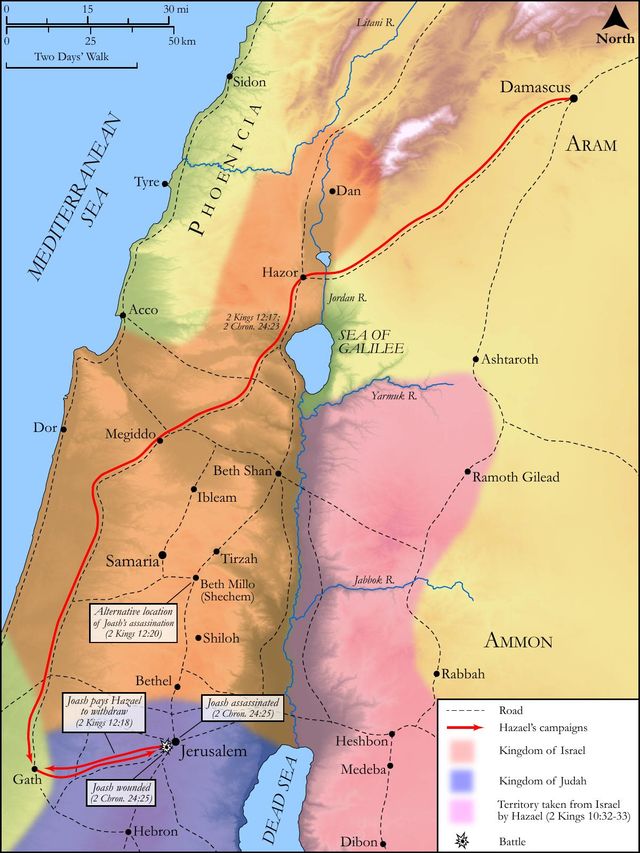
See on the biblical-era map
Study this verse
Public-domain commentary
Matthew Henry
From his Commentary on the Whole Bible. Henry comments on passages, not single verses — this entry covers 2 Kings 12:4–16. His four-level outline is real structure in the source text, so it is rendered as structure.
We have here an account of the repairing of the temple in the reign of Joash.
I.It seems, the temple had gone out of repair.
Though Solomon built it very strong, of the best materials and in the best manner, yet in time it went to decay, and there were breaches found in it (Kg2 12:5), in the roofs, or walls, or floors, the ceiling, or wainscoting, or windows, or the partitions of the courts. Even temples themselves are the worse for the wearing; but the heavenly temple will never wax old. Yet it was not only the teeth of time that made these breaches, the sons of Athaliah had broken up the house of God (Ch2 24:7), and, out of enmity to the service of the temple, had damaged the buildings of it, and the priests had not taken care to repair the breaches in time, so that they went worse and worse. Unworthy were those husbandmen to have this valuable vineyard let out to them upon such easy terms who could not afford to keep the winepress in due and tenantable repair, Mat 21:33. Justly did their great Lord sue them for this permissive waste, and by his judgments recover locum vastatum - for dilapidations (as the law speaks), when this neglected temple was laid even with the ground.
II.The king himself was (as it should seem) the first and forwardest man that took care for the repair of it.
We do not find that the priests complained of it or that Jehoiada himself was active in it, but the king was zealous in the matter,
1.Because he was king, and God expects and requires from those who have power that they use it for the maintenance and support of religion, the redress of grievances, and reparation of decays, for the exciting and engaging of ministers to do their part and people theirs.
2.Because the temple had been both his nursery and his sanctuary when he was a child, in a grateful remembrance of which he now appeared zealous for the honour of it. Those who have experienced the comfort and benefit of religious assemblies will make the reproach of them their burden (Zep 3:18), the support of them their care, and the prosperity of them their chief joy.
III.The priests were ordered to collect money for these repairs, and to take care that the work was done.
The king had the affairs of his kingdom to mind, and could not himself inspect this affair, but he employed the priests to manage it, the fittest persons, and most likely, one would think, to be hearty in it.
1.He gave them orders for the levying of the money of the dedicated things. They must not stay till it was paid in, but they must call for it where they knew it was due, in their respective districts, as redemption-money (by virtue of the law, Lev 27:2, Lev 27:3), or as a free-will offering, Kg2 12:4. This they were to gather every man of his acquaintance, and it was supposed that there was no man but had acquaintance with some or other of the priests. Note, We should take the opportunity that God gives us of exciting those we have a particular acquaintance with to that which is good.
2.He gave them orders for laying out the money they had levied in repairing the breaches of the house, Kg2 12:5.
IV.This method did not answer the intention, Kg2 12:6.
Little money was raised. Either the priests were careless, and did not call on the people to pay in their dues, or the people had so little confidence in the priests' management that they were backward to pay money into their hands; if they were distrusted without cause, it was the people's shame; if with, it was more theirs. But what money was raised was not applied to the proper use: The breaches of the house were not repaired; the priests thought it might serve as well as it had done, and therefore put off repairing from time to time. Church work is usually slow work, but it is a pity that churchmen, of all men, should be slow at it. Perhaps what little money they raised they thought it necessary to use for the maintenance of the priests, which must needs fall much short when ten tribes had wholly revolted and the other two were wretchedly corrupted.
V.Another method was therefore taken.
The king had his heart much set upon having the breaches of the house repaired, Kg2 12:7. His apostasy, at last, gives us cause to question whether he had as good an affection for the service of the temple as he had for the structure. Many have been zealous for building and beautifying churches, and for other forms of godliness, who yet have been strangers to the power of it. However, we commend his zeal, and blame him not for reproving even his tutor Jehoiada himself when he saw him remiss; and so convincing was his reproof that the priests owned themselves unworthy to be any longer employed, and consented to the taking of some other measures, and the giving up of the money they had received into other hands, Kg2 12:8. It was honestly done, when they found they had not spirit to do it themselves, not to hinder other people from doing it. Another course was taken,
1.For raising money, Kg2 12:9, Kg2 12:10. The money was not paid into private hands, but put into a public chest, and then people brought it in readily and in great abundance, not only their dues, but their free-will offerings for so good a work. The high priest and the secretary of state counted the money out of the chest, and laid it by in specie for the use to which it was appropriated. When public distributions are made faithfully public contributions will be made cheerfully. The money that was given,
(1.)Was dropped into the chest through a hole in the lid, past recall, to intimate that what has been once resigned to God must never be resumed. Every man, as he purposeth in his heart, so let him give.
(2.)The chest was put on the right hand as they went in, which, some think, is alluded to in that rule of charity which our Saviour gives, Let not thy left hand know what thy right hand doeth. But, while they were getting all they could for the repair of the temple, they did not break in upon that which was the stated maintenance of the priests, Kg2 12:16. The trespass-money and the sin-money (which were given to them by that law, Lev 5:15, Lev 5:16) were reserved to them. Let not the servants of the temple be starved under colour of repairing the breaches of it.
2.For laying out the money that was raised.
(1.)They did not put it into the hands of the priests, who were not versed in affairs of this nature, having other work to mind, but into the hands of those that did the work, or at least had the oversight of it, Kg2 12:11. Those were fittest to be entrusted with this business whose employment lay that way. Tractant fabrilia fabri - Every artist has his trade assigned; but let not those who are called to war the holy warfare entangle themselves in the affairs of this life. Those that were thus entrusted did the business,
[1.]Carefully, purchasing materials and paying workmen, Kg2 12:12. Business is done with expedition when those are employed in it that understand it and know which way to go about it.
[2.]Faithfully; such a reputation they got for honesty that there was no occasion to examine their bills or audit their accounts. Let all that are entrusted with public money, or public work, learn hence to deal faithfully, as those that know God will reckon with them, whether men do or no. Those that think it is no sin to cheat the government, cheat the country, or cheat the church, will be of another mind when God shall set their sins in order before them.
(2.)They did not lay it out in ornaments for the temple, in vessels of gold or silver, but in necessary repairs first (Kg2 12:13), whence we may learn, in all our expenses to give that the preference which is most needful, and, in dealing for the public, to deal as we would for ourselves. After the repairs were finished we find the overplus turned into plate for the service of the temple, Ch2 24:14.
Historical interpretation
Nine Centuries of Reception
3 surviving comments on this verse. Each one is dated, so this reads as a timeline rather than a list.
Select a marker to jump to its quote. Markers stagger vertically where authors wrote within a few decades of each other.
“The money for the assessment.” [The Scripture] uses [this term] for the money which is voluntarily given by the people for the “assessment” of their own person and whose payment has survived from the time of Moses who, after the [Israelites] were counted in the census, prescribed that four zouzē should be deducted from each of them. This form of contribution was perpetuated up to the days of our Lord as a memory of the kindness of God toward them. But at the time of our Lord they only gave two zouzē, because they had become poor.
The price of a soul: That is, the ordinary oblation, which every soul was to offer by the law. Ex. 30.
Sanctified: That is, dedicated to God's service.-- Ibid.
Continue studying 2 Kings 12:4 across the web’s major study libraries — every link below opens this exact verse, chapter, or book on the destination site.
Read & Compare
 BibleGatewayThis verse in more than 200 translations and 70 languages.
 Bible.comThe YouVersion reader — hundreds of translations, reading plans, and highlights.
 ESV.orgCrossway's official English Standard Version reader.
 NET BibleThe NET translation with 60,000+ translators' notes on every rendering decision.
 STEP BibleTyndale House's free study tool — original text, vocabulary, and scholarly resources.
 BibliaLogos Bible Software's free web reader.
 USCCBThe New American Bible (Revised Edition) with the U.S. bishops' study notes.
Commentaries
 BibleHub CommentariesDozens of classic commentaries on this verse, gathered on one page.
 StudyLightMore than 100 commentary sets — the largest collection on the web.
 BibleRefPlain-English commentary on what this verse means, verse by verse.
 Enduring WordDavid Guzik's free commentary on this chapter, widely used by Bible teachers.
 Bible Study ToolsVerse commentary alongside Greek and Hebrew study aids.
Original Language & Research
- BibleHub InterlinearThe verse word by word — original language, transliteration, and English.
- BibleHub LexiconEvery word's original-language definition and Strong's entry.
 Blue Letter BibleDeep-study tools — Strong's numbers, concordance, and word studies.
 SefariaThe Hebrew text with Rashi and centuries of Jewish commentary.
Sermons, Hymns & Audio


TrulyRandomVerse is not affiliated with these sites and doesn’t control their content. They’re linked because they’re genuinely useful.
Summary
In 2 Kings 12:4, King Jehoash initiates a critical project to restore the dilapidated Temple in Jerusalem. This verse meticulously records his direct communication to the priests, detailing the various categories of funds that had been collected and were available within the "House of the LORD." His precise inventory of these diverse financial contributions—encompassing consecrated items, the obligatory census tax, monetary redemptions for vows, and spontaneous freewill offerings—lays the essential groundwork for his subsequent instructions on how these resources should be properly allocated and utilized for the sacred structure's much-needed restoration, underscoring his profound commitment to the spiritual and physical integrity of the nation's central place of worship.
Context
ShowHideLiterary Context
This verse serves as the crucial opening to King Jehoash's significant Temple repair initiative, which forms the central narrative of 2 Kings 12. It immediately follows the account of his miraculous preservation from Athaliah's purge and his subsequent enthronement at a tender age under the steadfast guidance of the priest Jehoiada, as detailed in 2 Kings 11. The preceding chapter establishes a Judah that has endured a period of profound idolatry and neglect under Athaliah's reign, leading directly to the desecration and disrepair of the Temple. Verse 4 sets the stage for the king's direct and necessary intervention, as the priests, despite collecting funds, had not effectively used them for repairs, a critical issue explicitly addressed in 2 Kings 12:5-8. The subsequent verses in the chapter describe the implementation of a new, more efficient, and transparent system for fund collection and disbursement, showcasing Jehoash's proactive and accountable leadership in this sacred endeavor.
Historical & Cultural Context
King Jehoash (also known as Joash) reigned in Judah from approximately 835-796 BC. His early life and ascension to the throne were marked by the turbulent period following the reign of his grandmother, Athaliah, who had actively promoted Baal worship and severely neglected the Temple of Yahweh. The "House of the LORD" was far more than just a building; it was the central place of worship for the Israelite nation, symbolizing God's presence among His people and serving as the locus of the covenant. Its disrepair was thus a visible and potent sign of spiritual decay and national apostasy. Culturally, the various categories of offerings mentioned in the verse reflect established Mosaic laws and practices. The "money of every one that passeth [the account]" refers to the half-shekel Temple tax mandated in Exodus 30:11-16 for the upkeep of the Tabernacle and later the Temple. The "money that every man is set at" points to votive offerings, where individuals vowed themselves or their property to the Lord and then redeemed them with money, valued according to specific laws found in Leviticus 27. Finally, "all the money that cometh into any man's heart to bring" represents freewill offerings, given voluntarily out of personal devotion, as exemplified in Deuteronomy 16:10.
Key Themes
ShowHideThe primary theme powerfully conveyed in 2 Kings 12:4 is the reverence for and diligent maintenance of God's dwelling place. Jehoash's initiative underscores the profound spiritual importance of the Temple as the physical manifestation of God's presence and the indispensable center of Israelite worship. Its restoration was not merely a construction project but a deeply spiritual act, signifying a crucial return to covenant fidelity and national devotion to Yahweh after a prolonged period of neglect and idolatry. Another significant theme is stewardship and accountability. The king's detailed categorization of funds implicitly highlights the critical need for proper and transparent management of sacred resources. The broader narrative of 2 Kings 12 explicitly reveals that the priests had been collecting money but not using it effectively for repairs, necessitating the king's direct intervention and the establishment of a new, more transparent system. This emphasizes the vital responsibility of leaders and the community to faithfully manage resources dedicated to God's work. Finally, the verse clearly delineates diverse forms of giving, illustrating the various ways individuals contributed to the Temple's upkeep, ranging from mandatory contributions to voluntary acts of profound generosity, reflecting a comprehensive and multifaceted approach to supporting the sacred institution.
Exposition and Analysis
ShowHideKey Word Analysis
ShowHideThis word, derived from a root meaning "to build," refers broadly to a dwelling, habitation, or structure. In this context, "the house of the LORD" specifically designates the Temple in Jerusalem, which served as the central sanctuary and symbolic dwelling place of God among His people. The term emphasizes the physical structure as a dedicated space for worship and divine presence, highlighting the king's concern for its physical integrity.
Literally meaning "silver" (from its pale color), this term is used by implication to refer to money in general, as silver was a primary medium of exchange, as when Abraham weighed to Ephron four hundred shekels of silver. Its repeated mention throughout the verse underscores the financial nature of the contributions and the king's focus on the material resources available for the Temple's restoration.
This term signifies something consecrated, set apart, or holy to the Lord. In the context of the Temple, "dedicated things" refers to items or funds that individuals had vowed or specifically devoted to God for sacred purposes. These were not ordinary possessions but were considered exclusively God's property, often resulting from a vow (e.g., Numbers 21:2) or a special offering. The inclusion of this category highlights the variety of ways people expressed their devotion and commitment to God through material contributions.
Literally meaning "to cross over" or "to cross," in this context, it refers to those who "pass through the census" or "are counted." This phrase directly alludes to the half-shekel temple tax (also known as "redemption money" or "atonement money") mandated in Exodus 30:11-16. Every male Israelite aged twenty years or more was required to pay this fixed amount when a census was taken, specifically for the service and maintenance of the Tabernacle and later the Temple. It was a universal and obligatory contribution, distinct from voluntary offerings.
This word denotes a "valuation" or "assessment." It refers to the monetary equivalent assigned to a person or property that had been vowed or dedicated to the Lord, as detailed in Leviticus 27. If an individual vowed themselves, their animals, or their land to God, they could redeem it by paying a fixed monetary value determined by the priests according to specific Levitical criteria. This category represents a form of votive offering where a vow was fulfilled through a monetary payment rather than the literal dedication of the vowed item.
Figuratively, this term encompasses the feelings, will, and intellect, representing the inner core of a person. In the phrase "cometh into any man's heart to bring," it emphasizes the voluntary and heartfelt nature of freewill offerings, distinguishing them from obligatory payments or redemptions. It highlights a donation motivated by genuine desire and devotion rather than legal requirement.
Verse Breakdown
ShowHide"And Jehoash said to the priests,"
This opening clause immediately establishes the speaker and the audience, highlighting the king's direct, authoritative communication to the religious leaders who were primarily responsible for the Temple's upkeep. It signifies a royal edict or directive concerning a matter of national religious importance, indicating the king's personal involvement and deep concern for the sanctuary.
"All the money of the dedicated things that is brought into the house of the LORD,"
This specifies the first category of funds. These are monies derived from items or pledges that have been consecrated or set apart as holy to God. This could include the sale of dedicated items, or money given in fulfillment of specific vows, representing a stream of income from individual acts of profound devotion and commitment.
"[even] the money of every one that passeth [the account],"
This identifies the second category, referring to the obligatory half-shekel temple tax. This was a fixed, universal contribution required of every adult male Israelite during a census, intended specifically for the maintenance and service of the sanctuary. It represents a regular, predictable, and legally mandated source of funds for the Temple's ongoing upkeep.
"the money that every man is set at,"
This describes the third type of contribution, which refers to the monetary valuations of persons or property vowed to the Lord, as outlined in Leviticus 27. When an individual made a vow to dedicate themselves or their possessions to God, they could often redeem that vow by paying an assessed monetary value. This category reflects a specific legal and ritualistic form of giving, tied to vows.
"[and] all the money that cometh into any man's heart to bring into the house of the LORD,"
This final clause encompasses the fourth and distinct category: freewill offerings. Unlike the previous categories which were obligatory or tied to specific vows/valuations, these funds were given purely voluntarily, motivated by personal generosity, devotion, and a heartfelt desire to contribute to the Lord's house. This highlights the spontaneous and uncompelled aspect of giving, flowing from the individual's inner disposition.
Literary Devices
ShowHideThe verse employs several key literary devices to convey its message effectively and underscore the king's methodical approach. Enumeration is prominently featured, as the passage meticulously lists four distinct categories of money: "dedicated things," "every one that passeth [the account]," "every man is set at," and "cometh into any man's heart to bring." This precise and exhaustive listing emphasizes the comprehensive nature of the funds available and the king's thorough understanding of the Temple's diverse financial streams. Repetition of the phrase "the money of" or "all the money" across the different clauses serves to unify these diverse sources under a single umbrella—financial contributions—while simultaneously highlighting their distinct origins. This rhetorical device reinforces the central theme of financial resources being systematically gathered for the Temple's restoration. Furthermore, the recurring phrase "House of the LORD" functions as a powerful metonymy, where the physical structure stands in for the spiritual presence of God and the entire system of worship centered there. Its repeated mention underscores the sacred purpose of these funds and the profound significance of the building itself as the designated dwelling place of God among His people.
Theological and Thematic Connections
ShowHide2 Kings 12:4, by detailing the various streams of income for the Temple, underscores profound theological principles concerning God's dwelling, the nature of worship, and the responsibility of His people. The very act of collecting and categorizing these funds for the Temple's repair highlights the understanding that God's presence among His people was intrinsically linked to the sanctity and upkeep of His designated dwelling place. It reflects a theology where material resources are consecrated for spiritual purposes, demonstrating that faithful stewardship of physical assets is a tangible expression of devotion to God. The distinction between obligatory contributions (like the census tax) and freewill offerings reveals God's desire for both dutiful obedience and heartfelt generosity in worship. Ultimately, this passage points to the broader biblical theme that the community of faith is responsible for maintaining the physical and spiritual integrity of the "house of God," whether it be a literal Temple or, as in the New Testament, the body of believers.
Reflection and Application
ShowHideThe meticulous accounting and royal concern for the Temple's physical state in 2 Kings 12:4 offer profound and enduring lessons for believers today. Just as King Jehoash recognized the paramount importance of maintaining the physical structure that symbolized God's presence, so too are we called to value and support the spaces where God's people gather for worship, fellowship, and ministry. This extends beyond mere brick and mortar to the broader "house of God," which the New Testament reveals to be the community of believers, the Church itself (1 Timothy 3:15). Our generosity, whether through regular tithes, specific offerings, or spontaneous freewill gifts, directly contributes to the ongoing work of God's kingdom—supporting ministries, spreading the gospel, caring for the needy, and maintaining the infrastructure necessary for spiritual growth. Furthermore, Jehoash's intervention highlights the critical need for transparent stewardship and unwavering accountability within religious organizations. Leaders and congregants alike are called to ensure that resources dedicated to God's work are managed with integrity, wisdom, and faithfulness, ensuring they are used for their intended, God-honoring purposes. Our giving should be both obedient to biblical principles and heartfelt, reflecting a genuine desire to honor God with our possessions and our lives.
Questions for Reflection
ShowHideFAQ
ShowHideWhat was the significance of the "House of the LORD" in this context?
ShowHideThe "House of the LORD" (the Temple in Jerusalem) was of paramount significance as the designated dwelling place of God among His people, the central hub of Israelite worship, and the physical embodiment of the covenant. Its sanctity and proper upkeep were directly tied to the spiritual health and fidelity of the nation. Its disrepair, as seen before Jehoash's reign, symbolized a period of profound spiritual decline and neglect under Athaliah's idolatrous influence. Jehoash's initiative to repair it was therefore not merely a renovation project but a profound act of spiritual renewal and a reassertion of Judah's commitment to Yahweh. The Temple was where sacrifices were offered, prayers were made, and God's presence was uniquely manifested, making its proper state crucial for national worship and identity. The narrative in 2 Kings 12 emphasizes this spiritual importance through the king's diligent efforts.
Why did King Jehoash need to categorize the money in such detail?
ShowHideKing Jehoash's detailed categorization of the funds was crucial for several compelling reasons. Firstly, it demonstrated his thorough understanding of the Temple's financial streams, indicating a methodical and organized approach to addressing the problem of disrepair. Secondly, and perhaps most importantly, it was a necessary step for proper stewardship and accountability. The preceding verses (and subsequent ones, like 2 Kings 12:5) imply that the priests, who were collecting the money, had not been effectively using it for repairs. By categorizing the funds, Jehoash could ensure that the money was specifically allocated and used for its intended purpose—the Temple's restoration. This act of itemization was a precursor to establishing a new, more transparent system for collecting and disbursing funds, as detailed in 2 Kings 12:9-16, which ultimately led to the successful completion of the repairs and restored public trust.
Are these specific types of offerings still relevant for believers today?
ShowHideWhile the specific Mosaic laws and categories of offerings (like the half-shekel temple tax or votive valuations) are not directly binding on New Covenant believers, the underlying principles remain highly relevant and find new expression. The concept of "dedicated things" resonates with our call to consecrate our entire lives and all our resources to God (Romans 12:1). The "money of every one that passeth [the account]" (the obligatory tax) finds its parallel in the principle of regular, systematic giving, such as tithing, which supports the work of the church and ministry (Malachi 3:10). The "money that every man is set at" (votive offerings) reminds us of the importance of fulfilling our commitments and vows to God. And "all the money that cometh into any man's heart to bring" directly corresponds to the New Testament emphasis on cheerful, freewill giving motivated by love and generosity (2 Corinthians 9:7). Thus, while the forms have changed, the spiritual principles of giving, stewardship, and supporting God's "house" (now the Church) endure as vital expressions of faith.
Christ-Centered Fulfillment
ShowHideThe meticulous attention to the physical Temple's repair and the sacredness of its funds in 2 Kings 12:4 finds its ultimate fulfillment and profound transformation in Jesus Christ. The Old Testament Temple, though magnificent and divinely ordained, was inherently a shadow and a type, pointing forward to the true and perfect dwelling place of God. Jesus Himself declared that He was the ultimate Temple, stating, "Destroy this temple, and in three days I will raise it up" (John 2:19), referring to His own body and His resurrection. Just as Jehoash sought to purify and restore the physical house of God after a period of neglect, Christ came not merely to renovate a building but to purify and restore humanity, making us the new spiritual temple, "a dwelling place for God by the Spirit" (Ephesians 2:19-22). The various offerings listed in 2 Kings 12:4—dedicated things, census taxes, votive valuations, and freewill gifts—all foreshadow the singular, perfect, and ultimate "dedicated thing" given to God: the self-sacrifice of Jesus Christ, the Lamb of God who takes away the sin of the world. His life, death, and resurrection were the ultimate offering, fulfilling all requirements of the Law and surpassing all previous sacrifices, bringing about true atonement and access to God (Hebrews 9:11-14). In Christ, the need for a physical, earthly temple for divine presence is transcended, as God now dwells by His Spirit within believers, making the Church the living, spiritual "House of God" that we are called to build up and maintain through our lives, resources, and devotion, all empowered by the finished, perfect work of our Lord.