


2 Kings 12:3
Bible text: King James Version (1769 Blayney text) · Public domain
Bible text: Berean Standard Bible · Public domain
Bible text: American Standard Version (1901) · Public domain
Bible text: World English Bible, Messianic edition · Public domain
Bible text: Geneva Bible (1599) · Public domain
Bible text: Young's Literal Translation · Public domain
- רַקrakonlyH7535AdvAdverb
- הַבָּמוֹתha·ba·Motthe high placesH1116Art ¦ N-fpNoun Plural Feminine Absoluteהַtheבָּמוֹתhigh places
- לֹאlo'notH3808NegParticle Negative
- סָרוּSa·ruthey were removedH5493V-Qal-Perf-3cpVerb Qal Perfect 3rd Plural common gender
- עוֹדodstillH5750Adj-msAdjective Numerical Singular Masculine Absolute
- הָעָםha·'Amthe peopleH5971Art ¦ N-msNoun Singular Masculine Absoluteהָtheעָםpeople
- מְזַבְּחִיםme·za·be·Chim[were] sacrificingH2076V-Piel-Prtcpl-mpVerb Piel Participle Plural Masculine Absolute
- וּמְקַטְּרִיםu·me·ka·te·Rimand [were] making smokeH6999Conj-w ¦ V-Piel-Prtcpl-mpVerb Piel Participle Plural Masculine Absoluteוּandמְקַטְּרִים[were] making smoke
- בַּבָּמוֹתba·ba·Motat the high placesH1116Prep-b ¦ N-fpNoun Plural Feminine Absoluteבַּat theבָּמוֹתhigh places
English is a literal word-by-word gloss of the Hebrew, not the KJV's wording. Why?
This is the original text the KJV's translators worked from — each Hebrew word with its own literal English meaning in this verse, prepared by scholars at Tyndale House, Cambridge. The KJV translates whole sentences, not word by word, so its wording differs: one Hebrew word can become several English words, and the KJV may choose “the LORD” where the gloss reads “Yahweh”. Both are faithful — they answer different questions. For the KJV's own rendering, switch to the KJV text.
Details
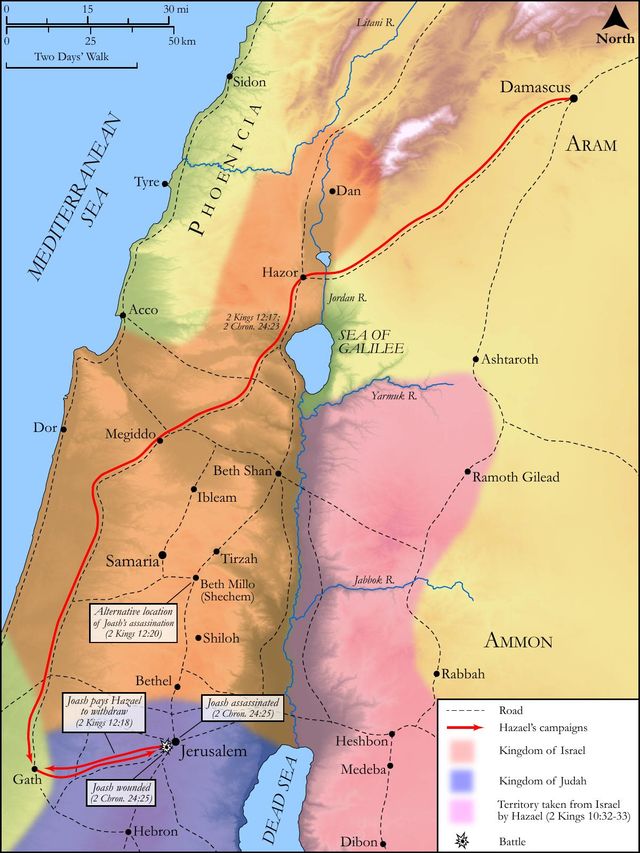
See on the biblical-era map
Study this verse
Public-domain commentary
Matthew Henry
From his Commentary on the Whole Bible. Henry comments on passages, not single verses — this entry covers 2 Kings 12:1–3.
The general account here given of Joash is, 1. That he reigned forty years. As he began his reign when he was very young, he might, in the course of nature, have continued much longer, for he was cut off when he was but forty-seven years old, Kg2 12:1. 2. That he did that which was right as long as Jehoiada lived to instruct him, Kg2 12:2. Many young men have come too soon to an estate - have had wealth, and power, and liberty, before they knew how to use them - and it has been of bad consequence to them; but against this danger Joash was well guarded by having such a good director as Jehoiada was, so wise, and experienced, and faithful to him, and by having so much wisdom as to hearken to him and be directed by him, even when he was grown up. Note, It is a great mercy to young people, and especially to young princes, and all young men of consequence, to be under good direction, and to have those about them that will instruct them to do that which is right in the sight of the Lord; and they then do wisely and well for themselves when they are willing to be counselled and ruled by such. A child left to himself brings his mother to shame, but a child left to such a tuition may bring himself to honour and comfort. 3. That the high places were not taken away, Kg2 12:3. Up and down the country they had altars both for sacrifice and incense, to the honour of the God of Israel only, but in competition with, and at least in tacit contempt of, his altar at Jerusalem. These private altars, perhaps, had been more used in the late bad reigns than formerly, because it was not safe to go up to Jerusalem, nor was the temple-service performed as it should have been; and, it may be, Jehoiada connived at them, because some well-meaning people were glad of them when they could not have better, and he hoped that the reforming of the temple, and putting things into a good posture there, would by degrees draw people from their high places and they would dwindle of themselves; or perhaps neither the king nor the priest had zeal enough to carry on their reformation so far, nor courage and strength enough to encounter such an inveterate usage.
Continue studying 2 Kings 12:3 across the web’s major study libraries — every link below opens this exact verse, chapter, or book on the destination site.
Read & Compare
 BibleGatewayThis verse in more than 200 translations and 70 languages.
 Bible.comThe YouVersion reader — hundreds of translations, reading plans, and highlights.
 ESV.orgCrossway's official English Standard Version reader.
 NET BibleThe NET translation with 60,000+ translators' notes on every rendering decision.
 STEP BibleTyndale House's free study tool — original text, vocabulary, and scholarly resources.
 BibliaLogos Bible Software's free web reader.
 USCCBThe New American Bible (Revised Edition) with the U.S. bishops' study notes.
Commentaries
 BibleHub CommentariesDozens of classic commentaries on this verse, gathered on one page.
 StudyLightMore than 100 commentary sets — the largest collection on the web.
 BibleRefPlain-English commentary on what this verse means, verse by verse.
 Enduring WordDavid Guzik's free commentary on this chapter, widely used by Bible teachers.
 Bible Study ToolsVerse commentary alongside Greek and Hebrew study aids.
Original Language & Research
- BibleHub InterlinearThe verse word by word — original language, transliteration, and English.
- BibleHub LexiconEvery word's original-language definition and Strong's entry.
 Blue Letter BibleDeep-study tools — Strong's numbers, concordance, and word studies.
 SefariaThe Hebrew text with Rashi and centuries of Jewish commentary.
Sermons, Hymns & Audio


TrulyRandomVerse is not affiliated with these sites and doesn’t control their content. They’re linked because they’re genuinely useful.
Summary
Second Kings 12:3 provides a critical qualification to the otherwise commendable reign of King Joash of Judah, revealing a persistent spiritual compromise: despite his general righteousness under Jehoiada's guidance, the "high places" were not removed. This verse highlights the ongoing problem of the people engaging in illicit sacrifices and burning incense at these local shrines, which often blended the worship of Yahweh with pagan customs, thereby undermining the purity of Israelite faith and the divine command for centralized worship.
Context
ShowHideLiterary Context
This verse immediately follows the positive assessment of King Joash's reign in 2 Kings 12:2, which states, "And Jehoash did that which was right in the sight of the LORD all the days wherein Jehoiada the priest instructed him." The adversative conjunction "But" at the beginning of 2 Kings 12:3 signals a significant caveat to this otherwise favorable report. This literary device of immediate qualification is a recurring pattern in the Books of Kings, frequently employed to temper positive evaluations of kings who, despite some commendable actions, failed to fully eradicate idolatrous practices or enforce complete adherence to the Mosaic Law. The subsequent narrative in 2 Kings 12:4-16 details Joash's commendable efforts to repair the Jerusalem Temple, further emphasizing the tension between his genuine zeal for Yahweh's house and his failure to address the deeply entrenched problem of the high places. This juxtaposition underscores the complexity of spiritual leadership and the challenge of complete obedience, even for well-intentioned rulers.
Historical & Cultural Context
The "high places" (Hebrew: bamot) were elevated cultic sites, often situated on hills or artificial mounds, that pre-dated the construction of the Jerusalem Temple. While some may have initially served as legitimate places for Yahweh worship in the pre-monarchic period, their continued existence became problematic after God commanded centralized worship at a single, chosen location, as explicitly detailed in Deuteronomy 12:5-14. In Judah, their persistence often indicated a syncretistic blend of Yahweh worship with Canaanite fertility cults and other pagan practices, or at the very least, a deviation from the divinely ordained system, fostering a diluted and compromised faith. For a king to be considered fully righteous and to fulfill their covenantal responsibilities, a key duty was to dismantle these high places, as exemplified by the reforms of later kings like Hezekiah (2 Kings 18:4) and Josiah (2 Kings 23:8). Joash's failure reflects the deep cultural entrenchment of these practices among the populace and perhaps the pragmatic difficulty of enforcing complete religious uniformity against popular sentiment.
Key Themes
ShowHideThis verse contributes significantly to several recurring themes prevalent throughout the Books of Kings. The most prominent is Partial Obedience and Compromise, illustrating that even a king who largely "did what was right" could still harbor significant areas of disobedience. Joash's failure to remove the high places represents a critical spiritual "but" in his reign, highlighting that doing good in some areas does not negate persistent disobedience in others. Another crucial theme is the Persistence of Idolatry and Syncretism. The "high places" were a constant spiritual battleground for the kings of Judah, symbolizing the nation's ongoing struggle against the allure of pagan practices and the tendency to mix true worship with foreign customs. This syncretism undermined the exclusive covenant relationship with Yahweh, emphasizing the importance of undivided loyalty. Finally, the verse speaks to the King's Responsibility in leading the nation in full obedience to God's law. A primary duty of a righteous king was to eradicate idolatry and its associated practices, thereby safeguarding the spiritual purity of the people. Joash's inability to fully dismantle these shrines, even under the guidance of Jehoiada, underscores a limitation in his spiritual leadership and the societal challenge of comprehensive religious reform, a challenge that would plague the monarchy until the exile.
Exposition and Analysis
ShowHideKey Word Analysis
ShowHideFrom an unused root meaning "to be high," this term refers to an elevation or cultic site, typically on a hill, where sacrifices and other religious rites were performed. While some pre-monarchic worship of Yahweh might have legitimately occurred at such sites, after the command for centralized worship at the Jerusalem Temple (as detailed in Deuteronomy 12), these locations became illicit. Their continued use often indicated a blend of Yahweh worship with Canaanite practices, or at least a deviation from the prescribed divine order, fostering syncretism and undermining the uniqueness of Israel's covenant with God.
This primitive root means "to turn off" or "to remove." In this context, it signifies the act of dismantling or abolishing the high places. The passive construction "were not taken away" highlights the absence of decisive action on the part of King Joash. This failure to remove these sites represented a direct contravention of God's commands regarding the eradication of idolatrous elements from the land, indicating an incomplete or compromised reformation.
This primitive root means "to slaughter an animal, usually in sacrifice." In this context, it refers to the act of offering animals or other gifts to a deity. The issue here is not the act of sacrifice itself, which was central to Israelite worship, but the location and context of these sacrifices. Performing them at the "high places" rather than exclusively at the Jerusalem Temple constituted disobedience and often implied a corrupted or unauthorized form of worship, even if purportedly directed towards Yahweh.
Verse Breakdown
ShowHide"But the high places were not taken away"
This opening clause serves as a stark contrast to the preceding verse, which lauded Joash's general righteousness. It immediately introduces the significant failure of his reign. The phrase "not taken away" implies a lack of decisive action, a critical omission in his religious reforms. This failure was a recurring problem for many kings of Judah, representing a deep-seated challenge to complete obedience to God's command for centralized worship and the eradication of illicit cultic sites.
"the people still sacrificed"
This part of the verse highlights the popular continuation of these illicit practices. It suggests that the king's inaction allowed the populace to persist in their traditional, yet unapproved, forms of worship. This indicates either a lack of royal authority to enforce a full religious reformation against popular sentiment or, more likely, a reluctance to fully commit to such a sweeping and potentially unpopular measure. The people's continued participation underscores the deep cultural entrenchment of these practices.
"and burnt incense in the high places"
This final clause specifies another key act of worship performed at these unauthorized sites. The mention of "burnt incense" (Hebrew: qâṭar, meaning "to smoke" or "to turn into fragrance by fire") alongside "sacrificed" emphasizes the full range of cultic activities that continued outside the Jerusalem Temple. This reinforces the idea of ongoing syncretism and disobedience, as these acts, even if intended for Yahweh, were performed in a manner and location contrary to divine command, thus diluting the purity of Israelite worship.
Literary Devices
ShowHideThe verse effectively employs Contrast and Juxtaposition by immediately following the positive assessment of Joash's reign in 2 Kings 12:2 with the negative qualification in 2 Kings 12:3. This "but" clause creates a tension that defines Joash's spiritual legacy: a king who did much good yet failed in a critical area of religious reform. Furthermore, the Repetition of the "high places" motif throughout the Books of Kings serves as a structural device that underscores the persistent nature of this spiritual problem for the Israelite monarchy and nation, signaling a recurring failure to fully adhere to the covenant. The verse also utilizes Foreshadowing, as this partial obedience and toleration of syncretistic practices ultimately contribute to the spiritual decline that leads to Judah's eventual exile and the destruction of the Temple itself.
Theological and Thematic Connections
ShowHideThe failure of King Joash to remove the high places, despite his otherwise commendable reign, powerfully illustrates the biblical theme of the danger of partial obedience and spiritual compromise. God's call to His people has always been for wholehearted devotion and exclusive worship, as articulated in the first commandment to have no other gods before Him (Exodus 20:3). The high places represented a persistent temptation to blend Yahweh worship with cultural norms or pagan practices, a syncretism that diluted the purity of faith and undermined the covenant relationship. This verse serves as a timeless reminder that while outward acts of piety or significant achievements (like Joash's Temple repair) are important, they do not negate the spiritual danger of unaddressed areas of compromise or disobedience in one's life or in the life of a community. True righteousness demands thorough and complete adherence to God's revealed will, not just a convenient or partial adherence.
Reflection and Application
ShowHideThe account of Joash's reign, particularly the poignant "but" of 2 Kings 12:3, offers profound lessons for contemporary believers. Just as Joash left the "high places" standing, we too can harbor areas of compromise in our lives—spiritual "high places" where we allow comfortable habits, cultural norms, or unaddressed sins to subtly undermine our complete devotion to God. These might be areas where we blend Christian faith with worldly values, where we tolerate less-than-holy practices, or where we prioritize personal convenience over God's clear commands. This verse challenges us to move beyond "good enough" and to pursue a thorough, uncompromising spiritual reform. It calls us to examine our hearts and lives for any lingering "high places" that might hinder our full obedience and intimate relationship with God, reminding us that true spiritual health requires consistent, radical faithfulness, not just partial adherence. It demands courage to confront popular opinion or personal comfort for the sake of God's glory and our own sanctification.
Questions for Reflection
ShowHideFAQ
ShowHideWhat exactly were "high places" and why were they problematic?
ShowHide"High places" (Hebrew: bamot) were elevated cultic sites, often on hills or artificial mounds, where people offered sacrifices and performed other religious rituals. They were problematic primarily because they violated God's command for centralized worship at the single, chosen location, the Jerusalem Temple, as articulated in Deuteronomy 12. Their continued existence fostered syncretism, where the worship of Yahweh was often mixed with the practices of the surrounding pagan nations, leading to idolatry and a diluted faith. Even if the intent was to worship Yahweh, the unauthorized location and often corrupted practices made them an affront to God's holiness and His desire for exclusive devotion, as God desires worship in spirit and truth, not merely ritualistic acts in unauthorized places.
Did Joash's failure to remove the high places negate his otherwise good reign?
ShowHideWhile Joash did many good things, particularly in repairing the Temple (2 Kings 12:4-16), his failure to remove the high places significantly qualified his reign. It did not negate all his good deeds, but it revealed a critical spiritual limitation and an incomplete obedience. This "but" clause highlights that even a generally righteous leader can have areas of compromise that undermine their full effectiveness and contribute to the nation's spiritual decline. It serves as a reminder that partial obedience is still disobedience in God's eyes, and that true faithfulness requires addressing all areas of life according to His will, echoing the principle that obedience is better than sacrifice.
Why didn't Jehoiada, the priest, ensure their removal, given his strong influence over Joash?
ShowHideJehoiada certainly had immense influence over Joash, guiding him in doing "that which was right in the sight of the LORD" (2 Kings 12:2). However, the ultimate authority for such sweeping religious reforms, including the dismantling of popular cultic sites, rested with the king. There are several possible reasons for this omission: it could have been a pragmatic compromise to maintain popular support, as these sites were deeply ingrained in the people's religious practices; Jehoiada might have prioritized the restoration of the Temple in Jerusalem as the most pressing reform, focusing on the central place of worship first; or perhaps it indicates that even the most righteous human leaders have limitations in their ability to enact complete spiritual purity, especially against deeply entrenched cultural norms and popular resistance. The narrative suggests that while Jehoiada provided righteous instruction, the full implementation of God's commands ultimately depended on Joash's personal resolve and commitment.
Christ-Centered Fulfillment
ShowHideThe failure of King Joash to remove the high places, a recurring motif of incomplete obedience and spiritual compromise throughout the Old Testament, finds its ultimate and perfect resolution in the person and work of Jesus Christ. Unlike Joash, whose reign was marked by a significant "but" of compromise, Jesus lived a life of absolute and perfect obedience to the Father, fulfilling every command of God's law and eradicating all spiritual "high places" of sin and idolatry. Through His sacrificial death on the cross, Christ did not merely repair a physical temple, but became the true Temple, the central and exclusive place where humanity can encounter God and offer pure worship. He is the Lamb of God who takes away the sin of the world, fully dealing with the root of all spiritual compromise and syncretism by atoning for our divided loyalties. Furthermore, through the indwelling of His Holy Spirit, Christ empowers believers in the New Covenant to dismantle the "high places" in their own hearts—those areas of compromise, hidden sin, or divided loyalties that hinder complete devotion. He calls us to worship God in spirit and truth, establishing a new reality where the need for physical "high places" is utterly superseded by the omnipresent reality of His reign and the accessibility of God's presence through Him, making every place a potential altar for pure worship.