


2 Kings 23:8
Bible text: King James Version (1769 Blayney text) · Public domain
Bible text: King James Version with Strong's numbers · Public domain
Bible text: Berean Standard Bible · Public domain
Bible text: American Standard Version (1901) · Public domain
Bible text: World English Bible, Messianic edition · Public domain
Bible text: Geneva Bible (1599) · Public domain
Bible text: Young's Literal Translation · Public domain
- וַיָּבֵאvai·ya·Ve'and he broughtH935Conj-w ¦ V-Hiphil-ConsecImperf-3msVerb Hiphil Consecutive Imperfect 3rd Singular Masculineוַandיָּבֵאhe brought
- אֶת'et<obj.>H853DirObjMParticle Object Indicator
- כָּלkolallH3605N-mscNoun Singular Masculine Construct
- הַכֹּהֲנִיםha·ko·ha·Nimthe priestsH3548Art ¦ N-mpNoun Plural Masculine Absoluteהַtheכֹּהֲנִיםpriests
- מֵעָרֵיme·'a·Reifrom [the] cities ofH5892Prep-m ¦ N-mpcNoun Plural Masculine Constructמֵfromעָרֵי[the] cities of
- יְהוּדָהye·hu·DahJudahH3063N-properNoun Proper Location
- וַיְטַמֵּאvay·ta·Me'and he made uncleanH2930Conj-w ¦ V-Piel-ConsecImperf-3msVerb Piel Consecutive Imperfect 3rd Singular Masculineוַandיְטַמֵּאhe made unclean
- אֶת'et<obj.>H853DirObjMParticle Object Indicator
- הַבָּמוֹתha·ba·Motthe high placesH1116Art ¦ N-fpNoun Plural Feminine Absoluteהַtheבָּמוֹתhigh places
- אֲשֶׁר'a·SherwhereH834RelParticle Relative
- קִטְּרוּki·te·ruthey had made smokeH6999V-Piel-Perf-3cpVerb Piel Perfect 3rd Plural common gender
- שָׁמָּהSha·mahthere <towards>H8033Adv ¦ SfxAdverbשָׁמָּthereה<towards>
- הַכֹּהֲנִיםha·Ko·ha·Nimthe priestsH3548Art ¦ N-mpNoun Plural Masculine Absoluteהַtheכֹּהֲנִיםpriests
- מִגֶּבַעmi·Ge·va'from GebaH1387Prep-m ¦ N-properNoun Proper LocationמִfromגֶּבַעGeba
- עַד'adtoH5704PrepPreposition
- בְּאֵרbe·'ErBeerH884N-properNoun Proper Location
- שָׁבַעSha·va'ShebaH884N-properNoun Proper Location
- וְנָתַץve·na·Tatzand he broke downH5422Conj-w ¦ V-Qal-ConsecPerf-3msVerb Qal Consecutive Perfect 3rd Singular Masculineוְandנָתַץhe broke down
- אֶת'et<obj.>H853DirObjMParticle Object Indicator
- בָּמוֹתba·Mot[the] high places ofH1116N-fpcNoun Plural Feminine Construct
- הַשְּׁעָרִיםha·she·'a·Rimthe gatesH8179Art ¦ N-mpNoun Plural Masculine Absoluteהַtheשְּׁעָרִיםgates
- אֲשֶׁר'a·SherwhichH834RelParticle Relative
- פֶּתַחPe·tach[were at] [the] entrance ofH6607N-mscNoun Singular Masculine Construct
- שַׁעַרSha·'ar[the] gate ofH8179N-mscNoun Singular Masculine Construct
- יְהוֹשֻׁעַye·ho·Shu·a'JoshuaH3091N-proper-mNoun Proper Masculine
- שַׂרsar[the] governor ofH8269N-mscNoun Singular Masculine Construct
- הָעִירha·'Irthe cityH5892Art ¦ N-fsNoun Singular Feminine Absoluteהָtheעִירcity
- אֲשֶׁר'a·SherwhichH834RelParticle Relative
- עַל'al[was] atH5921PrepPreposition
- שְׂמֹאולse·Mol[the] left [side] ofH8040N-mscNoun Singular Masculine Construct
- אִישׁ'ishanyoneH376N-msNoun Singular Masculine Absolute
- בְּשַׁעַרbe·Sha·'arat [the] gate ofH8179Prep-b ¦ N-mscNoun Singular Masculine Constructבְּatשַׁעַר[the] gate of
- הָעִירha·'Irthe cityH5892Art ¦ N-fsNoun Singular Feminine Absoluteהָtheעִירcity
English is a literal word-by-word gloss of the Hebrew, not the KJV's wording. Why?
This is the original text the KJV's translators worked from — each Hebrew word with its own literal English meaning in this verse, prepared by scholars at Tyndale House, Cambridge. The KJV translates whole sentences, not word by word, so its wording differs: one Hebrew word can become several English words, and the KJV may choose “the LORD” where the gloss reads “Yahweh”. Both are faithful — they answer different questions. For the KJV's own rendering, switch to the KJV text.
Details
See on the biblical-era maps
Study this verse
Public-domain commentary
Matthew Henry
From his Commentary on the Whole Bible. Henry comments on passages, not single verses — this entry covers 2 Kings 23:4–24. His three-level outline is real structure in the source text, so it is rendered as structure.
We have here an account of such a reformation as we have not met with in all the history of the kings of Judah, such thorough riddance made of all the abominable things and such foundations laid of a glorious good work; and here I cannot but wonder at two things: - 1. That so many wicked things should have got in, and kept standing so long, as we find here removed. 2. That notwithstanding the removal of these wicked things, and the hopeful prospects here given of a happy settlement, yet within a few years Jerusalem was utterly destroyed, and even this did not save it; for the generality of the people, after all, hated to be reformed. The founder melteth in vain, and therefore reprobate silver shall men call them, Jer 6:29, Jer 6:30. Let us here observe,
I.What abundance of wickedness there was, and had been, in Judah and Jerusalem.
One would not have believed it possible that in Judah, where God was known - in Israel, where his name was great - in Salem, in Sion, where his dwelling place was, such abominations should be found as here we have an account of. Josiah had now reigned eighteen years, and had himself set the people a good example, and kept up religion according to law; and yet, when he came to make inquisition for idolatry, the depth and extent of the dunghill he had to carry away appeared almost incredible.
1.Even in the house of the Lord, that sacred temple which Solomon built, and dedicated to the honour and for the worship of the God of Israel, there were found vessels, all manner of utensils, for the worship of Baal, and of the grove (or Ashtaroth), and of all the host of heaven, Kg2 23:4. Though Josiah had suppressed the worship of idols, yet the utensils made for that worship were all carefully preserved, even in the temple itself, to be used again whenever the present restraint should be taken off; nay, even the grove itself, the image of it, was yet standing in the temple (Kg2 23:6); some make it the image of Venus, the same with Ashtaroth.
2.Just at the entering in of the house of the Lord was a stable for horses kept (would you think it?) for a religious use; they were holy horses, given to the sun (Kg2 23:11), as if he needed them who rejoiceth as a strong man to run a race (Psa 19:5), or rather they would thus represent to themselves the swiftness of his motion, which they much admired, making their religion to conform to the poetical fictions of the chariot of the sun, the follies of which even a little philosophy, without any divinity, would have exposed and made them ashamed of. Some say that those horses were to be led forth in pomp every morning to meet the rising sun, others that the worshippers of the sun rode out upon them to adore the rising sun; it should seem that they drew the chariots of the sun, which the people worshipped. Strange that ever men who had the written word of God among them should be thus vain in their imaginations!
3.Hard by the house of the Lord there were houses of the Sodomites, where all manner of lewdness and filthiness, even that which was most unnatural, was practised, and under pretence of religion too, in honour of their impure deities. Corporal and spiritual whoredom went together, and the vile affections to which the people were given up were the punishment of their vain imaginations. Those that dishonoured their God were justly left thus to dishonour themselves, Rom 1:24, etc. There were women that wove hangings for the grove (Kg2 23:7), tents which encompassed the image of Venus, where the worshippers committed all manner of lewdness, and this in the house of the Lord. Those did ill that made our Father's house a house of merchandise; those did worse that made it a den of thieves; but those did worst of all that made it (Horrendum dictu! - Horrible to relate!) a brothel, in an impudent defiance of the holiness of God and of his temple. Well might the apostle call them abominable idolatries.
4.There were many idolatrous altars found (Kg2 23:12), some in the palace, on the top of the upper chamber of Ahaz. The roofs of their houses being flat, they made them their high places, and set up altars upon them (Jer 19:13; Zep 1:5), domestic altars. The kings of Judah did so: and, though Josiah never used them, yet to this time they remained there. Manasseh had built altars for his idols in the house of the Lord. When he repented he removed them, and cast them out of the city (Ch2 33:15), but, not destroying them, his son Amon, it seems, had brought them again into the courts of the temple; there Josiah found them, and thence he broke them down, Kg2 23:12.
5.There was Tophet, in the valley of the son of Hinnom, very near Jerusalem, where the image of Moloch (that god of unnatural cruelty, as others were of unnatural uncleanness) was kept, to which some sacrificed their children, burning them in the fire, others dedicated them, making them to pass through the fire (Kg2 23:10), labouring in the very fire, Hab 2:13. It is supposed to have been called Tophet from toph, a drum, because they beat drums at the burning of the children, that their shrieks might not be heard.
6.There were high places before Jerusalem, which Solomon had built, Kg2 23:13. The altars and images on those high places, we may suppose, had been taken away by some of the preceding godly kings, or perhaps Solomon himself had removed them when he became a penitent; but the buildings, or some parts of them, remained, with other high places, till Josiah's time. Those that introduce corruptions into religion know not how far they will reach nor how long they will last. Antiquity is no certain proof of verity. There were also high places all the kingdom over, from Geba to Beer-sheba (Kg2 23:8), and high places of the gates, in the entering in of the gate of the governor. In these high places (bishop Patrick thinks) they burnt incense to those tutelar gods to whom their idolatrous kings had committed the protection of their city; and probably the governor of the city had a private altar for his penates - his household-gods.
7.There were idolatrous priests, that officiated at all those idolatrous altars (Kg2 23:5), chemarim, black men, or that wore black. See Zep 1:4. Those that sacrificed to Osiris, or that wept for Tammuz (Eze 8:14), or that worshipped the infernal deities, put on black garments as mourners. These idolatrous priests the kings of Judah had ordained to burn incense in the high places; they were, it should seem, priests of the house of Aaron, who thus profaned their dignity, and there were others also who had no right at all to the priesthood, who burnt incense to Baal.
8.There were conjurers and wizards, and such as dealt with familiar spirits, Kg2 23:24. When they worshipped the devil as their god no marvel that they consulted him as their oracle.
II.What a full destruction good Josiah made of all those relics of idolatry.
Such is his zeal for the Lord of hosts, and his holy indignation against all that is displeasing to him, that nothing shall stand before him. The law was that the monuments of the Canaanites' idolatry must be all destroyed (Deu 7:5), much more those of the idolatry of the Israelites, in whom it was much more impious, profane, and perfidious.
1.He ordered Hilkiah, and the other priests, to clear the temple. This was their province, Kg2 23:4. Away with all the vessels that were made for Baal. They must never be employed in the service of God, no, nor reserved for any common use; they must all be burnt, and the ashes of them carried to Bethel. That place had been the common source of idolatry, for there was set up one of the calves, and, that lying next to Judah, the infection had thence spread into that kingdom, and therefore Josiah made it the lay-stall of idolatry, the dunghill to which he carried the filth and offscouring of all things, that, if possible, it might be made loathsome to those that had been fond of it.
2.The idolatrous priests were all put down. Those of them that were not of the house of Aaron, or had sacrificed to Baal or other false gods, he put to death, according to the law, Kg2 23:20. He slew them upon their own altars, the most acceptable sacrifice that ever had been offered upon them, a sacrifice to the justice of God. Those that were descendants from Aaron, and yet had burnt incense in the high places, but to the true God only, he forbade ever to approach the altar of the Lord; they had forfeited that honour (Kg2 23:9): He brought them out of the cities of Judah (Kg2 23:8), that they might not do mischief in the country by secretly keeping up their old idolatrous usages; but he allowed them to eat of the unleavened bread (the bread of the meat-offering, Lev 2:4, Lev 2:5) among their brethren, with whom they were to reside, that being under their eye they might be kept from doing hurt and taught to do well; that bread, that unleavened bread (heavy and unpleasant as it was), was better than they deserved, and that would serve to keep them alive. But whether they were permitted to eat of all the sacrifices, as blemished priests were (Lev 21:22), which is called, in general, the bread of their God, may be justly questioned.
3.All the images were broken to pieces and burnt. The image of the grove (Kg2 23:6), some goddess or other, was reduced to ashes, and the ashes cast upon the graves of the common people (Kg2 23:6), the common burying-place of the city. By the law a ceremonial uncleanness was contracted by the touch of a grave, so that in casting them here he declared them most impure, and none could touch them without thereby making themselves unclean. He cast it into the graves (so the Chaldee), intimating that he would have all idolatry buried out of his sight, as a loathsome thing, and forgotten, as dead men are out of mind, Kg2 23:14. He filled the places of the groves with the bones of men; as he carried the ashes of the images to the graves, to mingle them with dead men's bones, so he carried dead men's bones to the places where the images had been, and put them in the room of them, that, both ways, idolatry might be rendered loathsome, and the people kept both from the dust of the images and from the ruins of the places where they had been worshipped. Dead men and dead gods were much alike and fittest to go together.
4.All the wicked houses were suppressed, those nests of impiety that harboured idolaters, the houses of the Sodomites, Kg2 23:7. "Down with them, down with them, rase them to the foundations." The high places were in like manner broken down and levelled with the ground (Kg2 23:8), even that which belonged to the governor of the city; for no man's greatness or power may protect him in idolatry or profaneness. Let governors be obliged, in the first place, to reform, and then the governed will be the sooner influenced. He defiled the high places (Kg2 23:8 and again Kg2 23:13), did all he could to render them abominable, and put the people out of conceit with them, as Jehu did when he made the house of Baal a draught-house, Kg2 10:27. Tophet, which, contrary to other places of idolatry, was in a valley, whereas they were on hills or high places, was likewise defiled (Kg2 23:10), was made the burying-place of the city. Concerning this we have a whole sermon, Jer 19:1, Jer 19:2, etc., where it is said, They shall bury in Tophet, and the whole city is threatened to be made like Tophet.
5.The horses that had been given to the sun were taken away and put to common use, and so were delivered from the vanity to which they were made subject; and the chariots of the sun (what a pity was it that those horses and chariots should be kept as the chariots and horsemen of Israel!) he burnt with fire; and, if the sun be a flame, they never resembled him so much as they did when they were chariots of fire.
6.The workers with familiar spirits and the wizards were put away, Kg2 23:24. Those of them that were convicted of witchcraft, it is likely, he put to death, and so deterred others from those diabolical practices. In all this he had a sincere regard to the words of the law which were written in the book lately found, Kg2 23:24. He made that law his rule and kept that in his eye throughout this reformation.
III.How his zeal extended itself to the cities of Israel that were within his reach.
The ten tribes were carried captive and the Assyrian colonies did not fully people the country, so that, it is likely, many cities had put themselves under the protection of the kings of Judah, Ch2 30:1; Ch2 34:6. These he here visits, to carry on his reformation. As far as our influence goes our endeavours should go to do good and bring the wickedness of the wicked to an end.
1.He defiled and demolished Jeroboam's altar at Bethel, with the high place and the grove that belonged to it, Kg2 23:15, Kg2 23:16. The golden calf, it should seem, was gone (thy calf, O Samaria! has cast thee off), but the altar was there, which those that were wedded to their old idolatries made use of still. This was,
(1.)Defiled, Kg2 23:16. Josiah, in his pious zeal, was ransacking the old seats of idolatry, and spied the sepulchres in the mount, in which probably the idolatrous priests were buried, not far from the altar at which they had officiated, and which they were so fond of that they were desirous to lay their bones by it; these he opened, took out the bones, and burnt them upon the altar, to show that thus he would have done by the priests themselves if they had been alive, as he did by those whom he found alive, Kg2 23:20. Thus he polluted the altar, desecrated it, and made it odious. It is threatened against idolaters (Jer 8:1, Jer 8:2) that their bones shall be spread before the sun; that which is there threatened and this which is here executed (bespeaking their iniquity to be upon their bones, Eze 32:27) are an intimation of a punishment after death, reserved for those that live and die impenitent in that or any other sin; the burning of the bones, if that were all, is a small matter, but, if it signify the torment of the soul in a worse flame (Luk 16:24), it is very dreadful. This, as it was Josiah's act, seems to have been the result of a very sudden resolve; he would not have done it but that he happened to turn himself, and spy the sepulchres; and yet it was foretold above 350 years before, when this altar was first built by Jeroboam, Kg1 13:2. God always foresees, and has sometimes foretold as certain, that which yet to us seems most contingent. The king's heart is in the hand of the Lord; king Josiah's was so, and he turned it (or ever he himself was aware, Sol 6:12) to do this. No work of God shall fall to the ground.
(2.)It was demolished. He broke down the altar and all its appurtenances (Kg2 23:15), burnt what was combustible, and, since an idol is nothing in the world, he went as far towards the annihilating of it as he could; for he stamped it small to powder and made it as dust before the wind.
2.He destroyed all the houses of the high places, all those synagogues of Satan that were in the cities of Samaria, Kg2 23:19. These the kings of Israel built, and God raised up this king of Judah to pull them down, for the honour of the ancient house of David, from which the ten tribes had revolted; the priests he justly made sacrifices upon their own altars, Kg2 23:20.
3.He carefully preserved the sepulchre of that man of God who came from Judah to foretel this, which now a king who came from Judah executed. This was that good prophet who proclaimed these things against the altar of Bethel, and yet was himself slain by a lion for disobeying the word of the Lord; but to show that God's displeasure against him went no further than his death, but ended there, God so ordered it that when all the graves about his were disturbed his was safe (Kg2 23:17, Kg2 23:18) and no man moved his bones. He had entered into peace, and therefore should rest in his bed, Isa 57:2. The old lying prophet, who desired to be buried as near him as might be, it should seem, knew what he did; for his dust also, being mingled with that of the good prophet, was preserved for his sake; see Num 23:10.
IV.We are here told what a solemn passover Josiah and his people kept after all this.
When they had cleared the country of the old leaven they then applied themselves to the keeping of the feast. When Jehu had destroyed the worship of Baal, yet he took no heed to walk in the commandments and ordinances of God; but Josiah considered that we must learn to do well, and no only cease to do evil, and that the way to keep out all abominable customs is to keep up all instituted ordinances (see Lev 18:30), and therefore he commanded all the people to keep the passover, which was not only a memorial of their deliverance out of Egypt, but a token of their dedication to him that brought them out and their communion with him. This he found written in the book of the law, here called the book of the covenant; for, though the divine authority may deal with us in a way of absolute command, divine grace condescends to federal transactions, and therefore he observed it. We have not such a particular account of this passover as of that in Hezekiah's time, 2 Chr. 30. But, in general, we are told that there was not holden such a passover in any of the foregoing reigns, no, not from the days of the judges (Kg2 23:22), which, by the way, intimates that, though the account which the book of Judges gives of the state of Israel under that dynasty looks but melancholy, yet there were then some golden days. This passover, it seems, was extraordinary for the number and devotion of the communicants, their sacrifices and offerings, and their exact observance of the laws of the feast; and it was not now as in Hezekiah's passover, when many communicated that were not cleansed according to the purification of the sanctuary, and the Levites were permitted to do the priests' work. We have reason to think that during all the remainder of Josiah's reign religion flourished and the feasts of the Lord were very carefully observed; but in this passover the satisfaction they took in the covenant lately renewed, the reformation in pursuance of it, and the revival of an ordinance of which they had lately found the divine original in the book of the law, and which had long been neglected or carelessly kept, put them into great transports of holy joy; and God was pleased to recompense their zeal in destroying idolatry with uncommon tokens of his presence and favour. All this concurred to make it a distinguished passover.
Continue studying 2 Kings 23:8 across the web’s major study libraries — every link below opens this exact verse, chapter, or book on the destination site.
Read & Compare
 BibleGatewayThis verse in more than 200 translations and 70 languages.
 Bible.comThe YouVersion reader — hundreds of translations, reading plans, and highlights.
 ESV.orgCrossway's official English Standard Version reader.
 NET BibleThe NET translation with 60,000+ translators' notes on every rendering decision.
 STEP BibleTyndale House's free study tool — original text, vocabulary, and scholarly resources.
 BibliaLogos Bible Software's free web reader.
 USCCBThe New American Bible (Revised Edition) with the U.S. bishops' study notes.
Commentaries
 BibleHub CommentariesDozens of classic commentaries on this verse, gathered on one page.
 StudyLightMore than 100 commentary sets — the largest collection on the web.
 BibleRefPlain-English commentary on what this verse means, verse by verse.
 Enduring WordDavid Guzik's free commentary on this chapter, widely used by Bible teachers.
 Bible Study ToolsVerse commentary alongside Greek and Hebrew study aids.
Original Language & Research
- BibleHub InterlinearThe verse word by word — original language, transliteration, and English.
- BibleHub LexiconEvery word's original-language definition and Strong's entry.
 Blue Letter BibleDeep-study tools — Strong's numbers, concordance, and word studies.
 SefariaThe Hebrew text with Rashi and centuries of Jewish commentary.
Sermons, Hymns & Audio


TrulyRandomVerse is not affiliated with these sites and doesn’t control their content. They’re linked because they’re genuinely useful.
Summary
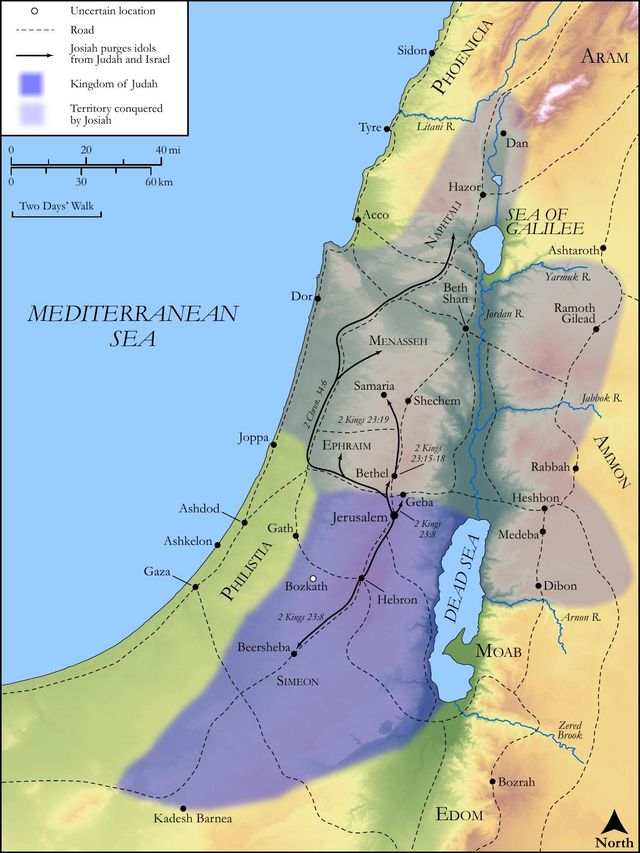
King Josiah's radical and comprehensive religious reforms are powerfully illustrated in 2 Kings 23:8. This verse details his systematic campaign to dismantle and ritually defile the "high places" of illicit worship throughout the entire kingdom of Judah, from its northern boundary at Geba to its southern extent at Beersheba. It also records his decisive action to remove the priests who ministered at these unauthorized shrines, extending his purge even to the altars found at city gates, which underscores the deep entrenchment of idolatry and syncretistic practices that permeated every aspect of Judahite society and which Josiah was determined to eradicate in his zealous pursuit of covenant fidelity.
Context
ShowHideLiterary Context
2 Kings 23:8 is strategically placed within the narrative of King Josiah's unparalleled religious revival, which commenced after the momentous discovery of the Book of the Law in the Temple during its renovation. The preceding verses, 2 Kings 23:4-7, meticulously describe Josiah's initial phase of purification, focusing on the Temple in Jerusalem and its immediate environs. This included the removal and destruction of all implements of Baal and Asherah worship, the dismantling of houses for male cult prostitutes, and the defilement of Topheth. Verse 8 marks a significant geographical expansion of these reforms, extending beyond the capital to encompass the entire territory of Judah. It specifically targets the "high places" and their associated priests, indicating a systematic and thorough dismantling of the decentralized, unauthorized worship infrastructure that had flourished for generations. This verse, therefore, represents a critical transition from cleansing the central sanctuary to purifying the entire land, demonstrating the comprehensive nature of Josiah's commitment to covenant renewal.
Historical & Cultural Context
The "high places" (Hebrew: bāmôt) were prevalent local altars or shrines, often situated on elevated sites, where various religious rites, including sacrifices, were performed. Historically, these sites became problematic because they either facilitated syncretistic practices—blending the worship of Yahweh with pagan deities like Baal and Asherah—or they simply violated the Mosaic command for a single, centralized place of worship in Jerusalem, as explicitly mandated in Deuteronomy 12:5-7. For centuries, many kings, even those considered "good," had failed to remove these high places, allowing them to become deeply ingrained in the religious landscape of Judah. The "priests" mentioned in this verse were likely those who officiated at these local high places, distinct from the legitimate Levitical priests serving at the Jerusalem Temple, or at least those who had compromised their calling by participating in unauthorized worship. Josiah's act of "defiling" these sites (Hebrew: ṭāmēʾ) was a powerful symbolic and practical gesture, rendering them ceremonially unclean and unfit for any sacred use, often by scattering human bones upon them (2 Kings 23:16), thus ensuring their permanent cessation as legitimate places of sacrifice or worship. The phrase "from Geba to Beersheba" was a well-understood geographical idiom in ancient Israel, signifying the entire north-south extent of the kingdom of Judah, emphasizing the absolute comprehensiveness of Josiah's reforms across the entire land. The presence of "high places of the gates" further highlights how deeply idolatry was woven into daily public life and civic spaces.
Key Themes
ShowHideThis verse profoundly contributes to several overarching themes within 2 Kings and the broader Deuteronomistic History. Firstly, it underscores the theme of Radical Purification and Covenant Fidelity. Josiah's actions were not superficial; they represented an uncompromising and thorough cleansing of the land from all forms of idolatry and unauthorized worship, a direct and zealous response to the rediscovered Law and a profound commitment to the covenant with Yahweh. Secondly, the verse highlights the crucial theme of the Centralization of Worship. By destroying the local high places and bringing their priests to Jerusalem, Josiah sought to enforce the biblical command for a single, central place of worship for the Lord, thereby preventing the spiritual corruption and syncretism that inevitably arose from decentralized altars. This act was paramount for maintaining the purity and singularity of Yahweh worship, as detailed throughout Deuteronomy 12. Finally, Josiah's uncompromising commitment to Obedience to God's Law is a major thematic thread. His immediate and decisive actions were a direct consequence of encountering the rediscovered Law, demonstrating a king's profound dedication to God's commands after centuries of spiritual decline. This unwavering commitment set him apart from all previous rulers, as explicitly stated in 2 Kings 23:25, portraying him as the epitome of a righteous king.
Exposition and Analysis
ShowHideKey Word Analysis
ShowHideThis verb (H2930) carries the meaning of being ceremonially unclean, polluted, or rendered unfit for sacred use. Josiah's act of "defiling" the high places was a deliberate and potent symbolic gesture. By associating these altars with ritual impurity—for instance, by scattering human bones or other unclean elements upon them, as described in 2 Kings 23:16—he rendered them unusable for any form of worship, whether pagan or syncretistic, thereby ensuring their permanent cessation as legitimate religious sites. This act went beyond mere destruction; it stripped them of any perceived sanctity and effectively desacralized them.
These (H1116) were elevated cultic sites, often on natural hills or constructed platforms, used for various religious worship practices. While some may have initially been dedicated to Yahweh, they invariably became centers for syncretistic practices, incorporating elements of Canaanite fertility cults, or were simply unauthorized alternatives to the central sanctuary in Jerusalem. Their widespread presence, "from Geba to Beersheba," underscores the pervasive nature of illicit worship throughout Judah, making their comprehensive destruction a monumental task for Josiah.
In this context, these (H3548) were likely the local priests who officiated at the high places. They were distinct from the legitimate Levitical priests serving at the Jerusalem Temple, or at least they were those who had compromised their calling by ministering at unauthorized altars. Many of these priests may have been descendants of those who served at the unauthorized altars established by Jeroboam I in the northern kingdom, or simply those who had adopted the corrupt practices prevalent in Judah. Josiah's action of bringing them "out of the cities of Judah" likely means he relocated them to Jerusalem, where they were given sustenance but forbidden from serving at the altar (2 Kings 23:9). This move was a strategic administrative measure to dismantle the personnel infrastructure supporting the high places and consolidate religious authority.
Verse Breakdown
ShowHide"And he brought all the priests out of the cities of Judah"
This initial clause details Josiah's administrative and religious centralization efforts. Rather than executing these priests, he removed them from their positions of influence within local communities. This action was designed to dismantle the personnel infrastructure that supported the high places, preventing future illicit worship and reinforcing the authority of the Jerusalem priesthood. It reflects a strategic move to consolidate religious power and practice under the legitimate Temple system.
"and defiled the high places where the priests had burned incense, from Geba to Beersheba"
This segment highlights the physical and symbolic cleansing of the land. The act of "defiling" these sites rendered them ritually impure and unusable for worship, effectively desacralizing them. The phrase "from Geba to Beersheba" functions as a merism, signifying the entire geographical breadth of Judah, from its northernmost point (Geba) to its southernmost (Beersheba). This emphasizes the comprehensive and thorough nature of Josiah's reforms, leaving no part of the kingdom untouched by his zealous purge of idolatry.
"and brake down the high places of the gates that [were] in the entering in of the gate of Joshua the governor of the city, which [were] on a man's left hand at the gate of the city"
This final, highly specific clause vividly illustrates the pervasive nature of illicit worship, even in prominent public and administrative spaces. Altars located at city gates were common in that day, serving as places for oaths, legal proceedings, and public gatherings, often incorporating religious elements. The mention of "the gate of Joshua the governor of the city" provides a precise detail, indicating a specific, prominent location within Jerusalem or a major Judahite city. The phrase "on a man's left hand at the gate of the city" offers a precise directional marker, suggesting these altars were highly visible and deeply integrated into the daily life and civic functions of the community, making their destruction a powerful statement of Josiah's unwavering resolve to purify every aspect of Judahite life.
Literary Devices
ShowHideThe text employs several literary devices to underscore the vast scope and profound significance of Josiah's reforms. The most prominent is Merism, evident in the phrase "from Geba to Beersheba," which serves as a rhetorical device to signify the totality or entirety of Judah. This effectively communicates the comprehensive and unsparing nature of Josiah's purge, indicating that no corner of the kingdom was left untouched by his zealous actions. Symbolism is also powerfully at play, with the "high places" serving as potent symbols of spiritual corruption, decentralized worship, and the nation's long-standing apostasy. Their systematic destruction symbolizes the breaking down of entrenched sin and the painstaking restoration of covenant purity. Furthermore, the highly detailed description of the "high places of the gates" and their specific location ("at the gate of Joshua the governor... on a man's left hand") adds a layer of Verisimilitude and Specificity, making the account feel remarkably immediate and tangible. This precision not only highlights how deeply ingrained idolatry was, even in public and administrative spaces, but also underscores the radical and thorough nature of Josiah's purification efforts. Finally, the narrative implicitly uses Contrast, setting Josiah's unparalleled righteousness and thoroughness against the backdrop of previous kings who either tolerated or even actively promoted such illicit practices, thereby elevating his actions as uniquely significant in Judah's history.
Theological and Thematic Connections
ShowHide2 Kings 23:8 profoundly underscores the theological truth of God's unwavering demand for exclusive worship and the severe consequences of idolatry. Josiah's actions are a direct, zealous response to the covenant stipulations, particularly the first commandment, which unequivocally prohibits having other gods before Yahweh (Exodus 20:3). The widespread nature of the high places, even at city gates, vividly reveals the deep-seated spiritual apostasy of Judah, which had effectively decentralized and corrupted the pure worship of Yahweh. Josiah's reforms, therefore, represent a national repentance and a determined return to the singular, pure worship of the Lord, emphasizing that true devotion must be undivided and solely centered on God alone, as revealed in His Law. This comprehensive cleansing highlights God's unwavering commitment to holiness and His expectation that His people reflect His character in their worship and daily lives, demanding a purity that extends from the heart to every sphere of existence.
Reflection and Application
ShowHideJosiah's zealous and comprehensive purification of Judah serves as a powerful and enduring paradigm for believers today. Just as he meticulously cleansed the land of physical idols and illicit altars, we are called to engage in a radical self-examination, identifying and "defiling" any "high places" or idols that may have subtly crept into our hearts and lives. These are not necessarily physical statues, but anything that displaces God from His rightful, central position of supreme authority and affection—be it possessions, career ambitions, relationships, self-reliance, comfort, or even good causes that become ultimate concerns, subtly competing for our ultimate devotion. This verse challenges us to pursue spiritual purity with an uncompromising commitment, ensuring that our worship is truly exclusive to the Lord and free from any contaminating influences or divided loyalties. It calls for a dismantling of personal altars of self-will and a centralization of our lives around the singular truth of God's Word, leading to wholehearted obedience and unreserved devotion that impacts every area of our existence.
Questions for Reflection
ShowHideFAQ
ShowHideWhat exactly were the "high places" and why were they so problematic?
ShowHideThe "high places" (Hebrew: bāmôt) were local altars or shrines, often built on elevated ground, used for religious worship. They were problematic for two primary reasons. First, while some may have initially been intended for the worship of Yahweh, they frequently became sites of syncretism, where the worship of God was blended with the worship of Canaanite deities like Baal and Asherah, often involving immoral practices (1 Kings 14:23). Second, and crucially, they violated God's command for a single, centralized place of worship in Jerusalem (Deuteronomy 12:5-7). God intended for His people to worship Him exclusively at the place He chose, to prevent the corruption and fragmentation of true worship. The existence of high places represented disobedience to this command and a persistent source of spiritual compromise, leading to national apostasy.
Who were the "priests" that Josiah brought out of the cities of Judah?
ShowHideThese "priests" were likely those who officiated at the illicit high places throughout Judah. They were not necessarily the legitimate Levitical priests who served at the Jerusalem Temple, or at least they were priests who had compromised their calling by ministering at unauthorized altars. Some scholars suggest they might have been descendants of the priests of the northern kingdom's idolatrous cults, or simply local religious leaders who had adopted the pervasive syncretistic practices. Josiah's action of bringing them to Jerusalem (2 Kings 23:9) was a strategic move to remove their influence from the local communities and centralize religious control. However, he did not allow them to serve at the altar in Jerusalem, only to eat unleavened bread among their brethren, effectively stripping them of their priestly function while providing for their sustenance.
Christ-Centered Fulfillment
ShowHideJosiah's radical and comprehensive cleansing of Judah, as meticulously described in 2 Kings 23:8, serves as a profound Old Testament foreshadowing of the ultimate and complete purification accomplished by Jesus Christ. Josiah, though a righteous king, could only cleanse the external structures and the physical land, removing the visible manifestations of idolatry. However, Christ, as the true and greater King, came not merely to cleanse external altars but to purify the human heart, the very source of all idolatry and sin (Mark 7:21-23). His perfect sacrifice on the cross is the ultimate "defiling" of sin's power, rendering it null and void for those who believe (Hebrews 9:26). Furthermore, just as Josiah centralized worship in Jerusalem, Christ Himself becomes the ultimate "place" of worship, the true Temple where God dwells and where all genuine worship is now offered "in spirit and truth" (John 4:21-24). Through His atoning work, Christ breaks down all spiritual "high places"—every stronghold of sin, every idol that seeks to usurp God's rightful place in our lives, and every false system of worship—and establishes His sovereign reign within the hearts of believers, creating a people purified and wholly devoted to Him (Ephesians 2:19-22). His is the final, perfect, and eternal cleansing that transforms not just a nation, but the very nature of humanity, making us fit for communion with a holy God.