


2 Kings 23:14
Bible text: King James Version (1769 Blayney text) · Public domain
Bible text: Berean Standard Bible · Public domain
Bible text: American Standard Version (1901) · Public domain
Bible text: World English Bible, Messianic edition · Public domain
Bible text: Geneva Bible (1599) · Public domain
Bible text: Young's Literal Translation · Public domain
- וְשִׁבַּרve·shi·Barand he brokeH7665Conj-w ¦ V-Piel-ConsecPerf-3msVerb Piel Consecutive Perfect 3rd Singular Masculineוְandשִׁבַּרhe broke
- אֶת'et<obj.>H853DirObjMParticle Object Indicator
- הַמַּצֵּבוֹתha·ma·tze·Votthe sacred pillarsH4676Art ¦ N-fpNoun Plural Feminine Absoluteהַtheמַּצֵּבוֹתsacred pillars
- וַיִּכְרֹתvai·yikh·Rotand he cut downH3772Conj-w ¦ V-Qal-ConsecImperf-3msVerb Qal Consecutive Imperfect 3rd Singular Masculineוַandיִּכְרֹתhe cut down
- אֶת'et<obj.>H853DirObjMParticle Object Indicator
- הָאֲשֵׁרִיםha·'a·she·Rimthe Asherah polesH842Art ¦ N-mpNoun Title Plural Masculine AbsoluteהָtheאֲשֵׁרִיםAsherah poles
- וַיְמַלֵּאvay·ma·Le'and he filledH4390Conj-w ¦ V-Piel-ConsecImperf-3msVerb Piel Consecutive Imperfect 3rd Singular Masculineוַandיְמַלֵּאhe filled
- אֶת'et<obj.>H853DirObjMParticle Object Indicator
- מְקוֹמָםme·ko·Mamtheir placeH4725N-msc ¦ 3mpNoun Singular Masculine Constructמְקוֹמָplaceםtheir
- עַצְמוֹתatz·Motbones ofH6106N-fpcNoun Plural Feminine Construct
- אָדָם'a·DamhumankindH120N-msNoun Singular Masculine Absolute
English is a literal word-by-word gloss of the Hebrew, not the KJV's wording. Why?
This is the original text the KJV's translators worked from — each Hebrew word with its own literal English meaning in this verse, prepared by scholars at Tyndale House, Cambridge. The KJV translates whole sentences, not word by word, so its wording differs: one Hebrew word can become several English words, and the KJV may choose “the LORD” where the gloss reads “Yahweh”. Both are faithful — they answer different questions. For the KJV's own rendering, switch to the KJV text.
Details
See on the biblical-era maps
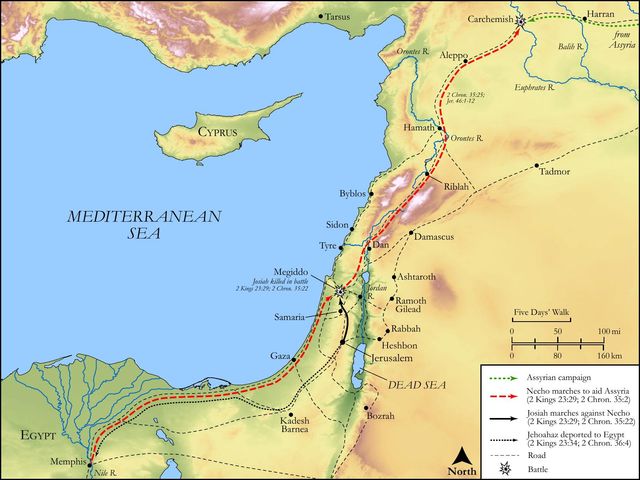
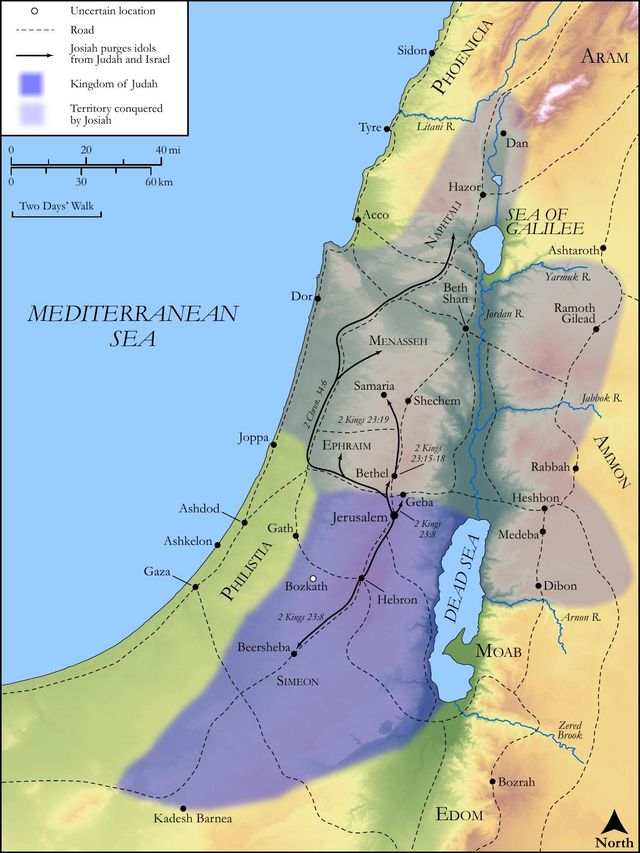
Study this verse
Public-domain commentary
Matthew Henry
From his Commentary on the Whole Bible. Henry comments on passages, not single verses — this entry covers 2 Kings 23:4–24. His three-level outline is real structure in the source text, so it is rendered as structure.
We have here an account of such a reformation as we have not met with in all the history of the kings of Judah, such thorough riddance made of all the abominable things and such foundations laid of a glorious good work; and here I cannot but wonder at two things: - 1. That so many wicked things should have got in, and kept standing so long, as we find here removed. 2. That notwithstanding the removal of these wicked things, and the hopeful prospects here given of a happy settlement, yet within a few years Jerusalem was utterly destroyed, and even this did not save it; for the generality of the people, after all, hated to be reformed. The founder melteth in vain, and therefore reprobate silver shall men call them, Jer 6:29, Jer 6:30. Let us here observe,
I.What abundance of wickedness there was, and had been, in Judah and Jerusalem.
One would not have believed it possible that in Judah, where God was known - in Israel, where his name was great - in Salem, in Sion, where his dwelling place was, such abominations should be found as here we have an account of. Josiah had now reigned eighteen years, and had himself set the people a good example, and kept up religion according to law; and yet, when he came to make inquisition for idolatry, the depth and extent of the dunghill he had to carry away appeared almost incredible.
1.Even in the house of the Lord, that sacred temple which Solomon built, and dedicated to the honour and for the worship of the God of Israel, there were found vessels, all manner of utensils, for the worship of Baal, and of the grove (or Ashtaroth), and of all the host of heaven, Kg2 23:4. Though Josiah had suppressed the worship of idols, yet the utensils made for that worship were all carefully preserved, even in the temple itself, to be used again whenever the present restraint should be taken off; nay, even the grove itself, the image of it, was yet standing in the temple (Kg2 23:6); some make it the image of Venus, the same with Ashtaroth.
2.Just at the entering in of the house of the Lord was a stable for horses kept (would you think it?) for a religious use; they were holy horses, given to the sun (Kg2 23:11), as if he needed them who rejoiceth as a strong man to run a race (Psa 19:5), or rather they would thus represent to themselves the swiftness of his motion, which they much admired, making their religion to conform to the poetical fictions of the chariot of the sun, the follies of which even a little philosophy, without any divinity, would have exposed and made them ashamed of. Some say that those horses were to be led forth in pomp every morning to meet the rising sun, others that the worshippers of the sun rode out upon them to adore the rising sun; it should seem that they drew the chariots of the sun, which the people worshipped. Strange that ever men who had the written word of God among them should be thus vain in their imaginations!
3.Hard by the house of the Lord there were houses of the Sodomites, where all manner of lewdness and filthiness, even that which was most unnatural, was practised, and under pretence of religion too, in honour of their impure deities. Corporal and spiritual whoredom went together, and the vile affections to which the people were given up were the punishment of their vain imaginations. Those that dishonoured their God were justly left thus to dishonour themselves, Rom 1:24, etc. There were women that wove hangings for the grove (Kg2 23:7), tents which encompassed the image of Venus, where the worshippers committed all manner of lewdness, and this in the house of the Lord. Those did ill that made our Father's house a house of merchandise; those did worse that made it a den of thieves; but those did worst of all that made it (Horrendum dictu! - Horrible to relate!) a brothel, in an impudent defiance of the holiness of God and of his temple. Well might the apostle call them abominable idolatries.
4.There were many idolatrous altars found (Kg2 23:12), some in the palace, on the top of the upper chamber of Ahaz. The roofs of their houses being flat, they made them their high places, and set up altars upon them (Jer 19:13; Zep 1:5), domestic altars. The kings of Judah did so: and, though Josiah never used them, yet to this time they remained there. Manasseh had built altars for his idols in the house of the Lord. When he repented he removed them, and cast them out of the city (Ch2 33:15), but, not destroying them, his son Amon, it seems, had brought them again into the courts of the temple; there Josiah found them, and thence he broke them down, Kg2 23:12.
5.There was Tophet, in the valley of the son of Hinnom, very near Jerusalem, where the image of Moloch (that god of unnatural cruelty, as others were of unnatural uncleanness) was kept, to which some sacrificed their children, burning them in the fire, others dedicated them, making them to pass through the fire (Kg2 23:10), labouring in the very fire, Hab 2:13. It is supposed to have been called Tophet from toph, a drum, because they beat drums at the burning of the children, that their shrieks might not be heard.
6.There were high places before Jerusalem, which Solomon had built, Kg2 23:13. The altars and images on those high places, we may suppose, had been taken away by some of the preceding godly kings, or perhaps Solomon himself had removed them when he became a penitent; but the buildings, or some parts of them, remained, with other high places, till Josiah's time. Those that introduce corruptions into religion know not how far they will reach nor how long they will last. Antiquity is no certain proof of verity. There were also high places all the kingdom over, from Geba to Beer-sheba (Kg2 23:8), and high places of the gates, in the entering in of the gate of the governor. In these high places (bishop Patrick thinks) they burnt incense to those tutelar gods to whom their idolatrous kings had committed the protection of their city; and probably the governor of the city had a private altar for his penates - his household-gods.
7.There were idolatrous priests, that officiated at all those idolatrous altars (Kg2 23:5), chemarim, black men, or that wore black. See Zep 1:4. Those that sacrificed to Osiris, or that wept for Tammuz (Eze 8:14), or that worshipped the infernal deities, put on black garments as mourners. These idolatrous priests the kings of Judah had ordained to burn incense in the high places; they were, it should seem, priests of the house of Aaron, who thus profaned their dignity, and there were others also who had no right at all to the priesthood, who burnt incense to Baal.
8.There were conjurers and wizards, and such as dealt with familiar spirits, Kg2 23:24. When they worshipped the devil as their god no marvel that they consulted him as their oracle.
II.What a full destruction good Josiah made of all those relics of idolatry.
Such is his zeal for the Lord of hosts, and his holy indignation against all that is displeasing to him, that nothing shall stand before him. The law was that the monuments of the Canaanites' idolatry must be all destroyed (Deu 7:5), much more those of the idolatry of the Israelites, in whom it was much more impious, profane, and perfidious.
1.He ordered Hilkiah, and the other priests, to clear the temple. This was their province, Kg2 23:4. Away with all the vessels that were made for Baal. They must never be employed in the service of God, no, nor reserved for any common use; they must all be burnt, and the ashes of them carried to Bethel. That place had been the common source of idolatry, for there was set up one of the calves, and, that lying next to Judah, the infection had thence spread into that kingdom, and therefore Josiah made it the lay-stall of idolatry, the dunghill to which he carried the filth and offscouring of all things, that, if possible, it might be made loathsome to those that had been fond of it.
2.The idolatrous priests were all put down. Those of them that were not of the house of Aaron, or had sacrificed to Baal or other false gods, he put to death, according to the law, Kg2 23:20. He slew them upon their own altars, the most acceptable sacrifice that ever had been offered upon them, a sacrifice to the justice of God. Those that were descendants from Aaron, and yet had burnt incense in the high places, but to the true God only, he forbade ever to approach the altar of the Lord; they had forfeited that honour (Kg2 23:9): He brought them out of the cities of Judah (Kg2 23:8), that they might not do mischief in the country by secretly keeping up their old idolatrous usages; but he allowed them to eat of the unleavened bread (the bread of the meat-offering, Lev 2:4, Lev 2:5) among their brethren, with whom they were to reside, that being under their eye they might be kept from doing hurt and taught to do well; that bread, that unleavened bread (heavy and unpleasant as it was), was better than they deserved, and that would serve to keep them alive. But whether they were permitted to eat of all the sacrifices, as blemished priests were (Lev 21:22), which is called, in general, the bread of their God, may be justly questioned.
3.All the images were broken to pieces and burnt. The image of the grove (Kg2 23:6), some goddess or other, was reduced to ashes, and the ashes cast upon the graves of the common people (Kg2 23:6), the common burying-place of the city. By the law a ceremonial uncleanness was contracted by the touch of a grave, so that in casting them here he declared them most impure, and none could touch them without thereby making themselves unclean. He cast it into the graves (so the Chaldee), intimating that he would have all idolatry buried out of his sight, as a loathsome thing, and forgotten, as dead men are out of mind, Kg2 23:14. He filled the places of the groves with the bones of men; as he carried the ashes of the images to the graves, to mingle them with dead men's bones, so he carried dead men's bones to the places where the images had been, and put them in the room of them, that, both ways, idolatry might be rendered loathsome, and the people kept both from the dust of the images and from the ruins of the places where they had been worshipped. Dead men and dead gods were much alike and fittest to go together.
4.All the wicked houses were suppressed, those nests of impiety that harboured idolaters, the houses of the Sodomites, Kg2 23:7. "Down with them, down with them, rase them to the foundations." The high places were in like manner broken down and levelled with the ground (Kg2 23:8), even that which belonged to the governor of the city; for no man's greatness or power may protect him in idolatry or profaneness. Let governors be obliged, in the first place, to reform, and then the governed will be the sooner influenced. He defiled the high places (Kg2 23:8 and again Kg2 23:13), did all he could to render them abominable, and put the people out of conceit with them, as Jehu did when he made the house of Baal a draught-house, Kg2 10:27. Tophet, which, contrary to other places of idolatry, was in a valley, whereas they were on hills or high places, was likewise defiled (Kg2 23:10), was made the burying-place of the city. Concerning this we have a whole sermon, Jer 19:1, Jer 19:2, etc., where it is said, They shall bury in Tophet, and the whole city is threatened to be made like Tophet.
5.The horses that had been given to the sun were taken away and put to common use, and so were delivered from the vanity to which they were made subject; and the chariots of the sun (what a pity was it that those horses and chariots should be kept as the chariots and horsemen of Israel!) he burnt with fire; and, if the sun be a flame, they never resembled him so much as they did when they were chariots of fire.
6.The workers with familiar spirits and the wizards were put away, Kg2 23:24. Those of them that were convicted of witchcraft, it is likely, he put to death, and so deterred others from those diabolical practices. In all this he had a sincere regard to the words of the law which were written in the book lately found, Kg2 23:24. He made that law his rule and kept that in his eye throughout this reformation.
III.How his zeal extended itself to the cities of Israel that were within his reach.
The ten tribes were carried captive and the Assyrian colonies did not fully people the country, so that, it is likely, many cities had put themselves under the protection of the kings of Judah, Ch2 30:1; Ch2 34:6. These he here visits, to carry on his reformation. As far as our influence goes our endeavours should go to do good and bring the wickedness of the wicked to an end.
1.He defiled and demolished Jeroboam's altar at Bethel, with the high place and the grove that belonged to it, Kg2 23:15, Kg2 23:16. The golden calf, it should seem, was gone (thy calf, O Samaria! has cast thee off), but the altar was there, which those that were wedded to their old idolatries made use of still. This was,
(1.)Defiled, Kg2 23:16. Josiah, in his pious zeal, was ransacking the old seats of idolatry, and spied the sepulchres in the mount, in which probably the idolatrous priests were buried, not far from the altar at which they had officiated, and which they were so fond of that they were desirous to lay their bones by it; these he opened, took out the bones, and burnt them upon the altar, to show that thus he would have done by the priests themselves if they had been alive, as he did by those whom he found alive, Kg2 23:20. Thus he polluted the altar, desecrated it, and made it odious. It is threatened against idolaters (Jer 8:1, Jer 8:2) that their bones shall be spread before the sun; that which is there threatened and this which is here executed (bespeaking their iniquity to be upon their bones, Eze 32:27) are an intimation of a punishment after death, reserved for those that live and die impenitent in that or any other sin; the burning of the bones, if that were all, is a small matter, but, if it signify the torment of the soul in a worse flame (Luk 16:24), it is very dreadful. This, as it was Josiah's act, seems to have been the result of a very sudden resolve; he would not have done it but that he happened to turn himself, and spy the sepulchres; and yet it was foretold above 350 years before, when this altar was first built by Jeroboam, Kg1 13:2. God always foresees, and has sometimes foretold as certain, that which yet to us seems most contingent. The king's heart is in the hand of the Lord; king Josiah's was so, and he turned it (or ever he himself was aware, Sol 6:12) to do this. No work of God shall fall to the ground.
(2.)It was demolished. He broke down the altar and all its appurtenances (Kg2 23:15), burnt what was combustible, and, since an idol is nothing in the world, he went as far towards the annihilating of it as he could; for he stamped it small to powder and made it as dust before the wind.
2.He destroyed all the houses of the high places, all those synagogues of Satan that were in the cities of Samaria, Kg2 23:19. These the kings of Israel built, and God raised up this king of Judah to pull them down, for the honour of the ancient house of David, from which the ten tribes had revolted; the priests he justly made sacrifices upon their own altars, Kg2 23:20.
3.He carefully preserved the sepulchre of that man of God who came from Judah to foretel this, which now a king who came from Judah executed. This was that good prophet who proclaimed these things against the altar of Bethel, and yet was himself slain by a lion for disobeying the word of the Lord; but to show that God's displeasure against him went no further than his death, but ended there, God so ordered it that when all the graves about his were disturbed his was safe (Kg2 23:17, Kg2 23:18) and no man moved his bones. He had entered into peace, and therefore should rest in his bed, Isa 57:2. The old lying prophet, who desired to be buried as near him as might be, it should seem, knew what he did; for his dust also, being mingled with that of the good prophet, was preserved for his sake; see Num 23:10.
IV.We are here told what a solemn passover Josiah and his people kept after all this.
When they had cleared the country of the old leaven they then applied themselves to the keeping of the feast. When Jehu had destroyed the worship of Baal, yet he took no heed to walk in the commandments and ordinances of God; but Josiah considered that we must learn to do well, and no only cease to do evil, and that the way to keep out all abominable customs is to keep up all instituted ordinances (see Lev 18:30), and therefore he commanded all the people to keep the passover, which was not only a memorial of their deliverance out of Egypt, but a token of their dedication to him that brought them out and their communion with him. This he found written in the book of the law, here called the book of the covenant; for, though the divine authority may deal with us in a way of absolute command, divine grace condescends to federal transactions, and therefore he observed it. We have not such a particular account of this passover as of that in Hezekiah's time, 2 Chr. 30. But, in general, we are told that there was not holden such a passover in any of the foregoing reigns, no, not from the days of the judges (Kg2 23:22), which, by the way, intimates that, though the account which the book of Judges gives of the state of Israel under that dynasty looks but melancholy, yet there were then some golden days. This passover, it seems, was extraordinary for the number and devotion of the communicants, their sacrifices and offerings, and their exact observance of the laws of the feast; and it was not now as in Hezekiah's passover, when many communicated that were not cleansed according to the purification of the sanctuary, and the Levites were permitted to do the priests' work. We have reason to think that during all the remainder of Josiah's reign religion flourished and the feasts of the Lord were very carefully observed; but in this passover the satisfaction they took in the covenant lately renewed, the reformation in pursuance of it, and the revival of an ordinance of which they had lately found the divine original in the book of the law, and which had long been neglected or carelessly kept, put them into great transports of holy joy; and God was pleased to recompense their zeal in destroying idolatry with uncommon tokens of his presence and favour. All this concurred to make it a distinguished passover.
Historical interpretation
Historical reception
1 surviving comment on this verse from the historical church.
“No one would make a son or a daughter pass through fire.” The passage through fire is the symbol of combustion. In fact, the demons demanded that [their worshipers] burn their own children, and sometimes they were immolated, sometimes they only underwent the symbolic rite mentioned above, as if they had been actually placed into the fire and consumed, and so the expectations of the demons were satisfied. Sometimes fire was also passed above somebody to signify that he was by now enveloped in fire. Then salt was thrown, too, according to the customs of those who worship the devil.
Continue studying 2 Kings 23:14 across the web’s major study libraries — every link below opens this exact verse, chapter, or book on the destination site.
Read & Compare
 BibleGatewayThis verse in more than 200 translations and 70 languages.
 Bible.comThe YouVersion reader — hundreds of translations, reading plans, and highlights.
 ESV.orgCrossway's official English Standard Version reader.
 NET BibleThe NET translation with 60,000+ translators' notes on every rendering decision.
 STEP BibleTyndale House's free study tool — original text, vocabulary, and scholarly resources.
 BibliaLogos Bible Software's free web reader.
 USCCBThe New American Bible (Revised Edition) with the U.S. bishops' study notes.
Commentaries
 BibleHub CommentariesDozens of classic commentaries on this verse, gathered on one page.
 StudyLightMore than 100 commentary sets — the largest collection on the web.
 BibleRefPlain-English commentary on what this verse means, verse by verse.
 Enduring WordDavid Guzik's free commentary on this chapter, widely used by Bible teachers.
 Bible Study ToolsVerse commentary alongside Greek and Hebrew study aids.
Original Language & Research
- BibleHub InterlinearThe verse word by word — original language, transliteration, and English.
- BibleHub LexiconEvery word's original-language definition and Strong's entry.
 Blue Letter BibleDeep-study tools — Strong's numbers, concordance, and word studies.
 SefariaThe Hebrew text with Rashi and centuries of Jewish commentary.
Sermons, Hymns & Audio


TrulyRandomVerse is not affiliated with these sites and doesn’t control their content. They’re linked because they’re genuinely useful.
Summary
King Josiah's reign marked a profound turning point for Judah, as he embarked on an unprecedented campaign of religious purification. This verse vividly describes his radical actions against the deeply entrenched idolatry throughout the land, detailing his ruthless destruction of pagan cult objects—specifically "images" and "groves"—and the extreme measure of defiling these sites by scattering human bones upon them. This act of desecration rendered the locations ritually unclean and unusable for future pagan worship, underscoring Josiah's unwavering commitment to restore exclusive devotion to Yahweh and eradicate all traces of syncretism from Judah.
Context
ShowHideLiterary Context
2 Kings 23:14 is situated within the comprehensive account of King Josiah's sweeping religious reforms, which began in earnest following the discovery of the Book of the Law in the Temple (likely a portion of Deuteronomy) as recorded in 2 Kings 22:8. The preceding verses (2 Kings 23:4-13) detail Josiah's systematic dismantling of idolatrous practices and objects within Jerusalem and the surrounding cities of Judah, including the defilement of the Topheth in the Valley of Hinnom and the destruction of altars built by previous kings. Verse 14 specifically describes the thoroughness of his actions against the physical structures of idolatry, emphasizing the complete obliteration and ritual defilement of these pagan worship sites, setting the stage for his further actions against the altar at Bethel, which held prophetic significance (2 Kings 23:15-20).
Historical & Cultural Context
Josiah reigned over Judah from 640 to 609 BC, a period marked by the decline of the mighty Assyrian Empire, which had previously exerted significant control over Judah. This decline created a window of opportunity for Judah to reassert its independence and, for Josiah, to undertake radical religious reforms without significant external interference. For generations, under kings like Manasseh and Amon, Judah had plunged into deep idolatry, adopting Canaanite practices such as Baal worship, Asherah cults, and astral worship, often involving child sacrifice and cultic prostitution. "Images" (matstsêbôt) were standing stone pillars, often associated with Baal worship, while "groves" (ʾăšērîm) referred to wooden poles or sacred trees dedicated to Asherah, a prominent Canaanite fertility goddess. The act of scattering human bones, particularly from graves, on these "sacred" pagan sites was the ultimate act of ritual defilement, rendering them utterly unclean and unfit for any religious ceremony, thereby making it impossible for idolaters to reuse them.
Key Themes
ShowHideThis verse powerfully contributes to several overarching themes within 2 Kings and the broader Deuteronomistic History. Firstly, it highlights the theme of Radical Purity and Exclusive Worship, demonstrating Josiah's uncompromising commitment to the first commandment, which demands exclusive devotion to Yahweh, as articulated in Exodus 20:3. His actions were not superficial but aimed at complete eradication of idolatry. Secondly, it underscores the theme of Fulfillment of Prophecy, as Josiah's defilement of the altar at Bethel by burning human bones on it (mentioned in the subsequent verses) directly fulfills a prophecy made centuries earlier by a man of God against King Jeroboam I in 1 Kings 13:2. This demonstrates God's sovereignty over history and His unwavering commitment to His word. Lastly, the severity of Josiah's actions reflects God's Jealousy for His Worship and His absolute intolerance for idolatry and syncretism, emphasizing the covenantal demand for faithfulness that runs throughout the narrative of Israel's kings.
Exposition and Analysis
ShowHideKey Word Analysis
ShowHideThis term refers to "something stationed," specifically a standing column or memorial stone, which by analogy came to denote an idol. These were stone pillars often erected as cultic symbols or altars in pagan worship, particularly associated with Baal. While sometimes used legitimately (e.g., Jacob's pillar in Genesis 28:18), in the context of idolatry, such pillars were explicitly forbidden by the Mosaic Law (e.g., Deuteronomy 16:22). Josiah's act of "breaking in pieces" signifies a complete and irreversible destruction, dismantling the very structures of false worship.
This term denotes Asherah (or Astarte), a Phoenician goddess, and also refers to an image of the same, often a wooden pole or sacred tree. These "groves" were cultic poles or sacred trees dedicated to Asherah, the Canaanite goddess of fertility and consort of Baal. The worship of Asherah often involved immoral and perverse practices, making the eradication of these "groves" a crucial step in purifying the land from spiritual and moral corruption. "Cutting down" these poles was a direct act of obedience to God's command to destroy all pagan symbols (e.g., Deuteronomy 7:5).
Meaning "a bone (as strong)," by extension referring to the body or, figuratively, the substance itself. In this context, it refers to human skeletal remains. The use of human bones, particularly from graves (as clarified in subsequent verses, often from the graves of idolaters or priests of Baal), was the ultimate act of ritual defilement in ancient Israelite culture.
Meaning "a human being" (an individual or the species, mankind). Here, it specifies that the bones were human. Contact with a corpse or human bones rendered a person or place ritually unclean (e.g., Numbers 19:16). By scattering human bones on pagan altars and sites, Josiah made them utterly impure and unusable for any religious ceremony, effectively nullifying their perceived sacredness and making it impossible for idolaters to reuse them.
Verse Breakdown
ShowHide"And he brake in pieces the images"
This clause describes Josiah's active and forceful destruction of the stone pillars or monuments associated with pagan deities. His actions were not merely removal but a violent dismantling, signifying a complete rejection of their spiritual power and a commitment to their permanent eradication from the land. This act was a direct assault on the physical representations of false gods.
"and cut down the groves"
Following the destruction of the stone images, Josiah turned his attention to the wooden Asherah poles. The verb "cut down" implies a deliberate felling and removal, symbolizing the severing of the connection to the Canaanite fertility cults that had permeated Judah. This was a direct assault on the symbols of a false god, rendering them inert and powerless and demonstrating a thoroughness in his cleansing efforts.
"and filled their places with the bones of men"
This final clause details the most extreme and irreversible act of defilement. By scattering human bones on the sites where the images and groves once stood, Josiah rendered these places ritually unclean and abhorrent according to Israelite law. This made it impossible for anyone to worship there without incurring severe ritual impurity, effectively making the sites unusable for any future pagan rituals and serving as a powerful, visual declaration of Yahweh's triumph over false gods and the utter profanation of what was once deemed sacred by idolaters.
Literary Devices
ShowHideThe verse employs several potent literary devices to convey the thoroughness and significance of Josiah's actions. Parallelism is evident in the repeated structure of destructive verbs ("brake in pieces," "cut down," "filled their places") followed by the objects of destruction ("images," "groves," "bones of men"), emphasizing the systematic and comprehensive nature of his reforms. Symbolism is central, with the "images" and "groves" symbolizing the pervasive idolatry that had defiled the land, and the "bones of men" symbolizing ultimate ritual impurity and the utter desecration of pagan sacred spaces. The act of filling the places with bones also carries an element of hyperbole or extreme action, underscoring the radical and uncompromising nature of Josiah's commitment to purification. Furthermore, this verse, especially when read in conjunction with the subsequent verses, serves as a powerful instance of fulfillment of prophecy, directly linking Josiah's actions to the ancient word spoken by the man of God in 1 Kings 13.
Theological and Thematic Connections
ShowHideJosiah's actions in 2 Kings 23:14 are a profound demonstration of God's demand for exclusive worship and the severe consequences of idolatry. The meticulous destruction and defilement of pagan sites reflect God's absolute holiness and His jealousy for His name, emphasizing that He will not share His glory with idols. This passage serves as a vivid illustration of covenant faithfulness, where a king, upon discovering the Law, responds with zealous obedience to purge the land of everything that offends God. It underscores the principle that true spiritual renewal requires not just the removal of evil, but its utter defilement and rendering unusable, ensuring no return to former practices. This radical purity points to the uncompromising nature of God's call for His people to be set apart, a call rooted in His own perfect character.
Reflection and Application
ShowHideJosiah's radical purification of Judah serves as a powerful and challenging paradigm for believers today. Just as he meticulously identified and destroyed the physical manifestations of idolatry in his kingdom, we are called to engage in a thorough and uncompromising spiritual cleansing of our own lives. This involves honestly examining our hearts to identify any "images" or "groves"—anything that competes for God's rightful place on the throne of our lives, whether it be materialism, career, relationships, self-image, comfort, or even spiritual disciplines performed for self-glory. True spiritual purity demands not just the removal of these idols but their complete defilement, rendering them unusable and undesirable in our lives, making a decisive break from anything that hinders our exclusive devotion to Christ. This passage encourages a zealous, wholehearted commitment to obedience to God's Word, trusting in His power to help us purge all that is impure and to live a life fully dedicated to Him, reflecting His holiness in every sphere.
Questions for Reflection
ShowHideFAQ
ShowHideWhy was the scattering of human bones considered the ultimate act of defilement?
ShowHideIn ancient Israelite culture, contact with a dead body or human bones rendered a person or place ritually unclean according to Mosaic Law (e.g., Numbers 19:16). This impurity was not merely ceremonial but also had profound spiritual implications, making the person or object unfit for worship or presence in the tabernacle/temple. By scattering human bones, particularly from graves (often of idolaters or pagan priests, as implied in subsequent verses like 2 Kings 23:20), on the pagan altars and worship sites, Josiah made these locations utterly abhorrent and ritually unusable for any religious ceremony. This was a powerful, irreversible statement of desecration, ensuring that no one could worship there without incurring severe impurity, thereby nullifying the perceived sacredness of these pagan places.
What was the specific significance of "images" and "groves" in the context of Canaanite worship?
ShowHide"Images" (Hebrew: matstsêbôt) were typically standing stone pillars or monuments, often associated with male deities like Baal, serving as cultic symbols or altars representing the presence or power of the deity. "Groves" (Hebrew: ʾăshērîm) were wooden poles or sacred trees dedicated to Asherah, a prominent Canaanite fertility goddess and consort of Baal. These were central to fertility cults that often involved ritual prostitution and other immoral practices, directly violating God's commands against idolatry and syncretism. Josiah's destruction of both types of objects was a comprehensive attack on the core symbols and practices of the pagan religions that had corrupted Judah, fulfilling the commands found in passages like Deuteronomy 12:3.
How did Josiah's actions in this verse relate to the broader commands given in the Law of Moses?
ShowHideJosiah's actions were a direct and zealous fulfillment of the commands given in the Law of Moses concerning the destruction of idolatry. Passages like Exodus 23:24 and Deuteronomy 7:5 explicitly commanded Israel to "break down their altars, and dash in pieces their images, and cut down their groves." Josiah's thoroughness, including the extreme defilement with bones, went beyond mere removal; it ensured that these sites could not be reused, reflecting the spirit of God's absolute intolerance for idolatry. His reforms were a profound act of covenant renewal, restoring Judah, at least temporarily, to the exclusive worship of Yahweh as stipulated in the covenant.
Christ-Centered Fulfillment
ShowHideKing Josiah's radical cleansing of Judah, as described in 2 Kings 23:14, serves as a powerful Old Testament type foreshadowing the ultimate and complete spiritual purification brought about by Jesus Christ. Josiah, a righteous king, purged the physical land of its idols and defiled their places, but his work was limited to external ritual purity and a temporary restoration of covenant faithfulness. Christ, the true and greater King, accomplishes a far more profound cleansing. He does not merely break down physical images or cut down groves, but He purifies the human heart, the very seat of idolatry, from the inside out (Mark 7:21-23). Through His atoning sacrifice on the cross, Jesus became the ultimate "defilement" for our sin, taking upon Himself the impurity of the world so that we might be made truly clean and righteous before God (2 Corinthians 5:21). His resurrection ensures that the "places" of our former spiritual bondage are not merely emptied but are filled with the life-giving Spirit, making us new creations (Romans 8:11). Just as Josiah made pagan sites unusable, Christ's victory over sin and death renders the power of idolatry and evil ineffective for those who are in Him, establishing a kingdom of righteousness where God alone is worshipped in Spirit and truth (John 4:24).