


Numbers 19:16
- וְכֹלve·Kholand everyH3605Conj-w ¦ N-msNoun Singular Masculine Absoluteוְandכֹלevery
- אֲשֶׁר'a·Sher[one] whoH834RelParticle Relative
- יִגַּעyi·Ga'he will touchH5060V-Qal-Imperf-3msVerb Qal Imperfect 3rd Singular Masculine
- עַל'alonH5921PrepPreposition
- פְּנֵיpe·Nei[the] face ofH6440N-mpcNoun Plural Masculine Construct
- הַשָּׂדֶהha·sa·Dehthe fieldH7704Art ¦ N-msNoun Singular Masculine Absoluteהַtheשָּׂדֶהfield
- בַּחֲלַלba·cha·lal<in> [one] slain ofH2491Prep-b ¦ Adj-mscAdjective Singular Masculine Constructבַּ<in>חֲלַל[one] slain of
- חֶרֶבche·reva swordH2719N-fsNoun Singular Feminine Absolute
- אוֹ'oorH176ConjConjunction
- בְמֵתve·Met<in> a dead [body]H4191Prep-b ¦ V-Qal-Prtcpl-msVerb Qal Participle Singular Masculine Absoluteבְ<in>מֵתa dead [body]
- אוֹ'ovorH176ConjConjunction
- בְעֶצֶםve·'E·tzem<in> a bone ofH6106Prep-b ¦ N-fscNoun Singular Feminine Constructבְ<in>עֶצֶםa bone of
- אָדָם'a·Dama humanH120N-msNoun Singular Masculine Absolute
- אוֹ'oorH176ConjConjunction
- בְקָבֶרve·Ka·ver<in> a graveH6913Prep-b ¦ N-msNoun Singular Masculine Absoluteבְ<in>קָבֶרa grave
- יִטְמָאyit·Ma'he will be uncleanH2930V-Qal-Imperf-3msVerb Qal Imperfect 3rd Singular Masculine
- שִׁבְעַתshiv·'AtsevenH7651Adj-cscAdjective Numerical Singular common gender Construct
- יָמִיםya·MimdaysH3117N-mpNoun Plural Masculine Absolute
English is a literal word-by-word gloss of the Hebrew, not the KJV's wording. Why?
This is the original text the KJV's translators worked from — each Hebrew word with its own literal English meaning in this verse, prepared by scholars at Tyndale House, Cambridge. The KJV translates whole sentences, not word by word, so its wording differs: one Hebrew word can become several English words, and the KJV may choose “the LORD” where the gloss reads “Yahweh”. Both are faithful — they answer different questions. For the KJV's own rendering, switch to the KJV text.
Details
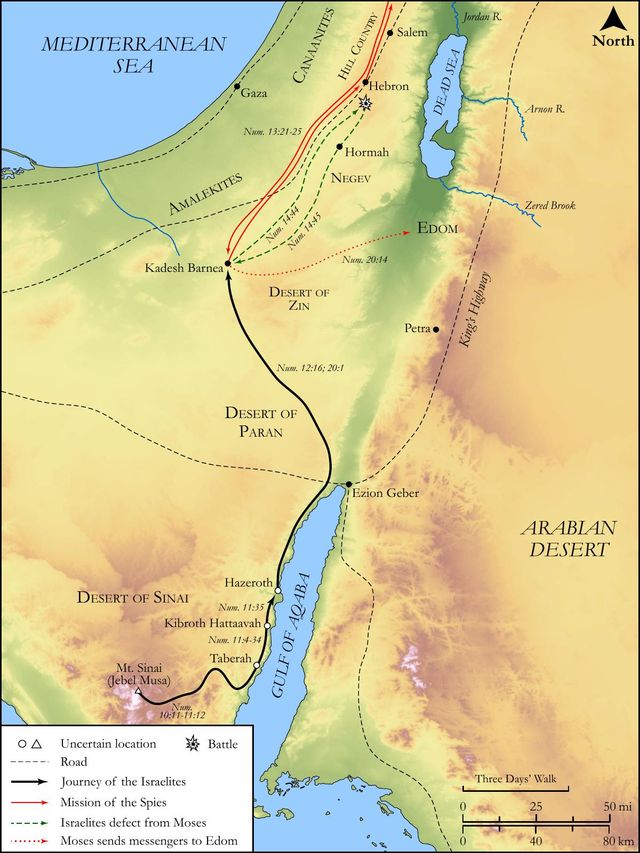
See on the biblical-era map
Study this verse
Public-domain commentary
Matthew Henry
From his Commentary on the Whole Bible. Henry comments on passages, not single verses — this entry covers Numbers 19:11–22. His three-level outline is real structure in the source text, so it is rendered as structure.
Directions are here given concerning the use and application of the ashes which were prepared for purification. they were laid up to be laid out; and therefore, though now one place would serve to keep them in, while all Israel lay so closely encamped, yet it is probable that afterwards, when they came to Canaan, some of these ashes were kept in every town, for there would be daily use for them. Observe,
I.In what cases there needed a purification with these ashes.
No other is mentioned here than the ceremonial uncleanness that was contracted by the touch of a dead body, or of the bone or grave of a dead man, or being in the tent or house where a dead body lay, Num 19:11, Num 19:14-16. This I look upon to have been one of the greatest burdens of the ceremonial law, and one of the most unaccountable. He that touched the carcase of an unclean beast, or any living man under the greatest ceremonial uncleanness, was made unclean by it only till the evening, and needed only common water to purify himself with; but he that came near the dead body of man, woman, or child, much bear the reproach of his uncleanness seven days, must twice be purified with the water of separation, which he could not obtain without trouble and charge, and till he was purified must not come near the sanctuary upon pain of death.
1.This was strange, considering, (1.) that whenever any died (and we are in deaths oft) several persons must unavoidable contract this pollution, the body must be stripped, washed, wound up, carried out, and buried, and this could not be done without many hands, and yet all defiled, which signifies that in our corrupt and fallen state there is none that lives and sins not; we cannot avoid being polluted by the defiling world we pass through, and we offend daily, yet the impossibility of our being sinless does not make sin the less polluting. (2.) that taking care of the dead, to see them decently buried, is not only necessary, but a very good office, and an act of kindness, both to the honour of the dead and the comfort of the living, and yet uncleanness was contracted by it, which intimates that the pollutions of sin mix with and cleave to our best services. There is not a just man upon earth that doeth good and sinneth not; we are apt some way or other to do amiss even in our doing good. (3.) That this pollution was contracted by what was done privately in their own houses, which intimates (as bishop Patrick observes) that God sees what is done in secret, and nothing can be concealed from the divine Majesty. (4.) This pollution might be contracted, and yet a man might never know it, as by the touch of a grave which appeared not, of which our Saviour says, Those that walk over it are not aware of it (Luk 11:44), which intimates the defilement of the conscience by sins of ignorance, and the cause we have to cry out, "Who can understand his errors?" and to pray, "Cleanse us from secret faults, faults which we ourselves do not see ourselves guilty of."
2.But why did the law make a dead corpse such a defiling thing?
(1.)Because death is the wages of sin, entered into the world by it, and reigns by the power of it. Death to mankind is another thing from what it is to other creatures: it is a curse, it is the execution of the law, and therefore the defilement of death signifies the defilement of sin.
(2.)Because the law could not conquer death, nor abolish it and alter the property of it, as the gospel does by bringing life and immortality to light, and so introducing a better hope. Since our Redeemer was dead and buried, death is no more destroying to the Israel of God, and therefore dead bodies are no more defiling; but while the church was under the law, to show that it made not the comers thereunto perfect, the pollution contracted by dead bodies could not but form in their minds melancholy and uncomfortable notions concerning death, while believers now through Christ can triumph over it. O grave! where is thy victory? Where is thy pollution?
II.How the ashes were to be used and applied in these cases.
1.A small quantity of the ashes must be put into a cup of spring water, and mixed with the water, which thereby was made, as it is here called, a water of separation, because it was to be sprinkled on those who were separated or removed from the sanctuary by their uncleanness. As the ashes of the heifer signified the merit of Christ, so the running water signified the power and grace of the blessed Spirit, who is compared to rivers of living water; and it is by his operation that the righteousness of Christ is applied to us for our cleansing. Hence we are said to be washed, that is, sanctified and justified, not only in the name of the Lord Jesus, but by the Spirit of our God, Co1 6:11; Pe1 1:2. Those that promise themselves benefit by the righteousness of Christ, while they submit not to the grace and influence of the Spirit, do but deceive themselves, for we cannot put asunder what God has joined, nor be purified by the ashes otherwise than in the running water.
2.This water must be applied by a bunch of hyssop dipped in it, with which the person or thing to be cleansed must be sprinkled (Num 19:18), in allusion to which David prays, Purge me with hyssop. Faith is the bunch of hyssop wherewith the conscience is sprinkled and the heart purified. Many might be sprinkled at once, and the water with which the ashes were mingled might serve for many sprinklings, till it was all spent; and a very little lighting upon a man served to purify him, if done with that intention. In allusion to this application of the water of separation by sprinkling, the blood of Christ is said to be the blood of sprinkling (Heb 12:24), and with it were are said to be sprinkled from an evil conscience (Heb 10:22), that is, we are freed from the uneasiness that arises from a sense of our guilt. And it is foretold that Christ, by his baptism, shall sprinkle many nations, Isa 52:15.
3.The unclean person must be sprinkled with this water on the third day after his pollution, and on the seventh day, Num 19:12-19. The days were reckoned (we may suppose) from the last time of his touching or coming near the dead body; for he would not begin the days of his cleansing while he was still under a necessity of repeating the pollution; but when the dead body was buried, so that there was no further occasion of meddling with it, then he began to reckon his days. Then, and then only, we may with comfort apply Christ's merit to our souls, when we have forsaken sin, and cease all fellowship with the unfruitful works of death and darkness. The repetition of the sprinkling teaches us often to renew the actings of repentance and faith, wash as Naaman, seven times; we need to do that often which is so necessary to be well done.
4.Though the pollution contracted was only ceremonial, yet the neglect of the purification prescribed would turn into moral guilt: He that shall be unclean and shall not purify himself, that soul shall be cut off, Num 19:20. Note, It is a dangerous thing to contemn divine institutions, though they may seem minute. A slight wound, if neglected, may prove fatal; a sin we call little, if not repented of, will be our ruin, when great sinners that repent shall find mercy. Our uncleanness separates us from God, but it is our being unclean and not purifying ourselves that will separate us for ever from him: it is not the wound that is fatal, so much as the contempt of the remedy.
5.Even he that sprinkled the water of separation, or touched it, or touched the unclean person, must be unclean till the evening, that is, must not come near the sanctuary on that day, Num 19:21, Num 19:22. Thus God would show them the imperfection of those services, and their insufficiency to purify the conscience, that they might look for the Messiah, who in the fulness of time should by the eternal Spirit offer himself without spot unto God, and so purge our consciences from dead works (that is, from sin, which defiles like a dead body, and is therefore called a body of death), that we may have liberty of access to the sanctuary, to serve the living God with living sacrifices.
Continue studying Numbers 19:16 across the web’s major study libraries — every link below opens this exact verse, chapter, or book on the destination site.
Read & Compare
 BibleGatewayThis verse in more than 200 translations and 70 languages.
 Bible.comThe YouVersion reader — hundreds of translations, reading plans, and highlights.
 ESV.orgCrossway's official English Standard Version reader.
 NET BibleThe NET translation with 60,000+ translators' notes on every rendering decision.
 STEP BibleTyndale House's free study tool — original text, vocabulary, and scholarly resources.
 BibliaLogos Bible Software's free web reader.
 USCCBThe New American Bible (Revised Edition) with the U.S. bishops' study notes.
Commentaries
 BibleHub CommentariesDozens of classic commentaries on this verse, gathered on one page.
 StudyLightMore than 100 commentary sets — the largest collection on the web.
 BibleRefPlain-English commentary on what this verse means, verse by verse.
 Enduring WordDavid Guzik's free commentary on this chapter, widely used by Bible teachers.
 Bible Study ToolsVerse commentary alongside Greek and Hebrew study aids.
Original Language & Research
- BibleHub InterlinearThe verse word by word — original language, transliteration, and English.
- BibleHub LexiconEvery word's original-language definition and Strong's entry.
 Blue Letter BibleDeep-study tools — Strong's numbers, concordance, and word studies.
 SefariaThe Hebrew text with Rashi and centuries of Jewish commentary.
Sermons, Hymns & Audio


TrulyRandomVerse is not affiliated with these sites and doesn’t control their content. They’re linked because they’re genuinely useful.
Summary
Numbers 19:16 meticulously outlines various forms of contact with death that render an individual ritually unclean for seven days, a crucial aspect of Israel's purity laws. This verse, embedded within the broader ordinance of the red heifer, highlights the profound defilement associated with death under the Mosaic covenant, necessitating a prescribed purification process to restore ritual purity and enable participation in the holy community and worship.
Context
ShowHideLiterary Context
Numbers 19:16 is an integral component of the detailed legislation concerning ritual defilement by death, which constitutes the central theme of Numbers 19. The chapter commences with the elaborate ritual of the red heifer, whose ashes, when mixed with living water, form the "water of purification" (or "water of impurity," mei niddah). This unique purification rite was divinely ordained specifically for cleansing those defiled by contact with a corpse. Verse 16 then precisely enumerates several common scenarios of such defilement, including touching a person slain by a sword, a general dead body, human bones, or a grave. These regulations immediately follow the dramatic account of Korah's rebellion and the subsequent divine plague, events that underscored the extreme seriousness of unauthorized approaches to God's holiness and the dire consequences of sin and death within the Israelite camp. Thus, the laws in Numbers 19 serve as a vital practical means to maintain the sanctity and purity of the Israelite encampment, where the holy Tabernacle and God's manifest presence resided, ensuring that the people remained ritually fit to dwell in His presence.
Historical & Cultural Context
In ancient Israel, the concept of ritual purity was of paramount importance, intricately woven into their understanding of God's absolute holiness and His dwelling amidst His people. Unlike moral impurity, ritual impurity was not inherently sinful but rather a temporary state that rendered an individual unfit for participation in sacred activities, for entering the Tabernacle precincts, or for partaking in communal worship. Death, being the ultimate antithesis of life—which is inherently derived from God and is His sacred gift—was considered the most potent source of ritual defilement. This perspective was not unique to Israel, as death was often associated with chaos and the underworld in the broader ancient Near East. However, for the Israelites, defilement by death was not rooted in a superstitious fear of spirits but stemmed from the profound theological truth that death is a direct consequence of sin and an unnatural intrusion into God's perfect creation. The elaborate purification rituals, including the prescribed seven-day period of uncleanness, were designed to impress upon the people the gravity of death's defiling power and the meticulous standards required for a holy people to commune with a holy God.
Key Themes
ShowHideNumbers 19:16 powerfully contributes to several overarching themes within the book of Numbers and the Pentateuch. Foremost among these is the theme of God's Absolute Holiness and Pervasive Human Impurity. The meticulous nature of these purity laws underscores God's unblemished purity and His utter intolerance of anything associated with corruption, decay, or death. This stands in stark contrast to humanity's pervasive susceptibility to defilement, emphasizing the constant need for divine provision for cleansing. Another critical theme is the Sanctity of Life and the Abhorrence of Death. Life is presented as a sacred gift from God, and death, as its antithesis, is ritually defiling, pointing to its unnaturalness and its origin in the fall. This theological truth is echoed throughout the narrative of the wilderness journey, where death is frequently depicted as a consequence of disobedience, notably seen in the fate of the generation that rebelled at Kadesh Barnea. Finally, the verse highlights the Indispensability of Atonement and Purification. The detailed instructions for cleansing, particularly through the unique water of purification, profoundly point to the necessity of a divinely ordained means to bridge the chasm between human impurity and divine holiness, a theme profoundly developed in Leviticus 16 and ultimately fulfilled in the person and work of Jesus Christ.
Exposition and Analysis
ShowHideKey Word Analysis
ShowHideThis verb signifies direct physical contact, ranging from a gentle touch to a violent strike. In the context of Numbers 19:16, it emphasizes that even incidental or unintentional contact with sources of death brings about ritual defilement. The broad semantic range of nâgaʻ' underscores the pervasive nature of death's defiling power, requiring meticulous avoidance or prescribed purification.
Derived from a root meaning "to pierce," this term specifically refers to someone who has been pierced or wounded, often to death. It denotes a person who has died violently, particularly by a weapon like a sword, as specified in the verse. The inclusion of "slain" highlights a specific, perhaps more shocking, form of death that carries the same defiling power as a natural death, emphasizing that the state of death, not merely its cause, is the source of impurity.
This primitive root describes a state of ritual impurity or defilement, distinct from moral sin. It signifies being ceremonially contaminated, rendering an individual unfit for participation in sacred rites, for entering the Tabernacle, or for full interaction within the holy community. The state of ṭâmêʼ' required a specific, divinely prescribed purification process to be reversed, indicating a temporary but significant disruption in one's ritual standing before God and the community.
Verse Breakdown
ShowHide"And whosoever toucheth one that is slain with a sword in the open fields"
This clause initiates the list of defiling contacts, specifically addressing the scenario of encountering a person who has died violently, particularly by a sword, and whose body lies exposed. The phrase "in the open fields" suggests an unburied body, which would be an especially potent source of defilement and often a sign of disorder, judgment, or lack of proper burial. The emphasis is on direct physical contact with such a corpse.
"or a dead body"
This phrase expands the scope of defilement to include any human corpse, regardless of the cause or location of death. This broad inclusion underscores that death itself, in any form, is the source of ritual defilement, not just specific or violent circumstances. It establishes a general rule that encompasses all human remains.
"or a bone of a man"
This specifies that even partial human remains, such as a single bone, carry the same defiling power as a complete corpse. This detail highlights the extreme potency of death's defilement and the meticulousness of the purity laws, leaving no room for ambiguity regarding contact with any part of human remains. It demonstrates the pervasive nature of death's impurity.
"or a grave"
Touching a grave implies contact with the place where a deceased person is interred, even if not directly touching the body or bones themselves. This extends the defilement to the very place associated with death, reinforcing the pervasive nature of its impurity. Practically, it also served as a crucial warning in a land where unmarked graves could be common, preventing accidental defilement.
"shall be unclean seven days"
This final clause states the universal consequence for any of the preceding forms of contact. The individual enters a state of ritual impurity for a full week. During this period, they are separated from the community's sacred activities and must undergo the prescribed purification rites involving the water of purification, emphasizing the thoroughness required for spiritual and communal restoration.
Literary Devices
ShowHideNumbers 19:16 employs several literary devices to convey its legal and theological weight with clarity and emphasis. The most prominent is Categorization, where the verse systematically lists various distinct forms of contact with death (a slain person, a general dead body, a human bone, a grave). This legal precision ensures comprehensive coverage and leaves no ambiguity regarding what constitutes a defiling contact, reflecting the meticulousness of divine law. The underlying concept of "unclean" is implicitly applied to each category, creating a form of Repetition that reinforces the central theme of ritual impurity and its universal consequence for such contacts. Furthermore, the verse functions as a Legal Formula, presenting a clear conditional statement ("whosoever toucheth... shall be unclean"). This direct and declarative style, characteristic of biblical law, emphasizes the divine authority behind these regulations and their non-negotiable nature for the Israelite community, leaving no room for negotiation or misinterpretation.
Theological and Thematic Connections
ShowHideNumbers 19:16, by meticulously detailing the defilement associated with death, profoundly illustrates the chasm between God's absolute holiness and the pervasive presence of death and impurity in a fallen world. Death, being the ultimate consequence of sin, is inherently antithetical to the life-giving presence of God. These laws were not merely arbitrary rituals but served as a constant pedagogical reminder to Israel of the seriousness of sin, which brings forth death, and the meticulous standards required to dwell in the presence of a holy God. They highlighted humanity's inherent inability to cleanse itself from the stain of death and impurity, thus pointing to the necessity of a divinely provided means of purification.
Reflection and Application
ShowHideWhile the ceremonial laws of the Old Testament are not binding on believers today, Numbers 19:16 offers profound spiritual insights that remain deeply relevant for contemporary faith. It powerfully illustrates God's absolute holiness and His utter separation from anything tainted by sin or death. This truth should instill in us a profound reverence for God and a sober understanding of the seriousness of sin, which truly defiles us in His sight and separates us from His perfect presence. Just as ancient Israel needed meticulous rituals to approach a holy God, we, too, are constantly confronted with our own spiritual impurity, a defilement that goes far deeper than external contact. This verse, therefore, highlights our desperate need for a cleansing that transcends mere external rituals—a spiritual purification that can only come from God. It calls us to examine our lives for anything that defiles our fellowship with God and to continually seek His grace for cleansing, forgiveness, and restoration, recognizing that true purity is a gift from Him.
Questions for Reflection
ShowHideFAQ
ShowHideWhy was contact with a dead body considered defiling, and what was the purpose of the seven-day uncleanness?
ShowHideContact with a dead body was considered defiling in ancient Israel not because death was inherently evil, but because it represented the ultimate antithesis of life, which is God's gift and essence. Death is the direct consequence of sin and an unnatural intrusion into God's perfect creation. Therefore, anything associated with death was ritually impure, signifying separation from the life-giving presence of God. The purpose of the seven-day uncleanness was multi-faceted: it impressed upon the Israelites the gravity of this defilement, provided a structured period for reflection and recognition of the impurity, and allowed time for the prescribed purification process. During this week, the defiled person was separated from the community's sacred activities and had to undergo a specific purification ritual involving the ashes of the red heifer mixed with water, as detailed in Numbers 19:9. This period and process were designed to restore the individual to a state of ritual purity, allowing them to re-enter full fellowship with the holy community and participate in worship.
Christ-Centered Fulfillment
ShowHideNumbers 19:16, with its stringent laws concerning defilement by death, powerfully foreshadows the ultimate and perfect purification offered through Jesus Christ. The Old Testament rituals, including the water of purification derived from the red heifer's ashes, could only provide external, temporary cleansing for ritual impurity, never truly addressing the deeper spiritual defilement of sin that leads to death (Hebrews 10:4). The very defilement associated with death in Numbers 19 points to the pervasive nature of sin, which brings spiritual death to humanity (Romans 6:23). Christ, however, entered into the realm of death, not to be defiled by it, but to conquer it. His own death on the cross, as the spotless Lamb of God, was the ultimate sacrifice that cleanses us from all sin and its defiling power (1 John 1:7). Through His shed blood, Jesus provides a superior and eternal purification for our consciences from "dead works" (Hebrews 9:14), enabling us to serve the living God with true spiritual purity. We are no longer bound by the shadows of ritual defilement but by the reality of His life-giving grace and resurrection power, which sets us free from the law of sin and death (Romans 8:2).