


Numbers 31:19
- וְאַתֶּםve·'a·Temand youH859Conj-w ¦ Pro-2mpPronoun Personal 2nd Plural Masculineוְandאַתֶּםyou
- חֲנוּcha·NuencampH2583V-Qal-Imp-2mpVerb Qal Imperative 2nd Plural Masculine
- מִחוּץmi·Chutzfrom [the] outsideH2351Prep-m ¦ N-mscNoun Singular Masculine Constructמִfromחוּץ[the] outside
- לַמַּחֲנֶהla·ma·cha·Nehof the campH4264Prep-l ¦ N-fsNoun Singular Feminine Absoluteלַof theמַּחֲנֶהcamp
- שִׁבְעַתshiv·'AtsevenH7651Adj-cscAdjective Numerical Singular common gender Construct
- יָמִיםya·MimdaysH3117N-mpNoun Plural Masculine Absolute
- כֹּלkolanyH3605N-msNoun Singular Masculine Absolute
- הֹרֵגho·Reg[one who] has killedH2026V-Qal-Prtcpl-msVerb Qal Participle Singular Masculine Absolute
- נֶפֶשׁNe·feshanyoneH5315N-fsNoun Singular Feminine Absolute
- וְכֹלve·Kholand anyH3605Conj-w ¦ N-msNoun Singular Masculine Absoluteוְandכֹלany
- נֹגֵעַno·Ge·a'[one who] has touchedH5060V-Qal-Prtcpl-msVerb Qal Participle Singular Masculine Absolute
- בֶּחָלָלbe·cha·Lal<in> the [one] slainH2491Prep-b ¦ Adj-msAdjective Singular Masculine Absoluteבֶּ<in> theחָלָל[one] slain
- תִּתְחַטְּאוּtit·cha·te·'Uyou will purify yourselvesH2398V-Hithpael-Imperf-2mpVerb Hithpael Imperfect 2nd Plural Masculine
- בַּיּוֹםbai·Yomon the dayH3117Prep-b ¦ N-msNoun Singular Masculine Absoluteבַּon theיּוֹםday
- הַשְּׁלִישִׁיha·she·li·Shi<the> thirdH7992Art ¦ Adj-msAdjective Numerical Position Singular Masculine Absoluteהַ<the>שְּׁלִישִׁיthird
- וּבַיּוֹםu·vai·Yomand on the dayH3117Conj-w ¦ Prep-b ¦ N-msNoun Singular Masculine Absoluteוּandבַon theיּוֹםday
- הַשְּׁבִיעִיha·she·vi·'I<the> seventhH7637Art ¦ Adj-msAdjective Numerical Position Singular Masculine Absoluteהַ<the>שְּׁבִיעִיseventh
- אַתֶּם'a·TemyouH859Pro-2mpPronoun Personal 2nd Plural Masculine
- וּשְׁבִיכֶםu·she·vi·Khemand your captive[s]H7628Conj-w ¦ N-msc ¦ 2mpNoun Singular Masculine Constructוּandשְׁבִיcaptive[s]כֶםyour
English is a literal word-by-word gloss of the Hebrew, not the KJV's wording. Why?
This is the original text the KJV's translators worked from — each Hebrew word with its own literal English meaning in this verse, prepared by scholars at Tyndale House, Cambridge. The KJV translates whole sentences, not word by word, so its wording differs: one Hebrew word can become several English words, and the KJV may choose “the LORD” where the gloss reads “Yahweh”. Both are faithful — they answer different questions. For the KJV's own rendering, switch to the KJV text.
Details
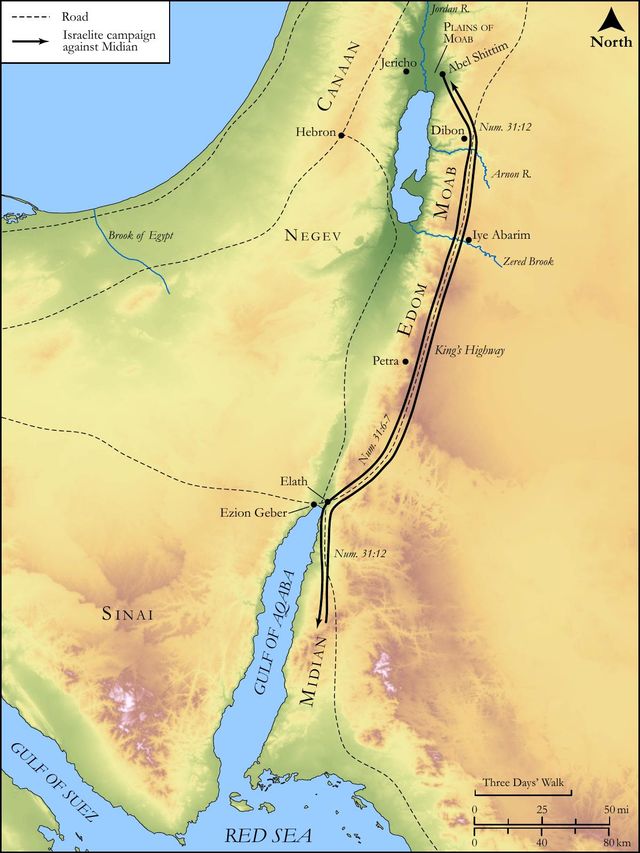
See on the biblical-era map
Study this verse
Continue studying Numbers 31:19 across the web’s major study libraries — every link below opens this exact verse, chapter, or book on the destination site.
Read & Compare
 BibleGatewayThis verse in more than 200 translations and 70 languages.
 Bible.comThe YouVersion reader — hundreds of translations, reading plans, and highlights.
 ESV.orgCrossway's official English Standard Version reader.
 NET BibleThe NET translation with 60,000+ translators' notes on every rendering decision.
 STEP BibleTyndale House's free study tool — original text, vocabulary, and scholarly resources.
 BibliaLogos Bible Software's free web reader.
 USCCBThe New American Bible (Revised Edition) with the U.S. bishops' study notes.
Commentaries
 BibleHub CommentariesDozens of classic commentaries on this verse, gathered on one page.
 StudyLightMore than 100 commentary sets — the largest collection on the web.
 BibleRefPlain-English commentary on what this verse means, verse by verse.
 Enduring WordDavid Guzik's free commentary on this chapter, widely used by Bible teachers.
 Bible Study ToolsVerse commentary alongside Greek and Hebrew study aids.
Original Language & Research
- BibleHub InterlinearThe verse word by word — original language, transliteration, and English.
- BibleHub LexiconEvery word's original-language definition and Strong's entry.
 Blue Letter BibleDeep-study tools — Strong's numbers, concordance, and word studies.
 SefariaThe Hebrew text with Rashi and centuries of Jewish commentary.
Sermons, Hymns & Audio


TrulyRandomVerse is not affiliated with these sites and doesn’t control their content. They’re linked because they’re genuinely useful.
Summary
Numbers 31:19 delivers a crucial divine mandate for the Israelite soldiers and their Midianite captives following their decisive military victory. This instruction outlines a meticulous post-war purification protocol, emphasizing the non-negotiable requirement for ceremonial cleanliness in ancient Israelite society. It details a mandatory seven-day period of isolation outside the sacred camp and a two-stage purification ritual, underscoring the profound defilement incurred through contact with death, even in the context of a divinely sanctioned campaign, and the necessary steps to restore ritual fitness for re-entry into the holy community.
Context
ShowHideLiterary Context
Numbers 31:19 is strategically placed immediately after the Israelites' triumphant, yet morally complex, military campaign against the Midianites. The preceding narrative details the execution of God's vengeance against Midian, who had enticed Israel into idolatry and sexual immorality at Baal of Peor (Numbers 25:16-18). The initial phases of the war, including the complete destruction of Midianite males and cities, and the taking of women, children, and spoil, are recounted in Numbers 31:1-12. Moses' subsequent anger at the sparing of certain Midianite women, who were instrumental in Israel's past sin, leads to further instructions for their elimination (Numbers 31:13-18). Against this backdrop of warfare and its aftermath, verse 19 initiates a series of purification laws (Numbers 31:19-24) that address the ritual defilement incurred by contact with the dead. These laws are essential for maintaining the sanctity of the camp before the distribution of the vast spoils, ensuring that the community remains holy in the presence of God.
Historical & Cultural Context
The directives in Numbers 31:19 are deeply rooted in the historical and cultural realities of ancient Israelite nomadic life and the Mosaic Covenant. The Israelite camp was far more than a temporary dwelling; it was a sacred domain, meticulously organized around the Tabernacle, which symbolized the very presence of Yahweh dwelling among His people. Consequently, stringent laws of ritual purity were paramount to preserve the camp's holiness and avert divine judgment. Contact with a corpse, whether human or animal, was a primary and potent source of ritual impurity in Israelite law (Numbers 19:11-13). This defilement was not a moral failing but a ritual state that rendered an individual unfit to participate in worship, approach the Tabernacle, or even reside within the main camp. Even in the context of a divinely sanctioned "holy war," the physical reality of death brought about this defilement, necessitating a precise and thorough purification process. The explicit inclusion of the Midianite captives in this purification underscores that anyone entering or residing within the Israelite community, regardless of their origin, was subject to its fundamental laws of purity and order.
Key Themes
ShowHideThis verse significantly contributes to several overarching theological and narrative themes prevalent throughout the book of Numbers and the Pentateuch. Central among these is the theme of Ritual Purity and Holiness, which consistently emphasizes that a holy God demands a holy people and a holy environment, especially where His presence resides. The defilement incurred through contact with death powerfully underscores The Pervasive Nature of Sin and Death; death, as the ultimate antithesis of life, is a profound symbol of sin's consequence and its inherent power to separate humanity from God, the source of all life. The meticulous and precise instructions for purification reflect God's Meticulous Law and Divine Order, demonstrating His sovereign concern for every facet of Israel's existence, from their worship to their warfare, and His gracious provision for restoration. Finally, the inclusion of the captives in the purification process subtly introduces themes of Inclusion and Assimilation, indicating that even non-Israelites who became part of the community were brought under the comprehensive reach of God's covenant demands and the necessity of conforming to His standards of purity for communal life.
Exposition and Analysis
ShowHideKey Word Analysis
ShowHideThis primitive root means "to incline," and by implication, "to pitch a tent" or "to encamp." In Numbers 31:19, it signifies the command for the soldiers and captives to "remain" or "camp" outside the main Israelite encampment. This is not merely a logistical instruction but a ritual separation, emphasizing their temporary exclusion from the sacred space of the community due to their defiled state. It denotes a necessary period of isolation before re-entry.
This word derives from a root meaning "pierced," specifically "pierced to death." It refers to those who have been killed or fatally wounded. In this context, it highlights the source of defilement: contact with the dead bodies of the Midianites. The term underscores the grim reality of death in battle and its inherent capacity to render individuals ritually impure, regardless of the justness of the conflict.
This primitive root primarily means "to miss" or "to sin," but by inference, it also means "to expiate," "to cleanse," or "to purify." In Numbers 31:19, it refers to the ceremonial process of removing ritual defilement, specifically that contracted through contact with the dead. This purification is not about moral guilt but about restoring an individual to a state of ritual cleanliness, making them fit to re-enter the holy community and participate in its sacred life. It highlights the divine provision for overcoming impurity.
Verse Breakdown
ShowHide"And do ye abide without the camp seven days:"
This initial command establishes a mandatory period of quarantine and separation for the returning Israelite soldiers and their newly acquired captives. To be "without the camp" signifies temporary exclusion from the sacred communal space where God's presence dwelt, underscoring the severity of the ritual defilement incurred through warfare and contact with the dead. The "seven days" indicates a complete and thorough cycle of purification, emphasizing the divine order and patience required for full ritual restoration.
"whosoever hath killed any person, and whosoever hath touched any slain,"
This clause precisely identifies the two categories of individuals who have incurred ritual impurity and are therefore subject to the purification rites. It encompasses not only those directly involved in the act of killing during the battle ("hath killed any person") but also anyone who merely came into incidental contact with a dead body ("hath touched any slain"). This broad scope underscores the pervasive and potent defiling nature of death under the Mosaic Law, emphasizing that even indirect association with a corpse rendered one unclean and unfit for the holy camp.
"purify [both] yourselves and your captives on the third day, and on the seventh day."
This final instruction details the two-stage purification process required for all defiled individuals, explicitly including the Midianite captives. The cleansing on the "third day" likely involved an initial sprinkling with the water of purification (prepared from the ashes of the red heifer, as prescribed in Numbers 19:19), signifying the commencement of the cleansing process. The "seventh day" marked the completion of the purification, typically involving a full body wash and the washing of clothes, allowing for full re-entry into the camp. The explicit inclusion of "your captives" demonstrates that the laws of ritual purity applied universally to all individuals who would reside within the Israelite community, regardless of their origin, if they had been exposed to defilement.
Literary Devices
ShowHideNumbers 31:19 employs several literary devices to convey its authoritative and precise message. The most prominent is Legal Language, characteristic of the Mosaic Law, presenting a direct and unambiguous imperative command from God through Moses. This authoritative tone underscores the divine origin and non-negotiable nature of the instructions regarding ritual purity. The verse also utilizes Categorization and Specificity, meticulously delineating "whosoever hath killed any person" and "whosoever hath touched any slain," ensuring that no one exposed to death is overlooked in the purification process. This precision highlights the meticulousness and comprehensiveness of God's law. Furthermore, there is a profound use of Symbolism: the "camp" itself symbolizes the holy presence of God and the consecrated community, while "abiding without the camp" symbolizes separation from that holiness due to defilement. The very act of "purifying" symbolizes the restoration of relationship and fitness to draw near to God, a physical act pointing to a spiritual reality.
Theological and Thematic Connections
ShowHideNumbers 31:19, while focused on specific ceremonial laws, reveals profound theological truths about God's intrinsic nature and humanity's fallen condition. The stringent requirements for purification after contact with death powerfully illustrate God's absolute holiness and His utter intolerance for anything that defiles His sacred presence. In the Old Testament, death is inextricably linked to sin (Romans 6:23), representing the ultimate separation from the life-giving God. Thus, the ritual defilement caused by a corpse serves as a tangible, visceral reminder of humanity's pervasive spiritual defilement by sin, which inherently separates us from a holy God. The prescribed purification rituals, though temporary and external in their efficacy, powerfully foreshadow the ultimate and eternal need for a divine provision to cleanse deep-seated spiritual impurity, enabling true reconciliation and unhindered fellowship with God. They underscore the profound truth that humanity cannot cleanse itself and is utterly dependent on a divinely ordained means of atonement and purification to bridge the chasm created by sin and death.
Reflection and Application
ShowHideWhile believers today are no longer bound by the specific ceremonial laws of the Old Testament, the enduring spiritual principles embedded in Numbers 31:19 hold profound relevance for contemporary Christian living. This verse serves as a powerful reminder of the pervasive and serious nature of spiritual defilement—sin—which, much like contact with a corpse, renders us unfit for intimate, unhindered fellowship with a holy God. Just as the Israelites were commanded to intentionally separate themselves "without the camp" for a prescribed period, we are called to discern and actively distance ourselves from the defiling influences of the world and the insidious presence of sin in our lives. This is not about physical isolation, but about cultivating spiritual vigilance, intentionality, and a deep commitment to holiness in our daily walk. The two-stage purification process on the third and seventh days can be seen as a symbolic representation of the ongoing, progressive nature of sanctification, where we are continually being cleansed, refined, and transformed by God's grace, moving from initial repentance to deeper conformity to the image of Christ. It also highlights the critical importance of seeking restoration and re-entering full, vibrant fellowship with God and His community after periods of spiritual struggle, compromise, or defilement, acknowledging that God, in His boundless grace, always provides a way back to purity and communion.
Questions for Reflection
ShowHideFAQ
ShowHideWhy was contact with a dead body considered defiling, even in a divinely sanctioned war?
ShowHideIn the Old Testament, death was considered the ultimate antithesis of life, and God is the source of all life. Therefore, anything associated with death, including a corpse, was ritually impure. This impurity was not about moral guilt but about a state of unfitness to approach a holy God or participate in the community's sacred life. The law reflected the profound theological truth that sin brought death into the world (Romans 5:12), and thus, death itself was a pervasive symbol of sin's defiling power. Even though the war against Midian was divinely commanded and just, the physical consequences of engaging with death still applied. This necessitated a meticulous purification process to maintain the sanctity of the Israelite camp, where God's holy presence dwelt (Numbers 5:3), ensuring that even righteous acts did not negate the need for ritual purity in the presence of a holy God.
Did the captives have to undergo the same purification process as the Israelites?
ShowHideYes, Numbers 31:19 explicitly states, "purify [both] yourselves and your captives." This instruction unequivocally indicates that anyone who had been exposed to the defilement of death, regardless of their origin or status as a captive, needed to undergo the prescribed purification rites. This highlights the universal nature of the defilement caused by death and the absolute requirement for ritual cleanliness for all individuals who were to reside within the clean confines of the Israelite camp. It underscores the comprehensive reach of God's laws of purity over all who came under the community's sphere of influence, demonstrating that even those newly integrated into the Israelite household or community were subject to its fundamental standards of purity and order.
Christ-Centered Fulfillment
ShowHideThe meticulous purification laws of Numbers 31:19, requiring a seven-day separation and a two-stage cleansing from the defilement of death, serve as a powerful type and shadow pointing to the ultimate and perfect purification found in Jesus Christ. These Old Testament rituals, though divinely commanded, were inherently temporary and external, incapable of truly cleansing the conscience or removing the deep-seated defilement of sin itself (Hebrews 9:9-10). They served as a constant reminder to Israel of their inherent impurity and their profound need for a perfect, once-for-all sacrifice. Jesus, however, is the true Lamb of God who takes away the sin of the world, whose singular, definitive sacrifice on the cross conquered sin and death in a way that the blood of bulls and goats never could (Hebrews 2:14-15). His precious, atoning blood provides not merely ritual cleansing but a complete, internal, and eternal purification from all unrighteousness, effectively cleansing our consciences from dead works to enable us to serve the living God (Hebrews 9:14; 1 John 1:7). Through faith in Him, we are no longer required to "abide without the camp" in a spiritual sense, for we have been brought near by His blood (Ephesians 2:13) and are continually being sanctified by the Spirit, enabling us to draw near to a holy God with full assurance and confidence (Hebrews 10:19-22).