


Old Testament · History · Book 12 of 66
2 Kings
The kings of Israel and Judah from Elijah’s departure until Samaria falls to Assyria and Jerusalem to Babylon, as the LORD’s word by the prophets comes to pass.
- 25 chapters
- 719 verses
- About 1.8 hours to read
- The Divided Kingdom, c. 930–586 BC
The book opens with a king of Israel sending to ask Baalzebub whether he will recover. Elijah meets his messengers with the LORD’s question: “Is it not because there is not a God in Israel, that ye go to enquire of Baalzebub the god of Ekron?” (2 Kings 1:3). The rest of the book answers it. Elisha’s signs reach a widow in debt, a Shunammite mother and a Syrian captain. The northern kingdom declines through murdered kings to the fall of Samaria, and the writer gives the reasons (17:7–23).
Judah lasts longer, “for David his servant’s sake” (8:19). Hezekiah trusts the LORD against Assyria, and Josiah keeps a passover not holden “from the days of the judges” (23:22). But the LORD does not turn from his wrath over Manasseh’s sins (23:26), and Jerusalem falls “according to the word of the LORD, which he spake by his servants the prophets” (24:2). Each reign is set in the same frame: when it began, how long it lasted, and whether the king did right or evil “in the sight of the LORD.” The last verses find David’s heir lifted out of prison in Babylon.
Yet the LORD testified against Israel, and against Judah, by all the prophets, and by all the seers, saying, Turn ye from your evil ways, and keep my commandments and my statutes, according to all the law which I commanded your fathers, and which I sent to you by my servants the prophets.
2 Kings 17:13 KJV
Before you read
- Who wrote it
- Not named in the book; traditionally Jeremiah. The writer cites “the book of the chronicles of the kings of Israel” (1:18) and of Judah (8:23). His closing account, from Zedekiah’s reign to Jehoiachin’s release, appears again with small differences as Jeremiah 52.
- When it was written
- During the exile, after Jehoiachin was lifted out of prison “in the seven and thirtieth year of the captivity” (25:27). The book records no return.
How 2 Kings is laid out
8 movements · 110 passages · 719 verses
Elijah taken up
Chapters 1–2 · 43 verses
Ahaziah of Israel, sick from a fall, sends to enquire of Baalzebub, and Elijah tells him he will die. Fire from heaven consumes two captains and their fifties. Beyond Jordan Elijah is taken up by a whirlwind, and Elisha, who asked a double portion of his spirit, takes up his mantle. He heals the waters of Jericho, and forty-two who mock him at Bethel are torn by bears.
7 passages
- 1:1–8 Moab Rebels; Ahaziah Consults Baalzebub
- 1:9–15 Elijah Calls Down Fire on Two Captains
- 1:16–18 Ahaziah Dies According to God’s Word
- 2:1–12 Elijah's Final Journey and Succession
- 2:13–18 Elisha Assumes the Prophetic Mantle
- 2:19–22 Elisha Heals the Waters of Jericho
- 2:23–25 Judgment on Mockers at Bethel
The works of Elisha
3:1–8:15 · 166 verses
Elisha promises water and victory to three kings marching on Moab. He fills a widow’s vessels with oil, promises the Shunammite a son and raises him from the dead, and sends Naaman the Syrian to wash in Jordan. He makes iron swim, leads a blinded Syrian band into Samaria, and foretells plenty in the starving city. At Damascus he weeps before Hazael, who smothers Benhadad and reigns.
Jehu and the house of Ahab
8:16–10:36 · 87 verses
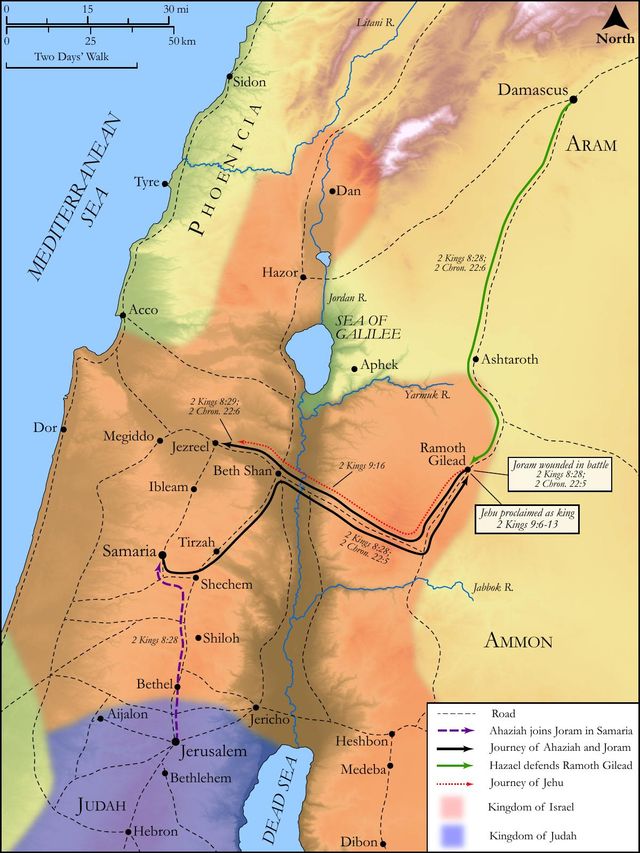
Jehoram and Ahaziah of Judah walk in the way of Ahab’s house, into which Jehoram married. A son of the prophets anoints Jehu at Ramoth-gilead to cut that house off. Jehu kills Joram of Israel and Ahaziah of Judah, has Jezebel thrown down and Ahab’s seventy sons slain, and destroys Baal’s worshippers in Baal’s house. Yet he keeps Jeroboam’s calves, and the LORD begins to cut Israel short.
11 passages
- 8:16–24 Jehoram Reigns in Judah
- 8:25–29 Ahaziah Reigns in Judah
- 9:1–10 Elisha Commissions Jehu's Anointing
- 9:11–13 Jehu Proclaimed King by the Army
- 9:14–29 Jehu Executes Joram and Ahaziah
- 9:30–37 The Death of Jezebel
- 10:1–11 Jehu Orders the Execution of Ahab's Seventy Sons
- 10:12–14 Jehu Executes the Relatives of Ahaziah of Judah
- 10:15–17 Alliance with Jehonadab the Rechabite
- 10:18–28 The Destruction of Baal Worship in Samaria
- 10:29–36 Jehu’s Partial Obedience and Reign Summary
A hidden heir, a dying prophet
Chapters 11–14 · 96 verses
Athaliah destroys the royal seed, but the infant Joash is hidden in the temple six years. Jehoiada the priest crowns him, makes a covenant and has Athaliah slain. Joash repairs the temple and is killed by his servants. Syria presses Jehu’s house until the dying Elisha promises three victories. Jehoash of Israel defeats Amaziah of Judah, and Jeroboam son of Joash restores Israel’s border.
17 passages
- 11:1–3 Athaliah Seizes the Throne
- 11:4–12 Jehoiada Organizes the Coup
- 11:13–16 Athaliah Is Executed
- 11:17–20 Restoration of the Davidic Covenant
- 11:21–12:3 Jehoash Begins His Reign
- 12:4–16 Funding the Temple Restoration
- 12:17–18 Syrian Threat and Tribute
- 12:19–21 Death of Jehoash
- 13:1–9 Jehoahaz Reigns Over Israel
- 13:10–13 Jehoash Succeeds His Father
- 13:14–19 Elisha's Dying Prophecy
- 13:20–21 Death and Posthumous Miracle of Elisha
- 13:22–25 God's Covenant Faithfulness and Deliverance
- 14:1–7 Amaziah Reigns in Judah
- 14:8–16 Amaziah Challenges Israel's King Jehoash
- 14:17–22 Conspiracy and Death of Amaziah
- 14:23–29 Jeroboam II Reigns in Israel
Israel carried away
Chapters 15–17 · 99 verses
Azariah reigns fifty-two years in Judah, while four of Israel’s next five kings are slain by their successors. Assyria takes tribute, then cities and captives. Ahaz makes his son pass through the fire, buys Assyria’s help, and copies an altar from Damascus. In Hoshea’s ninth year Samaria falls and Israel is carried away. The writer explains why, and new settlers fear the LORD and serve their own gods.
14 passages
- 15:1–7 Azariah (Uzziah) Reigns in Judah
- 15:8–12 Zachariah of Israel Assassinated
- 15:13–16 Shallum's Brief Reign
- 15:17–22 Menahem Pays Tribute to Assyria
- 15:23–26 Pekahiah Rules Israel
- 15:27–31 Pekah's Reign and Assyrian Invasion
- 15:32–38 Jotham Reigns in Judah
- 16:1–4 Reign and Wickedness of Ahaz
- 16:5–9 Ahaz Appeals to Assyria for Help
- 16:10–16 Ahaz Adopts a Foreign Altar
- 16:17–20 Temple Defilement and Death of Ahaz
- 17:1–6 The Fall of Samaria and the End of Israel
- 17:7–23 The Theological Reason for Israel's Exile
- 17:24–41 Foreign Settlers and Syncretistic Worship
Hezekiah trusts the LORD
Chapters 18–20 · 95 verses
Hezekiah removes the high places and breaks the brasen serpent Moses made. Sennacherib takes Judah’s fenced cities, and Rabshakeh mocks Hezekiah’s trust before Jerusalem’s wall. Hezekiah spreads Sennacherib’s letter before the LORD, Isaiah answers, and the angel of the LORD smites a hundred and eighty-five thousand in one night. Healed and given fifteen years, Hezekiah shows his treasures to Babylon’s envoys and is told all will be carried there.
12 passages
- 18:1–8 Hezekiah's Righteous Reign and Reforms
- 18:9–12 The Fall of the Northern Kingdom (Israel)
- 18:13–16 Sennacherib Invades Judah; Hezekiah Pays Tribute
- 18:17–37 The Assyrian Siege and Rabshakeh's Taunt
- 19:1–7 Hezekiah Seeks Counsel from Isaiah
- 19:8–13 Sennacherib's Second Threat
- 19:14–19 Hezekiah’s Prayer
- 19:20–34 God’s Prophetic Response through Isaiah
- 19:35–37 The Deliverance and Sennacherib's Death
- 20:1–11 Hezekiah’s Illness and Prayer
- 20:12–19 Hezekiah Shows Treasures to Babylon
- 20:20–21 Conclusion of Hezekiah’s Reign
Manasseh’s sin, Josiah’s reform
21:1–23:30 · 76 verses
Manasseh rebuilds the high places, sets a graven image in the temple and sheds innocent blood, and the LORD pronounces Jerusalem’s ruin. Josiah, crowned at eight after Amon’s murder, repairs the temple, where the book of the law is found. Huldah confirms the judgment but promises Josiah peace. He renews the covenant, purges idolatry as far as Bethel and keeps the passover, yet the wrath stands. He falls at Megiddo.
13 passages
- 21:1–9 The Wicked Reign of Manasseh
- 21:10–18 God Pronounces Judgment on Jerusalem
- 21:19–26 The Brief Reign of Amon
- 22:1–2 Josiah's Righteous Reign Begins
- 22:3–7 Repairing the Temple
- 22:8–10 Discovery of the Book of the Law
- 22:11–20 Huldah Prophesies Judgment and Grace
- 23:1–3 Josiah Renews the Covenant
- 23:4–14 Purge of Idolatry in Judah
- 23:15–20 Destruction of High Places in Bethel and Samaria
- 23:21–24 The Great Passover and the Last Purge
- 23:25–28 Summary of Josiah’s Reign and God’s Wrath
- 23:29–30 Josiah Is Killed at Megiddo
Jerusalem burned
23:31–25:30 · 57 verses
Pharaoh-nechoh deposes Jehoahaz and sets up Jehoiakim, who later serves Babylon and rebels. Nebuchadnezzar carries Jehoiachin, the temple treasures and ten thousand captives to Babylon, and makes Zedekiah king. Zedekiah rebels; Jerusalem is besieged and broken up, the temple burned and the people carried away. Gedaliah, left as governor, is murdered. Thirty-seven years into his captivity, Jehoiachin is lifted out of prison and eats before the king of Babylon.
10 passages
- 23:31–35 Reign of Jehoahaz
- 23:36–37 Reign of Jehoiakim
- 24:1–7 Jehoiakim Rebels Against Babylon
- 24:8–17 Jehoiachin's Short Reign and First Deportation
- 24:18–20 Zedekiah Reigns and Rebels
- 25:1–7 The Siege and Capture of Jerusalem
- 25:8–17 The Destruction of the Temple and Jerusalem
- 25:18–21 The Execution of Leaders and Final Deportation
- 25:22–26 Gedaliah Appointed Governor
- 25:27–30 Jehoiachin Released from Prison
The words 2 Kings turns on
Reign opens each king’s account and turn aside judges it; the prophets bring the word, and the book found in the temple renews the covenant.
What 2 Kings teaches
ʼĕlôhîym · God
Is there no God in Israel?
Elijah puts the question to Ahaziah on his sickbed: “is it not because there is no God in Israel to enquire of his word?” (1:16). The book answers it, often through foreigners. Elisha sends for Naaman so that “he shall know that there is a prophet in Israel” (5:8), and the cleansed Syrian confesses, “now I know that there is no God in all the earth, but in Israel” (5:15). Rabshakeh asks the reverse: “Hath any of the gods of the nations delivered at all his land out of the hand of the king of Assyria?” (18:33). Hezekiah prays “that all the kingdoms of the earth may know that thou art the LORD God, even thou only” (19:19), and that night the Assyrian camp is struck. The settlers of Samaria tried to hold both: they “feared the LORD, and served their own gods” (17:33).
çûwr · turn aside
The sins of Jeroboam
The kings of Israel are measured against Jeroboam, who set up the calves at Bethel and Dan, and the verdict hardly varies: “he departed not from the sins of Jeroboam, which made Israel to sin” (10:31). Jehu, who “destroyed Baal out of Israel” (10:28), is no exception. Judah’s good kings are measured by David, and most of them leave one thing standing: “the high places were not taken away” (12:3). Hezekiah “removed the high places” (18:4), and Josiah “turned not aside to the right hand or to the left” (22:2). One Hebrew verb, çûwr, joins the sin to its judgment. Israel “departed not from them; Until the LORD removed Israel out of his sight” (17:22–23), and the LORD says, “I will remove Judah also out of my sight, as I have removed Israel” (23:27).
dâbâr · word
According to the word of the LORD
The book records prophecy and fulfilment. Ahaziah “died according to the word of the LORD which Elijah had spoken” (1:17). When Jezebel is eaten by dogs, Jehu says, “This is the word of the LORD, which he spake by his servant Elijah the Tishbite” (9:36). The doubting lord sees the flour sold for a shekel and dies in the gate (7:17–20). In Jeroboam’s day a man of God named Josiah over the altar at Bethel (1 Kings 13:2), and Josiah burns bones on it “according to the word of the LORD which the man of God proclaimed” (23:16). Huldah’s word to Josiah also stands: he dies before Jerusalem falls, as she said his eyes would “not see all the evil” (22:20). The end comes the same way: the LORD had “testified against Israel, and against Judah, by all the prophets” (17:13).
shâlak · cast
Not cast out as yet
Judgment is long delayed, and the book gives the reasons. Under Jehoahaz the LORD was gracious to Israel “because of his covenant with Abraham, Isaac, and Jacob,” and “neither cast he them from his presence as yet” (13:23). Under Jeroboam son of Joash he “saw the affliction of Israel, that it was very bitter,” and saved them (14:26–27). Judah was spared for David, “as he promised him to give him alway a light, and to his children” (8:19), and Jerusalem defended “for mine own sake, and for my servant David’s sake” (19:34). The same word, cast, then marks the end of that patience. The LORD “rejected all the seed of Israel … until he had cast them out of his sight” (17:20), and Judah’s turn came “until he had cast them out from his presence” (24:20).
Christ in 2 Kings
The book opens with Elijah’s last days, and the gospels open with his likeness. The prophet known as “an hairy man, and girt with a girdle of leather about his loins” (2 Kings 1:8) returns in John, “clothed with camel’s hair, and with a girdle of a skin about his loins” (Mark 1:6), who went before the Lord “in the spirit and power of Elias” (Luke 1:17).
In the synagogue at Nazareth Jesus named Naaman: “none of them was cleansed, saving Naaman the Syrian” (Luke 4:27). Mercy shown to a Syrian while Israel’s lepers stayed unclean was a warning his hearers understood, and they “were filled with wrath” (4:28). When James and John asked to call down fire “even as Elias did” (Luke 9:54; 2 Kings 1:10), “he turned, and rebuked them” (9:55). And the light promised to David, kept through Athaliah’s purge and the fall of Jerusalem, continues in Matthew’s genealogy past Jechonias and the carrying away to Babylon (Matthew 1:11–12), to Jesus, who is called Christ.
- David promised a light alway
- Jehoram Joram; married Ahab’s daughter
- Azariah Ozias; Azariah in 15:1
- Jotham
- Ahaz
- Hezekiah trusted the LORD
- Manasseh
- Amon
- Josiah found the book of the law
- Jehoiachin Jechonias; carried to Babylon
- … Matthew 1:12–16
- Jesus, who is called Christ
People
By how many verses name them
- ElishaA son of Shaphat49
- JehuA son of Jehoshaphat; father of Jehoahaz40
- HezekiahSon of Ahaz and Abi; a brother of Maaseiah; husband of Hephzibah; father of Manasseh38
- AhabA son of Omri; husband of Jezebel; father of Joash, Ahaziah, Joram, Athaliah22
- Elijah22
- DavidSon of Jesse18
- AhazA son of Jotham; husband of Abi; father of Hezekiah and Maaseiah17
- HazaelFather of Ben-hadad16
139 more are named.
Places
94 named
- JerusalemJudah’s royal city, delivered from Sennacherib, burned by Nebuchadnezzar56
- SamariaIsrael’s royal city, besieged by Syria, taken by Assyria44
- AssyriaCarries Israel captive; its army struck before Jerusalem in a night40
- BabylonWhose envoys see Hezekiah’s treasures, and where Judah is carried28
- SyriaNaaman’s country, at war with Israel through Elisha’s days25
- JezreelWhere Jehu shoots Joram and dogs eat Jezebel11
- Egypt10
- BethelSeat of Jeroboam’s calf; its altar broken down by Josiah9
Where 2 Kings reaches
The passages it leans on, and the ones that lean on it
Elijah’s hair garment and leather girdle, worn again by John the Baptist.
Naaman, the one leper Jesus names as cleansed in Elisha’s day.
A man of God names Josiah at Bethel’s altar in Jeroboam’s day; Josiah later burns bones on it.
Josiah keeps the great commandment, turning to the LORD “with all his heart, and with all his soul, and with all his might.”
Isaiah 36–39 tells Sennacherib’s invasion, Hezekiah’s sickness and the envoys from Babylon again.
Books 2 Kings links to most
The Church Fathers on 2 Kings
147 quotations from 25 writers before AD 800 · the ten most quoted, in date order
- Origen253
- Ephrem373
- Apostolic Constitutions380
- Ambrose397
- Chrysostom407
- Jerome420
- Augustine430
- Maximus465
- Caesarius542
- Bede735
Origen, on Elijah’s spirit resting on Elisha and coming again with John the Baptist.
But do not marvel in regard to what is said about Elijah, if, just as something strange happened to him different from all the saints who are recorded, in respect of his having been caught up by a whirlwind into heaven, so his spirit had something of choice excellence, so that not only did it rest on Elisha but also descended along with John at his birth …
Justin Martyr read the axe head raised by wood as a figure of the cross and of baptism.
Elisha, by casting a stick into the river Jordan, recovered the iron part of the axe with which the sons of the prophets had gone to cut down trees to build the house in which they wished to read and study the law and commandments of God; even as our Christ, by being crucified on the tree, and by purifying us with water, has redeemed us, though plunged in the direst offences which we have committed, and has made us a house of prayer and adoration.
Augustine on the brasen serpent: a figure of the crucifixion, then an idol, until Hezekiah broke it.
Then there were the miracles ... of the deadly bites of serpents, inflicted as just punishment for sin, and healed when a brazen serpent was raised on a wooden pole in sight of all, so that not only did relief come to an afflicted people but also the destruction of death by death was symbolized by this image of the crucifixion. This serpent was preserved intact in memory of the miracle but afterwards was worshiped as an idol by the unfaithful people until King Hezekiah, religiously using his power in the service of God, destroyed it and thus gained great renown for his piety.
Chrysostom on why Jerusalem was spared for David’s sake.
Frequently, when a just person cannot be found in the present life, he takes pity on the living on account of the virtue of the departed and cries aloud in the words, “I will protect this city for my own sake and the sake of my servant David.”
Keep studying
Articles