


Old Testament · History · Book 13 of 66
1 Chronicles
Genealogies from Adam to the return from Babylon, then the reign of David: the ark brought to Jerusalem, God’s promise of a house, and the temple prepared.
- 29 chapters
- 942 verses
- About 1.6 hours to read
- The Reign of David, c. 1010–970 BC
First Chronicles begins with Adam and spends nine chapters on names: the nations from Noah’s sons, the line of Abraham, the twelve tribes with Judah first and Levi at the centre, and those who dwelt again in Jerusalem after the captivity. One sentence explains the lists: “So all Israel were reckoned by genealogies; and, behold, they were written in the book of the kings of Israel and Judah, who were carried away to Babylon for their transgression” (1 Chronicles 9:1).
From chapter 10 the book follows one reign. Saul dies because he “enquired not of the LORD” (10:14), and David is made king, brings up the ark, receives the promise of a house, and prepares a temple he will not build. Much of this retells Samuel, and much is found only here: the singers and their psalm, the courses of priests and Levites, the pattern of the house and the gifts for it. David’s last prayer gives the sum: “thine is the kingdom, O LORD, and thou art exalted as head above all” (29:11).
Thine, O LORD, is the greatness, and the power, and the glory, and the victory, and the majesty: for all that is in the heaven and in the earth is thine; thine is the kingdom, O LORD, and thou art exalted as head above all.
Before you read
- Who wrote it
- Not named in the book; traditionally Ezra. Chronicles closes with the decree of Cyrus in nearly the words that open Ezra (2 Chronicles 36:22; Ezra 1:1). For David’s reign the writer names his sources: the books of Samuel the seer, Nathan the prophet and Gad the seer (29:29).
- When it was written
- After the return from Babylon. The genealogies are those of a people “carried away to Babylon for their transgression” (9:1), and they name the first who dwelt again in their cities (9:2). David’s line is carried down past Zerubbabel (3:19–24).
- When it happens
- The genealogies reach from Adam to the return. The history is David’s reign of forty years, “seven years reigned he in Hebron, and thirty and three years reigned he in Jerusalem” (29:27), from Saul’s death to Solomon’s accession.
How 1 Chronicles is laid out
8 movements · 123 passages · 942 verses
From Adam to Israel
Chapter 1 · 54 verses
Names alone carry the line from Adam to Noah and his three sons. The sons of Japheth, Ham and Shem follow, the families from whom the nations came; then Shem’s line to Abram, and the sons of Ishmael and of Keturah. Isaac’s sons are “Esau and Israel.” Esau’s line comes first: his sons, the kings who reigned in Edom before Israel had a king, and the dukes of Edom.
The tribes of Israel
Chapters 2–9 · 353 verses
Judah comes first and at greatest length: the line of Pharez to David, David’s sons, and his line down past the captivity. Simeon and the tribes beyond Jordan follow, until Assyria carries them away. Levi stands at the centre, with the high priests, the singers and the Levites’ cities, and the other tribes close with Benjamin and Saul’s house. Chapter 9 names those who dwelt again in Jerusalem.
King over all Israel
Chapters 10–12 · 101 verses
Saul and his sons fall on mount Gilboa. The book gives the cause: he asked counsel of one that had a familiar spirit and not of the LORD, who “turned the kingdom unto David.” All Israel anoints David at Hebron, and he takes the castle of Zion from the Jebusites. His mighty men are named, and the men of every tribe who came to make him king.
13 passages
- 10:1–7 The Death of King Saul
- 10:8–10 The Philistines Desecrate Saul's Body
- 10:11–12 Jabesh-gilead Buries the Bodies
- 10:13–14 The Chronicler's Theological Summary
- 11:1–3 David Anointed King Over All Israel
- 11:4–9 The Conquest of Jerusalem
- 11:10–14 The List of David's Mighty Men
- 11:15–25 The Exploit of the Three
- 11:26–47 The Thirty Captains
- 12:1–7 Men Join David at Ziklag
- 12:8–15 The Mighty Gadite Warriors
- 12:16–22 David Receives Allies and Amasai's Prophecy
- 12:23–40 The Great Assembly at Hebron to Crown David
The ark comes to Jerusalem
Chapters 13–16 · 103 verses
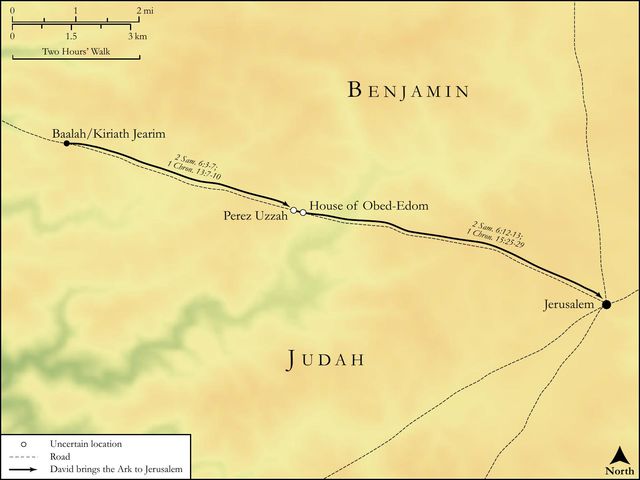
David’s first counsel is to bring up the ark. It goes on a new cart; at the threshing floor of Chidon Uzza puts out his hand to hold it, and the LORD smites him. After three months with Obed-edom, the Levites bear it on their shoulders “as Moses commanded.” David sets it in a tent, gives Asaph a psalm of thanks, and appoints ministers before it continually.
15 passages
- 13:1–4 David Plans to Retrieve the Ark
- 13:5–8 The Procession Begins
- 13:9–11 Uzza is Struck Down
- 13:12–14 The Ark Rests with Obed-Edom
- 14:1–7 David's Kingdom Established in Jerusalem
- 14:8–12 Victory over the Philistines at Baal-perazim
- 14:13–17 The Second Defeat of the Philistines
- 15:1–2 David Prepares a Place for the Ark
- 15:3–15 The Assembly and the Priests
- 15:16–24 Organizing the Temple Musicians
- 15:25–29 The Ark Brought to Jerusalem
- 16:1–3 The Ark Placed and Sacrifices Offered
- 16:4–6 Appointment of Levitical Ministers
- 16:7–36 David's Psalm of Thanksgiving
- 16:37–43 Organization of Continuous Worship
A house for David
Chapters 17–20 · 71 verses
David would build a house for the ark, but by Nathan the LORD answers that he will build David a house: David’s son will build the temple, and his throne will be established for ever. David sits before the LORD and gives thanks. Then the LORD subdues David’s enemies as he promised: the Philistines, Moab, Zobah, Syria, Edom and Ammon, and the sons of the giant in Gath.
12 passages
- 17:1–2 David Desires to Build the Temple
- 17:3–6 God Rejects David's Offer
- 17:7–15 God Promises David an Eternal Dynasty
- 17:16–27 David’s Prayer of Thanksgiving
- 18:1–8 David's Victories Over Neighboring Nations
- 18:9–13 Tribute from Hamath and Dedication of Spoils
- 18:14–17 David's Administration and Officials
- 19:1–5 David's Kindness Rejected by Ammon
- 19:6–15 The Ammonites Prepare for War
- 19:16–19 David Defeats the Renewed Syrian Threat
- 20:1–3 David Captures Rabbah and Conquers Ammon
- 20:4–8 Battles Against the Philistine Giants
The threshing floor of Ornan
Chapters 21–22 · 49 verses
Satan provokes David to number Israel, and the LORD sends pestilence. David confesses, “I have sinned greatly,” and chooses to fall into the hand of the LORD. At the angel’s word he buys Ornan’s threshing floor, builds an altar, and is answered by fire from heaven. He names the place for the house of the LORD, gathers materials, and charges Solomon and the princes to build.
The courses of service
Chapters 23–27 · 160 verses
Old and full of days, David makes Solomon king and orders those who will serve. The Levites are numbered from twenty years old; the priests of Eleazar and Ithamar are divided by lot into twenty-four courses, and so are the singers of Asaph, Heman and Jeduthun. Porters, treasurers and judges follow, then the army’s twelve monthly courses and the officers of the tribes and the king.
David’s last assembly
Chapters 28–29 · 51 verses
David gathers the leaders of Israel and gives Solomon the pattern of the house, which he had “by the spirit” and in writing from the LORD’s hand. He gives his own gold and silver; the princes and people offer willingly, and David blesses the LORD before the congregation. Solomon is made king the second time, and David dies “in a good old age, full of days, riches, and honour.”
8 passages
- 28:1–10 David Assembles the Leaders
- 28:11–19 The Divine Pattern for the Temple
- 28:20–21 Final Charge and Assurance
- 29:1–5 David Prepares for the Temple
- 29:6–9 The People Offer Willingly
- 29:10–19 David’s Prayer of Praise and Thanksgiving
- 29:20–25 Worship, Sacrifice, and Solomon Anointed
- 29:26–30 Summary of David’s Reign and Death
The words 1 Chronicles turns on
Begat carries chapters 1–9, ark chapters 13–16, and course chapters 23–28; offer willingly belongs to chapter 29, and seek runs from Saul’s death to David’s charge.
What 1 Chronicles teaches
dârash · seek
Seek the LORD
The book sums up Saul’s fall with this word, rendered enquire and seek. He died “for asking counsel of one that had a familiar spirit, to enquire of it,” and because he “enquired not of the LORD” (10:13–14). David’s first proposal as king answers it: “let us bring again the ark of our God to us: for we enquired not at it in the days of Saul” (13:3). When the first attempt fails, he names the fault with the same word: “we sought him not after the due order” (15:13). The psalm of the ark calls, “Seek the LORD and his strength, seek his face continually” (16:11), and David’s charge to Solomon turns on it: “if thou seek him, he will be found of thee; but if thou forsake him, he will cast thee off for ever” (28:9).
bayith · house
A house for his name
David, who dwells in “an house of cedars,” would build for the ark, which “remaineth under curtains” (17:1). The LORD turns the word around: “Thou shalt not build me an house to dwell in” (17:4), but “the LORD will build thee an house” (17:10), and David’s son “shall build me an house, and I will stablish his throne for ever” (17:12). David later gives the reason he was held back: “Thou hast shed blood abundantly, and hast made great wars” (22:8), while Solomon would be “a man of rest” (22:9). Origen set David’s wars against Solomon’s peace: Solomon because of this peace has time to construct the famous temple for God
. Jerome held that the reference is not, as some think, to his wars, but to the murder
of Uriah.
machălôqeth · course
In the due order
On its first journey the ark rode on a new cart, as the Philistines had sent it back (1 Samuel 6:7). When the oxen stumbled, Uzza “put forth his hand to hold the ark,” and died there (13:9–10). The law had given the holy things to the sons of Kohath to bear, and said, “they shall not touch any holy thing, lest they die” (Numbers 4:15). The second time the Levites carried it on their shoulders “as Moses commanded” (15:15). The same care orders chapters 23 to 26: priests, singers and porters are divided into courses by lot, “as well the small as the great, the teacher as the scholar” (25:8). Luke’s Gospel opens inside that order, with Zacharias, “of the course of Abia” (Luke 1:5; 1 Chronicles 24:10).
nâdab · offer willingly
Of thine own
David gives of his own gold and silver “over and above all that I have prepared for the holy house” (29:3), then asks, “who then is willing to consecrate his service this day unto the LORD?” (29:5). The leaders offer willingly, and “the people rejoiced, for that they offered willingly, because with perfect heart they offered willingly to the LORD” (29:9). David’s prayer gives the gift back to its source: “all things come of thee, and of thine own have we given thee” (29:14). He asks God to keep that willingness in his people and “prepare their heart unto thee” (29:18). Augustine saw the same in Amasai, who came over to David when the spirit came upon him: God wrought in his heart that he should so will and speak and act
.
Christ in 1 Chronicles
The book’s genealogy begins at Adam and narrows to the house of David, and both genealogies of Jesus run through names it keeps. Matthew follows the kings from Solomon (Matthew 1:6–7; 1 Chronicles 3:10). Luke follows Solomon’s brother Nathan (Luke 3:31; 1 Chronicles 3:5) back to “Adam, which was the son of God” (Luke 3:38).
The promise of chapter 17 reaches past Solomon. Of David’s son the LORD says, “I will be his father, and he shall be my son” (17:13), and Hebrews hears it as the Father’s word to the Son, who is above the angels (Hebrews 1:5). Chronicles calls David’s throne “the throne of the kingdom of the LORD” (28:5), and the LORD says of the son, “I will settle him in mine house and in my kingdom for ever” (17:14). Gabriel gives that throne to Mary’s son: “he shall reign over the house of Jacob for ever; and of his kingdom there shall be no end” (Luke 1:33).
- Adam the book’s first name
- Noah
- Abraham
- Israel
- Judah first of the tribes
- Pharez
- … 1 Chronicles 2:5–12
- Jesse
- David the king
- Solomon builder of the house
- … Matthew 1:7–16
- Jesus, who is called Christ
People
By how many verses name them
- DavidSon of Jesse159
- SolomonSon of David and Bathsheba; a brother of Shammua, Shobab and Nathan24
- JoabHis mother was Zeruiah; a brother of Abishai and Asahel21
- MerariSon of Levi; a brother of Gershon, Kohath and Jochebed; father of Mahli, Mushi and Jaaziah17
- AaronSon of Amram and Jochebed; a brother of Moses and Miriam; husband of Elisheba12
- KohathSon of Levi; a brother of Gershon, Merari and Jochebed12
- ZadokA son of Ahitub; father of Ahimaaz11
- AsaphA son of Berechiah; father of Zaccur, Joseph, Nethaniah and Asharelah10
1317 more are named.
Places
166 named
- JerusalemTaken from the Jebusites; the ark’s resting place and the temple’s site24
- HebronWhere all Israel anointed David, and he reigned seven years9
- Gilead7
- Bashan6
- GibeonThe tabernacle and altar stood at its high place6
- Moab6
- Edom5
- GathPhilistine city David took; home of the giant’s sons5
Where 1 Chronicles reaches
The passages it leans on, and the ones that lean on it
2 Samuel 7:12–16 1 Chronicles 17:11–14 Luke 1:32–33
Nathan’s promise in both histories, and Gabriel’s word that David’s son will reign for ever.
2 Samuel 24:1 1 Chronicles 21:1
One census, two accounts: Samuel names the LORD’s anger against Israel, Chronicles the adversary he permitted to provoke David.
1 Chronicles 21:18 2 Chronicles 3:1 Genesis 22:2
Ornan’s threshing floor becomes the temple’s site on mount Moriah, in the land where Abraham was sent to offer Isaac.
1 Chronicles 16:8–36 Psalms 105:1–15 Psalms 96:1–13
David’s psalm for the ark: its parts stand in the Psalter as Psalm 105:1–15, Psalm 96, and the close of Psalm 106.
Deuteronomy 31:6 1 Chronicles 28:20 Hebrews 13:5
“He will not fail thee, nor forsake thee”: Moses to Israel, David to Solomon, and Hebrews to the church.
Books 1 Chronicles links to most
The Church Fathers on 1 Chronicles
38 quotations from 13 writers before AD 800 · the ten most quoted, in date order
- Justin Martyr165
- Origen253
- Eusebius339
- Basil379
- Jerome420
- Augustine430
- Theodoret458
- Cassiodorus585
- Gregory604
- Bede735
Theodoret on what the opening genealogy shows, and on the son of David from whom Luke counts.
The first book begins with a genealogy that sets out to demonstrate how the human race came from a single man. … Here we come to know Nathan, from whom the blessed Luke constructed the beginning of his genealogy of our Lord and Savior …
Origen traced David’s psalm in chapter 16 to its places in the Psalter.
The sixth song is in 1 Chronicles, where David first established Asaph and his brothers for praising the Lord. … the first part of the text in 1 Chronicles, up to the place where it says “and do my prophets no harm,” is like Psalm 105, and the latter part of it, following the verse just mentioned, bears a likeness to the first part of Psalm 96 …
Eusebius asked how a throne promised for ever could be Solomon’s.
For if the years of the reign of Solomon are reckoned, they will be found to be forty and no more. Even if the reigns of all his successors are added up, they do not altogether come to 500 years.
Bede read Ornan’s threshing floor, where the temple would stand, as a figure of the church.
It is appropriate that this place should be on the threshing floor of Ornan the Jebusite because the church is customarily designated by the term “threshing floor,” as John says of the Lord: “His winnowing fork is in his hand, and he will clear his threshing floor.”
Keep studying
Articles