


1 Chronicles 15:13
- כִּיkiforH3588PrtParticle Conditional
- לְמַבָּרִאשׁוֹנָהle·ma·ba·Ri·sho·Nahto what? at the first [time]H4100Prep-l ¦ Interrog ¦ Prep-b ¦ Adj-fsPronoun Interrogativeלְtoמַwhat?בָּat theרִאשׁוֹנָהfirst [time]
- לֹאlo'notH3808NegParticle Negative
- אַתֶּם'a·TemyouH859Pro-2mpPronoun Personal 2nd Plural Masculine
- פָּרַץpa·Ratzhe burst outH6555V-Qal-Perf-3msVerb Qal Perfect 3rd Singular Masculine
- יְהוָהYah·wehYahwehH3068N-properNoun Proper Title
- אֱלֹהֵינוּ'e·lo·Hei·nuour GodH430N-mpc ¦ 1cpNoun Plural Masculine ConstructאֱלֹהֵיGodנוּour
- בָּנוּBa·nuagainst usPrep-b ¦ 1cpSuffix Personal 1st Plural common genderבָּagainstנוּus
- כִּיkiforH3588PrtParticle Conditional
- לֹאlo'notH3808NegParticle Negative
- דְרַשְׁנֻהוּde·rash·Nu·huwe sought himH1875V-Qal-Perf-1cp ¦ 3msVerb Qal Perfect 1st Plural common genderדְרַשְׁנֻwe soughtהוּhim
- כַּמִּשְׁפָּטka·mish·Pataccording to the ordinanceH4941Prep-k ¦ N-msNoun Singular Masculine Absoluteכַּaccording to theמִּשְׁפָּטordinance
English is a literal word-by-word gloss of the Hebrew, not the KJV's wording. Why?
This is the original text the KJV's translators worked from — each Hebrew word with its own literal English meaning in this verse, prepared by scholars at Tyndale House, Cambridge. The KJV translates whole sentences, not word by word, so its wording differs: one Hebrew word can become several English words, and the KJV may choose “the LORD” where the gloss reads “Yahweh”. Both are faithful — they answer different questions. For the KJV's own rendering, switch to the KJV text.
Details
See on the biblical-era map
Study this verse
Public-domain commentary
Matthew Henry
From his Commentary on the Whole Bible. Henry comments on passages, not single verses — this entry covers 1 Chronicles 15:1–24.
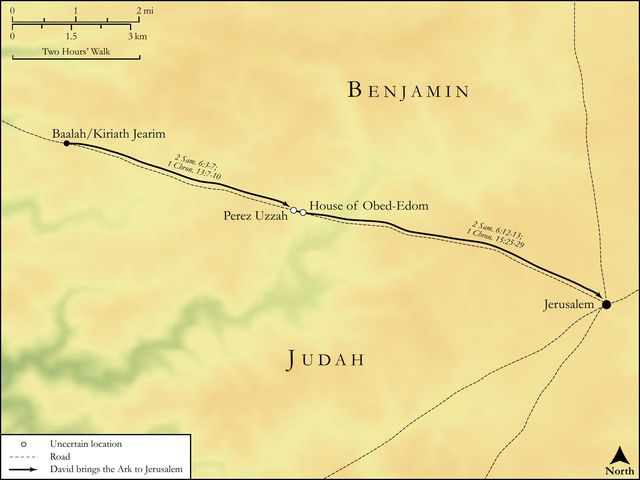
Preparation is here made for the bringing of the ark home to the city of David from the house of Obed-edom. It is here owned that in the former attempt, though it was a very good work and in it they sought God, yet they sought him, not after the due order, Ch1 15:13. "We did not go about our work considerately; and therefore we sped so ill." Note, It is not enough that we do that which is good, but we must do it well - not enough that we seek God in a due ordinance, but we must seek after him, in a due order. Note, also, When we have suffered for our irregularities we must learn thereby to be more regular; then we answer the end of chastisement. Let us see how the matter was mended. 1. David now prepared a place for the reception of the ark, before he brought it to him; and thus he sought in the due order. He had not time to build a house, but he pitched a tent for it (Ch1 15:1), probably according to the pattern shown to Moses in the mount, or as near it as might be, of curtains and boards. Observe, When he made houses for himself in the city of David he prepared a place for the ark. Note, Wherever we build for ourselves, we must be sure to make room for God's ark, for a church in the house. 2. David now ordered that the Levites or priests should carry the ark upon their shoulders. Now he bethought himself of that which he could not but know before, that, none ought to carry the ark but the Levites, Ch1 15:2. The Kohathites carried it in their ordinary marches, and therefore had no wagons allotted them, because their work was to bear upon their shoulders, Num 7:9. But upon extraordinary occasions, as when they passed Jordan and compassed Jericho, the priests carried it. This rule was express, and yet David himself forgot it, and put the ark upon a cart. Note, Even those that are very knowing in the word of God, yet have it not always so ready to them as were to be wished when they have occasion to use it. Wise and good men may be guilty of an oversight, which, as soon as they are aware of, they will correct. David did not go about to justify what had been done amiss, nor to lay the blame on others, but owned himself guilty, with others, of not seeking God in a due order, and now took care not only to summon the Levites to the solemnity, as he did all Israel (Ch1 15:3), and had done before (Ch1 13:2), but to see that they assembled (Ch1 15:4), especially the sons of Aaron, Ch1 15:11. To them he gives the solemn charge (Ch1 15:12): You are the chief of the fathers of the Levites, therefore do you bring up the ark of the Lord. It is expected that those who are advanced above others in dignity should go before others in duty. "You are the chief, and therefore more is expected from you than from others, both by way of service yourselves and influence on the rest. You did it not at first, neither did your duty yourselves nor took care to instruct us, and we smarted for it: The Lord made a breach upon us; we have all smarted for your neglect; this has been by your means (see Mal 1:9): therefore sanctify yourselves, and mind your business." When those that have suffered for doing ill thus learn to do better the correction is well bestowed. 3. The Levites and priests sanctified themselves (Ch1 15:14) and were ready to carry the ark on their shoulders, according to the law, Ch1 15:15. Note, Many that are very remiss in their duty, if they were but faithfully told of it, would reform and do better. The breach upon Uzza made the priests more careful to sanctify themselves, that is, to cleanse themselves from all ceremonial pollution and to compose themselves for the solemn service of God, so as to strike a reverence upon the people. Some are made examples, that others may be made exemplary and very cautious. 4. Officers were appointed to be ready to bid the ark welcome, with every possible expression of joy, Ch1 15:16. David ordered the chief of the Levites to nominate those that they knew to be proficients for this service. Heman, Asaph, and Ethan, were now first appointed, Ch1 15:17. They undertook to sound with symbols (Ch1 15:19), others with psalteries (Ch1 15:20), others with harps, on the Sheminith, or eighth, eight notes higher or lower than the rest, according to the rules of the concert, Ch1 15:21. Some that were priests blew with the trumpet (Ch1 15:24), as was usual at the removal of the ark (Num 10:8) and at solemn feasts, Psa 81:3. And one was appointed for song (Ch1 15:22), for he was skilful in it, could sing well himself and instruct others. Note, As every man has received the gift, so he ought to minister the same, Pe1 4:10. And those that excel in any endowment should not only use it for the common good themselves, but teach others also, and not grudge to make others as wise as themselves. This way of praising God by musical instruments had not hitherto been in use. But David, being a prophet, instituted it by divine direction, and added it to the other carnal ordinances of that dispensation, as the apostle calls them, Heb 9:10. The New Testament keeps up singing of psalms, but has not appointed church-music. Some were appointed to be porters (Ch1 15:18), others door-keepers for the ark (Ch1 15:23, Ch1 15:24), and one of these was Obed-edom, who reckoned it no doubt a place of honour, and accepted it as recompence for the entertainment he had given to the ark. He had been for three months housekeeper to the ark, and indeed its landlord. But, when he might not be so any longer, such an affection had he for it that he was glad to be its door-keeper.
Continue studying 1 Chronicles 15:13 across the web’s major study libraries — every link below opens this exact verse, chapter, or book on the destination site.
Read & Compare
 BibleGatewayThis verse in more than 200 translations and 70 languages.
 Bible.comThe YouVersion reader — hundreds of translations, reading plans, and highlights.
 ESV.orgCrossway's official English Standard Version reader.
 NET BibleThe NET translation with 60,000+ translators' notes on every rendering decision.
 STEP BibleTyndale House's free study tool — original text, vocabulary, and scholarly resources.
 BibliaLogos Bible Software's free web reader.
 USCCBThe New American Bible (Revised Edition) with the U.S. bishops' study notes.
Commentaries
 BibleHub CommentariesDozens of classic commentaries on this verse, gathered on one page.
 StudyLightMore than 100 commentary sets — the largest collection on the web.
 BibleRefPlain-English commentary on what this verse means, verse by verse.
 Enduring WordDavid Guzik's free commentary on this chapter, widely used by Bible teachers.
 Bible Study ToolsVerse commentary alongside Greek and Hebrew study aids.
Original Language & Research
- BibleHub InterlinearThe verse word by word — original language, transliteration, and English.
- BibleHub LexiconEvery word's original-language definition and Strong's entry.
 Blue Letter BibleDeep-study tools — Strong's numbers, concordance, and word studies.
 SefariaThe Hebrew text with Rashi and centuries of Jewish commentary.
Sermons, Hymns & Audio


TrulyRandomVerse is not affiliated with these sites and doesn’t control their content. They’re linked because they’re genuinely useful.
Summary
1 Chronicles 15:13 presents King David's profound confession and theological insight following the disastrous first attempt to transport the Ark of the Covenant to Jerusalem. He attributes the "breach"—specifically the divine judgment that resulted in Uzzah's death—not to arbitrary divine wrath, but to their collective failure to approach God according to His explicit, divinely ordained instructions. This pivotal verse underscores the critical importance of divine order, humble obedience, and reverent adherence to God's revealed will in all matters pertaining to His holy presence and worship, marking a crucial moment of national repentance and re-education in Israel's sacred history.
Context
ShowHideLiterary Context
This verse is spoken by King David to the Levites and priests, recorded in the midst of Israel's second, successful attempt to bring the Ark of the Covenant to Jerusalem. It immediately follows the detailed preparations for this sacred undertaking, including the sanctification of the Levites and the careful arrangement for carrying the Ark on poles, as prescribed by Mosaic law. David's words here serve as a retrospective explanation and a solemn warning, directly referencing the tragic events of 1 Chronicles 13, where Uzzah was struck down for touching the Ark when it was transported improperly on a new cart. David's confession ensures that the mistakes of the past are understood and not repeated, marking a crucial turning point from presumption to humble obedience, and setting the tone for the proper establishment of worship in Jerusalem.
Historical & Cultural Context
The Ark of the Covenant was the most sacred object in ancient Israel, representing God's throne and His tangible presence among His people. Its handling was governed by strict Mosaic laws, particularly those found in Numbers 4 and Exodus 25. These laws explicitly stated that the Ark was to be carried by the Kohathite Levites using poles inserted through rings, never to be touched directly, and never transported on a cart. The first attempt, influenced by Philistine methods (as seen in 1 Samuel 6), disregarded these divine commands. David's statement in 1 Chronicles 15:13 reflects a renewed commitment to covenant fidelity and a profound recognition that God's holiness demanded adherence to His specific, revealed will, not human innovation or convenience.
Key Themes
ShowHideThe primary themes embedded in this verse are divine holiness and its demands, the consequences of disobedience, and the necessity of seeking God according to His revealed will. God's holiness is not merely an abstract concept but a powerful, active reality that requires a specific, reverent approach, as evidenced by the "breach" that occurred when His commands were violated. The death of Uzzah served as a stark, undeniable demonstration that good intentions do not supersede divine instruction, highlighting the severe consequences of neglecting God's established ways. David's confession also introduces the theme of learning from error and national repentance, showcasing a leader who humbles himself and leads his people back to the "due order" of God's covenant, ensuring that future worship and service are aligned with divine truth, as seen in the joyous and orderly procession described in 1 Chronicles 15:25-28.
Exposition and Analysis
ShowHideKey Word Analysis
ShowHideThis primitive root signifies "to tread or frequent," but more commonly "to follow (for pursuit or search)," and by implication, "to seek or ask." Crucially, it can also mean "to worship" or "to inquire." In this context, "sought him not" implies a failure to properly inquire of God, to diligently follow His instructions, or to approach Him in the prescribed manner of worship and service. It highlights a lack of diligent adherence to God's revealed will.
Derived from a primitive root meaning "to break out," this word signifies "a breaking forth," "a bursting out," or "a breach." Here, it refers to God's sudden, forceful, and destructive intervention or judgment. It is not an accident but a direct divine act, emphasizing the severity of God's displeasure and the immediate, fatal consequences of violating His sacred commands regarding the Ark. It underscores the active and decisive nature of God's response to their disobedience.
This term, from the root "to judge," properly means "a verdict," "divine law," "ordinance," or "rule." When used with the preposition "after the," it implies "according to the established rule" or "in the proper manner." It refers to the specific, divinely prescribed protocol for handling and transporting the Ark, which involved the Levites carrying it on poles, as meticulously detailed in the Law of Moses. David's confession acknowledges that their failure was not merely a procedural oversight but a profound neglect of God's revealed will and established order.
Verse Breakdown
ShowHide"For because ye [did it] not at the first"
This opening clause directly refers to the initial, failed attempt to transport the Ark, described in 1 Chronicles 13. It establishes a clear causal link, highlighting that the subsequent divine judgment was a direct consequence of their prior actions—or rather, their lack of adherence to God's prescribed method. David, as the leader, takes corporate responsibility for this omission, demonstrating humility and a commitment to learning from past errors.
"the LORD our God made a breach upon us"
This is the core statement of divine judgment. The "breach" (referring to Uzzah's death) is explicitly attributed to "the LORD our God," emphasizing that it was a sovereign act of God, not an accident or a random misfortune. It underscores God's active involvement in upholding His holiness and the sanctity of His commands. The phrase "upon us" indicates a corporate judgment, affecting the entire community, even though Uzzah was the immediate casualty, signifying that the entire nation bore the consequences of this collective failure to obey.
"for that we sought him not after the due order"
This final clause provides the precise reason for the "breach." The failure was not a lack of zeal or good intention, but a failure to "seek Him" (meaning to approach Him, to serve Him, to worship Him) "after the due order"—that is, according to His specific, revealed instructions. This reveals David's profound theological understanding: God's holiness dictates the terms of engagement, and human innovation or convenience cannot override divine command. It highlights that true devotion must be expressed through obedience to God's established ways.
Literary Devices
ShowHideThe verse employs several significant literary devices that amplify its message. Causality is central, as David explicitly links the "breach" (effect) to their failure to "seek Him not after the due order" (cause), establishing a clear theological principle of divine consequence for disobedience. The phrase "made a breach upon us" functions as a powerful euphemism for the death of Uzzah, yet it vividly conveys the sudden, destructive nature of God's judgment and the corporate impact of the transgression. The verse also serves as a moment of profound confession and didacticism, as David, the leader, openly acknowledges collective sin and uses the past failure as a teaching moment for the Levites and priests, ensuring that the correct procedures for approaching God are now understood and followed. This public declaration reinforces the absolute necessity of obedience to God's revealed will for proper worship and service.
Theological and Thematic Connections
ShowHideThis verse profoundly articulates the biblical principle that God's holiness demands a specific, reverent approach from His people. It teaches that while God is gracious and desires to dwell among His people, His nature as the holy and righteous sovereign means He cannot be approached casually or on human terms. The "breach" serves as a stark reminder that disobedience to God's revealed will, even when seemingly well-intentioned, carries severe consequences because it dishonors His character and undermines His authority. This incident, and David's understanding of it, laid a crucial foundation for proper worship in Israel, emphasizing that true service to God must always be in humble submission to His commands, rather than relying on human wisdom, convenience, or cultural adaptation. It underscores that God's ways are higher than our ways, and His instructions are for our good and His glory.
Reflection and Application
ShowHide1 Chronicles 15:13 offers timeless lessons for believers today, transcending the specific ceremonial laws of the Old Covenant to reveal enduring principles about God's character and our relationship with Him. It challenges any casual or presumptuous approach to God, reminding us that reverence, humility, and obedience to His revealed will remain paramount. While we no longer transport a physical Ark, the principle of seeking God "after the due order" translates to living according to His moral commands, worshipping Him in spirit and truth, and relying on the finished work of Christ for our access. This verse calls us to examine our own lives: are we approaching God on His terms, as revealed in Scripture, or are we inadvertently creating our own "due order" based on personal preference, cultural norms, or convenience? Learning from past failures, both personal and corporate, and humbly correcting our course according to God's instruction is essential for spiritual growth, fruitful service, and avoiding unnecessary "breaches" in our walk with Him. It encourages a posture of continuous learning and submission to divine authority.
Questions for Reflection
ShowHideFAQ
ShowHideWhat was the "breach" mentioned in this verse?
ShowHideThe "breach" (Hebrew pârats) refers specifically to the sudden divine judgment that resulted in the death of Uzzah, as recorded in 1 Chronicles 13:9-10. Uzzah was struck down by God for touching the Ark of the Covenant, an act forbidden by divine law, when the Ark was being transported improperly on a new cart instead of being carried by Levites using poles. This incident served as a stark demonstration of God's holiness and the severe consequences of violating His commands.
What was the "due order" for transporting the Ark of the Covenant?
ShowHideThe "due order" refers to the specific, divinely prescribed method for handling and transporting the Ark, as detailed in the Mosaic Law. According to Numbers 4:15 and Exodus 25:14, the Ark was to be carried on the shoulders of the Kohathite Levites using poles inserted through rings permanently attached to its sides. It was never to be touched directly or transported by any other means, such as on a cart, as this violated the sanctity of God's presence.
Does this verse mean God still "makes breaches" or inflicts immediate physical judgment today for disobedience?
ShowHideWhile the specific, immediate physical judgments seen in the Old Testament (like Uzzah's death or Nadab and Abihu's in Leviticus 10:1-2) were part of the Old Covenant's administration of God's holiness and justice, the New Covenant operates under different principles, primarily grace and the indwelling Holy Spirit. God's character as holy and just remains unchanged, and disobedience still carries consequences (e.g., spiritual barrenness, loss of fellowship, divine discipline, or natural consequences of sin), but the nature of those consequences has shifted from immediate physical death to spiritual and relational repercussions. The underlying principle, however, remains: God's holiness demands reverence and obedience, and we must approach Him on His terms, not our own.
Christ-Centered Fulfillment
ShowHide1 Chronicles 15:13, with its emphasis on approaching God "after the due order," finds its ultimate fulfillment and transformation in Jesus Christ. In the Old Covenant, access to God's tangible presence, symbolized by the Ark, was mediated through specific rituals, objects, and a Levitical priesthood, all governed by strict laws to protect God's holiness and man's impurity. The "breach" served as a terrifying reminder that human beings could not approach a holy God on their own terms or through their own innovations. However, Jesus Christ Himself is the new and living "due order" for humanity's access to God. He declared, "I am the way, the truth, and the life. No one comes to the Father except through Me" (John 14:6). Through His perfect life, atoning death on the cross, and victorious resurrection, Christ tore the veil of the temple (Matthew 27:51), granting believers direct, confident access to God's presence not through ceremonial law or physical objects, but through His shed blood (Hebrews 10:19-22). The Ark, once the profound symbol of God's presence, is superseded by Christ, in whom "the whole fullness of deity dwells bodily" (Colossians 2:9). Now, our worship is not about external regulations but about worshipping God "in spirit and truth" (John 4:23-24), made possible by the indwelling Holy Spirit, who transforms our very bodies into "temples of the Holy Spirit" (1 Corinthians 6:19-20). Thus, the terrifying "breach" of the Old Covenant gives way to the glorious reconciliation and intimate fellowship offered through Christ, who is the perfect "due order" for all who seek God.